Sample Category Title
AUD/USD Struggles Not To Fall Below The 0.69 Handle
Markets
Yesterday's news flow provided global core bonds little guidance. Investors are in a Fed-countdown mode (June 19). US (and German) bond markets entered a state of calm even as geopolitical tensions rose dramatically after alleged attacks on two oil vessels in the Gulf of Oman. The US note future followed volatility in Japanese bonds in lockstep during Asian trading hours but hovered sideways afterwards. A fine US 30y auction possibly created some spillovers to the rest of the yield curve as rates dropped a few bps towards the end of the session. The US curve bull steepened with yields changing from -4bps (2y) to -2.5bps (10y) over -1.5bp (30y). The German curve flattened with yields declining marginally at the long end. Peripheral spreads narrowed up to 7bps (Italy). Today's US retail sales and U. of Michigan consumer confidence is expected at solid levels. We would err on the side of caution as the US economy started to show signs of fatigue lately. However, with yields already at bottom levels and the Fed meeting looming we do not expect a notable and durable market reaction from a rates perspective unless a significant (negative) surprise would emerge. We would argue for a sideways trading pattern going into the weekend.
EUR/USD trading was mostly technical in nature yesterday. An upside test of the 1.1340/50 resistance was rejected twice this week, indicating that the USD correction was meeting a roadblock. EMU April production was weak, but didn't come as a surprise. The intraday correction of the euro accelerated as the IMF warned on EMU growth. The pair dropped to the 1.1270 area. FX and interest rate markets are counting down to next week's Fed meeting, where at dovish tone is expected. US yields stayed downwardly oriented, but with little additional negative impact on the dollar anymore. EUR/USD closed at 1.1276. USD/JPY finished 108.38.
This morning, Asian equity markets mostly show modest losses. Persistent uncertainty on the US-China trade developments and rising geopolitical tensions (US-Iran) cause investors to stay cautious. Australian touched now record low level this morning and AUD/USD struggles not to fall below the 0.69 handle. The yuan continues trading with a tentative soft bias (USD/CNY 6.92 area). USD/JPY is little changed at 108.35. EUR/USD is holding near this week's low (1.1270 area).
Today, the US retails sales and Michigan consumer confidence will be published. Markets expect sales to rebound after a soft April reading. Michigan consumer is expected to ease slightly, albeit from very strong levels. We see little reason for a big negative surprise for today's US data. We expect any USD reaction to be guarded ahead of the (soft expected) Fed. Within the 1.1107/1.1348 trading range, intermediate support is seen near 1.1255 and 1.1200.
EUR/GBP traded a bit choppy hovering near the 0.89 pivot yesterday as markets were awaiting the outcome of the first round in leadership vote of the conservative party. EUR/GBP traded north of 0.8920 ahead of the publication of the result. Boris Johnson beat the other candidates by a wide margin, but this was expected. Sterling even regained a few ticks after the publication. EUR/GBP closed at 0.8973. There are no eco data in the UK today. We expect more technical trading for sterling ahead of the next vote for the leadership in the conservative party next week.
News Headlines
Today's event calendar focusses on the US. May retail sales, industrial production and U. of Michigan consumer confidence (June) are scheduled for release. We also take a close look at some important Chinese data later this morning. Bank of England chair Carney speaks in London.
China decided to raise the anti-dumping duties on some US and EU steel products after the previous ones expired in May. The levies can be as much as ten times higher (up to 148%) compared to the previous rates and come amid the recent escalation of the US/Sino trade dispute.
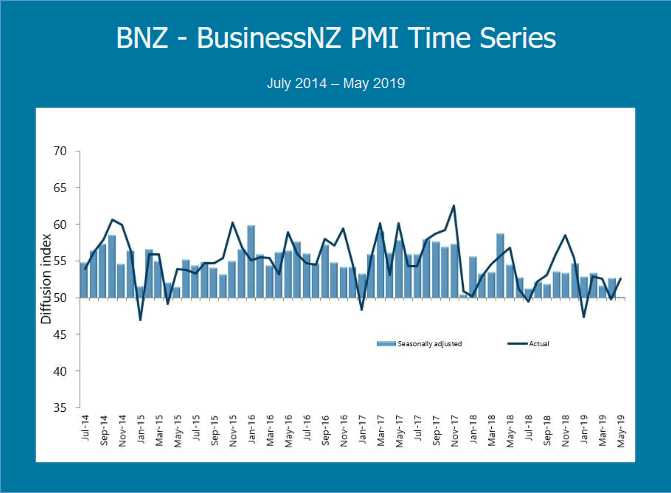
New Zealand Manufacturing PMI dropped to 50.2, lowest since 2012, downside risks accumulating
New Zealand BusinessNZ Manufacturing PMI dropped to 50.2 in May, down from 52.7. Also, it's the lowest reading since December 2012. BusinessNZ's executive director for manufacturing Catherine Beard said that the drop in activity to its lowest point in over six years was obviously a concern, especially when the sub-index values are examined.
She added: "Production (46.4) was at its lowest value since April 2012, while the other key sub-index of new orders (50.4) only just managed to stay in positive territory. Given the latter feeds through into the former, it does not instil a strong belief that the sector will show solid improvement over the next few months".
BNZ Senior Economist, Doug Steel said that "the PMI sends a warning signal for near term growth via its mix of falling production, near flat new orders, and rising inventory. Next week's Q1 GDP should be reasonable, but beyond this downside risks are accumulating".
661 US Companies and Associations urged Trump to avoid tariff escalation
In an open letter to Trump, 661 US Companies and Associations urged the administration to avoid tariff escalation with China. Instead, the administration should try to reach resolution with China on trade. The letter came as US Trade Representative is set to start hearings regarding 25% tariffs on USD 300B, essentially all untaxed, Chinese imports. The letter, lead by "Tariffs Hurt the Heartland" campaign,w as signed by 520 companies and 141 trade associations. .
"We remain concerned about the escalation of tit-for-tat tariffs," the letter states. "We know firsthand that the additional tariffs will have a significant, negative and long-term impact on American businesses, farmers, families and the U.S. economy. Broadly applied tariffs are not an effective tool to change China's unfair trade practices. Tariffs are taxes paid directly by U.S. companies, including those listed below – not China."
"We urge your administration to get back to the negotiating table while working with our allies to develop global, enforceable solutions. An escalated trade war is not in the country's best interest, and both sides will lose," the companies and associations added.
USD/JPY Needs Break Of Bear Flag Pattern Soon
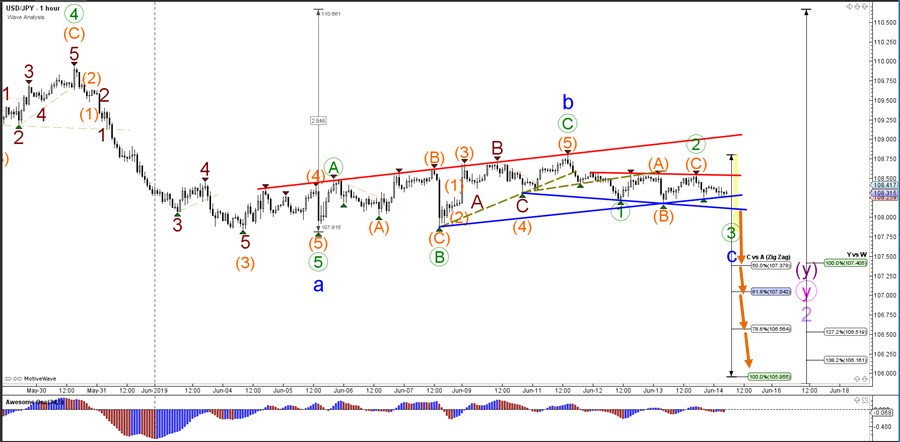
The USD/JPY wave pattern remains in an indecisive zone as long as price fails to break below the support lines (blue). The tentative price action could also mean that price will expand the wave B (blue) with a new high first before continuing lower with the larger bearish wave C (blue). The key aspect remains whether price will break above resistance (red) or below support (blue).
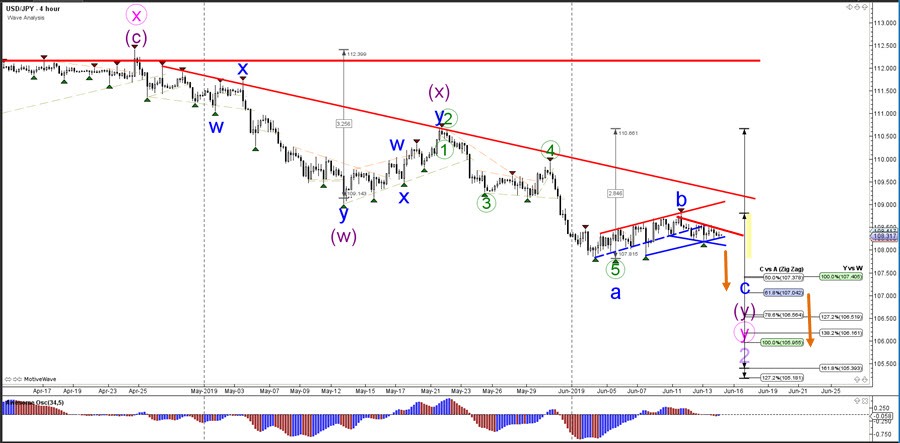
The USD/JPY is building a bear flag continuation chart pattern. A break below the flag pattern confirms a downtrend resumption, which should aim for the Fibonacci target levels of wave C vs A and Y vs W. Till now this pair has been choppy and corrective which could either be explain by an ABC (orange) in wave 2 (green) or a potential reversal and deeper wave B (blue) retracement.
Asian Equity Markets Trade Generally Lower Ahead Of China’s May Data
General Trend:
- Financials continue to weigh on the Hang Seng; Bank of East Asia down over 7% on profit warning
- Various HK banks reopen branches that were closed due to protests
- Telecom Services and IT firms are among the decliners in Shanghai
- Mining stocks rise in Australia as China iron ore futures hit another record high
- Brent crude extends gains in Asian trading with the focus on recent tanker attacks in the Gulf of Oman
- Aussie 3-year yield declines as more analysts call for below 1% RBA cash rate
- NZD declines as manufacturing PMI hit multi-year low
- Commodity currencies trade generally weaker ahead of China data
- China May data (including industrial production) due to be released at 0700 GMT (3 AM EST)
- Bank of Japan (BOJ) due to hold policy meeting next week on June 19-20th (Wed-Thursday)
Headlines/Economic Data
Australia/New Zealand
- ASX 200 opened +0.1%
- Navitas, Syrah, Seven West Media to be removed from the S&P ASX 200 index; Clinuvel, Service Stream and Austal to be added to the index
- (AU) NAB now expects the RBA to also cut its cash rate to 0.75% in Nov 2019 (previously said it saw rate cuts in June and Aug 2019)
- (AU) RBC now expects the RBA to cut the cash rate to 0.5% by May 2020
- (NZ) New Zealand May Business Manufacturing PMI: 50.2 v 52.7 prior (multi-year low)
China/Hong Kong
- Shanghai Composite opened +0.1%, Hang Seng -0.4%
- (HK) Hong Kong lawmakers are reportedly open to extending extradition bill debate - South China Morning Post
- (HK) Banks including HSBC and Bank of China HK said to raise mortgage rates for certain loans - HK media
- (CN) Former PBoC Gov Zhou: Trade war could trigger global currency depreciation
- (CN) China Commerce Ministry (MOFCOM) Spokesman Gao Feng: China to fight to the end if U.S. insists to escalate; China will not back down on principle issues in trade talks (comments from June 13th)
- (CN) China to raise anti-dumping duties on US (up to 147.8%) and EU (up to 60.8%) seamless steel tubes; effective immediately
- (CN) China PBoC sets yuan reference rate: 6.8937 v 6.8934 prior
- (CN) China PBoC Open Market Operation (OMO): Injects CNY100B in 28-day reverse repos v CNY100B combined in 7-day and 28-day prior; Net CNY100B injected v CNY90B drain prior
Japan
- Nikkei 225 opened +0.1%
- (JP) Nikkei 225 June Futures and options said to settle at ~21,061
- (JP) Japan Economy Min Motegi: Exchanged view on trade 'candidly' with USTR Lighthizer (as expected), declines to comment on details; will meet with Lighthizer before G20
Korea
- Kospi opened -0.3%
- (US) US to cut tariffs on South Korea hot-rolled steel - Korea Press
- (KR) South Korea sells KRW300B v KRW300B indicated in 50-year bonds: avg yield 1.650% v 1.880% prior; bid to cover 1.82x
- (KR) South Korea May Export Price Index M/M: 2.6% v 0.5% prior; Y/Y: 0.4% v -0.4% prior
Europe
- (US) Sec of State Pompeo: Iran is responsible for today's tanker attacks; Iran continues to actively work to interrupt flow of oil
- (US) US reportedly has video of Iranian military removing unexploded mine from side of Japanese tanker - US Press
- (UK) UK govt reportedly agrees with US assessment that Iran was responsible for attacks on two Gulf tankers - UK press
- (IR) Iran Mission to UN: Rejects US claims as "unfounded" regarding the Gulf of Oman tanker attacks - Iranian Press
- US Navy Destroyer USS Mason heading to Gulf of Oman to scene of attacks on oil tankers
Levels as of 1:20 ET
- Nikkei 225, -0.3%, ASX 200 flat, Hang Seng -0.5%; Shanghai Composite -0.4%; Kospi -0.5%
- Equity Futures: S&P500 +0.1%; Nasdaq100 -0.2%, Dax flat; FTSE100 +0.2%
- EUR 1.1288-1.1270 ; JPY 108.40-108.26 ; AUD 0.6919-0.6891 ;NZD 0.6574-0.6527
- Gold +0.5% at $1,349/oz; Crude Oil 0.5% at $52.54/brl; Copper -0.1% at $2.656/lb
War Hawks Raise Eyebrows
Market movers today
In the US , we get a range of data releases to keep an eye on today in light of the increased uncertainty over the macro outlook, notably industrial production and retail sales for May . In addition, the first estimate of consumer confidence from the University of Michigan for June is due out.
In Europe, it is quiet on the data front and markets will stay tuned to the political headlines ahead of next week's EU summit and the ECB's Sintra Forum.
In the Scandi markets, today's big event will be the Swedish May inflation figures (see next page).
The Bank of Russia (CBR) will announce its decision on the key rate and the central bank governor will hold a press conference. Together with Bloomberg and Reuters consensus, we expect a 25bp cut to 7.50% as the central bank has stated its confidence about decelerating inflation, and external conditions (lack of new anti-Russian sanctions by the US) are not shaking up the RUB .
Selected market news
Stocks in the Asian session traded miscellaneously on Friday morning, while the bond rally intensified on trade war concerns putting the brakes on global economic growth and new geopolitical tensions in the Persian Gulf region after the tanker incident. The Trump administration accused Iran of the attacks on the tankers while Iranian officials denied they were behind the incident.
US Secretary of State Michael Pompeo said on Thursday in Washington that Iran had threatened earlier to restrain oil transport in the Strait of Hormuz. While Pompeo gave no evidence and did not take any questions from reporters, Trump administration officials said that at least one of the ships was attacked by mines. They showed a picture of a tanker with a hole caused by a mine that had exploded and an undetonated mine inside.
The US has sent a guided missile destroyer to the Gulf of Oman to join another US destroyer stationed near a damaged tanker. While the Pentagon stated that Iranian small boats were identified in the area, the US Central Command said "a war with Iran is not in our strategic interest, nor in the best interest of the international community".
Brent soared by almost one US dollar per barrel after Pompeo's statement, but quickly deflated, trading around 61.5 USD/bbl on Friday morning, which means a 3.7% surge from yesterday's lows.
In the UK, Boris Johnson led the race to become the country's next prime minister in a secret ballot of Tory MPs. Foreign Secretary Jeremy Hunt came second, gaining less than half of votes versus those for Johnson. The next round of voting is next Tuesday.
Euro-Zone’s Industrial Production Declined At Its Fastest Pace In 4 Months In April
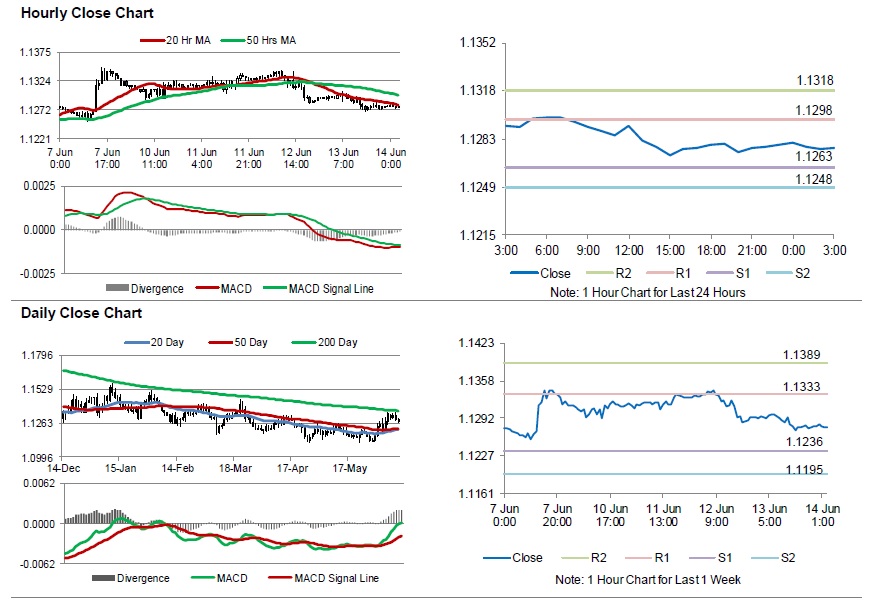
For the 24 hours to 23:00 GMT, the EUR declined 0.12% against the USD and closed at 1.1279.
On the data front, Euro-zone's seasonally adjusted industrial production slid 0.5% on a monthly basis in April, declining at its quickest pace in 4 months and in line with market expectations. In the previous month, industrial production had recorded a revised fall of 0.4%.
Separately, in Germany, the final consumer price index (CPI) eased 1.4% on an annual basis in May, meeting market anticipations and confirming the preliminary figures. In the previous month, the CPI had registered a climb of 2.0%.
In the US, data showed that seasonally adjusted initial jobless claims unexpectedly advanced to a level of 222.0K in the week ended 08 June 2019, compared to a revised level of 219.0K in the previous week. Market participants had envisaged initial jobless claims to register a decline to 215.0K.
In the Asian session, at GMT0300, the pair is trading at 1.1277, with the EUR trading a tad lower against the USD from yesterday's close.
The pair is expected to find support at 1.1263, and a fall through could take it to the next support level of 1.1248. The pair is expected to find its first resistance at 1.1298, and a rise through could take it to the next resistance level of 1.1318.
Amid lack of macroeconomic releases in the Euro-zone today, traders would await the US advance retail sales, industrial production, manufacturing (sic) production, all for May and the Michigan consumer sentiment for June, slated to release later in the day.
The currency pair is showing convergence with its 20 Hr moving average and trading below its 50 Hr moving average.
British Pound Trading A Tad Lower In The Asian Session
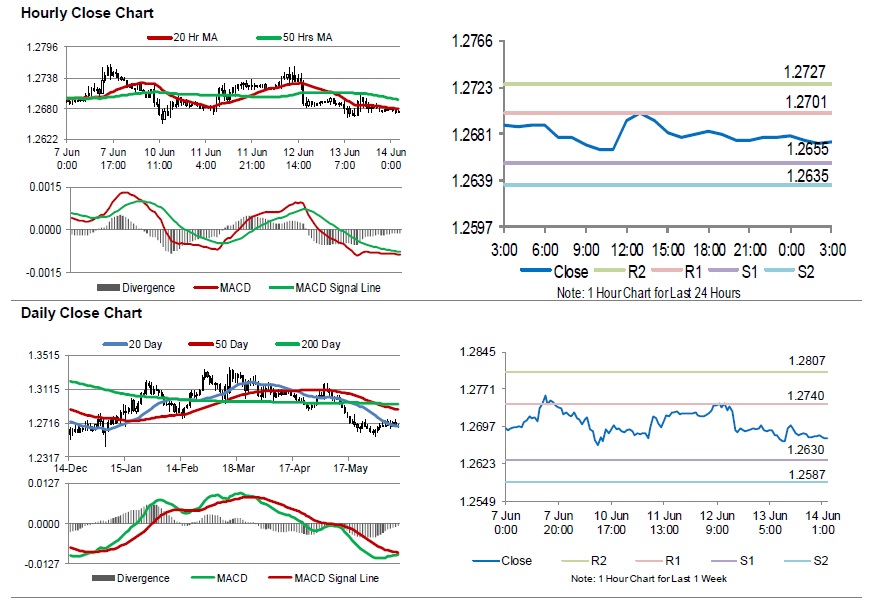
For the 24 hours to 23:00 GMT, the GBP declined 0.12% against the USD and closed at 1.2678, after MPs rejected a motion to block no-deal Brexit.
In the Asian session, at GMT0300, the pair is trading at 1.2674, with the GBP trading marginally lower against the USD from yesterday’s close.
The pair is expected to find support at 1.2655, and a fall through could take it to the next support level of 1.2635. The pair is expected to find its first resistance at 1.2701, and a rise through could take it to the next resistance level of 1.2727.
Looking ahead, investors would keep an eye on the Bank of England Governor Mark Carney’s speech, due in a few hours.
The currency pair is trading below its 20 Hr and 50 Hr moving averages.
Japan’s Industrial Production Declined In April
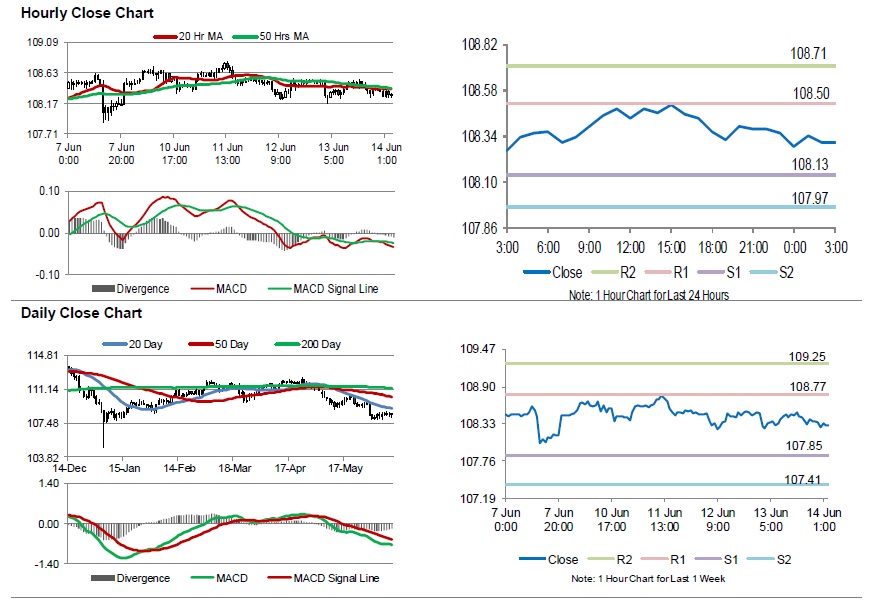
For the 24 hours to 23:00 GMT, the USD declined 0.12% against the JPY and closed at 108.35.
In the Asian session, at GMT0300, the pair is trading at 108.30, with the USD trading 0.05% lower against the JPY from yesterday's close.
Early morning data indicated that Japan's final industrial production fell 1.1% on a yearly basis, in April, confirming the preliminary print. In the preceding month, the industrial production had recorded a decline of 4.3%.
The pair is expected to find support at 108.13, and a fall through could take it to the next support level of 107.97. The pair is expected to find its first resistance at 108.50, and a rise through could take it to the next resistance level of 108.71.
The currency pair is trading below its 20 Hr and 50 Hr moving averages.
SNB Left Its Key Interest Rate Steady At -0.75%
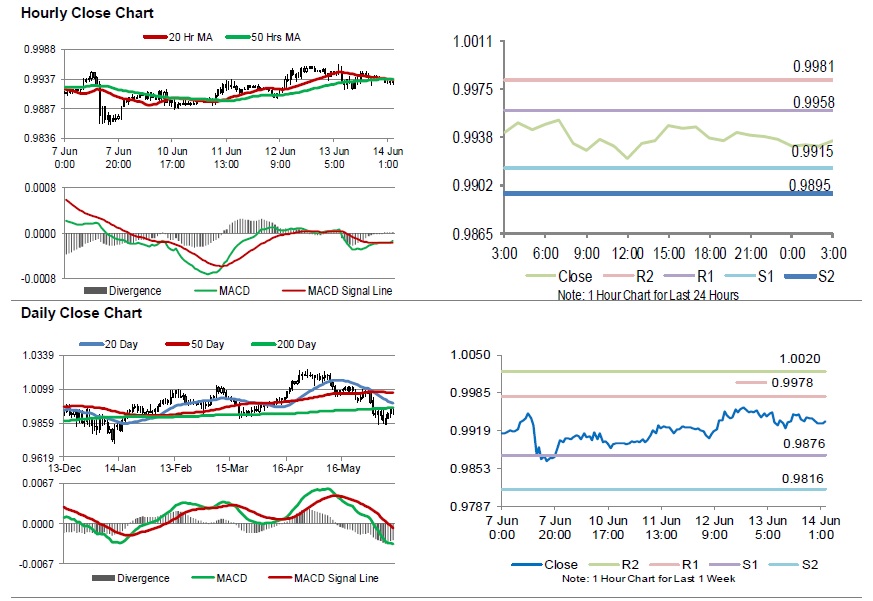
For the 24 hours to 23:00 GMT, the USD declined 0.15% against the CHF and closed at 0.9937.
In economic news, Switzerland’s producer and import price index dropped 0.8% on an annual basis in May, more than market expectations for a fall of 0.7%. The index had recorded a decline of 0.6% in the previous month.
The Swiss National Bank, in its latest monetary policy meeting, opted to leave its key interest rate steady at -0.75%, as widely expected and indicated that the central bank would hold its ultra-loose monetary policy unchanged till 2021.
In major news, the State Secretariat for Economic Affairs’ (SECO), in its June economic forecasts upgraded its 2019 economic growth forecast to 1.2% and maintained its 2020 growth outlook of 1.7%, however, the agency warned over risk of global trade war.
In the Asian session, at GMT0300, the pair is trading at 0.9935, with the USD trading marginally lower against the CHF from yesterday’s close.
The pair is expected to find support at 0.9915, and a fall through could take it to the next support level of 0.9895. The pair is expected to find its first resistance at 0.9958, and a rise through could take it to the next resistance level of 0.9981.
With no macroeconomic releases in Switzerland today, investors would look forward to global macroeconomic releases for further direction.
The currency pair is showing convergence with its 20 Hr and 50 Hr moving averages.