

Sample Category Title
EURUSD Rejects Higher Prices With Eyes On 1.1200 Level
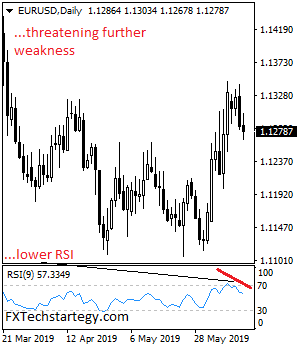
EURUSD rejects higher prices with eyes on 1.1200 level in the days ahead. Support comes in at the 1.1250 where a violation will turn risk to the 1.1200 level. A break below here will target the 1.1150 level. Further down, support sits at the 1.1100. Its daily RSI is bearish and pointing lower suggesting further weakness. Conversely, on the upside, resistance resides at 1.1350 level with a break through there opening the door for further upside towards the 1.1.1400 level. Further up, resistance comes in at the 1.1450 level where a violation will expose the 1.1500 level. All in all, EURUSD rejects higher prices with eyes on 1.1200 level.
USD/CAD Canadian Dollar Rises On Oil Surge After Attacks
The US dollar is mixed on Thursday as the attacks against two tankers in the Gulf of Oman led investors to seek refuge in safe havens. The Japanese yen and the Swiss franc appreciated against the greenback, with the Canadian dollar rising as the price of oil jumped on supply concerns as the result of the attacks.
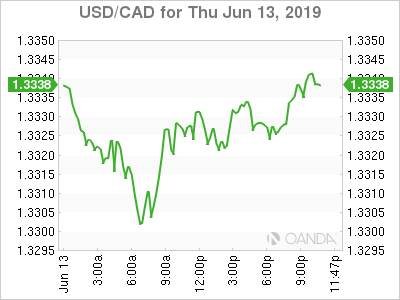
The Canadian dollar appreciated on Thursday after being under pressure against the US dollar. The attacks on two oil tankers in the Gulf of Oman drove crude prices higher and took the loonie along for the ride. Mixed economic data, with one of the major red flags being further evidence of housing weakness.
Tanker Attacks Trigger Supply Concerns as US Blames Iran
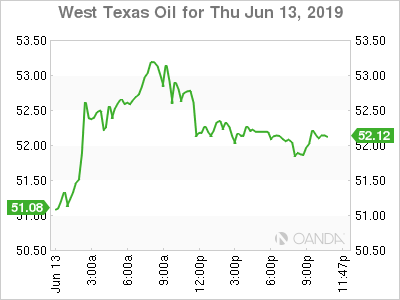
Oil prices surged more than 2 percent on Thursday as attacks on tanker ships in the Gulf of Oman created supply concerns. Oil prices were falling earlier in the week as doubts surrounded the extension of the OPEC+ agreement and rising US production was seen as weekly crude inventories have posted large buildups.
Supply disruptions in the Middle East due to violence will be a major factor, especially when it’s close to the largest sea lane for crude. Russia is playing hard to get in signalling its commitment to an OPEC+ production cut extension. The agreement from producers to reduce their output was the major factor that added stability and appreciated crude prices, losing one of the biggest non-OPEC producers could be the end not only of the pact, but could tear the group apart.
US Secretary of State Pompeo went on the record saying Iran was responsible for the attacks to reduce the flow of oil. President Trump also tweeted that Iran is not ready for a deal, as the attacks happened when Japanese Prime Minister Abe was visiting to meet with Ayatollah Khamenei.
Oil remains sensitive to supply disruptions rising despite trade war concerns putting pressure downward on energy demand and the threat of higher US crude production. The US-China trade dispute has no end in sight and investors await a potential sit down between the two leaders as a sidebar to their G20 commitments later this month.
Gold Rises After Middle East Tension Triggers Flight to Safety
Gold rose 0.69 percent on Thursday as tensions intensified in the Middle East as two tankers were attacked in the Gulf of Oman pushing the metal to $1,342.
Gold traded higher as its appeal as an alternative investment in times of uncertainty. The yellow metal has risen as the probabilities of a summer interest rate cut by the Fed have increased.
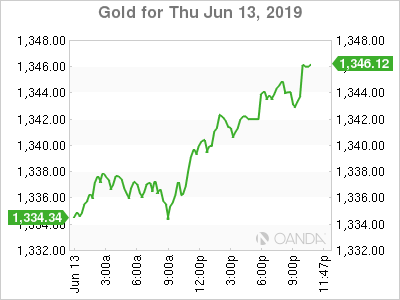
Trade tensions had given a boost to the US dollar as a refuge for investors, but the potential showdown with Iran in the aftermath of the attacks in the Middle East steered investors away from the greenback.
Stocks Rose as Energy Sector and Disney Stand Out
Equities finished higher on Thursday reversing a two-day losing streak. Energy stocks got a shot in the arm after the attack on two shipping vessels in the Gulf of Oman drove oil prices higher.
Fed rate cut probabilities continue to climb and were validated with a higher than expected weekly unemployment claims in the US.
Disney shares also rose as it is expected to be a strong player in the stream wars based on the embarrassment of IP riches the company possesses.
Markets are not focused on the US-China trade war and even brushed off some of the negative impact an escalation after the US attributed the attacks in the Oman Gulf to Iran.
Eco Data 6/14/19
[php_everywhere instance="1"]
British Pound Subdued in Data-Light Session
GBP/USD is flat in the Thursday session. Currently, GBP/USD is trading at 1.2685, down 0.03% on the day. On the release front, U.S. unemployment claims was unexpectedly high, climbing to 222 thousand. This was the highest reading in five weeks. There are no British events on the schedule. On Friday, the U.S. releases retail sales and consumer confidence reports.
In the U.K., the race is on to replace Prime Minister Theresa May, who will step down in August. Boris Johnson, the former foreign minister, is favored to win the leadership race, but he will have to beat out seven other candidates. Earlier this week, Johnson said that the U.K. should leave the European Union as scheduled on October 31, with or without a deal in place. Johnson is known for his hard-line approach towards the EU, and if he becomes prime minister, relations could fray even further with the EU, which could hurt the British pound.
As expected, consumer inflation in the U.S. remained soft in May. CPI slowed to 0.1%, down from 0.3% in the previous release. This matched the estimate. The core reading posted a gain of 0.1% for a fourth straight month, shy of the forecast of 0.2%. With the May inflation numbers remaining low, there could be more pressure on the Fed to lower interest rates in order to boost economic activity and inflation. The likelihood of further rates this year is increasing – the CME Group has set the odds of a July cut at 66% and another cut in September at 50%. Lower interest rates make the U.S. dollar less attractive to investors, so investors will be keeping an eye on alternative assets.
Euro’s international role recovered in period of trade tensions and protracted slowdown
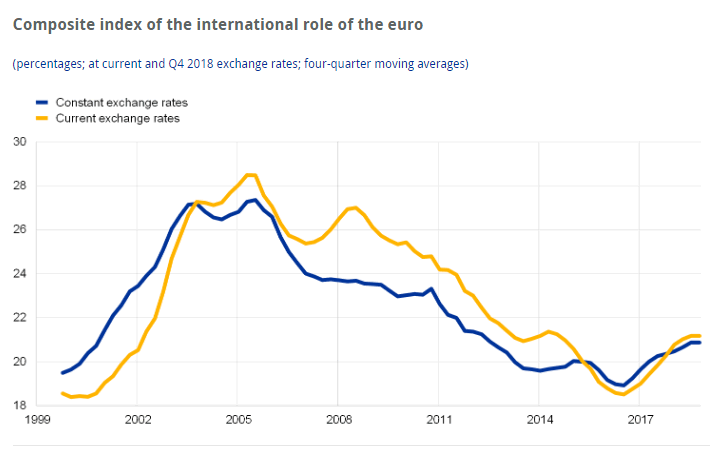
ECB said in a report that euro's international role strengthened in 2018 and early 2019 reversing a declining trend in recent years. Share of Euro as global reserve currency rose 1.2% in 2018, up from 19.5% to 20.8%. The euro's share in international debt issuance and international deposits also increased, together with its share in the value of outstanding international loans.
ECB President Mario Draghi said that the period was "characterized by growing concerns about the impact of international trade tensions, a protracted slowdown in global growth, reversals in cross-border capital flows and challenges to multilateralism, including the imposition of unilateral sanctions.:
"On balance, these developments, together with progress towards deepening Economic and Monetary Union (EMU), seem to have had a positive effect on the international use of the euro, which showed tentative signs of recovering from historic lows."
White House said it looks like Trump is moving in that direction of meeting with Chinese Xi
White House spokesman Hogan Gidley was asked by Fox News Channel if Trump and Chinese President Xi will have a sideline meeting at G20 summit in Osaka. He didn't answer directly and said "it looks like we're moving in that direction."
Trump said yesterday he has "no deadline" for the trade negotiations with China. But he emphasized that "I would never take something that would be less than what we already had". He reiterated he had very good relationship with Xi, just "a little bit testy right now".
New Zealand Dollar Under Pressure, NZ Manufacturing Report Next
The New Zealand dollar continues to lose ground, with NZD/USD declining 1.56% this week. In Thursday’s North American trade, NZD/USD is trading at 0.6563, down 0.17% on the day. On the release front, U.S., unemployment claims was unexpectedly high, climbing to 222 thousand. This was the highest reading in five weeks. Later in the day, New Zealand releases the Business NZ Manufacturing Index. On Friday, the U.S. releases retail sales and consumer confidence reports.
In the U.S., consumer inflation remained soft in May. CPI slowed to 0.1%, down from 0.3% in the previous release. This matched the estimate. The core reading posted a gain of 0.1% for a fourth straight month, shy of the forecast of 0.2%. With the May inflation numbers remaining low, there could be more pressure on the Fed to lower interest rates in order to boost economic activity and inflation. The likelihood of further rates this year is increasing – the CME Group has set the odds of a July cut at 66% and another cut in September at 50%. Lower interest rates make the U.S. dollar less attractive to investors, so investors will be keeping an eye on alternative assets.
China is New Zealand’s largest trade partner, so it’s no surprise that the slowdown in the Chinese economy has hurt the export-reliant New Zealand economy. There are further signs that the Chinese economy is feeling the effects of the trade war with the U.S. Chinese consumer inflation rose at an annualized rate of 2.7% in May, matching the forecast. However, producer price inflation slowed to 0.6% in May, down from 0.9% in April. As well, Chinese auto sales plunged 16.4% in May, its worst monthly decline on record. This marked an 11th successive decline and comes after a 14.6% drop in April. The soft numbers are reflective of the slowdown which has gripped the Chinese economy, and investors remain concerned, as the trade war with the U.S. shows no signs of easing.
Gold Eyes Prior Peak after Brief Correction
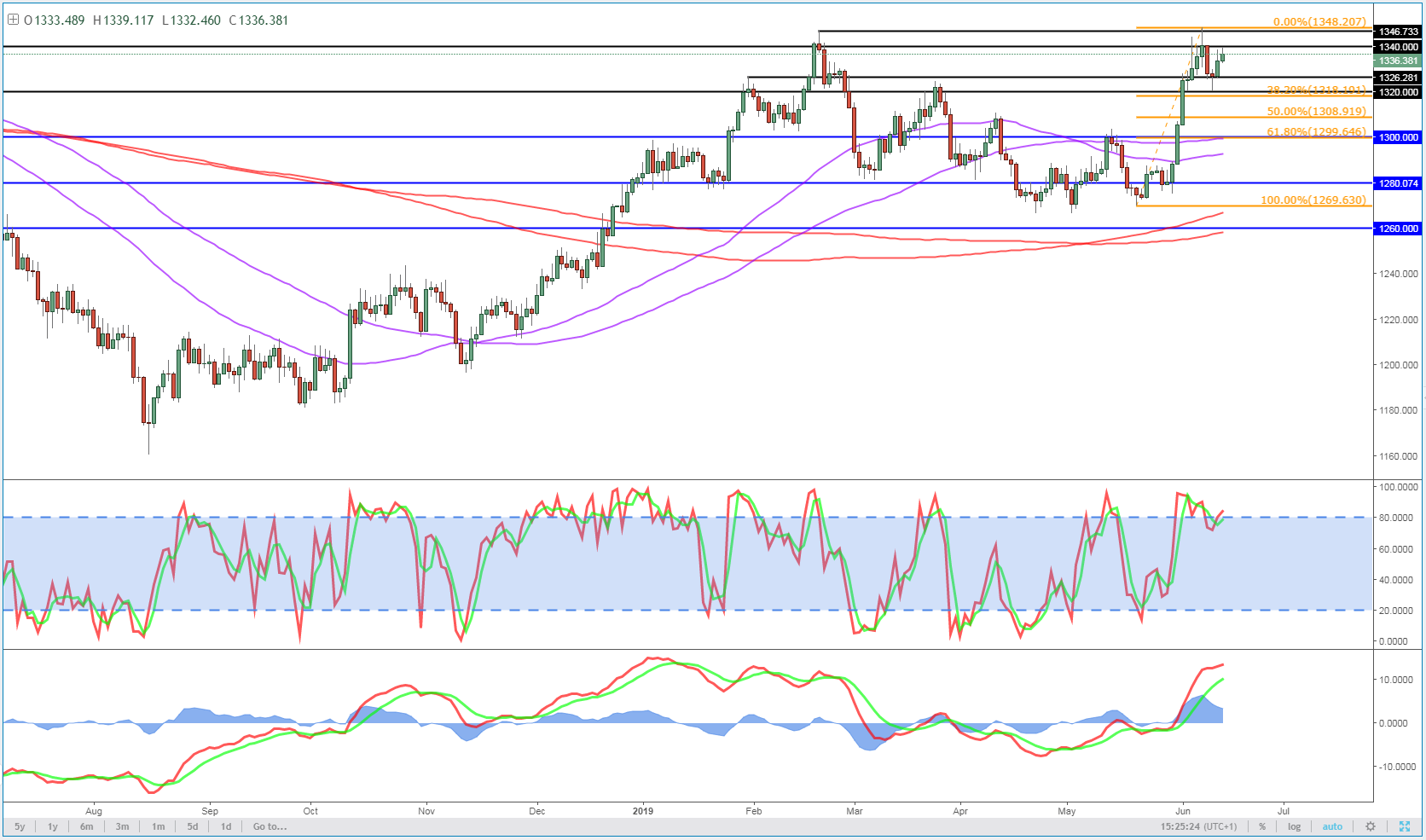
Gold is continuing to edge higher today, supported to an extent by the weaker dollar, not that it held the yellow metal back much yesterday.
It found strong support around $1,320 earlier this week and has since burst higher with the previous peak around $1,350 in its view. A break of this could propel gold higher, although it will have to be matched with momentum because as we saw last week, the absence of this saw it reverse course very quickly.
The shallow correction earlier this week will be encouraging for gold bulls, having only retraced 38.2% on the previous pullback, although this optimism may fade fast if it runs out of steam prior to the peak. Risk appetite in the markets is likely to work against gold but the dollar looking vulnerable is clearly supportive.
Should gold fail to break and pull back further, I don’t think it changes the bullish appearance just yet. The area between the 50 and 61.8 fib levels – roughly between $1,300 and $1,320 – could be a very interesting support area for the yellow metal. A break of this and the picture may start to look very different.
Gold Daily Chart
Elliott Wave Analysis: EUR/NZD With 1.7300 In Sight!
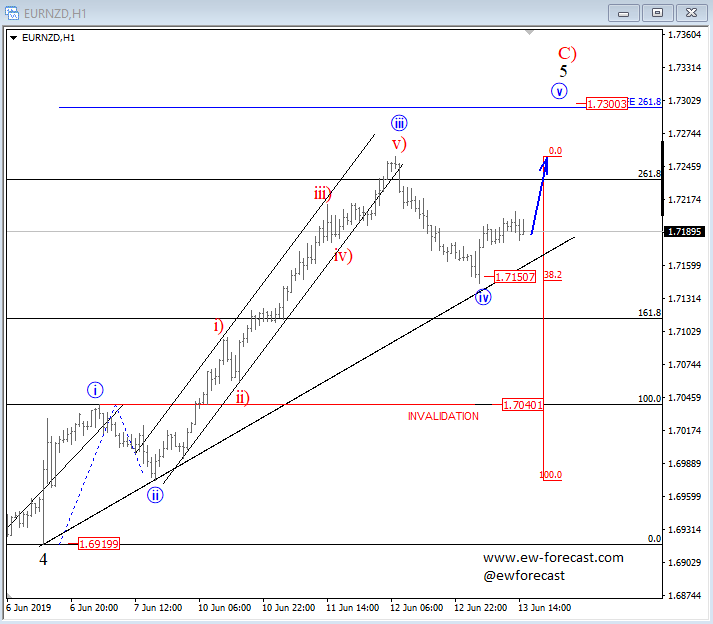
EURNZD dropped exactly into projected 38,2% Fibo. retracement and 1.7150 level, which is ideal support for wave »iv«, especially because it's still trading above strong trend line connected from the beginning of June. So, be aware of another jump, probably the final one for wave »v« towards 1.7300 area and this is where bullish trend may come to an end.
EURNZD, 1h
Sunset Market Commentary
Markets
The US Note future followed volatility in JGB’s during Asian dealings, but global core bonds treaded water near opening levels afterwards. The market is clearly is Fed-countdown mode and expects a dovish outcome. Weak EMU industrial production was expected following earlier national reading while the German economy ministry also warned for a bleak Q2. Second tier eco data and the upspring in the oil price (see headlines) failed to do the trick as well. The US yield curve bull steepens marginally with yields up to 1.2 bps (2-yr) lower. Changes on the German yield curve vary between -0.7 bps and +0.3 bps. Peripheral yield spreads vs Germany narrowed by 3 bps to 6 bps.
A lackluster trading session kept EUR/USD in a tight range today. Euro zone industrial production declined for a second straight month in April (-0.5% MoM) but that didn’t came as a big surprise to markets after horrible German data earlier in June. The euro did feel some selling pressure starting around noon. EUR/USD reached an intraday low after the IMF warned that the euro zone’s growth forecasts are “precarious” given the risks surrounding trade and Brexit. The technical driven decline stopped short of breaking the 100-day moving average (mid 1.127/8’s) before settling around 1.128. USD/JPY completely recovered an intraday loss (108.5 to 108.2), now trading virtually unchanged compared to yesterday’s close.
Today was all about the first voting round of the process to find Prime Minister May’s successor. Notorious hardliner Esther McVey got eliminated by default as she received the least support (9 votes) of the 313 Tory members in Parliament. Others exiting the race are Andrea Leadsom (11 votes) and Mark Harper (10), having received less than the required minimum of 17 votes. Boris Johnson takes the lead by 114 votes, leaving numbers two and three, Jeremy Hunt (43) and Michael Gove (37), far behind. The second voting round for the seven remaining candidates takes place next Tuesday. Sterling suffered a bit from nervousness going into the vote but pared losses after the results got public. Johnson’s crushing victory simply confirmed what markets widely expected. EUR/GBP dipped below 0.89 (0.889 at the time of writing), little changed vs opening levels. Cable showed a similar trading pattern and is currently changing hands close to but below 1.27.
News Headlines
The Swiss National kept its deposit rate unchanged at -0.75%. The central bank introduced a new SNB policy rate (-0.75%) which will replace the target range for the three-month Libor, used previously. The SNB’s willingness to intervene in the FX market, against the “highly valued” Swiss franc remains essential to lower the attractiveness of CHF investments and ease pressure on the currency.
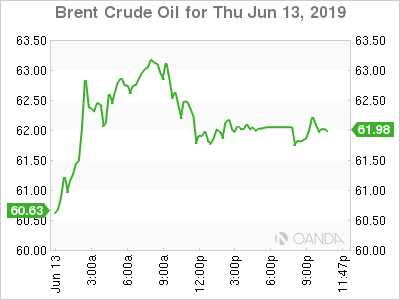
Brent crude oil pared yesterday’s losses, surging from $60/barrel to $62.50/barrel. The rally started following reports of attacks against two oil tankers in the Gulf of Oman which inspired Middle East supply worries. The reduction in OPEC’s 2019 oil demand growth forecast couldn’t reverse the leap higher.
The most hawkish member of the Czech national bank, Vojtech Benda, warned that the overall balance of risks is rather inflationary. He’ll carefully consider whether there’s room for another rate hike already at the next meeting (June 26) as domestic price pressures and a weaker-than-expected currency outweigh effects of the global slowdown.