

Sample Category Title
GBP/USD Mid-Day Outlook
Daily Pivots: (S1) 1.2661; (P) 1.2710; (R1) 1.2738; More....
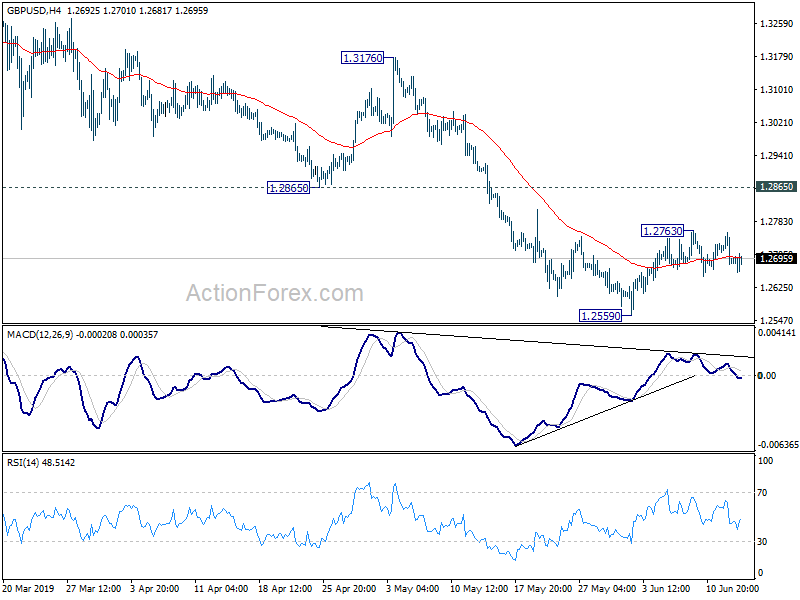
GBP/USD is staying in consolidation from 1.2559 and intraday bias remains neutral first. On the upside, break of 1.2763 will extend the corrective rise from 1.2559. But in that case, upside should be limited by by 1.2865 support turned resistance to bring fall resumption eventually. On the downside, break of 1.2559 low will extend the decline from 1.3381 for 1.2391 low first.
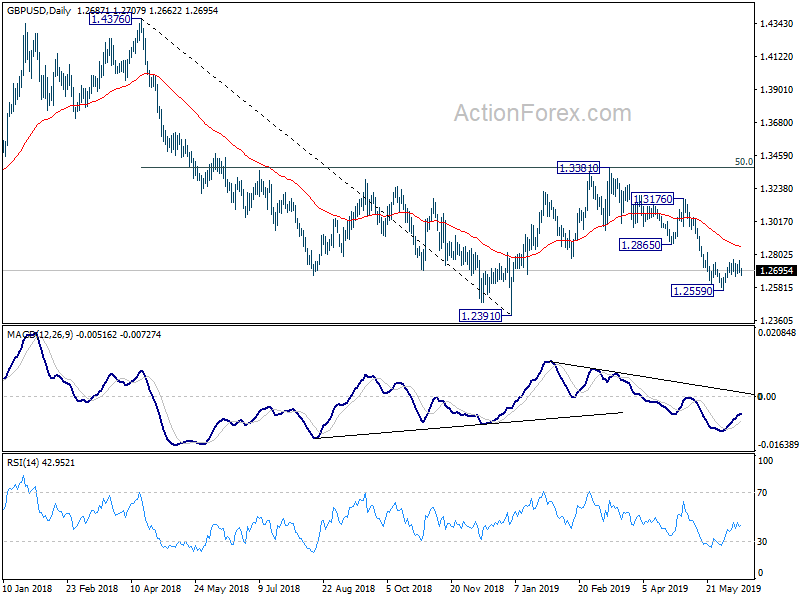
In the bigger picture, medium term decline from 1.4376 (2018 high) is possibly ready to resume. Decisive break of 1.2391 would target a test on 1.1946 long term bottom (2016 low). For now, we don't expect a firm break there yet. Hence focus will be on bottoming signal as it approaches 1.1946. In any case, medium term outlook will stay bearish as long as 1.3381 resistance holds, in case of strong rebound.
Swiss Franc Lifted by Attacks on Oil Tankers, Shrugs SNB
Attacks on two oil tankers in the Gulf of Oman is the biggest news in early US session. WTI oil price is up 3.5% and is back pressing 53 handle after dipping to 50.85 yesterday. The news is both supportive Swiss Franc and Canadian Dollar, which are currently the two strongest ones for today so far. Australian Dollar remains the weakest one as weak details in the job report affirms RBA's path for rate cuts this year. New Zealand Dollar follows as second weakest.
Technically, notable weakness is seen in Euro today. But at this point, EUR/USD is holding above 1.2510 minor support. EUR/JPY stays above 122.10 minor support. EUR/GBP is kept well above 0.8829 minor support. There is not clear sign of topping in the resilient Euro yet. Yen attempted to rally early today but retreated with risk aversion. USD/JPY and GBP/JPY will likely stay in consolidation for a while longer.
In other markets, DOW open mildly higher today and is currently trading up 0.44%. 10-year yield, however, ids down -0.0079 at 2.11. In Europe, FTSE is currently up 0.07%. DAX is up 0.52%. CAC is up 0.09%. German 10-year yield is down -0.0059 % -0.243. Earlier in Asia, Nikkei dropped -0.46%. Hong Kong HSI dropped -0.05%. China Shanghai SSE rose 0.05%. Singapore Strait Times rose 0.40%. Japan 10-year JGB yield rose 0.0004 to -0.111.
US initial jobless claims rose 3k to 222k, import price dropped -0.3%
US initial jobless claims rose 3k to 222k in the week ending June 8, above expectation of 215k. Four-week moving average of initial claims rose 2.5k to 217.75k. Continuing claims rose 2 to 1.69M. US import price index dropped -0.3% mom in May, matched expectations.
Also released, Canada new housing price index rose 0.0% mom in April, matched expectations.
SNB kept policy rate at -0.75%, global risks more pronounced
SNB left Sight Deposit rate unchanged at -0.75% as widely expected and changed the name to SNB policy rate . SNB will also "remain active in the foreign exchange market as necessary". The central bank noted that expansionary monetary policy "remains necessary" against the backdrop of the current price and economic developments". Franc's exchange rate is "somewhat stronger" than in March and is "still highly valued". Current markets "continues to be fragile".
Also signs from global economy "remain mixed". But SNB expect global growth to "remain in line with potential". Risks are "still to the downside" and are "more pronounced" than at March meeting. "Chief among them are political uncertainty and trade tensions, which could lead to renewed turbulence on the financial markets and a further dampening of economic sentiment." Swiss growth "gathered momentum" at the beginning of 2019 with "positive" labor market development and "well utilized" production capacity. Momentum remains "favorable" for 1.5% growth in 2019.
In the new economic projection, SNB raised 2019 inflation forecast to 0.6%, up from 0.3%. 2020 inflation forecast was raised to 0.7%, down from 0.6%. But for 2021, inflation forecast was lowered to 1.1%, down from 1.2%.
In the post meeting press conference, SNB Chairman Thomas Jordan noted that "when the trade dispute between the US and China escalated again in May, the Swiss franc and the Japanese yen appreciated" as safe havens. And, "in light of the high valuation of the franc and the fragility of the situation, our willingness to intervene remains necessary, as does the negative interest rate.
Jordan also, noted decline in long term rates in US, Swiss and Eurozone since December meeting. And, "the global decline in long-term interest rates reflects the heightened risks. Inflation expectations in Swiss "declined slightly" but "remain within the range of 0% to 2% that we equate with price stability."
Swiss SECO raised 2019 growth forecasts to 1.2%, still below average
Swiss State Secretariat for Economic Affairs expects growth to remain "below average" this year on subdued outlook and high uncertainty. But growth forecasts for 2019 was revised slightly up to 1.2%, from 1.1%. For 2020, growth projection was kept unchanged at 1.7%.
SECO noted that "declining momentum in the international economy, the development of world trade is weak and demand for Swiss products is flattening out, slowing down the export economy." And, "downside risks continue to predominate for the global economy".
It warned that with the recent tariff increases between US and China, the trade dispute has taken an "unfavourable turn". Swiss economy would "cool off more strongly" if situation were to intensify further, particularly if EU and Germany were to be significantly affected. Meanwhile, "political uncertainty remains high in Europe", including Brexit and Italy.
German government: Subdued economy with first signs of labor market slowdown
German Federal Ministry of Economy and Energy said the economy will "remain subdued for the time being". And data indicates continuation of "two-part development" as services support growth but manufacturing is in decline. Meanwhile, there are also two parts in manufacturing, paralyzing industry and booming construction.
The ministry also noted "the first signs of the economic slowdown are evident in the labor market: employment continues to grow, but the lower momentum is solidifying. Unemployment increased in May, not just because of special factors."
Eurozone industrial production dropped -0.5% in April
Eurozone industrial production dropped -0.5% mom in April, in line with expectation. in EU28, industrial production dropped -0.7% mom. Among the main industrial groups, in Eurozone, production of durable consumer goods fell by -1.7%, capital goods by -1.4% and intermediate goods by -1.0%. Production of non-durable consumer goods rose by 0.2% and energy by 1.4%.
Italy Tria insists no additional measures needed on budget
Ahead of a meeting of euro zone finance ministers Italian Economy Minister Giovanni Tria insisted that no additional measures are needed over its budget. But Italy can still seek a deal with EU to avoid the excessive deficit procedures. He said "we will explain we will reach our targets over deficit... we don't need additional measures, (but if needed) we will adopt them". And what will happen at the Eurozone finance minister meeting by July 9 is that " we will seek a deal."
Eurogroup President Mario Centeno warned that reducing Italy's debt "is of utmost importance for growth, for the stability of the euro zone." And, what he expected to hear from Tria was "that the targets that were committed by the Italian government at the end of last year are achieved".
European Commission Vice President Valdis Dombrovskis reiterated that "substantial corrections" is needed in Italy's budget to meet fiscal targets for 2019 agreed with the European Commission last December.
Australian employment data shows much slack remains, affirms RBA cut path
Australia employment rose 42.3k in May, well over expectation of 16.0k. However, the growth was mainly driven by 39.8k addition in part-time jobs. Full-employment rose merely 2.4k. Monthly hours worked in all jobs also decreased by -0.3%. Unemployment rate was steady at 5.2% , above expectation of 5.1%. Participation rate rose 0.1% to 66.0%.
In seasonally adjusted terms, the largest increase in employment was in New South Wales (up 38.5k), followed by Victoria (up 28.6k) and Queensland (up 7.8k). The only decreases were in Western Australia (down -4.0k) and Tasmania (down -0.4k).
The data suggests that there is still considerable slack in the labor market. According to recent comments from RBA Assistant Governor Luci Ellis, unemployment could need to be pushed down to as low as 4.5% before material uplift in wage pressure and inflation. There's still a long way to go for the central bank, which is on track for more rate cuts this year.
Also from Australia, consumer inflation expectation was unchanged at 3.3% in June.
From Japan, BSI manufacturing index dropped to -10.4 in Q2. Tertiary industry index rose 0.8% mom in April versus expectation of 0.4% mom.
USD/CHF Mid-Day Outlook
Daily Pivots: (S1) 0.9919; (P) 0.9940; (R1) 0.9976; More...
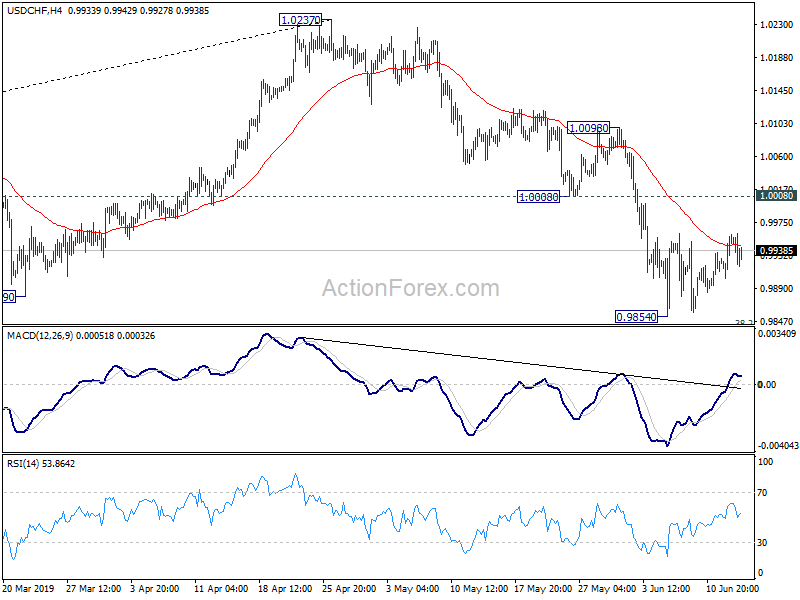
USD/CHF weakens mildly today but stays well inside consolidation for 0.9852. Intraday bias remains neutral at this point. In case of another recovery, upside should be limited by 1.0008 support turned resistance and bring fall resumption. On the downside, break of 0.9854 will extend the decline from 1.0237 to 0.9716 cluster support (50% retracement of 0.9186 to 1.0237 at 0.9712).
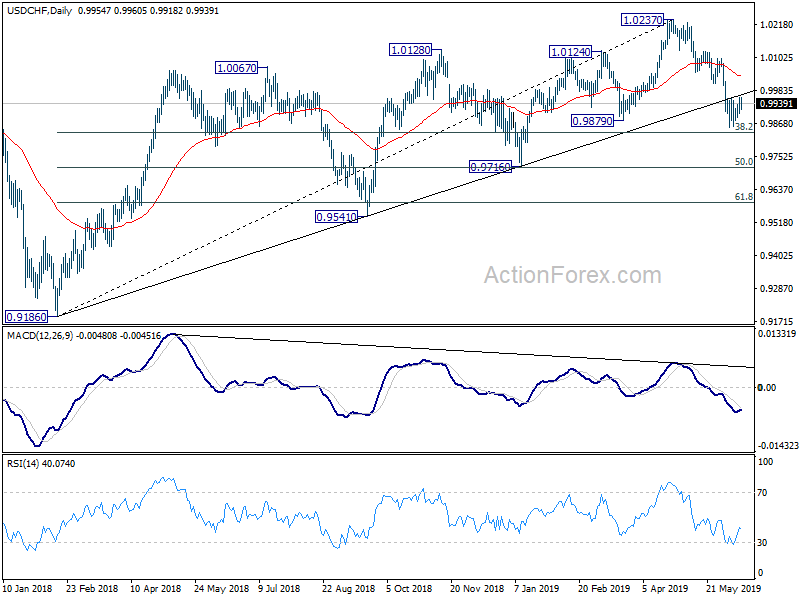
In the bigger picture, USD/CHF's break of long term trend line support is the first indication of medium term reversal. Focus is now back on 0.9879 support. Sustained break should confirm that medium term up trend from 0.9186 has completed at 1.0237 already. Further fall should be seen to 0.9716 cluster support (50% retracement of 0.9186 to 1.0237 at 0.9712) next. Break will target 61.8% retracement at 0.9587.
Economic Indicators Update
| GMT | Ccy | Events | Actual | Forecast | Previous | Revised |
|---|---|---|---|---|---|---|
| 23:01 | GBP | RICS House Price Balance May | -10.00% | -21.00% | -23.00% | -22.00% |
| 23:50 | JPY | BSI Large Manufacturing Q/Q Q2 | -10.4 | 4.5 | -7.3 | |
| 01:00 | AUD | Consumer Inflation Expectation Jun | 3.30% | 3.30% | ||
| 01:30 | AUD | Employment Change May | 42.3k | 16.0k | 28.4k | 43.1k |
| 01:30 | AUD | Unemployment Rate May | 5.20% | 5.10% | 5.20% | |
| 04:30 | JPY | Tertiary Industry Index M/M Apr | 0.80% | 0.40% | -0.40% | |
| 06:00 | EUR | German CPI M/M May F | 0.20% | 0.20% | 0.20% | |
| 06:00 | EUR | German CPI Y/Y May F | 1.40% | 1.40% | 1.40% | |
| 06:30 | CHF | Producer & Import Prices M/M May | 0.00% | 0.10% | 0.00% | |
| 06:30 | CHF | Producer & Import Prices Y/Y May | -0.80% | -0.70% | -0.60% | |
| 07:30 | CHF | SNB Sight Deposit Interest Rate | -0.75% | -0.75% | -0.75% | |
| 07:30 | CHF | SNB 3-Month Libor Lower Target Range | -1.25% | -1.25% | -1.25% | |
| 07:30 | CHF | SNB 3-Month Libor Upper Target Range | -0.25% | -0.25% | -0.25% | |
| 09:00 | EUR | Eurozone Industrial Production M/M Apr | -0.5 | -0.50% | -0.30% | -0.40% |
| 12:30 | CAD | New Housing Price Index M/M Apr | 0.00% | 0.00% | 0.00% | |
| 12:30 | USD | Import Price Index M/M May | -0.30% | -0.30% | 0.20% | 0.10% |
| 12:30 | USD | Initial Jobless Claims (JUN 8) | 222K | 215K | 218K | 219K |
| 14:30 | USD | Natural Gas Storage | 110B | 119B |
USD/CHF Mid-Day Outlook
Daily Pivots: (S1) 0.9919; (P) 0.9940; (R1) 0.9976; More...
USD/CHF weakens mildly today but stays well inside consolidation for 0.9852. Intraday bias remains neutral at this point. In case of another recovery, upside should be limited by 1.0008 support turned resistance and bring fall resumption. On the downside, break of 0.9854 will extend the decline from 1.0237 to 0.9716 cluster support (50% retracement of 0.9186 to 1.0237 at 0.9712).
In the bigger picture, USD/CHF's break of long term trend line support is the first indication of medium term reversal. Focus is now back on 0.9879 support. Sustained break should confirm that medium term up trend from 0.9186 has completed at 1.0237 already. Further fall should be seen to 0.9716 cluster support (50% retracement of 0.9186 to 1.0237 at 0.9712) next. Break will target 61.8% retracement at 0.9587.
EUR/USD Mid-Day Outlook
Daily Pivots: (S1) 1.1264; (P) 1.1306; (R1) 1.1329; More......
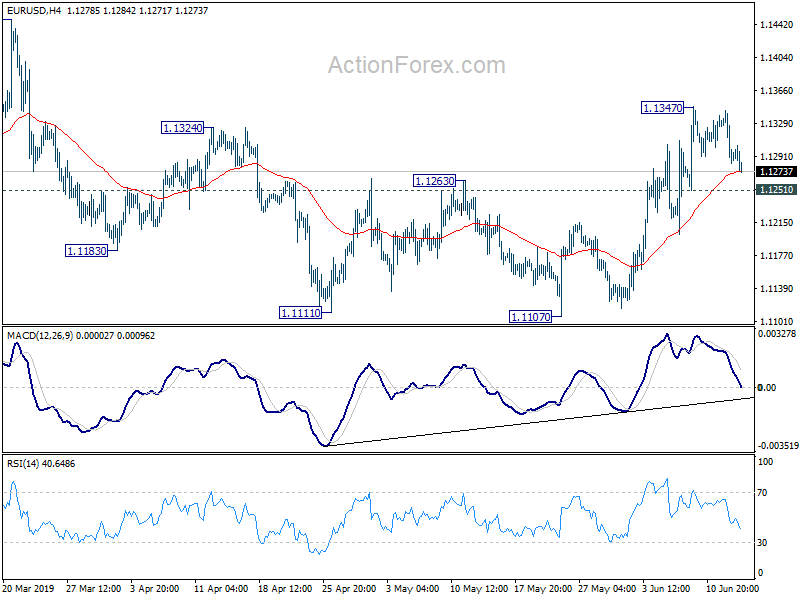
EUR/USD drops notably lower today and is now pressing 4 hour 55 EMA. But downside is so far contained above 1.1251 minor support. Intraday bias remains neutral and further rise is mildly in favor. On the upside, above 1.1347 will target 1.1448 key resistance next. Decisive break there will carry larger bullish implications. On the downside, break of 1.1251 minor support will suggest that recovery from 1.1107 has completed. Intraday bias will be turned back to the downside for retesting 1.1107 low.
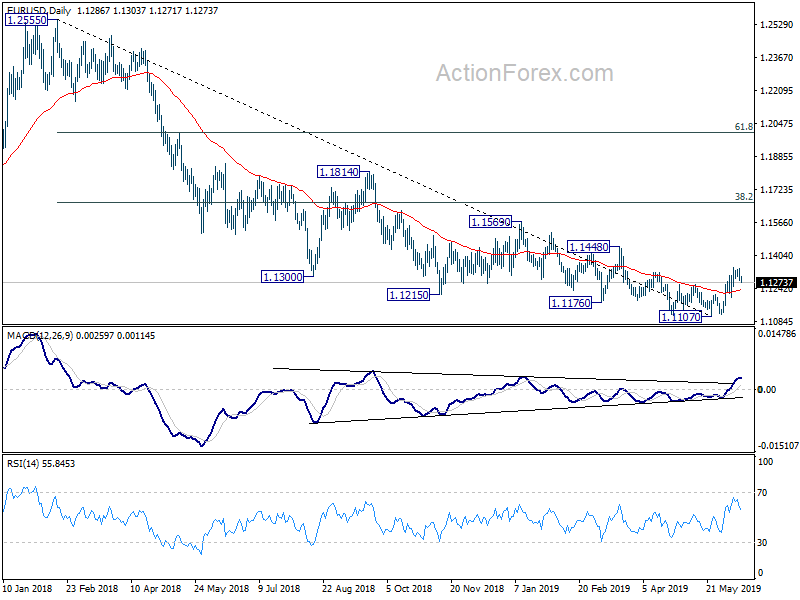
In the bigger picture, current development argues that a medium term bottom could be in place at 1.1107, on bullish convergence condition in daily MACD. Decisive break of 1.1448 resistance would confirm this case. And stronger rebound would be seen to 38.2% retracement of 1.2555 to 1.1107 at 1.1660. At this point, it's early to judge whether rise from 1.1107 is a corrective move or the start of an medium term up trend. We'd look at the structure of the rebound to decide later. But in any case, for now, risk will remain on the upside as long as 1.1107 low holds.
US Dollar Index Rebounds on Ascending Line; Gains are Expected
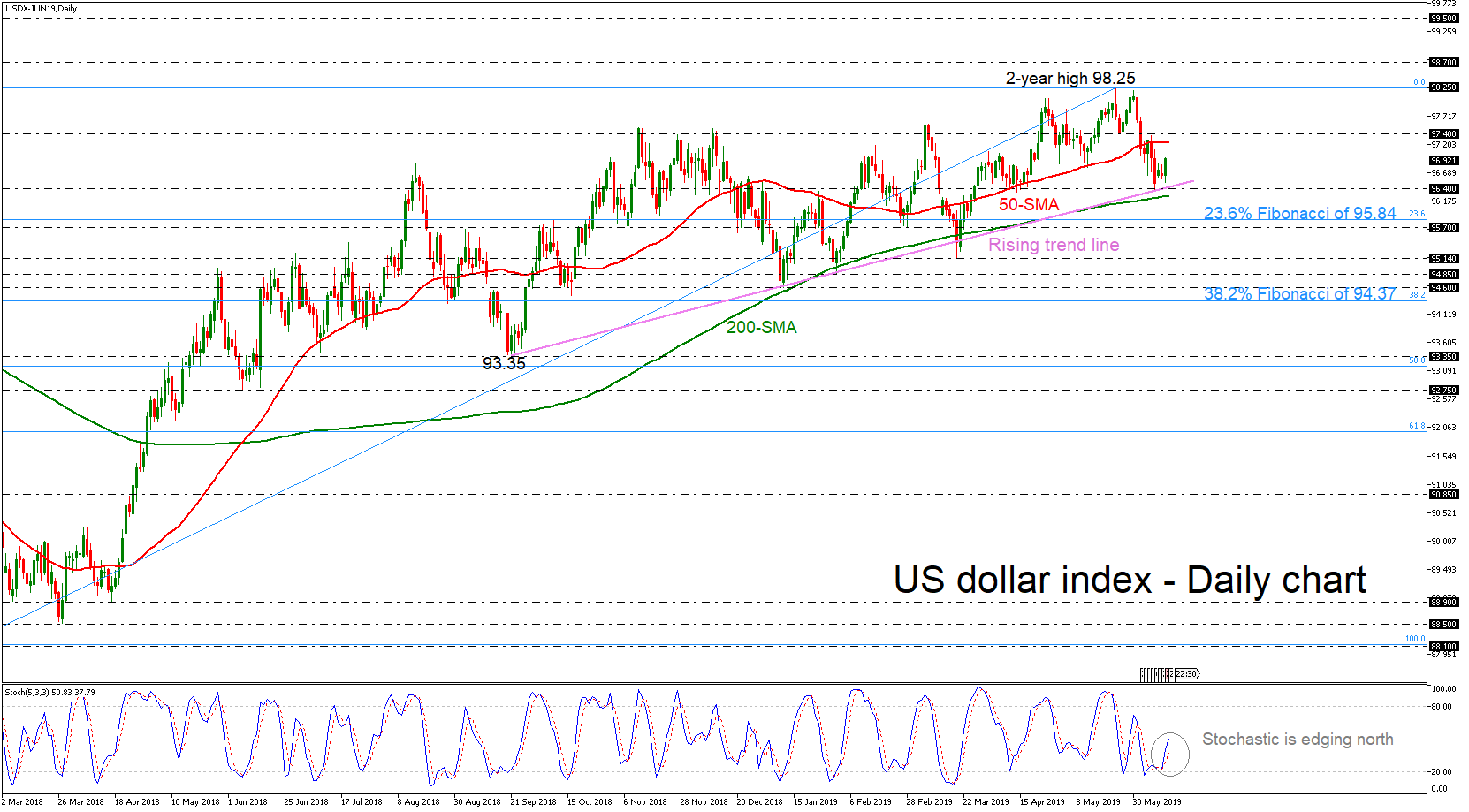
The US dollar index found a strong support obstacle on the long-term ascending trend line once again, sending the price higher. The short-term bias is tilted to the upside as the stochastic oscillator is approaching the overbought area with stronger momentum than before in the daily timeframe.
If the index moves higher, the 50-day simple moving average (SMA) currently at 97.25 and the 97.40 resistance level could attract traders’ attention before the price hit the two-year high of 98.25. Any violation above this hurdle could open the way for the 98.70 resistance, posting a higher high in the long term.
On the other hand, if the price posts a bearish retracement the next support could come from 96.40 and the 200-day SMA near 96.27. More losses could shift the long-term bullish outlook to bearish, meeting the 23.6% Fibonacci retracement level of the upward wave from 88.10 to 98.25 around 95.84.
In the bigger picture, the dollar index has held in an upside tendency, however, looking at the very short-term, the price is returning higher towards the 50-day SMA.
EURCHF Eases in Downward Sloping Channel; Negative Overall
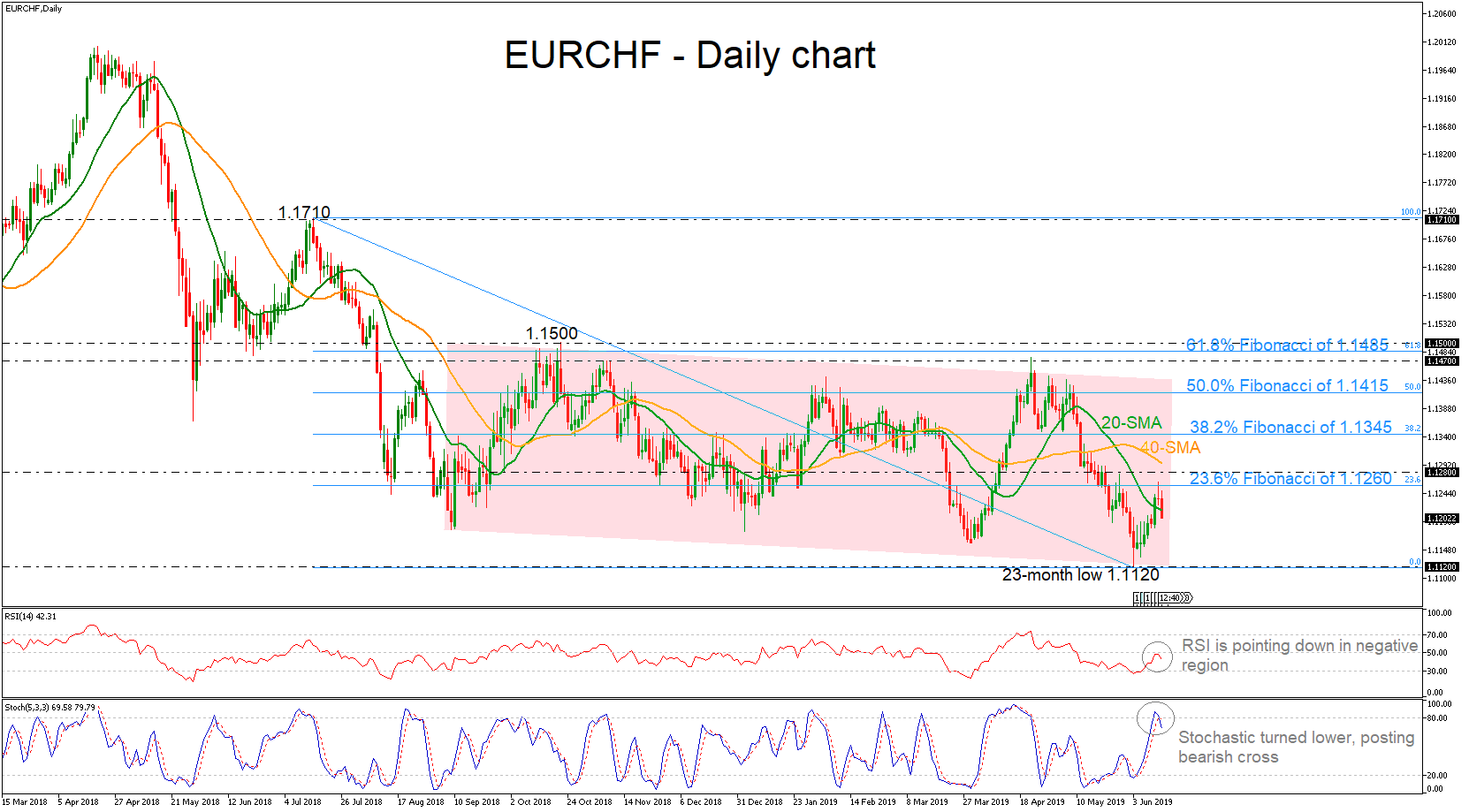
EURCHF is retreating today, falling below both its 20- and 40-day simple moving averages (SMAs) as well as beneath the 23.6% Fibonacci retracement level of the downleg from 1.1710 to 1.1120 near 1.1260. The bigger picture still seems negative as the price has been developing in a descending channel since September 2018.
Short-term momentum oscillators concur, with the RSI already below 50 and pointing lower, and the stochastic is posting a bearish cross within the %K and %D lines in the daily timeframe.
Further declines could meet support near the 23-month low of 1.1120, defined by the low on June 3, with a downside break opening the door for the 1.1000 significant handle, taken from the inside swing top on May 2017. This could endorse the scenario for stronger bearish structure.
On the flipside, a rebound may stall near the neighborhood of 1.1260 – 1.1280. Close to that region is also the 40-day SMA currently at 1.1293 ahead of the 38.2% Fibonacci mark of 1.1345.
In brief, some further losses shouldn’t be ruled out in the immediate term, but as long as the price remains in the downward sloping channel, the broader outlook is negative.
Stocks Stabilize as Markets Await Trade and Hong Kong Developments; Oil Surges on Tanker Attacks in Middle East
US stocks are poised to open higher as markets await developments on the trade front and the situation in Hong Kong. This is turning out to be a difficult week for President Xi as he is seeing his Communist Party be threatened by Hong Kong’s fight to maintain autonomy. Xi cannot allow Hong Kong a win, otherwise the mainland will see that the power of protesting could change policy. With no meaningful updates expected in the US – China trade war until we get closer to the June 28-29th G20 Summit in Japan, we could see markets remain slightly optimistic until then.
The morning data release in North America saw limited market reactions after pretty much coming in line with expectations. US jobless claims rose 3,000 to 222,000, slightly above the 4-week moving average of 217,750. US import prices also declined slightly more than expected at 0.3%. Canada’s April new home price index was unchanged from a month ago and matching the analysts consensus.
-
GBP – Boris 114 votes, Hunt 43 after first round of voting
-
CHF – SNB keeps rates unchanged and introduces policy rate
-
Oil – Higher after Tanker Attack in Gulf of Oman
-
Gold – Higher on Fed Rate Cut Bet Momentum
GBP
Former Foreign Secretary Boris Johnson had a strong outing at the first round of voting in U.K. Conservative leadership contest to succeed Prime Minister Theresa May. Johnson dominated with 114 votes, while Foreign Secretary Hunt came in second place with 43 votes and Environment Secretary Gove won 37 votes. The field is narrower as Former Leader of the House of Commons Andrea Leadsom, Former Chief Whip Mark Harper and are Former Work and Pensions Secretary Esther McVey all got eliminated after failing to receive enough support. The next rounds of voting is expected on June 18th, 19th, and 20th.
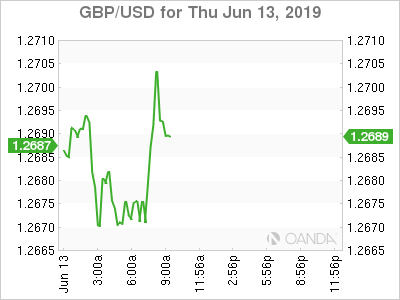
The British pound saw little reaction to the voting results and remains unchanged on the session at 1.2689.
CHF
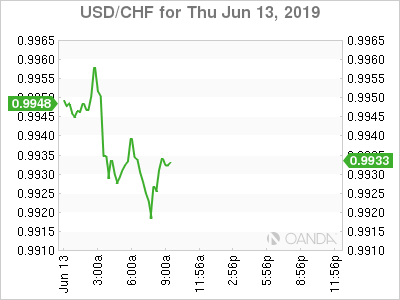
The SNB kept rates steady and introduced a new policy rate, since the Libor rate is being put away for good. The bank reiterated their pledge to battle currency strength and will keep policy as expansionary as before.
The Swiss franc is the best performing currency and it could see further gains once the Fed capitulates in delivering rate cuts. Global growth deterioration that has stemmed from the global trade wars is seeing investors still flee to the franc.
Oil
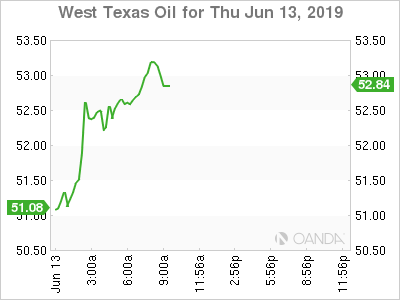
Crude prices jumped higher after reports that two tankers were attacked and sustained damage in the Gulf of Oman. The suspected attack follows is the second major one near the Strait of Hormuz, a key passage where roughly 30% of the world’s sea-borne crude oil passes. Roughly a month ago four oil vessels were sabotaged at United Arab Emirates port of Fujairah, in what the US says were attacks led by Tehran. Geopolitical risks are tentatively stopping the recent downtrend with oil prices which have fallen to near five-month lows.
Instability in the region could threaten oil supplies in what will likely become a tug-of-war battle for oil prices as sellers will focus on falling global demand. Oil was ripe for a pullback, especially after the recent slide fell into bear market territory and approached key psychological levels (Brent $60/WTI $50). Oil could see a strong rush of bullish momentum if Trump and XI are able to deescalate their trade war at the end of the month.
OPEC also released their monthly report which delivered a warning that trade tensions are hurting global oil demand. The group is targeting demand growth below 1 million barrels a day in the first quarter. Poised for the weakest growth in a decade, demand will remain vulnerable as long as China and the US cannot reach an agreement.
OPEC still needs to finalize when they will meet, and expectations are they will still curtail production even as US production rises to new record levels. A successful OPEC + agreement will require the support from Russia and Iran, possibly a tall task given the current political environment.
Gold
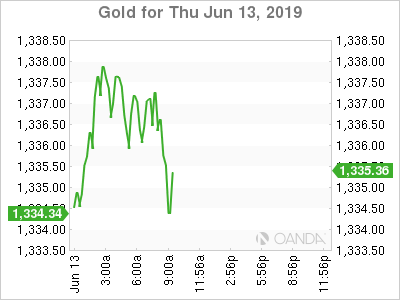
Gold could continue to benefit on cooler US inflation data which drove up Fed rate cut expectations. The yellow metal did not receive much of boost from the reports of tanker attacks in the Gulf of Oman. If the situation continues to intensify in the Middle East, gold should extend their recent gains.
WTI Crude – Spikes on Reported Tanker Attacks
Oil spikes on reports of tanker explosions
Oil prices have spiked on Thursday following reports of tankers being attacked in the Gulf of Oman, off the coast of Iran.
This comes a month after allegations of sabotage in the same region, which was blamed on Iran and threatened to stoke further tensions in the region. It comes at a time when the US has imposed sanctions on Iran in an attempt to reduce oil exports to zero, ruin the economy and apply maximum pressure to the regime after Trump pulled out of the nuclear accord.
The knee jerk reaction is more a response to the risks associated with higher tensions in the region and prospect of more attacks, than immediate impact on oil supplies. It comes at a time when oil prices have been under pressure from weaker economic prospects and record US output, despite efforts by OPEC and its allies to reduce output and cut the oversupply.
WTI Daily Chart
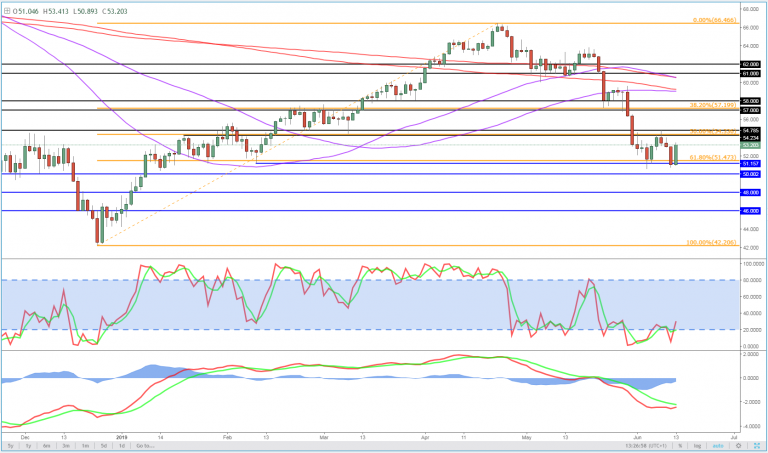
WTI was hovering around $50 – long term support and 61.8% retracement of the 2018 lows to 2019 highs – when the reports came out which may have aided the rally, being such a key support level. As long as prices remain below $55 though, being the recent high, it will continue to look vulnerable. A lower high, if registered, would be seen as weakness given what triggered the rally.
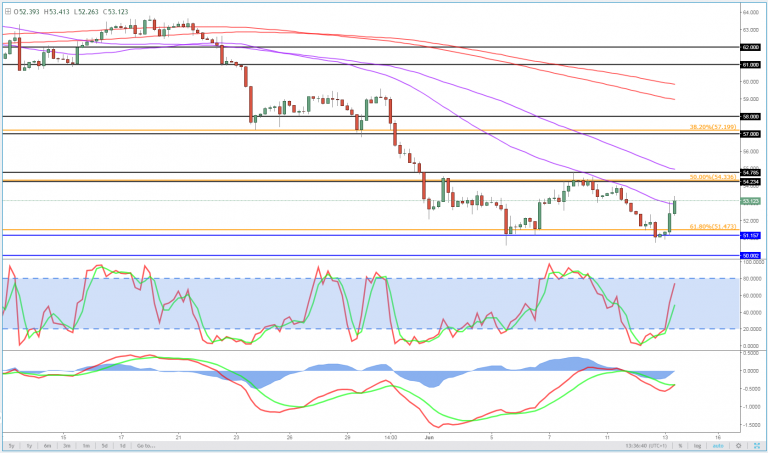
What may give a bullish impression today is a close above $53, which would create a bullish engulfing pattern – albeit a slightly imperfect one – and see us close above the 55-period moving average on the 4-hour chart which price has recently tracked below. This would make the next couple of days very interesting.
WTI 4-Hour Chart
Aussie Slips to 2-Week Low as Unemployment Rate Misses Forecast
AUD/USD has edged lower in the Thursday session. In North American trade, AUD/USD is trading at 0.6914, down 0.22% on the day. On the release front, Australian MI Inflation Expectations remained steady at 3.3%. Australian employment numbers were mixed. The economy created 42.3 thousand in May, which marked a 9-month high. However, the unemployment rate was unchanged at 5.2%, above the estimate of 5.1%. In the U.S., unemployment claims was unexpectedly high, climbing to 222 thousand. This was the highest reading in five weeks.
Australian consumers are pessimistic, according to the Westpac Consumer Confidence indicator. The survey declined in June by 0.6%. This was a disappointment, as analysts had hoped that the recent RBA rate cut will energize the economy and improve consumer confidence. There was better news from the business sector, as the NAB business confidence survey climbed to 7 points in May. Aside from the rate cut, the business sector was pleased with the shock victory of the conservative coalition in the general election last month, as the conservatives have a business-friendly stance.
In the U.S., consumer inflation remained soft in May. CPI slowed to 0.1%, down from 0.3% in the previous release. This matched the estimate. The core reading posted a gain of 0.1% for a fourth straight month, shy of the forecast of 0.2%. With the May inflation numbers remaining low, there could be more pressure on the Fed to lower interest rates in order to boost economic activity and inflation. The likelihood of further rates this year is increasing – the CME Group has set the odds of a July cut at 66% and another cut in September at 50%. Lower interest rates make the U.S. dollar less attractive to investors, so investors will be keeping an eye at alternative assets.
US initial jobless claims rose 3k to 222k, import price dropped -0.3% mom
US initial jobless claims rose 3k to 222k in the week ending June 8, above expectation of 215k. Four-week moving average of initial claims rose 2.5k to 217.75k. Continuing claims rose 2 to 1.69M.
US import price index dropped -0.3% mom in May, matched expectations.
Also release, Canada new housing price index rose 0.0% mom in April, matched expectations.