Sample Category Title
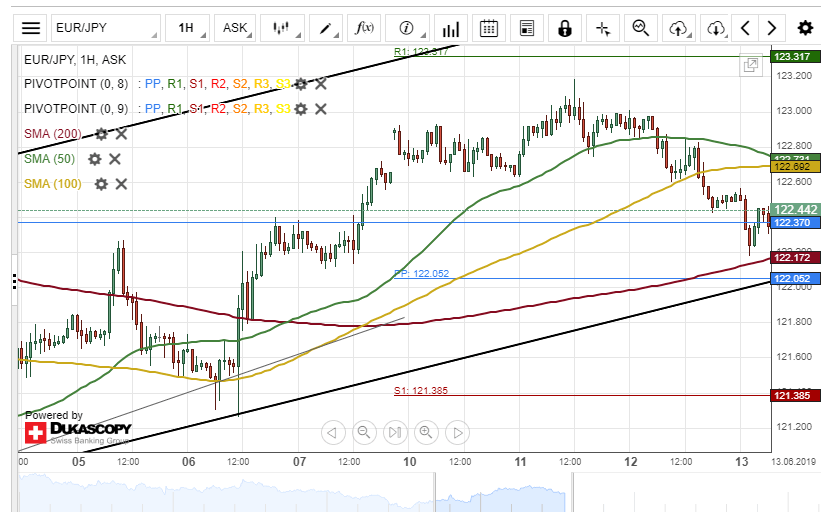
EUR/JPY Supported By 200-Hour SMA
The single European currency depreciated about 56 base points against the Japanese Yen on Wednesday. The currency pair breached both the 50– and 100-hour SMAs during yesterday's trading session.
Currently, the 200-hour simple moving average is providing support for the exchange rate at 122.15.
If this support level holds, a surge towards the 123.20 regions could be expected during the following trading session.
However, if the pair passes the 200-hour SMA, a potential breakout through the bottom border of an ascending channel pattern is likely to occur today.
AUD/USD Likely To Maintain Channel Pattern
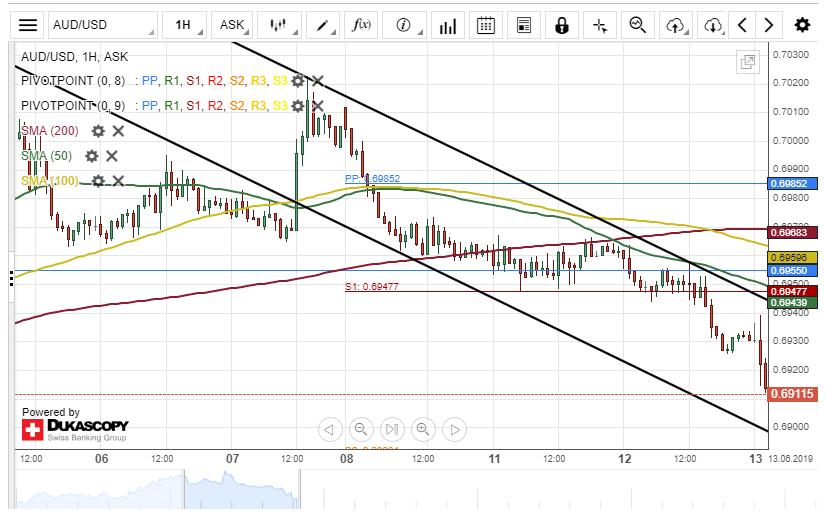
The Australian Dollar has continued its decline in a descending channel pattern against the US Dollar. The currency pair has dropped about 0.83% in value since yesterday's trading session.
Technical indicators flash sell signals both on the smaller and the larger time-frame charts. Most likely, the exchange rate will maintain its channel pattern within this session.
However, the currency exchange rate might reverse from the current price level at 0.6908 and aim for a resistance level formed by the 50-hour simple moving average at 0.6945 during the following trading session
USD/CAD Could Aim For 50– And 100-Hour SMAs
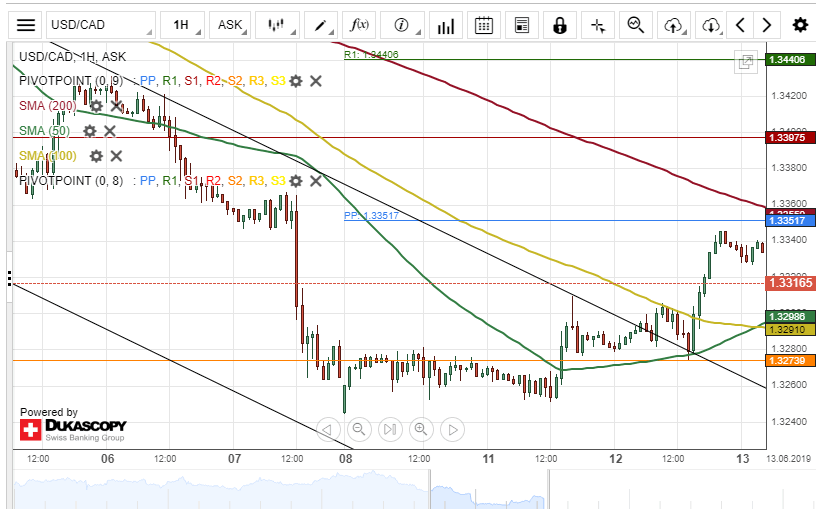
The US Dollar appreciated about 68 base points against the Canadian Dollar on Wednesday. The surge was stopped by the weekly pivot point at 1.3351 during yesterday's trading session.
As for the near future, it is likely that the USD/CAD exchange rate will edge lower towards a support cluster formed by the combination of the 50– and 100-hour SMAs at 1.3291.
If the support cluster holds, the currency exchange rate could continue its upside movement during the following trading session.
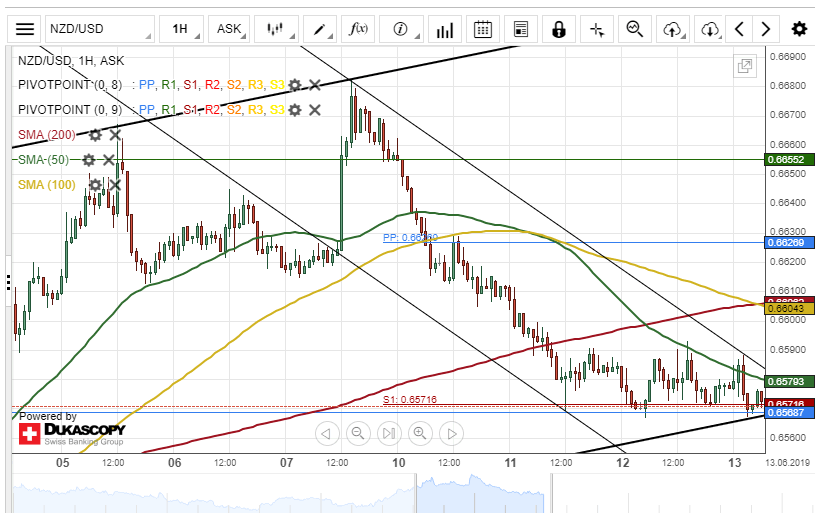
NZD/USD Likely To Make Some Gain Today
The New Zealand Dollar traded sideways movement against the US Dollar on Wednesday. The 50-hour simple moving average provided resistance for the pair during Wednesday's trading session.
Everything being equal, most likely, the NZD/USD currency pair will make some gain today. The potential target for bullish traders will be near the 100– and 200-hour SMAs at 0.6605.
On the other hand, if the currency exchange rate breaks the medium-term ascending channel pattern, the pair might end this week's trading sessions with a decline.
SNB Jordan: Swiss Franc and Yen appreciated as safe havens as US-China trade tensions escalated
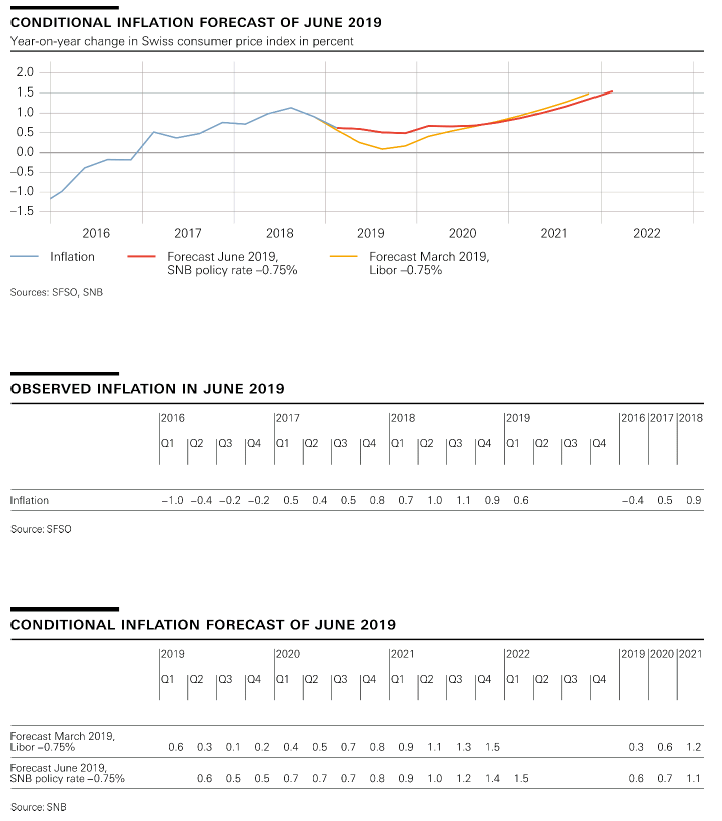
In the post meeting press conference, SNB Chairman Thomas Jordan noted that "when the trade dispute between the US and China escalated again in May, the Swiss franc and the Japanese yen appreciated" as safe havens. And, "in light of the high valuation of the franc and the fragility of the situation, our willingness to intervene remains necessary, as does the negative interest rate.
Jordan also, noted decline in long term rates in US, Swiss and Eurozone since December meeting. And, "the global decline in long-term interest rates reflects the heightened risks. Inflation expectations in Swiss "declined slightly" but "remain within the range of 0% to 2% that we equate with price stability."
SNB kept policy rate at -0.75%, global risks more pronounced
SNB left Sight Deposit rate unchanged at -0.75% as widely expected and changed the name to SNB policy rate . SNB will also "remain active in the foreign exchange market as necessary". The central bank noted that expansionary monetary policy "remains necessary" against the backdrop of the current price and economic developments". Franc's exchange rate is "somewhat stronger" than in March and is "still highly valued". Current markets "continues to be fragile".
Also signs from global economy "remain mixed". But SNB expect global growth to "remain in line with potential". Risks are "still to the downside" and are "more pronounced" than at March meeting. "Chief among them are political uncertainty and trade tensions, which could lead to renewed turbulence on the financial markets and a further dampening of economic sentiment." Swiss growth "gathered momentum" at the beginning of 2019 with "positive" labor market development and "well utilized" production capacity. Momentum remains "favorable" for 1.5% growth in 2019.
In the new economic projection, SNB raised 2019 inflation forecast to 0.6%, up from 0.3%. 2020 inflation forecast was raised to 0.7%, down from 0.6%. But for 2021, inflation forecast was lowered to 1.1%, down from 1.2%.
GBPJPY Consolidates Rebound, Indicators Trend Up
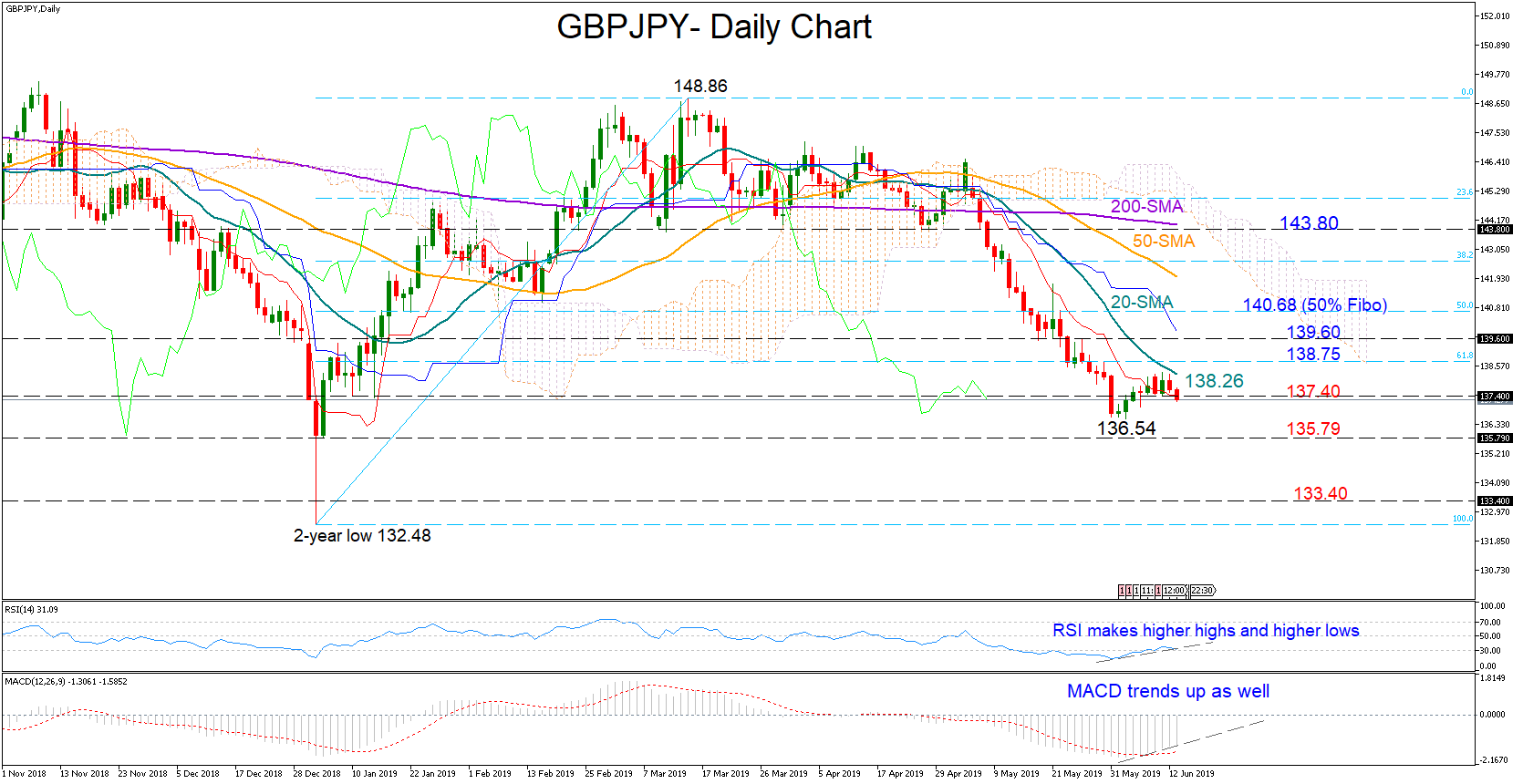
GBPJPY stabilized around a key barrier of 137.40 after bouncing on the five-month trough of 136.54.
Although the RSI is currently sloping down, the indicator seems to be building an uptrend, confirming another higher high near its 30 oversold mark earlier this week. The MACD is also trending up above its red signal line, adding further hopes for a supported market in the short-term.
The 20-day simple moving average (SMA) at 138.26 and the 61.8% Fibonacci of 138.75 of the upleg from 132.48 to 148.86 could halt upside movements ahead of the 139.60 level. Higher, the bulls should push harder to breach the 50% Fibonacci of 140.68.
A failure to hold above 137.40 would shift attention to the 136.54 bottom and the January 4 low of 135.79. If the latter proves a weak obstacle, then the way could open towards 133.40, a former support and resistance spot.
Meanwhile in the medium-term timeframe, the sentiment remains bearish. A rally above 143.80 would change the outlook back to neutral, though with the 50-day SMA moving with a steep negative slope under the 200-day SMA, such a recovery is currently looking less likely.
Sterling Relent Gains As No Deal Is Still Alive
The pound made some gains against a number of its counterparts yesterday, as hopes grew for a possible blocking of a no deal scenario. However the UK Parliament rejected blocking the blocking by a rather thin majority, hence the pound was forced to relent any gains made. With the election of a new leader not being over until the 22nd of July, time limits seem to be getting very tight for the UK to decide on Brexit. The election process in the conservative party is to begin and Boris Johnson is expected to be the favorite. We see the case for the pound to be Brexit driven, yet at the same time we would like to point out that the moderation in the pounds' reaction yesterday, may show how many negative scenarios the pound has priced in, at the moment. GBP/JPY dropped yesterday, aiming for the 137.20 (S1) support line. Technically, as the pair has broken the upward trendline incepted since the 4th of June, we switch our bullish outlook in favor of a sideways scenario. Should the pair come under the selling interest of the market, we could see it breaking the 137.20 (S1) support line and aim for the 136.00 (S2) support level. Should the pair's long positions be favored by the market, we could see it breaking the 138.20 (R1) resistance line and aim for the 139.45 (R2) resistance level.
USD gains on trade tension easing
The USD marked some gains on Wednesday and stabilized somewhat during today's Asian session as trade tensions seem to ease a bit. US president Trump expressed optimism over making a deal with China and pressures on the USD seem to be reduced. The US president had expressed a “feeling” that a US-China trade deal could be reached, yet at the same time threatened to increase tariffs on US imports from China should there be no agreement. Our worries however, were enhanced about a possible over spilling of the trade tensions in Europe and Japan, as the US president had blamed the EUR devaluation of putting the US in disadvantage. Analysts point out that the USD may have also benefited from the weak performance of other currencies and we tend to concur with that opinion, especially the EUR's. We could see the USD be somewhat less data driven today and new headlines could influence its direction. AUD/USD dropped yesterday and during today's Asian session broke the 0.6925 (R1) support line (now turned to resistance). Technically the pair's direction seems to be dominated by the downward trendline, incepted since the 7th of June, hence at the current stage we maintain our bearish bias. Should the bears maintain control over the pair's direction, we could see it aiming for the 0.6860 (S1) support line. Should the bulls take over, we could see the pair breaking the 0.6925 (R1) resistance line and aim for higher grounds.
Other economic highlights, today and early tomorrow
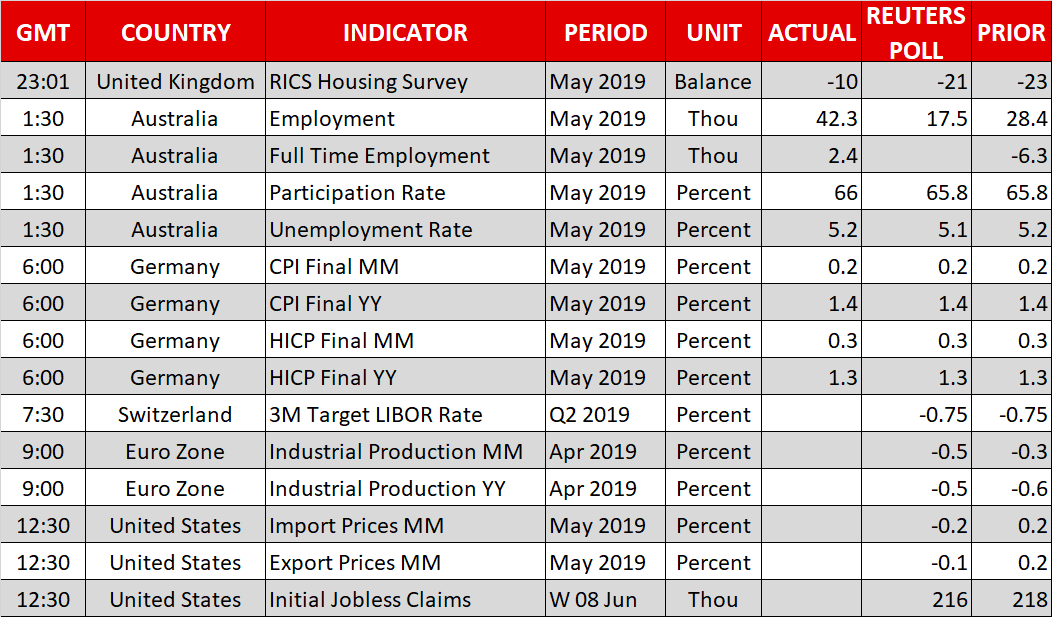
Today during the late European session, we get from Germany the final HICP rate for May and from Switzerland SNB's interest rate decision, which is widely expected to remain on hold at -0.75%. We wouldn't be surprised to see the bank issuing an accompanying statement with its content tilted towards the dovish side, which in turn could weaken the CHF somewhat. Also, during the European session, we get Eurozone's industrial production growth rate for May and later on the release of OPEC's monthly report may spark some interest among oil traders. In the American session, we get the US initial jobless claims figure and during tomorrow's Asian session, we get Japan's final industrial production growth rate for April.
GBP/JPY H4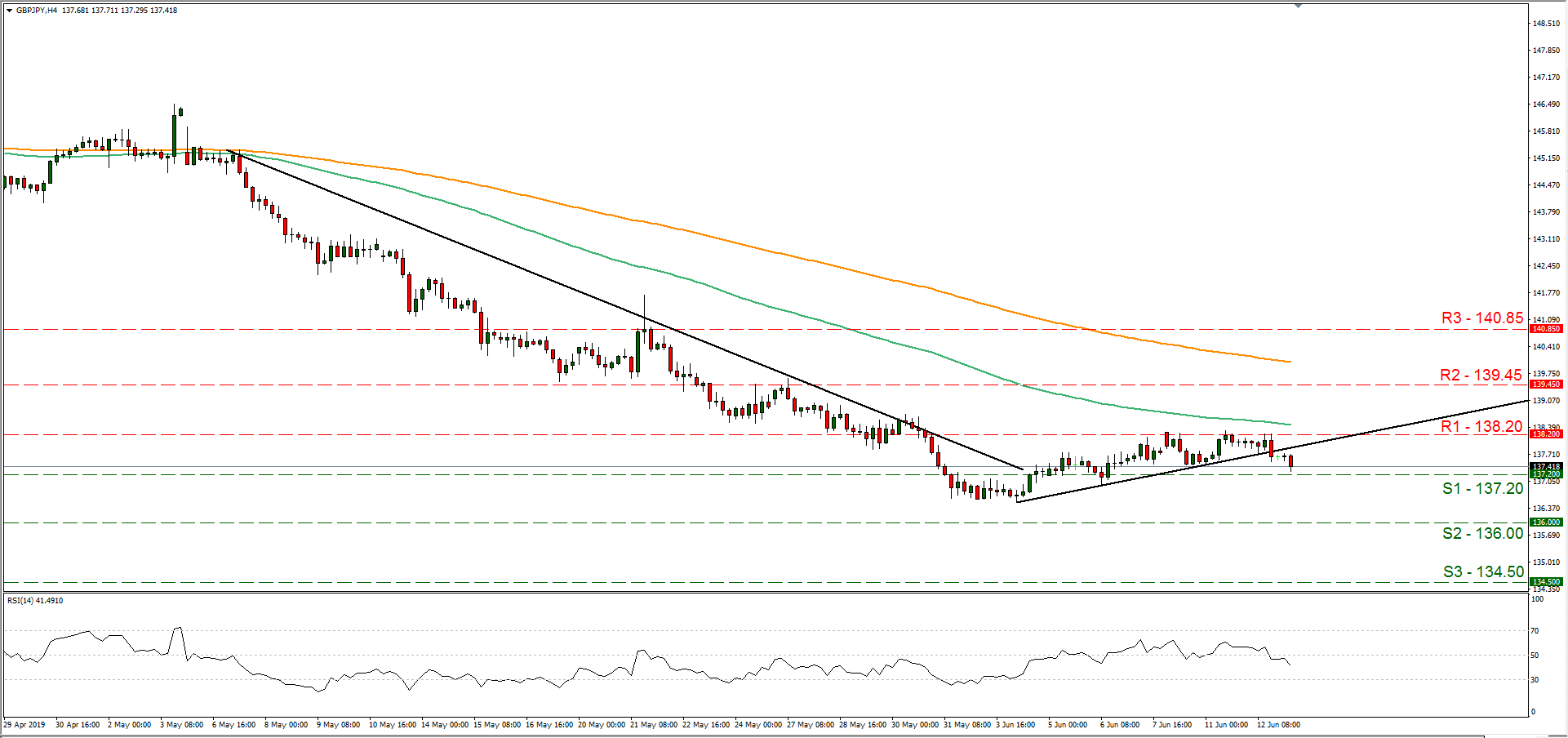
Support: 137.20 (S1), 136.00 (S2), 134.50 (S3)
Resistance: 138.20 (R1), 139.45 (R2), 140.85 (R3)
AUD/USD H4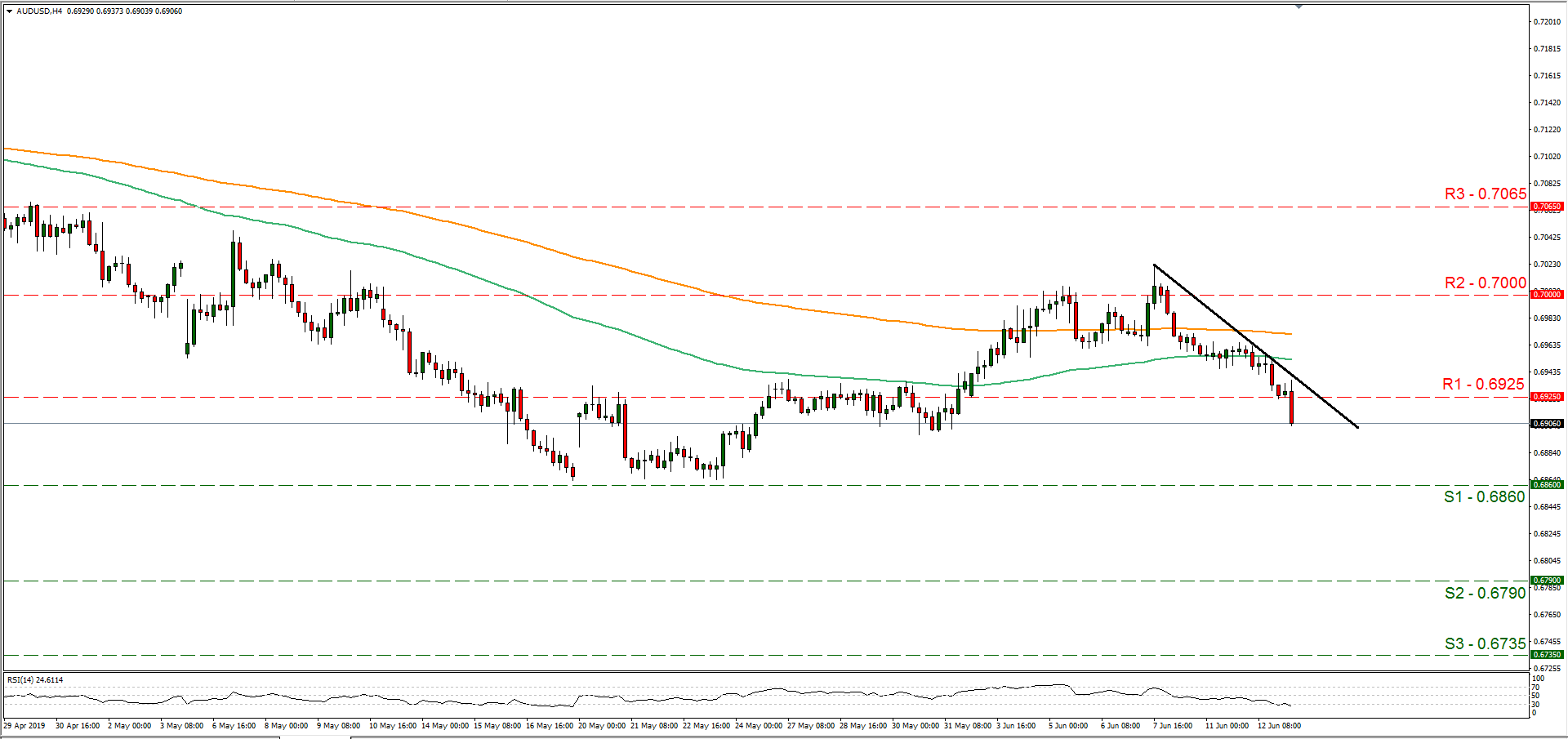
Support: 0.6860 (S1), 0.6790 (S2), 0.6735 (S3)
Resistance: 0.6925 (R1), 0.7000 (R2), 0.7065 (R3)
(SNB) Introductory remarks by Thomas Jordan
Ladies and gentlemen
It is my pleasure to welcome you to the Swiss National Bank's news conference. I will begin by setting out our monetary policy decision and our assessment of the economic situation, and will also be explaining an adjustment to our monetary policy strategy. I will then hand over to Fritz Zurbrügg, who will present this year's Financial Stability Report. After that, Andréa Maechler will talk about the situation on the financial markets, the progress made in replacing the Libor, and the SNB joining the Network for Greening the Financial System. Finally, we will – as ever – be pleased to take your questions.
Monetary policy decision and introduction of the SNB policy rate
Let me begin with our monetary policy decision. We are maintaining our expansionary monetary policy. Interest on sight deposits held by banks at the SNB remains at –0.75%, and we will continue to be active in the foreign exchange market as necessary, while taking the overall currency situation into consideration. Our expansionary monetary policy remains necessary. We thereby stabilise price developments and support economic activity.
At our monetary policy assessment we also decided to make a small adjustment to our monetary policy strategy. We are now introducing the SNB policy rate, which will take over the function previously performed by the target range for the three-month Libor. The SNB policy rate currently stands at −0.75%.
The reason for this adjustment is that the future of the Libor is not guaranteed. The UK's Financial Conduct Authority will only ensure that the Libor is maintained through to the end of 2021. The volume of money market transactions underlying the Libor has dwindled. This has also placed a question mark over the basis for its calculation. Given that our monetary policy is focused on the medium term, we are already adjusting our strategy at this juncture.
Our inflation forecast is based on the assumption that a specified interest rate remains unchanged over the entire forecast horizon of three years. The current forecast extends beyond the end of 2021 for the first time. The introduction of the SNB policy rate ensures that it will be based on the same interest rate over the entire horizon.
So what is the SNB policy rate, and what changes does this entail for our monetary policy strategy? In answering these questions, please allow me to give you a brief recap of the three elements of our strategy and explain the impact this adjustment will have.
The first element is our definition of price stability. The SNB equates price stability with a rise in the Swiss consumer price index of less than 2% per annum. Price stability is to be ensured over the medium term. This primary goal of our monetary policy remains unchanged.
The second element is our conditional inflation forecast. This is drawn up quarterly, with each forecast having a horizon of three years. The inflation forecast gives us an indication as to whether our current monetary policy stance is appropriate for keeping future inflation within the range consistent with price stability. It is our compass, so to speak, showing us whether we are heading in the right direction. It plays another important role in that it gives the public an indication with regard to the need for monetary policy adjustments going forward. The inflation forecast is based on the assumption that a given interest rate remains unchanged over the entire forecast horizon. To date this has been the three-month Libor, and from now on it will be the SNB policy rate.
This brings me to the third element of our monetary policy strategy. This determines how we communicate the level of money market rates we seek to maintain. To date, we have used the target range for the three-month Libor for this purpose. We will now do so by setting the SNB policy rate. In implementing our monetary policy, we will ensure that the secured short-term money market rates are close to the SNB policy rate. In this regard, we are focusing on SARON, the most representative of the short-term Swiss franc rates. SARON is an overnight rate. Given that we are now focusing on an overnight rate rather than a three-month rate, there is no further need for a target range. This was previously necessary because expectations regarding future monetary policy could strongly influence the three-month rate.
The SNB policy rate also sets the terms for monetary policy-related transactions with the SNB. The conditions on the money market are currently determined by the interest rate banks pay on their sight deposits at the SNB. We have decided that the interest on these deposits will at present correspond to the SNB policy rate, and will thus remain at −0.75%.
I will now summarise the importance of the SNB policy rate. From this point onwards, we will use the SNB policy rate in taking and communicating our interest rate decisions. Our conditional inflation forecast will now be based on the assumption of an unchanged SNB policy rate over the relevant horizon. The SNB policy rate signals the interest rate level we will seek to maintain on the short-term money market. In assessing the actual conditions on the money market, we are focusing on SARON. The terms for monetary policy-related transactions will be based on the SNB policy rate.
This adjustment does not entail any change in our current monetary policy, and in particular our expansionary stance. The inflation forecast of March 2019 and the new forecast can be directly compared with one another. In the current environment, the assumption of a given interest rate remaining unchanged results in an identical forecast, irrespective of whether it is the SNB policy rate or the three-month Libor that is being kept constant. This also applies to the conditions on the money market. The three-month Libor and SARON are virtually on a par at present. Setting the SNB policy rate at −0.75% therefore means that conditions on the money market remain unchanged.
In my remarks, I have looked at the changeover to the SNB policy rate from the perspective of monetary policy. My colleague Andréa Maechler will talk about the market's transitioning from the Libor to SARON in more detail. We are supporting the work on this transition since representative and reliable reference rates are of pivotal importance for monetary policy and the financial markets alike.
I would now like to return to my explanation of our monetary policy. An expansionary monetary policy remains necessary against the backdrop of the current price and economic developments. On a trade-weighted basis, the Swiss franc is somewhat stronger than in March and is still highly valued. The situation on the foreign exchange market continues to be fragile. The negative interest rate and our willingness to intervene in the foreign exchange market as necessary remain essential in order to keep the attractiveness of Swiss franc investments low and thus ease pressure on the currency.
Looking at the short term, the new conditional inflation forecast is slightly higher than in March. This is primarily attributable to a rise in the prices of imported goods. The longer-term inflation forecast is virtually unchanged. For 2019 it stands at 0.6%, up from the figure of 0.3% last quarter. For 2020, we anticipate an inflation rate of 0.7%, compared to 0.6% last quarter. The forecast for 2021 is 1.1%, 0.1 of a percentage point lower than last quarter. The conditional inflation forecast is based on the assumption that the SNB policy rate remains at –0.75% over the entire forecast horizon.
Global economic outlook
Our inflation forecast is based on assumptions regarding the development of the global economy. The signs from the global economy remain mixed. GDP growth picked up in the first quarter, with all large economies recording above-average expansion. However, manufacturing output again tended to weaken in a number of countries. This has been accompanied by subdued capital spending and a decline in the global trade in goods. The weakening in industrial activity is attributable to various factors, including difficulties faced by specific sectors – in particular the automotive industry – as well as the impact of protectionist measures and increased uncertainty.
On the labour markets, the signals have remained positive overall. Employment figures have risen again in the advanced economies. Unemployment has continued to decline, and is now at or close to historic lows. This favourable situation on the labour market is supporting consumer demand.
In our baseline scenario for the global economy, we expect growth in the coming quarters to remain in line with potential. In the advanced economies, expansionary monetary policy is lending support, as is fiscal policy in some countries. Inflationary pressure is likely to remain moderate.
The risks to this baseline scenario for the global economy are still to the downside. However, they are more pronounced than at our previous monetary policy assessment. Chief among them are political uncertainty and trade tensions, which could lead to renewed turbulence on the financial markets and a further dampening of economic sentiment.
Swiss economic outlook
I shall now turn to the economic outlook for Switzerland. The Swiss economy also gathered momentum at the beginning of the year. According to the initial estimate, GDP grew by 2.3% in the first quarter. Growth was broad-based across the different sectors of the economy. Labour market developments were also positive. Employment figures continued to rise, and the unemployment rate remained stable at a low level. Production capacity in Switzerland was well utilised overall.
As regards the developments in the second quarter and the months thereafter, the surveys and leading indicators are currently presenting a mixed picture. All in all, however, they point towards momentum remaining favourable. Even in manufacturing, which is likely to be affected most directly by weaker industrial activity, expectations are that the business situation will continue to improve. Companies' plans regarding capital spending and recruitment also remain positive, which offers further grounds for confidence. Against this backdrop, we continue to expect the economy to grow by around 1.5% in 2019.
As is the case with the global economy, the risks for this scenario remain to the downside. In particular, an unexpectedly sharp slowdown internationally would quickly spread to Switzerland.
Exchange rates, interest rates and inflation expectations
Let me now move on to address monetary conditions – that is to say, exchange rates and interest rates – as well as inflation expectations. My comments here relate to the developments since our last news conference in December, and not just those during the past quarter.
Monetary conditions are similar today to six months ago. The Swiss franc remains highly valued. The situation on the foreign exchange market is still fragile. When the trade dispute between the US and China escalated again in May, the Swiss franc and the Japanese yen appreciated. Both currencies are sought after as safe havens in periods of uncertainty. In light of the high valuation of the franc and the fragility of the situation, our willingness to intervene remains necessary, as does the negative interest rate.
This brings me to the development of interest rates since December. At the beginning of the year, the US Federal Reserve signalled that it would be patient with regard to raising interest rates further. Since then, long-term rates in the US as well as in Switzerland and the euro area have continued to decline, as they have been doing since autumn 2018. The yield on 10-year Swiss Confederation bonds currently stands at –0.45%, around 35 basis points lower than in December. The global decline in long-term interest rates reflects the heightened risks.
Finally, inflation expectations have declined slightly in Switzerland by comparison with December. However, they remain within the range of 0% to 2% that we equate with price stability.
Monetary policy outlook
Ladies and gentlemen, allow me to summarise the key messages with regard to our monetary policy. Inflation and inflation expectations in Switzerland are consistent with our definition of price stability. The conditional inflation forecast for the current year is slightly higher than in March, but it remains essentially unchanged looking at the medium term. Our economy is likely to grow by around 1.5% this year. However, the risks are to the downside. The Swiss franc remains highly valued, and the situation on the foreign exchange market is still fragile.
Against this backdrop, our expansionary monetary policy remains necessary. With the negative interest rate and our willingness to intervene in the foreign exchange market as necessary, we support economic activity and ensure price stability.
Ladies and gentlemen, thank you for your attention. It is my pleasure to give the floor to Fritz Zurbrügg.
Yen Up On Trade Deal Pessimism, Pound Down On Failed Bid To Block No-Deal Brexit
- Major pairs struggle against the yen as the market mood sours on low hopes of a US-China trade deal
- US dollar also supported from risk-off despite softer-than-expected inflation data
- Pound gains then falls again as opposition MPs fail to get backing for legislation blocking a no-deal Brexit
Safe havens back in demand
Fading hopes that there could be a breakthrough in the stalled trade talks between the United States and China at the G20 summit weighed on market sentiment for a second day. Safe-haven assets such as the yen and government bonds led the way, while equities extended their losses.
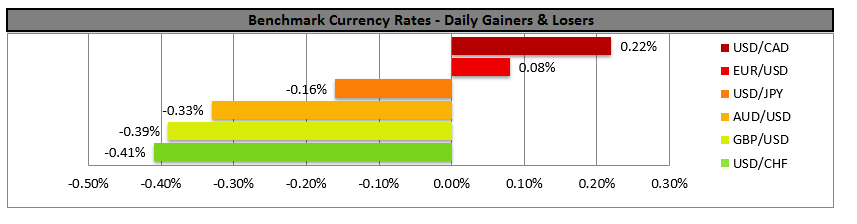
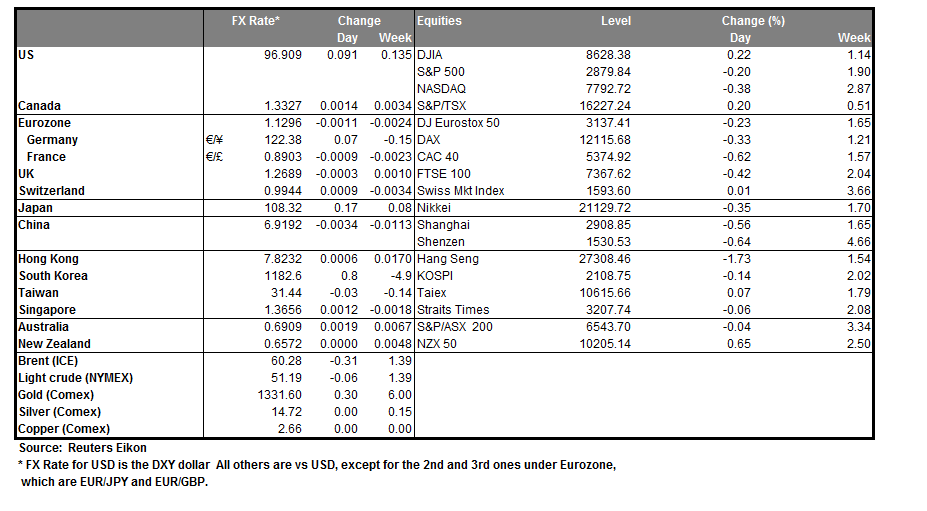
The yen rallied against the risk-sensitive Australian dollar, hitting a 5-month top of 74.77, while against the greenback, it firmed to near a one-week high of 108.15. Trade uncertainty also gave the US dollar broad support even as investors are increasingly confident that the Federal Reserve will cut interest rates in the coming months.
Fed rate cut bets were boosted further yesterday from US inflation data that pointed to weakening price pressures. The annual rate of CPI eased by more than forecast in May, falling to 1.8%. The next big clue for the US economy will come from Friday’s retail sales figures, though a bigger focus for investors is next week’s policy meeting by the Fed on June 18-19.
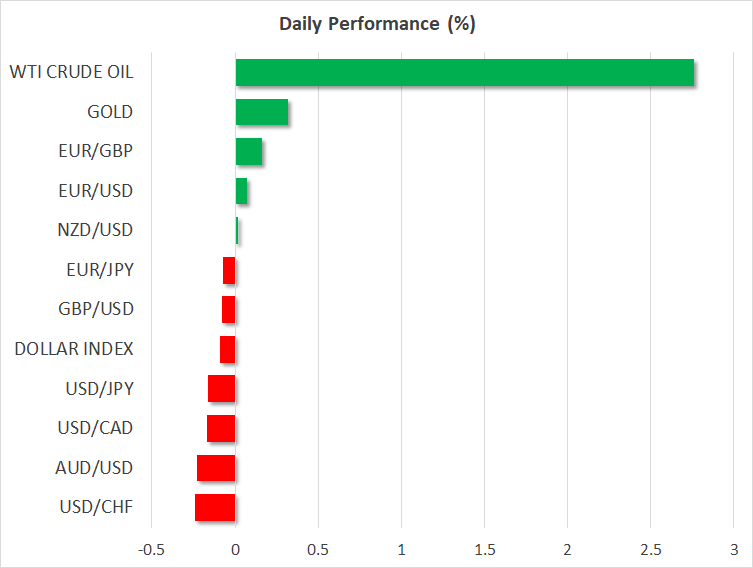
Gold was another beneficiary of the risk-off tone and was last up at $1337 an ounce. The yellow metal is in line for even steeper gains and could attempt to break above $1350 should the Fed next week signal that rate cuts are on the way.
The Swiss franc was another winner today, though its advances were led more by a not-so-dovish SNB at its policy meeting today than safety flows.
Mixed Australian jobs report fails to satisfy aussie bulls
The Australian dollar’s losses weren’t limited to the yen as the aussie slipped across the board, falling to two-week lows against the US dollar just above the $0.69 level. Australia’s jobless rate was unchanged at 5.2% defying expectations of a drop, and while employment rose robustly, the labour force participation rate was also up, pointing to plenty of slack in the labour market and keeping the door open to more rate cuts by the RBA.
Sliding oil prices were a further drag on the aussie as well as on other commodity-linked currencies such as the kiwi and loonie. WTI and Brent crude were both up sharply on Thursday, recovering most of yesterday’s losses when they plunged to 5-month lows that came after there was another big jump in US crude stockpiles. However, with no end in sight to the US-China trade war and slowing growth around the world, the bearish outlook for oil is unlikely to change anytime soon.
Euro steadier, pound slips further as risks loom large
The euro and pound were stuck below key levels on Thursday following yesterday’s declines against the dollar. The single currency’s rebound above $1.13 was cut short after President Trump threatened to impose sanctions on the Russian natural gas pipeline project, Nord Stream 2, which, when completed, would become a major source of energy supply for Germany.
The pound meanwhile remained on the backfoot, having reversed yesterday’s earlier gains to tumble below $1.27 following a failed attempt in the British Parliament by opposition MPs to pass legislation that would block any attempt of a no-deal Brexit. There was some relief, however, when Boris Johnson – the favourite to replace Theresa May as prime minister – said he is “not aiming for a no-deal outcome”. Conservative MPs will today vote in the first round of the elimination process to select their next leader and the results are expected soon after 1200 GMT.