

Sample Category Title
Volatility Continues for New Zealand Dollar
The New Zealand dollar has posted sharp losses in the Monday session. In North American trade, NZD/USD is trading at 0.6615, down 0.74% on the day. In New Zealand, ANZ Commodity Prices slowed to 0.0% in May. In the U.S., unemployment claims rose to 218 thousand, above the estimate of 215 thousand. On Friday, the U.S. releases nonfarm payrolls and wage growth.
The New Zealand dollar enjoyed a banner week, climbing 1.97% last week. This was its strongest weekly gain since mid-November. The kiwi took advantage of a weak U.S. dollar, as investors stayed away after the Federal Reserve hinted that a rate cut could be in the works later this year. The Fed has sounded neutral about its next rate move, but last week’s comments from Powell and FOMC member James Bullard were clear hints that the Fed is leaning to a rate cut. The CME Group has set the odds of a quarter-point cut in July at 67%, as the likelihood a rate cut later this year is growing.
NZD/USD posted strong gains on Friday, after the U.S. posted a very soft nonfarm payrolls report. This was the second dismal release in the past four months. In May, the economy created only 75 thousand jobs, down from 263 thousand a month earlier. Wage growth was unchanged at 0.2%, shy of the estimate of 0.3%. Despite these soft job numbers, the U.S. labor market is in strong shape, and the greenback could quickly bounce back.
Italy Salvini willing to compromise everything to EU except unemployment rate
Italian Deputy Prime Minister Matteo Salvini, leader of the League, expressed his confidence on an agreement with EU over the country's excessive deficit. He comments came ahead of a coalition meeting with another deputy prime minister, Luigi Di Maio of the 5-Star Movement, and Prime Minister Giuseppe Conte.
Salvini said "The last thing we want to do is pick up a fight with Europe ... The only thing I'm not ready to compromise on is the need to reduce Italy's unemployment rate". And, "I believe it is also in Europe's interest to have an Italy that runs and not an Italy that strolls, so I'm convinced that among sensible people an accord can be found."
Trump: Tariffs are a beautiful thing when you have all the money
In a CNBC Squawk Box telephone interview, Trump romanticized tariffs as a "beautiful thing" that countries with money should use. He said "People haven't used tariffs, but tariffs are a beautiful thing when you are the piggy bank, when you have all the money. Everyone is trying to get our money". He also touted boasted that "If we didn't have tariffs we wouldn't have made a deal with Mexico" on migration problem of the US.
He's also confidence that the China trade deal is going to work out "Because of tariffs. Because right now China is getting absolutely decimated by countries that are leaving China, going to other countries, including our own." China is "going to make a deal because they're going to have to make a deal, " Trump added.
Yet, he praised China's system as "the head of the Fed in China is President Xi" and "He can do whatever he wants. They devalue." They loosen". He added, "They devalue their currency. They have for years. It's put them at a tremendous advantage". On the other hand, "we don't have that advantage because we have a Fed that doesn't lower interest rates."
Trump said the Fed "certainly didn't listen to me because they made a big mistake. They raised interest rates far too fast," and he went on to chide them for hiking "the day before a bond issue goes out so we have to pay more money." He certainly believed in a system that central banks work for the countries leader, instead of independently.
British Pound Slips as GDP, Manufacturing Production Shrink
GBP/USD has posted considerable losses in the Monday session. Currently, GBP/USD is trading at 1.2685 down 0.41% on the day. On the release front, British numbers were unexpectedly soft. Monthly GDP dropped 0.4% in April, its second straight decline. There was no relief from Manufacturing Production, which plunged 3.9% in April, much weaker than the forecast of -1.1%. This was the largest decline since June 2002. In the U.S., there are no major events. JOLTS Jobs Orders slowed to 7.45 million, shy of the estimate of 7.50 million. On Tuesday, the U.K. releases wage growth and unemployment rolls, while the U.S. posts Producer Price Index reports.
The pound registered gains of close to 1.0% last week, as the U.S. dollar was broadly lower against the major currencies. Comments from Federal Reserve officials hinting at a rate cut sent the greenback lower. For most of the year, the Fed has sounded neutral about its next rate move, but last week’s U-turn was a dramatic development. Fed chair Jerome Powell said that the Fed would “act as appropriate to sustain the expansion”, and analysts noted that he did not mention his “patient” approach to monetary policy, which has been a buzzword in Powell’s recent comments. Powell’s remarks echoed comments from James Bullard, president of the St. Louis Fed. Bullard stated that the Fed might have to lower rates shortly due to low inflation and the ongoing trade war with China. The CME Group has set the odds of a quarter-point cut in July at 67%, as the likelihood a rate cut later this year is growing.
The U.S. ended the week on a sour note, as nonfarm payrolls posted its second dismal reading in four months. In May, the economy created only 75 thousand jobs, down from 263 thousand a month earlier. Wage growth was unchanged at 0.2%, shy of the estimate of 0.3%. Despite these soft job numbers, the U.S. labor market is in strong shape, and the greenback could quickly bounce back.
USD/ZAR Outlook: Pullback Extends after Strong Upside Rejection
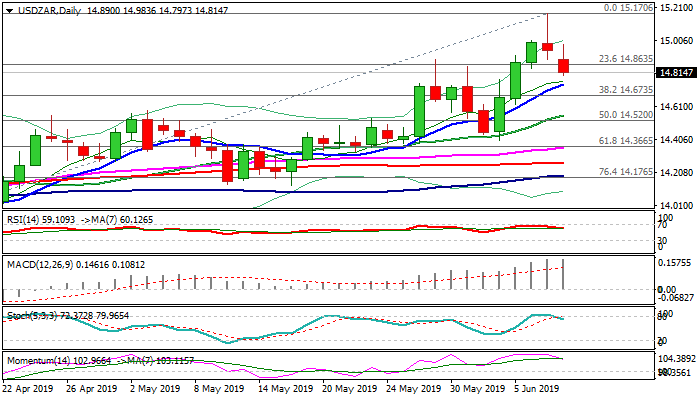
Bulls are losing traction as the price eases for the second day, following strong upside rejection on Friday (spike high was left at 15.17, the highest since early Sep) before quick pullback. Daily stochastic reversed from overbought territory, RSI turned south and weakening momentum is crossing below its 7-d SMA, adding to signals for correction. Overall structure on daily chart is bullish and dips should be ideally contained at 14.70 zone (Fibo 38.2% of 13.86/15.17 rally/rising 10SMA) to guard pivotal rising 20SMA (14.55). Only sustained break below 20SMA would put bulls on hold for deeper correction.
Res: 14.89; 14.98; 15.00; 15.17
Sup: 14.74; 14.67; 14.61; 14.55
EUR/GBP Daily Outlook
Daily Pivots: (S1) 0.8864; (P) 0.8884; (R1) 0.8918; More...
EUR/GBP's rally resumes by breaking 0.8902 temporary top and reaches as high as 0.8929 so far. Intraday bias is back on the upside for 0.9101 key resistance next. On the downside, break of 0.8829 support will turn bias neutral and bring more consolidations first.
In the bigger picture, medium term decline from 0.9305 (2017 high) is seen as a corrective move. No change in this view. Current development argues that it might have completed with three waves down to 0.8472, just ahead of 38.2% retracement of 0.6935 (2015 low) to 0.9306 at 0.8400, after hitting 55 month EMA (now at 0.8526). Decisive break of 0.9101 resistance will confirm this bullish case. Nevertheless, as EUR/GBP is still staying inside long term falling channel, correction from 0.9305 could still extend to 0.8400 fibonacci level before completion, if upside is rejected by 0.9101.
USD/JPY Mid-Day Outlook
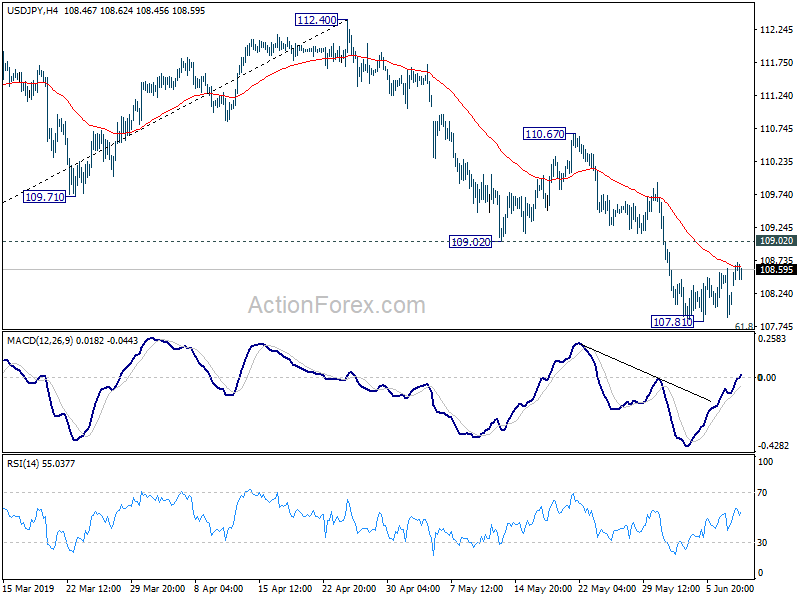
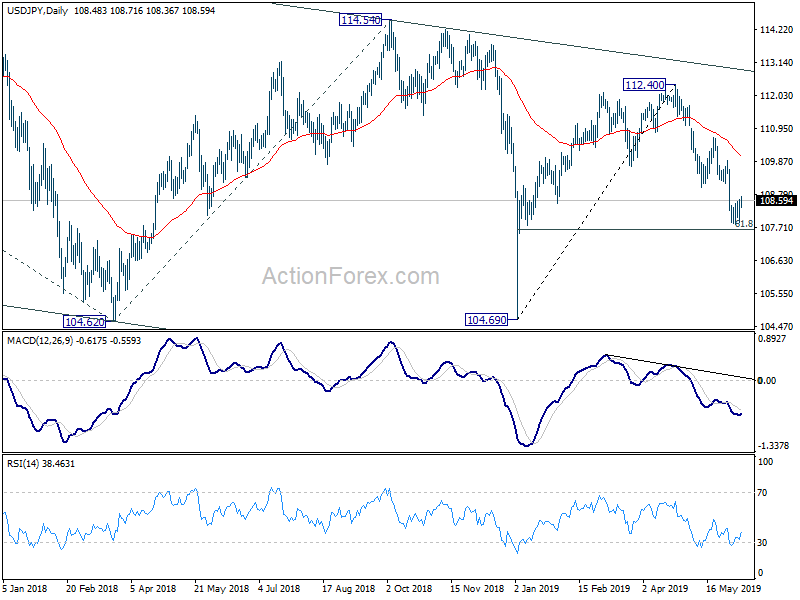
Daily Pivots: (S1) 107.83; (P) 108.22; (R1) 108.59; More...
USD/JPY is staying in consolidation from 107.81 temporary low. Intraday bias remains neutral for the moment. Upside of recovery should be limited by 109.02 support turned resistance to bring fall resumption. On the downside, sustained break of 61.8% retracement of 104.69 to 112.40 at 107.63 will pave the way back to 104.62/9 key support zone. Though, break of 109.02 support turned resistance will indicate short term bottoming and bring lengthier consolidations first.
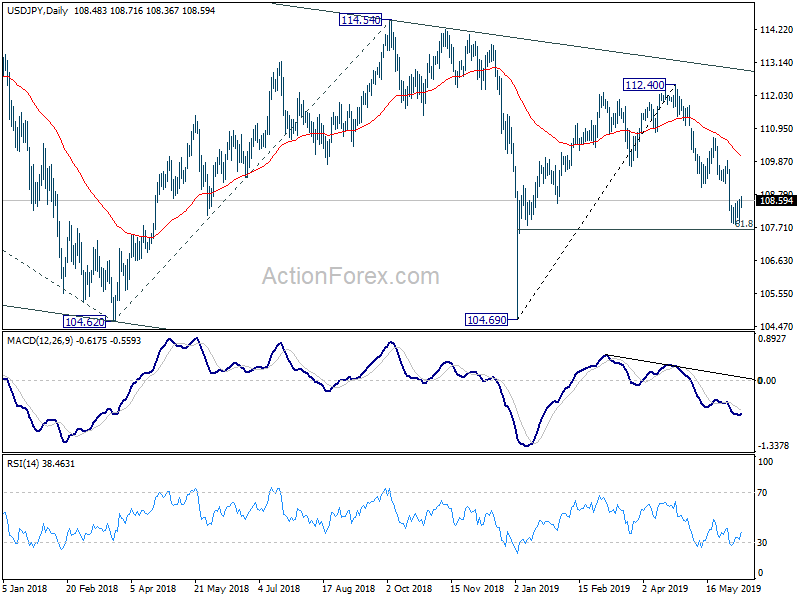
In the bigger picture, decline from 118.65 (Dec 2016) is still in progress, with the pair staying indicate long term falling channel. Break of 104.62 will target 100% projection of 118.65 to 104.62 from 114.54 at 100.51. For now, we'd expect strong support above 98.97 (2016 low) to contain downside to bring rebound.
USD/CHF Mid-Day Outlook
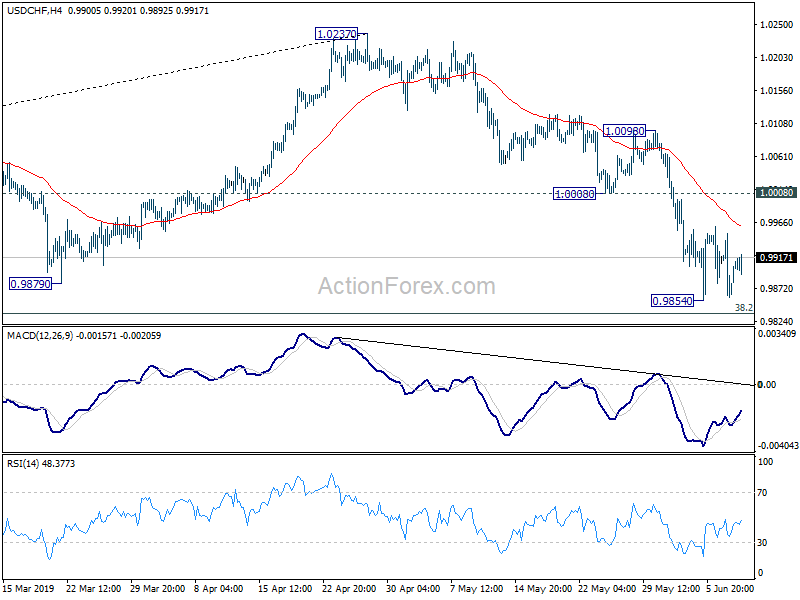
Daily Pivots: (S1) 0.9841; (P) 0.9896; (R1) 0.9933; More...
USD/CHF is staying in consolidation from 0.9854 and intraday bias remains neutral first. Stronger recovery could be seen but upside should be limited by 1.0008 support turned resistance and bring fall resumption. On the downside, break of 0.9854 will extend the decline from 1.0237 to 0.9716 cluster support (50% retracement of 0.9186 to 1.0237 at 0.9712).
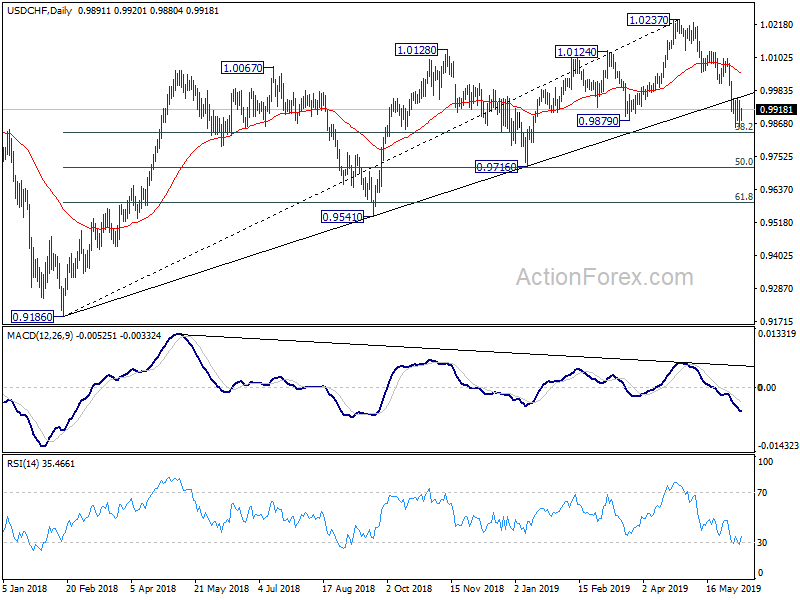
In the bigger picture, USD/CHF's break of long term trend line support is the first indication of medium term reversal. Focus is now back on 0.9879 support. Sustained break should confirm that medium term up trend from 0.9186 has completed at 1.0237 already. Further fall should be seen to 0.9716 cluster support (50% retracement of 0.9186 to 1.0237 at 0.9712) next. Break will target 61.8% retracement at 0.9587.
EUR/USD Mid-Day Outlook
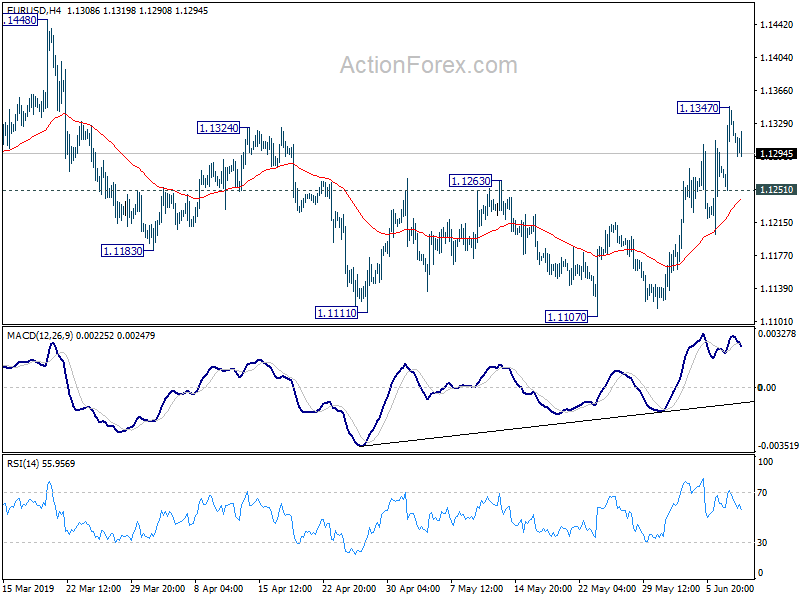
Daily Pivots: (S1) 1.1273; (P) 1.1311; (R1) 1.1370; More.....
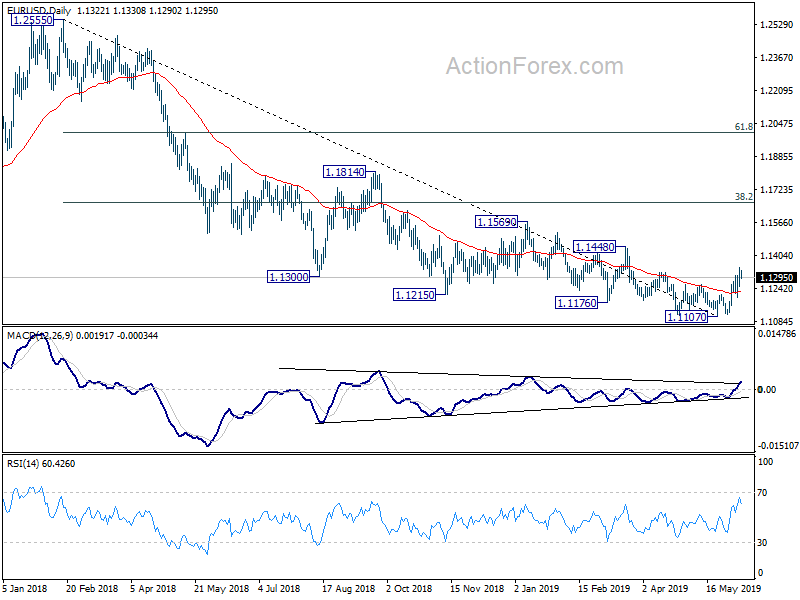
Intraday bias in EUR/USD is turned neutral with 4 hour MACD crossed below signal line. On the downside, break of 1.1251 minor support will suggest that recovery from 1.1107 has completed. Intraday bias will be turned back to the downside for retesting 1.1107 low. On the upside, above 1.1347 will target 1.1148 key resistance next. Decisive break there will carry larger bullish implications.
In the bigger picture, current development argues that a medium term bottom could be in place at 1.1107, on bullish convergence condition in daily MACD. Decisive break of 1.1448 resistance would confirm this case. And stronger rebound would be seen to 38.2% retracement of 1.2555 to 1.1107 at 1.1660. At this point, it's early to judge whether rise from 1.1107 is a corrective move or the start of an medium term up trend. We'd look at the structure of the rebound to decide later. But in any case, for now, risk will remain on the upside as long as 1.1107 low holds.
Canadian Housing Starts Trend Easing Toward the 200k Mark
- Canadian housing starts were close to expectations, falling to 202k annualized units in May from 233k in April
- The six-month trend was also 202k, which is the slowest pace in more than two years
- May’s pullback was concentrated in multi-unit starts though the trend in that component remains solid
- Starts fell sharply in Ontario to retrace a significant increase in the previous month
- A separate report saw building permits jump to their highest level since 2005, largely due to a surge in BC ahead of an increase in development costs in Vancouver
Homebuilding has picked up in the current quarter after wintry weather held starts to a four-year low in Q1. But even with stronger activity in the last two months, starts are tracking around 200k year-to-date, short of the 213k and 220k pace in 2018 and 2017, respectively. This moderation has lagged a much more significant slowdown on the home resale side. It’s not surprising that starts have held up fairly well given the supply shortages in several major markets that have hurt affordability. We expect starts will continue to slow gradually as the year progresses, albeit remaining at fairly solid levels thanks to ongoing strength in the multi-unit segment.