Sample Category Title
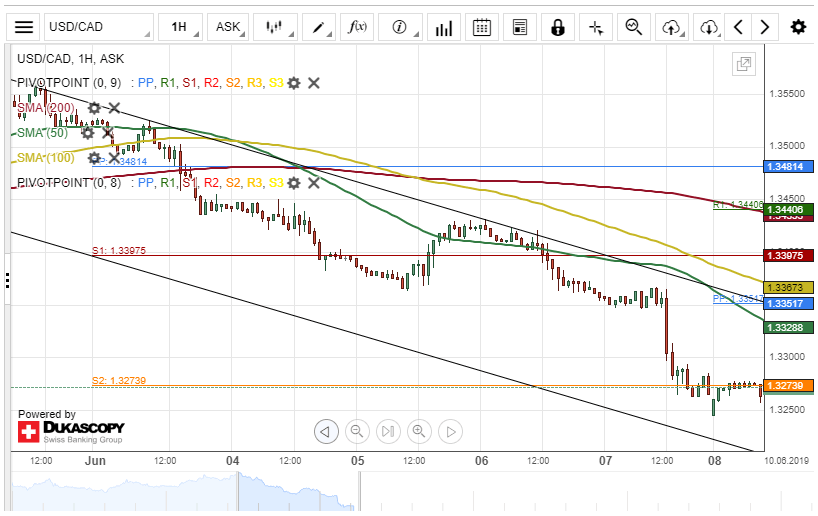
USD/CAD Might Aim For 50-Hour SMA
The US Dollar depreciated about 103 base points against the Canadian Dollar on Friday. The decline was stopped by a support level formed by the monthly S2 at 1.3273 at the end of Friday's trading session.
Everything being equal, it is likely that the USD/CAD currency pair will make a brief retracement towards a resistance cluster formed by the combination of the 50-hour simple moving average and the weekly pivot point at 1.3351 during the following trading session.
However, technical indicators flash sell signals on both the smaller and the larger time-frame charts.
NZD/USD Breakout Occurs
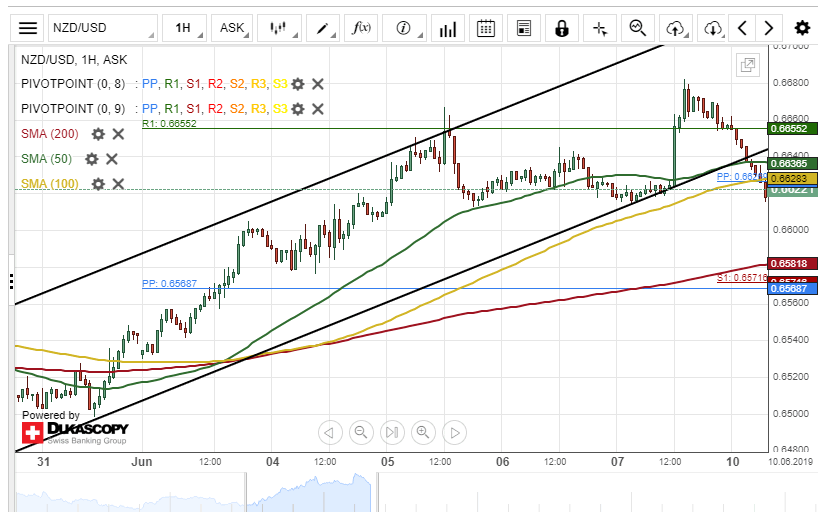
The New Zealand Dollar appreciated about 0.97% in value against the US Dollar on Friday. The 50-hour simple moving average provided support for the currency pair at 0.6627.
However, today's trading session began with a bearish sentiment. By the middle of the trading day, a breakout occurred through the lower boundary of an ascending channel pattern.
Given that a breakout had occurred, it is likely that the NZD/USD currency exchange rate will aim for a support level formed by the 200-hour SMA at 0.6580 during the following trading session.
Italy PM Conte: EU’s EDP would compromise our economic sovereignty
Italian Prime Minister Giuseppe Conte warned of the long lasting impact of EU's "Excessive Deficit Procedures" in a Corriere della Sera interview.
He said if the EDP is opened, it's "not just a question of a fine". Italy will be " subjected to checks and checks for years... compromising our sovereignty in the economic field".
And, the result could "put the savings of Italians at risk."
Dollar Bounces Back From Soft Jobs Report On Mexico-US Migrant Deal
- Risk appetite recovers after US unexpectedly suspends planned tariffs on Mexico indefinitely
- US dollar and global stocks boosted but Fed rate cut bets remain high following weak NFP report
- Disappointing Chinese data also limits risk-on as yuan hits fresh 2019 lows
Markets lifted by surprise US and Mexico deal
It was a positive start to trading on Monday as markets were greeted by some rare good news. President Trump unexpectedly suspended tariffs on all Mexican imports indefinitely late on Friday as a deal with Mexico was struck to resolve the dispute over illegal migrants crossing into the US. Tariffs of 5% were due to come into force today, in what would have been a major escalation of Trump’s trade war with the rest of the world.
Relief in equity markets over the deal was evident with most Asian indices closing 1% higher, while US and European stock futures were pointing to solid gains at the start of Monday trading.
The positive trade developments raised hopes that the US and China would also be able to reach some kind of an agreement soon that would end their increasingly bitter tariff dispute. Data released earlier today showed the Chinese economy continuing to take a hit from the ongoing trade uncertainty. Imports into China plunged by a greater-than-expected 8.5% annually in May, in a possible sign of weakening domestic demand. Exports, meanwhile, posted a surprise 1.1% annual gain, though this was suspected to be mainly due to front loading of shipments ahead of the latest wave of US tariffs.
Dollar up, yuan down
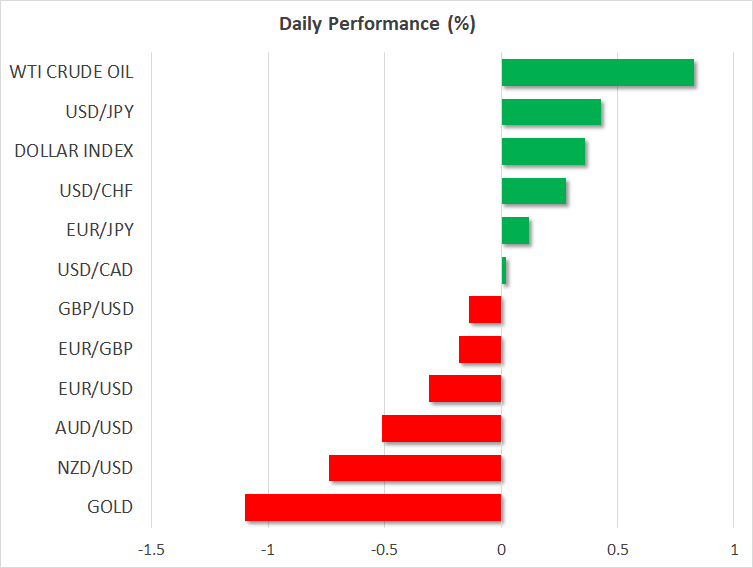
The US dollar rose across the board on Monday, recouping some of its sharp losses from Friday when it plummeted following a worryingly soft jobs report. Nonfarm payrolls in the US rose by just 75k in May, missing expectations of 185k by a wide margin. Wage growth disappointed too, with the annual rate easing to 3.1%. Expectations that the Fed would cut rates as early as July surged after the data, sending the dollar index to 2½-month lows.
However, although investors continue to anticipate a Fed rate cut soon, the easing trade tensions helped US Treasury yields recover from the depths of Friday’s multi-month lows, which in turn lifted the greenback. Dollar/yen was last trading around a one-week high of 108.65.
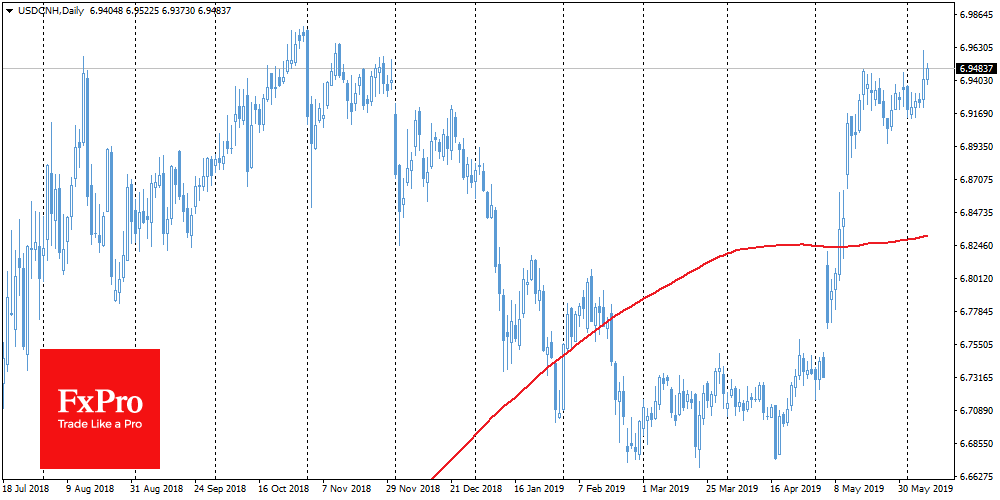
In contrast, the Chinese yuan plumbed to its lowest level this year, hitting a 6-month low of 6.9352 per dollar in onshore trade. Aside from fears of a slowing economy, the yuan is under pressure from comments by the Governor of the People’s Bank of China, who on Friday played down the significance of the 7-yuan level, suggesting the central bank could let the currency slide beyond this psychologically important mark.
But even if the PBOC is less concerned about defending the yuan, a weaker exchange rate would likely catch the attention of the Trump administration, which has long been accusing China of currency manipulation. As US and Chinese relations go through a critical phase, the stakes are high ahead of the G20 summit in Japan later this month when it’s hoped Trump and Xi will be able to meet on the sidelines to end the stalemate in stalled talks.
Euro eases from highs, pound looks to UK data
The euro scaled a 2½-month of $1.1347 on Friday as the dollar sell-off and a not-so-dovish ECB meeting bolstered the single currency. However, the euro was feeling the heat on Monday as two separate reports yesterday and today suggested the ECB may be closer to cutting rates than it indicated at the policy meeting last Thursday. According to one report from Reuters, sources from the ECB are saying a rate cut “is warranted” if growth and inflation slow further.
The euro slipped back below the $1.13 on those reports, while the pound was once again testing the $1.27 level. The Conservative leadership race formally begins in the UK today, with hard-line Brexiteer Boris Johnson still the front runner. But with the selection process expected to last until late July, the immediate focus for the pound will be on monthly GDP and industrial output figures out of the UK today, amid signs of slowing growth.
In commodities, gold was also under pressure from the rebound in the dollar, with the precious metal retreating from more than one-year highs to around $1325 an ounce on Monday. However, oil prices advanced higher for a third day after Saudi Arabia’s energy minister said OPEC and Russia were close to agreeing an extension to the output cuts after the current deal ends at the end of June.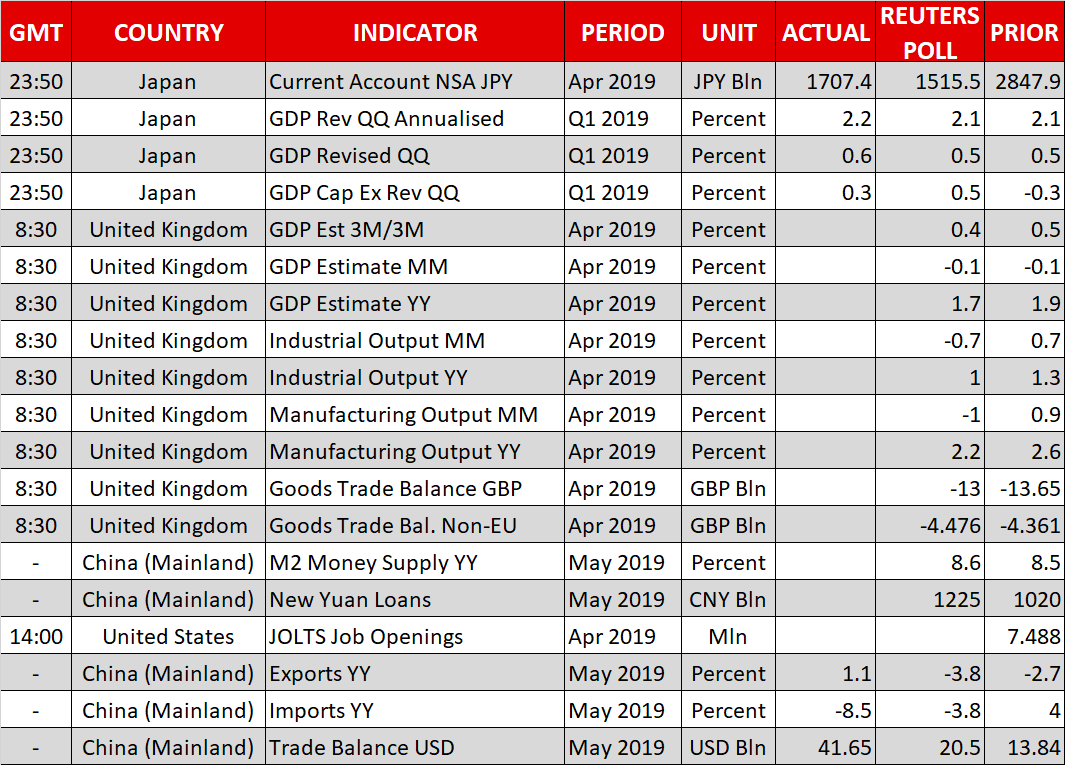
Gold Turns Overbought Near Former Key Resistance
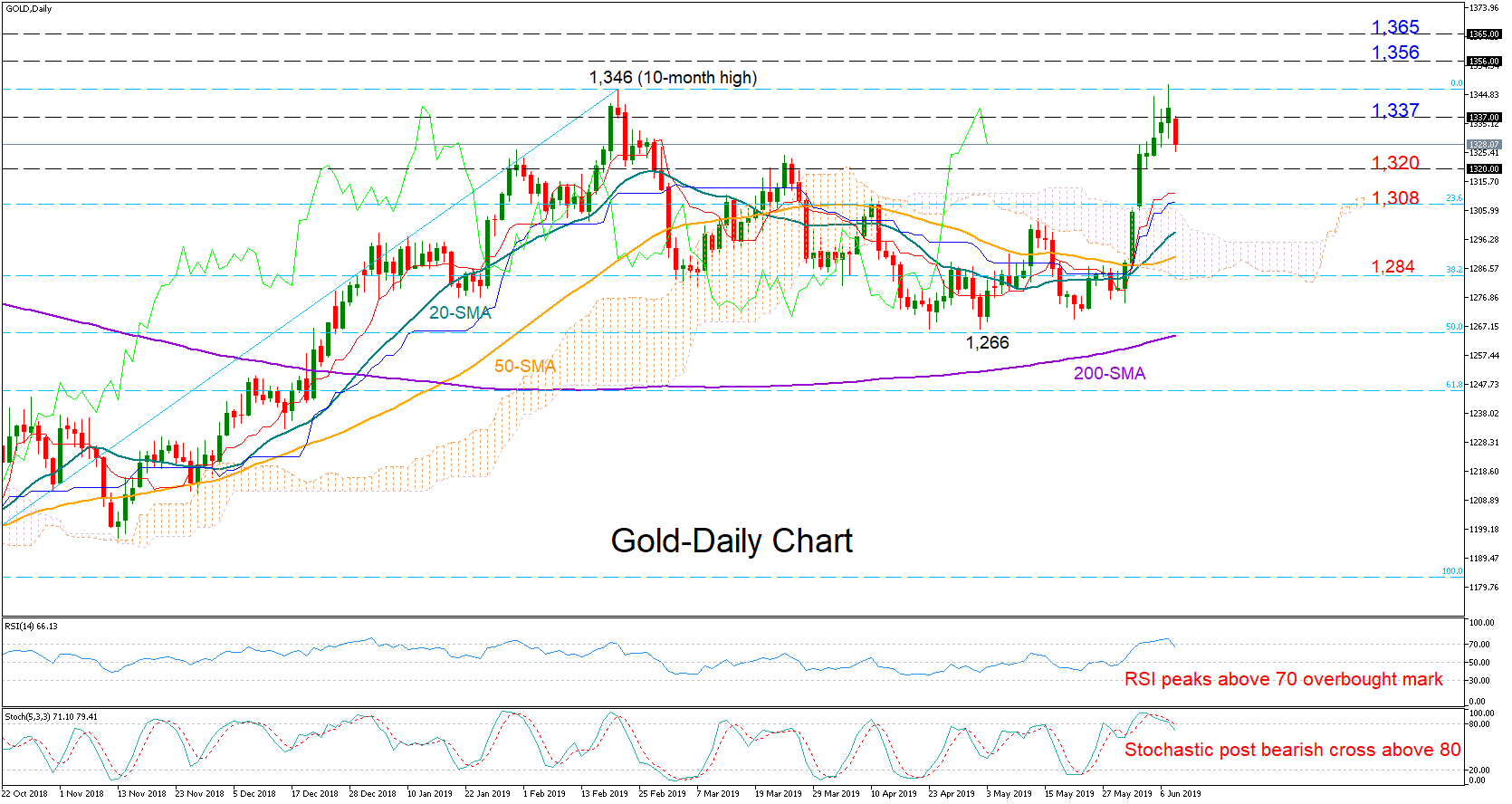
Gold recorded its best weekly performance so far this year, topping near a former key resistance of 1,346 on Friday. The RSI and the Stochastics, however, indicated that the bulls are exhausted as the measures peaked in overbought territory – letting the bears take over on Monday. Yet, with the 20-day simple moving average (SMA) increasing its distance above the 50-day SMA, the positive market trend may likely extend forward in the short-term.
Should the market close comfortably below the 1,320 level, the bearish action may extend towards the upper surface of the Ichimoku cloud and the 23.6% Fibonacci of the long uptrend from 1,183 to 1346 – near 1,308. Another step lower, could open the door for the 38.2% Fibonacci of 1,283.95.
In case of a rebound, today’s high of 1,337 could provide immediate resistance, while higher, the bulls will find it harder to clear the 1,346 top. Breaking that wall, the price may pause around the 1,356 barrier before an even more challenging battle starts at 1,365. The latter level has not been breached since 2013.
Meanwhile in the medium-term timeframe, conditions are still neutral, with the price ranging within the 1,346-1,266 area. The reversal in the 50-day SMA suggests that a bear market is not yet a serious threat.
In brief, the risk is skewed to the downside in the short-term as the market is currently looking overbought, while in the medium-term, the outlook remains neutral.
GBPAUD Hovers Near Lower Boundary Of Trading Range
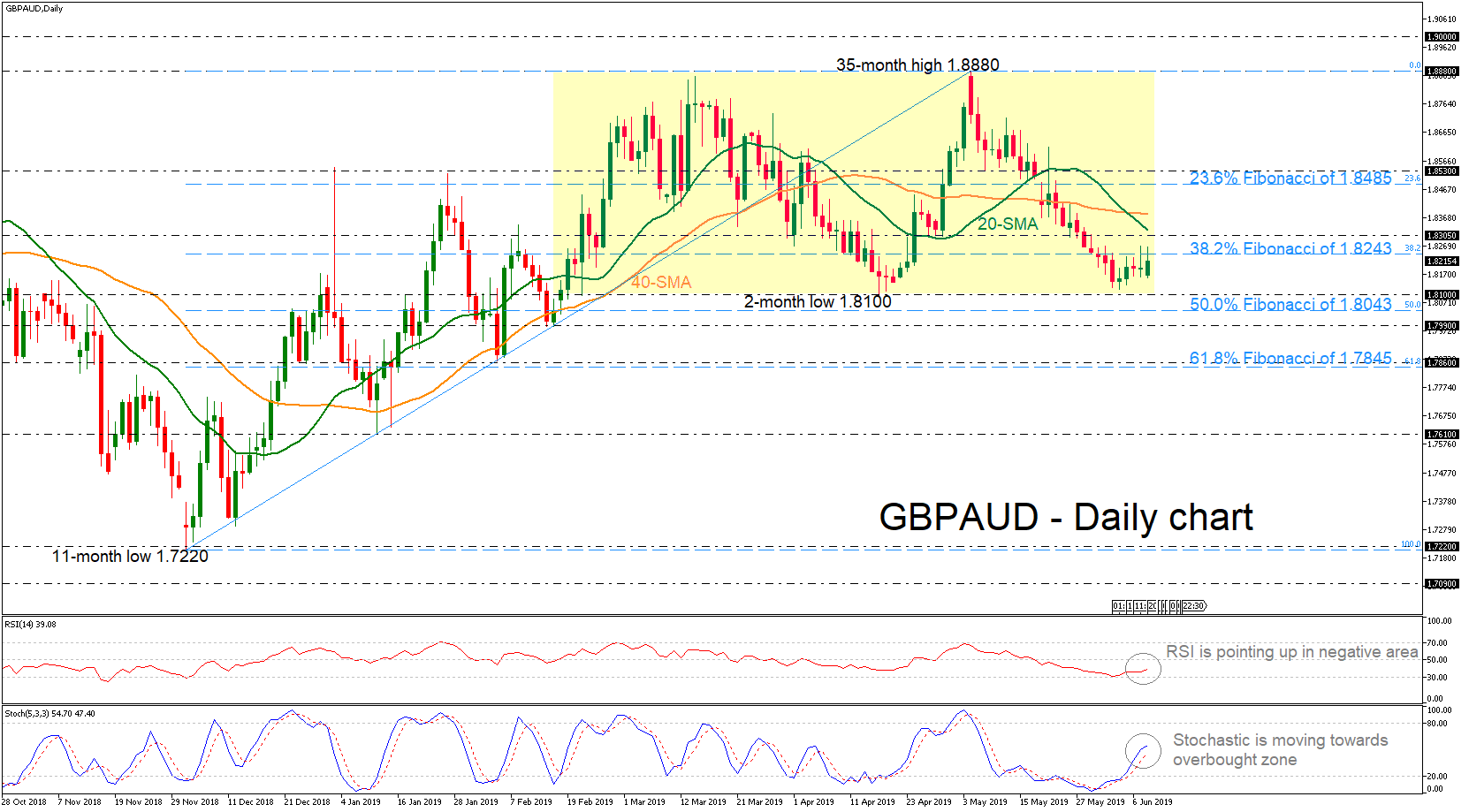
GBPAUD has been trading in a consolidation area since February 19, with upper boundary the 35-month high of 1.8880 and lower boundary the two-month low of 1.8100. Currently, the price is edging slightly higher, with the short-term momentum indicators signaling a bullish bias. The RSI is pointing up in the negative territory, while the stochastic is moving towards the overbought area.
The 20-day simple moving average (SMA) near the 1.8305 resistance could halt upside movements ahead of the 40-day SMA at 1.8385. Crossing above this area, the buying interest could turn more aggressive, with the bulls probably targeting the 23.6% Fibonacci retracement level of the upleg from 1.7220 to 1.8880 near 1.8485.
Should the market change direction to the downside, support could initially emerge between 1.8100-1.8043, which overlaps with the 50.0% Fibonacci. Even lower, a rally lower could find an obstacle at the 1.7990 region.
Concluding, investors should wait to see a drop below 1.8100 for bearish actions or a climb above 1.8880 for bullish orders.
GBP/USD Outlook: Pound Eases After Downbeat UK Data And Eyes Key 10SMA Support
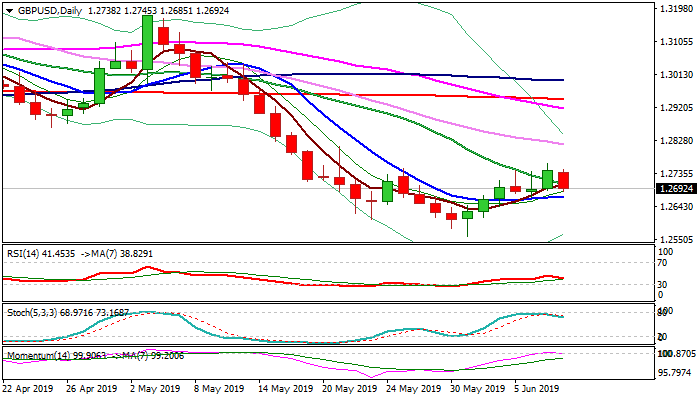
Cable accelerated lower after weaker than expected UK data, extending pullback from Friday’s post-US jobs data rally high at 1.2762.
Disappointing data (GDP -0.4% vs -0.1% f/c, IP Apr -2.7% vs -0.7% f/c, MP Apr -3.9% vs -1.1% f/c) add to existing pressure on Brexit concerns and race for new UK Prime Minister, as well as fresh dollar’s strength on relief news about US/Mexico trade conflict.
Fresh weakness returns below broken 20SMA (1.2704), increasing risk of deeper pullback and signal that corrective leg from 1.2559 low might be over.
The notion is supported by south-reversing daily momentum and stochastic, with sideways-moving 10SMA (1.2668) marking pivotal support, close blow which would generate stronger bearish signal.
Hopes of fresh upside attempts would stay alive while the price holds above 10SMA, but catalyst will be needed to spark bullish action.
Res: 1.2704, 1.2745, 1.2762, 1.2796
Sup: 1.2685, 1.2668, 1.2610, 1.2580
EUR/USD Outlook: Bulls Are Re-Positioning For Fresh Upside, Daily Cloud Top Marks Key Support
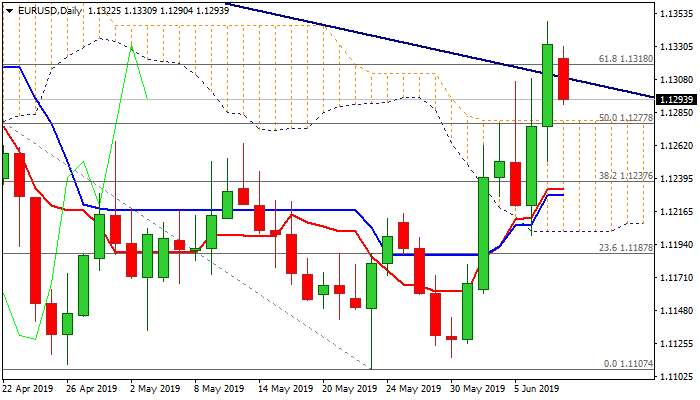
The Euro stands at the back foot in early Monday's trading and probes below 1.13 handle, on easing from new 2 1/2 month high at 1.1347. Traders took profit from strong Thu/Fri 1% rally, as weak US jobs data on Friday sent dollar lower and further boosted Euro. News that US and Mexico reached deal to avoid tariffs on Mexican goods, lifted dollar on Monday, offsetting partially negative impact from downbeat jobs data. The pair generated strong bullish signals from Friday's rally that eventually broke and closed above daily cloud top and extension higher that resulted in close above pivotal barriers at 1.1308/18/23 (trendline resistance / Fibo 61.8% of 1.1448/1.1107/mid-Apr lower platform). Current pullback could be seen as positioning for fresh advance (as bulls eye key 200SMA barrier at 1.1367) if broken pivotal barriers, now strong supports, at 1.1279/74 (daily cloud top/100SMA) hold dips. Daily MA bull-crosses (5/100 and 10/55SMA's) underpin and support scenario. On the other side, extension and close below cloud top / 100SMA would weaken near-term structure and risk deeper pullback.
Res: 1.1309, 1.1318, 1.1347, 1.1367
Sup: 1.1279, 1.1274, 1.1259, 1.1231
Weak Dollar And Strong Markets After The Unexpected Nonfarm Payrolls
At the weekend Mexico and the United States announced the deal on a trade and migration. This news triggered a 2% spike in the Mexican peso to 19.13 at one point, to levels that preceded the sudden announcement of the imminent introduction of tariffs on Mexican imports. Positive news from the trading front supported the growth of the markets at the start of the week. However, another front — the Chinese — cannot yet boast such a success. The Chinese yuan updates the lows of the year, reaching 6.96 at the end of last week and staying at 6.95 on Monday morning. Now all investors' attention again turned to disputes between China and the United States, and markets are hoping for a breakthrough in negotiations after Trump and Xi Jinping meet on the G20 (June 28-29).
Stocks
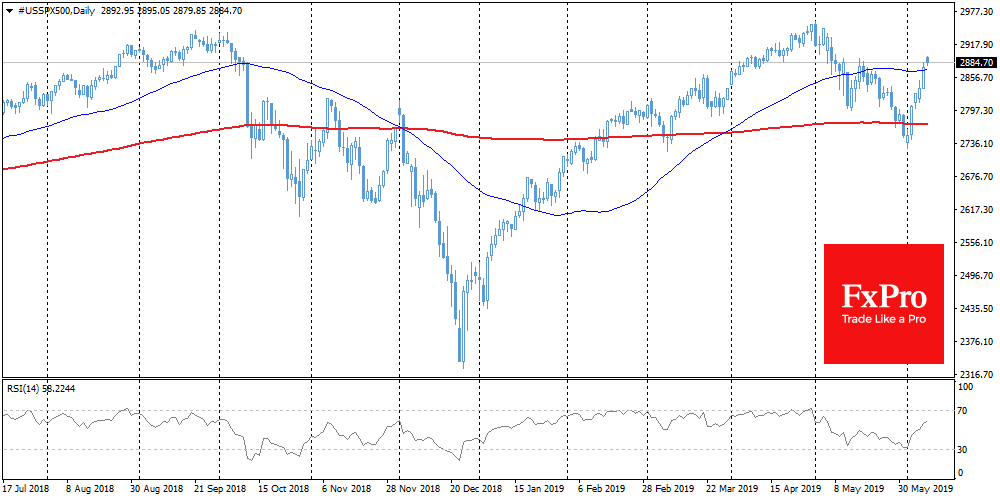
Stocks are rising at the start of trading on Monday. Purchases are supported by a number of factors, from expectations of the world central banks softening of the policies and trade negotiations to investor interest in stocks after the sale in May. The technical picture on SPX is still in favour of the bulls: the index received support after falling below the 200-day moving average. The index is once again enjoying a growth momentum on the news of the US and Mexico deal after closing Friday above MA50. In addition, Friday's labour market data in the US only increased the pressure on the dollar and spurred speculation about the Fed’s imminent cut of interest rates.
EURUSD
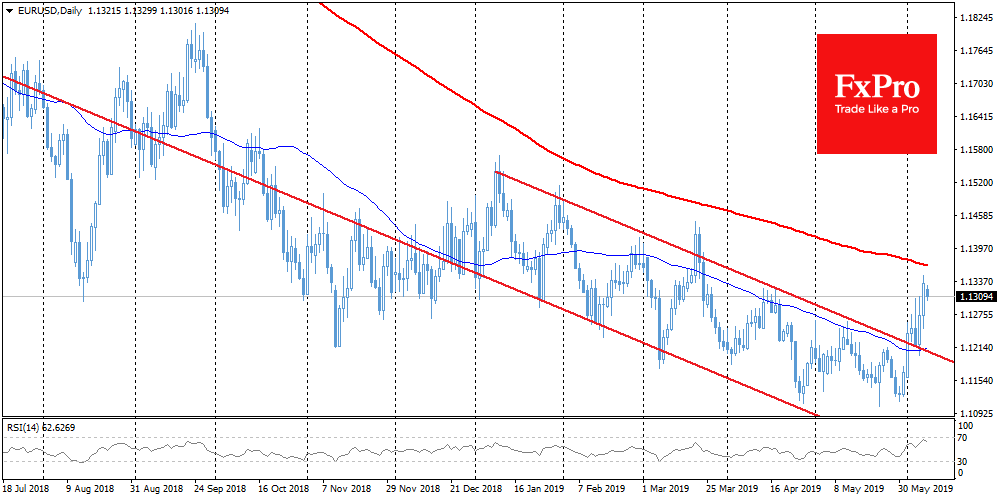
Extremely weak payrolls in the United States (an increase by just 75K against the expected 180K) increased expectations that the Fed will cut rates as early as in June. At the same time, on the eve, the position of the ECB was regarded by investors as less dovish, which caused the strengthening of EURUSD. The pair trades around 1.1300 at the start of trading on Monday after touching 1.1340 on Friday. The pair has already confirmed the breakdown of the downward trend and tried to break through the significant resistance at 1.1300. The next test for the pair may be the level of the 200-day moving average at 1.1369. The intersection of this line is often accompanied by the joining of big capital to the trend, forming a tendency for several months. In this case, EURUSD is quite capable of turning to growth in the region of 1.1500 (round level near the highs of the year) or higher - 1.1700, where there was consolidation in Q3 2018.
Gold
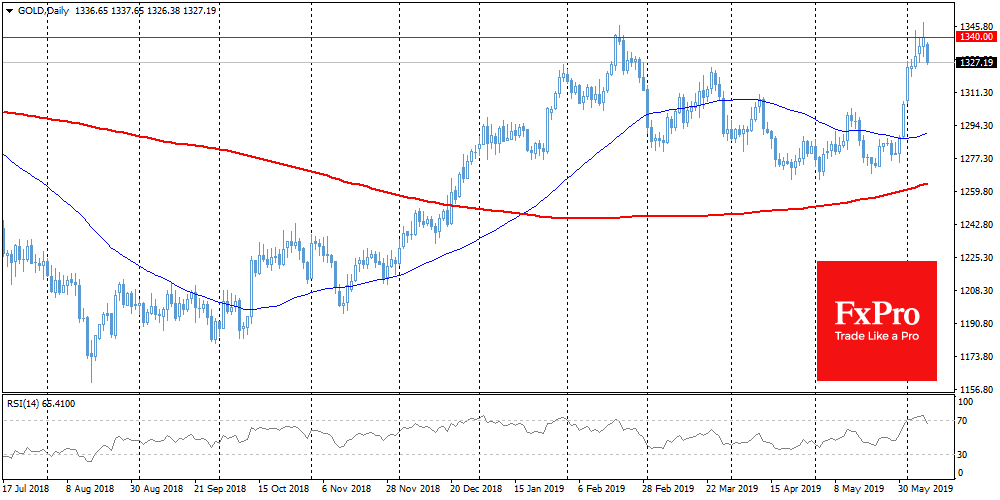
The weakening of the dollar at the end of last week supported gold. As a result, the price of this metal has updated the annual highs at 1348. Nevertheless, the Friday impulse looks more like the final chord of the previous rally. Gold attracted buyers at the end of May due to the global flight from risky assets and sales on stock exchanges. But at the beginning of June, stocks were actively growing, launching a wave of profit-taking on gold. In the coming days, it will not be surprising to see a decline in the precious metal that has lost its main growth driver.
USD/CNY
Chinese yuan updates the minimum of the year against the US currency. This price dynamic is clearly out of the general direction of the markets where the dollar retreated last week. USDCNY stabilized at the end of last month, but spiked on Friday, touching 6.96. The last time we saw such high levels at the end of last year, when investors were selling the yuan, pricing in a quick increase in tariffs for Chinese goods. It is important that this was on the eve of the meeting of Trump and Xi in Buenos Aires, after which a truce was announced. Markets returned the yuan to the same point. The weakening of the Chinese currency should not be liked either by China (as it provokes the outflow from financial markets), or the USA (as it increases the competitiveness of local goods). It is possible that the weakening of the yuan will be a sufficient impetus for both sides to soften the mutual rhetoric in the trade disputes that have been going on for more than a year.
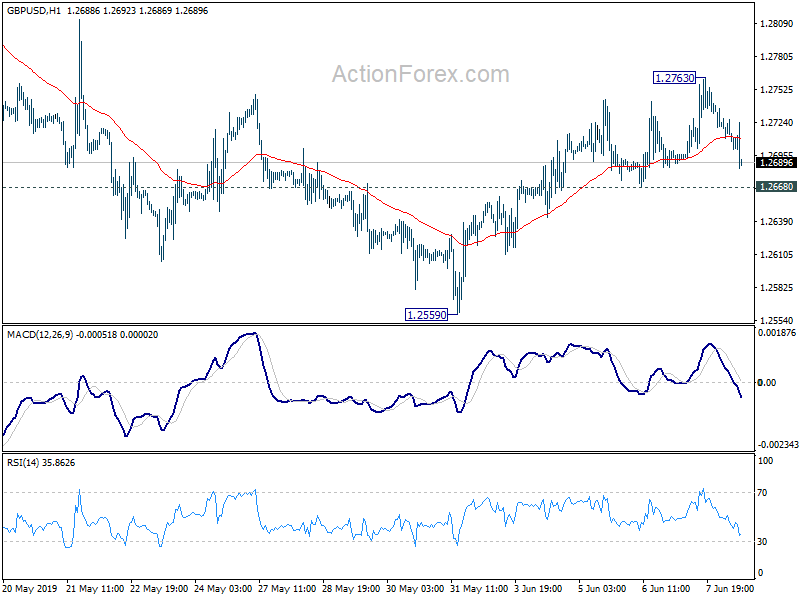
UK manufacturing contracts most since 2002, GBP/USD eyes 1.2668 minor support
In April, UK industrial production dropped -2.7% mom, -1.0% yoy, much worse than expectation of -1.0% mom, 0.9% yoy. Manufacturing production dropped -3.9% mom, -0.% yoy, also way below expectation of -1.4% mom, 2.0% yoy. The contraction in manufacturing sector was the worst since June 2002 and the impact of Golden jubilee shutdowns. Also from UK, visible trade deficit narrowed to GBP -12.1B in April versus expectation of GBP -13.1B.
GBP/USD dips notably after the data releases. Focus is immediately back on 1.2668 minor support. Break will indicate completion of the corrective rebound from 1.2559. Further decline would then be seen back to retest 1.2559.