

Sample Category Title
Dollar in Steep Decline… Before Trump Drops Mexico Tariffs
Dollar weakness was the main theme over the whole week. It started with worries over Trump's tariff threats to Mexico. Then Fed officials came out acknowledging the risks from Trump's tariff policies and signaled their openness to rate cuts should trade tensions worsen. Selling reached its peak after poor non-farm payroll report which gives a nod to monetary easing. However, the situation had an about turn, after market, when Trump declared that the tariffs on Mexico would be "indefinitely suspended" as a so-called "agreement" was made. So, the question is, are Fed officials now less worried? Or are they more worried by such high level of uncertainty? Anyway, a whole new world is possibly lying ahead for the greenback this week.
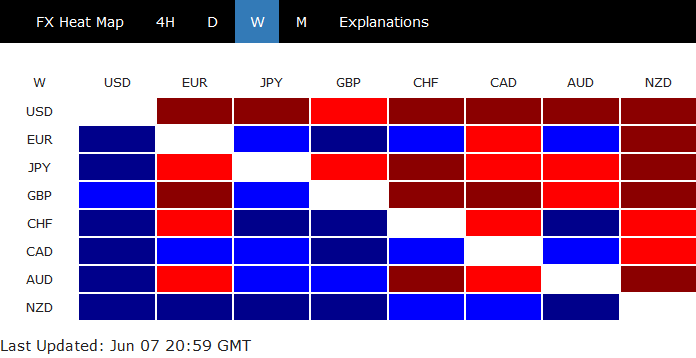
Over the week, Dollar was undoubtedly the weakest one. Yen followed as the second weakest. Major treasury yields dropped, with German 10-year bund hitting new record low. But Yen chose to follow surging stocks on Fed cut speculations. Sterling was the third weakest, saying farewell to UK Prime Minister Theresa May. New Zealand Dollar was the strongest one. Canadian Dollar was initially pressured by free falling oil prices, but then rebounded on stellar job report to close as second strongest. BoC is few of those who's less likely to cut rates. Euro was the third strongest after less dovish than expected ECB announcement. Aussie was mixed only after RBA rate cut.
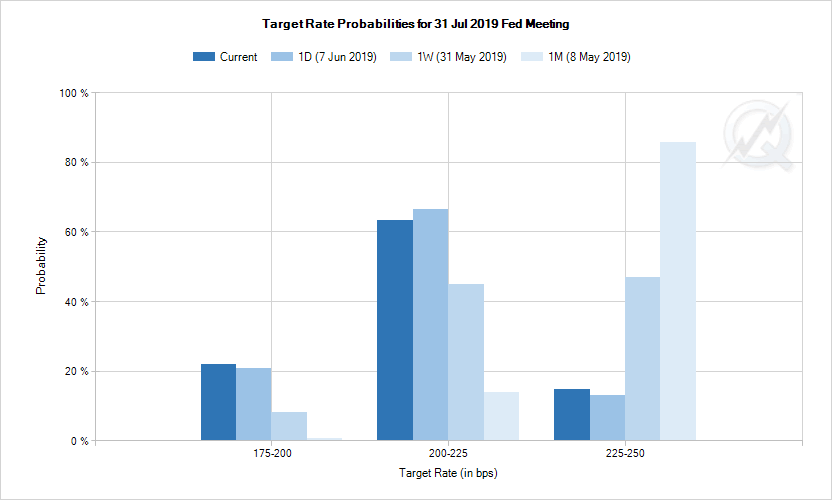
Speculations on Fed rate cut intensified drastically
Market speculations on Fed rate cuts intensified drastically last week. A key reason behind was Fed officials' acknowledgement of risks from trade tensions, and their openness to rate cuts. Another factor was the poor non-farm payroll report, which showed only 75k growth in May, added to worries of slowdown in the economy.
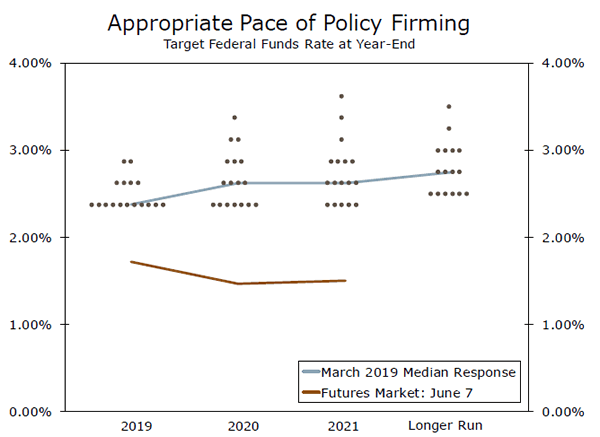
Fed funds futures are now pricing 85.2% chance of rate cut by July meeting. That compares to 53.1% chance a week ago and just 14.4% a month ago.
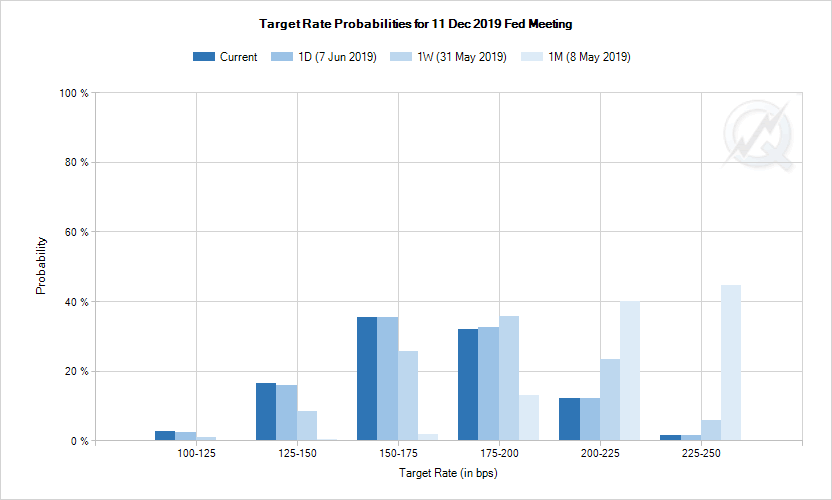
By December meeting, it's now at 86.4% chance that Fed will cut twice to 1.75-2.00%. A month ago, there was 84.8% chance that federal funds rate would be at 2.00-2.50%, that is at most one cut.
Fed officials signaled openness to insurance rate cut, but is that necessary?
However, to us, the markets were overly dovish on Fed. St. Louis Fed President James Bullard was the only one calling for a rate cut to provide "insurance" for "sharper-than-expected slowdown" as "global trade uncertainties have become more severe." Chair Jerome Powell, Vice Chair Richard Clarida and Governor Lael Brainard just indicated they were ready to act on the implications of the developments in trade tensions. Chicago Fed President Charles Evans maintained that "our current setting has been appropriate".
The most thoughtful one was Dallas Fed President Robert Kaplan's. He noted "I want to take a little bit more time and be patient here, because some of these recent events could be reversed… Worth being cognizant of the fact that these recent tensions have just elevated in the last five, six weeks… And in the next five, six weeks, a number of them could be alleviated."
Kaplan was right that in just a matter of days, threats of tariffs on Mexico vanished. With the experience of the the market volatility after Trump's suddenly announcement of the tariffs on Mexico, would he still go ahead with tariffs on all untaxed USD 300B Chinese imports? If not, then there is is probably no more urgency for Fed to have those insurance cuts. Business confidence and investment will come back to the US if policies are not that erratic.
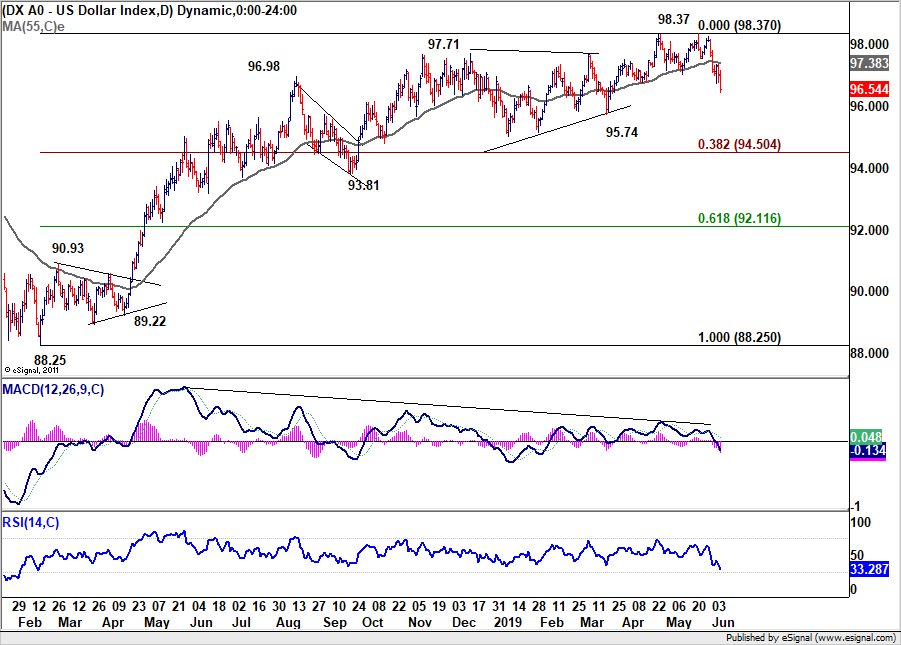
Dollar index confirmed medium term topping, but not reversal yet
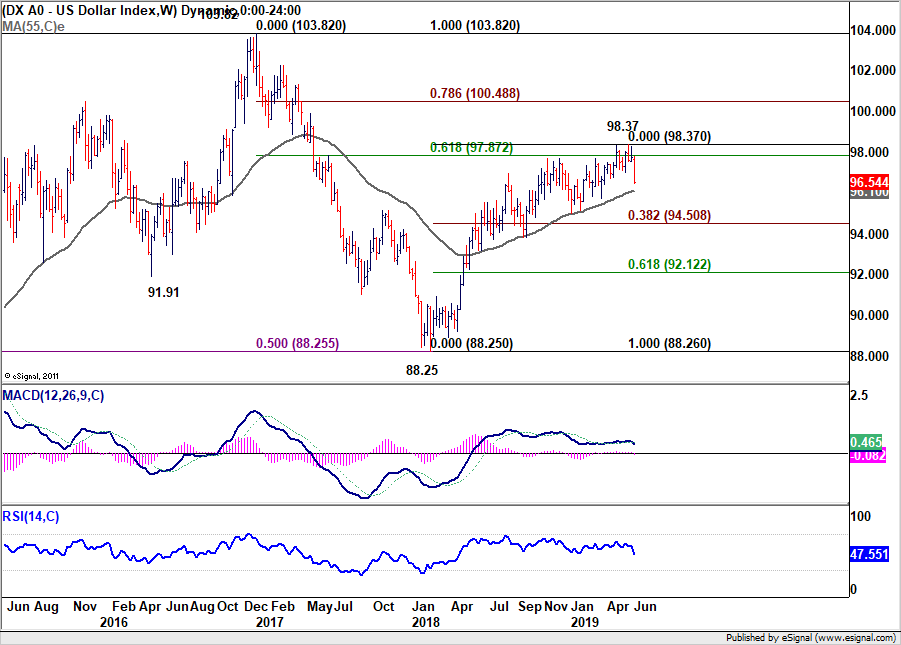
Dollar index's strong break of 97.20 support now serves as an important sign of medium term topping at 98.37, on bearish divergence condition in daily MACD. Some support could be seen from 55 week EMA (now at 96.10) to bring recovery. But risk will stay on the downside as long as 55 day EMA (now at 97.38) holds. Dollar index could gyrate towards 38.2% retracement of 88.25 to 98.37 at 94.50. We'd look at the structure of the fall to assess whether it's just a correction or a change in trend at a later stage.
10-year yield pressing key support level, recovery due
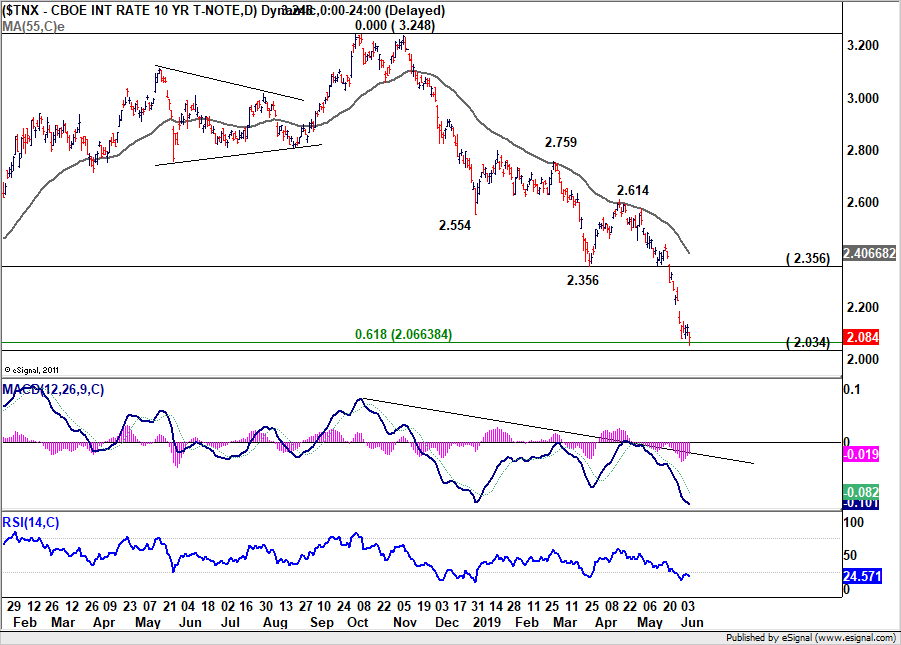
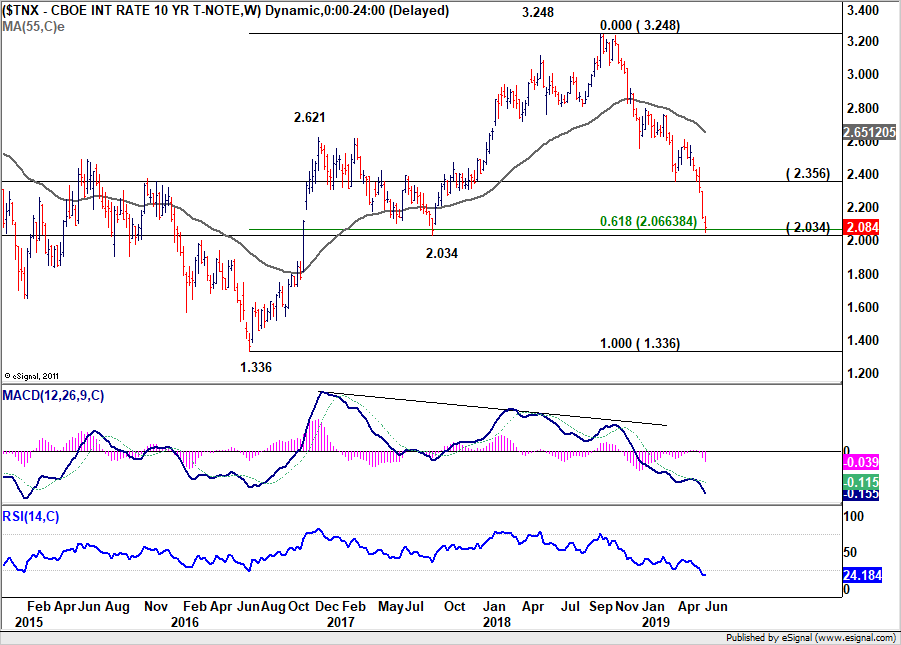
10-year yield extended recent down trend last week and breached 61.8% retracement of 1.336 to 3.248 at 2.066 before closing at 2.084. We'd maintain that 2.034/066 is an important support zone that should hold at least on first attempt. A recovery is likely due that could help Dollar stabilizing. However, break of 2.356 support turned resistance is needed to indicate bottoming. Otherwise, further decline would remain in favor. The next fall could send TNX through 2.0 psychological level.
DOW looks on track to new high, but...
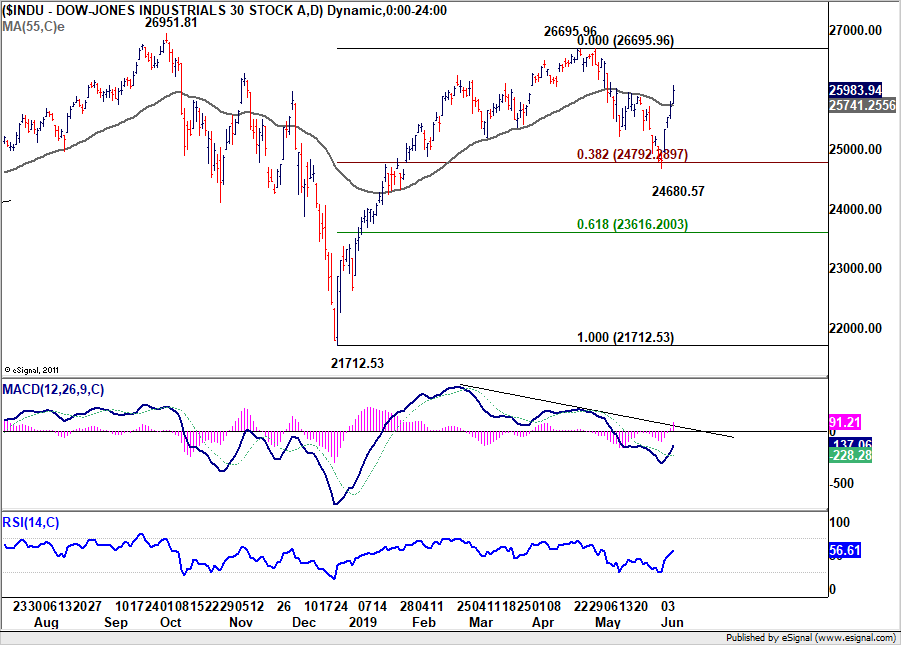
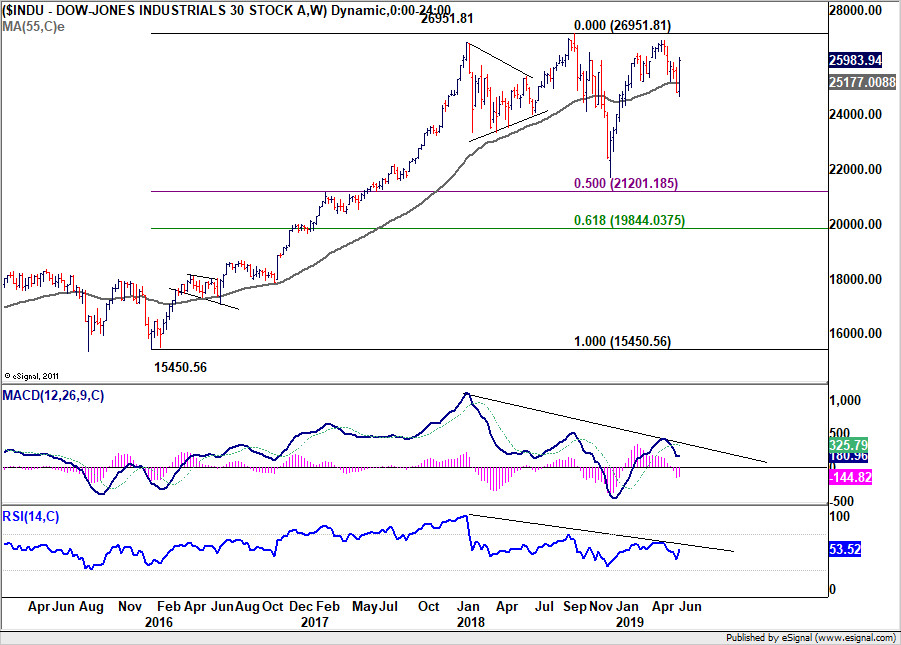
After edging lower to 24680.57 last week, DOW staged a very strong rebound to close at 25983.94, above 55 day EMA. The development seriously dampened our original bearish view that fall from 26695.96 is the third leg of consolidation pattern from 25951.81.
Strong support was seen from 38.2% retracement of 21712.53 to 26695.96 at 24792.28, as well as 55 week EMA (now at 25177.00). Both are rather bullish signal and suggest that rise from 21712.53 is not completed yet. If that's the case, then rise from 21712.53 should indeed be resuming the long term up trend. That is, 26951.81 historical high should be taken out rather decisively soon.
But then, the current rally in stocks appeared to be fueled by expectation of Fed rate cuts, on slowdown in the economy. A rate cut while stocks are making new record high doesn't make much sense to us. And, without the rate cut, the reason for the current rally on economic slowdown is non-existent. The situation is rather contradictory and thus, we'll refrain from taking a view on US stocks for the moment.
ECB said rates to stay low till H1 2020, still confidence on baseline outlook
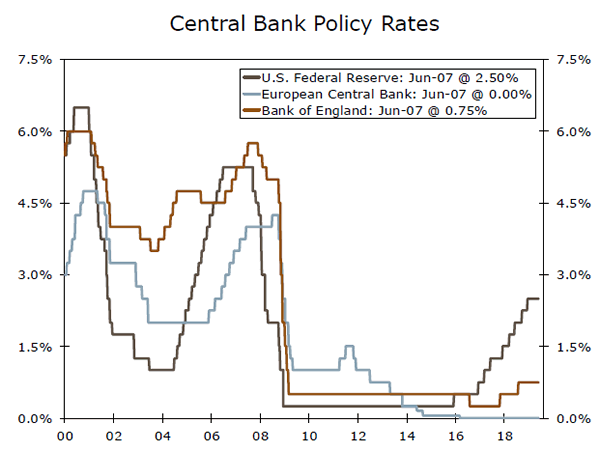
ECB left interest rates unchanged as widely expected. That is, main refinancing, marginal lending and deposit rates are kept at 0.00%, 0.25% and -0.40% respectively. The forward guidance was changed as the central bank said interest rates are going to stay at currently level for longer, "at least through the first half of 2020", rather than end of 2019.
The post meeting press conference was not too dovish at all. In short, it just reflected, as President Mario Draghi described, "confidence in the present baseline, but also clear acknowledgement of risks". Growth outlook for 2019 was revised up, but slightly down for 2020 and 21. Inflation outlook for 2019 was revised up, down for 2020.
Overall, ECB remains patient and would take more time to see how this year's slowdown plays out, before committing to a move. The less dovish than expected meeting lifted Euro against Dollar and Yen clearly. However, there was no post ECB upside breakout in EUR/GBP, EUR/CAD, EUR/CHF, and not even EUR/AUD.
Suggested readings:
- Northern Exposure: ECB Concerned Over Prolonged Uncertainty
- ECB Promises Additional Easing If Needed
- ECB Not Dovish Enough – Low Rate to Stay until Mid-2020 and TLTRO Pricing Revealed.
- ECB Not Delivering to Market Expectations
RBA delivered rate cut, more on the table
RBA cut cash rate by 25bps to 1.25% as widely expected. The objective of the cut is to "assist with faster progress in reducing unemployment" and thus, "achieve more assured progress towards the inflation target". More importantly, RBA leaves the option open for more rate cut. It will "continue to monitor developments in the labour market closely and adjust monetary policy" for the objectives.
Later, Governor Philip Lowe used to speech to confirm that more rate cuts are on the table. He said: "It is possible that the current policy settings will be enough – that we just need to be patient. But it is also possible that the current policy settings will leave us short. Given this, the possibility of lower interest rates remains on the table".
Aussie ended the week mixed only. The rate cut and dovish path ahead should be rather well priced in for now. Aussie is supported as other global central banks, possibly except BoC, don't appear to be in a much better position than RBA.
Suggested readings on RBA:
- RBA Moves Further Towards Additional Easing; FOMC to Deliver Two Cuts on Geopolitical Uncertainty
- RBA Lowe: Today's Reduction in the Cash Rate
- RBA Lowers Policy Rate to 1.25%. Two of Big Four Pledge to Pass the Cut to Market in Full
- RBA Cuts Cash Rate and Leaves Open Prospects for Further Moves
USD/CAD Weekly Outlook
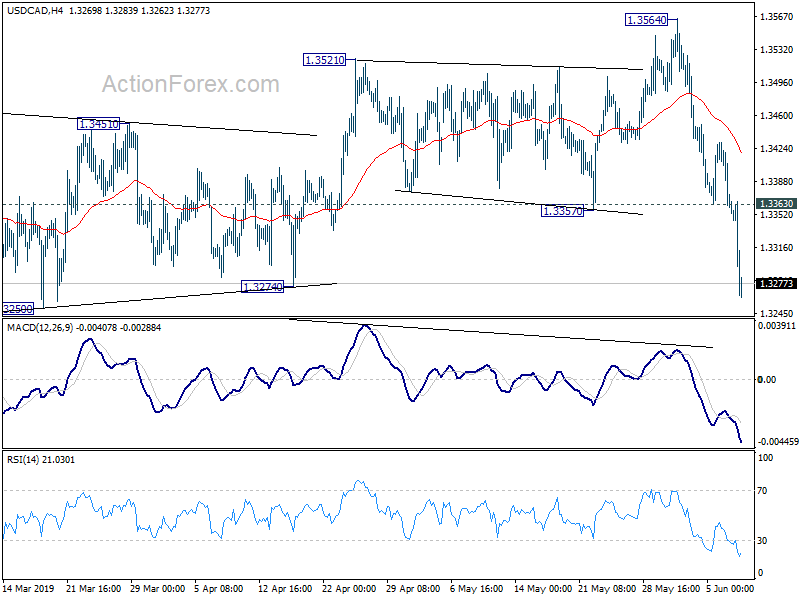
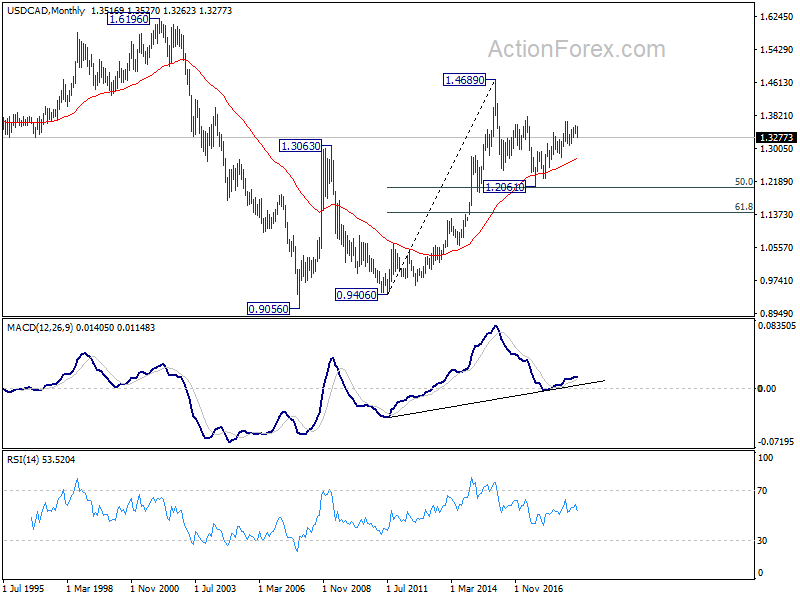
USD/CAD's sharp decline last week suggests that choppy rise from 1.3068 has completed at 1.3564 already. Initial bias remains on the downside for 1.3052/68 cluster support. On the upside, break of 1.3363 support turned resistance is needed to indicate short term bottoming. Otherwise, outlook will remain bearish in case of recovery.
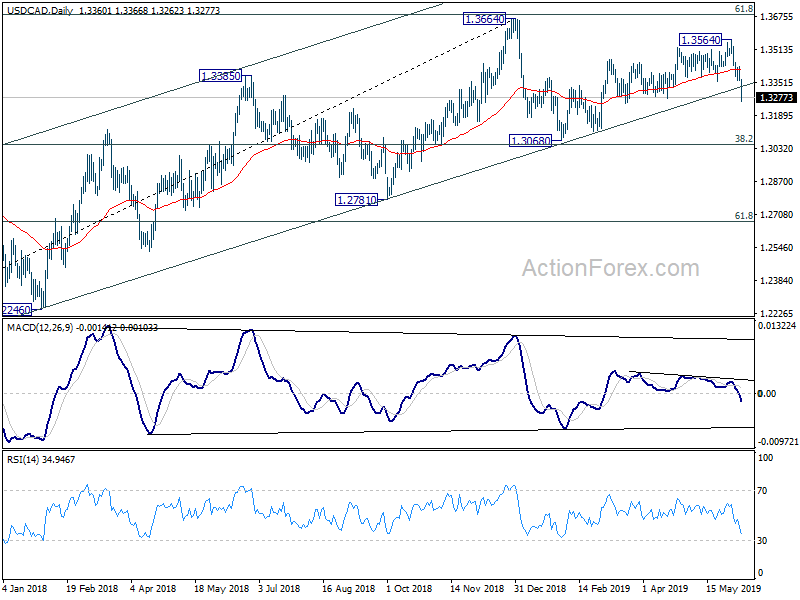
In the bigger picture, the strong break of medium term channel support now argues that up trend from 1.2061 (2017 low) has completed at 1.3664 (2018 high), just ahead of 61.8% retracement of 1.4689 (2016 high) to 1.2061 at 1.3685, and 1.3793 resistance. Decisive break of 1.3068 cluster support (38.2% retracement of 1.2061 to 1.3664 at 1.3052) will confirm and pave the way to 61.8% retracement at 1.2673 next. For now, risk will remain on the downside as long as 1.3564 resistance holds, even in case of strong rebound.
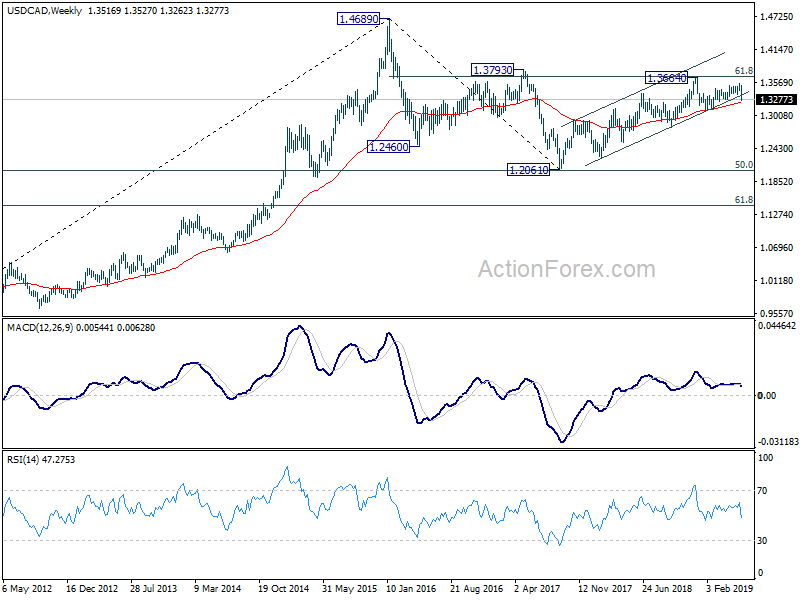
In the longer term picture, outlook remains unchanged that price actions from 1.4689 (2016 high) are forming a corrective pattern. Rejection by 1.3793 resistance would raise the chance of lengthier extension, with risk of dropping through 1.2061 low before completion.
Summary 6/10 – 6/14
Monday, Jun 10, 2019
[php_everywhere instance="1"]
Tuesday, Jun 11, 2019
[php_everywhere instance="2"]
Wednesday, Jun 12, 2019
[php_everywhere instance="3"]
Thursday, Jun 13, 2019
[php_everywhere instance="4"]
Friday, Jun 14, 2019
[php_everywhere instance="5"]
Trump announced to indefinitely suspend tariffs on Mexico as agreement reached
Trump suddenly announced on late Friday evening that the US has reached agreement with Mexico on migration issue. Hence, the proposed tariffs will be "indefinitely suspended". He hailed that Mexico has has agreed to take strong measures to stem the tide of Migration through Mexico, and to our Southern Border. This is being done to greatly reduce, or eliminate, Illegal Immigration coming from Mexico and into the United States."
The news should be welcomed by the markets. But at the same time, it might raise a big question. That is, is an "insurance cut" by Fed still needed?
https://twitter.com/realDonaldTrump/status/1137155057667989511
US and Mexico also released a joint statement on the agreement. Full text below:
U.S.-Mexico Joint Declaration
The United States and Mexico met this week to address the shared challenges of irregular migration, to include the entry of migrants into the United States in violation of U.S. law. Given the dramatic increase in migrants moving from Central America through Mexico to the United States, both countries recognize the vital importance of rapidly resolving the humanitarian emergency and security situation. The Governments of the United States and Mexico will work together to immediately implement a durable solution.
As a result of these discussions, the United States and Mexico commit to:
Mexican Enforcement Surge
Mexico will take unprecedented steps to increase enforcement to curb irregular migration, to include the deployment of its National Guard throughout Mexico, giving priority to its southern border. Mexico is also taking decisive action to dismantle human smuggling and trafficking organizations as well as their illicit financial and transportation networks. Additionally, the United States and Mexico commit to strengthen bilateral cooperation, including information sharing and coordinated actions to better protect and secure our common border.
Migrant Protection Protocols
The United States will immediately expand the implementation of the existing Migrant Protection Protocols across its entire Southern Border. This means that those crossing the U.S. Southern Border to seek asylum will be rapidly returned to Mexico where they may await the adjudication of their asylum claims.
In response, Mexico will authorize the entrance of all of those individuals for humanitarian reasons, in compliance with its international obligations, while they await the adjudication of their asylum claims. Mexico will also offer jobs, healthcare and education according to its principles.
The United States commits to work to accelerate the adjudication of asylum claims and to conclude removal proceedings as expeditiously as possible.
Further Actions
Both parties also agree that, in the event the measures adopted do not have the expected results, they will take further actions. Therefore, the United States and Mexico will continue their discussions on the terms of additional understandings to address irregular migrant flows and asylum issues, to be completed and announced within 90 days, if necessary.
Ongoing Regional Strategy
The United States and Mexico reiterate their previous statement of December 18, 2018, that both countries recognize the strong links between promoting development and economic growth in southern Mexico and the success of promoting prosperity, good governance and security in Central America. The United States and Mexico welcome the Comprehensive Development Plan launched by the Government of Mexico in concert with the Governments of El Salvador, Guatemala and Honduras to promote these goals. The United States and Mexico will lead in working with regional and international partners to build a more prosperous and secure Central America to address the underlying causes of migration, so that citizens of the region can build better lives for themselves and their families at home.
Weekly Economic and Financial Commentary: Growing Hints of a Slowdown
U.S. Review
Growing Hints of a Slowdown
- In the midst of rising prospects of a prolonged and more pronounced trade war, data this week seemed to lend some credence to the idea that the domestic economy is beginning to succumb more materially to all the uncertainty.
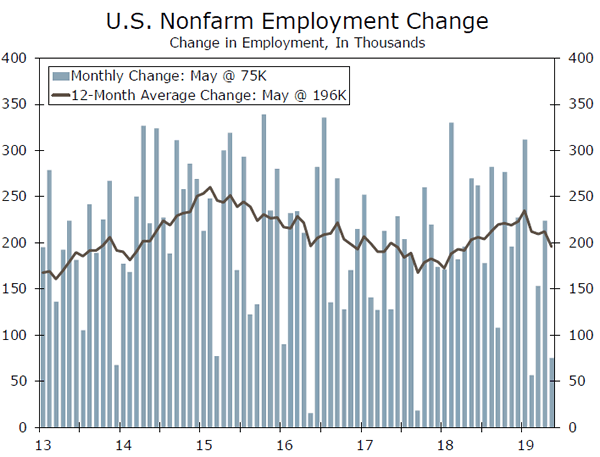
- Nonfarm employers added just 75,000 jobs in May, while average hourly earnings also missed expectations, up 3.1% over the year, the slowest rise since September.
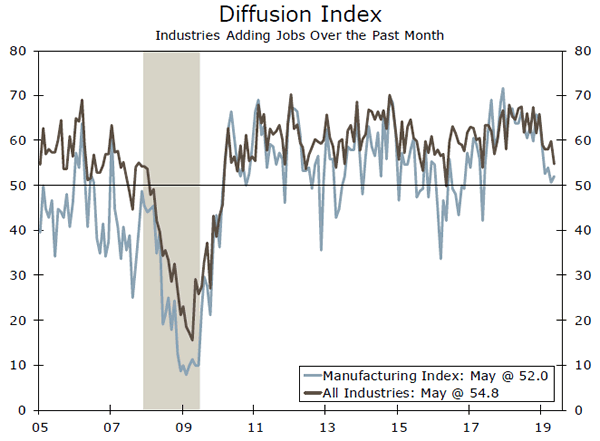
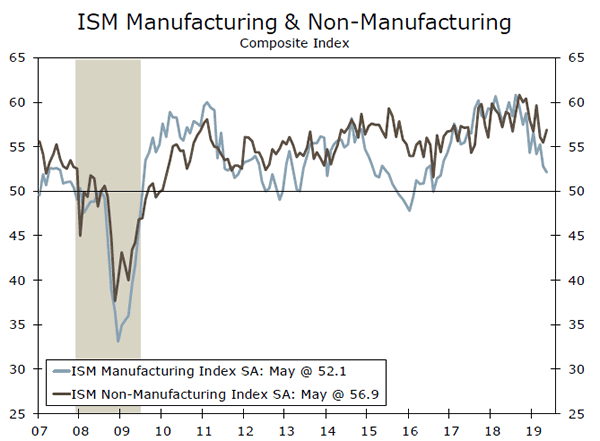
- The ISM manufacturing survey fell 0.7 points to a 31-month low of 52.1, while the non-manufacturing survey rose 1.4 to 56.9, offering some evidence of the ongoing divergence between the manufacturing and the much larger service sector.
Growing Hints of a Slowdown
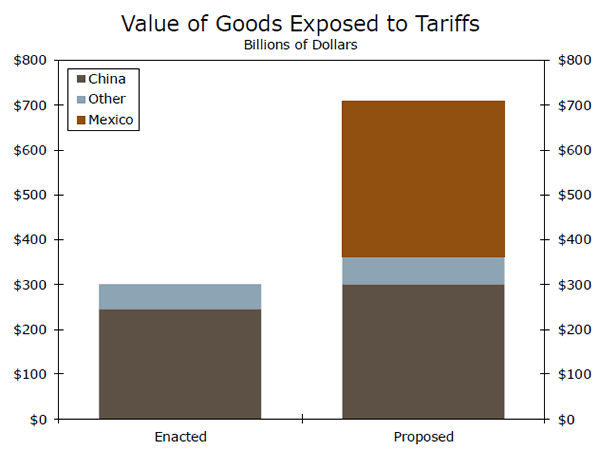
In the midst of rising prospects of a prolonged and more pronounced trade war, data this week seemed to lend some credence to the idea that the domestic economy is beginning to succumb more materially to all the uncertainty. Nonfarm employers added just 75,000 jobs in May, missing even the lowest forecast, while downward revisions shaved off a further 75,000 from prior months' reported gains. Average hourly earnings also missed expectations, up 0.2% on the month and 3.1% over the year, the slowest rise since September. The bond market reaction was swift; yields on both the two-year and 10-year immediately fell more than six bps, likely out of a belief that the growing hint of labor market weakness may force the Fed's hand and induce a rate cut. Indeed, the market has come to view a cut this year as a foregone conclusion; futures markets have priced in around 75 bps of easing this year. A more defiant stance from the Trump administration towards China and the threat of a new volley of tariffs directed against Mexico are likely driving the pessimism and risk-off attitude. Despite high-level negotiations regarding the U.S.-Mexico border situation this week, 5% tariffs on all imports from Mexico are slated to go into effect Monday, and could rise as high as 25% by October. This latest escalation more than doubles the total value of goods subject to tariffs to around $700 billion and, perhaps more worryingly, brings into stark view the willingness of the administration to use tariffs as leverage for political or diplomatic concessions, dropping even the pretense of an economic rationale. See Topic of the Week for more detail.
The question for the Fed, then, is whether markets are overreacting to trade uncertainty by expecting three cuts in a 3.6% unemployment rate economy. Noted dove James Bullard kicked off the Fedspeak on Monday, stating that a cut "may be warranted soon", and noted that even if growth does not succumb to trade tensions significantly, lower rates would help bring inflation up to target more quickly. Chair Jay Powell took the baton on Tuesday, saying, "We are closely monitoring the implications of these developments for the U.S. economic outlook and, as always, we will act as appropriate to sustain the expansion". Markets took these comments and ran with them, as the S&P 500 surged 2.1% on the day and remained buoyant the rest of the week. We would suggest a more leveled view, as his comments are not anything new, per se. Expectations of a 'Powell put' may be a bit premature, if we resist reading into his comments too deeply, and in light of Robert Kaplan's call for patience amidst trade threats that could be reversed as quickly as the president can tweet. John Williams similarly suggested staying on the path of data dependence. To that end, the ISM manufacturing survey fell 0.7 points to a 31-month low of 52.1, while the non-manufacturing survey rose 1.4 to 56.9, offering some evidence that the divergence between the manufacturing and the much larger service sector is persisting; in other words, the slowdown in the trade and global growth-exposed manufacturing sector has yet to spill over into the broader economy in a major way. Still, the majority of economic data lags. The cyclical parts of the economy are already slowing, and the uncertainty over the entire economy is already here.
U.S. Outlook
Consumer Price Index • Wednesday
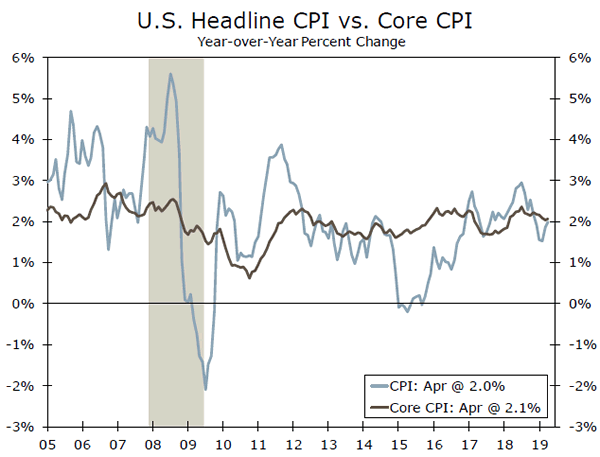
For the second consecutive month, higher energy prices led to another solid monthly gain in the Consumer Price Index (CPI) in April, +0.3%. Outside of energy, price gains were more modest with the core CPI rising 0.1% on the month. The primary driver of weakness in the core CPI has been apparel price declines as a result of a source data change in the collection sample (-0.8% and -1.9% in April and March, respectively). Apparel—which constitutes roughly 4% of the core CPI—has had an outsized impact on core inflation in recent months despite its relatively small weighting. The influence of this data source change should begin to dissipate.
Looking to May, we project headline CPI to rise a more moderate 0.2% as energy price gains eased considerably last month. Excluding food and energy, the core CPI should register a trend-like 0.2% increase. We see little change to the overall trend in inflation as Fed officials prepare to meet later this month.
Previous: 0.3% Wells Fargo: 0.2% Consensus: 0.1% (Month-over-Month)
Retail Sales • Friday
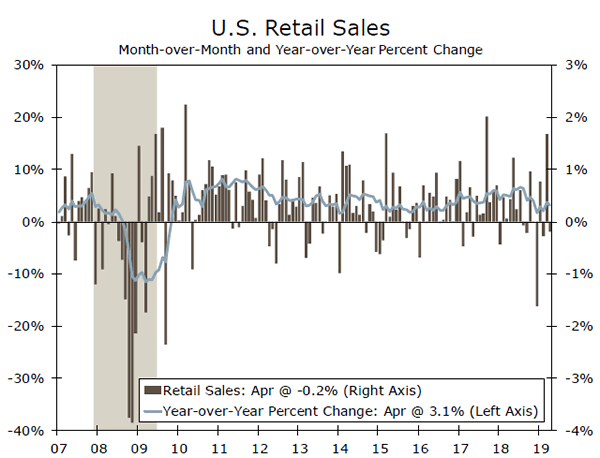
Retail sales have experienced a volatile monthly performance so far this year. In April, headline sales unexpectedly slipped 0.2% on the month, following an exceptionally strong 1.7% gain in March.
We expect a rebounding performance in May, with headline retail sales increasing 0.7% (excluding vehicles, +0.4%). Motor vehicle sales increased 5.5% last month and should accompany an otherwise broad-based increase across the retail sectors.
Looking ahead, we remain constructive on the consumer and their contribution to overall economic growth. Fundamentals for sustained, solid consumer spending remain sound, including healthy hiring gains, low unemployment and firming wages. Assuming the labor market remains healthy, as we expect, consumer spending growth should be solid in the quarters ahead.
Previous: -0.5% Wells Fargo: 0.7% Consensus: 0.7% (Month-over-Month)
Industrial Production • Friday
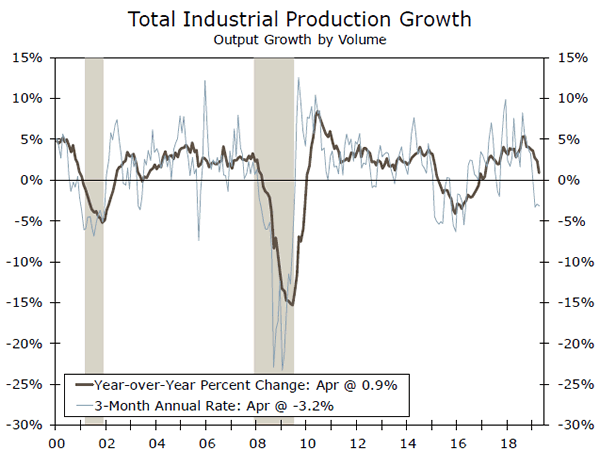
Reflecting the ongoing, and now escalating, trade policy concerns, industrial production has fallen for the third time over the past four months. Manufacturing output contracted 0.5% in April, as production of motor vehicles & parts fell by the most in three months, while machinery output shrank by the most since 2014.
We look for a 0.1% decline in May total industrial production given there has been little relief in the factory sector data since last month. The headline ISM manufacturing fell moderately in May, though new orders showed some modest improvement on the month. Looking ahead, the manufacturing sector will continue to face the same issues seen over the past few months—namely, dealing with the challenges in trade due to the strong dollar and the need to slow inventory accumulation.
Previous: -0.5% Wells Fargo: -0.1% Consensus: 0.2% (Month-over-Month)
Global Review
ECB Hints At Easing for Ailing Eurozone Economy
- The European Central Bank announced policy this week, acknowledging that policymakers discussed rate cuts and restarting its asset purchase program. Those discussions come amid continued weakness in Eurozone economic data, including inflation well below target and ongoing concerns in Germany's industrial sector.
- The race for U.K. prime minister is under way, while PMIs released this week signaled U.K. economic sentiment is anything but inspiring. Meanwhile, Canada had another banner jobs report in May.
ECB Hints at Easing for Ailing Eurozone Economy
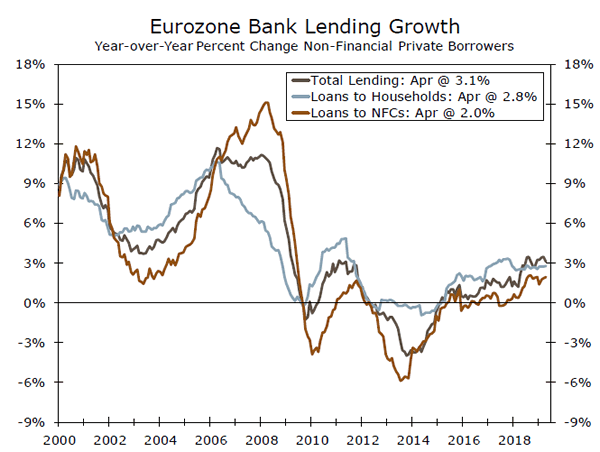
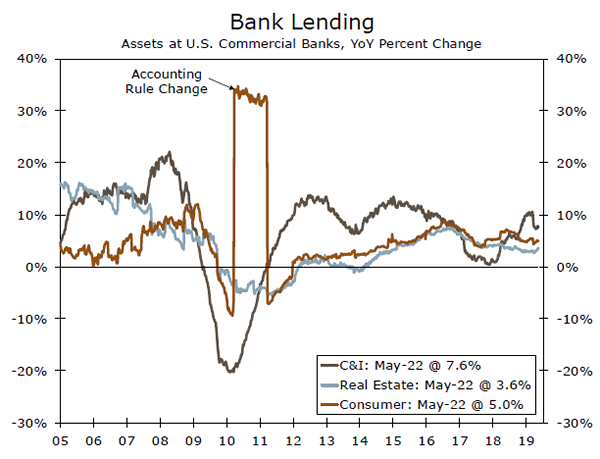
It was a busy week for Europe. The European Central Bank (ECB) as expected, held its policy rates steady. As part of the announcement, it provided the terms of its TLTRO program of longer-term loans for banks, which were generally less favorable for banks than some had expected. The recent strength in bank lending in the Eurozone probably gave the ECB some leeway to be stingier with the lending terms, although those terms will still be fairly favorable as they allow for long-term loans to potentially be disbursed to commercial banks at negative interest rates.
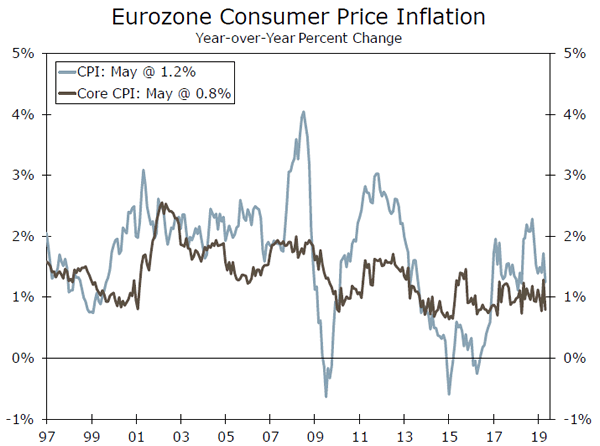
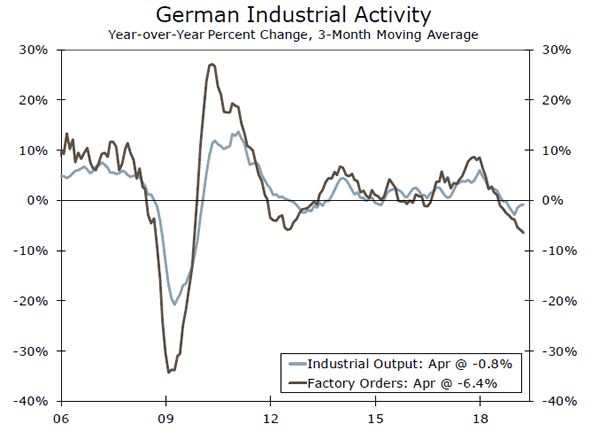
Meanwhile, the central bank said rates would remain at present levels at least through the first half of 2020, whereas previously it had noted that rates would remain on hold at least through the end of 2019. ECB President Draghi noted that some policymakers had discussed rate cuts, and that there was scope for renewed purchases under its quantitative easing (QE) program. Those discussions come amidst ongoing economic weakness in the Eurozone, highlighted by some key data releases this week. Eurozone CPI inflation slowed more than expected to 1.2% yearover- year, while core CPI inflation slipped to 0.8%. Meanwhile, German industrial output unexpectedly fell 1.9% on a sequential basis in April. Despite ongoing economic weakness in the Eurozone, we are not yet convinced the ECB will restart QE or cut rates anytime soon. However, with the change in forward guidance, we now see substantial risks that the ECB will not raise rates in Q1-2020 as we currently expect.
Last but not least, Italian political concerns escalated this week after the European Commission recommended a formal procedure to rein in Italy's budget deficit and debt-to-GDP ratio, which it views as in violation of the E.U. budget rules. To sum up, ECB policy is likely to remain accommodative for some time amid a soft domestic growth and inflation backdrop and ongoing political concerns in the region.
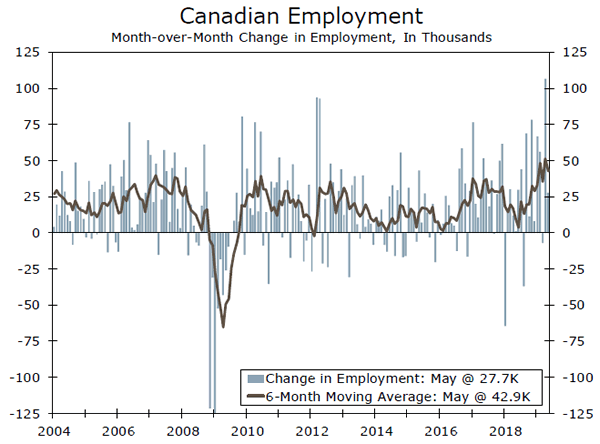
Elsewhere, the race to replace U.K. Prime Minister Theresa May kicked into gear this week, as the field of candidates narrowed slightly and candidates began formalizing their stances on Brexit and other issues. Reports indicate the Conservative Party is seeking to conclude the leadership race by July 26. U.K. domestic economic data this week were mixed but pointed to weak economic sentiment. The May manufacturing PMI fell to 49.4, the lowest since July 2016, while the services PMI rose to a still-low 51.0. The U.K. manufacturing sector is likely reaping the impact of overbuilt inventories earlier this year, although the services sector has probably been more resilient than sentiment figures currently suggest. Finally, there was some focus on Canadian labor market figures, which were generally stronger than expected. Employment rose 27,700 in May with all the gains in full-time jobs, following the largest increase on record in April (+106,500). The other details of the report were also constructive, as wage growth remained solid at 2.6% year-over-year, while the unemployment rate fell to 5.4%.
Global Outlook
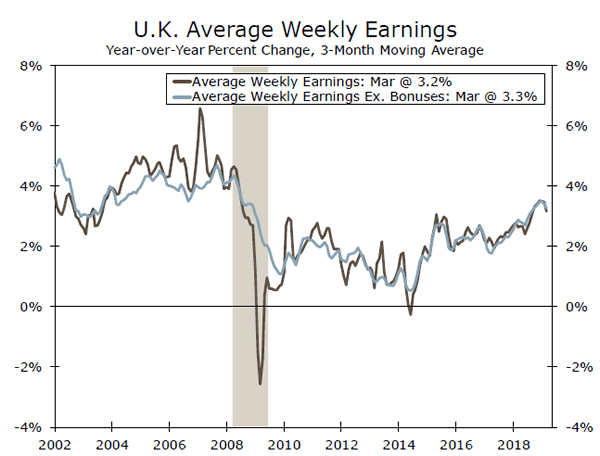
U.K. Labor Market Report • Monday
The U.K. economy has been surprisingly resilient in the face of Brexit uncertainty, as real GDP grew 0.5% in Q1 (not annualized) on solid domestic demand growth. That solid domestic economic picture is also reflected in the labor market, where wage growth remains solid, the unemployment rate is at a multi-decade low and employment growth is strong.
In our view, the most important metric to watch in next week's labor market report is wage growth, which has tapered off a bit recently but generally remains near the highest levels of the cycle. Unit labor costs, which adjust wage growth for the productivity of workers, has picked up meaningfully, suggesting the rise in wages is not entirely reflective of increases in productivity. We suspect the Bank of England is watching these developments closely, and while Brexit uncertainty probably means no rate hikes are coming soon, rising cost pressures could eventually force the central bank's hand.
Previous: 3.2% Consensus: 3.0% (Year-over-Year, 3-MMA)
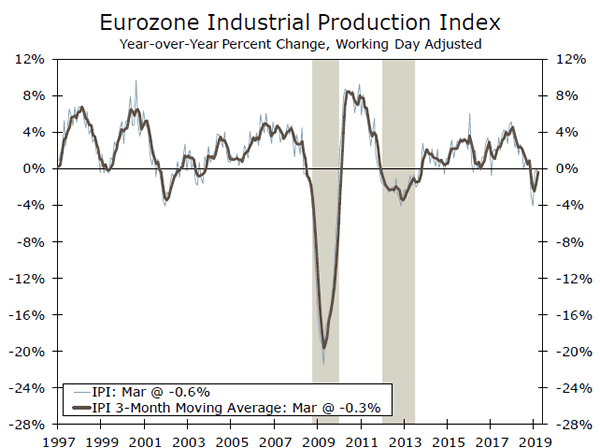
Eurozone Industrial Output • Thursday
The Eurozone's economic woes seemingly have yet to meaningfully abate, but next week's reading on industrial output from the bloc will offer some insight into whether that story has changed. The industrial sector has languished, particularly in Germany, as weaker global trade has dinged the export-sensitive economy. Output in the industrial sector has recovered a bit in recent months, but Germany's industrial output reading this week shows that the recovery may have stalled.
The recent increase in trade tensions only adds to the downside risks for output, particularly if tensions linger or worsen in the months ahead. On the bright side, retail sales have picked up recently as inflation remains low, and ultimately we remain of the view that the Eurozone will dodge a full-scale recession. Still, our full-year 2019 forecast for Eurozone GDP growth is just 1.1%, hardly an inspiring outlook.
Previous: -0.3% Consensus: -0.4% (Month-over-Month)
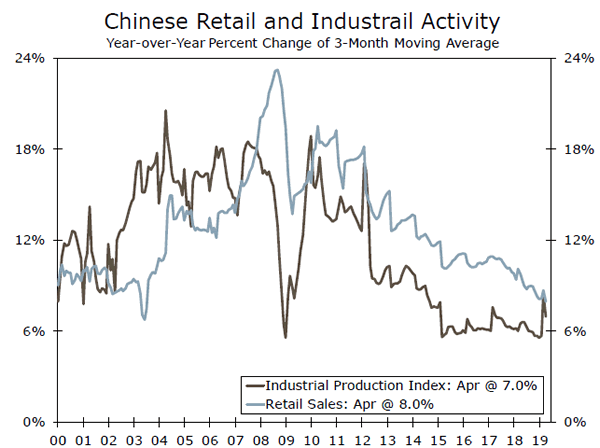
China Economic Activity • Friday
China releases industrial output and retail sales figures for May next week, and these numbers will provide our first look at whether the recent escalation in U.S.-China trade tensions has had any discernible impact on Chinese activity. The manufacturing PMI fell further into contractionary territory last week (49.4), which may bode poorly for industrial output, although the non-manufacturing PMI continues to be more resilient and remains comfortably above 50. Next week will also feature the release of Chinese trade data for May, which will also encapsulate the period since the United States raised tariffs on US$200B in goods. Ironically, the tariffs could pose upside risks for Chinese exports to the United States if firms in China rushed to send off shipments before the tariffs took effect. Finally, there could be a relatively swift reaction from Chinese authorities, including pledges to ease monetary or fiscal policy, if any of next week's data releases are particularly underwhelming.
Previous: 5.4% (Industrial Prod.) & 7.2% (Retail Sales) Consensus: 5.4% & 8.0% (Both Year-over-Year)
Point of View
Interest Rate Watch
The Bond Market Looks Prescient
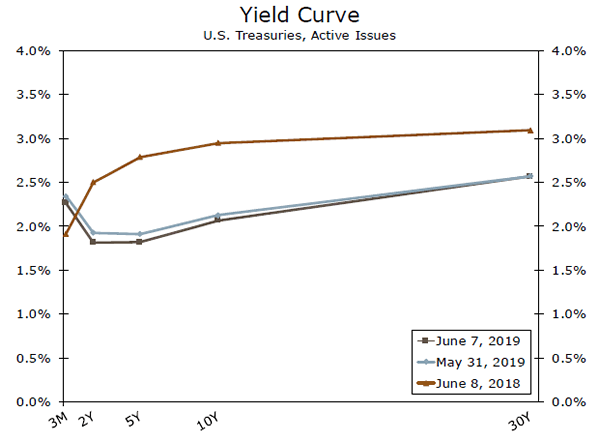
The May employment data drive home many of the points we made in this column last week, namely that the inversion of the yield curve is for real this time. With both the 2-year and 10-year Treasury yields below the federal funds rate, the bond market has put the Fed on notice that their near-term and longer-term forecasts for U.S. economic growth are too optimistic. This morning's weaker employment report, which showed nonfarm payrolls adding around 100,000 fewer jobs than the consensus estimate and downward revisions to the prior two months data, reinforced that message and very likely removed any lingering doubts that the economy has slowed.
The financial markets are now pricing in two or three quarter-point cuts in the federal funds rate this year. That is probably too much. Part of this morning's smaller job gain was simply a payback for the exceptionally strong April data. The devastating flooding in the Midwest appears to have bolstered hiring in heavy engineering, possibly to shore up levees. Hiring also rose sharply in social services, particularly areas providing disaster assistance. Seasonal adjustment likely magnified the impact last month and the May data saw some mean reversion. The relatively late May survey period also meant a large number of teachers, both in government and the private sector, fell off of payrolls this past month. The bottom line is job growth has moderated but perhaps not as much as the May data suggest.
Bond yields retreated following the jobs data. The financial markets are concerned about the implications of a widening trade war and the possible near-term distortions from even a short period of tariffs on imports from Mexico. If a deal can be reached with Mexico before tariffs are put in place, yields will likely rise, as that would likely keep the Fed on hold for a few more weeks. Policymakers also need to determine how much damage tariffs on Chinese imports and the threat of tariffs on Mexico has already done to the economy. Risk aversion has undoubtedly increased, which raises the hurdle rate for every additional investment dollar and new hire.
Credit Market Insights
Italy's Credit Vulnerability
On Wednesday, the European Commission released a report that recommended disciplinary proceedings against Italy, over its failure to follow European Union (EU) debt rules. The Commission concluded that an excessive debt procedure (EDP) is warranted and the report marked the first step in the EDP. Next, the analysis will be submitted to EU members to discuss their opinions on the commission's proposal over Italy's budget. If EU members are unsatisfied with Italy's ability to reduce its debt based on the recommendations, the country may face fines up to roughly €3.5B (0.2% of GDP).
According to EU rules, Article 126(2) TFEU states that, in order to be in compliance with budgetary discipline; no country should have a government deficit larger than 3% of or government debt exceeding 60% of GDP. According to the report, Italy did not comply with the debt reduction benchmark last year. In 2018, Italy's gross debt rose to 132.2% of GDP, above the 60% reference value, however its deficit remained within the 3% limit. The Commission forecasts Italy's debt-to-GDP will reach even higher levels in 2019 (133.7%) and 2020 (135.2%), while in 2020, the general government deficit is projected to exceed the reference value.
Italy's mounting public debt has left its economy vulnerable. In the second half of 2018, Italy's nominal GDP growth dipped below 2%, hindering its ability to reduce its public debt at a faster rate.
Topic of the Week
The Latest Front in the Trade War: Mexico
What's Happening: U.S. and Mexico officials have yet to reach a deal on illegal immigration. Unless negotiators make major progress, tariffs on goods coming into the United States from Mexico will be subject to a 5% tariff starting this Monday, June 10. There is a built-in escalation of five percentage points each month until the tariff rate hits 25% on October 1.
Why it Matters: Tariffs on Mexican goods would mark the biggest escalation yet in the ongoing trade war. The dollar value of goods currently subject to tariffs totals about $300 billion. The proposed tariffs on Mexico would affect an additional $346 billion of goods coming into the United States. This is more than just a new front; it is a more than doubling of the trade war in one shot.
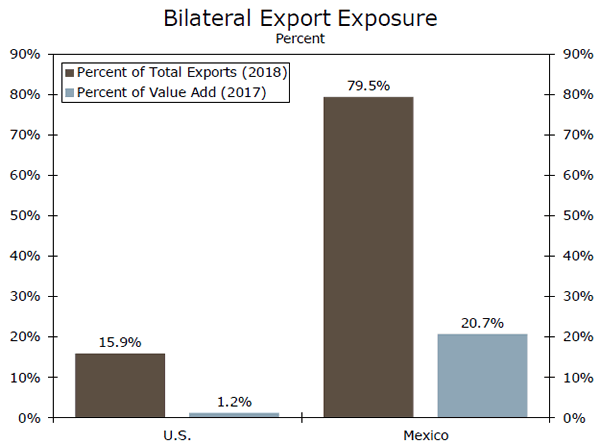
Mexico is the second largest market for both U.S. imports and exports. Last year, the share of total U.S. exports to Mexico was just 15.9%. A big number, but it pales in comparison to the 79.5% share of Mexican exports destined for the United States. Exports to Mexico comprise only 1.2% in terms of value added in the U.S. economy. So at least in terms of the bilateral trade relationship, Mexico has more to lose than the United States. The auto industry accounts for more than a third of U.S. imports from Mexico. This large share and the interconnectivity of North American supply chains suggest the auto industry is at heightened risk from tariffs.
Our Takeaway: By itself, a trade war with Mexico would not plunge the U.S. economy into recession. But, coupled with the other tariffs, it is likely to weigh on U.S. growth. While we suspect there is not much support for these policies on either side of the aisle that may not prevent the tariffs from going into effect next week or escalating in subsequent weeks. Should these measures go into effect, the economic pain they will cause, particularly in the auto sector, will likely make this a politically untenable plan in the longer run.
Forward Guidance: Focus on US Industrial Sector
Light Canadian data week and trade tensions should leave focus on US industrial sector
A light Canadian economic data calendar over the next week should leave attention focused on external trade risks. Key to that will be whether the US follows through with planned 5% across-the-board tariffs on imports from Mexico on Monday, adding to new tariffs on imports from China last month. That would mark another blow for the US manufacturing sector which, we have noted before, has borne the brunt of US import tariffs to date and already posted declines in three of the first four months of 2019. In that respect, the May US industrial production report is perhaps the most consequential economic release on the docket for this week. Early indicators are not particularly positive. A softer-than-expected May employment gain included a 0.1% dip in manufacturing hours worked by production workers – yes, a small dip, but the fourth straight monthly decline.
The US and Canadian manufacturing sectors are incredibly closely integrated. There may be some opportunities for temporary reallocation of supply chains away from US-Mexico trade to US-Canada trade in the event the US follows through on their Mexico tariff threats. But anything that is bad for the US industrial sector – and added tariffs would definitely qualify – would almost certainly also be bad for Canada on net.
Yet it’s also important to remember that not all the economic data out of the US has been bad. The 90% of the economy that is not the industrial sector still has been doing okay. The ISM non-manufacturing output released over the last week is still consistent with solid expansion, not contraction. Even that softer-than-expected 75k gain in US employment in May looked a bit better under the hood. The unemployment rate held close to multi-decade lows and the broader ‘U6’ underemployment rate (which includes sources of ‘hidden unemployment’ like discouraged workers) declined to a new cycle-low. Wage growth ticked lower but is still running 3% or higher. And we have seen trade risks ebb and flow before – and typically with little notice. There is still time for the Trump administration to pull back from the brink ahead of G20 meetings at the end of this month – or to be pulled back by resistance from Congress. A pickup in motor vehicle sales in May is a good sign that retail sales picked up in May, consistent with a still decent looking consumer spending backdrop.
In Canada, the recent economic data has been downright strong. A 0.5% bounce-back in GDP in March bodes well for a return to growth in the 2% range in Q2 after disappointing growth over the prior two quarters. The 28k gain in employment in May was the 8th in the last 9 months for what is normally a volatile measure with job gains totaling 417k over that period. We expect housing starts – out on Monday – to slow but hold at an above-200k rate with activity continuing to recover from a big weather-related drop in February. Thursday will provide the latest update on the state of household balance sheets. Household net wealth probably bounced back alongside a recovery in equity markets in Q1 but we expect the closely-watched debt-to-disposable-income measure to hold steady at elevated levels.
The Weekly Bottom Line: Data Reaffirms Bank of Canada’s Steady Approach
U.S. Highlights
- Trade tensions continued to dominate economic headlines, with U.S.-Mexico taking center stage. It remains unclear if a deal can be reached by Monday. The US-China spat also resurfaced, with signs that it is spreading beyond goods trade.
- Fed Chair Powell noted that the Fed was monitoring trade developments closely, and was ready to "act as appropriate to sustain the expansion". This appeared to soothe equity markets, which rebounded to a three-week high.
- The May jobs report disappointed expectations, with payrolls up only 75k. Looking through the recent volatility, the hiring trend has slowed but remains decent, averaging 151k in the last three months. The unemployment rate held steady at 3.6% and wage growth, while slowing a touch, held above 3% y/y.
Canadian Highlights
- Global equity markets were in better spirits this week, helped by hopes of a rate cut amid escalating trade tensions. The S&P/TSX composite followed it its global peers, ending the week higher even as oil prices (WTI) were slightly down.
- Economic data was reassuring, supporting the view that the Canadian economy is emerging from a soft patch. International trade showed improvement as trade deficit continued to narrow.
- Reports from Toronto and Vancouver real estate boards suggest that the national housing market will likely continue to firm in May. After a strong print in April, job growth continued at a decent clip in May with economy adding 28k jobs.
U.S. - Tariff Threats Muddy the Economic Waters
Trade tensions continued to dominate economic headlines this week, with the U.S.-Mexico quarrel taking center stage. Mexico sent a senior delegation to D.C. to try to address President Trump's concerns regarding illegal migration, and to defuse the impending tariff threat. While some progress has been made, as at the time of writing, it is unclear if a deal can be reached by Monday's deadline.
With Mexico busy at the negotiation table, President Trump tilted the conversation back to China by reaffirming the threat to raise tariffs on another $300 billion of Chinese goods. China's Commerce Ministry struck a defiant tone in response, suggesting that China would "fight till the end" if need be. Beyond the colorful language, there were signs that the conflict is spreading beyond goods trade, with China cautioning its citizens about the dangers of travelling or studying in the United States.
The uncertainty generated by these events has kept the Fed on high alert. Among several Fed speeches this week, Fed Chair Powell noted that the Fed was monitoring trade developments closely, and was ready to "act as appropriate to sustain the expansion." Chair Powell's emphasis on the Fed's flexibility appeared to soothe equity markets, which rebounded to a three-week high.
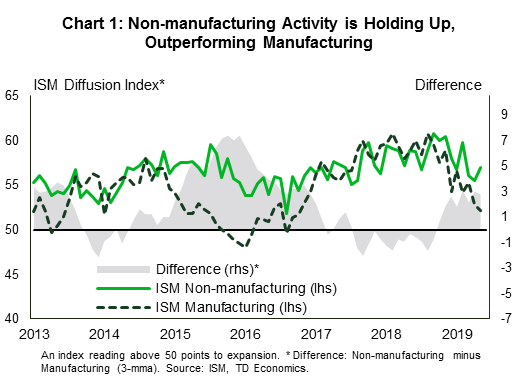
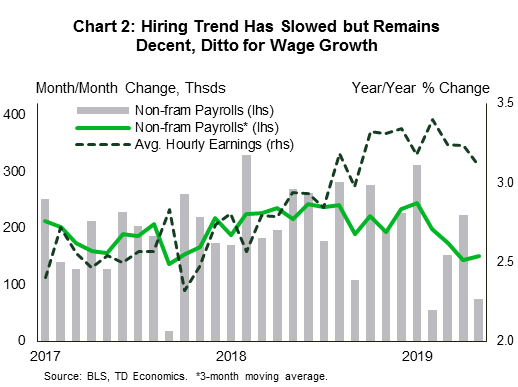
Financial conditions factor heavily in FOMC decisions, but economic data is the primary determinant. On that front, data this week reinforced the view that while growth has slowed, there are no impending signs of calamity. Trade tensions are weighing on the manufacturing sector, but the much larger services (non-manufacturing) side of the economy is holding up, as highlighted by the divergent performance of the ISM indices through May (Chart 1). That said, the most awaited report of the week, the jobs report, was a bit of a downer, with payrolls rising by only 75k in May – over 100k short of market consensus. This came alongside downward revisions of 75k to the previous two months. Looking through the recent volatility, the hiring trend has slowed but remains decent, averaging 151k in the last three months (Chart 2). This is broadly in line with our expectations. In addition, most other aspects of the May report were encouraging. The unemployment rate held steady at 3.6% and wage growth, while slowing a touch, held above 3% y/y.
With the broad economic backdrop still decent, trade and global growth remain the ultimate wildcard. Mexico is the second biggest source of goods entering the U.S. after China. As such, the impending 5% tariff will be problematic, particularly for products that cross the border multiple times (i.e. auto parts). Prospects for an increase in the tariff rate to 25% are more daunting, with supply chain disruptions, reduced market access and the hit to confidence all more acute. A simultaneous escalation in tensions with Mexico and China would accentuate these risks further. In the event that tensions escalate in this fashion, the Fed will have little choice but to act.
Canada - Data Reaffirms Bank of Canada's Steady Approach
Global equity markets were on a better footing this week. Investors' spirits were lifted by a more dovish stance of some central banks which fueled hopes of a rate cut amid escalating trade tensions and growing downside risks to global growth. The S&P/TSX composite followed it its global peers, ending the week higher. After falling precipitously last week, oil prices (WTI) edged slightly lower this week, while Canadian dollar has strengthened.
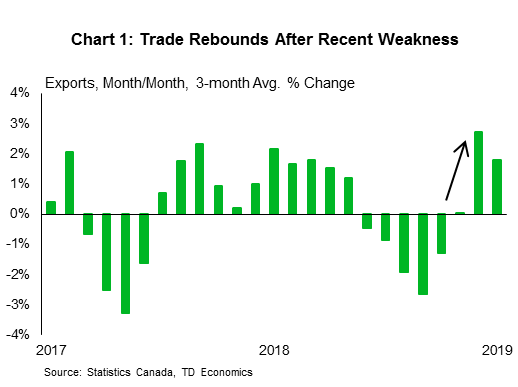
This week's economic data also looked reassuring, providing further credence to ours and the Bank of Canada view that after two quarters of tepid growth the Canadian economy is emerging from the soft patch. International trade showed improvement. Building on a healthy momentum in March, April's data delivered further good news. Trade deficit narrowed to $0.97 billion in April, down from a revised $2.3 billion deficit a month earlier, as export volumes rose 2%, while import volumes declined 1.9% (Chart 1).
Some green shoots have emerged in the housing market in spring, with activity rebounding after weather-induced weakness in Q1. Home sales and average home prices posted two back-to-back gains in March and April, and while May's nation-wide data is not due for another ten days, this week's data for Toronto and Vancouver suggests that housing market likely continued to firm in May. Lower mortgage rates and healthy employment and population gains will further support activity in the coming months.
In terms of the details, the Toronto housing market showed further signs of improvement, with sales and prices rising in May. In Vancouver sales also posted a double-digit increase on the month. That being said, despite the sizeable gain, Vancouver's housing market will not be off to the races any time soon as the overall demand remains very subdued relative to history, hindered by lingering affordability challenges and several rounds of provincial regulations, on top of stricter federal mortgage rules and past rate hikes.
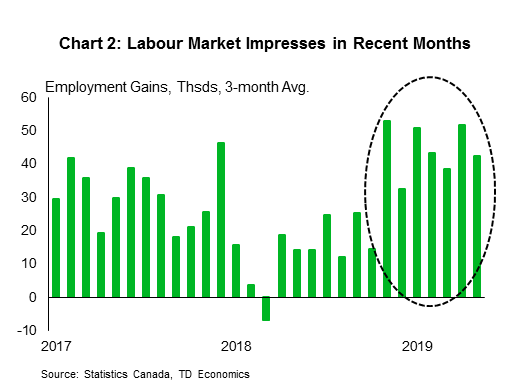
Capping this week's encouraging data were today's employment numbers. Following a blockbuster print in April, job creation continued at a decent clip in May with economy adding 28k jobs. However, the fly in the ointment was that all of the gains (and then some) were in self-employment, while both private and public sectors shed jobs. That being said, some moderation in employment was to be expected given the recent strength in hiring (Chart 2).
All in all, recent data points suggest that economic backdrop is indeed improving, in line with the Bank of Canada view. After two-quarters of sub-0.5% prints, we expect real GDP growth will average closer to 2% over the rest of the year. While the outlook is laden with significant risks, the Bank of Canada believes that "the degree of accommodation [provided at present] remains appropriate". Thus, even as the market expectations intensify for the U.S. Federal Reserve to cut policy rate this year, with similar, if less intense moves seen here as well, we expect the Bank of Canada to stay pat.
U.S.: Upcoming Key Economic Releases
U.S. Consumer Price Index - May
Release Date: June 12, 2019
Previous: 0.3% m/m, core 0.1% m/m
TD Forecast: 0.1% m/m, core 0.2% m/m
Consensus: 0.1% m/m, core 0.2% m/m
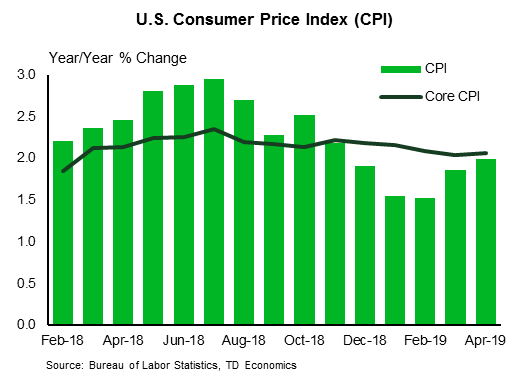
We look for headline CPI to slow two tenths to 1.8% in May on the back of a mild 0.1% seasonally-adjusted monthly increase. The softer monthly increase is largely the result of the normalization in energy prices, which were a major driver to the upside in recent months. Core inflation, on the other hand, should remain steady at 2.1% y/y, reflecting a firm 0.2% m/m advance. We pencil in a softer 0.2% m/m increase in core services, which we expect to be aided by a 0.2% rebound in core goods – its first increase in four months. We anticipate OER to remain largely steady at 0.3% m/m and for the ex-shelter segment to slow marginally on a monthly basis.
U.S. Retail Sales - May
Release Date: June 14, 2019
Previous: -0.2%, ex auto: 0.1%
TD Forecast: 0.8%, ex auto: 0.1%
Consensus: 0.6%, ex auto: 0.5%
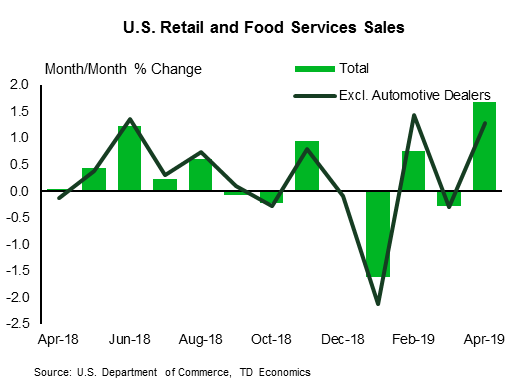
We expect a firm increase in auto sales (+2.5% m/m) to be the main driver behind a 0.8% rise in the headline measure for May. Indeed, the ex-auto measure should advance at a softer 0.1% print during the month. Although we expect sales at gasoline stations to remain supportive of the headline figure, it will be so at a lower magnitude reflecting the stabilization in gasoline prices. Furthermore, we anticipate sales in the key control group to rebound modestly at 0.2% m/m following the unexpected flat increase posted in April.
Canada: Upcoming Key Economic Releases
Canadian Housing Starts - May
Release Date: June 10, 2019
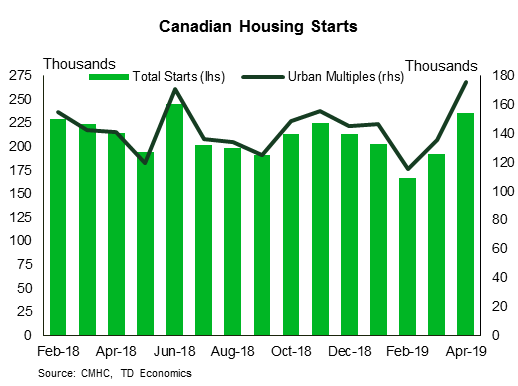
Previous: 236k
TD Forecast: 212k
Consensus: NA
TD looks for residential housing starts to slow to a 212k pace in May, returning some of the gains from the prior month on a pullback in multi-unit construction. April housing starts were noteworthy on account of a record month for multi-unit construction in urban centers, with developers breaking ground on over 175k (annualized) units during the month. While housing stock remains in short supply across certain fast growing regions, permit issuance has fallen by nearly 20% in the last two months of available data which will weigh on multi-unit starts in May. Single family starts have stabilized since bottoming out at 37.5k in February and while we see risk of some giveback, any downside should be modest given current levels.
Gold resuming rally for 1380 key fib resistance zone
Gold jumps further to as high as 1348.22 today on broad based weakness in Dollar. Much lower than expected US NFP and smaller than expected wage growth added to speculation of Fed's rate cut. June 19 is probably still a bit too early given that it's just one month of poor job data. September is more likely if there is no improvement in Trump's trade war with China and Mexico.
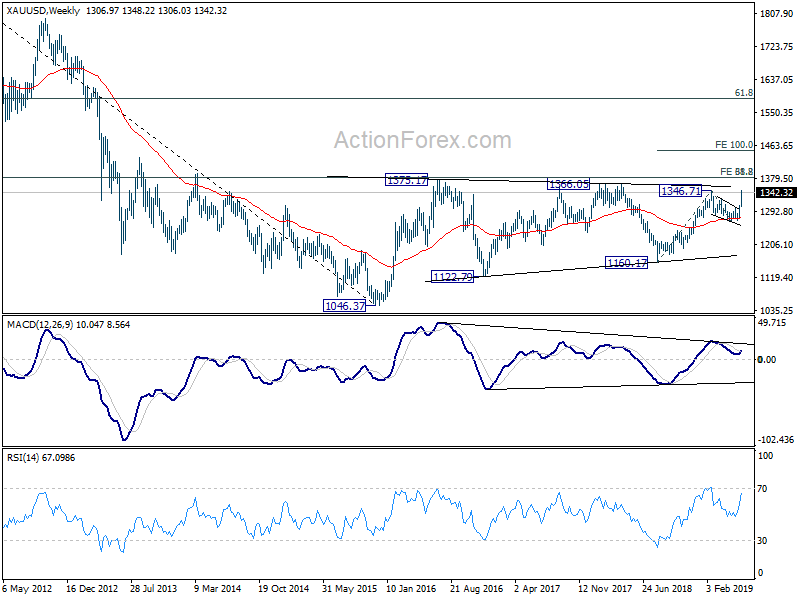
Back to Gold, rise from 1160.17 is likely resuming. Sustained trading above 1346.71 will pave the way to 61.8% projection of 1160.17 to 1346.71 from 1266.26 at 1381.54. Break of 1319.98 support, however, will probably extend the consolidation from 1346.71 with another decline.
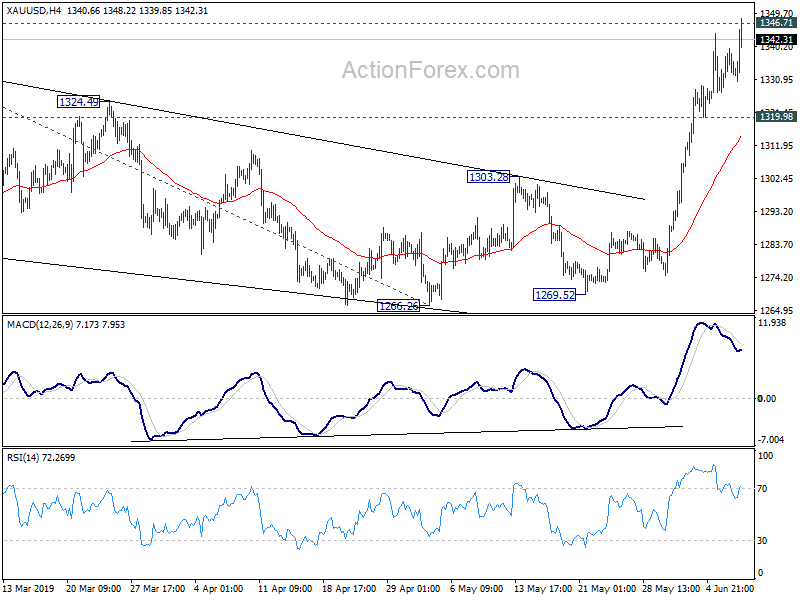
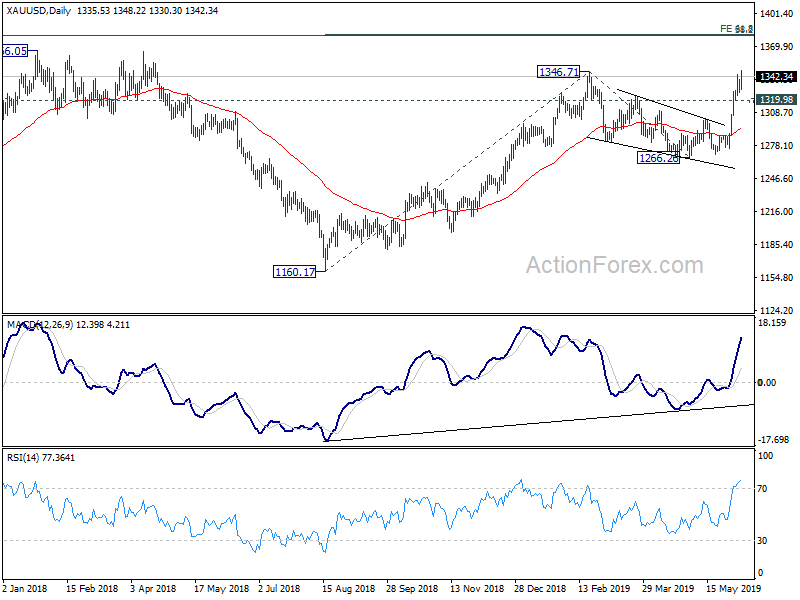
Let's be reminded that 1381.54 is very close to long term fibonacci resistance of 38.2% retracement of 1920.70 (2011 high) to 1046.37 (2015 low) at 1380.36. As noted before, the strong support from 55 week EMA is taken as a rather bullish signal. That raises the chance that gold would finally overcome this fib resistance after multiple attempt over the last few years. We'll monitor the momentum of next move to see.
UK GDP Growth and Jobs Data Key Events to Watch
The pound is expected to have a busy start to next week as the latest update on UK GDP growth and industrial production will hit the markets on Monday at 0830 GMT, while on Tuesday at the same time employment data will provide another insight into the British economy. The stats however may not be as promising as in the previous release.
In the first quarter, the fear of a disorderly Brexit at the end of March forced companies to bring purchases forward to avoid any supply disruption in the months ahead. Consequently, industrial production more than doubled on an annual basis, with both services and manufacturing sectors contributing strongly positively to Q1 GDP growth that clocked in higher than expected at 1.9% y/y and 0.5% q/q.
On Monday, markets will likely realize that the above Brexit stockpiling effect was rather temporary as forecasts see industrial output contracting by 0.7% m/m in April after rising by an equivalent percentage in March, squeezing the annual gauge to 1.0% y/y. Of more importance, the monthly GDP growth is projected to have declined by 0.1%, the same rate as in the preceding month, sending the yearly measure lower to 1.7%.
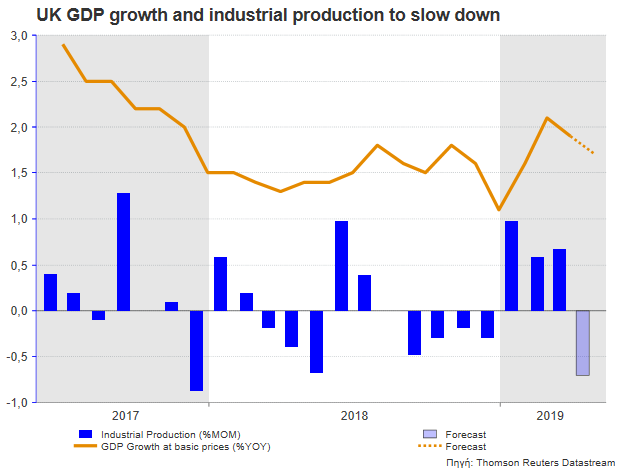
Honestly, such an outcome would not be a big surprise following the deep fall in manufacturing and construction PMI readings earlier this week. Despite the modest increase, the services PMI did not excite either as the indicator remained close to the 50 mark that separates expansion, barely offsetting the loss in other sectors. Indeed, with uncertainty currently growing over whether the Brexit contribution of the new Conservative leader will be positive or negative before the October deadline, companies could reasonably remain cautious on spending and investing, shaving growth in upcoming quarters.
The employment report could demonstrate the bleak business sentiment on Tuesday if April’s data indicate a softer rise in new job positions and wage growth. Particularly, analysts believe that job creation slowed even dramatically in April, recording a marginal rise of 13k compared to 99k in March and 179k in February. Average hourly earnings including bonuses are also predicted to have softened from 3.2% to 3.0% despite the unemployment rate steadying at 3.8%, the lowest level since 1974.
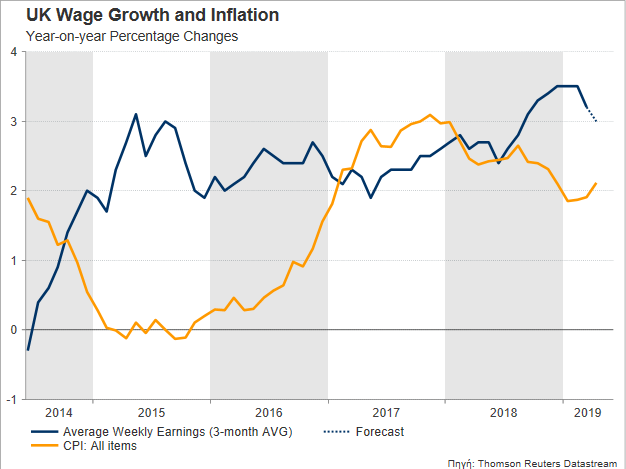
While a wage growth of 3.0% is still supportive to consumption – as long as it holds well above the current inflation rate of 2.1% – another consecutive slowdown could upset the Bank of England governor. According to the central bank’s annual report written on May 21, Mark Carney is positive that upward pressure on prices is likely to build and hence interest rates should be raised, gradually and to a limited extend though, to keep inflation at the target (2.0%). Sure, the Brexit drama together with a tougher US trade policy could keep the pound under pressure, making imports more expensive. But with businesses struggling to boost sales and consumers facing slowing wages, a hike in interest rates would be premature.
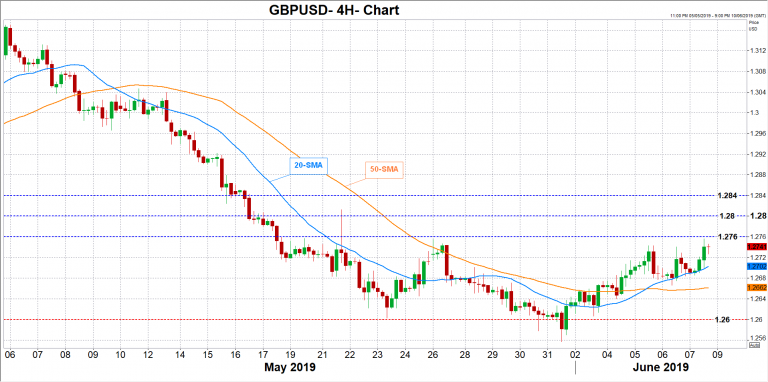
All in all, a negative surprise in next week’s data would further undermine the outlook for the British economy and put Carney’s rate hike hopes into question. The pound could feel the pain in the aftermath, with GBPUSD probably meeting the 20-period simple moving average (SMA) in the four-hour chart, around 1.2700. The 50-SMA currently at 1.2662 could also halt downside corrections ahead of the 1.2600 mark.
In the alternative scenario, better-than-expected figures may show that conditions are not so stormy as markets think, increasing chances for a rate hike if Brexit happens smoothly. In this case, GBPUSD could break resistance around 1.2760 and run towards the 1.28-1.2840 zone.
Its also worth noting that the first round of the Conservative ballot gets underway on June 13, with the results expected to be announced at the same day.
Week Ahead – Busy Data Week for China, UK and US; SNB Meets Amid Appreciating Franc
As the global growth outlook darkens again, traders will be paying attention to the slew of data that’s expected out of China, the United Kingdom and the United States next week for clues on how major economies are withstanding the increased trade uncertainty. Important indicators are also due from Australia and Japan, while the Eurozone will be enjoying a quieter few days. As central banks around the world switch to a more accommodative stance, the Swiss National Bank could be the next to turn more dovish as investors flee to the safety of the franc, to the ire of Swiss policymakers.
Aussie bounce looks to domestic jobs and Chinese data
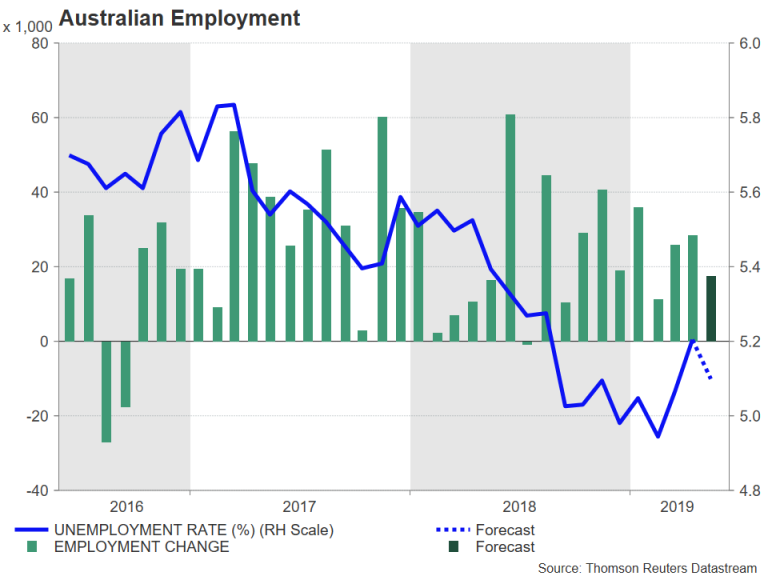
The Reserve Bank of Australia delivered its first rate cut in three years this week and markets are anticipating two more 25-bps cuts before the year end. Despite those odds, the Australian dollar is headed for weekly gains of more than 0.5% against its US counterpart as the Fed could soon join the RBA in lowering borrowing costs. As a result, the aussie has managed to climb to near one-month highs. However, whether the rebound proves sustainable or not could depend on next week’s releases from Australia and China.
Traders will be watching the NAB business confidence index on Tuesday and Westpac’s consumer sentiment gauge on Wednesday, as well as the latest employment report on Thursday. April’s jobs numbers had disappointed and were a factor in the RBA’s decision to go ahead with a rate cut. Another weak report in May would increase speculation of more cuts to come, whereas an improvement in the labour market may see investors paring back their expectations.
Big week for Chinese releases
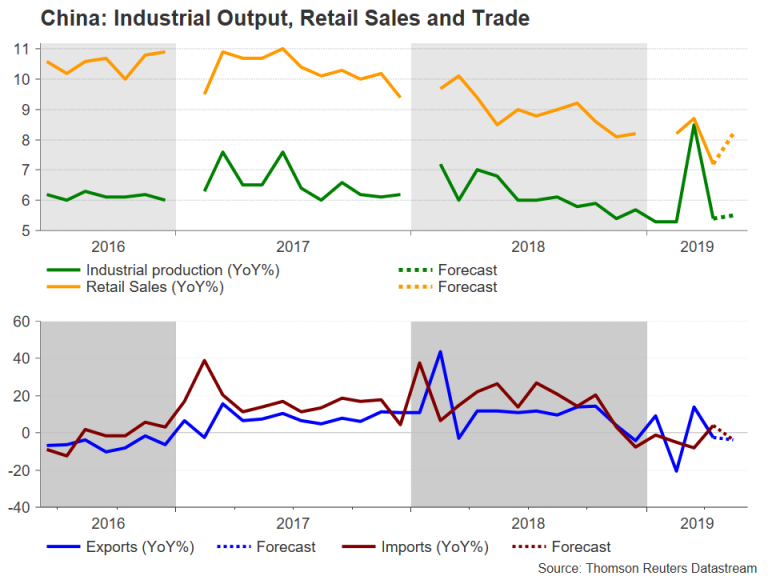
Chinese data will also be highly significant for the aussie given that China is the biggest buyer of Australian exports. Trade figures are out on Monday and economists are forecasting a second straight month of an annual drop in exports in May. On Wednesday, the producer and consumer price indices will be published for May, and rounding up the week on Friday are industrial output, retail sales and fixed-asset investment.
Growth in industrial production and retail sales are projected to have accelerated in May from an unexpectedly bad April. Market sentiment will be especially sensitive to the export and industrial output numbers as very poor readings in these barometers would heighten worries about slowing growth in the world’s second largest economy.
Japanese data not expected to be game changer for yen
As the yen approaches the highs it scaled during the flash crash of early January, the moves are sure to be raising eyebrows at the Bank of Japan. But with limited tools available at the BoJ’s disposal, next week’s figures are not expected to prompt policymakers into action just yet.
Revised GDP estimates for the first quarter are due on Monday, to be followed by corporate goods prices and machinery orders for May on Wednesday. Machinery orders – seen as a good indicator for future capital spending – has been declining year-on-year during the first quarter. A negative reading for April as well would signal Japanese businesses continue to see weak demand for their goods.
SNB meets; to likely comment on franc’s rise
There’s not going to be much of interest for traders on the European calendar next week but that’s not to say the euro will be out of the spotlight as headlines about Italy have the potential to generate considerable volatility for the single currency. So far, there’s only been a cautious response by the markets to news that the European Commission has begun disciplinary action against Italy over excessive debt. The euro and Italian government bond prices could come under pressure if Italy’s coalition partners take a confrontational approach to the EU’s decision, or, infighting on how to deal with the country’s economic troubles leads to the resignation of the prime minister, Guiseppe Conte.
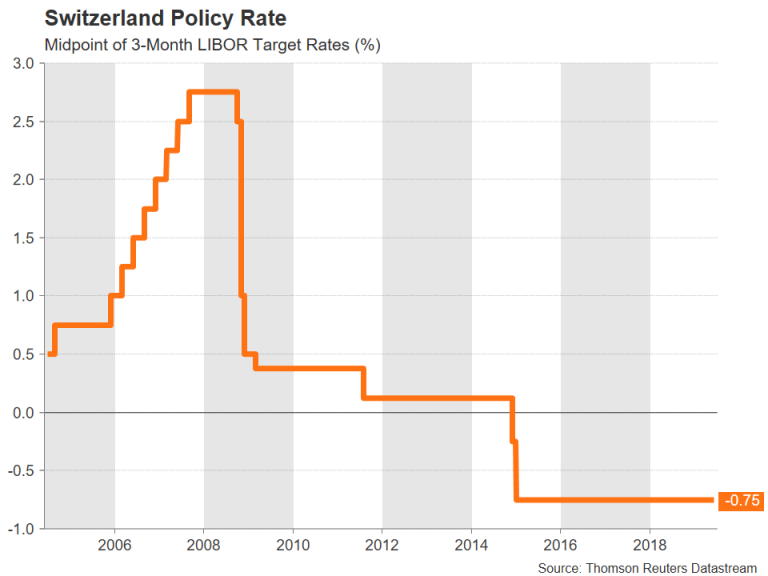
Also impacting the euro will be the Swiss National Bank’s policy decision on Thursday. The SNB is expected to hold interest rates unchanged in negative territory but could signal looser policy as a risk-off driven strong currency and global trade tensions threaten to derail Switzerland’s growth rebound enjoyed in the first quarter. SNB Chairman Thomas Jordan will probably also reiterate the central bank’s willingness to intervene in foreign exchange markets to keep the Swiss franc down. Policymakers are unlikely to be happy about the franc’s appreciation to 22-month highs versus the euro this week and euro/franc could face a sell-off if Jordan issues a strongly worded statement on the exchange rate.
Plenty of UK data but focus on Tory leadership race
The race on who will replace Theresa May as Conservative party leader and as prime minister is well and truly underway and the first ballot to trim down the long list of candidates will take place on June 13. Thus, amidst all the political headlines, next week’s numbers from the UK could merely act as a distraction for the pound.
Still, investors will be keeping an eye on key monthly stats for possible signs UK growth could be faltering. Manufacturing output was boosted in March due to businesses stockpiling on fears of a hard Brexit. But with the Brexit deadline now pushed back until at least October 31, production likely fell back significantly in April.
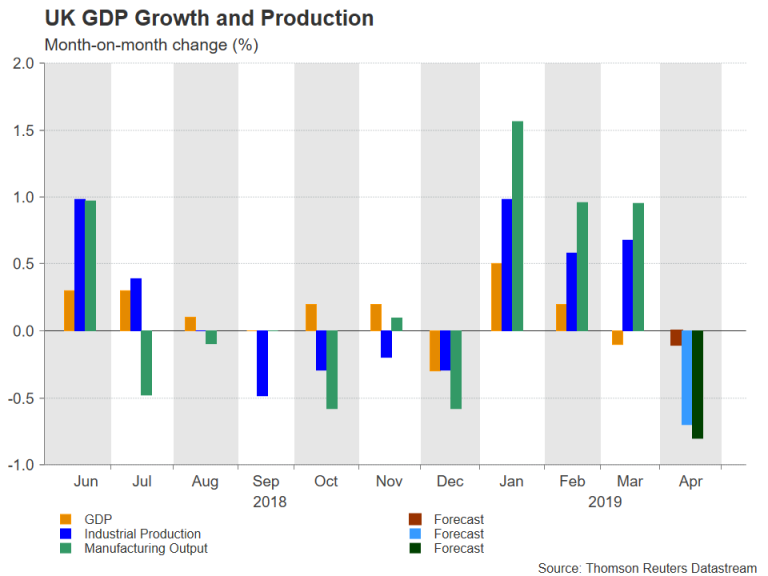
The services sector on the other hand is expected to have bounced back in April after being weighed by the Brexit turmoil in March. However, this probably wasn’t enough to lift the month-on-month GDP change to positive from -0.1% in March. The GDP and industrial/manufacturing output numbers will be released on Monday, along with April trade data. The latest employment report will follow on Tuesday where the focal point will be the pace of jobs and wage growth, as a tight labour market is essential to sustain domestic consumption in the UK against the backdrop of the Brexit uncertainty and sluggish overseas demand.
Inflation and retail sales to be watched in the US
As traders speculate when a Fed rate cut will arrive, there should be plenty of clues from next week’s data out of the US. The JOLTS job openings for April will kick off the week on Monday and May producer prices will follow on Tuesday. Next up, and likely to attract more attention, will be CPI numbers on Wednesday. Annual inflation, according to the consumer price index, is forecast to ease back to 1.9% in May from 2.0% previously. The core rate is expected to remain unchanged at 2.1%. Although the Fed does not target CPI inflation, a decline in this measure would not bode well for the preferred PCE inflation, which is even lower than the CPI rate.
The other highlight in the US will be Friday’s retail sales figures. Retail sales are expected to have increased by 0.6% m/m in May, which would suggest US consumer spending is holding up in what would be a healthy sign for Q2 growth. Also due on Friday are May industrial production figures and the University of Michigan’s preliminary print of the consumer sentiment index for June.
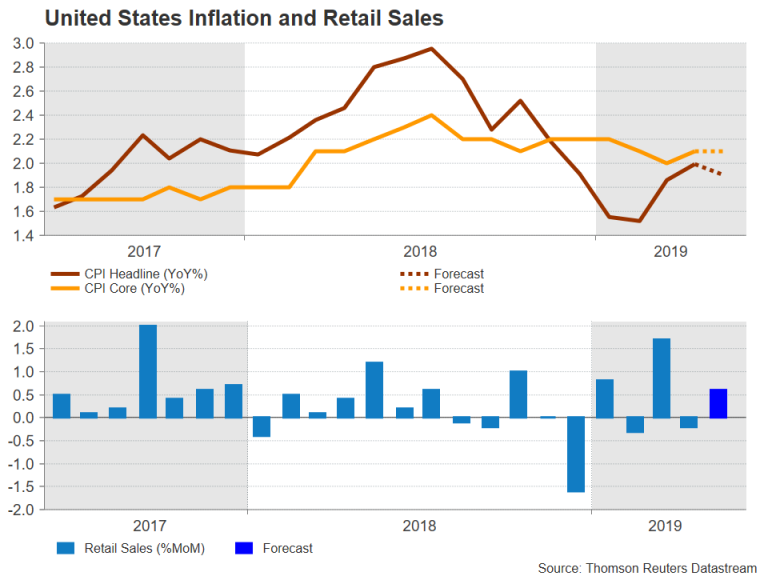
With recent data out of the US looking mixed, more of the same next week could help the sliding US dollar find a floor as this would indicate the American economy is nowhere near the doom and gloom that would cause the Fed to cut rates multiple times in the next 12 months, as is being predicted by the markets. However, any worrying numbers could fuel rate cut bets even more, pushing the greenback to new lows versus its peers, particularly the yen.
Weekly Focus: Trump to Make Final Decision on Mexican Tariffs
Market Movers ahead
- With no movement in the negotiations between the US and Mexico so far, there is a real risk of the US imposing higher tariffs on Mexican imports, although the decision may be postponed, as the Mexican government is seen to be taking the talks seriously.
- In the US, the Fed is entering its blackout period ahead of the FOMC meeting on 18-19 June, so there will not be any new Fed policy signals next week. Look out for industrial production and retail sales for May.
- In the euro area, industrial production data for April is due out.
- In the UK, the Conservative Party leadership contest officially kicks off. The first voting takes place next week and the final two candidates will be known the following week. We also get the monthly GDP print and labour market report.
- In Japan, we get revised Q1 GDP data, which may be interesting given the surprising flash estimate.
- In China, focus is on trade data for any signs of weakness in light of the ongoing trade conflict.
- In Sweden, inflation should come in lower than the Riksbank's projections, which puts pressure on the organisation ahead of the next meeting in early July.
Weekly wrap-up
- New Fed call - next step, rate cut
- Dovish ECB disappoints markets
- Euro area inflation misses estimates
- Markets dovishly priced