Sample Category Title
Big NFP Miss Confirms Summer Easing Path for Fed
The US employment report was terrible, making the rate cut decision a lot easier for Fed officials. The nonfarm payroll report came in at 75,000 jobs, missing the median estimate by 100,000 and when you factor in the two-month revisions of 75,000 jobs, you get a net zero in May. If the broader data on the economy continues to deteriorate going forward, we could see odds rise for two rate cuts before the summers over. The trade war has damaged sentiment and will likely continue drive the recent deceleration in the economy.
The odds for a rate cut at the June 19th meeting almost doubled to 33.2%, while the July 31st meeting sees a 74.6% chance for a cut. Labor data is lagging, so we might not need to wait for another month of employment data to further cement those odds. If we don’t see meaningful trade progress by the June 19th FOMC meeting, the Fed has ammunition to pull the trigger on a 25 basis rate point cut.
The dollar got crushed across the board, with declines of 0.4% to the euro, yen, and loonie.
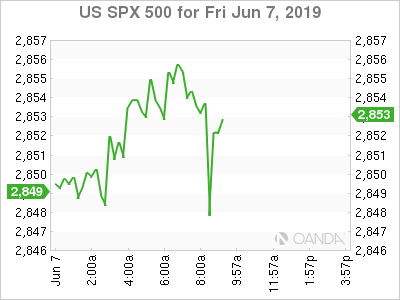
The Dow and S&P futures gave up their earlier gains and are looking at a slightly positive open.
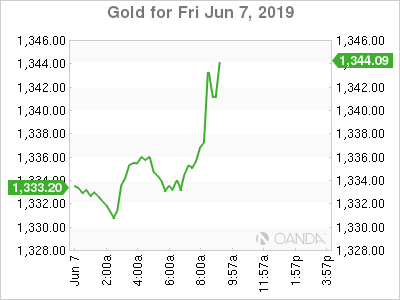
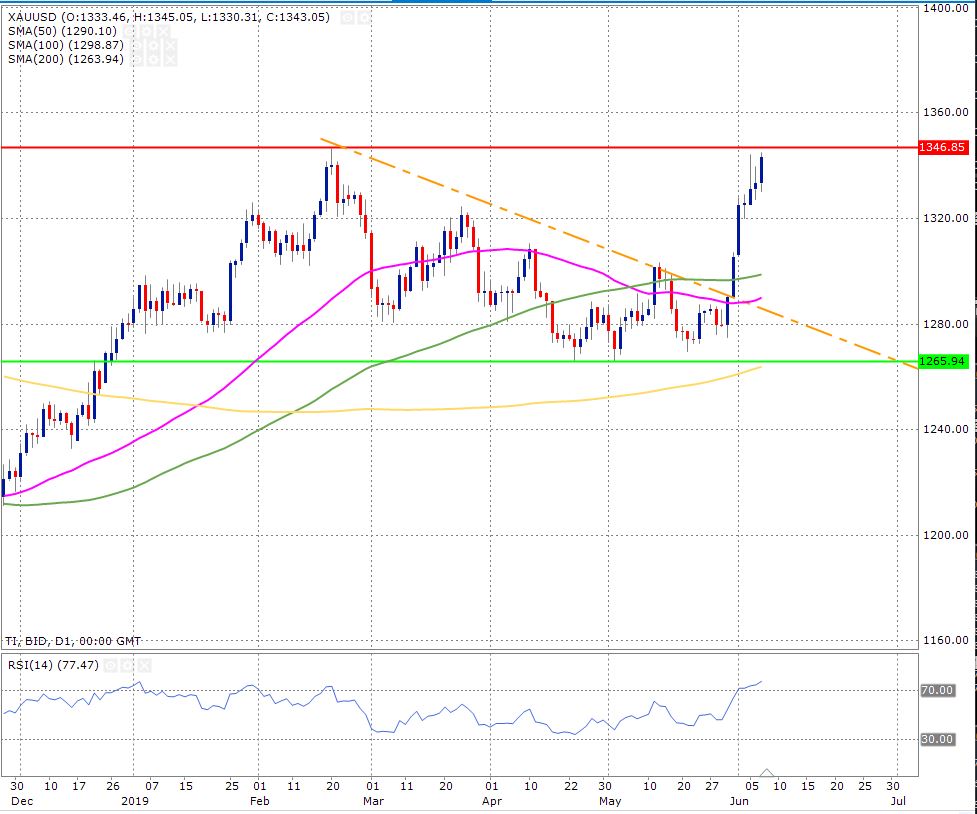
Gold’s bullish momentum is firmly in place and seems like only a matter of time before breaking out higher.
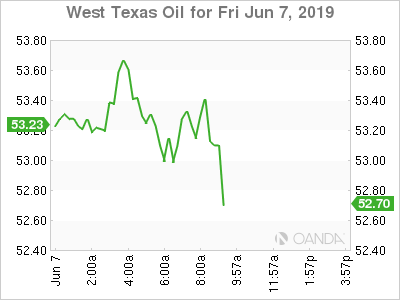
Oil was unfazed by the NFP release and still trading higher on overall risk-on tone and positive comments from the Saudi and Russian oil ministers.
Big Miss On US NFP Data; Gold Price Blasts To The Upside
*No change in US wage pressure and investors question full employment *Dollar index fell off the cliff
No new jobs created and that means no wage pressure but the miss on the headline number has shaken the sentiment among investors.
Usually the reaction would not be this rough, but investors are dropping the dollar index like a stone because of the concerns around the trade war.
Remember we are really in a situation where bad news is bad news. This is because the Fed is always late in the game and we clearly know that it has taken a long time for the Fed to acknowledge the weakness in the economic data, and now, the question is not for one rate cut but perhaps more
Nonetheless, the initial reaction for the gold price has been towards upside, and overall investors are optimistic about the current upward momentum.
Modestly More Canadian Jobs in May
- A net 27.7k more Canadians were at work in May. As modest as the headline gain was, a drop in the participation rate – after solid increases so far this year – was enough to pull down the unemployment rate to 5.4% - the lowest its been since at least 1976.
- The composition was a bit mixed. The gains were entirely full-time, but both the public and private sector shed jobs (-13.1k and -20.7k respectively), leaving a 61.5k rise in self-employment the driver of job growth.
- The service sector led the way (+22.8k), helped by gains in health care, professional services, and transportation. Goods-producers added 4.9k on generally modest performances from the main sub-sectors.
- Among the provinces, performances were generally modest. Rises in Ontario (+20.9k) and B.C. (+16.8k) were partly offset by generally modest performances elsewhere and a small decline in Quebec (-11.6k on net).
- Coming in a bit ahead of expectations, wage gains for permanent employees held steady at 2.6% year-on-year. Total hours worked fell for the fourth time in six months, down 0.3%.
Key Implications
- Meh. Looking past the new record low in the unemployment rate, this report was a bit on the soft side. All of the job gains (and then some) are down to self-employment, and the drop in the unemployment rate was driven by fewer Canadians engaging with labour markets, notably among the under-55 population. The only real bright spot was wages, which held up nicely despite some unfavourable base effects (i.e. strong gains this time last year).
- Still, we wouldn't get too hung up on this report. Some sort of pause/slowdown was to be expected eventually given the recent strength in hiring that has not been matched elsewhere in the economic data. We hope for a better composition, but today's report is consistent with our view of a more moderate pace of hiring going forward.
- For the Bank of Canada, today's report will serve to reinforce their cautious approach. Recent communication attributed weakness in hours worked to caution among employers. That caution clearly remains, and with trade uncertainty elevated, expect the Bank of Canada to stay on the sidelines for some time.
US Labour Market Report Shows Softening in Job Creation
- 75K jobs created in May, March and April gains revised down by 75K
- Unemployment rate held at 3.6% in May, the lowest in half a century
- Wage gains running at 3.1%, just slightly slower than in April
Today’s labour data showed a disappointing pace of job creation although the unemployment rate remained at a cycle low and wage growth eased very slightly. The weaker showing on employment accompanied other indicators that suggest the US economy is starting to show cracks. Talk of levying tariffs on imports from Mexico on top of increased tariffs on Chinese imports is taking a toll on the US industrial sector and manufacturing employment posted another month of very small gains. Services sector employment increased by 82K, about half the average pace of increase over the past five years. That said, business sentiment in the non-manufacturing sectors continues to hold up. Consumer confidence also improved in May with the cycle low unemployment rate and over 3% wage growth appearing to outweigh consumers’ concerns about the impact of escalating trade tensions. Today’s report hints that the US economy’s momentum may be starting to fray – and if some easing in trade tensions doesn’t emerge the industrial sector will start to look significantly worse.
EUR/USD Mid-Day Outlook
Daily Pivots: (S1) 1.1217; (P) 1.1263; (R1) 1.1322; More.....
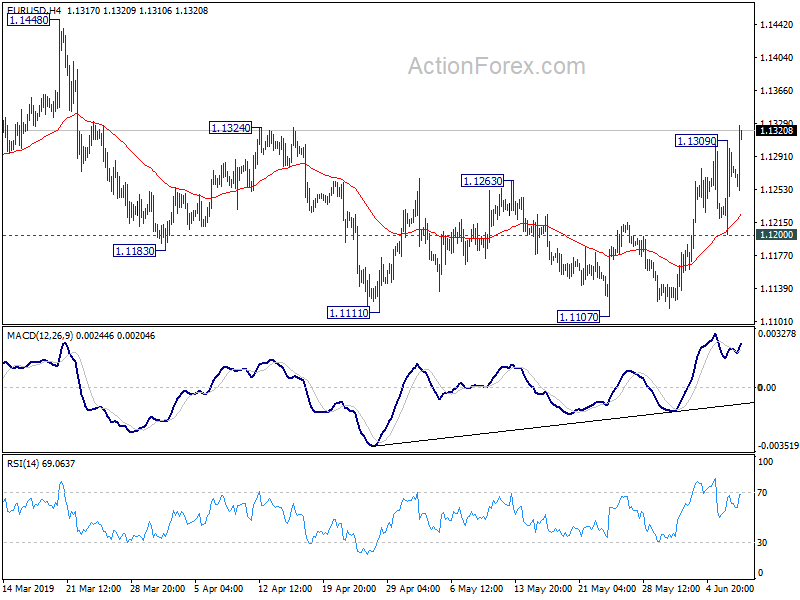
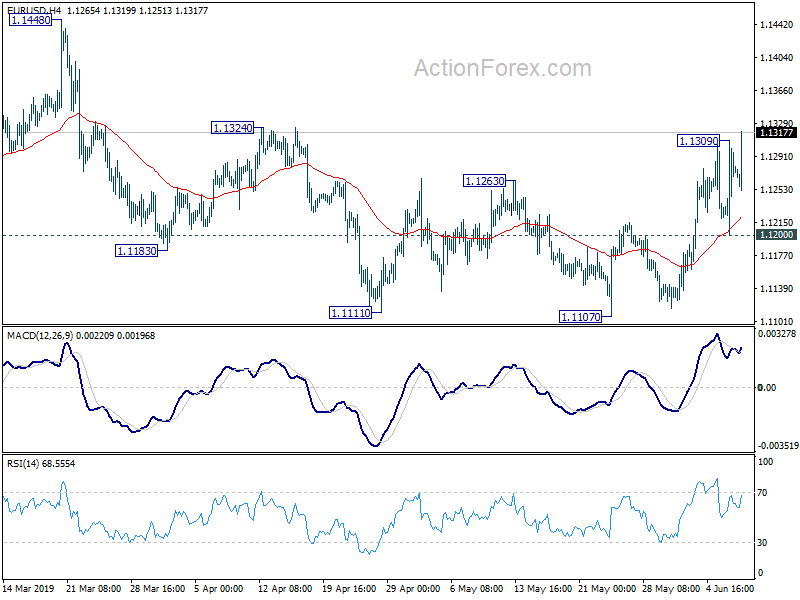
EUR/USD's rebound from 1.1107 resumes after brief consolidation and breaks 1.1309 temporary top. Intraday bias is back on the upside. Further rally should be seen towards 1.1448 key resistance next. Decisive break there will carry larger bullish implications. On the downside, break of 1.1200 support is needed to confirm completion of the rebound. Otherwise, further rise will remain in favor in case of retreat.
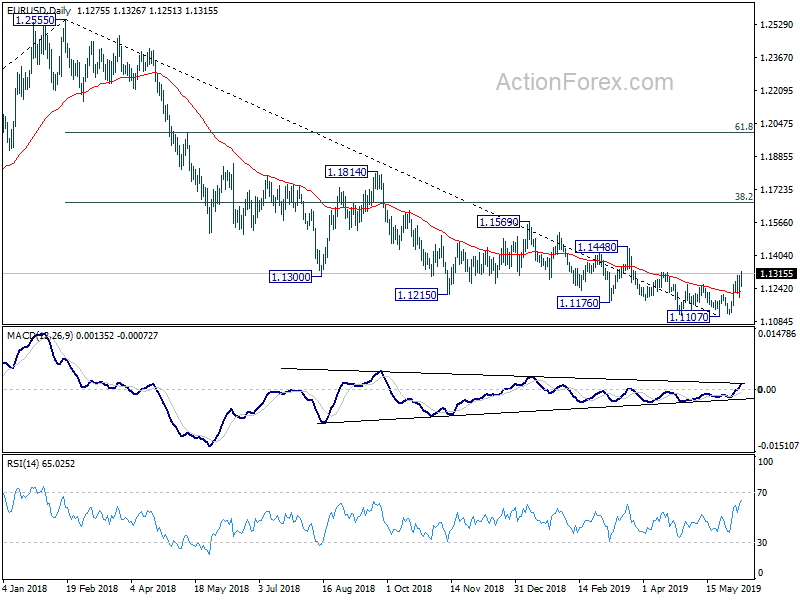
In the bigger picture, down trend from 1.2555 (2018 high) might still be in progress. Such decline would target 78.6% retracement of 1.0339 (2016 low) to 1.2555 (2018 high) at 1.0813 on resumption. However, break of 1.1448 resistance would confirm medium term bottoming, on bullish convergence condition in daily MACD. In such case, stronger rebound should be seen to 38.2% retracement of 1.2555 to 1.1107 at 1.1660. We'd look at the structure of the rebound to decide whether it's a corrective rise later.
Dollar and Yield Tumble as Poor NFP Affirms Fed’s Rate Cut
Dollar tumbles sharply in early as poor non-farm payroll report affirms the case for Fed rate cut this year. The headline number of 75k is a big miss. Equally importantly, weaker than expected wage growth argues that inflation pressure could remain subdued ahead. The question now is on whether there will be substantial improvement in trade tensions ahead. As Dallas Fed Kaplan put, things could be turned around in a matter of weeks. Though, at least, there is little chance for a deal between US and China in the near term. Hope is more on whether Mexico could avert the tariffs due Monday.
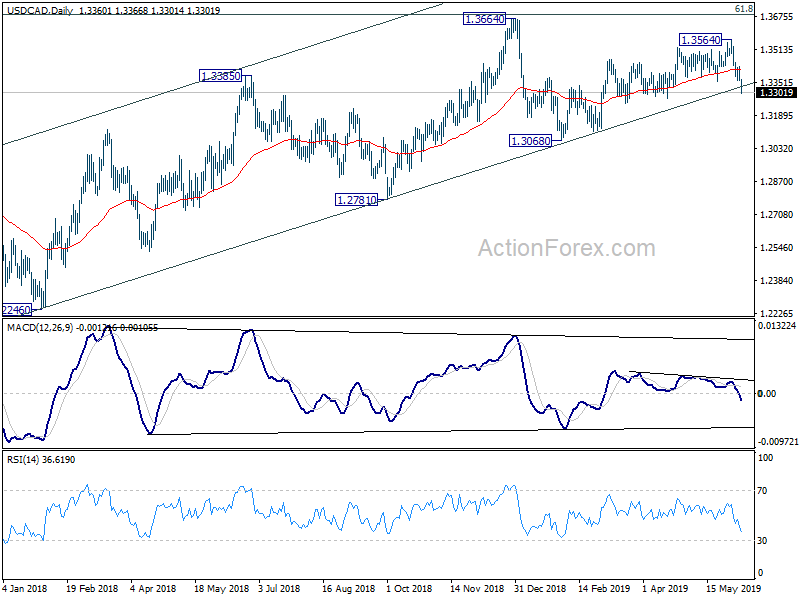
Technically, the biggest mover is found in USD/CAD, which plummets on strong Canadian job data. Current development firstly confirms completion of rise from February's low of 1.3068. More importantly, there is sign of reversing the medium term trend from 2017 low of 1.2061 too. EUR/USD also breaks through yesterday's high of 1.1309. Rebound from 1.1107 is now expected to extend towards 1.1448 key resistance Though, for now, Dollar is held above this week's low again Swiss, Yen and Aussie. We'd see if there is breakout before weekly close.
In other markets, DOW futures is still trading up 0.1% at the time of writing. But 10-year yield extends recent decline to as low as 2.059. In Europe, currently, FTSE is up 0.57%. DAX is up 0.37%. CAC is up 1.17%. German 10-year yield is down -0.016 at -0.252, extending the run for record lows. Earlier in Asia, Nikkei rose 0.53%. Hong Kong and China were on holiday. Singapore Strait Times rose 0.64%. Japan 10-year JGB yield rose 0.0048 to -0.116.
Big miss in US NFP, Canadian unemployment rate dropped to lowest since 1976
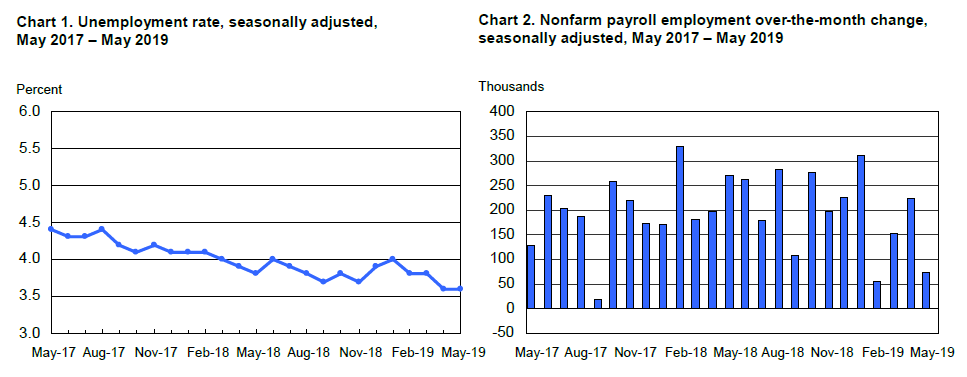
US non-farm payroll grew 75k in May, well below expectation of 180k. monthly job gains have averaged 164k in 2019, notably lower than 223k monthly average in 2018. Unemployment rate was unchanged at 3.6% while participation rate was unchanged at 62.8%. Average hourly earnings rose 0.2% mom, below expectation of 0.3% mom.
Canada employment grew 27.7k in May, well above expectation of -5.5k contraction. Unemployment dropped to 5.4%, well below expectation of 5.7%. That's the lowest level since record began in 1976.
USD/CAD dives sharply after the release and breaks medium term channel support decisively. The development now suggests medium term bearish reversal and focus will be on 1.3068 support for confirmation.
Bundesbank slashes 2019 German growth forecasts to 0.6% (down from 1.6%), lacklustre export growth taking a toll
Bundesbank sharply slashed German growth forecasts to just 0.6% in 2019 and said the economy is "currently experiencing a marked cool down". That is "mainly due to the downturn in industry, where lacklustre export growth is taking a toll. Nevertheless, "a more protracted, clear decline in economic output currently seems an unlikely prospect, though." And, "once foreign demand picks up, German economic growth will be more broadly based again."
Still, risks are tilted to the downside. And, it warned "additional negative external developments could intensify or prolong the downturn in Germany's strongly export-driven economy." In particular, the experts warn that an escalation of protectionist measures around the world could place considerable strain on German industry. In addition, they highlight the possibility of a disorderly Brexit as well as uncertainties surrounding the fiscal policy stance of the Italian government as risk factors for economic growth in Germany.
On GDP growth: 2019 at 0.6% (down from Dec projection of 1.6%); 2020 at 1.2% (down from 1.6%); 2021 at 1.3% (down from 1.5%). On HICP: 2019 at 1.4% (unchanged); 2020 at 1.5% (down from 1.8%); 2021 at 1.7% (down from -0.1%;
Also released from Germany, industrial production dropped -1.9% mom in April, much worse than expectation of -0.5% mom. Trade surplus narrowed to EUR 17.0B in April. From Swiss, foreign currency reserves dropped CHF -16B to CHF 760B. Unemployment rate was unchanged at 2.4%.
ECB Vasle: TLTRO keeps favorable financing conditions and supports transmission of monetary policy
ECB Governing Council member Bostjan Vasle said the biggest risks for Eurozone growth is that worsening global condition could slow trade. However, the current favorable financing conditions and robust domestic demand will support Eurozone economy.
He emphasized that "it is of key importance that the instrument (TLTRO) keeps favorable conditions of financing for banks and thus supports transmission of monetary policy into banks' credit activity". Also ECB stand ready to use "other available measures" if needed.
Vasle also noted that persistent low inflation is a result of moderation in growth, weaker energy prices and lower wage pressures. He said "the council of governors has responded to these movements by adjusting its decrees with a purpose of ensuring the necessary accommodation line of its monetary policy also in worsened conditions."
Separately, another Governing Council member Vitas Vasiliauskas said inflation outlook is "not bad". And, the council still needs time to see however the economy developments in the second half of the year. Also a Governing Council member, Ewald Nowotny said there is no risk of recession, just a slowdown.
BoE survey: 5-year inflation expectation hits decade high
The BoE Inflation Attitudes Survey showed the public's five year inflation expectation jumped sharply to 3.8% in May, hitting the highest level in more than a decade.
Looking at somes details: Current inflation rate is seen at 3.1% (median), up from February's 2.9%. One year inflation expectation is at 3.0%, up from 2.9%. 5-year inflation expectation is at 3.8%, up from 3.4%.
On interest rates: 18% said rates should go up, up from 17%. 19% said rates should go down, up from 17%. 35% said no change, down from 37%.
PBoC Yi: Tremendous room in fiscal and monetary policy to counter trade war
People's Bank of China Governor Yi Gang said in a Bloomberg interview that China has "tremendous" room for adjusting its fiscal and monetary policy to counter the impact of trade war with US. And, there is no red line in Yuan's exchange rate.
"We have plenty of room in interest rates, we have plenty of room in required reserve ratio rate, and also for the fiscal, monetary policy toolkit, I think the room for adjustment is tremendous," Yi said. He also noted that China's fiscal policy this year is "probably the largest and strongest fiscal reform package". That include tax cuts and fiscal resources allocation. If situation is getting "a little bit worse", the current fiscal package "is able to cover". But it situations gets "tremendously worse", they will "open the discussion".
On Yuan exchange rate, Yi said "trade war would have a temporary depreciation pressure on renminbi". However, he insisted "after the noise, renminbi will continue to be very stable and relatively strong compared to emerging market currencies, even compared to convertible currencies." Meanwhile, Yi also emphasized there is no red line in the exchange rate, and no "numeric number" is more important than the others.
Released in Asian session, Australia home loans dropped -1.2% mom in April versus expectation of -0.3% mom. AiG Performance of Construction index dropped further to 40.4 in May, down from 42.6. From Japan, household spending rose 1.3% yoy in April versus expectation of 2.7% yoy. Labor cash earnings dropped -0.1% yoy versus expectation of -0.7% yoy. Leading indicator dropped to 95.5, down from 95.9.
EUR/USD Mid-Day Outlook
Daily Pivots: (S1) 1.1217; (P) 1.1263; (R1) 1.1322; More.....
EUR/USD's rebound from 1.1107 resumes after brief consolidation and breaks 1.1309 temporary top. Intraday bias is back on the upside. Further rally should be seen towards 1.1448 key resistance next. Decisive break there will carry larger bullish implications. On the downside, break of 1.1200 support is needed to confirm completion of the rebound. Otherwise, further rise will remain in favor in case of retreat.
In the bigger picture, down trend from 1.2555 (2018 high) might still be in progress. Such decline would target 78.6% retracement of 1.0339 (2016 low) to 1.2555 (2018 high) at 1.0813 on resumption. However, break of 1.1448 resistance would confirm medium term bottoming, on bullish convergence condition in daily MACD. In such case, stronger rebound should be seen to 38.2% retracement of 1.2555 to 1.1107 at 1.1660. We'd look at the structure of the rebound to decide whether it's a corrective rise later.
Economic Indicators Update
| GMT | Ccy | Events | Actual | Forecast | Previous | Revised |
|---|---|---|---|---|---|---|
| 22:30 | AUD | AiG Performance of Construction Index May | 40.4 | 42.6 | ||
| 23:30 | JPY | Overall Household Spending Y/Y Apr | 1.30% | 2.70% | 2.10% | |
| 23:30 | JPY | Labor Cash Earnings Y/Y Apr | -0.10% | -0.70% | -1.90% | -1.30% |
| 01:30 | AUD | Home Loans M/M Apr | -1.20% | -0.30% | -2.80% | -2.30% |
| 05:00 | JPY | Leading Index CI Apr P | 95.5 | 96 | 95.9 | |
| 05:45 | CHF | Unemployment Rate May | 2.40% | 2.40% | 2.40% | |
| 06:00 | EUR | German Industrial Production M/M Apr | -1.90% | -0.50% | 0.50% | |
| 06:00 | EUR | German Trade Balance (EUR) Apr | 17.0B | 18.7B | 20.0B | |
| 07:00 | CHF | Foreign Currency Reserves (CHF) May | 760B | 772B | ||
| 12:30 | CAD | Net Change in Employment May | 27.7K | -5.5K | 106.5K | |
| 12:30 | CAD | Unemployment Rate May | 5.40% | 5.70% | 5.70% | |
| 12:30 | USD | Change in Non-farm Payrolls May | 75K | 180K | 263K | 224K |
| 12:30 | USD | Unemployment Rate May | 3.60% | 3.60% | 3.60% | |
| 12:30 | USD | Average Hourly Earnings M/M May | 0.20% | 0.30% | 0.20% | |
| 14:00 | USD | Wholesale Inventories M/M Apr F | 0.70% | 0.70% |
Canada unemployment dropped to 5.4%, lowest since 1976, USD/CAD dives
Canada employment grew 27.7k in May, well above expectation of -5.5k contraction. Unemployment dropped to 5.4%, well below expectation of 5.7%. That's the lowest level since record began in 1976.
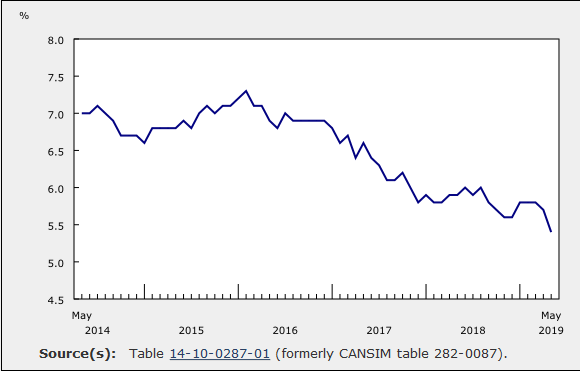
USD/CAD dives sharply after the release and breaks medium term channel support decisively. The development now suggests medium term bearish reversal and focus will be on 1.3068 support for confirmation.
Dollar dives as NFP grew only 75k, EURUSD breaks 1.13 again
US non-farm payroll grew 75k in May, well below expectation of 180k. monthly job gains have averaged 164k in 2019, notably lower than 223k monthly average in 2018. Unemployment rate was unchanged at 3.6% while participation rate was unchanged at 62.8%. Average hourly earnings rose 0.2% mom, below expectation of 0.3% mom.
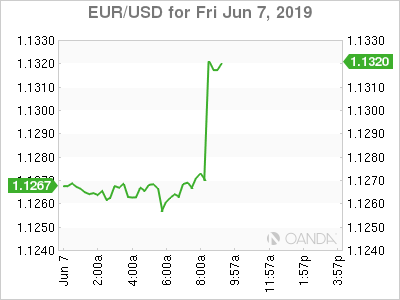
Dollar is sold off immediately after the release. In particular, EUR/USD breaks yesterday's high of 1.1309 to resume the rally from 1.1107. Further rise should now be seen towards 1.1448 key resistance next.
FTSE Hits 2-Week High on Hopes U.S Won’t Hit Mexico with Tariffs
The FTSE has posted considerable gains on Friday. Currently, the index is trading at 7,323, up 0.67% on the day. On the release front, there are no key British events. All eyes are on the U.S., which will release key employment numbers. Nonfarm payrolls are expected to fall sharply to 177 thousand, while wage growth is projected to edge up to 0.3%.
Risk appetite has improved, boosting global equity markets. The FTSE has sparkled this week, posting gains of 2.3%. The index has posted four successive winning sessions and the gains have continued on Friday. Concerns about a new trade war have eased, after reports that the U.S. could delay imposing tariffs on Mexico. President Trump had threatened to punish Mexico if it does not take measures to solve the illegal immigration crisis. Mexico has responded by cracking down on illegal immigration from Guatemala, and Vice-President Pence said this was a positive step. Still, it’s unclear if Trump will suspend the tariffs, which are scheduled to take effect on June 10. If the tariffs are put in place, equity markets will likely head lower.
British PMIs, which are gauges of key sectors of the economy, are pointing to weakness in the U.K. economy. The manufacturing and services PMIs missed their estimates and came in at 48.6 and 49.4, which indicates contraction. The services PMI was slightly better, with a reading of 51.0. Still, the blue-chip FTSE has rebounded after a dismal month of May, when the index fell 3.6%. The FTSE has clawed back in June, with gains of 2.3%.
Traders are keeping a close eye on U.S. nonfarm payrolls for May. Earlier in the week, ADP nonfarm payrolls plunged to a paltry 27 thousand for May, down from 275 thousand a month earlier. Will the official release also nosedive? The markets are expecting NFP to fall to 177 thousand, compared to 263 thousand a month earlier. If the estimates are on target and NFP sags, risk appetite could drop and weigh on the FTSE.
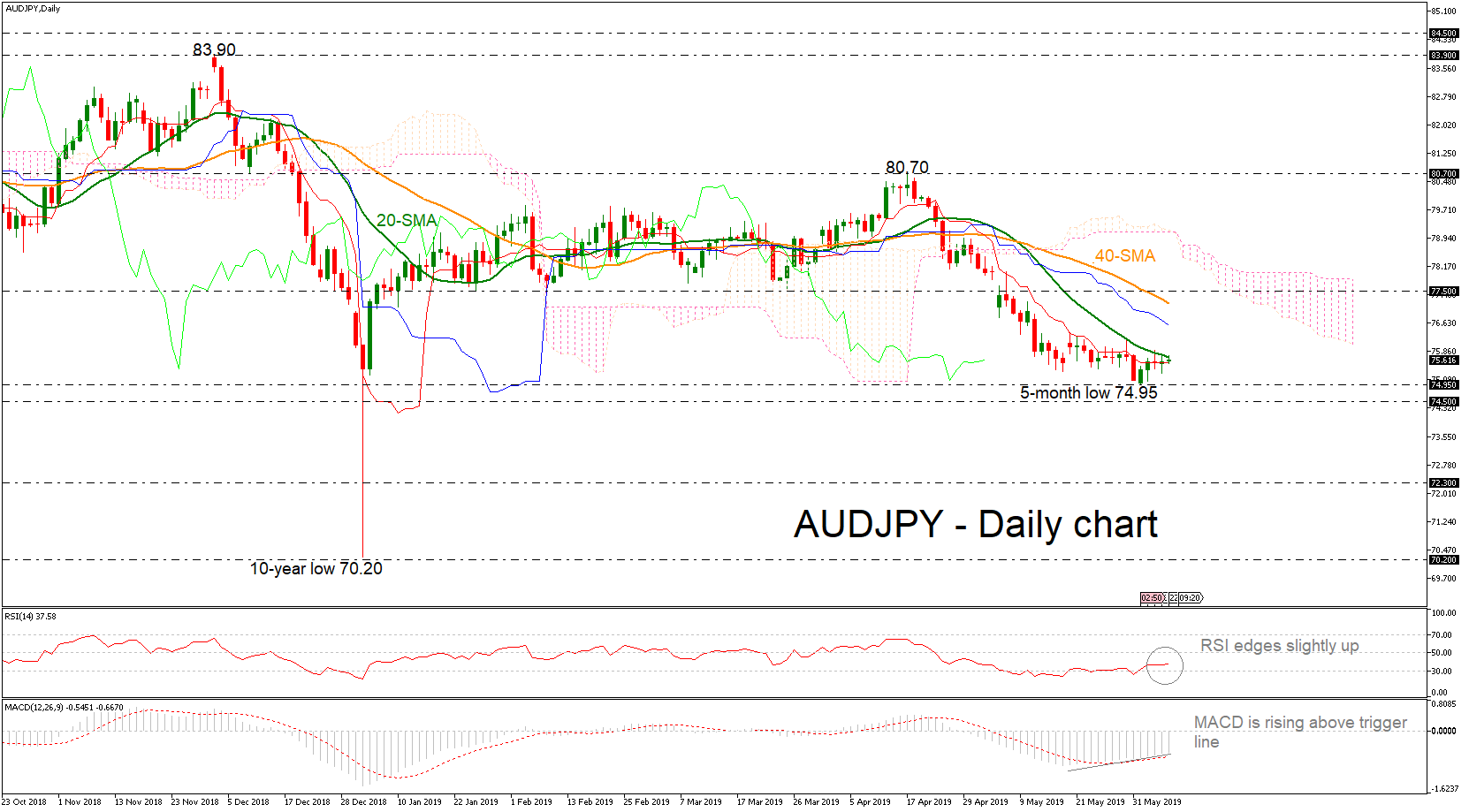
AUDJPY Bulls Face Big Challenge Around 20-SMA
Selling interest is continuing in the AUDJPY market, remaining below the 20-day simple moving average (SMA). However, the technical indicators are suggesting a possible upside correction. The MACD is strengthening its bullish momentum above the trigger line, while the RSI is looking slightly positive in the negative threshold.
Should positive pressure come in play and the price surpasses the 20-SMA obstacle, resistance could be faced around the 77.16 level, where the 40-SMA is standing. Above this level, the 77.50 resistance could be the next key level to watch.
On the other hand, a drop below the five-month low of 74.95 could take the price until the immediate support of 74.50 ahead of the 72.30 barrier, identified by the low on June 2016.
In the short-term, the downfall from the 80.70 barrier opened the way for a new downside rally. A successful drop below 74.50 could add more fuel to the bears, while a jump above the 20-SMA could add positive sentiment in the market.