Sample Category Title
Forex Technical Analysis: EUR/USD, USD/JPY, GBP/USD
EUR/USD
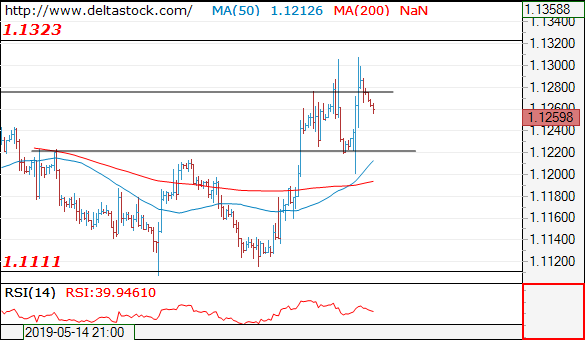
Current level - 1.1259
The test of 1.1220 failed and the pair is struggling again below 1.1330 resistance. The intraday bias is neutral.
| Resistance | Support | ||
| intraday | intraweek | intraday | intraweek |
| 1.1330 | 1.1330 | 1.1220 | 1.1015 |
| 1.1330 | 1.1450 | 1.1110 | 1.0860 |
USD/JPY
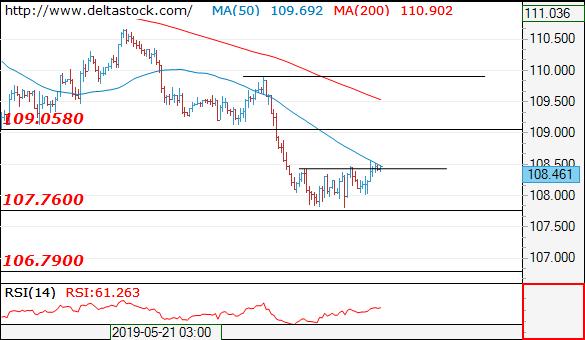
Current level - 108.46
The intraday bias is slightly positive, for a rise towards 109.05 area. Crucial on the downside is 108.00 low.
| Resistance | Support | ||
| intraday | intraweek | intraday | intraweek |
| 108.50 | 109.90 | 108.00 | 107.70 |
| 109.05 | 112.40 | 106.70 | 106.70 |
GBP/USD
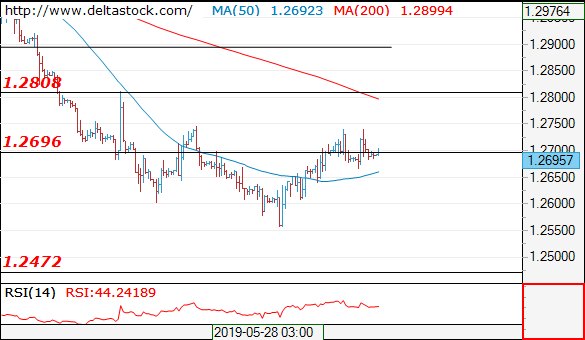
Current level - 1.2695
My outlook here is neutral, as the pair is currently trading below the minor resistance at 1.2750. Next hurdle on the upside is 1.2810.
| Resistance | Support | ||
| intraday | intraweek | intraday | intraweek |
| 1.2745 | 1.2960 | 1.2640 | 1.2570 |
| 1.2810 | 1.3170 | 1.2550 | 1.2470 |
EUR/USD – Euro Ticks Lower As German Industrial Production Shrinks
EUR/USD has ticked lower in the Friday session, after gaining ground on Thursday. Currently, the pair is trading at 1.1268, down 0.07% on the day. On the release front, German numbers were a disappointment. Industrial production declined 1.9%, much weaker than the estimate of -0.4%. Germany’s trade surplus narrowed to EUR17.0 billion in April, below the estimate of EUR 18.7 billion. This marked the lowest surplus since July 2018. In the U.S., the focus is on employment numbers. Nonfarm payrolls are expected to fall sharply to 177 thousand, while wage growth is projected to edge up to 0.3%.
The message from the ECB policy meeting was dovish, yet the euro still managed to post considerable gains on Thursday. The ECB surprised the markets by revising its forward guidance, saying that it would not raise interest rates prior to middle of 2020. Previously, the bank had said that it would not hike rates prior to the spring of 2020. The delay is a response to weak economic conditions in the eurozone, as the global trade war has taken a toll on manufacturing and exports in Germany and the rest of the bloc.
As expected, ECB President Draghi said that ECB will pay banks to borrow funds from the central bank, if the funds are passed on to consumers and small businesses. This is a stimulus measure with the aim of boosting spending in the private sector. The bank upwardly revised its 2019 outlooks for growth and inflation. In March, the ECB forecast GDP at 1.1% and inflation at 1.2% – these were revised to 1.2% and 1.3%, respectively.
Traders will be keeping a close eye on U.S. nonfarm payrolls for May. Earlier this week, ADP nonfarm payrolls plunged to a paltry 27 thousand for May, down from 275 thousand a month earlier. Will the official release follow suit? The markets are expecting NFP to fall to 177 thousand, compared to 263 thousand a month earlier. If the estimates are on target, the dollar could lose ground in the North American session.
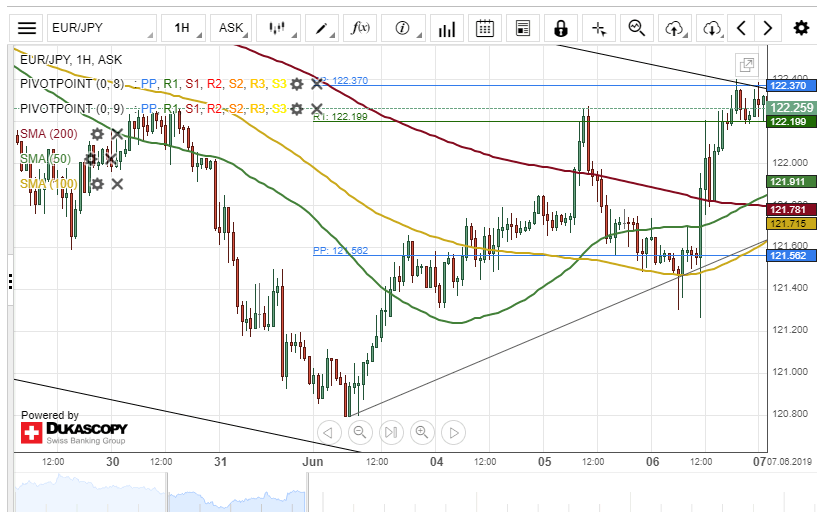
EUR/JPY Makes New High
The single European currency made a new swing high against the Japanese Yen on Thursday. The currency pair tested the upper boundary of a descending channel pattern at 122.37 during yesterday's trading session.
As for the near future, it is likely that the exchange rate will continue to edge higher. The potential upward swing for bullish traders will be near the weekly pivot point at 123.44.
However, given that technical indicators flash bearish signals on both the smaller and the larger time-frame charts, bears could drag the currency exchange rate towards the 50-hour SMA at 121.88 within this session
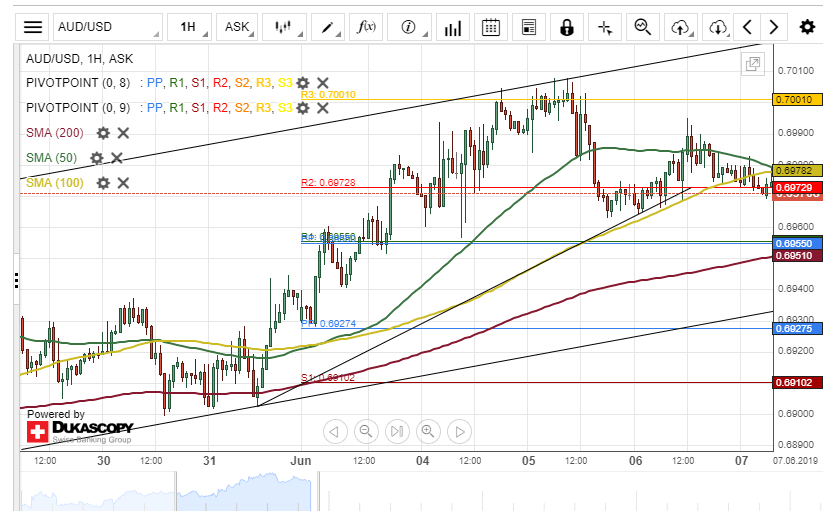
AUD/USD Awaits NFP
The 100-hour simple moving average guided the Australian Dollar versus the US Dollar on Thursday. The currency pair appreciated about 31 base points during yesterday's trading session.
Given that the exchange rate has breached both the 50– and 100-hour SMAs at 0.6977, it is likely that the pair will aim for a support level formed by the 200-hour simple moving average at 0.6950 within this session.
However, today's macroeconomic data releases scheduled at 12:30 GMT could play a significant role in the overall positioning of the currency exchange rate during the following trading session.
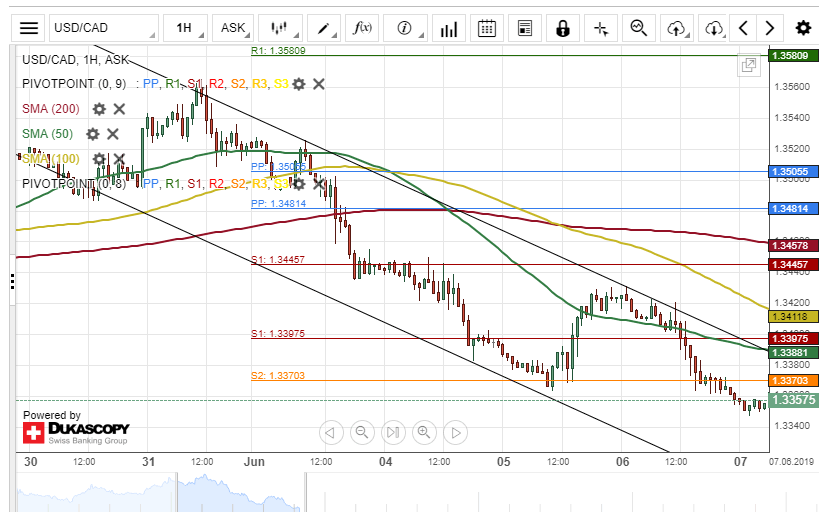
USD/CAD Awaits Unemployment Rate
The US Dollar edged lower by about 75 base points against the Canadian Dollar on Thursday. The currency pair was pressured south by the 50-hour simple moving average during Thursday's trading session.
By and large, most likely, the USD/CAD exchange rate will continue its southern journey within this session. The potential target for bearish traders will be near the bottom border of the descending channel pattern at 1.3310.
Nevertheless, Friday's macroeconomic data releases, namely, the US Non-Farm Payroll and the Canadian unemployment rate could make technical analysis obsolete today.
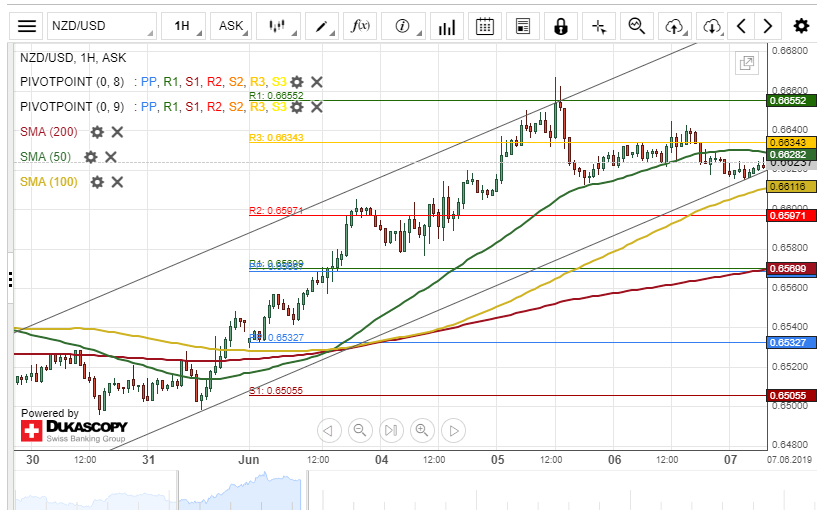
NZD/USD Awaits US Macroeconomic Data Releases
The New Zealand Dollar traded sideways against the US Dollar on Thursday. However, the exchange rate managed to breached the 50-hour simple moving average during the previous trading session.
The currency pair is currently trading near the lower boundary of an ascending channel pattern and could be set for a breakout.
If this breakout occurs, bearish traders could push the currency exchange rate lower within this session.
Although, the US Non-Farm Employment Change and Unemployment Rate could be a game-changer during the following trading session.
BoE survey: 5-year inflation expectation hits decade high
The BoE Inflation Attitudes Survey showed the public's five year inflation expectation jumped sharply to 3.8% in May, hitting the highest level in more than a decade.
Looking at the details:
- Current inflation rate is seen at 3.1% (median), up from February's 2.9%.
- One year inflation expectation is at 3.0%, up from 2.9%.
- 5-year inflation expectation is at 3.8%, up from 3.4%.
On interest rates:
- 18% said rates should go up, up from 17%.
- 19% said rates should go down, up from 17%.
- 35% said no change, down from 37%.
Trade Duty Threats Weigh On MXN
Times have become difficult for December-elected President Andres Manuel Lopez Obrador. US President unexpected threat of implementing tariffs on all exports to the US set for next Monday as well as recent Fitch downgrade and Moody’s negative outlook could push the country into a recession.
Mexico’s heavy reliance on external trade makes the country much more sensitive to potential trade war effects. Total exports contribution to GDP accounts for 35% or over $450 billion, while US exports are estimated at 80% of the total. Therefore, a unique tariff slap from the US of 5% would imply duties of $18 billion worth and if no convincing solutions are presented by Mexican Foreign Ministry to stem illegal immigration, the rise could set at 10% on 1 July and then increase by five percentage points each month until October 25% threshold is reached. Although this scenario is yet far from being reasonable, USD/MXN grew +2.89% as the announcements made by Fitch and Moody’s added oil to the fire. Fitch cut Mexico’s sovereign debt to BBB, at the border between investment grade and junk status, while Moody’s followed S&P and cut its outlook to negative due to AMLO’s $8 billion refinery spending plan, Petroleos Mexicanos, the state-owned and world’s most indebted oil company as well as recent trade tensions with Mexico’s first commercial partner. While the recent decision offsets positive sentiment from last week over USMCA trade of steel and aluminum, we expect Mexican peso to remain under pressure short-term until final call. In the event of a no-deal, we should see upside risks to inflation, which the Banxico would defend by maintaining high interest rates (Overnight rate: 8.25%) and tight monetary conditions, at the cost of economic growth. In the opposite scenario, Mexican peso would benefit from a push. A last-minute deal is however very likely.
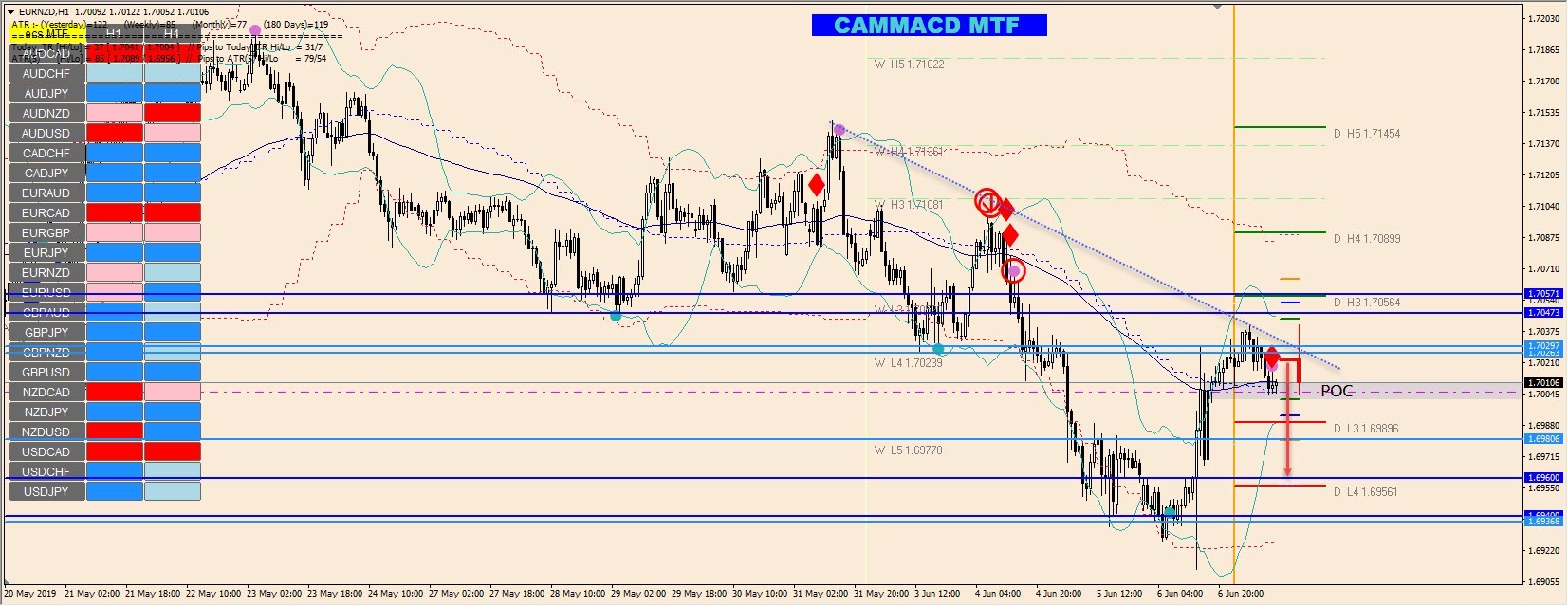
EUR/NZD Bearish Pressure Building If The Price Goes Below The POC
The EUR/NZD went into a retracement mode reaching confluence spot where we might be looking for short trade opportunities
1.7005-15 is the POC zone where the price is consolidating. We can also spot a T-89 pattern and the re-entry dot (pink). It could create another bearish pressure if sellers join the fray. Targets are 1.6980 followed by 1.6960. As the price already went below W L5, it is a sign of strong bearishness in the EUR/NZD pair. However, today is NFP so we will see a big volatility later during the US session. Be careful with risk placement.
GBP/USD Outlook: Pound Remains Bid But Lacks Direction, US Jobs Data Eyed For Fresh Signals
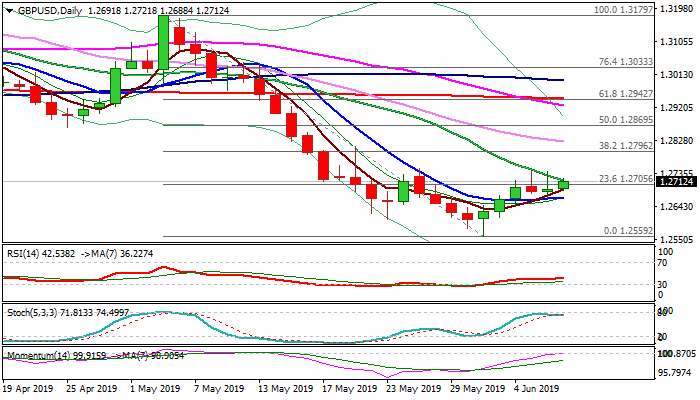
Cable remains constructive in early Friday's trading, modestly supported by surprise results of election in eastern England and better than expected UK May housing data, released this morning Fresh upside attempts remain for now capped by falling 20SMA (1.2715) which limited the action of past two days. Two daily candles with long upper shadows signal that recovery from 1.2559 (31 May low) might be running out of steam. The notion is supported by momentum turning sideways at the centerline and stochastic turning south. However, near-term action lacks direction and looks for a catalyst to break out of congestion. US jobs data are the key event today and may provide fresh direction signal. Strong numbers may shift near-term focus lower for attempt below pivotal 10SMA support (1.2663) close below which will be bearish signal. Disappointing US labor data would push sterling for eventual break above 20SMA, but bulls will require confirmation on close above pivotal Fibo barrier at 1.2796 (38.2% of 1.3179/1.2559 descend).
Res: 1.2715, 1.2743, 1.2796, 1.2823
Sup: 1.2689, 1.2663, 1.2610, 1.2580