Sample Category Title
Brent Futures Return Up But Find Obstacle At 40-SMA
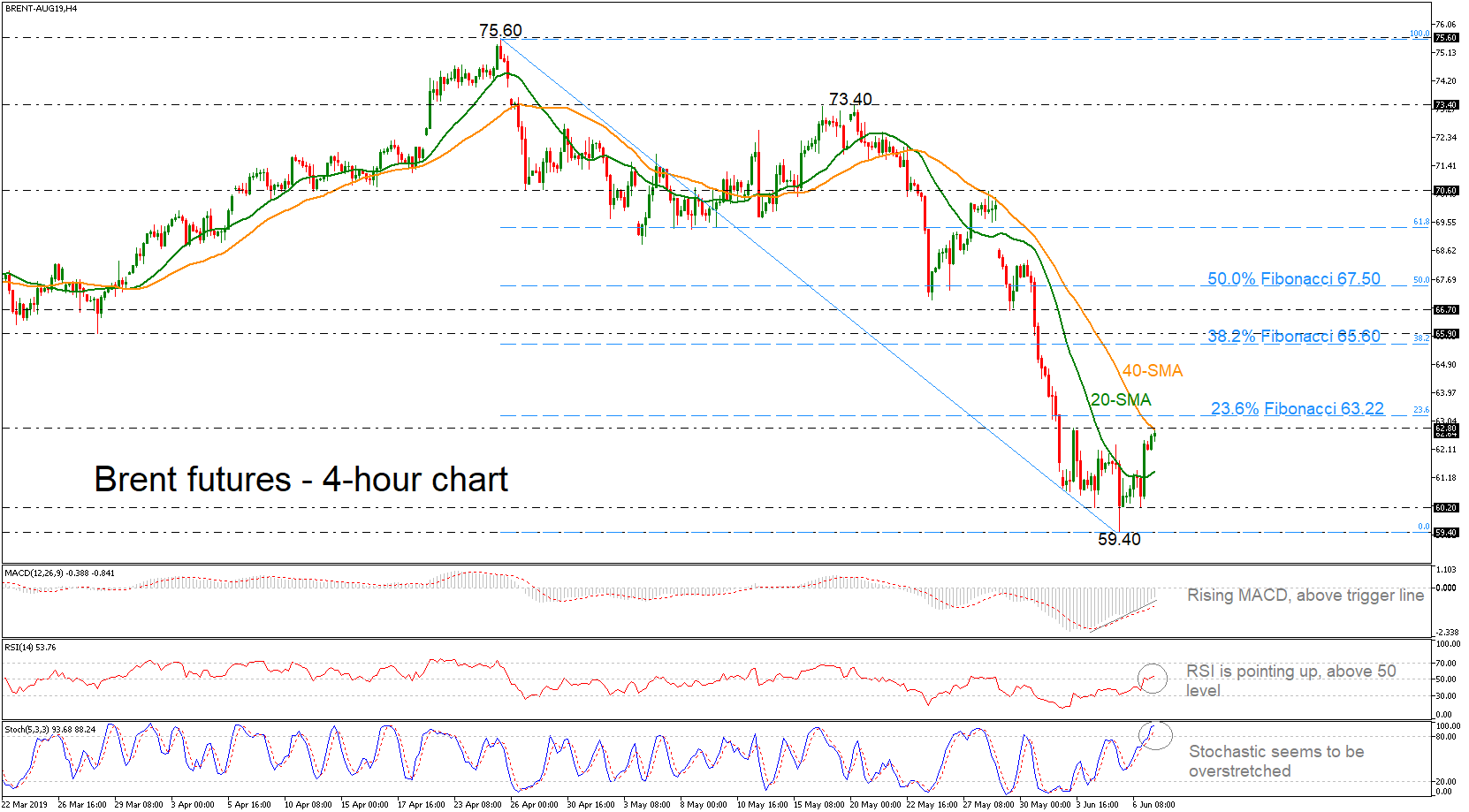
Brent crude oil futures has gained a little extra this week to jump above the 20-period simple moving average (SMA) and re-challenge the 40-SMA. The technical indicators are currently feeding prospects for a possible positive short-term trading as the RSI is holding above 50 level, while the MACD continues to strengthen above its trigger line. However, the stochastic oscillator is flagging overbought conditions, as it fluctuates above 80 with a softer positive slope.
A failure to overcome the 62.80 resistance, could send the price down to the 20-SMA currently at 61.40 in the 4-hour chart. Lower, support could be next found around 60.20, while a decisive close below it could stage a steeper sell-off until 59.40.
Alternatively, if 62.80 and the 23.6% Fibonacci of the downward wave from 75.60 to 59.40, near 63.22, proves easy to get through, the spotlight will turn to the 38.2% Fibonacci of 65.60 and the 65.90 resistance area.
Summarizing, the oil market seems to be neutral in the very short-term (over the last week), with the technical indicators suggesting more bullish actions.
Why Today’s US NFP Number Matters The Most
Today's US NFP data has a special importance among traders. We all know that President Trump has turned the trillion dollar US economy in a war ship and he is picking up conflicts on his left and right. This has left a huge impact on the sentiment among investors.
Due to this reason, there is no doubt that the cracks have started to surface in the US economic data. As a result of this, main stream banks have started to revise their growth estimates for the US economy.
But, Mr Trump blames everything on the Fed's monetary policy and he believes that the US equity markets would have been higher by at least 10,000 points if there were no interest rate hikes by the Federal Reserve Bank. Jerome Powell, the chairman of the Fed, has substantially changed the bank's monetary policy stance since last year. The chief reason for that is the slowdown in the US economy because of the on going trade war between the US and China.
Although, it has taken a long time for the Fed to acknowledge the Fed that the trade war has dented the sentiment over in the US.
In the light of this, investors have started to bet that the Fed is going to make an interest rate cut in its monetary policy. The odds have started to stack up for such an event to take place before the end of this year.
It is in this essence that the US NFP number is of significant importance because the timing of such decision is very much dependent on the strength of the job market.
The US wage growth has experienced a strong upward trend since the financial crisis. The average hourly earnings number is expected to maintain its reading of 3.2% which is well above the average of 2.3%. The headline number is expected to come in at 175K. If we see any weakness in any of these numbers, it is highly that we would see more weakness in the dollar index becuase of the expectations of interest rate cuts.
Bundesbank slashes 2019 German growth forecasts to 0.6% (down from 1.6%), lacklustre export growth taking a toll
Bundesbank sharply slashed German growth forecasts to just 0.6% in 2019 and said the economy is "currently experiencing a marked cool down". That is "mainly due to the downturn in industry, where lacklustre export growth is taking a toll. Nevertheless, "a more protracted, clear decline in economic output currently seems an unlikely prospect, though." And, "once foreign demand picks up, German economic growth will be more broadly based again."
Still, risks are tilted to the downside. And, it warned "additional negative external developments could intensify or prolong the downturn in Germany's strongly export-driven economy." In particular, the experts warn that an escalation of protectionist measures around the world could place considerable strain on German industry. In addition, they highlight the possibility of a disorderly Brexit as well as uncertainties surrounding the fiscal policy stance of the Italian government as risk factors for economic growth in Germany.
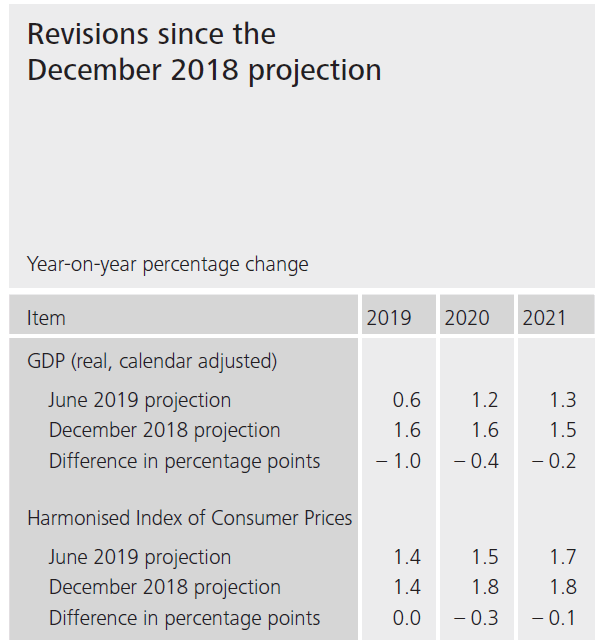
On GDP growth:
- 2019 at 0.6% (down from Dec projection of 1.6%);
- 2020 at 1.2% (down from 1.6%);
- 2021 at 1.3% (down from 1.5%).
On HICP:
- 2019 at 1.4% (unchanged);
- 2020 at 1.5% (down from 1.8%);
- 2021 at 1.7% (down from -0.1%;
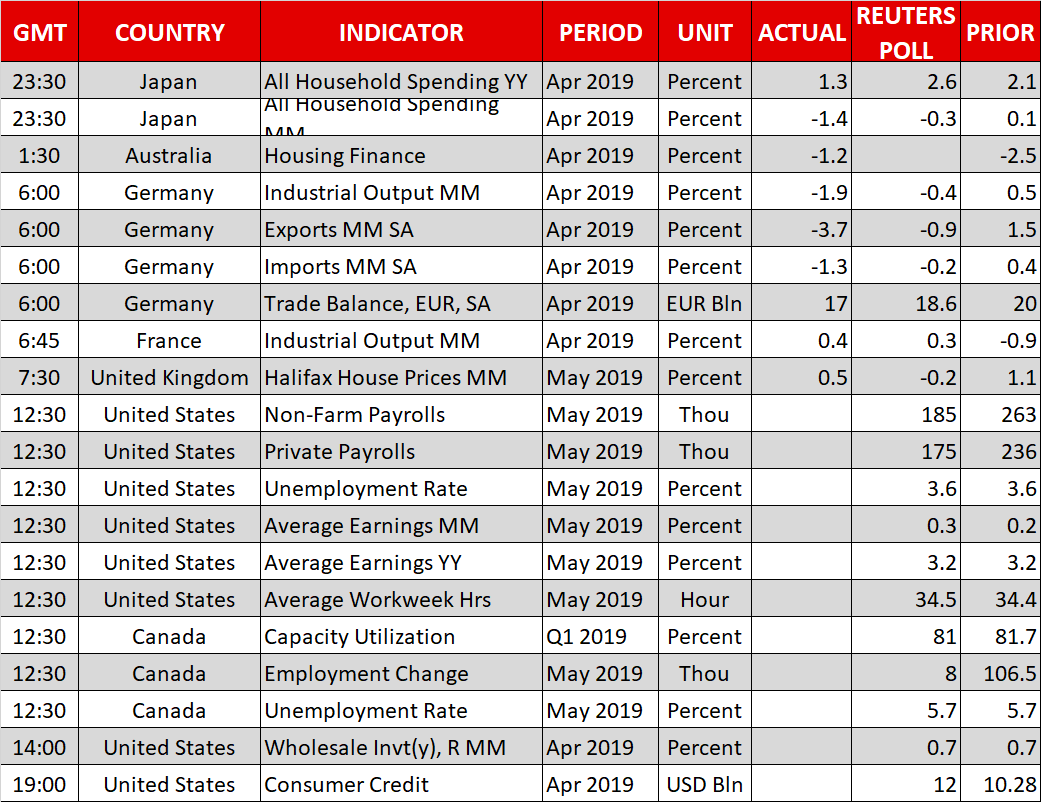
Also released from Germany, industrial production dropped -1.9% mom in April, much worse than expectation of -0.5% mom. Trade surplus narrowed to EUR 17.0B in April. From Swiss, foreign currency reserves dropped CHF -16B to CHF 760B. Unemployment rate was unchanged at 2.4%.
ECB Sounds Less Dovish And The EUR Strengthens
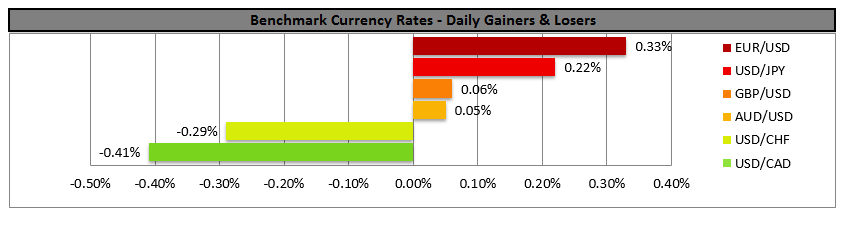
The ECB released its interest rate decision yesterday and decided to remain on hold at 0.0% as was widely expected. In the accompanying statement, the bank acted proactively once again, yet sounded less dovish than what the market may have been expected. TLTRO’s were priced at deposit rate +10 bps providing banks with a margin of 30 bps from the marginal lending rate of the bank to benefit. Rate guidance also altered maintaining the current rate levels throughout the first half of 2020. ECB president Draghi in his press conference repeatedly stated that the ECB had discussed “at a granular” level easing if contingencies unfold. Also on the positive side, GDP forecasts for 2019 are a bit higher, yet drop for 2020 and 2021. We could see the EUR remaining data driven and should there be some negative releases could start weakening once again. EUR/USD showed rose yesterday, breaking the 1.1260 (S1) resistance line (now turned to support) and then testing but failing to clearly break the 1.1300 (R1) resistance line. The pair could be influenced by today’s financial releases, especially the US employment report during today’s American session. Should the pair be under the selling interest of the market, we could see it breaking the 1.1260 (S1) support line and aim for the 1.1220 (S2) support level. Should the pair’s long positions be favored by the market, we could see it aiming If not breaking the 1.1300 (R1) resistance level.
USD steadies before US employment report is out
The USD steadied before the release of the US employment report for May at 12:30, GMT today. The Non-Farm Payrolls figure is expected to drop reaching 185k if compared to the previous release, yet the unemployment rate and the average earnings growth rate toe remain unchanged at 3.6% and +3.2% yoy respectively. On the one hand, the greenback could be getting some support as the unemployment rate is expected to remain at the lowest level for decades. On the other hand, the unchanged average earnings growth rate and a possible drop of the NFP figure could enhance arguments for a monetary easing by the Fed and hence weaken the USD. Should the release disappoint the markets we could see the USD weakening. AUD/USD maintained a sideways motion since breaking its upward trendline on Wednesday, below the 0.7000 (R1) resistance line. We maintain our bias towards a sideways motion, yet could see the pair being affected by the US employment report release during today’s American session, as well as the Chinese trading data, due out on Monday’s Asian session. Should the bears dictate the pair’s direction we could see it breaking the 0.6920 (S1) support line, while if the bulls take over, we could see the pair breaking the 0.7000 (R1) resistance line and aim for the 0.7065 (R2) resistance level.
Other economic highlights, today and early tomorrow
Today during the European session, we get Germany’s factory output growth rate and trade balance figure, both for April. In the American session, besides the US employment report for May, we get Canada employment data for May and the Baker Hughes active oilrig count. During Monday’s Asian session, we get from Japan, the current account balance for April and the final reading of the GDP growth rate for Q1. Also we get China’s trade data for May and the expected slowdown of the Chinese imports growth rate could weaken the Aussie and the Kiwi.
AUD/USD H4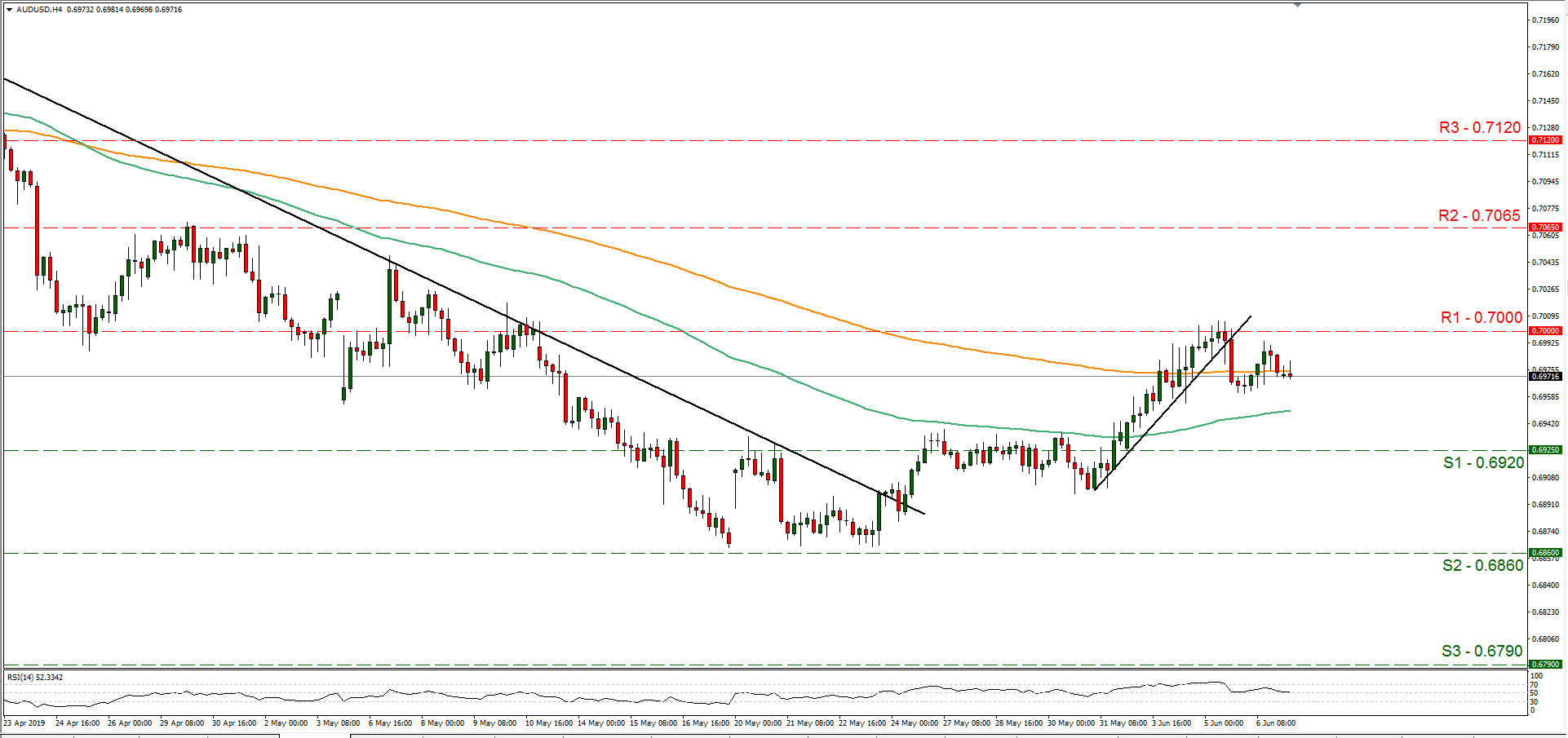
Support: 0.6920 (S1), 0.6860 (S2), 0.6790 (S3)
Resistance: 0.7000 (R1), 0.7065 (R2), 0.7120 (R3)
EUR/USD H4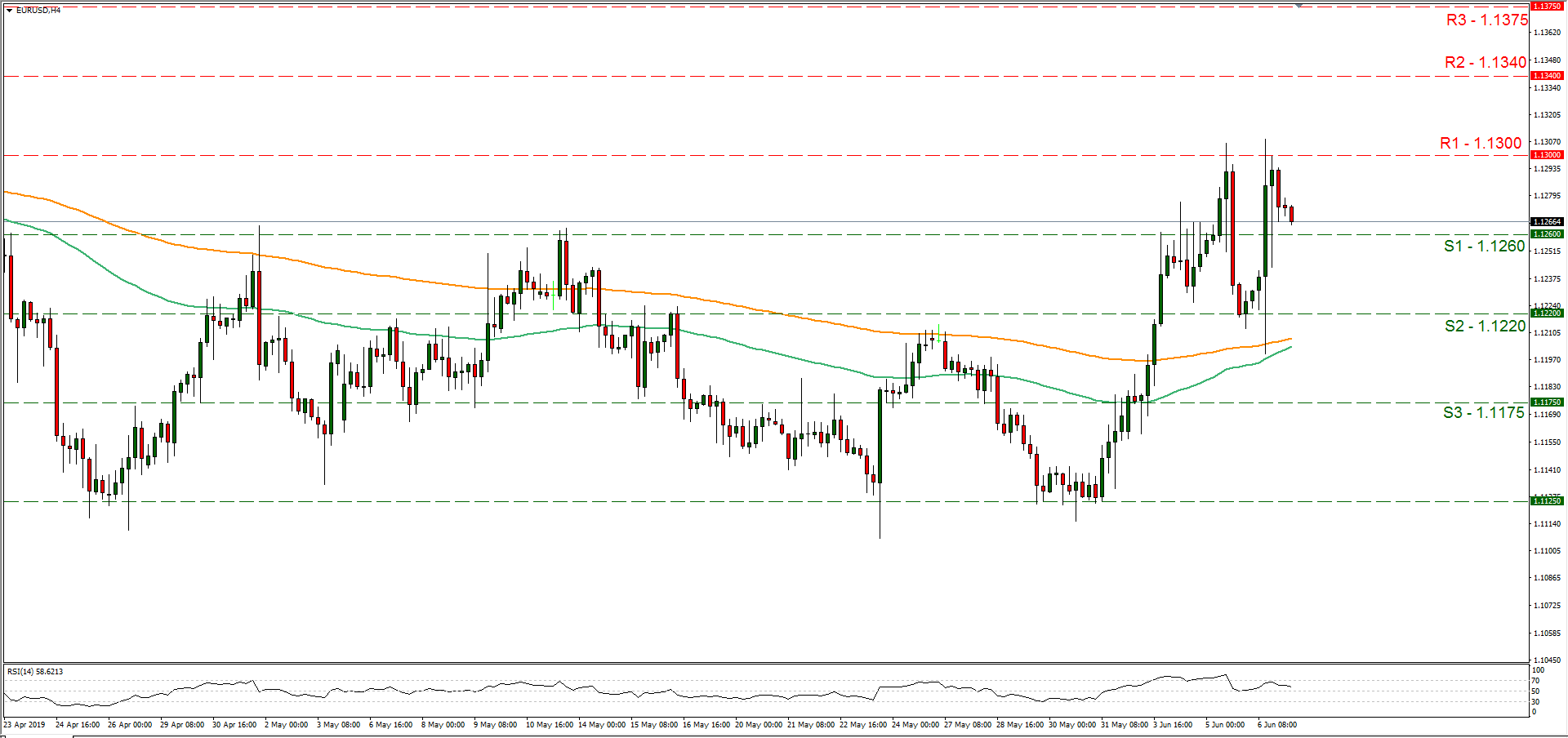
Support: 1.1260 (S1), 1.1220 (S2), 1.1175 (S3)
Resistance: 1.1300 (R1), 1.1340 (R2), 1.1375 (R3)
The Analytical Overview Of The Main Currency Pairs
The EUR/USD currency pair
Technical indicators of the currency pair:
Prev Open: 1.12209
Open: 1.12760
% chg. over the last day: +0.49
Day's range: 1.12636 – 1.12793
52 wk range: 1.1111 – 1.2009
EUR/USD shows high trading activity and volatility. The Central Bank of Europe, as expected, kept the monetary policy on the same levels. The regulator increased the forecasted value of the EU GDP growth from 1.1% to 1.2% this year. The Central Bank left out the increase in the key interest rates until the end of the first half of 2020. Mario Draghi earlier mentioned that some of the CBE representatives are ready to review the restoration of the quantitative easing program should the conditions become unfavourable. The local support and resistance levels are 1.12500 and 1.12750. The investors are waiting for the May US labour market report. Keep an eye on the difference between the real and the forecasted values and open positions from the key levels.
At 15:30 the US will publish a labour market report.
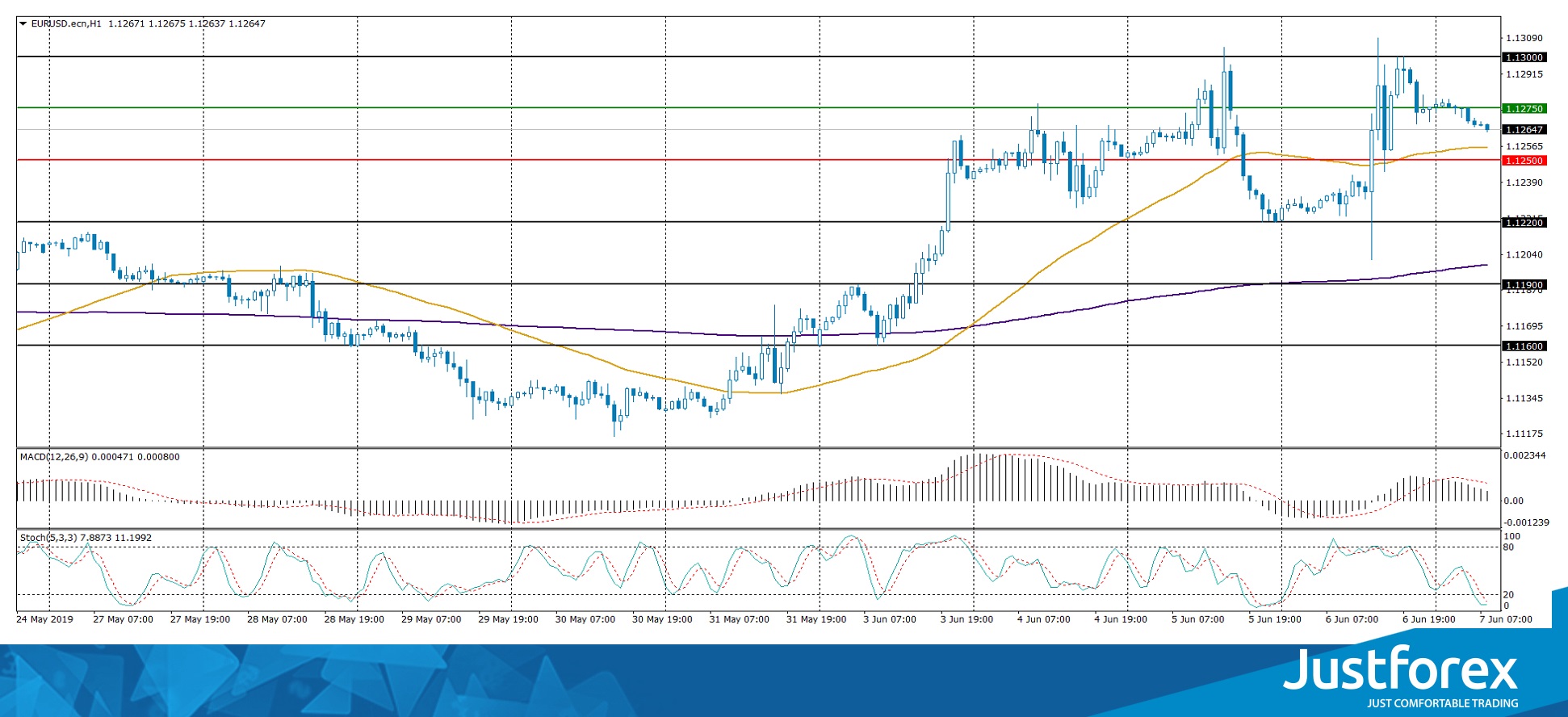
The price fixed above 50 MA and 200 MA which points to the power of the buyers.
The MACD histogram is in the positive zone but below the signal line which points towards buying EUR/USD.
The Stochastic Oscillator is in the oversold zone, the %K line. There are no signals at the moment.
Trading recommendations
Support levels: 1.12500, 1.12200, 1.11900
Resistance levels: 1.12750, 1.13000
If the price fixes above 1.12750, expect the growth towards 1.13250-1.13500.
Alternatively, the quotes can descend towards 1.12000-1.11800.
The GBP/USD currency pair
Technical indicators of the currency pair:
Prev Open: 1.26988
Open: 1.26834
% chg. over the last day: -0.08
Day's range: 1.26741 – 1.26939
52 wk range: 1.2438 – 1.3631
GBP/USD stabilized after a long growth since the beginning of May. The quotes are moving sideways. The investors are waiting for additional drivers. The support and resistance levels are 1.26750 and 1.27100. The market pariticpants are waiting for the US labour market report. Open positions from the key levels.
The Economic News Feed for 07.06.2019 is calm.
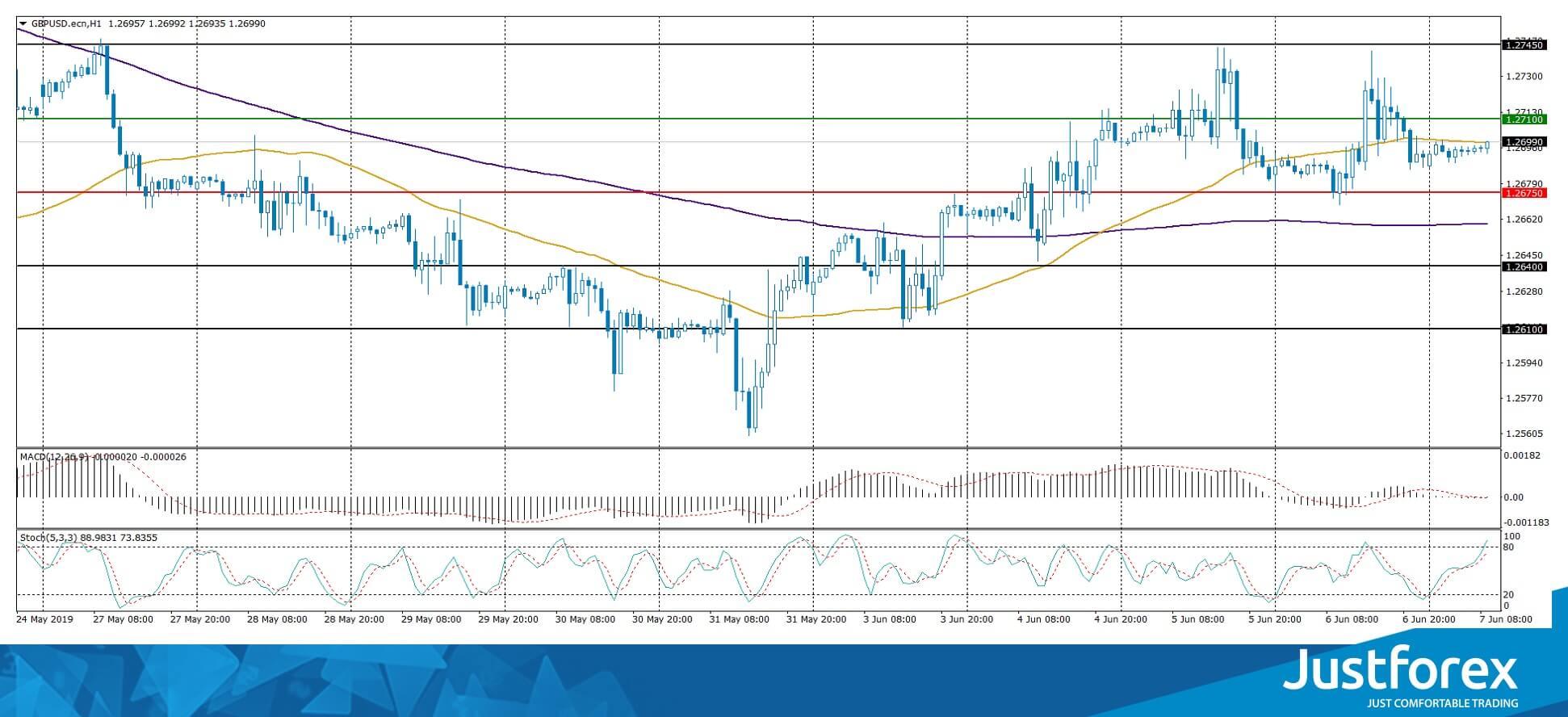
The indicators do not provide precise signals, the price crossed 50 MA.
The MACD histogram is close to 0
The Stochastic Oscillator is in the neutral zone, the %K line is above the %D line which points to a bullish mood
Trading recommendations
Support levels: 1.26750, 1.26400, 1.26100
Resistance levels: 1.27100, 1.27450
If the price fixes above 1.27100, expect further growth towards 1.27500-1.27700.
Alternatively, the quotes can descend towards 1.26400-1.26200.
The USD/CAD currency pair
Technical indicators of the currency pair:
Prev Open: 1.34145
Open: 1.33617
% chg. over the last day: -0.45
Day's range: 1.33459 – 1.33668
52 wk range: 1.2727 – 1.3664
USD/CAD started to descend again. The trading instrument updated the two-month minimums. The price on oil recovered, which gave a boost to CAD. Right now the quotes are near the local support of 1.33450 with 1.33750 acting as a nearest resistance. The quotes can descend further. Keep an eye on the US and Canada labour market reports and open positions from the key levels.
At 15:30 (GMT+3:00) Canada will puiblish a labour market report.
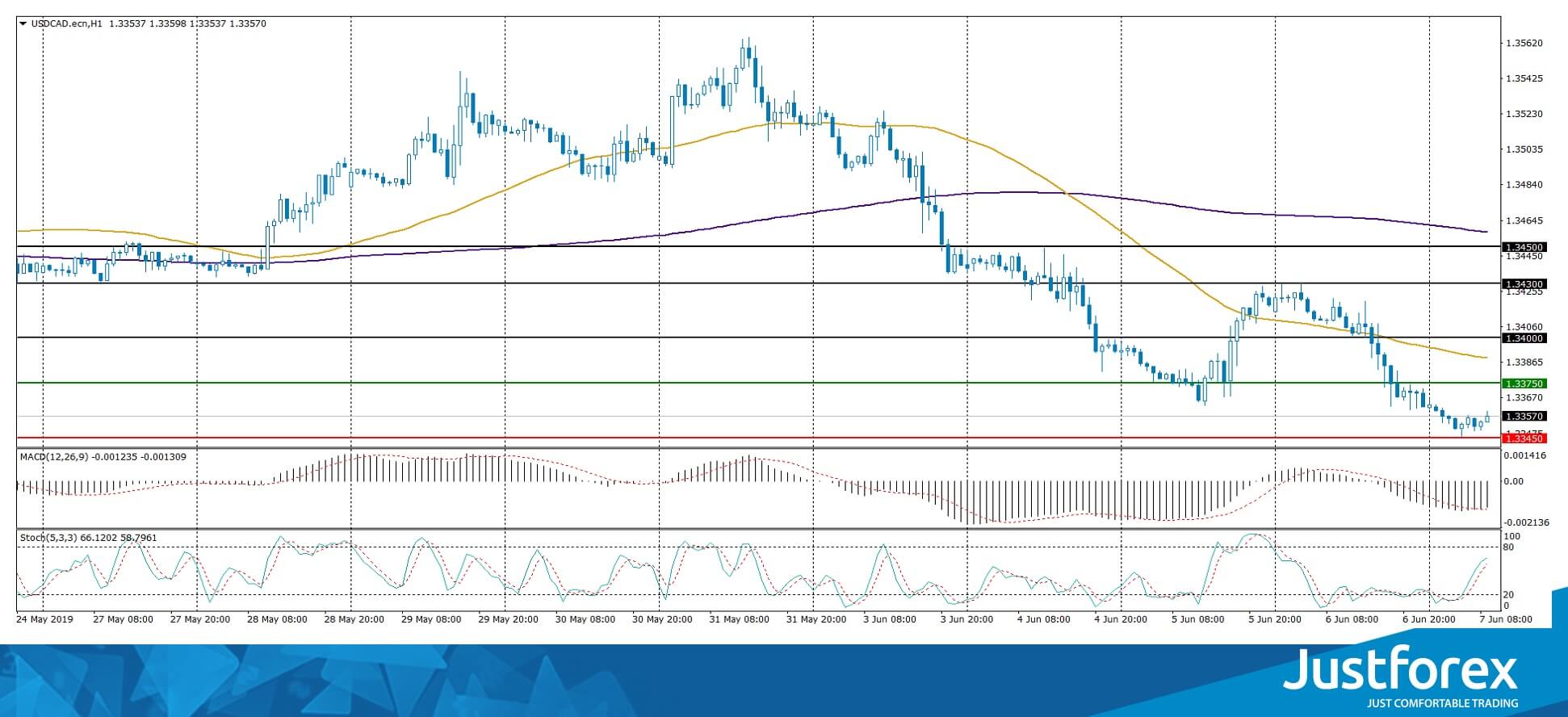
The price fixed below 50 MA and 200 MA which point to the power of the buyers.
The MACD histogram is in the negative zone which points to the bearish mood.
The Stochastic Oscillator is in the neutral zone, the %K line is above the %D line which gives a signal to sell USD/CAD.
Trading recommendations
Support levels: 1.33450, 1.33000
Resistance levels: 1.33750, 1.34000, 1.34300
If the price fixes below 1.33450, expect further descend towards 1.33000.
Alternatively, the quotes can grow towards 1.34000-1.34300.
The USD/JPY currency pair
Technical indicators of the currency pair:
Prev Open: 108.464
Open: 108.399
% chg. over the last day: -0.03
Day's range: 108.320 – 108.535
52 wk range: 104.97 – 114.56
The USD/JPY quotes are moving sideways, the technical picture is ambiguous. The market participants are waiting for the US labour market report. The quotes are consolidating around 108.200-108.550. The demand on the safe assets remains high. Keep an eye on the US Treasury bonds' yield and open positions from the key levels.
During the Asian trading session, Japan published weak household expenditure data.
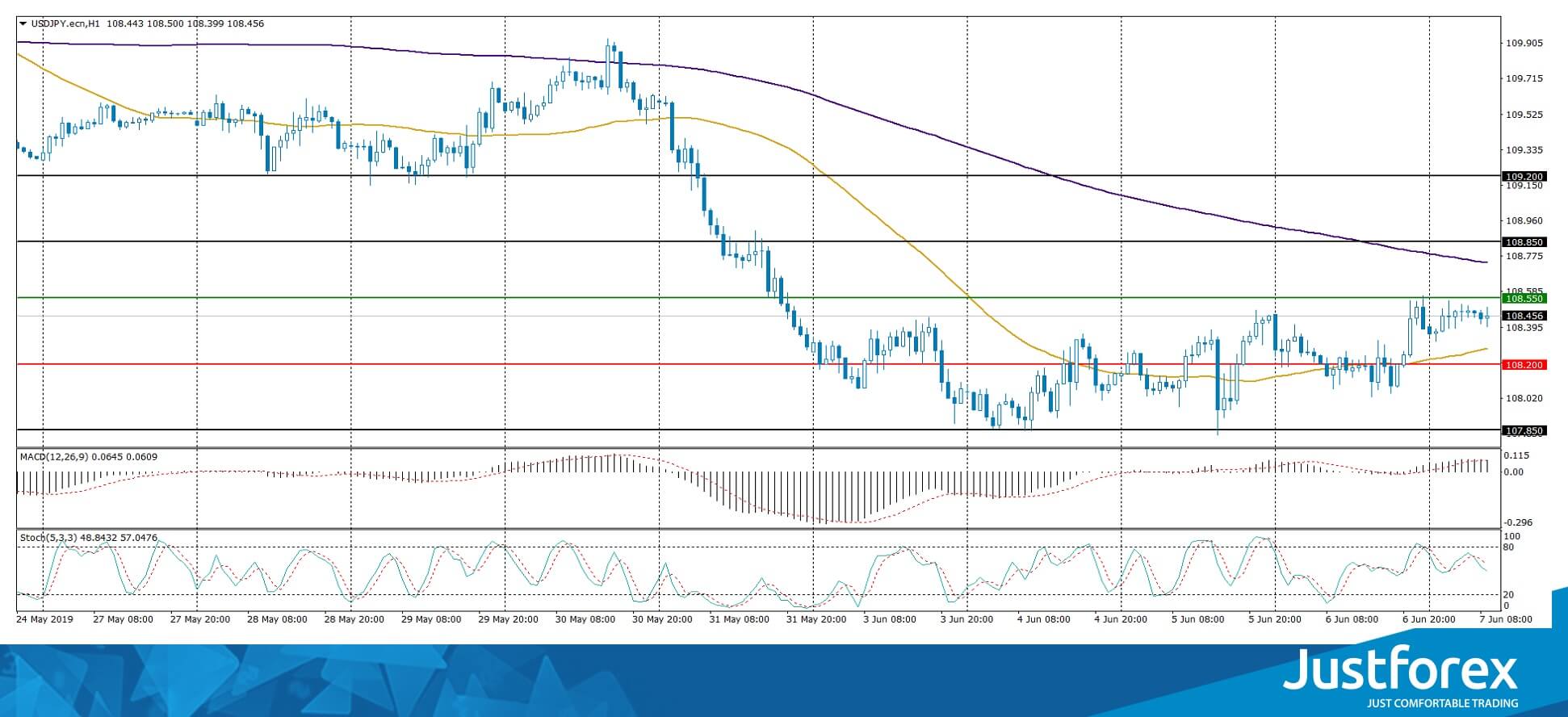
The indicators do not provide precise signals, the price fixed between 50 and 200 MA.
The MACD histogram is in the positive zone, which points to a bullish mood.
The Stochastic Oscillator is in the neutral zone, the %K line is below the %D line which gives a signal to sell USD/JPY.
Trading recommendations
Support levels: 108.200, 107.850, 107.500
Resistance levels: 108.550, 108.850, 109.200
If the price fixes below 108.200, the quotes can descend towards 107.850-107.500.
Alternatively, the quotes can recover towards 109.000-109.200.
Stocks Buoyed By Hopes Of US-Mexico Deal, Dollar Crawls Higher Ahead Of NFP
- Markets hopeful the US and Mexico can reach a deal on migration to avert tariffs
- Dollar inches higher ahead of May nonfarm payrolls report
- Euro firmer after ECB meeting as Draghi fails to provide strong easing signals
Optimism about US-Mexico talks lifts markets
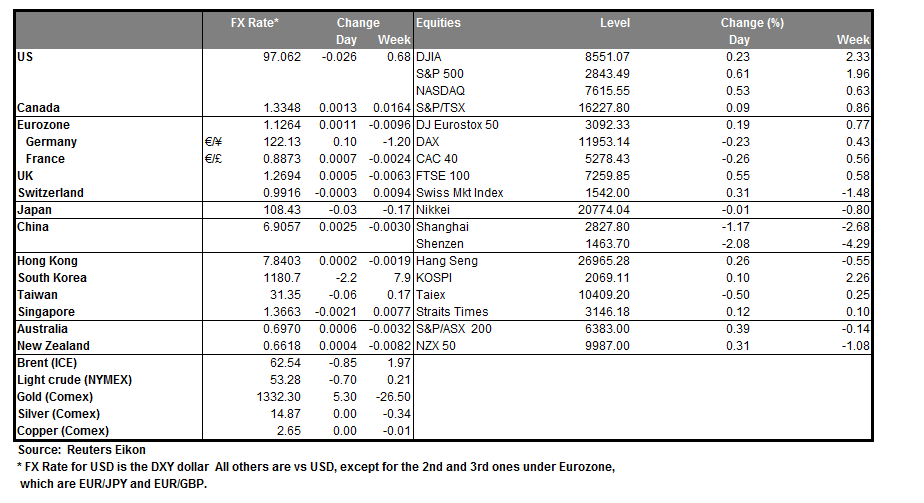
Global stock indices were headed for weekly gains as expectations that the US Federal Reserve and other central banks around the world would soon cut interest rates to counter the damaging impact of rising trade tensions lifted sentiment. Traders were also hopeful that US and Mexican officials will be able to resolve the issue of illegal migration across the two countries’ border.
There were some encouraging signs from yesterday’s talks, with US Vice President Mike Pence saying Mexico had come back to the table with “more” but added that the final decision was still with President Trump. Negotiations are set to continue today but unless major progress is made, the US looks set to increase tariffs on all Mexican imports by 5% on Monday. Trump also again raised the prospect yesterday of introducing tariffs on $300 billion worth of imports from China but said he will wait until after the G20 summit later this month before deciding.
Wall Street’s leading indices managed to close between 0.50-0.75% higher and futures were pointing to small gains when US markets open later today. European equities were also looking to stretch their weekly gains but hopes of stimulus wasn’t enough to boost Chinese stocks as intensifying trade worries pushed the main indices around 1% lower today.
Dollar to take its cues from US jobs report
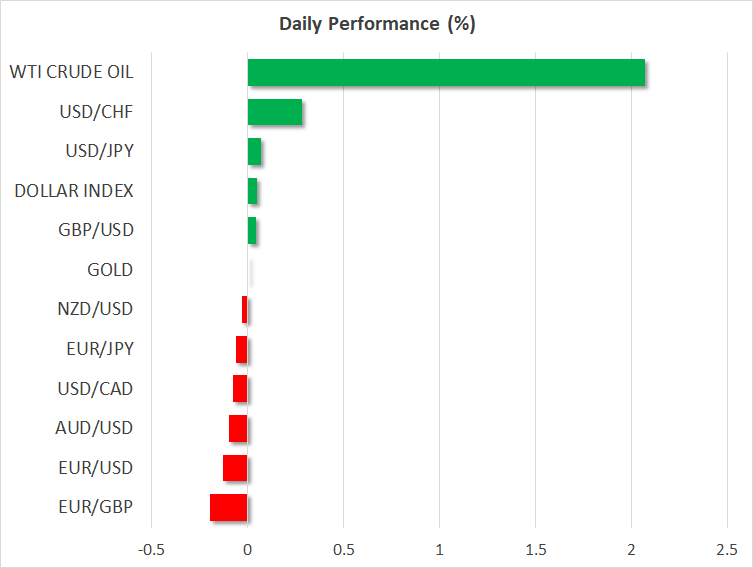
The US dollar was steady on Friday but remained not too far from the multi-month lows plumbed earlier in the week. It was last trading marginally higher at 108.45 versus the yen, in line with the moves in Treasury yields.
New York Fed President John Williams became the latest senior Fed official to open the door to a possible rate cut. In comments in New York, Williams said the Fed may need to be prepared to “adjust” its views on the economy given the rising headwinds from trade frictions.
All eyes will now be on the nonfarm payrolls report for May due at 12:30 GMT. Any weakness in the jobs numbers will likely fuel bets of a rate cut in the coming months. But with investors already fully pricing in a 25bps rate cut by September, a poor jobs report may fail to generate a significant sell-off for the dollar and a positive surprise in the figures potentially pose a bigger upside risk for the US currency.
Canada will also publish employment numbers for May today. The loonie, which is on track to finish the week more than 1% firmer against the greenback, could extend its advances beyond today’s 1½-month high of C$1.3341 to the dollar if there’s another month of solid jobs gains.
Euro heads higher on Draghi disappointment
The European Central Bank, as expected, kept policy unchanged on Thursday and gave more details about its latest round of cheap loans for banks. The terms of the loans were not quite as generous as had been speculated, suggesting the ECB is not as gloomy about the outlook as some had been anticipating. The ECB also revised its forward guidance, saying it now expects interest rates to stay at current levels until the middle of 2020 as opposed to the previous guidance of end of 2019.
However, with markets now pricing a rate cut rather than a rate increase, the ECB’s dovish tilt failed to impress traders and the euro ended the day sharply higher, eying the $1.13 level. More crucially, though, although ECB chief Mario Draghi didn’t hesitate to reassure markets that the bank stands ready to increase monetary stimulus if needed, he remained confident about the outlook, saying the risk of a recession was low. This indicates the ECB is far from considering a rate cut just yet and raised concerns the bank could be slow to respond to any new downturn in the Eurozone economy.
Another currency to benefit from a not-so-dovish central bank was the pound. Sterling rose slightly to around the $1.27 level after the Bank of England’s governor, Mark Carney, reiterated that UK interest rates would need to rise at a limited and gradual pace over the coming period. But with Brexit still unresolved, investors remain doubtful of the Bank’s projections.
British prime minister Theresa May is due to officially step down as Conservative party leader today and her replacement could be elected by the end of July, setting the stage for a volatile few weeks for the pound.
ECB Vasle: TLTRO keeps favorable financing conditions and supports transmission of monetary policy
ECB Governing Council member Bostjan Vasle said the biggest risks for Eurozone growth is that worsening global condition could slow trade. However, the current favorable financing conditions and robust domestic demand will support Eurozone economy.
He emphasized that "it is of key importance that the instrument (TLTRO) keeps favorable conditions of financing for banks and thus supports transmission of monetary policy into banks' credit activity". Also ECB stand ready to use "other available measures" if needed.
Vasle also noted that persistent low inflation is a result of moderation in growth, weaker energy prices and lower wage pressures. He said "the council of governors has responded to these movements by adjusting its decrees with a purpose of ensuring the necessary accommodation line of its monetary policy also in worsened conditions."
Separately, another Governing Council member Vitas Vasiliauskas said inflation outlook is "not bad". And, the council still needs time to see however the economy developments in the second half of the year. Also a Governing Council member, Ewald Nowotny said there is no risk of recession, just a slowdown.
Cliff Notes: Australian GDP Justifies Three RBA Cuts in 2019; FOMC Likely to Cut Twice
Key insights from the week that was.
Uncertainty has remained rife this week as Australian growth disappointed after the RBA cut rates and US trade tensions persisted.
Q1 2019 proved to be a particularly weak quarter for our economy, GDP growth rising just 0.4% and domestic demand weaker still at 0.1%. Over the 12 months to March, GDP growth was a full percentage point below trend at 1.8%, meaning per capita growth over the period was just 0.1%. Within the detail, there is a dramatic divergence between public and private demand. Spending by the government rose 1.1% in Q1 to be 5.7% higher over the year, as investment to meet the needs of a growing population continues at pace. In stark contrast, private sector demand fell 0.2% in Q1 to be 0.3% lower over the nine months to March – the weakest result since the GFC, when a 0.6% contraction in private demand was seen over the nine months to March 2009. April retail sales data points to continued weakness in consumer spending in Q2 2019 and hence a good chance of another below-trend read on GDP.
As highlighted by our Chief Economist Bill Evans this week, the above GDP outcome will come as a surprise to the RBA and mean they will likely have to revise their growth expectations down again from an already below-trend 2.6%yr at May 2019 (to 1 decimal place). Importantly that forecast was predicated on two rate cuts by year end. So with growth having disappointed again and Governor Lowe voicing a need to get the unemployment rate down to at least 4.5% (from 5.2% in April) to bring inflation back to target, we have strong confidence in our expectation that two more cuts will be delivered by year end – in August and November, taking the cash rate down to 0.75%.
Turning to the US, last Friday’s decision by President Trump to impose tariffs on Mexico from 10 June has continued to send shockwaves through financial markets. Equity markets initially moved sharply lower, but have since partly recovered as participants’ expectations of FOMC rate cuts by year end firmed. The market has been expecting rate cuts for much of 2019. Up until now however, we have not been convinced, believing that a lasting resolution to trade tensions could be found against the backdrop of clear strength for the US consumer.
However, together with the actions against Huawei, the Mexico tariffs point to trade tensions instead being an open-ended source of uncertainty for the US economy, forestalling investment as business remains concerned about what could happen next and, if not acted against, putting household demand at risk.
To that end, we now look for two cuts from the FOMC by year end, in September and December. If, as we expect, these cuts stabilise growth/ inflation near trend/ target (2%yr), then the FOMC will remain on hold through 2020 rather than cutting further as implied by market pricing for a November 2020 federal funds rate of 1.37% (100bps below today’s level).
Given that we have a more upbeat central view relative to the market, we see little scope for a further material move lower in the US 10-year to end 2019, with a modest rise then expected to end-2020. Along with trend US growth through 2020, revised market rate expectations should weigh on the Australian dollar in 2020, the cross trading around USD0.66 in the first half of 2020 and finishing the year at USD0.67.
Of course, central bank dovishness is not exclusive to Australia and the US. In Europe, the June ECB meeting marked a continued dovish shift with the ECB now “ready to act” in the case that “adverse contingencies” materialise. Ultimately, this is an acknowledgement that high economic uncertainty is going to linger for some time and downside risk has increased.
So what are these adverse contingencies? The dominant worry relates to the persistent weakness in the manufacturing sector which is more exposed to external demand. While he notes that that economic data is not bad and domestic demand remains robust (the Q1 national accounts show it currently tracking at 1.9%yr), he questions how long these areas of the economy can remain “insulated” from the difficulties of the manufacturing sector.
Regarding policy decisions in June, they are somewhat more ambiguous. Forward guidance was extended to rates being on hold at least through the first half of 2020, but the decision on TLTRO-III (new loans to banks) was to provide slightly less favourable pricing than its maturing predecessor TLTRO-II.
As with TLTRO-II, banks will receive loans at a base rate linked to the refi rate (currently 0%), with a conditional rate linked to the deposit rate (currently –0.4%) if banks exceed lending benchmarks. The key difference is that the new loans will come at a 10bp premium to the linked policy rates, and the linked rate that applies will be the average over the life of the respective TLTRO operation. Draghi’s rationale behind the TLTRO-III decision was that the loans are intended to be a backstop, and while there is a slight “disincentive” versus before, the terms are still very generous.
RBA Moves Further Towards Additional Easing; FOMC to Deliver Two Cuts on Geopolitical Uncertainty
Data supports our view of need for August and November cash rate cuts following June decision. FOMC to act in September and December.
Developments since the RBA rate cut on Tuesday 4 June have provided us with further confidence that our forecast for three rate cuts in 2019 will prove accurate. Firstly, the Governor has pointed to an ambitious objective for the labour market, with an unemployment rate of 4.5% seen as necessary to bring inflation back to target. This is despite his own forecasts indicating a 5% result on the basis of two rate cuts. That challenge can certainly be interpreted as an expectation of the need to deliver more than just two rate cuts.
Our earlier discussion on 24 May around our target cash rate of 0.75% emphasised downside risks to the cash rate, but noted the difficulties in lowering the cash rate below 0.5% and providing some pass through to the general economy – except for the impact on the currency. We concluded that 0.5% could be the lower bound for the cash rate, although we are comfortable with our 0.75% target. The Governor considered international precedence and referred to the 0.25-0.50% seen in the US, UK and Canada, but did not indicate whether the same level would be effective for Australia.
The other significant development since the RBA meeting has been the disappointing GDP report for the March quarter. This again highlighted the key themes that have been most prominent in our consistent assessment that the Australian economy is likely to continue operating well below potential, namely weak household income growth, a cautious consumer and a turning point in the savings rate.
This report, showing that GDP growth was only 0.4% in the March quarter is likely to trigger a further downward revision to the RBA’s 2019 GDP forecast. Westpac has consistently forecast around 2.2% for GDP growth in 2019, while the RBA has recently lowered its forecast from 3% in February to 2.75% in May (2.6% to 1 decimal point), with a likely further downward revision in August.
We have also argued that it will be difficult to retain the 1.75% underlying inflation forecast for 2019 by August when, as we expect, the June quarter underlying CPI will print 0.4% for a total of 0.7% for the first half of the year. We think it will be important that when the RBA addresses these lower forecasts, it responds with a further rate cut in August and another one to follow in November.
There has been some speculation that the RBA may cut earlier in July. This is not our central view given the likely need to respond to these downward revisions in August.
Turning to the US, we have revised our federal funds rate profile to include two cuts of 25bps in September and December this year.
A key influence on this assessment is that a new variable has entered the US economic model – one labelled “political unpredictability”. This variable is certain to have a negative coefficient on any equation describing US investment decisions and general confidence. We believe that it is now so embedded in US business behaviour that even resolutions of the current trade controversies are unlikely to convince business that the coast is clear.
We expect the FOMC will be assessing current risks in a similar fashion, revising down central growth views, particularly around business investment and confidence, and widening the uncertainty bands around these views. Chair Powell has recently pivoted from his previous “patient” stance to one where he is prepared to act and it is likely that the FOMC are seeing this variable as part of their risk assessment.
At this stage, we are not franking market pricing by extending the rate cuts into 2020 as we expect some reasonable resolutions to the current crises to prevent a ‘worst case’ scenario, particularly for the US consumer. Failure to resolve these issues would lead to a considerable shock to household disposable income and household demand. That development, of course, would require further action from the FOMC than we are currently forecasting. In 2020, with the consumer remaining in reasonable shape, we would also expect the housing market, which has currently stabilised, to respond to this lower profile for interest rates.
With markets currently pricing in more extensive cuts than we are forecasting, we see little scope for further declines in US yields in 2019, and anticipate they will rise modestly through 2020.
Given that markets are still not fully pricing in our RBA view by the end of 2019 and are more aggressive on the profile for federal funds rate cuts, we are comfortable to retain our central forecast that the AUD drifts down to USD 0.66, albeit reaching that level in the first half of 2020 rather than late 2019.
Revised forecasts for key variables will appear in the forecast table of our Weekly, with full detail made available in our June Market Outlook (to be released 11 June).
Northern Exposure: ECB Concerned Over Prolonged Uncertainty
The June ECB meeting marks a continued shift among central bankers to express a willingness to act if conditions were to weaken. Ultimately, this is an acknowledgement that high economic uncertainty is going to linger for some time and downside risk has increased. The main message from the meeting is that the ECB is "ready to act".
Regarding policy decisions, they are somewhat more ambiguous. Forward guidance was extended to rates being on hold at least through the first half of 2020, but the decision on TLTRO-III (new loans to banks) was to provide slightly less favourable pricing than its maturing predecessor TLTRO-II.
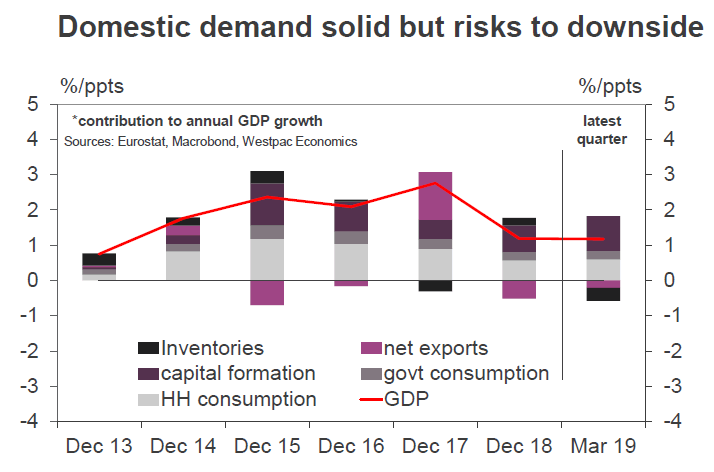
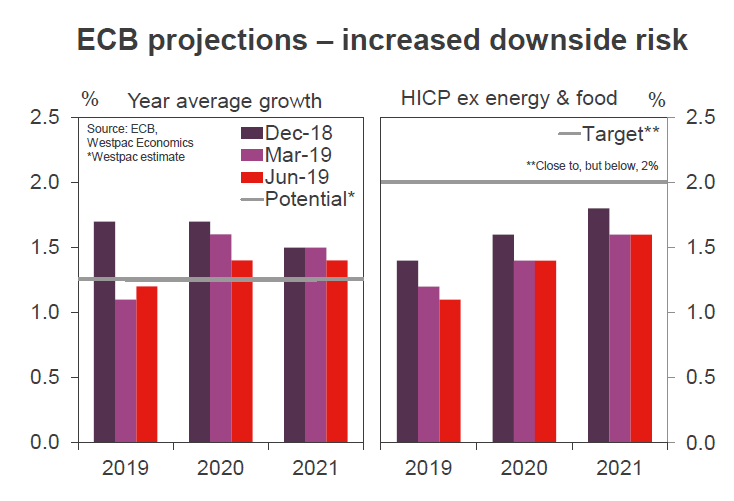
Starting with the ECB's economic outlook, the June meeting provided relatively unchanged projections from March. The ECB sees moderate, around-trend growth through the forecast horizon. The out years were lowered slightly but 2019 revised up slightly with the profile now 1.2% in 2019 and 1.4% in 2020 and 2021.
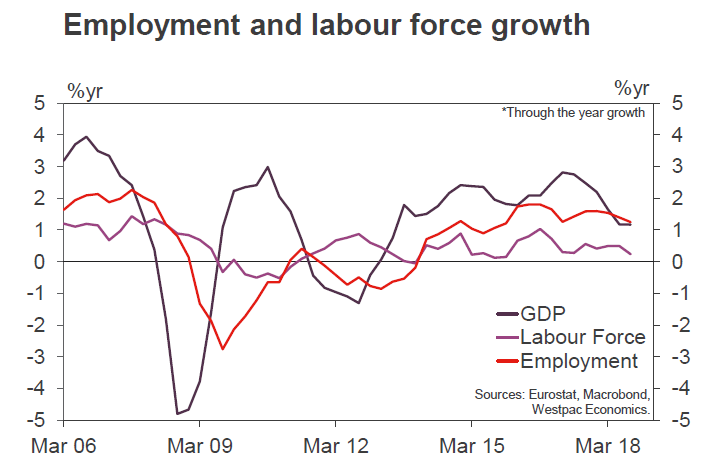
The unemployment rate track has been lowered but with only gradual improvement seen over the forecast horizon. The unemployment rate has fallen to 7.6% as at April, down from 8.4% a year earlier. The ECB sees the trend flattening, with a forecast 7.3% in 2021 - although note the pre-GFC low was 7.2%.
Inflation is still seen as modest, only gradually reaching 1.6% in 2021. President Draghi noted in the press conference that they are taking the decline in market based inflation expectations seriously, and notes that their inflation models show a mass of distribution between 0-1.5% - below the ECB target of close to, but below, 2%.
So all in all, the central view is relatively benign and Draghi notes that the data about the economy is not bad. But while the baseline is stable, the ECB's concern about downside risks is elevated.
Draghi's press conference emphasises that the ECB are aware of the "prolongation" of "increased" uncertainties. Key here is the threat of rising protectionism and the effect this has already had on lowering trade growth.
With that in mind, the ECB are ready to act in the case that adverse contingencies materialise. Indeed, members raised the possibility of further rate cuts, restarting the asset purchase program or extending forward guidance on rates even further.
So what are these adverse contingencies? The dominant worry relates to the persistent weakness in the manufacturing sector which is more exposed to external demand. While he notes that domestic demand remains robust (the Q1 national accounts show it currently tracking at 1.9% annual growth) he questions how long these areas of the economy can remain "insulated" from the difficulties in the manufacturing sector.
Accordingly, Draghi was questioned in the press conference on the effect on the banking sector of an even lower policy rate. Here, Draghi reiterated that in "aggregate", the ECB do not see damaging side effects from the current level of negative interest rates. Of course, if these were to appear, they would consider mitigating measures. That is a tacit acknowledgment of the possibility of tiered rates but no indication that this policy will be implemented in the near-term.
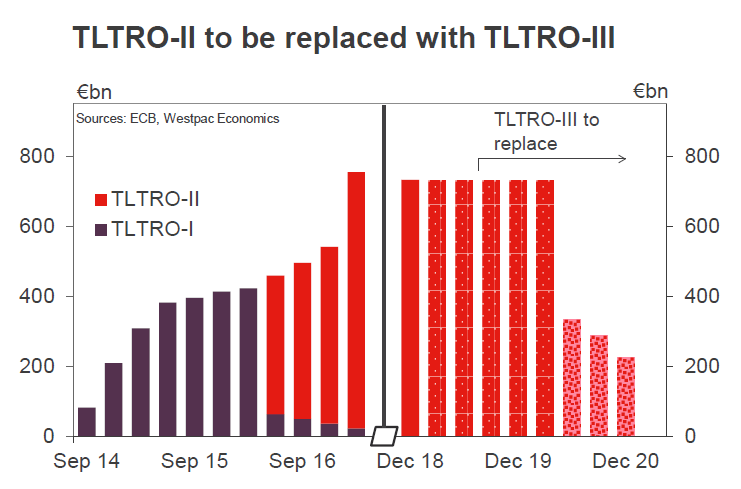
On that note as well, the pricing decision on TLTRO-III was within the range of market expectations. As with its predecessor, TLTROII, banks will receive loans at a base rate linked to the refi rate (currently 0%) with a conditional rate linked to the deposit rate (currently -0.4%) if banks exceed lending benchmarks.
The key difference is that the new loans will come at a 10bps premium to the linked policy rates, and the linked rate that applies will be the average over the life of the respective TLTRO operation. Previously at the March meeting, we learned that TLTRO-III operations will be made at quarterly intervals from September 2019 to March 2021, with loan maturities of two years. These will replace TLTRO-II, where the first operation (roughly 50% of the stock) matures in June 2020 - although note under bank's required stable funding regulation, the effect of maturities will be felt from June 2019. Draghi's rationale behind the TLTRO-III decision was that the loans are intended to be a backstop, and while there is a slight "disincentive" to before, the terms are still very generous.