Sample Category Title
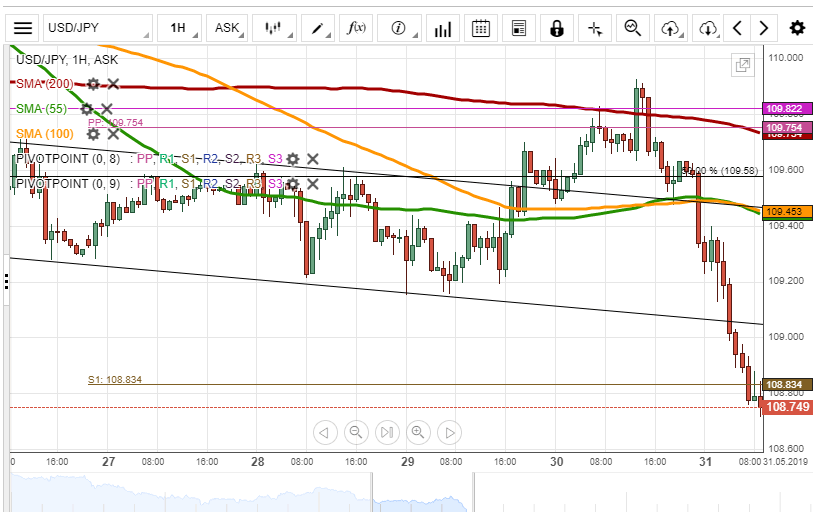
XAU/USD Outlook: Fresh Rally On Risk Aversion Pressures Key Barriers At $1303/06
Spot gold rose close to psychological $1300 barrier on Friday, in extension of strong rally of the previous day and marked nearly 0.8% advance since Asian opening on Friday.
Unexpected US tariffs on goods imported from Mexico boosted global fears of trade war spreading, prompting investors from riskier assets into safe-havens.
The yellow metal benefited from fresh risk aversion, as Friday’s bullish acceleration penetrated thick daily cloud and broke through Fibo barriers at $1295/97 (76.4% of $1303/$1269 / 38.2% of $1346/$1266) that exposed key barriers at $1303 (14 May high) and $1306 (daily cloud top / 50% of $1346/$1266).
Rising fears about global slowdown on persisting trade tensions between US and China and the newest announcement on Mexico tariffs, improved the sentiment for further advance.
Caution on lack of bullish momentum that can slow the advance, but close above cracked $1297 Fibo barrier would generate positive signal and keep focus at the upside.
Res: 1300, 1303, 1306, 1310
Sup: 1296, 1290, 1288, 1286
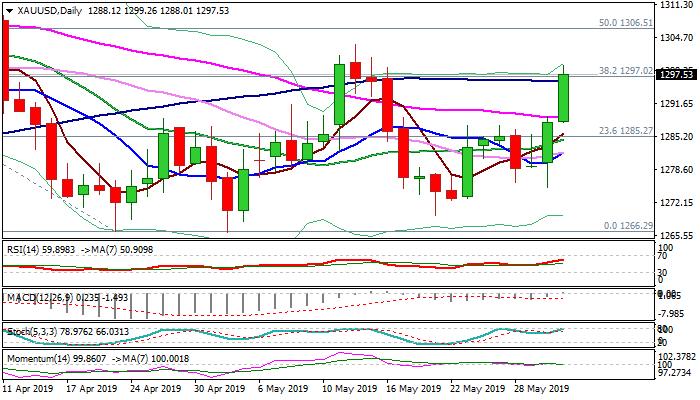
Oil Price Continues To Spiral On Fresh Threats Of Trade War Spread / Record US Output
WTI extends weakness on Friday and hit lowest levels since early March, following Thursday’s strong fall when WTI contract was down 4.5%.
Fresh bearish acceleration clearly broke below rising daily cloud base (after several strong spikes lower, but every time closing within the cloud) and also broke and closed below pivotal Fibo support at $57.33 (38.2% of $42.36/$66.58), generating strong bearish signals.
Strong bearish momentum and multiple bear-crosses of daily MA’s add to negative outlook, as Thursday’s long bearish daily candle weighs.
There are no obstacles on the way towards next target at $54.47 (50% of $42.36/$66.58 / weekly Kijun-sen / 8 Mar low), which is in near-term focus.
Broken Fibo support at $57.33 (also former low of 23 May) now acts as solid resistance which should ideally cap.
The price is on track for the second straight bearish weekly close and also the biggest monthly loss since Nov 2018) that adds to negative stance.
Negative fundaments on US tariffs to imports from Mexico that increase concerns about slowdown of global demand, smaller than expected fall in US oil stocks and US oi production at its record levels add to bearish outlook.
Res: 56.58, 57.33, 57.90, 58.60
Sup: 55.63, 55.00, 54.47, 53.33
EUR/USD – Euro Edges Higher, German Consumer Inflation Next
EUR/USD has posted gains on Friday. Currently, the pair is trading at 1.1154, up 0.22% on the day. On the release front, German consumer data is in focus. Retail sales declined by 2.0% in April, much worse than the estimate of a 0.4% gain. Later in the day, Germany releases CPI, with an estimate of 0.3%. It’s a busy day in the U.S, with consumer data also in the spotlight. The Federal Reserve’s preferred inflation gauge, Core PCE Price Index, is expected to improve to 0.2%. However, personal spending is projected to slow to o.2%, after a strong gain of 0.9% in the previous release.
Is the German locomotive slowing down? The normally strong labor market shocked investors as unemployment rolls soared by 60,000. This was the first gain in almost two years. There was more negative news on Friday, as retail sales fell 2.0%, its sharpest drop since January. German inflation is next, with Preliminary CPI projected to slow to 0.3% in May, after a strong gain of 1.0% in April.
The U.S. economy continues to perform well, with first-quarter growth above the 3% level. Second estimate GDP posted a gain of 3.1%, matching the estimate. This was just shy of the initial estimate in April, which came in at 3.1%. The U.S. economy is firing on all cylinders, despite the nasty trade war with China, which has escalated in recent weeks. U.S. officials, including President Trump, had announced that substantial progress had been made, and it seemed that a trade deal was just around the corner. However, Trump shocked the markets by slapping further tariffs on China, which led to counter-tariffs against U.S. products. China has reacted angrily to U.S. trade sanctions on Huawei, a giant Chinese telecom company. The euro has managed to weather the latest crisis in the U.S.-China trade war, but if there is no improvement, investors could opt for the safety of the greenback, at the expense of the euro.
Trump Feels Tariffs are an Effective Way of Pressuring Countries
We're back in the red on Friday, with Trump's latest announcement on Mexican tariffs adding to the feeling of unease among investors.
The initial tariffs are very small but regular incremental rises means we're facing the prospect of 25% levies by October on another major US trading partner, something that has the potential to jeopardise the USMCA deal that is yet to be ratified. We know that Trump feels tariffs are an effective way of pressuring countries into bending to his will but the timing of this announcement is very strange.
The President is still engaged in a trade war with China, one that's turned sour and looks set to escalate before compromise will be found. Moreover, he's slapping tariffs on another major trading partner before the USMCA is ratified and ahead of an election year. And that's before you throw a wobbly stock market into the equation, with the tariffs only likely to make nervy investors more anxious.
All things considered, the headwinds are growing and the inversion in the yield curve is not helping matters. We know that Trump closely monitors the markets, which may make the next few weeks a little uncomfortable for him.
The dollar is taking a breather at the end of the week which is providing some reprieve for gold on Friday, which despite being a traditional safe haven, hasn't had a great time in the current environment. The flattening of the yield curve, as investors move into Treasuries in anticipation of lower interest rates, has lifted the dollar and held gold back.
There's nothing to say that will continue though. In the fourth quarter of last year, gold got off to a stuttered start but did rally in the final couple of months, eventually reaping the benefits of its safe haven status. There's nothing to say that won't happen again and it failing to break below $1,265 so far again this week may support that prospect.
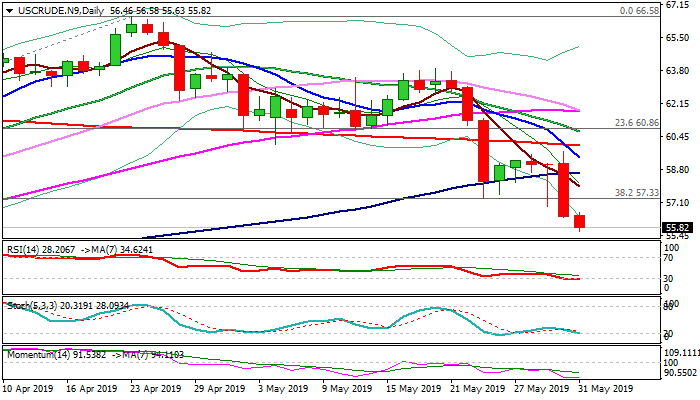
EURUSD 1.1165 Upcoming Resistance
The euro has staged a technical correction against the US dollar during the European trading session after sellers once again failed to take the pair below the 1.1100 support level. The 1.1165 level is the next major resistance area to watch if the rebound continues. Overall, bulls need to move the EURUSD pair above the 1.1215 level to end the current bullish short-term trend.
The EURUSD pair is intraday bearish while trading below the 1.1180 level, key technical support is found at the 1.1130 and 1.1100 levels.
If the EURUSD pair trades above the 1.1180 level, key technical resistance is found at the 1.1216 and 1.1230 levels.
USDJPY 108.40 Critical Support
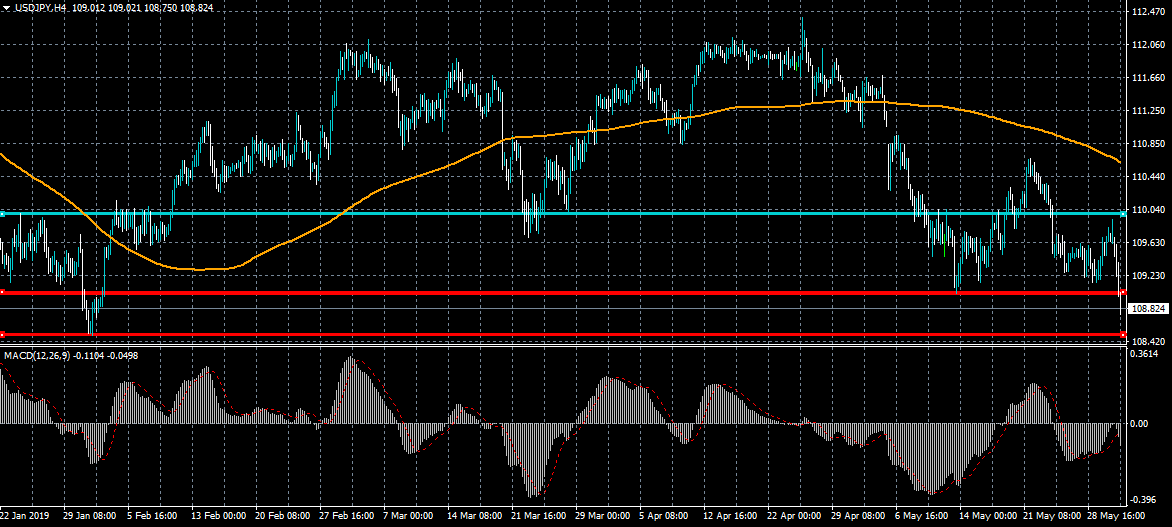
The US dollar has continued to move lower against the Japanese yen currency during the European trading session as risk-off trading sentiment returns. A small bearish pattern is now in play on the four-hour time frame with a one hundred and fifty point downside projection. A much larger bearish pattern will also form if the USDJPY pair trades towards the 108.40 level.
The USDJPY pair is heavily bearish while trading below the 109.00 level, key support is found at the 108.40 and 107.70 levels.
If the USDJPY pair trades above the 109.00 level, key technical resistance is found at the 109.60 and 109.92 levels.
Dollar Turns Its Sights To ISM PMIs
The next key releases for the dollar will be the ISM manufacturing and non-manufacturing PMIs for May, due on Monday and Wednesday respectively, both at 14:00 GMT. Forecasts point to a rebound in both figures, but considering the escalation in trade conflicts, those seem overoptimistic. Disappointing numbers may hurt the dollar a little, but for the greenback to weaken substantially, some other major currency needs to become attractive again – a condition not satisfied yet.
The US economy grew by a solid 3.1% in annualized terms in Q1, but signs are accumulating that growth slowed in Q2, with the Atlanta Fed GDP Now model estimating Q2 expansion at a mere 1.3%. That seems reasonable, since much of the strength in Q1 came from firms stockpiling inventories, which is not only unlikely to be sustained but may in fact be a drag on future growth as companies unwind those inventories.
Meanwhile, data for Q2 haven’t been bright so far, with durable goods orders and retail sales data for April disappointing. Separately, the latest escalation in the US-China trade war may have taken a heavy toll on business sentiment – and thus investment. As much was highlighted by the Markit PMIs for May, which noted that trade worries impacted confidence, new orders, and even hiring by firms.
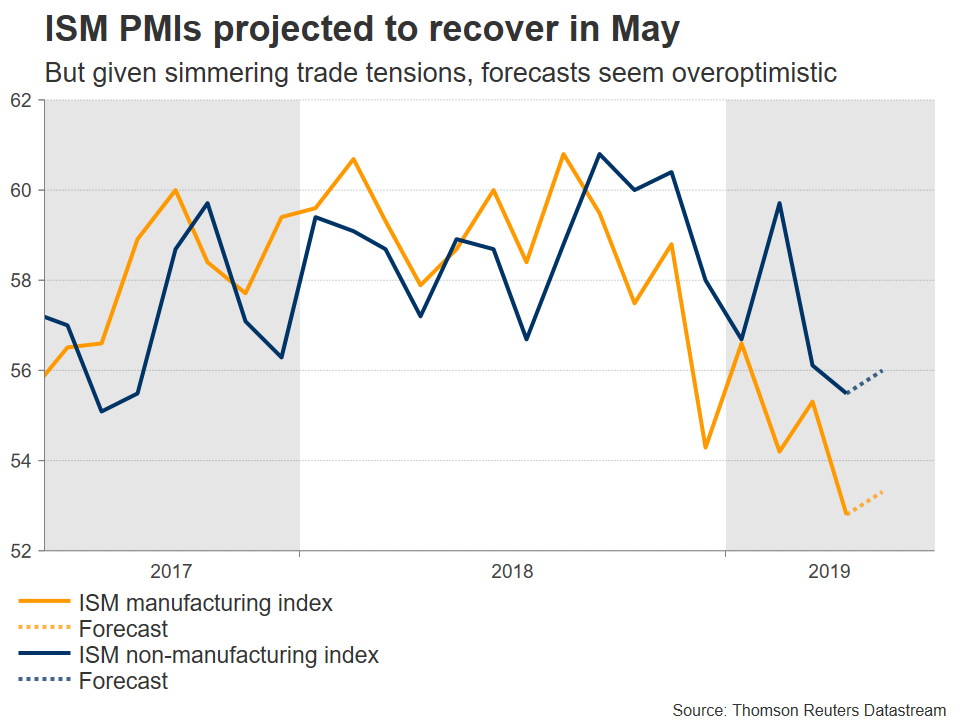
Of course, investors pay much more attention to the ISM PMIs, which makes the upcoming releases even more important for the dollar. In May, the manufacturing index is forecast to have risen to 53.3, from 52.8 in April, while the non-manufacturing print is also expected to have cruised higher to 56.0 from 55.5 earlier.
Alas, these forecasts seem overoptimistic, and the risks surrounding them may be tilted to the downside. Considering that trade tensions returned with a vengeance in early May, it would be almost surreal to see business morale rise, especially in manufacturing. Looking back at the April survey, new orders were already low and some companies cited the prospect of a trade deal as a factor keeping them confident, so many were probably caught off guard.
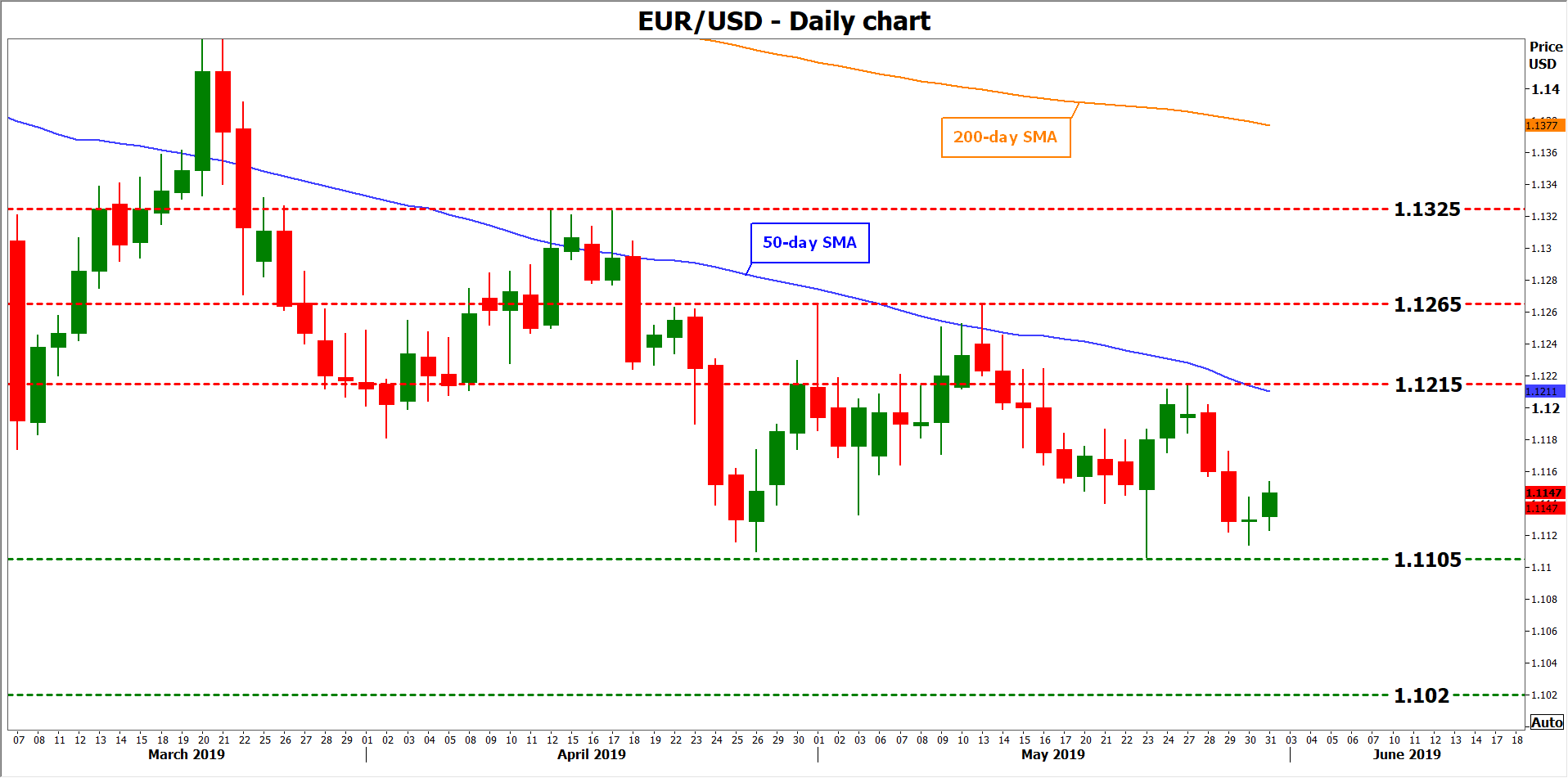
If the PMIs indeed disappoint, that could amplify even further market expectations for Fed rate cuts, and thereby hurt the dollar on the news. Technically, advances in euro/dollar may stall initially around 1.1215, with an upside break opening the door for the 1.1265 zone.
On the flipside, if the PMIs beat expectations for example, support to declines could come at the 2-year low of 1.1105, before the 1.1020 area comes into view.
In the bigger picture, even though market bets for Fed cuts have soared, that hasn’t translated into a weaker dollar. Far from it, actually, with the dollar index still trading just below 2-year highs. This divergence highlights that growing rate-cut expectations are only one half of the puzzle needed to weaken the dollar. The other half depends on some other major currency, and especially the euro, becoming attractive enough to offer a viable alternative to the greenback – a condition that is not satisfied yet.
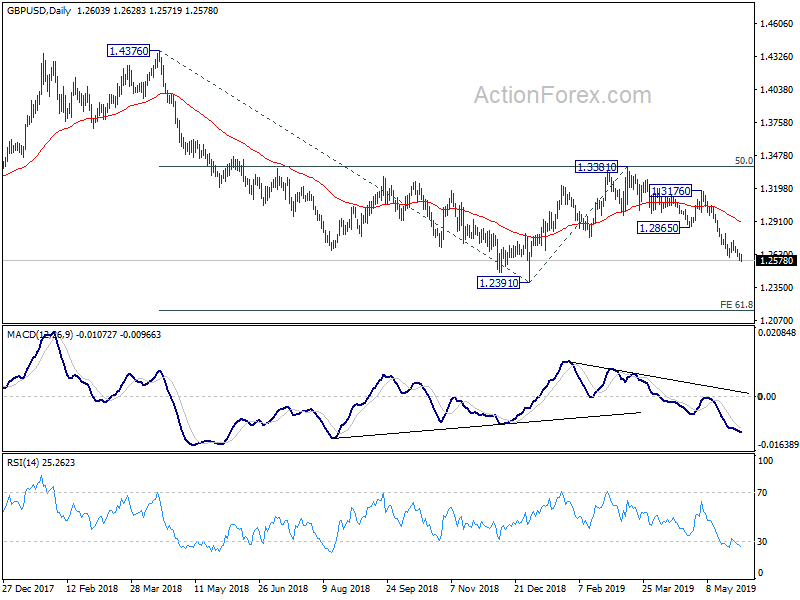
Pound selloff resumes with EUR/GBP upside breakout
Pound's selloff resumes today and it's for now the second weakest, just next to Canadian. The decline is rather unrelated to today's main theme of Trump's tariff on Mexico. Rather, Sterling is on its own downward trajectory on Brexit uncertainty. Prime Minister Theresa May will step down on June 7. Nominations will start in the week on June 10. That's the week we'll finally know who are the real runners.
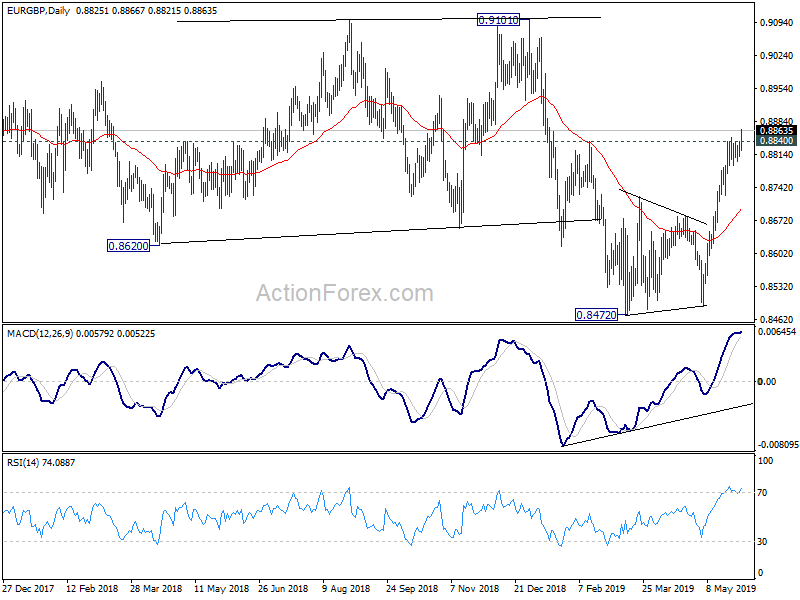
EUR/GBP breaks out of this week's sluggish range and hits as high as 0.8866 so far. With 0.8840 resistance now firstly taken out, next stop will be 0.9101 key resistance.
GBP/USD is also on track for 1.2391 low.
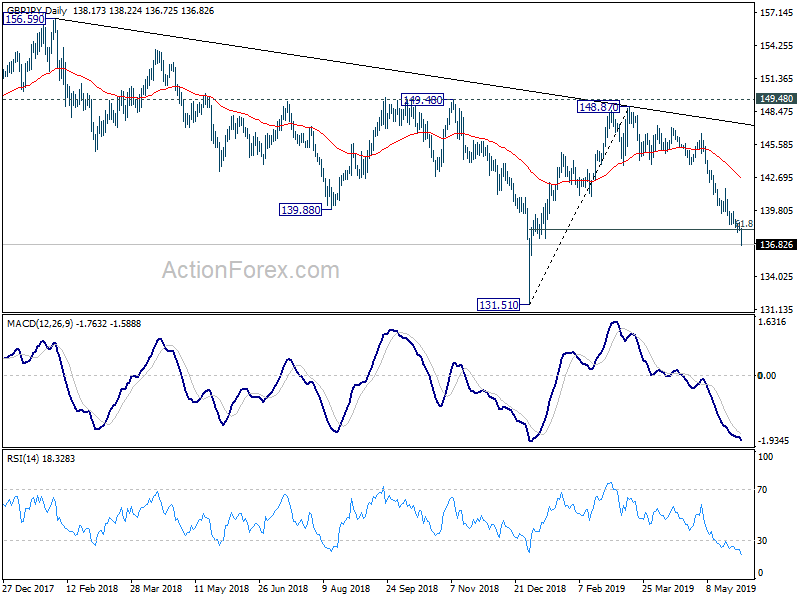
GBP/JPY is also targeting 131.51 low even that flash crash low looks a bit far.
XAU/USD Could Target 1,300.00 Level
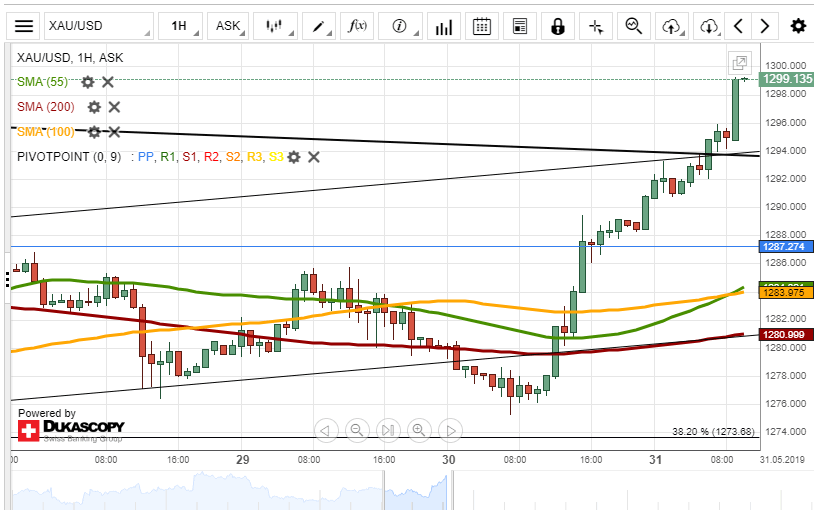
Yesterday, the XAU/USD exchange rate skyrocketed to the psychological level at the 1,290.00 mark. During today's morning, the rate breached the falling wedge pattern north.
From the one hand, the price for gold could continue to increase. In this case, important resistance level to look out for is the psychological level at the 1,300.00 mark.
On the other hand, the rate could trade sideways around the psychological level at 1,295.00 in the short term.
It is unlikely, that the price for gold could drop lower than 2,87.27 due to the support of the monthly PP.
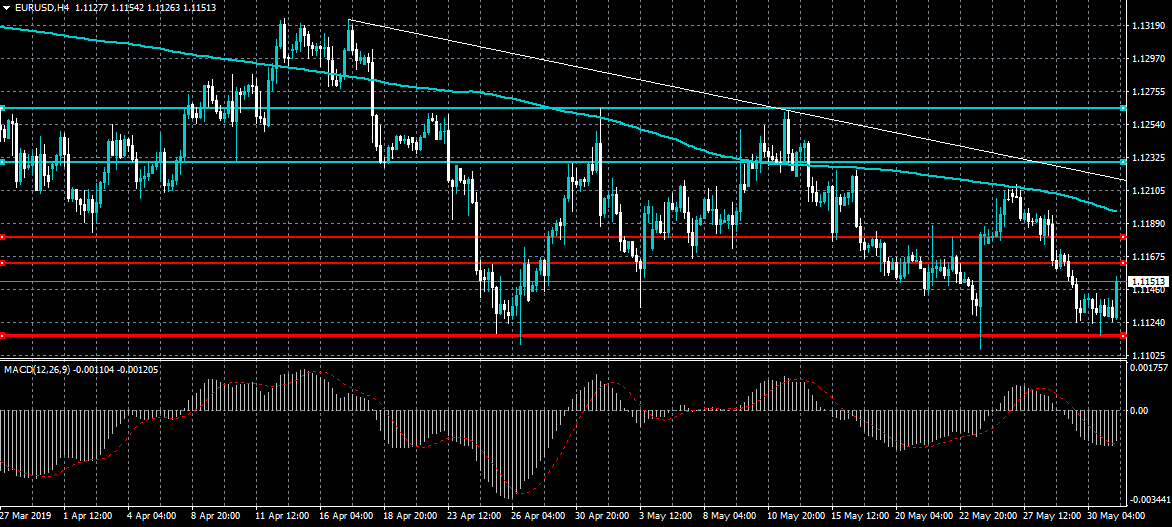
USD/JPY: Two Scenarios Likely
On Thursday, the USD/JPY currency pair dropped to the monthly S3 at 109.12. During Friday's morning, the pair declined to the support level—weekly S1 at 108.83.
If the given support level holds, it is expected, that a reversal north could occur within the following trading hours. In this case, the pair would have to surpass the given monthly S3.
Also, it is unlikely, that the exchange rate could jump higher than the 109.45 mark due to the resistance of the 55– and 100-hour SMAs.
If the given support does not hold, it is likely, that the rate could target the Fibonacci 38.20% retracement at the 108.44 mark.