Sample Category Title
EUR/GBP Mid-Day Outlook
Daily Pivots: (S1) 0.8809; (P) 0.8826; (R1) 0.8842; More...
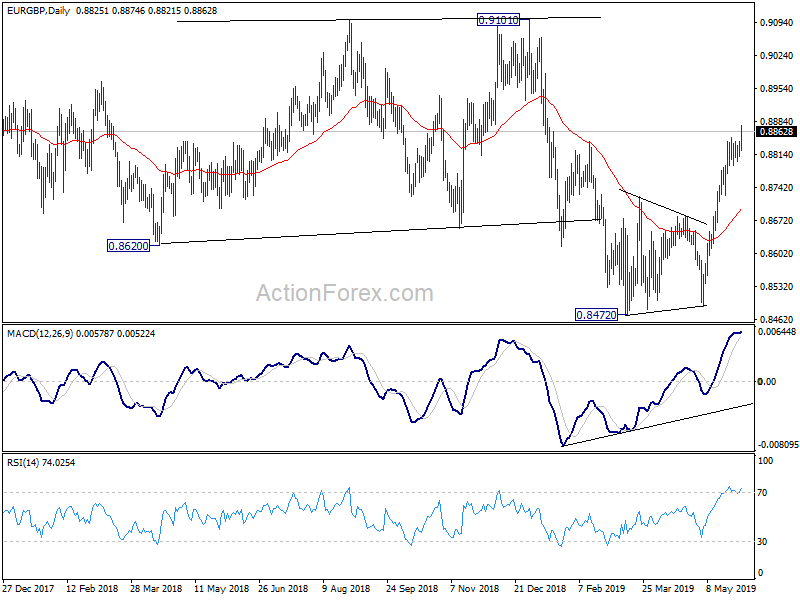
EUR/GBP's rally resumes by taking out 0.8850 and reaches as high as 0.8874 so far. Intraday bias is back on the upside. Further rise should now be seen back to retest 0.9101 key resistance. On the downside, break of 0.8790 minor support will turn bias neutral and bring consolidations again.
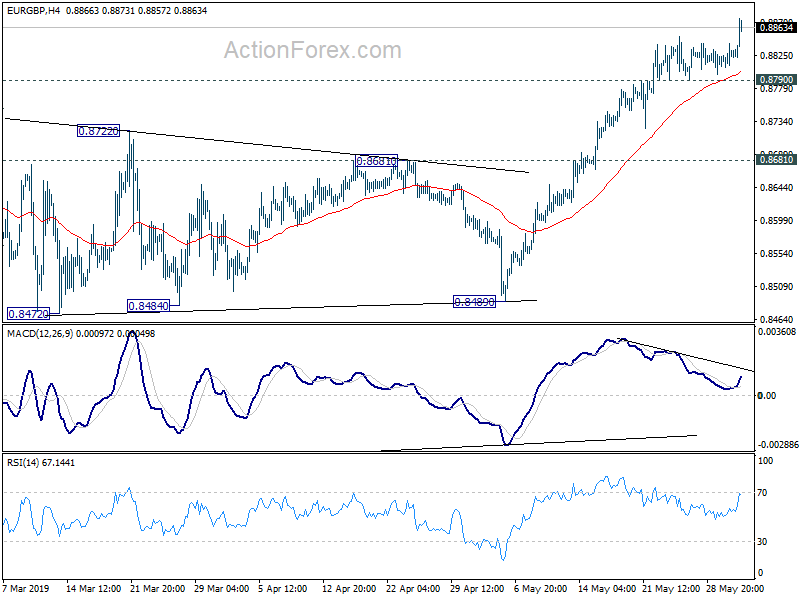
In the bigger picture, medium term decline from 0.9305 (2017 high) is seen as a corrective move. No change in this view. Current development argues that it might have completed with three waves down to 0.8472, just ahead of 38.2% retracement of 0.6935 (2015 low) to 0.9306 at 0.8400, after hitting 55 month EMA (now at 0.8511). Decisive break of 0.9101 resistance will confirm this bullish case. Nevertheless, as EUR/GBP is still staying inside long term falling channel, correction from 0.9305 could still extend to 0.8400 fibonacci level before completion.
Canadian Q1 GDP Increased 0.4% But Details Stronger
- Canadian GDP increased 0.4% in Q1, essentially matching a 0.3% increase in Q4
- Details were firmer and a 0.5% surge in March GDP bodes well for a return to stronger growth rates in Q2.
Q1 growth was widely expected to come in on the soft side. The 0.4% increase was a touch below market expectations and more in line with the Bank of Canada’s last call for a 0.3% gain. More importantly, much of the softness in Q1 can still be traced to disruptions to oil & gas activity in the wake of lower prices last year and mandated production cuts in Alberta. Oil prices have since bounced back and the mandated production cuts have already begun to be eased – indeed, oil & gas output jumped by 3.3% in March, in line with at least a partial bounce-back in the sector in Q2. Excluding the oil & gas sector, output rose by ~1½% in Q1 and that was despite a big weather-related dip in output in February. A 0.5% surge in GDP on a monthly basis in March is right in line with calls for a pickup in growth in Q2 – leaving if anything some near-term upside risk to our own call for a 2.2% increase. And the composition of Q1 GDP growth on an expenditure basis was generally better than feared. A 3.5% jump in Q1 consumer spending is tough to square with earlier-released soft retail spending numbers but household disposable income also posted a decent 3.5% (nominal) increase after an upwardly revised Q4 gain. A significant chunk of a 13.5% jump in business investment reflected lumpy increases in aircraft purchases flagged earlier in the international imports data but Statistics Canada noted that spending rose in 8 of 9 sub-categories of equipment investment.
Net trade was, as expected, the main drag on growth in Q1 with lower oil production weighing on exports. It is also where concerns about future growth prospects are still centered, though. As the Bank of Canada noted in their policy decision this week, negative fallout from the ongoing US-China trade war has the potential to spill over into Canada. And new threats of US tariffs on Mexico – even as passage of the new USMCA (NAFTA replacement) seemed to be getting closer – is a reminder that no trade agreement or past indications of goodwill is really full protection against a re-emergence of tensions with the US under the Trump administration. That uncertainty will remain a headwind for business investment spending in particular. The current economic backdrop still looks okay, and better than quarterly GDP growth headlines in the last couple of quarters would imply, but there is still plenty uncertainty about the outlook to keep the BoC on the sidelines in terms of any future interest rate hikes for now.
EUR/USD Mid-Day Outlook
Daily Pivots: (S1) 1.1116; (P) 1.1131; (R1) 1.1145; More.....
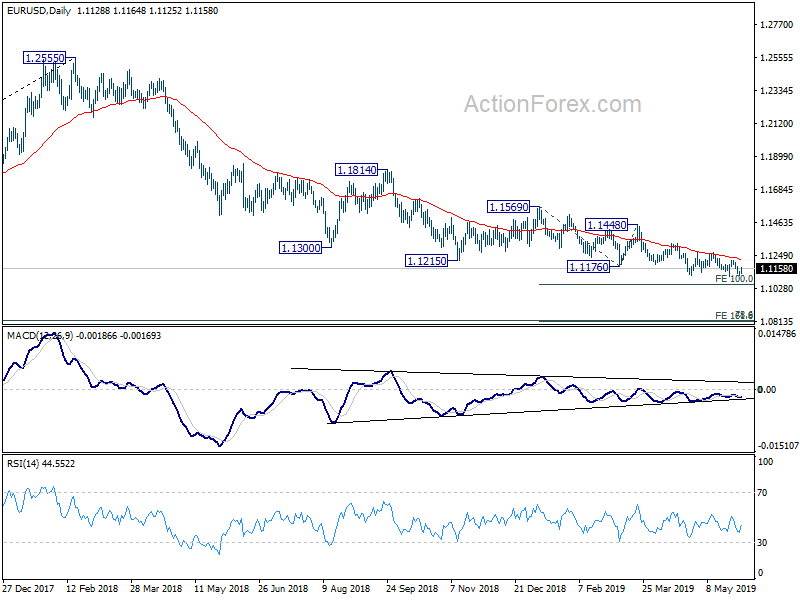
EUR/USD is staying in consolidation from 1.1111 and intraday bias remains neutral. In case of stronger recovery, upside should be limited by 1.1263 resistance to bring down trend resumption. On the downside, firm break of 1.1107 will target 100% projection of 1.1448 to 1.1183 from 1.1324 at 1.1059. However, sustained break of 1.1263 resistance will now be an early sign of trend reversal and turn bias to the upside for 1.1448 key resistance.
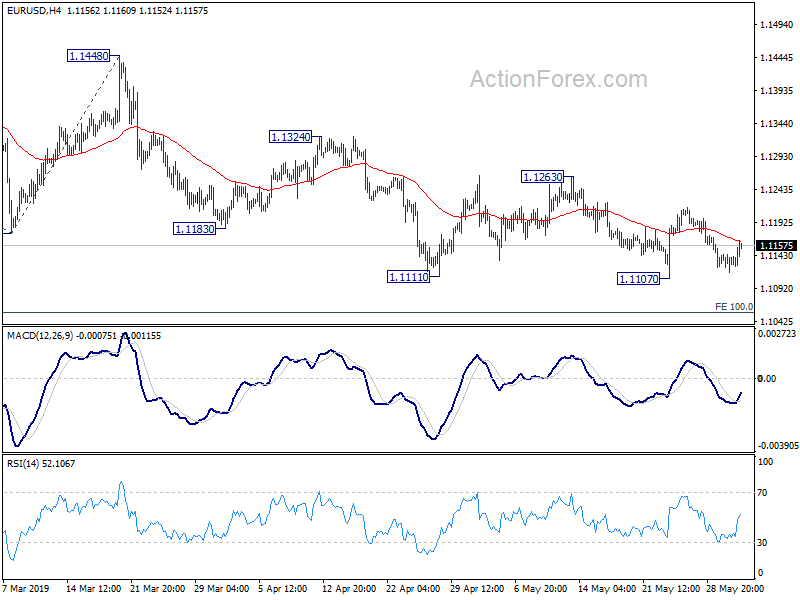
In the bigger picture, down trend from 1.2555 (2018 high) is still in progress. Such decline would target 78.6% retracement of 1.0339 (2016 low) to 1.2555 (2018 high) at 1.0813 next. Sustained break there will pave the way to retest 1.0339. On the upside, break of 1.1448 resistance is needed to be the first sign of medium term bottoming. Otherwise, outlook will stay bearish in case of rebound.
GBP/USD Mid-Day Outlook
Daily Pivots: (S1) 1.2580; (P) 1.2610; (R1) 1.2640; More....
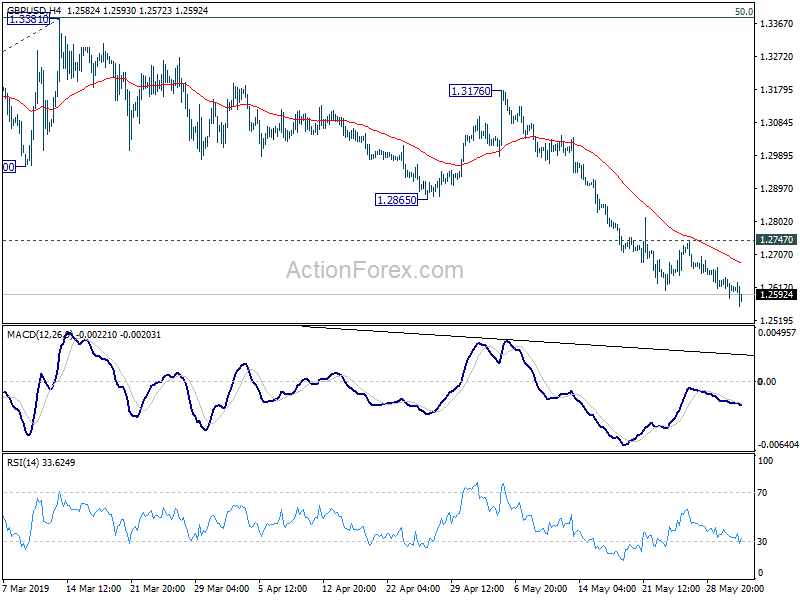
GBP/USD's decline is still in progress and intraday bias stays on the downside. Current fall from 1.3381 should target 1.2391 low first. Firm break there will resume larger down trend to 61.8% projection of 1.4376 to 1.2391 from 1.3381 at 1.2154 next. On the upside, break of 1.2747 resistance is needed to indicate short term bottoming. Otherwise, outlook will remain bearish in case of recovery.
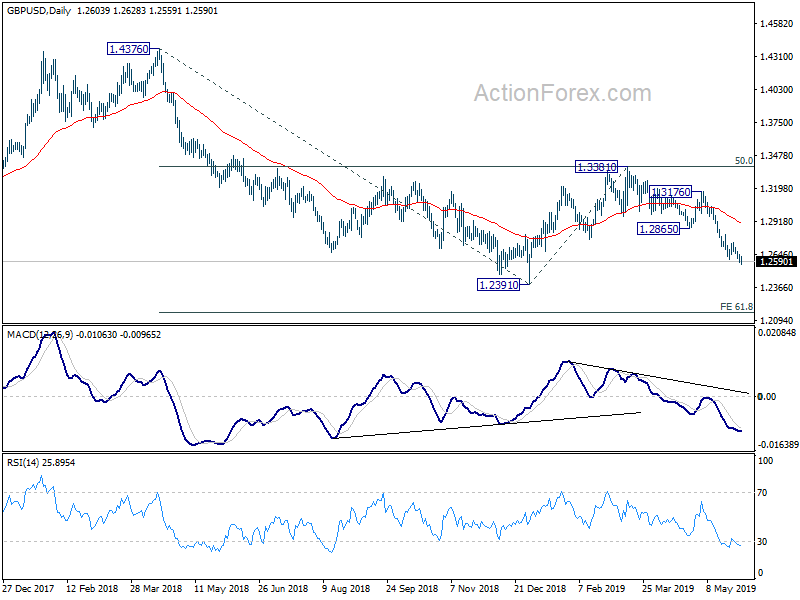
In the bigger picture, current development suggests that medium term decline from 1.4376 (2018 high) is not completed, and is possibly ready to resume. Decisive break of 1.2391 would target a test on 1.1946 long term bottom (2016 low). For now, we don't expect a firm break there yet. Hence focus will be on bottoming signal as it approaches 1.1946. In any case, medium term outlook will stay bearish as long as 1.3381 resistance holds, in case of strong rebound.
USD/CHF Mid-Day Outlook
Daily Pivots: (S1) 1.0066; (P) 1.0082; (R1) 1.0096; More...
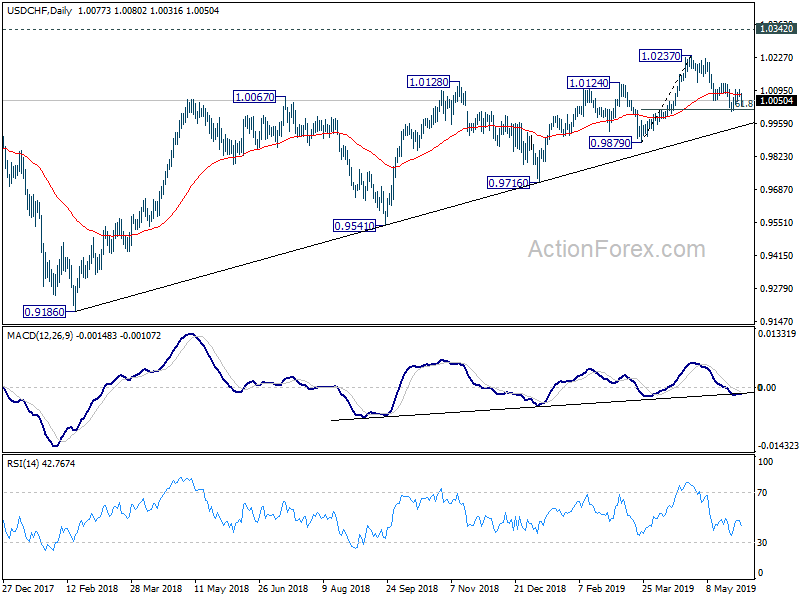
USD/CHF drops notably today but stays above 1.0008 temporary low. Intraday bias remains neutral for the moment. On the upside, decisive break of 1.0119 resistance will suggest that decline from 1.0237 is merely a correction and has completed. Intraday bias will be turned back to the upside for retesting 1.0237. That will also retain medium term bullishness in the pair. On the downside, however, firm break of 1.0008 should pave the way to retest 0.9879 key support next.
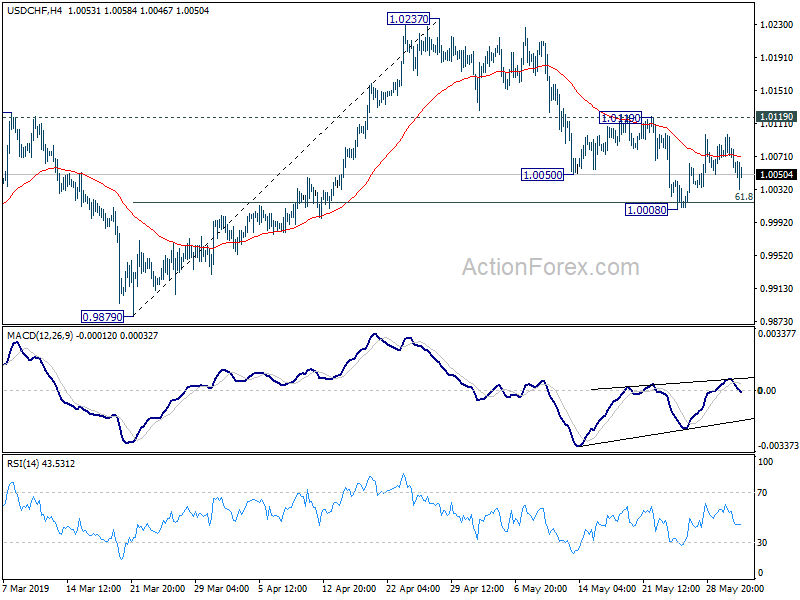
In the bigger picture, USD/CHF is losing upside momentum ahead of 1.0342 key resistance (2016 high). There is no clear sign of reversal yet. But even in case of another rise, we'd be cautious on strong resistance from 1.0342 to limit upside. On the downside, break of 0.9879 support will suggest that larger rise from 0.9186 (2018 low) has completed. Deeper fall will be seen to 0.9716 support for confirmation.
Canadian GDP Starts 2019 on Decent Footing
- Canada kicked off 2019 with modest overall growth as GDP grew just 0.4% (q/q, annualized). This was a bit below the consensus expectation of a 0.7% gain, but right in line with our final tracking. Nominal GDP, which includes the impact of price changes, did much better, climbing 5% as export prices recovered.
- The details of the report were better than the headline would suggest. Final domestic demand growth broke its downtrend, rebounding to a solid 3.4% gain. Consumption led the way as household spending climbed 3.5%, with all major categories showing solid gains. Business investment performed well. Investment in structures fell again, but machinery and equipment spending surged 39.5% in its strongest showing in more than 20 years. Spending in this category was broad-based, with particular strength in vehicles, notably aircraft. Government investment also came back, up 6.4%.
- Inventories rose, likely reflecting build-ups among manufacturers and wholesalers during the quarter, as well as a pricing environment that spurred little destocking in the energy sector despite production curtailments. Notably, the climb (which added 0.7 percentage points to growth) was smaller than might have been expected, probably due to the strength of business spending.
- On the negative side, residential investment fell for a fifth straight quarter (-6.1% q/q saar). New construction (-13.7%) and ownership transfer costs (-12.2%) were the culprits.
- The biggest contributor to the soft headline number was a weak export performance. Headline exports fell 4.1%, driven by goods (-5.7%), notably energy products. Inventories and investment appear to have been fed by imports, up 7.7% on the quarter, largely due to goods imports (+9.6%), notably motor vehicles, aircraft, and consumer goods.
- Turning to incomes, total employee compensation gained 4.2%. With consumers continuing to spend, the household savings rate fell to 1.1% from an upwardly revised 1.4% in Q4. On the corporate side, a modest rebound of the gross operating surplus (+5.6%) was seen.
- We also received the monthly GDP data today, showing better momentum heading into spring. Economic activity rose 0.5% month-on-month in March, a solid showing. 16 of 20 major industries expanded, with goods-producers (+0.7%) leading the way on strength in mining/quarrying/oil and gas (+2.0%) and manufacturing (+0.9%). Service industries weren't far behind, up 0.4% as a whole on solid wholesale, transportation, and real estate activity.
Key Implications
- Don't let the headline fool you, this was a pretty decent GDP report. Final domestic demand finally broke its downtrend, with impressive strength seen in business spending on machinery and equipment – its best quarterly performance since 1996, bringing the level of spending back to pre-crisis levels. It was a good story on the household side too – soft retail sales volumes seem to have been a bit of a red herring, as spending growth ramped up to 3.5%, its best showing in more than a year.
- This gives us good hope that the soft patch is indeed behind us. Some areas in today's report, such as investment in aircraft, tend to be lumpy, so a repeat is unlikely, but we're still set up for a good acceleration of output into the second quarter. The robust 0.5% monthly climb in March, solid jobs and housing data already seen in April, and easing of curtailments on oil production all augur well for growth. While we'll have to run through the numbers carefully in the coming days, early analysis suggests growth around the 2% mark in the second quarter is achievable.
- The messaging from the Bank of Canada ahead of today's data was that it would likely carry less weight than normal, but Governor Poloz and team are likely to be happy with today's showing. One month is hardly a trend, but the March data suggests that the economy remains on track. Solid labour markets seem to finally be translating into stronger consumer spending. But, with the international backdrop still highly uncertain (witness the conflicting signals from the U.S. yesterday of CUSMA ratification alongside potential new tariffs on Mexico), the path forward for the Bank of Canada will be determined by the economic outcomes in the months and quarters ahead, leaving monetary policy stasis the best assumption.
US: Personal Spending Soft in April, Following Strong (and Upwardly Revised) Gain in March
- Personal income rose 0.5% in April, beating the median survey estimate for 0.3%. Personal spending (nominal) rose 0.3%, also marginally ahead of expectations (for 0.2%). March spending was revised up to 1.1% (from 0.9%).
- Removing price growth, real spending was flat (-0.03%). Durable goods spending fell 0.4% and services fell 0.1%, but was offset by a 0.3% gain in non-durable goods.
- The personal consumption price deflator rose 0.3% on the month, and 1.5% on a year-on-year basis. The core measure rose 0.2% (month-on-month) and accelerated to 1.6% year-on-year (from a revised 1.5% in March).
- The personal saving rate edged up to 6.2% in April after falling to 6.1% in March (from 7.0% in February)
Key Implications
- Even with a flat reading on real spending in April, strong growth in March sets up for a solid Q2, with real PCE growth likely just shy of 3% (annualized). This is good, because other domestic sectors, particularly business investment are looking weak.
- Core inflation edged higher in April, the first time in 2019. This remains the indicator to watch as the Fed looks for signs that its recent downward plunge is indeed transitory.
- While consumer spending is looking decent at the moment, the recent bout of financial volatility and continued escalation of trade tensions are likely to take a toll on confidence in the coming months. The imposition of tariffs on imports from Mexico will raise costs for consumers and businesses, and suggests additional downside risks to an already-precarious economic outlook.
USD/JPY Mid-Day Outlook
Daily Pivots: (S1) 109.42; (P) 109.68; (R1) 109.88; More...
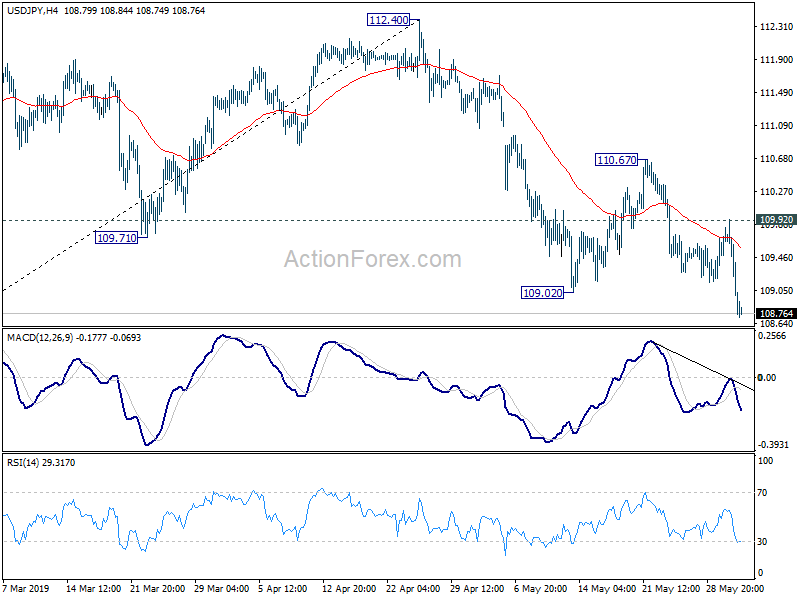
Intraday bias in USD/JPY remains on the downside for the moment. Fall from 112.40 has just resumed and should now target 61.8% retracement of 104.69 to 112.40 at 107.63 next. Sustained trading below 107.63 will pave the way to retest 104.69 low. On the upside, break of 109.92 resistance is needed to indicate short term bottoming. Otherwise, outlook will remain bearish in case of recovery.
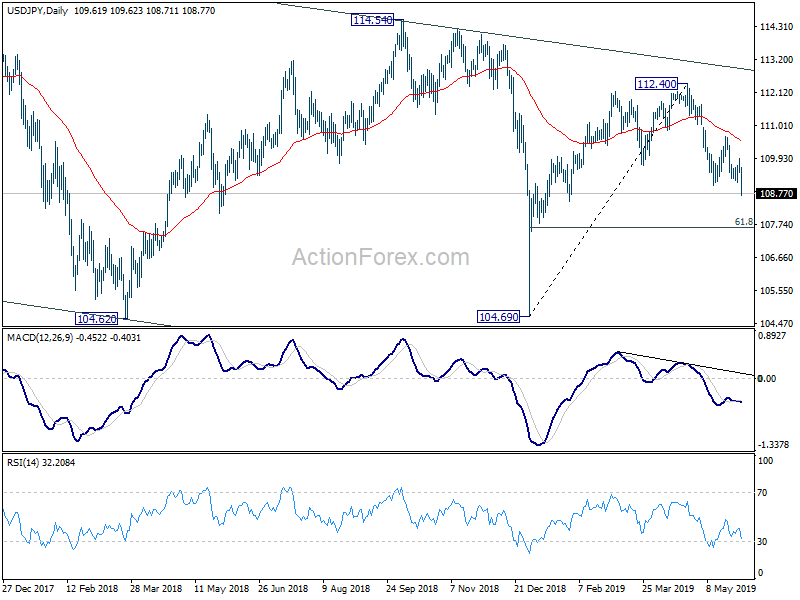
In the bigger picture, USD/JPY is staying inside falling channel from 118.65. Current development suggests that rebound from 104.69 is only a corrective move. And fall from 118.65 is not completed yet. Decisive break of 104.69 will extend the down trend towards 98.97 support (2016 low). For now, we'd expect strong support above there to bring rebound.
DOW Opens Down 1% as Bears Cheer Trump’s Mexican Tariffs, Yen Maintains Strong Momentum
Global financial markets are rocked by Trump's decision to use tariffs as a way to force Mexico to solve border security crisis of the US. 5% tariffs will be imposed in all Mexico imports to US starting June 10, then "gradually" as Trump claimed, go up to 25% on October 1. The implications to some is huge as Trump is now using tariffs for non-economic issues. It's much more than just protectionism. On the other hand, the never-ending trade negotiations are going nowhere after the collapse and China is preparing more retaliations. The positive news, though, is that US economy data released remain solid.
To talk about the seriousness of today's moves, firstly, Mexico Peso sank as much as 3% today while CDS was pushed to two-month high. German 10-year yield dived to new record low at -0.212 even though it gradually climbed above above -0.2 handle. European indices are all in deep red. DOW opens down -250 pts or -1% and is set to press 24900. US 10-year yield gaps down and reaches as low as 2.161 so far. 2% handle is not far away.
In the currency markets, Yen and Swiss Franc are the strongest ones. But Euro is following closely, partly helped by rally in EUR/GBP. Canadian Dollar is the weakness one for today, with WTI crude oil breaching 55 handle. Sterling is the next weakest as selloff resumes. Dollar is indeed the third weakest, decoupling from Yen and Franc.
In Europe, currently, FTSE is down -1.02%. DAX is down -1.75%. CAC is down -1.40%. German 10-year yield is down -0.021 at -0.192. Earlier in Asia, Nikkei dropped -1.63%. Hong Kong HSI dropped -0.79%. China Shanghai SSE dropped -0.24%. Singapore Strait Times dropped -0.80%. Japan 10-year yield dropped -0.0161 to -0.098.
US personal income rose 0.5%, spending rose 0.3%, core PCE at 1.6%
In April, US personal income rose 0.5% or USD 92.8B, above expectation of 0.3%. Spending rose 0.3% or USD 42.7B, above above expectation of 0.2%. Headline PCE rose to 1.5% yoy, up from 1.4% and matched expectations. Core PCE inflation rose to 1.6% yoy, up from 1.5% yoy and matched expectations.
Little reaction is seen in Dollar after the release. The question remains on whether inflation will "persistently" miss 2% target that eventually force a Fed cut. For now, there is no clear evidence for that yet. The greenback might need to look at ISMs and NFP next week for more inspirations.
Canada GDP grew 0.5% mom in March, 0.4% annualized in Q1
Canada GDP grew 0.5% mom in March, , well above expectation of 0.3% mom. Goods-producing industries were up 0.7%, offsetting most of the decline in February, while services-producing industries (+0.4%) posted their strongest increase since May 2018. There were gains in 16 of the 20 industrial sectors.
For Q1, GDP grew an annualized 0.4%, well below expectation of 0.7%. Growth in real GDP was driven by a 0.9% increase in household spending and an 8.7% rise in business investment in machinery and equipment. These increases were moderated by a 1.0% decline in exports, coupled with a 1.9% increase in imports. Additionally, investment in housing continued to decline, down 1.6% in the first quarter.
German retail sales dropped -2.0%, CPI slowed to 1.4%
Released in European session, German retail sales dropped -2.0% mom in April, well below expectation of 0.4% mom rise. German CPI slowed back to 1.4% yoy in May, down from 2.0% yoy, missed expectation of 1.6% yoy. Swiss retail sales dropped -0.7% yoy in April, below expectation of -0.8% yoy. UK Mortgage approvals rose to 66k in April, above expectation of 64k. UK M4 money supply rose 0.9% mom in April, above expectation of 0.4% mom.
China's unreliable entities list on the way as countermeasures to US
Just as the Chinese Communist Party run hawkish tabloid Global Times warned that "major retaliative measures' on US for Huawei are underway, the Commerce Ministry announced to set up a list of "unreliable entities" targets companies that violate market rules, cut off supply to the country.
The ministry noted that for non-commercial purposes, some foreign entities impose blockades, confessions and other discriminatory measures against Chinese enterprises and damage their legitimate rights and interests". Such entities endanger China's national security and interests, and also pose a threat to global supply chain. Detailed measures regarding the list will be announced later.
China PMI manufacturing dropped to 49.4, widening decline, increasing downward pressure
The official China PMI manufacturing dropped to 49.4 in May, down from 50.1 and missed expectation of 49.9. It further confirmed that March's recovery was a false dawn and the slowdown trajectory in China is ongoing. More importantly, deterioration could quick further with the current round of US-China trade war escalation. Non-manufacturing PMI was unchanged at 54.3.
Analyst Zhang Liqun noted that "the decline was widening, indicating that the downward pressure on the economy has increased." And, "foundation for economic stabilization has not yet been established." In particular, new orders index, the export order index decreased significantly, "reflecting the lack of market demand is more prominent, especially the downward pressure on exports".
Looking at some details: Production dropped -0.4 to 51.7; New order dropped -1.6 to 49.8; New Export order dropped -2.7 to 46.5; Import dropped -2.6 to 47.1; Employment dropped -0.2 to 47.0.
Japan unemployment rate dropped, so was consumer confidence
The batch of economic data released from Japan today is mixed. Unemployment rate dropped to 2.4% in April, down from 2.5%, matched expectations. However, better employment was not reflected in retail sales nor consumer sentiment. Retail sales rose 0.5% yoy, missed expectation of 1.0% yoy. Consumer confidence dropped to 39.4, below expectation of 40.6.
Meanwhile, industrial production rose 0.6% mom in April, above expectation of 0.2% mom. However, the road ahead could be bumpy with trade war escalation in May. Housing starts dropped -5.7% yoy in April, below expectation of -0.8% yoy. Tokyo CPI core slowed to 1.1% yoy in May, down from 1.3% yoy and missed expectation of 1.2% yoy.
USD/JPY Mid-Day Outlook
Daily Pivots: (S1) 109.42; (P) 109.68; (R1) 109.88; More...
Intraday bias in USD/JPY remains on the downside for the moment. Fall from 112.40 has just resumed and should now target 61.8% retracement of 104.69 to 112.40 at 107.63 next. Sustained trading below 107.63 will pave the way to retest 104.69 low. On the upside, break of 109.92 resistance is needed to indicate short term bottoming. Otherwise, outlook will remain bearish in case of recovery.
In the bigger picture, USD/JPY is staying inside falling channel from 118.65. Current development suggests that rebound from 104.69 is only a corrective move. And fall from 118.65 is not completed yet. Decisive break of 104.69 will extend the down trend towards 98.97 support (2016 low). For now, we'd expect strong support above there to bring rebound.
Economic Indicators Update
| GMT | Ccy | Events | Actual | Forecast | Previous | Revised |
|---|---|---|---|---|---|---|
| 23:01 | GBP | GfK Consumer Confidence May | -10 | -12 | -13 | |
| 23:30 | JPY | Unemployment Rate Apr | 2.40% | 2.40% | 2.50% | |
| 23:30 | JPY | Tokyo CPI Core Y/Y May | 1.10% | 1.20% | 1.30% | |
| 23:50 | JPY | Industrial Production M/M Apr P | 0.60% | 0.20% | -0.60% | |
| 23:50 | JPY | Retail Trade Y/Y Apr | 0.50% | 1.00% | 1.00% | |
| 01:00 | CNY | Manufacturing PMI May | 49.4 | 49.9 | 50.1 | |
| 01:00 | CNY | Non-manufacturing PMI May | 54.3 | 54.3 | 54.3 | |
| 01:30 | AUD | Private Sector Credit M/M Apr | 0.20% | 0.30% | 0.30% | |
| 05:00 | JPY | Consumer Confidence Index May | 39.4 | 40.6 | 40.4 | |
| 05:00 | JPY | Housing Starts Y/Y Apr | -5.70% | -0.80% | 10.00% | |
| 06:00 | EUR | German Retail Sales M/M Apr | -2.00% | 0.40% | -0.20% | |
| 06:30 | CHF | Retail Sales Real Y/Y Apr | -0.70% | -0.80% | -0.70% | |
| 08:30 | GBP | Mortgage Approvals Apr | 66K | 64K | 62K | |
| 08:30 | GBP | Money Supply M4 M/M Apr | 0.90% | 0.40% | -0.50% | |
| 12:00 | EUR | German CPI M/M May P | 0.20% | 0.30% | 1.00% | |
| 12:00 | EUR | German CPI Y/Y May P | 1.40% | 1.60% | 2.00% | |
| 12:30 | CAD | GDP M/M Mar | 0.50% | 0.30% | -0.10% | -0.20% |
| 12:30 | CAD | GDP Annualized Q/Q Q1 | 0.40% | 0.70% | 0.30% | |
| 12:30 | CAD | Industrial Product Price M/M Apr | 0.80% | 0.30% | 1.30% | |
| 12:30 | CAD | Raw Materials Price Index M/M Apr | 5.60% | 2.40% | 2.80% | |
| 12:30 | USD | Personal Income Apr | 0.50% | 0.30% | 0.10% | |
| 12:30 | USD | Personal Spending Apr | 0.30% | 0.20% | 0.90% | 1.10% |
| 12:30 | USD | PCE Deflator M/M Apr | 0.30% | 0.30% | 0.20% | |
| 12:30 | USD | PCE Deflator Y/Y Apr | 1.50% | 1.50% | 1.50% | 1.40% |
| 12:30 | USD | PCE Core M/M Apr | 0.20% | 0.20% | 0.00% | 0.10% |
| 12:30 | USD | PCE Core Y/Y Apr | 1.60% | 1.60% | 1.60% | 1.50% |
| 13:45 | USD | Chicago PMI May | 54 | 52.6 | ||
| 14:00 | USD | U. of Mich. Sentiment May F | 101 | 102.4 |
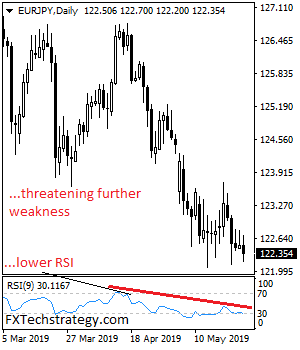
EUR/JPY Retains Broader Downside Pressure With Eyes On 122.00 Level
EURJPY retains broader downside pressure with eyes on 122.00 level and beyond in the days ahead. Support comes in at the 121.50 level where a break if seen will aim at the 121.00 level. A cut through here will turn focus to the 120.50 level and possibly lower towards the 120.00 level. Its daily RSI is bearish and pointing higher suggesting further weakness. On the upside, resistance resides at the 123.00 level. Further out, we envisage a possible move towards the 123.50 level. Further out, resistance resides at the 124.00 level with a turn above here aiming at the 124.50 level. On the whole, EURJPY retains broader downside pressure with eyes on 122.00 level.