

Sample Category Title
GBP/JPY Weekly Outlook
GBP/JPY's fall reaccelerated to as low as 136.63 last week and initial bias stays on the downside this week. Now that 61.8% retracement of 131.51 to 148.87 at 138.14 is firmly taken out, next target will be 131.51 low. On the upside, break of 138.73 minor resistance will turn intraday bias neutral and bring consolidations first, before staging another fall.
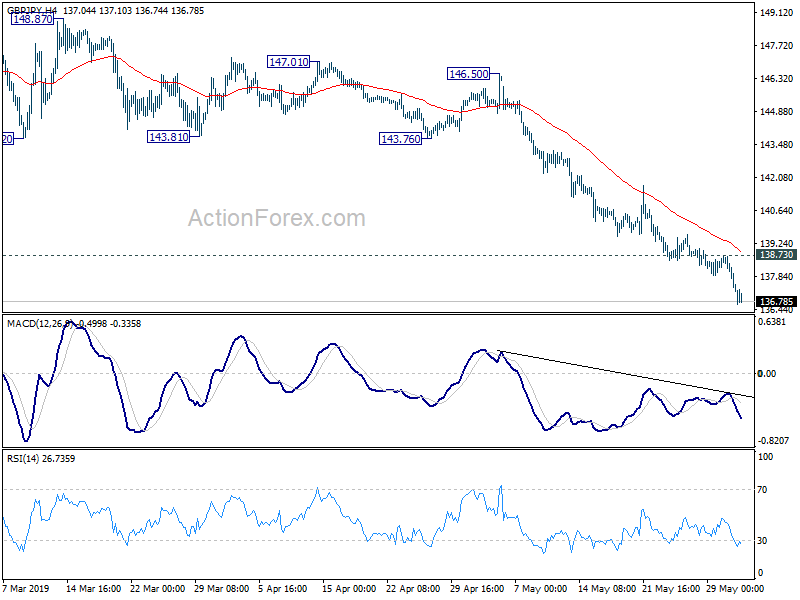
In the bigger picture, current development suggests that GBP/JPY medium term fall from 156.59 (2018 high) is still in progress. Break of 131.51 will target 122.36 (2016 low). Structure of such decline is corrective looking so far, arguing that it's just the second leg of consolidation from 122.36. Thus, we'd expect strong support from 122.36 to contain downside to bring reversal.
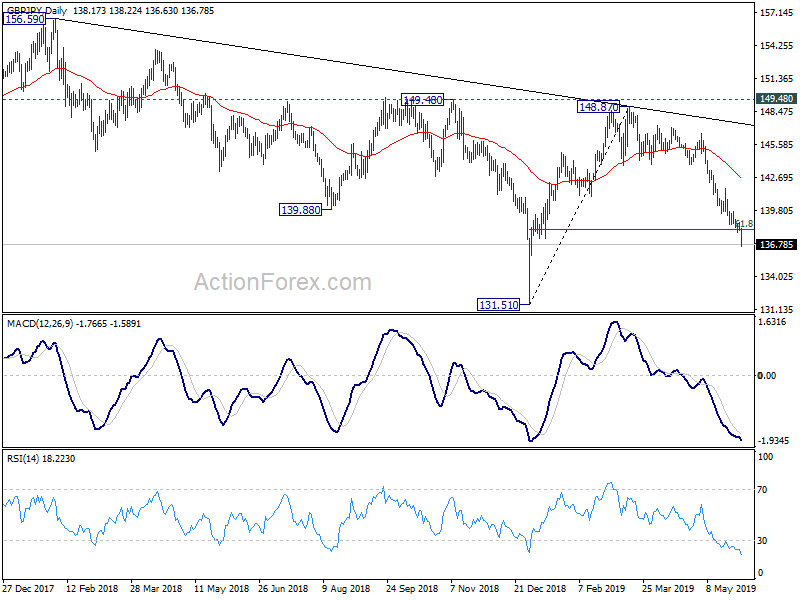
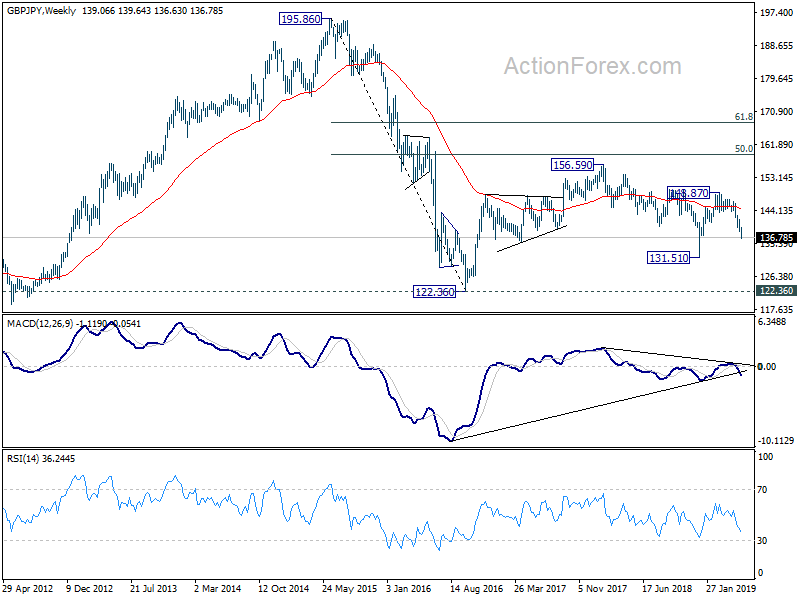
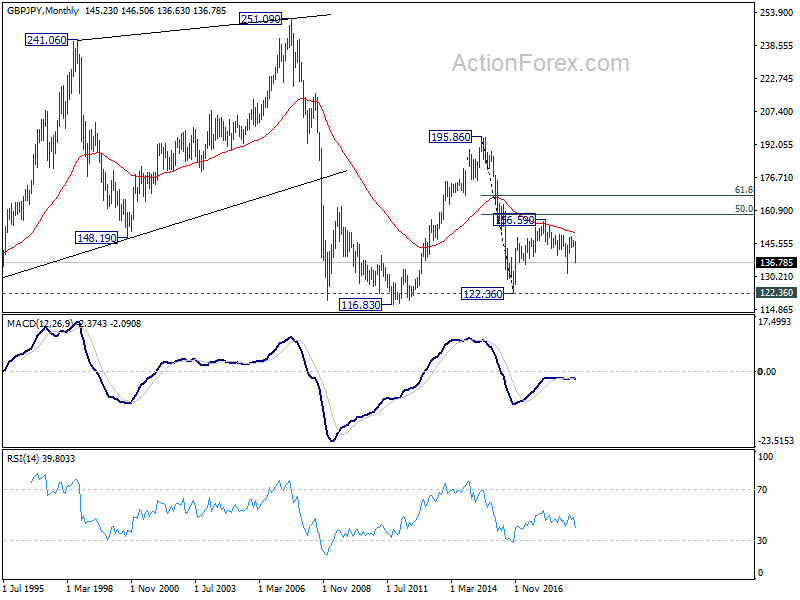
In the longer term picture, firstly, GBP/JPY's is kept well below 55 week EMA, keeping outlook bearish. But we're treating price actions from 122.36 as a corrective pattern. Hence, we'd expect range trading to continue longer. In case of an extension, strong resistance is likely to be seen at 50% retracement of 195.86 (2015 high) to 122.36 at 159.11 to limit upside. However, break of 122.26 will put 116.83 (2011 low) back into focus.
Sentiment Sank on Trump’s Political Weaponization of Tariffs
Free fall in major government yields extended, and accelerated last week. Meanwhile, it seemed that stocks investors finally woke up with sharply deteriorating sentiments. Major indices staged steep decline as risk aversion heightened. The first factor being the "ever-present" US-China trade tensions. Hard-line rhetorics from official media blossomed after Xi urged his citizens to prepare for a "new long march" earlier in the month.
And now China is also stepping counter-measures to US isolation of Huawei. Rare earth will be used to disrupt US industrial and tech supply chain. And a so called "unreliable entity list" will be set up. There are divided opinions on the effectiveness of China's moves but they're somewhat irrelevant. The key message is that there is no room for negotiations for now. Further, on Sunday, China is going to lay out its position on trade talks with the US in a white paper titled "China's Position on the China-U.S. Economic and Trade Consultations".
Judging from the intensity of market reactions, Trump's suddenly move to tariff Mexican products had a more profound impact that unsettle global investor confidence. In short, in order to force Mexico to curb immigration flow through the country to US, Trump announced to impose 5% tariffs on all Mexican products on June 10. That will eventually move up to 25% on October 1 if he's not satisfied with what Mexico is going to do. That's an unprecedented move in using tariffs on issues unrelated to trade nor economy. That's beyond the scope of trade war and it's no longer just protectionism. It's weaponization of tariffs for political agenda.
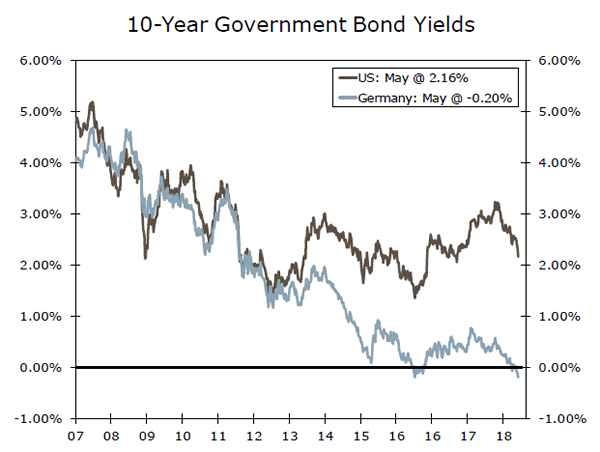
The net results were, over the week: DOW dropped -3.01%. S&P 500 dropped -2.62%. NASDAQ dropped -2.41%. DAX dropped -2.37%. CAC dropped -2.05%. FTSE dropped -1.59%. Nikkei dropped -2.44%. China Shanghai SSE surprisingly rose 1.6%. US 10-year yield dropped -0.182 to -2.142. 30-year yield dropped -0.169 to 2.583. German 10-year yield dropped to record low at -0.211 before closing at -0.20, down -0.086.
In the currency markets, Yen was overwhelmingly the strongest one. It's surprisingly followed by the resilient Australian Dollar, and then Swiss Franc. Sterling was the worst performing one. Canadian Dollar was second worst, following steep decline in oil price.
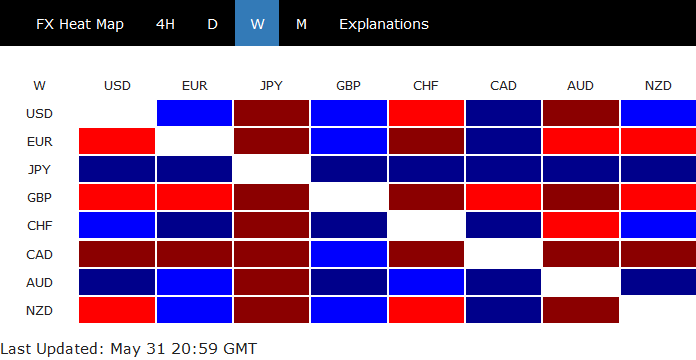
Dollar dragged down by Fed cut pricing and falling yields
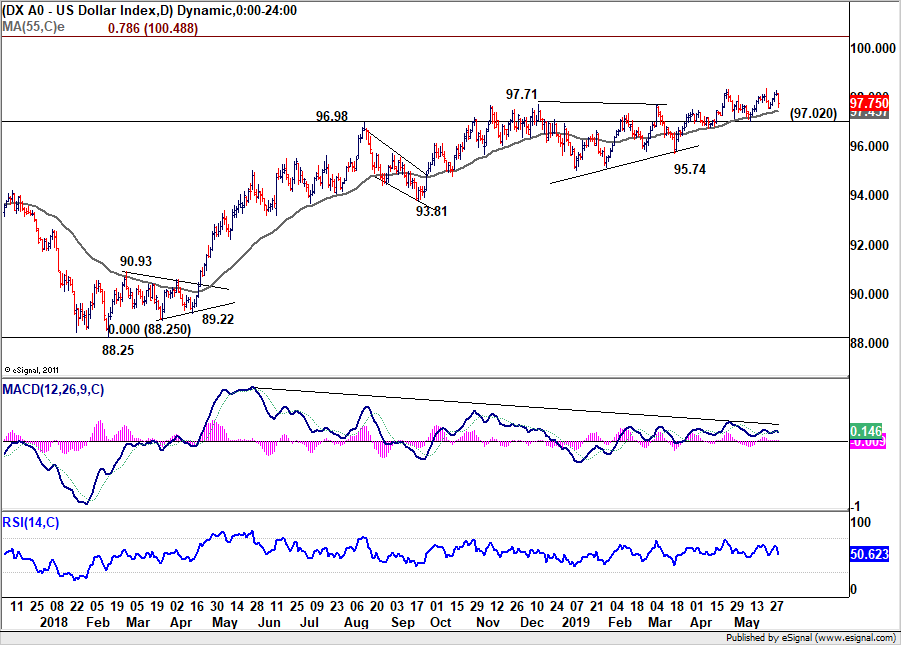
Dollar was left behind by Yen and France last week and ended mixed despite risk aversion on trade tensions. Increasing bets on Fed rate cut this year was a factor weighing on the greenback. Free fall in treasury yield was another. Both developments could intensify this week with the heavy weight economic data releases. Both ISM indices are expected to stay steady in May. But given that Market PMIs deteriorated sharpy to 50.6 (manufacturing) and 50.9 (services), the markets could be setting themselves up for disappointment. Personal spending in the US has been strong while consumer confidence stayed high. Jobless claims also hovered around very low levels. So, it's less likely that non-farm payroll would disappoint. But any downside surprise in NFP would trigger huge reactions based on current weak sentiments.
Dollar index has been losing upside momentum for some time, as seen in daily MACD too. But after all, it's support above 55 day EMA in the current rising leg and there is no clear sign of topping yet. For now, outlook remains cautiously bullish for 100 psychological level. However, firm break of 97.02 support will be an early sign of medium term bearish reversal. And focus will be turned back to 95.74 structure support for confirmation.
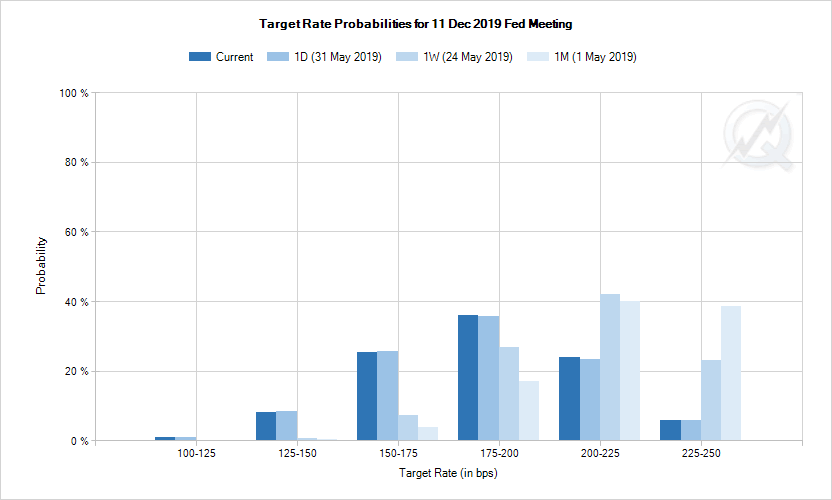
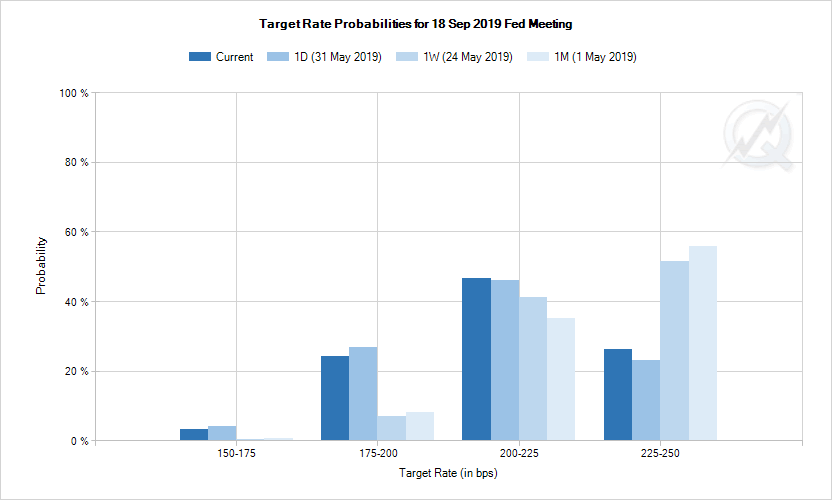
Investors now see 73.9% chance of Fed cut by September meeting
Recent comments from Fed officials continued to reinforce the patient stance. Sluggish inflation was seen as transitory and improvements in job market will eventually lift inflation back to target and above. But such view could quickly change if data point to slowdown or even turnaround in employment. Investors are clearly ahead of Fed on the issue.
Fed fund futures are now pricing in 94.1% chance of at least one rate cut by December this year. That's notably higher than 76.9% a week ago and 61.4% a month ago.
Also, chance for a Fed cut by September meet now stands at 73.9%. It was less than 50% a week and and month ago.
 10-year yield close to key support zone after steep decline
10-year yield dropped to as low as 2.137 before closing at 2.142. For now, we'd still look for support between 2.034 and 61.8% retracement of 1.336 to 3.248 at 2.066 to bring a recovery. But break of 2.356 resistance is needed to be the first sign of bottoming. Otherwise, outlook will stay bearish and more downside is in favor. Indeed, current downside acceleration suggests that 2.0 handle will likely be taken out too. It's just a matter of time.
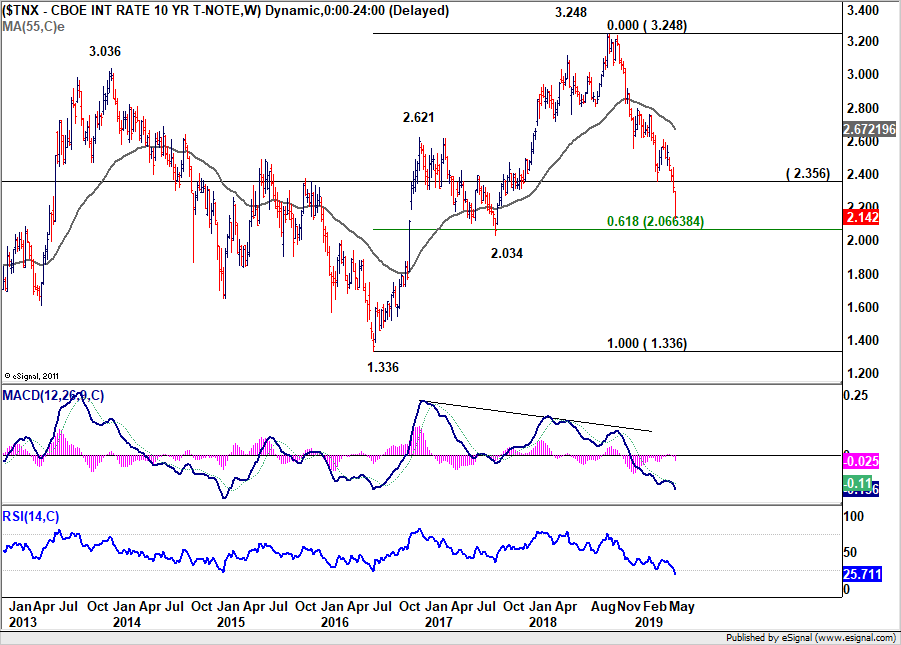
Also, looking at the biggest picture, TNX was held by decade long channel resistance. 55 month EMA was also taken out with last week's steep fall. It's still a bit early to say. But sustained trading below 2.0 handle could pave the way back to 1.336 low.
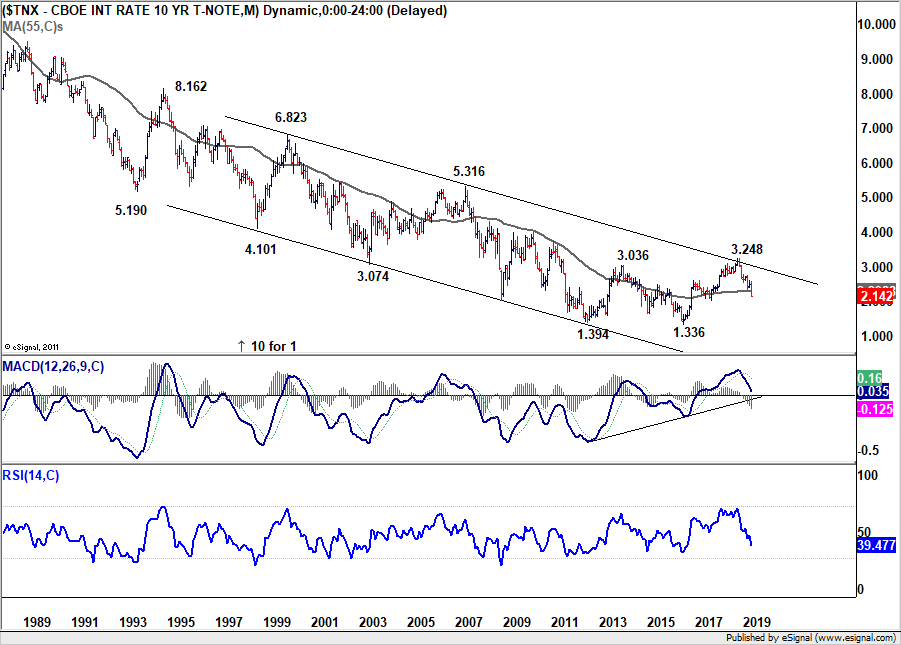
DOW's fall fro 26685.96 resumed and accelerated
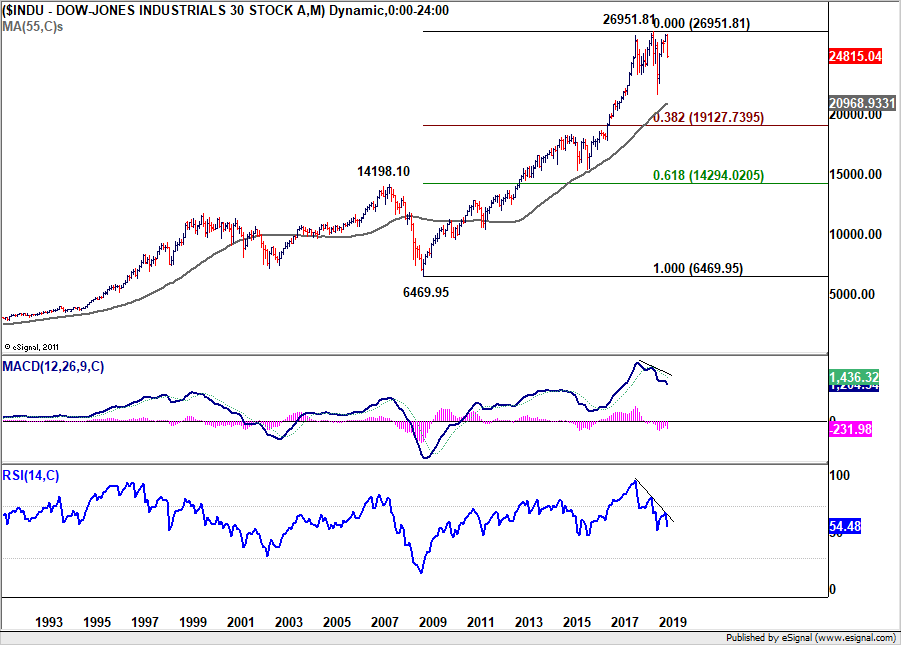
DOW's decline from 26696.95 extended to as low as 24809.51 last week. It was just inch above 38.2% retracement of 21712.53 to 26695.96 at 24792.28. DOW might try to recover from current level. But break of 25342.28 gap resistance is needed to indicate bottoming. Otherwise, further decline is expected ahead to 61.8% retracement at 23616.20 at least.
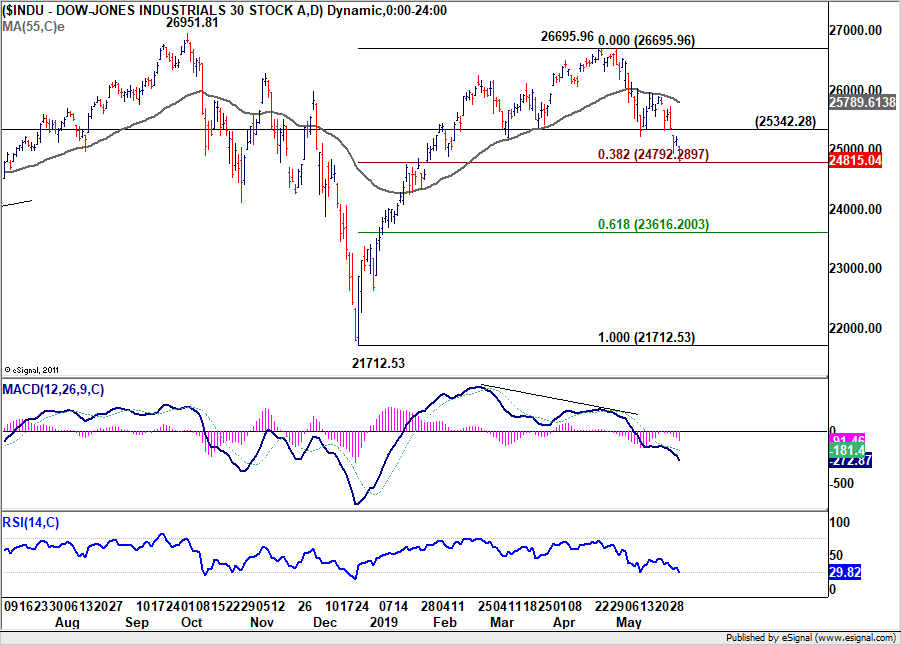
Also, we've pointed out before that fall from 26696.95 is seen as the third leg of the consolidation pattern from 26951.981 high. Such decline could even have a take on 50% retracement of 15450.56 to 26951.81 at 21201.18 before completion. That's not too bearish a view already as we're not seeing it as correction to the whole up trend from 2009 low at 6469.96 (yet).
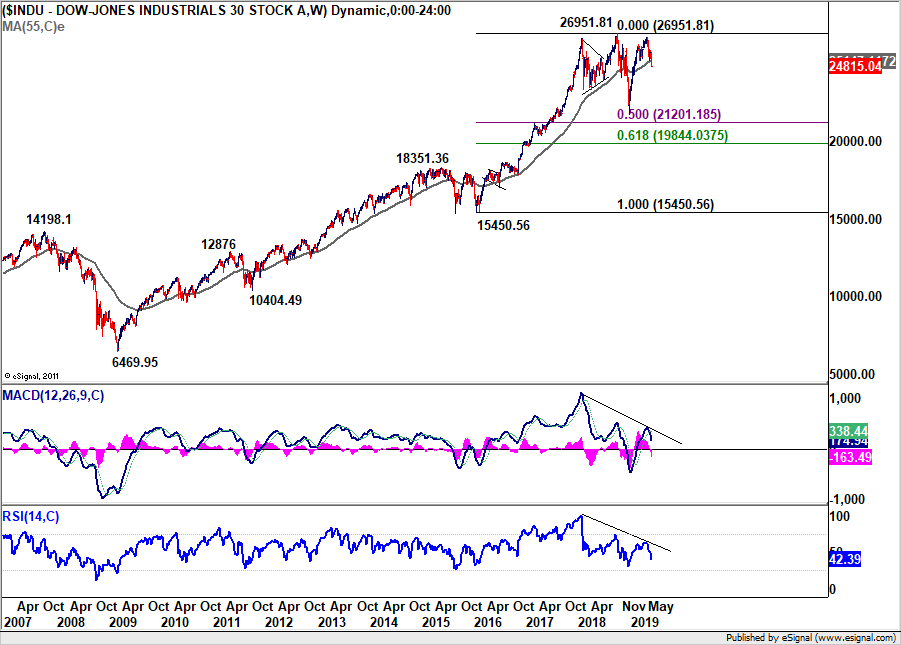
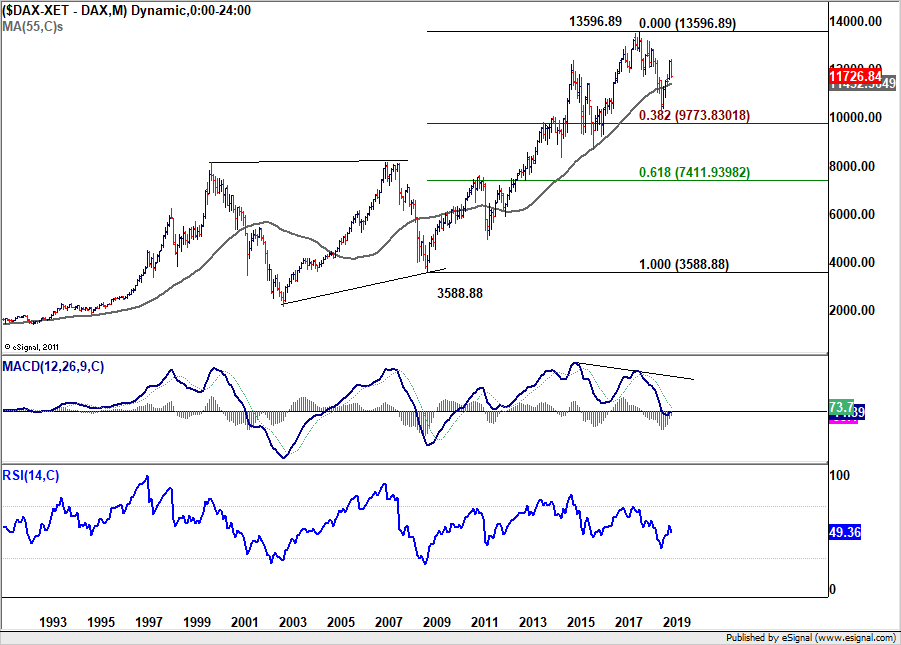
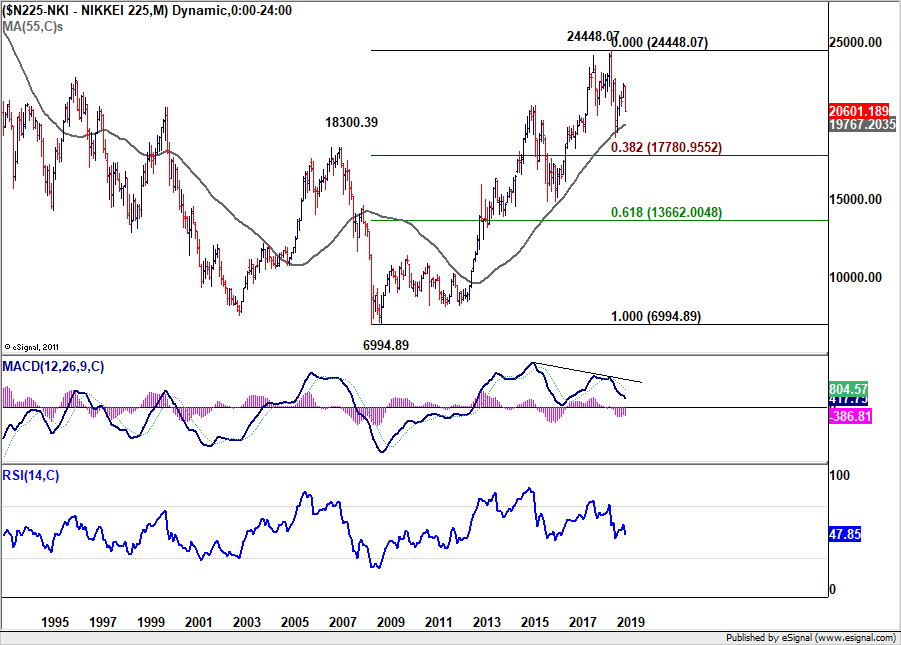
Comparing long term charts of DAX, Nikkei and DOW
However, if we look at DAX, it's hard to deny that it's corrective the up trend from 2009 low at 3588.88.
And Nikkei is also correcting whole up trend from 2009 low at 6995.89.
So, maybe DOW is doing so too. We'll see.
USD/JPY Weekly Outlook
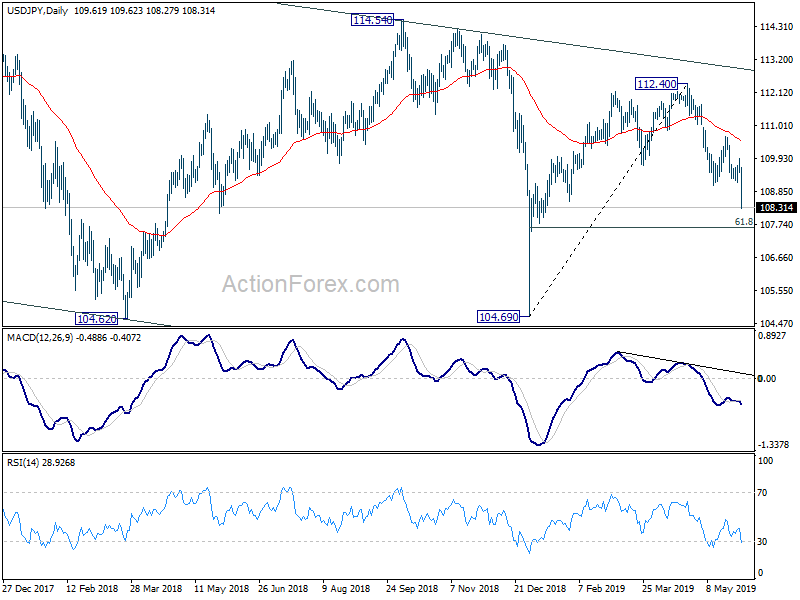
USD/JPY's decline from 112.40 resumed last week by dropping through 109.02 support and hit as low as 108.27. Initial bias stays on the downside this week for 61.8% retracement of 104.69 to 112.40 at 107.63. Sustained break there will pave the way back to 104.62/9 key support zone. On the upside, break of 109.15 support turned resistance is needed to be the first sign of short term bottoming. Otherwise, outlook will remain bearish in case of recovery.
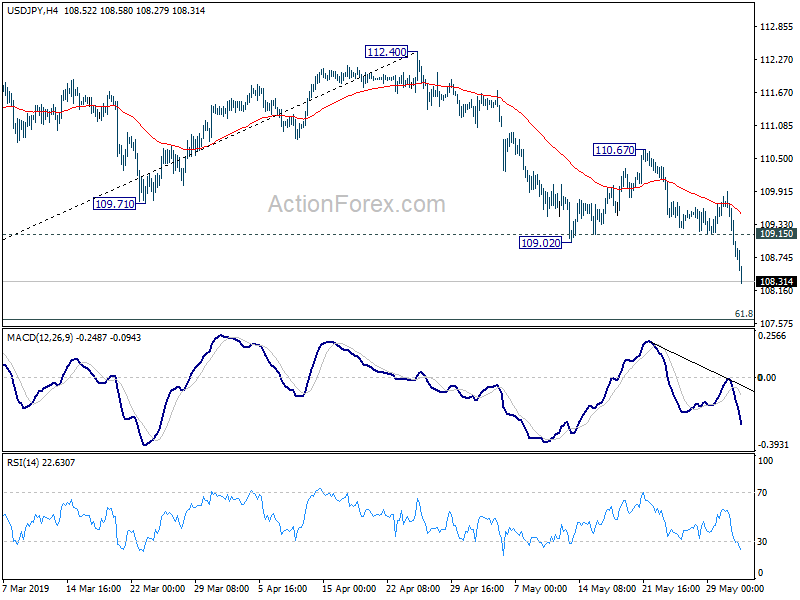
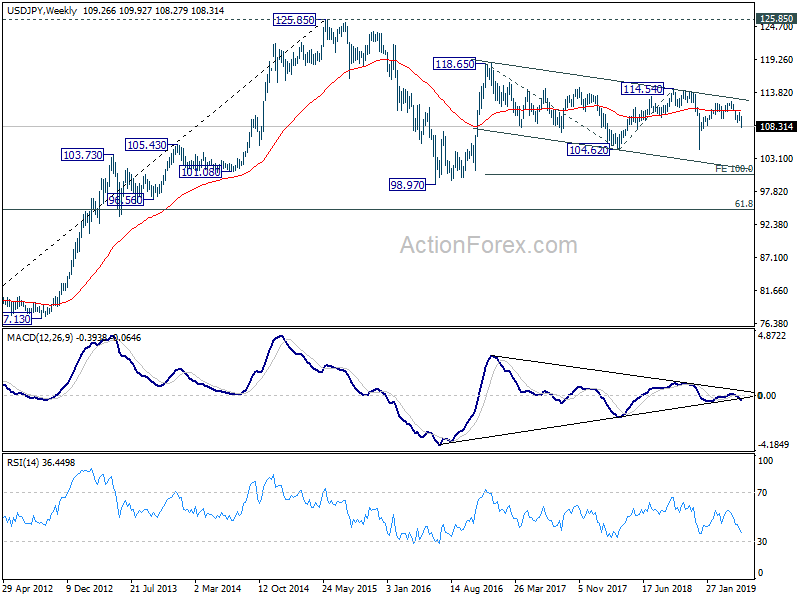
In the bigger picture, decline from 118.65 (Dec 2016) is still in progress, with the pair staying indicate long term falling channel. Break of 104.62 will target 100% projection of 118.65 to 104.62 from 114.54 at 100.51. For now, we'd expect strong support above 98.97 (2016 low) to contain downside to bring rebound.
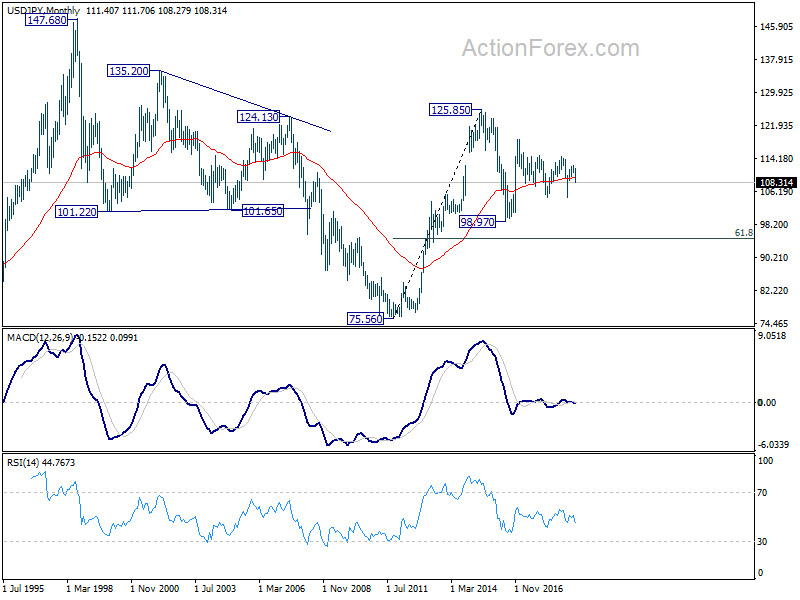
In the long term picture, the rise from 75.56 (2011 low) long term bottom to 125.85 (2015 high) is viewed as an impulsive move, no change in this view. Price actions from 125.85 are seen as a corrective move which could still extend. In case of deeper fall, downside should be contained by 61.8% retracement of 75.56 to 125.85 at 94.77. Up trend from 75.56 is expected to resume at a later stage for above 135.20/147.68 resistance zone.
Summary 6/3 – 6/7
Monday, Jun 3, 2019
[php_everywhere instance="1"]
Tuesday, Jun 4, 2019
[php_everywhere instance="2"]
Wednesday, Jun 5, 2019
[php_everywhere instance="3"]
Thursday, Jun 6, 2019
[php_everywhere instance="4"]
Friday, Jun 7, 2019
[php_everywhere instance="5"]
Weekly Economic and Financial Commentary: Markets Jitter as Trade War Escalates
U.S. Review
Markets Jitter as Trade War Escalates
- Fear around the trade war remained top of mind for market participants this week, and helped instigate another inversion of the yield curve.
- There is no denying that the yield curve has inverted prior to each of the past six recessions, but we stand by our previously stated deduction that it alone does not necessarily mean we are headed for an impending downturn.
- That said, the trade war remains the largest downside risk to the outlook. Increased tariffs have yet to manifest themselves in steep increases in consumer goods prices, however, the potential is there.
Markets Jitter as Trade War Escalates
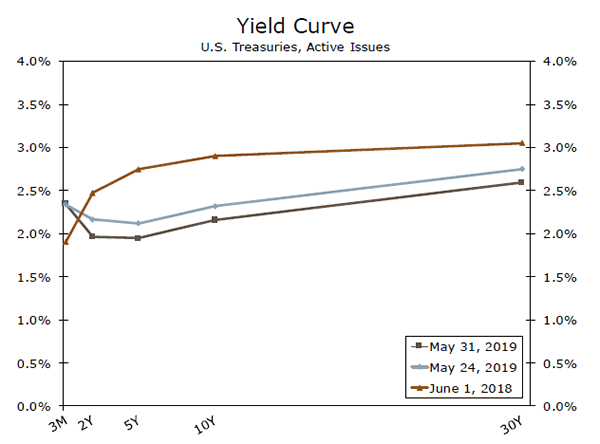
Fear around the trade war remained top of mind for market participants this week, and helped instigate another inversion of the yield curve. The yield curve has been flirting with inversion for the past six months, but recent escalation in the trade war has brought fear of an imminent recession back into the fore.
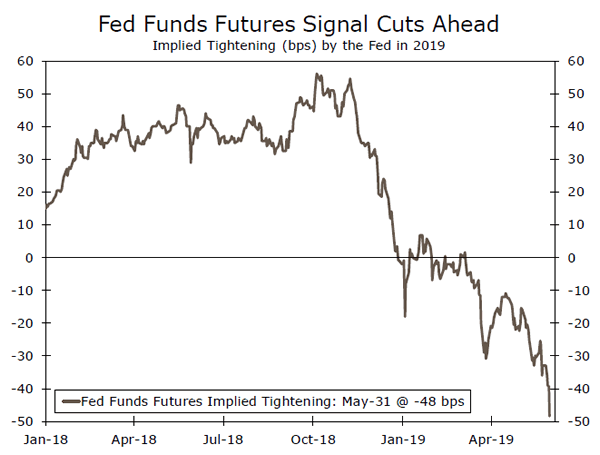
An inversion of the yield curve can signal investor suspicion— about the pace of future growth, or if the Fed will need to cut rates. The escalating trade war has boosted uncertainty about growth, while the market implied probability of a rate cut by year-end continues to rise (top chart). There is no denying that the yield curve has inverted prior to each of the past seven recessions, but we stand by our previously stated deduction that it alone does not necessarily mean we are headed for an impending downturn.
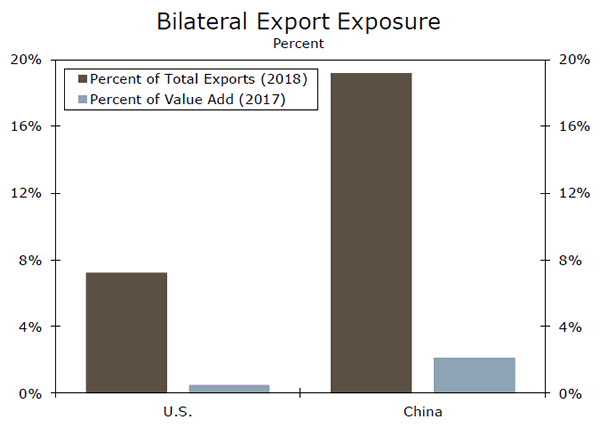
That said, the trade war remains the largest downside risk to the outlook. A couple of weeks ago, the Trump administration hiked tariffs to 25% from 10% on an estimated $200 billion of Chinese imports, and threatened to impose the 25% tariff on all remaining goods from China. In response, China announced a hike to tariffs on U.S. imports. While exports to China account for less than 8% of total U.S. exports (middle chart), the trade war may be beginning to have rippling effects throughout the economy.
Even if President Trump's tariff 'strategy' gives way to better relations with our trading partners and tariffs are eventually rolled back, they have already began to affect corporate supply chains and are expected to weigh on profits this year. At the end of the day, remember tariffs are taxes. They tend to raise the price of imported goods for U.S. consumers and producers, which could cause prices of domestic goods that compete with these imports to rise.
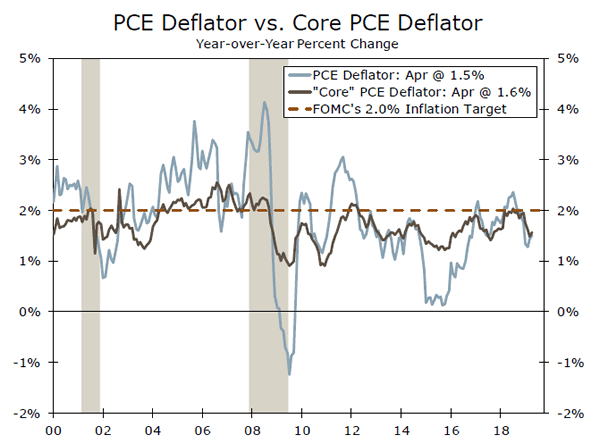
Increased tariffs have yet to manifest themselves in steep increases in consumer goods prices, however. At 1.6% on a year-over-year basis in April, core PCE inflation remains below the Fed's target (bottom chart). The core PCE deflator did rise 0.25% in April, which is the largest monthly increase since October 2017, and perhaps provides support to Chair Powell's assertion that the recent soft patch in inflation was temporary. Recall, these figures reflect April prices, before the recent escalation in the trade war, so there may be scope for prices to rise in coming months. The broader impact of tariffs, say via investment decisions, is more difficult to quantify. This morning President Trump threatened a 5% tariff on Mexican imports (quoted to start on June 10), to combat illegal migration. With little sign of a resolution to the escalating—and expanding—trade war, growth expectations will likely trend lower in coming months.
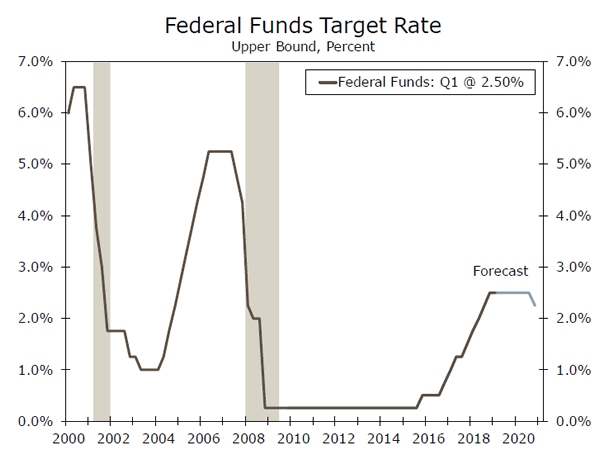
The trade skirmish is escalating just as many economists had expected the economy to slow from the first quarter's artificially high headline number of 3.1%. Indeed, first quarter final domestic demand growth was the weakest it has been in nearly six years. With trade risks becoming increasingly important to the outlook and inflation remaining comfortably south of the Fed's 2% target, the Fed may need less of a reason to move from its patient stance, and cut rates earlier than currently expected.
U.S. Outlook
ISM Manufacturing • Monday
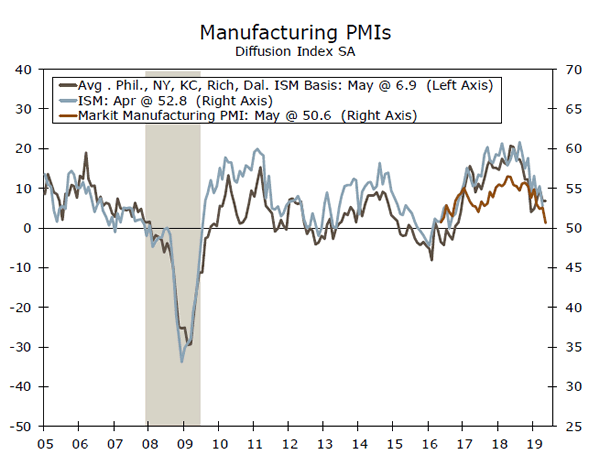
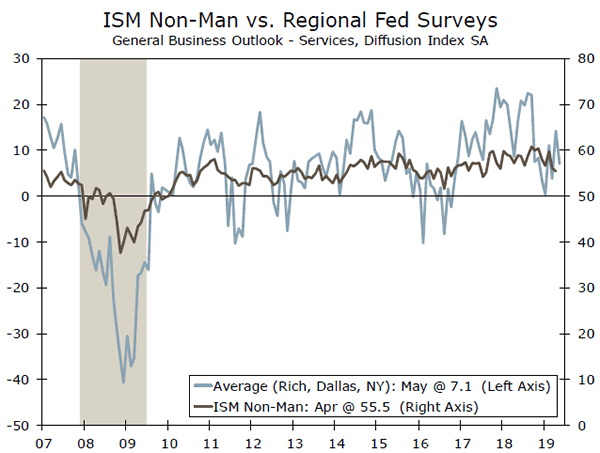
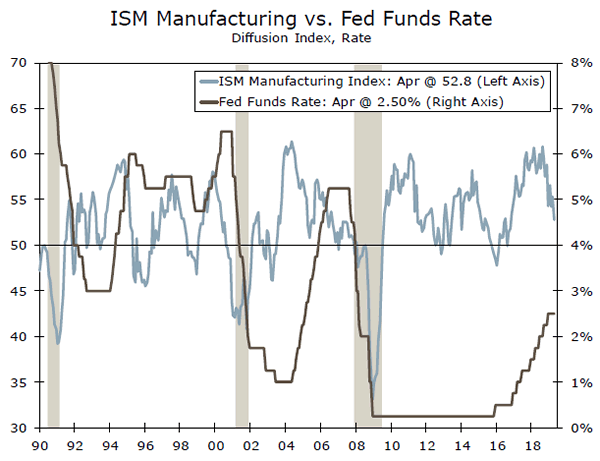
Markets will be watching the ISM manufacturing index more closely than usual on Monday. Last week the preliminary Markit PMI fell to a nine-year low, sparking fears that the recent escalation in trade tensions with China is snuffing out the expansion. Other purchasing managers' indices have held up better, however. An ISM-equivalent average of the regional Fed PMIs signals the pace of manufacturing output was little changed last month. We expect the ISM index to signal a further slowdown in factory activity in May, but to remain in expansion territory.
An unexpectedly weak reading would pile on to the market's recent concerns about growth in light of the latest trade developments. However, with manufacturing accounting for only 12% of U.S. output, it would take a severe drop in the index for the Fed to push aside its patient stance and cut rates.
Previous: 52.8 Wells Fargo: 52.1 Consensus: 53.0
ISM Non-Manufacturing • Wednesday
Given that the ISM non-manufacturing index reflects the remaining 88% of the U.S. economy, Wednesday's ISM release will be more telling about the state of growth. Similar to its manufacturing counterpart, the preliminary read of the Markit service sector PMI fell in May and added to concerns about U.S. growth continuing to slow. Service-sector surveys from the regional Federal Reserve banks also showed activity slowed in May, albeit from an eight-month high in April. We therefore look for the ISM non-manufacturing index to be little changed for May.
A downside miss would signal that the slowdown in growth extends beyond the external-facing parts of the economy most exposed to trade. Fed officials, however, were already expecting growth to moderate this year as fiscal stimulus fades. As long as the non-manufacturing index stays around the mid-50s, we would not expect it to shift the Fed's near-term policy stance.
Previous: 55.5 Wells Fargo: 55.4 Consensus:55.7
Employment • Friday
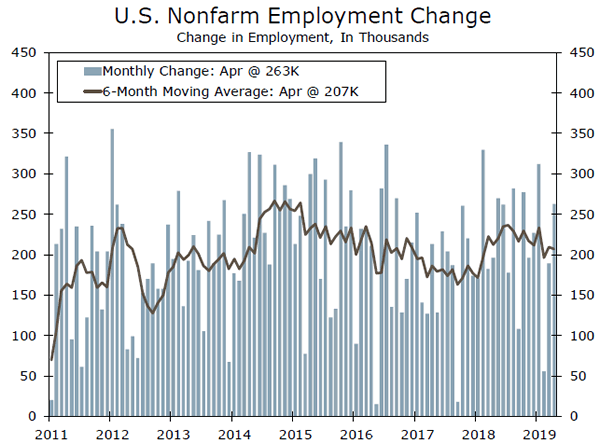
Hiring likely cooled in May after a surprisingly strong gain of 263,000 jobs in April. We expect payroll growth to slow in May but, at 180,000, to remain close to its recent trend. Initial jobless claims have moved up since April, but are on par with their average since the start of the year. Given recent swings in the labor force, we expect the unemployment rate to rise to 3.7%, while average hourly earnings should rise 0.3%.
The quick escalation in the trade war this month was unlikely to have affected the employment numbers, which were based on employment in the middle of the month. Another solid read on hiring would therefore signal to the FOMC that the labor market was humming along ahead of recent concerns. A marked miss to the downside, on the other hand, would suggest that the growth outlook was already cooling, and potentially pull forward expectations of the FOMC adjusting policy with a rate cut.
Previous: 263K Wells Fargo: 180K Consensus: 185K
Global Review
Bank of Canada Upbeat, Italy Stirs the Pot
- Despite another soft GDP print, policymakers at the Bank of Canada expressed optimism this week that the slowdown in growth in late 2018/early 2019 will prove to be temporary.
- Italian sovereign bond spreads crept higher this week as concerns about Italy's fiscal outlook returned to the headlines.
- The European Commission projects that under current policy the Italian budget deficit will rise to 3.5% in 2020, a clear violation of the bloc's rules. If Deputy Prime Minister Matteo Salvini has his way and enacts a flat tax, the deficit may be even larger, potentially setting up another fiscal showdown between Brussels and Rome this fall.
Bank of Canada Upbeat, Italy Stirs the Pot
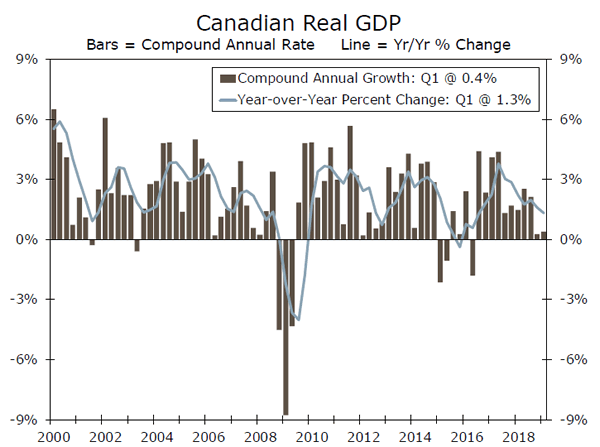
The Bank of Canada (BoC) met this week, and like many of the world's central banks was forced to reckon with the slowdown in global growth over the past few quarters. Data released this morning showed the Canadian economy growing at just 0.4% on an annualized basis in Q1, the second consecutive sub-1% reading (see chart on page one). Despite the soft print, the BoC adopted a relatively upbeat tone, noting in its statement that "recent data have reinforced the Governing Council's view that the slowdown in late 2018 and early 2019 was temporary." The BoC pointed to a recovery in the oil sector and housing market indicators that point to a "more stable national market, albeit with continued weakness in some regions."
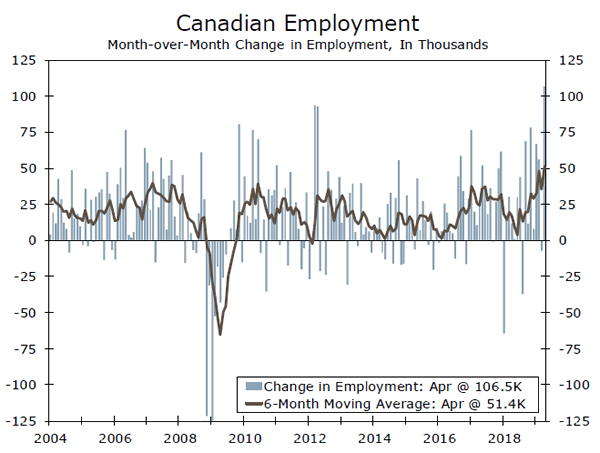
Another recent bright spot has been the robust Canadian labor market. Canadian payrolls rose nearly 107,000 in April, the largest gain on record. While some of the recent strength can be attributed to a jump in part-time employment, full-time employment in Canada is up 1.6% over the past year, even better than the 1.3% pace in the United States. At present, financial markets are only pricing in 25 bps of easing by the BoC over the next twelve months, compared to 69 bps in the United States. We expect the BoC to be on hold through the end of the year, but think the BoC may start to hike again early in 2020.
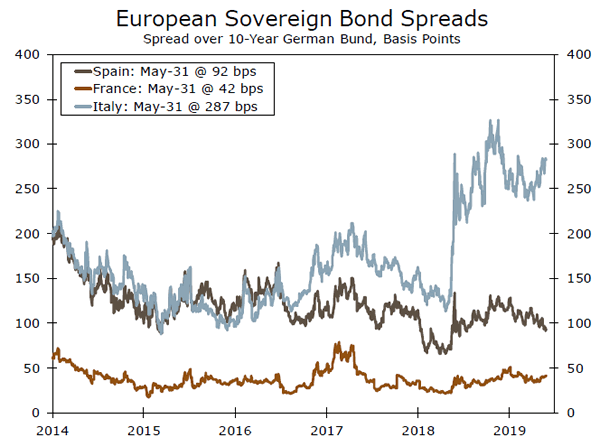
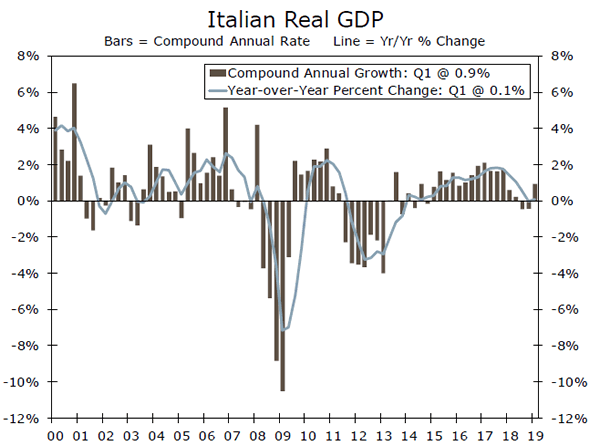
Italian sovereign bond spreads over German bunds continued to creep higher this week as concerns about Italy's fiscal outlook returned to the headlines (middle chart). After all of the hand wringing last fall, Italy's budget deficit for 2019 is projected to be 2.5%, up only a bit from 2.1% in 2018. Given in part how much the Italian economy has slowed over the past few quarters (bottom chart), Italy has managed to avoid any financial penalties from the European Union for this fiscal slippage. As 2020 comes into focus, however, the European Commission (EC) this week expressed concern over the fiscal outlook. Despite forecasting faster growth and inflation in Italy next year, the EC projects that the budget deficit will widen to 3.5%, a clear violation of European Union rules.
Italy introduced a citizens' income and some more generous pension provisions earlier this year that are already baked into the aforementioned EC projections. However, additional fiscal easing may still be around the corner. Deputy Prime Minister Matteo Salvini, emboldened by his party's strong showing in the European Parliament elections, has continued to push for fiscal and economic reforms that include, among other things, a flat tax that would likely widen the deficit even further.
If Salvini can push through tax cuts of some sort, the clash between Rome and Brussels could be similar to or even worse than the one that occurred in the second half of last year. The conflict would likely ramp up in September/October, when Italy will have to draft and submit a budget plan to European Union officials. If the coalition between Salvini's party ("Lega") and the Five Star Movement falls apart in the coming months, Italy could have national elections later this year for the second year in a row.
Global Outlook
Reserve Bank of Australia • Tuesday
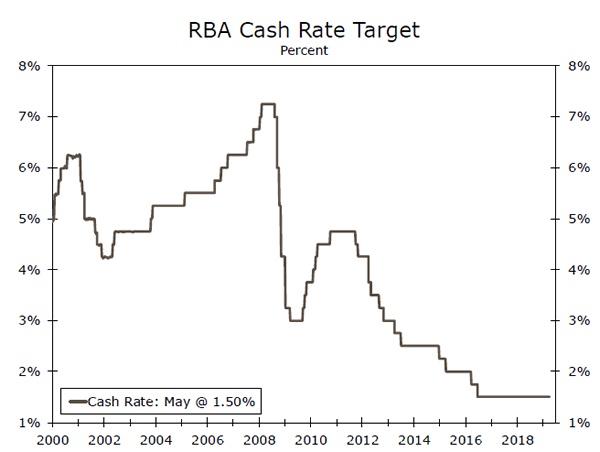
The Reserve Bank of Australia (RBA) will meet next Tuesday and evaluate whether conditions have evolved such that the first rate cut since 2016 is warranted. Q1-2019 real GDP growth in Australia will be released the same day and could show economic growth slowing to below 2% on a year-over-year basis. Australia's economic linkages to China are relatively high compared to most other developed economies, and the slowdown in China has likely contributed to some of the weakness in Australia.
Like Canada, the Australian housing market is currently going through a soft patch and inflation has remained subdued, up about 1.5% through the first quarter. Against this backdrop, financial markets are pricing in roughly 68 bps of easing by the RBA over the next 12 months. Given that the U.S.-China trade spat has only worsened since the last RBA meeting, it would not surprise us if the RBA cuts its main policy rate 25 bps next week.
Previous: 1.50% Consensus: 1.25%
European Central Bank • Thursday
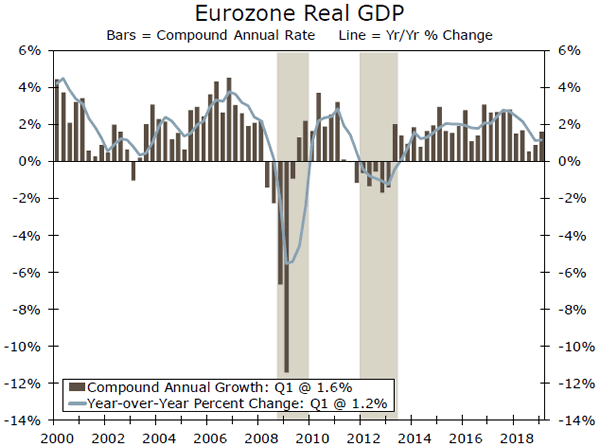
Monetary policymakers in Europe will meet next week to discuss the ailing Eurozone economy. Real GDP growth was a bit stronger in Q1, but it still registered an anemic 1.2% year-over-year. The data thus far in the second quarter suggest that the economy is continuing to tread water around this pace. The Markit Eurozone composite PMI was 51.6 in May, up 0.1 from April and flat from March. The May manufacturing PMI, at 47.7, remained in contractionary territory.
The European Central Bank (ECB) will announce the parameters for its targeted longer-term refinancing operations (TLTROs) next week, but past that our expectation is for the central bank to more or less maintain its wait and see approach. The economy has not weakened enough to warrant a full reversal into an easing cycle, but it remains a ways off from the first rate hike. Our expectation is for the ECB's policy rates to remain on hold for the remainder of the year, but gradually exit negative territory in 2020.
Previous: -0.40% Wells Fargo: -0.40% Consensus: -0.40% (Deposit Rate)
Reserve Bank of India • Thursday
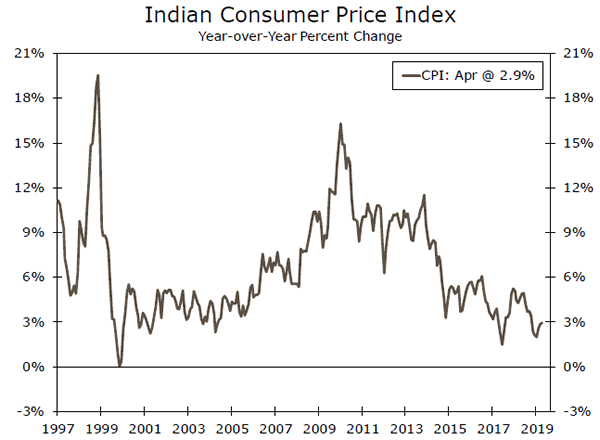
In the wake of Prime Minister Narendra Modi's reelection, the Reserve Bank of India (RBI) will meet next Thursday. Data on real GDP growth in India were released this morning and showed the economy expanded 5.8% year-over-year in Q1-2019. Though strong relative to most other major economies at present, this still marked the slowest pace of growth since 2014. Inflation also remains firmly in control; the RBI targets consumer price inflation of 4% within a +/- 2% range, and price growth is currently running at about 3%.
Slower growth and inflation have prompted some to speculate that the RBI might cut interest rates at an upcoming meeting. Financial markets appear to be pricing in about 39 bps of easing over the next 12 months. The RBI has already cut rates 50 bps this year, and with some of the uncertainty in the economy likely easing post-election, it looks like a close call whether the RBI will keep easing or wait to see how the economy reacts to previous rate cuts.
Previous: 5.75% Consensus: 5.50% (Reverse Repo Rate)
Point of View
Interest Rate Watch
Inverted For Real
For all the talk about how this time is different, the recent inversion of the yield curve appears to have all of the characteristics of past inversions. The yield curve is an indication of bond investors' views of future economic conditions, and those views have been downgraded considerably after trade negotiations with China took a bearish turn earlier this month. The key take-away from the negative turn in trade talks was that China never intended to fulfill any agreement made with the United States and finally balked when U.S. negotiators insisted on including repercussions for non-compliance in any agreement. Global growth is now likely to slow even further and remain slower for longer, which has pulled down long-term rates in Germany and the United States.
The greater influence of slower global economic growth and lower and even negative interest rates overseas is the most cited reason so many folks have been so quick to dismiss the most recent inversion of the yield curve, which has seen the yield on both the 10-year and 2-year Treasury note fall below the federal funds rate. The implicit assumption here is that the bond market is more concerned about the U.S. economy's long-term and near-term prospects than the Federal Reserve is.
The near-term data look fairly benign. Real consumer spending was unchanged in April, but healthy gains in March put Q2 consumer spending on a pace to rise at a 3% annual rate. Consumer confidence also rebounded solidly and jobless claims remain near their cycle lows. Data from the manufacturing sector are worrisome, with industrial production down year-over-year and orders clearly decelerating. That said, the most recent round of Fed manufacturing surveys was somewhat more positive.
While all this seems reassuring, most of this data reflect activity and sentiment prior to the intensification of trade talks. Even the better news on consumer spending says more about what happened two months ago that what is happening today. Private final demand has clearly lost momentum, leaving the economy more vulnerable to an external shock or policy mistake.
Credit Market Insights
Starts with a Three
The 30-year fixed-rate mortgage rate dropped into the three-range this week for the first time since January 2018. Swirling uncertainty surrounding trade and global growth have sparked a sustained rally in longer-term Treasurys, causing the 10-yearthree- month yield curve to invert this week. The 10-year is currently yielding only 2.2%, the lowest since 2017. Such a steep drop in mortgage rates will likely provide a boost— or at least a floor—to housing in coming months. The domestic housing market is fairly insulated from the issues driving investors into safe assets and could therefore see a slight pickup at the same time overall growth weakens, so long as the growing risk-off attitude on Wall Street doesn't take a turn onto Main Street. Moreover, the 3.99% rate—down seven bps since just last week—reported by Freddie Mac and highlighted by the media represents a so called "top tier" rate, as it assumes a 20% down payment and otherwise sterling buyer credit. Thus many potential homebuyers may not yet be seeing a three-handle from their bank. Mortgage bankers suggest it may take several weeks of continued strength in the bond market before rates truly push into the three-range for a majority of future homebuyers. Nevertheless, it was only a few quarters ago that the 30-year rate was about to breach 5%. While the spring housing rebound many expected has not quite materialized, the market has certainly stabilized, likely due in large part to lower rates, which should continue to provide support.
Topic of the Week
Do Deficits Still Matter?
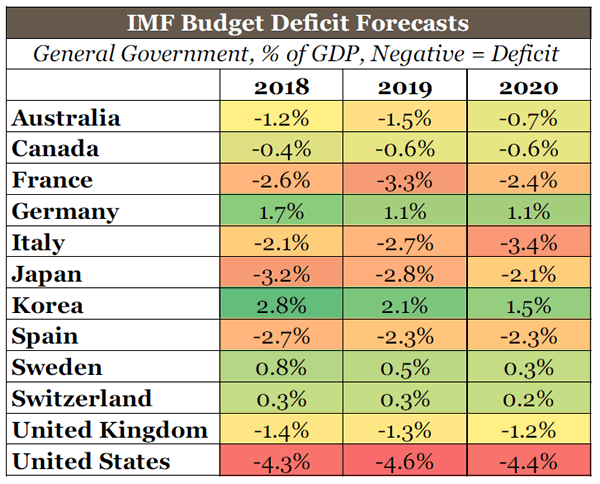
The recent widening in the federal budget deficit and persistently low yields on U.S. Treasury securities have led some observers to question the idea that larger deficits lead to higher interest rates, or even if deficits matter at all. Using the International Monetary Fund's measure of the general government budget deficit, the United States is currently running one of the largest consolidated budget deficits in the developed world (table to right). Can the United States really run large budget deficits indefinitely with minimal consequences?
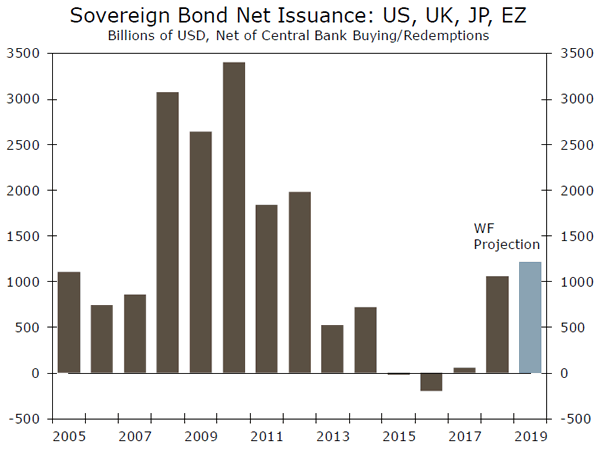
In our view, yields on Treasury securities have remained low in the face of bigger deficits for both cyclical and structural reasons. On the cyclical side, a dovish turn by the Fed and falling growth/inflation expectations have weighed on yields, dominating the upward pressure from more government debt issuance. Net sovereign bond issuance in other major foreign economies has also been quite low recently, due to both fiscal consolidation and to quantitative easing programs by foreign central banks (bottom chart). These factors probably have contributed to downward pressure on U.S. government bond yields as well. Econometric analysis that attempts to control for factors like these suggests that deficits still exert upward pressure on yields, all else equal.
On the structural side, the United States enjoys many built-in advantages that make financing large deficits easier. The U.S. dollar is the world's reserve currency, the U.S. economy is the largest in the world and the Treasury market is the gold standard for liquid, safe assets.
Could some of these circumstances change one day, making it much harder to finance structurally large budget deficits? Of course, though when or whether they will is up for debate. In our view, it is not that deficits no longer matter. Rather, favorable circumstances for large-scale sovereign debt issuance exist today, but that does not mean they will exist forever.
For further reading, see our recent special report, "Do Deficits Still Matter?"
The Weekly Bottom Line: Trade Tensions Still in the Spotlight
U.S. Highlights
- U.S.-China trade tensions continued to dominate headlines as both countries dig in for another round of negotiations under more strained circumstances. U.S. tariffs against Mexico appear to also be in the works.
- As trade tensions flare, investors have run for cover, driving up bond prices and sending the yield curve into inversion territory.
- U.S. Q1 growth was revised marginally lower (3.1% vs. 3.2%), and Q2 is projected to be lower still (below 2%). Inflation however managed to edge marginally higher with core PCE at 1.6% year-on-year in April.
Canadian Highlights
- Trade-related risk-off sentiment weighed on Canadian financial markets this week, with the S&P/TSX Composite down more than 1% and WTI oil prices falling more than 5%.
- Statistics Canada's GDP release confirmed that the Canadian economy hit a soft patch in Q1, with GDP up a modest 0.4% (annualized). Nevertheless, details of the report point to improving momentum heading into Q2.
- The Bank of Canada kept its overnight rate on hold at 1.75%, as expected, with its communication offering a relatively constructive tone on the back of improving domestic data, but weighing the latter against elevated global trade uncertainty.
U.S. - Trade Tensions Still in the Spotlight
U.S.-China trade negotiations hit a major speedbump earlier in the month and there is now a higher probability that talks could face protracted delays. President Trump stated that the U.S. is "not ready to make a deal", though he still believes the two nations will ultimately reach an agreement.
In other trade news, just as the U.S. and Mexico took steps this week to ratify the USMCA, President Trump threatened to impose a 5% tariff on all Mexican imports starting June 10th. The President wants Mexico to do more to deter illegal migration from Central America. These tariffs, alongside prolonged Chinese negotiations, complicate trade relations even further. The heightened bout of uncertainty is likely to dent already shaky business confidence.
China has responded to U.S. rhetoric with both direct and indirect threats. The country suggested that they too may influence global supply chains through their dominance of "rare earth" exports – a group of 17 minerals used in the production of most modern electronic devices. A ban on exports to the U.S. could disrupt production and affect prices of many products ranging from smartphones to satellites. There are also indications that China may have once again halted purchases of U.S. soybeans after previously resuming purchases as a sign of goodwill during negotiations.
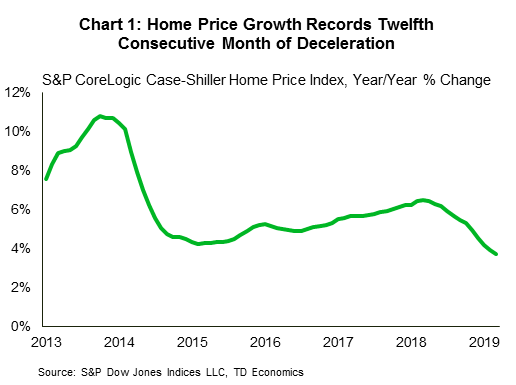
Meanwhile, on the domestic data front, home price appreciation continues to moderate. Data for March showed that home prices grew 3.7% year-on-year, lower than the 3.9% recorded in February (Chart 1). Price growth has been decelerating since April last year, suggesting that even with lower mortgage rates and rising wages, past price growth may have stretched affordability for many potential buyers.
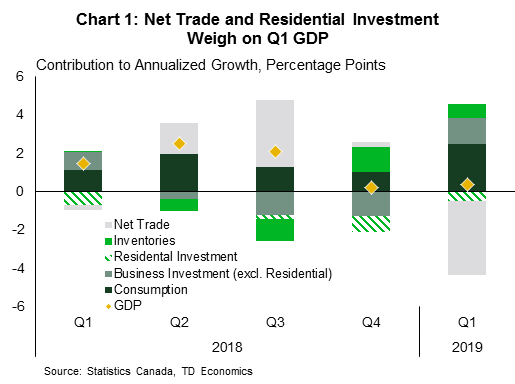
First quarter real GDP growth was revised to 3.1% annualized, relative to 3.2% previously. The slight downgrade reflected lower business and residential investment. Weak performance in these two categories is expected to continue, weighing on growth in Q2 and resulting in a sub 2% outturn. Personal spending in April was also soft at 0.3% month-on-month, even as incomes rose more than expected, coming in at 0.5%. April's outturn, however, followed strong growth in March, suggesting that personal spending will be a key driver of Q2 growth, even as other components such as investment look to drag on activity.
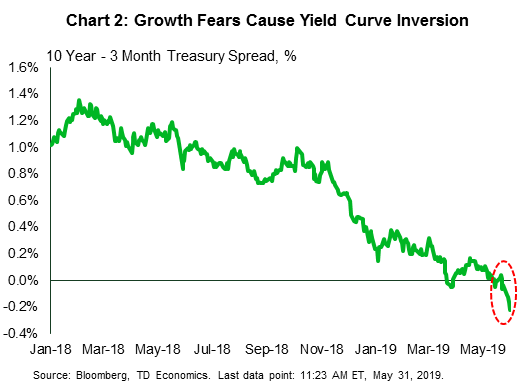
With concerns of lower growth and heightened trade tensions, investors pushed the yield on 10-yr Treasury notes to the lowest close since September 2017 this week. This caused the yield curve to invert as it dipped below the three-month note (Chart 2). While inversions tend to precede recessions, the phenomenon would need to be sustained and observed among other maturities before the indicator signals an imminent risk and materially affect decisions at the Fed. All said, the reignited trade tensions have skewed the risks to both U.S. and global growth further to the downside – a development which will no doubt receive close monitoring by central bank officials.
Canada - A Soft Q1 with a Dose of Optimism
Lingering trade tensions between the U.S. and China continued to weigh on sentiment this week, impacting both global and Canadian markets. The S&P/TSX Composite followed its global peers lower, dropping more than 1% at the time of writing, whereas (WTI) oil slumped more than 5% on the heels of the aforementioned trade worries and elevated inventories in the U.S. The U.S. threat to impose a 5% tariff on imported Mexican goods dampened sentiment further.
On the data front, Statistics Canada's GDP release was the highlight of the week. Real GDP grew at 0.4% (annualized) in the first quarter, in line with our tracking and closely in line with the Bank of Canada's 0.3% forecast. As expected, exports were the culprit (Chart 1), with the 4.1% drop in Q1 subtracting a full 1.3 ppts from GDP, and with net trade exerting an even larger drag due to a strong rebound in imports (+7.7%). Meanwhile, housing continued to be a weak spot, with residential investment falling for a fifth consecutive quarter. Most of the weakness in these two categories was pre-written. Indeed, exports experienced a broad-based decline in February that was led by a sharp slump in oil shipments, whereas data on home resales and residential construction continued to disappoint, with signs of stabilization starting to appear only recently.
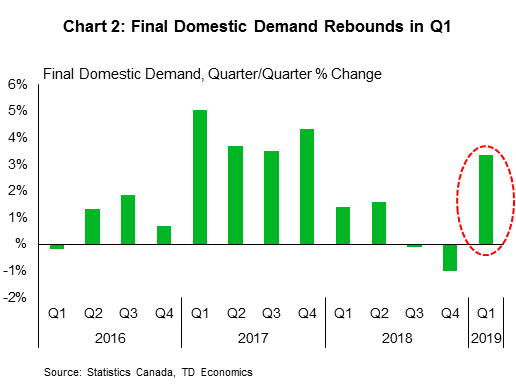
Still, the weak GDP headline masked some encouraging details. Most important amongst these was a strong, 3.4% rebound in final domestic demand (Chart 2), led by household spending (+3.5%). A stronger-than-expected labour market performance partially explains this, with the healthy trend in job gains further confirmed by this week's payrolls data. At the other end of the spectrum, a long-awaited pick up in business investment was another bright spot, ending a streak of serial disappointments that casted doubt on any potential rotation in economic growth to this category. Wrapping up the data release, a healthy 0.5% print in March's monthly GDP, which was relatively broad-based across the industries, adds credence to the expectation of improving momentum heading into Q2.
On a separate, yet related note, the Bank of Canada kept its overnight interest rate on hold at 1.75% this week. In its release and the subsequent speech by Senior Deputy Governor Wilkins, the central bank maintained a constructive tone, highlighting some green shoots in the economy, including improving household spending and strong labour markets, while emphasizing that the current level of interest rates is appropriate given the macroeconomic backdrop.
Looking ahead, we expect the Bank of Canada to remain on the sidelines. Recent data has been pointing to improving momentum, but the outlook remains clouded with uncertainty. For instance, one fly in the ointment in today's report is an inventory build, which together with that in Q4, will likely result in a drag on GDP growth going forward. More importantly, escalating trade tensions are likely the biggest headwind heading into the second half of the year, a risk highlighted by the Bank of Canada this week.
U.S.: Upcoming Key Economic Releases
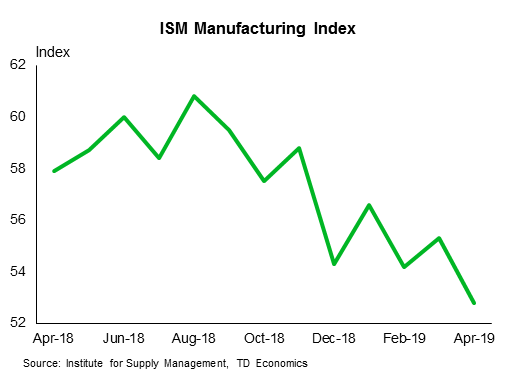
U.S. ISM Manufacturing Index - May
Release Date: June 3, 2019
Previous: 52.8
TD Forecast: 52.5
Consensus: 53.0
We look for a modest monthly decline in the manufacturing ISM index as we expect trade-related headwinds to remain a major obstacle for recovery in the short-term. The average of the ISM-adjusted regional surveys failed to improve in May and remained unchanged at 53.5, with declines in three out of the six published surveys we track. Based on regional data, a decline in inventories is likely to be a major drag for the index. Moreover, a recent spate of weak growth in core durable goods orders, a downside surprise in the Markit PMI survey, and another below-50 China manufacturing PMI print also boost the odds for a downside surprise in May, in our view.
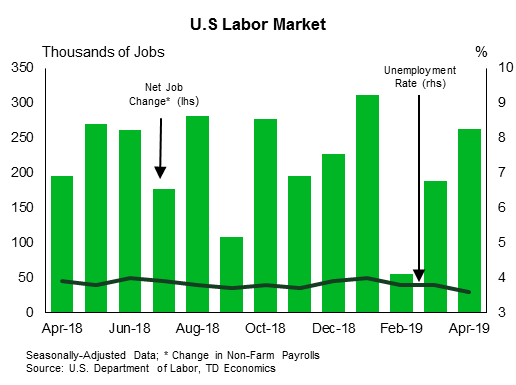
U.S. Employment - May
Release Date: June 7, 2019
Previous: 263k, unemployment rate: 3.6%
TD Forecast: 190k, unemployment rate: 3.6%
Consensus: 185k, unemployment rate: 3.6%
We look for payrolls to trend lower to 190k in May, following an eye-popping 263k print in the previous month. In particular, we expect job creation in the manufacturing sector to remain subdued, staying in the single-digit range for a fourth consecutive month. Likewise, we anticipate a mean-reversion in employment in the services sector following the 200k+ print in April. We do flag risks to the upside on the back of a larger-than-expected recovery in employment in the retail sector after three notable declines in Feb-April. All in, the household survey should show the unemployment rate remained steady at 3.6%, while wages are expected to rise 0.2% m/m. The latter should bring the annual print down a tenth to 3.1%. However, if the monthly growth rate were to round up to a "soft" 0.3% advance, that would keep wage growth unchanged at 3.2% y/y.
Canada: Upcoming Key Economic Releases
Canadian International Trade - April
Release Date: June 6, 2019
Previous: -$3.2bn
TD Forecast: -$2.9bn
Consensus: -$2.8bn
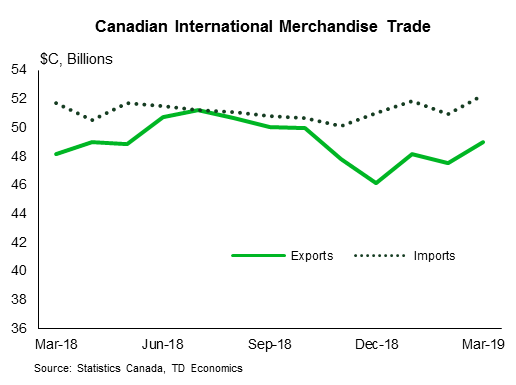
TD looks for the international trade deficit to narrow modestly to $2.9bn in April on a combination of weaker import activity and stronger energy exports, partially offset by a pullback in non-energy exports. Motor vehicles are the primary culprit to the latter after a major automaker idled production for two weeks in April, and a sharp drop in preliminary US imports suggests a significant impact on auto exports. Energy products will provide a key offset on higher prices alongside further recovery in crude export volumes which bottomed in February. On the other side of the ledge, imports should pare gains after the 2.5% increase in March, led by a pullback in aircraft imports.
Canadian Employment - May
Release Date: June 7, 2019
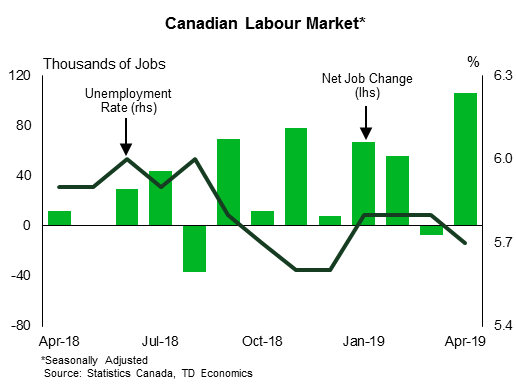
Previous: 106k, unemployment rate: 5.7%
TD Forecast: -5k, unemployment rate: 5.8%
Consensus: -5k, unemployment rate: 5.7%
TD looks for the labour market to disappoint in May with employment falling by 5k which should push the unemployment rate to 5.8%, while wages should soften to 2.5% y/y on a sizeable base-effect from May 2018. We have previously argued that recent labour market strength is unwarranted by the economic backdrop and last month's blockbuster print has not changed our view. While we acknowledge that the volatility of the LFS makes it difficult to accurately predict the timing of any pullback, we view the risks as disproportionately skewed towards a soft print and think our forecast could prove conservative should such a pullback occur. Previous examples have shown much larger giveback after periods of strength; for example, net employment fell by over 60k in January 2018 after job growth was reported at 140k over 2017Q4. Any giveback should be led by the goods-producing sector, with manufacturing in the spotlight after adding 10k jobs over March/April as PMIs dipped into contractionary territory. However, segments of the service-producing sector also appear vulnerable with wholesale/retail trade employment rising by 4.8% (annualized) over the last six months.
Forward Guidance: Near-Term Canadian Growth Trends Still Constructive
Near-term Canadian growth trends still constructive but risks of escalating trade tensions continue to dominate sentiment
Current domestic economic data – including the release of high profile net trade and employment reports in the week – will continue to be overshadowed by concerns about escalating US trade tensions. The latest being the Trump administration’s threat to impose across-the-board tariff hikes on Mexico in an attempt to force that country to do more to stem flow of illegal immigration. Of course, “targeting” foreign countries with import tariffs really means taxing domestic producers and consumers. The US industrial sector has borne much of tariff hikes to-date and has already been looking wobbly after the US imposed added tariffs on $US 200 billion worth of imports from China late last year. US manufacturing output has fallen in three of four months to-date in 2019 and sentiment in the sector has softened. That’s before the rate on that last (for now) round of tariffs on Chinese goods was boosted to 25% from 10%. The ‘new’ tariff threats on Mexico would impact a broader swath of products but, once again, the US industrial sector would likely end up paying a sizeable chunk of the cost. Industrial machinery imports alone account for ~20% of US imports from Mexico.
Anything that hurts the US industrial sector will have negative implications for Canada, given tight integration of cross-border industrial production chains. And the threat of new tariffs on Mexico highlights the limits to protection from trade deals like NAFTA (or the new USMCA) when dealing with the Trump administration. The latest threats may turn out to be just that, and we have seen trade tensions ebb and flow significantly before. But the unpredictability of US trade policy is just one added source of uncertainty for businesses. And one more reason for the Bank of Canada to stay firmly planted in a holding pattern in terms of any future interest rate moves, despite what still looks like an okay economic backdrop currently.
Next week’s economic data will be looked at to confirm the economy pulled out of the recent funk. Much of the soft 0.4% Q1 GDP growth rate reflected transitory disruptions to oil & gas production and bad weather. After dropping early in the first quarter we are looking for next week’s report on April trade data to show activity continued to recover. We are looking for the trade balance to improve on the back of higher oil prices and increased rail shipments that suggest the weather-related drag on transportation capacity in February continued to unwind. The other important domestic report on tap is the labour data. We would not be at all surprised to see a sizeable pullback at some point in the notoriously volatile employment growth numbers after a whopping 426k increase over the last year, but are penciling in a small 5k increase in May alongside a steady unemployment rate at 5.7%
Market Death by Tariffs; Safe-Havens Reign Supreme
Risk aversion ran wild as stock markets and other risk assets plummeted on global tariff escalation. The US dollar’s early gains during the end of May market rout is starting to reverse course on expectations the Fed may cut rates twice this year. Stocks are licking their wounds following a double dose of negative trade news. The first bullet came from China’s retaliatory measures that will deliver a crippling blow to multi-nationals and likely further downgrade earnings forecasts as the Sino-US relationship appears to going towards a path of irreparable damage. The second bullet came from the escalation in trade tensions between Mexico and US, which pretty much came out of nowhere. The trade spat with China has been brewing, but markets were taken back with the US actions towards Mexico. The US, Mexico and Canada were in the process of getting the USMCA approved with their respective governments, but that may have hit a road block now. President Trump’s attack to their southern neighbor saw a Mexican response that US exports of grains, pork, and apples may be hit with tariffs. Tariff escalation is detrimental to global growth and the bond market saw Bunds fall to a record low and the 10-year Treasury yield dropped to a fresh 20-month low and fell further below the Fed’s fund target range.
Markets will continue to care about every incremental trade update, but they should also closely pay attention to a couple important rate decisions and a wrath of Fed speak, which includes Chair Powell’s discussion on policy strategy. On Monday, President Trump will also make a state visit to the UK, where he will meet with Queen Elizabeth and PM May. Tuesday, the RBA is expected to cut rates and we hear from Fed Chairman Jerome Powell at a Fed Research Conference. Wednesday, the EIA releases their crude oil weekly report and the Fed releases the Beige book and members Clarida and Bostic speak. On Thursday, the ECB will keep policy steady and update their economic forecasts. Friday will see PM May step down as the leader of the conservative party and have the release of the US employment report, which expects to see hiring deliver 185,000 new jobs in May.
- RBA to cut rates and signal more are coming
- ECB to downgrade forecasts and give details on next round of TLTROs
- Fed’s Speakers to address recent trade war escalation and possible capitulation on cuts
RBA
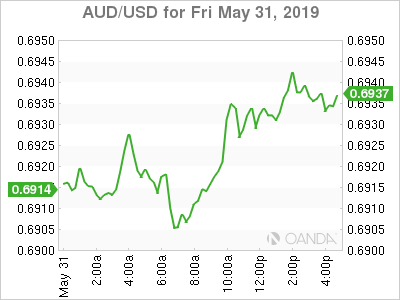
On Tuesday, the Reserve Bank of Australia (RBA) is widely expected to cut the cash rate by 25 basis points to 1.25%, with investors focusing on how many more cuts will be queued up. Only 5% of economists, two specifically, see the RBA keep rates steady. At the last meeting, the RBA surprised many when they kept policy following disappointingly weak first-quarter inflation.
The RBA may decide on holding off on confirming any additional rate cuts, preferring to see how the global growth slowdown hits their domestic economy. The recent global bond rally took the Australian 10-year yield below the RBA’s cash rate of 1.5%, for the first time since 2015. Analysts are piling on the rate cut bets, JP Morgan sees rates falling to 0.50% by mid-2020 while Westpac and Capital Economics see cuts targeting 0.75%. With tame inflation, the RBA’s easing decision should be an easy one.
The Australian dollar remains near the lows of the year, as the recent escalation in trade wars dims global growth outlooks, and while data points in the Asia-Pacific continue to deteriorate. With China’s May manufacturing PMI falling back into contraction, expectations remain high the PBOC will come to the rescue. While the market begins pricing in further RBA rate cuts, we could limited Australian dollar downside as the greater driver could be the Fed’s capitulation with delivering their own rate cuts.
Fed
A wrath of Federal Reserve members will speak next week, with investors waiting to see further confirming signals that the Fed will provide further accommodation shortly. On Tuesday, Fed Chair Jerome Powell will discuss monetary policy strategy, tools, and communication practices at the Fed’s framework review conference in Chicago. Markets have not heard from Powell since the trade war went on steroids and he could use this as his stage to begin capitulate and signal accommodation is needed. The Fed’s preferred core price measure in April stayed steady at 1.6%, but still comfortably below the Fed’s 2% target. The US trade war escalations with China and Mexico will likely dominate the Fed’s concerns here and while the data-dependent script may suggest they need to see further data confirm weakness, they might agree that is not necessary.
ECB
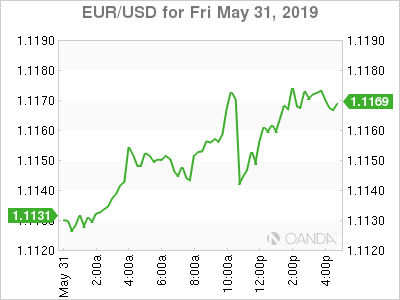
The ECB rate decision is expected to see no change with rates and possibly minor downgrades with their economic forecasts. The central bank will also deliver more details on the expected launch of its third round of targeted long-term refinancing operations in September. Economists are expecting them to use TLTROs as a backstop, which could provide insurance in times of heightened uncertainty. With most of the other G7 central banks on the verge of providing stimulus, expectations are rising for the ECB to also provide fresh support to the ailing economy. Global trade wars are raising the risk for a euro zone recession, but that is still not the base case. The current implied interest rate probabilities see a 53% chance that the ECB cuts rates at the January 23rd 2020 meeting.
The upcoming meeting should see the ECB provide a slight adjustment to forward guidance becoming more accommodative. Economists however still are not abandoning a rate hike in the near future and that should provide some support for the euro. A Reuters poll showed 47% of the 60 contributors expect a rate hike at some point between now and the end of 2020, while 3% saw a cut and the rest expect no change in rates.
The euro remains stuck in very tight range and we should see 1.11 remain formidable support, while 1.1250 provides initial resistance.
Oil
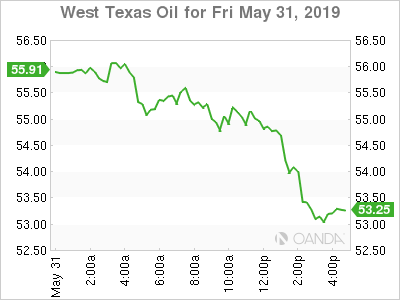
The month of May was a disaster for crude prices, the worst May performance in seven years, as unabrupt escalation with global trade war saw the global growth outlook crumble. Oil prices have now given up the lion share of the effects of the OPEC + production cuts. Geopolitical risks remain in place but right now demand growth is in freefall and oil remains vulnerable. The US – China trade war remains most critical to the global growth outlook, but the addition of trade tensions between the US and Mexico raised the slower demand picture for the Americas.
West Texas Intermediate crude’s selloff is now around 20% lower from the April 23rd high of $66.60. With rising expectations that OPEC will be less effective in signaling continued production cuts going forward, crude will need to rely on some positive outcomes on the trade front for prices to begin stabilizing.
Gold
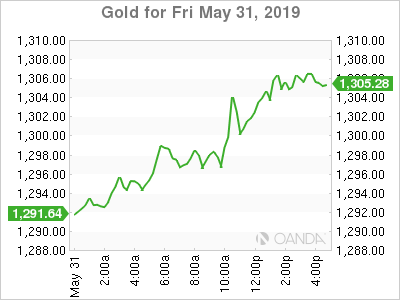
It took a while, but gold prices finally broke out higher after the trade war escalation led to a code red for global growth. A devastating month for equities, the worst one since December, and other risk assets saw a global bond rally lead the way for safe-haven assets. The yellow metal is once again becoming an attractive safe-haven as markets will remain skeptical on any trade progress after seeing how fast we could see Trump deliver a new tariff threat.
Sunday, June 2nd
9:45pm ET CNY Caixin Manufacturing PMI
Monday, June 3rd
2:30am ET CHF CPI m/m
3:15am ET EUR Spain Manufacturing PMI
3:45am ET EUR Italy Manufacturing PMI
3:50am ET EUR France Manufacturing PMI
3:55am ET EUR Germany Manufacturing PMI
4:00am ET EUR Eurozone Manufacturing PMI
4:30am ET GBP Manufacturing PMI
10:00am ET USD ISM Manufacturing PMI
10:00am ET USD Construction Spending m/m
9:30pm ET AUD Retail Sales m/m
Tuesday, June 4th
12:30am ET AUD RBA Interest Rate Decision
3:00am ET EUR Spain Unemployment m/m
4:30am ET GBP Construction PMI
5:00am ET EUR CPI Flash Estimate y/y
5:30am ET ZAR GDP Annualized q/q
9:00am ET MXN Consumer Confidence Index
10:00am ET USD Factory Orders m/m
10:00am ET USD Final Durable Goods Orders
9:30pm ET AUD GDP q/q
9:45pm ET CNY Caixin Services PMI
Wednesday, June 5th
4:30am ET GBP Services PMI
5:00am ET EUR Eurozone PPI m/m
5:00am ET EUR Eurozone retail sales m/m
8:15am ET USD ADP Employment Change
9:45am ET USD Final Markit Services PMI
10:00am ET USD ISM Non-Manufacturing Index
10:30am ET DOE US Crude Oil Inventories
1:00pm ET NZD QV House Prices y/y
9:30pm ET AUD Trade Balance
9:30pm ET AUD Building Approvals m/m
Thursday, June 6th
2:00am ET EUR Germany Factory Orders m/m
7:45am ET EUR ECB Interest Rate Decision
8:30am ET USD Trade Balance
8:30am ET USD Initial Jobless Claims
7:30pm ET JPY Household Spending y/y
Friday, June 7th
2:00am ET EUR Germany Industrial Production m/m
2:00am ET EUR Germany Trade Balance
2:00am ET NOK Norway Production data
2:45am ET EUR Industrial Production m/m
3:30am ET GBP Halifax House Prices m/m
8:30am ET USD Non-Farm Payroll Report, Unemployment Rate and Wage Data
8:30am ET CAD Employment Change and Unemployment Rate
9:00am ET MXN CPI y/y
Eurozone Flash Inflation Expected to Tick Down as Political Fractures Weigh on Euro
Flash inflation readings from the Eurozone next week could cause more misery for the euro, which is already under pressure from a transforming political landscape across the bloc and an empowered Matteo Salvini in Italy. Eurostat will publish the flash report on Tuesday at 09:00 GMT but the readings will probably not be good news for the European Central Bank as headline inflation is expected to decline.
Eurozone inflation likely eased in May
After rising by 1.7% year-on-year in April, the headline rate of inflation as measured by the Harmonised Indices of Consumer Prices (HICP) is forecast to fall back to 1.3% in May. The two underlying measures of inflation also headed higher in April, though they remained within their recent ranges. The core rate excluding food, energy, alcohol and tobacco prices, which the markets put more emphasis on, is forecast to ease from 1.3% to 0.9% y/y.
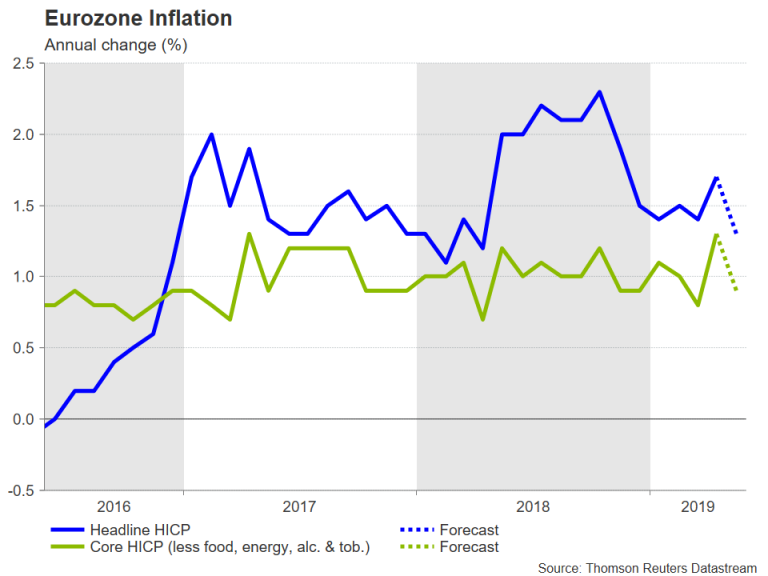 The HICP rate is the ECB’s officially targeted measure of inflation, but ideally, the Bank also wants to see core prices to show a sustained move towards its goal of “below, but close to 2%” before it claims success. But with the Eurozone economy still lacking sufficient growth momentum amid all the regional and global uncertainties, achieving this is taking much longer than policymakers had anticipated.
Inflation expectations have been falling to worrying levels
A new worry for the Bank is a slide in inflation expectations. Five-year market-based expectations of inflation have fallen sharply since late 2018 and this week hit the lowest since September 2016, reaching 1.2987%. Governing Council members expressed concern about this development in the account of their April policy meeting, though for now, they seem to think the decline is a temporary response to the worsening economic outlook, suggesting they don’t see any urgency just yet for further policy action.
However, should the outlook continue to deteriorate, it may only be a matter of time before the ECB has to consider ways to loosen monetary policy again. The political situation in the European Union certainty isn’t doing much to shore up business confidence at the moment. Although the European elections weren’t quite as disastrous for the mainstream parties as had been anticipated, they did produce a very fragmented Parliament, suggesting it will be harder for all the different factions to reach consensus, creating uncertainty about the EU’s future policy agenda.
Italy a big risk for the euro
But a potentially bigger headache for policymakers is Italy. The League party, which forms one half of the governing coalition, was the big election winner in Italy, and its leader, Salvini, will likely use this to push harder against conforming to the EU’s fiscal rules. A fresh crisis in Italy, along with the ongoing Brexit and trade uncertainty, not to mention the possibility of the trade war reaching Europe, pose great downside risks for the euro in the short to medium term.
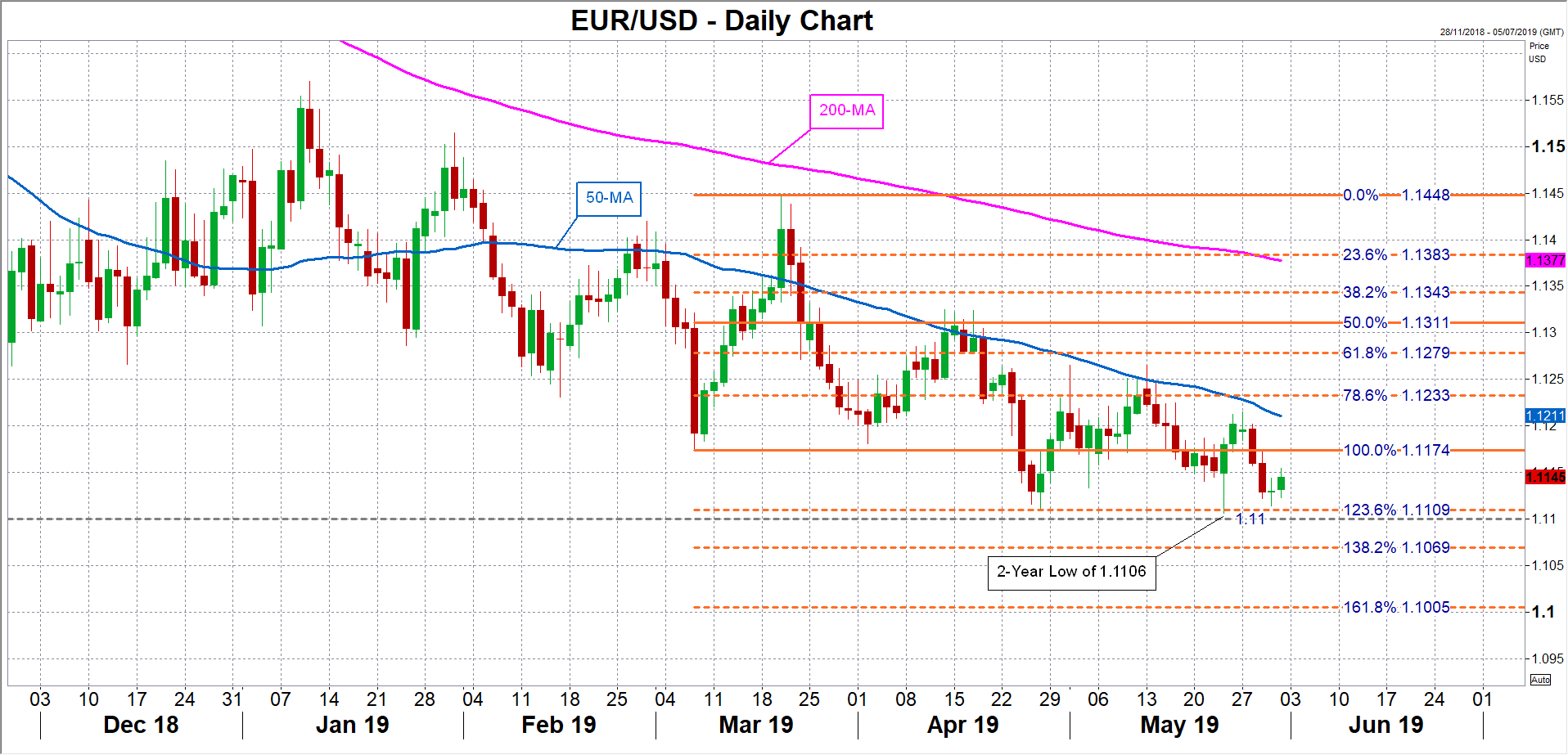
A breach of the $1.11 handle is looking increasingly likely for the single currency given the shortage of positive headlines. Weaker inflation numbers on Tuesday could be one catalyst that could push euro/dollar below 1.11, especially if the nearest support at 1.1109 – the 123.6% Fibonacci extension of the 1.1174-1.1448 upleg – is broken. If there is a drop below this level, the focus for sellers would turn to the 138.2% and 161.8% Fibonacci extensions at 1.1069 and 1.1005, respectively.
RBA to Cut Rates, But Will It Signal Aggressive Easing?
The Reserve Bank of Australia (RBA) is widely expected to cut rates when it announces its policy decision on Tuesday at 04:30 GMT. With a cut fully priced in already, and another one by September, price action in the aussie will likely depend mainly on how aggressive the signals for future easing are. While the Bank may disappoint the bears at this meeting, the broader outlook for the currency remains negative.
Markets are all but certain the RBA will embark on an easing cycle starting next week, in an attempt to fight off a rising unemployment rate, as well as tepid growth and inflation. Indeed, Governor Lowe recently confirmed a rate cut will be ‘considered’ at the June meeting, which was seen as a clear signal that one will take place, given both a worsening domestic outlook and simmering trade conflicts globally.
What is much less certain though, is the scope and breadth of this easing cycle – in other words, how low interest rates will go. In that sense, market pricing currently implies another quarter-point cut by September after this one, and then another 30% probability for a third one by December. Remember, these expectations are already reflected in the exchange rate, so for the aussie to weaken further on the decision, the RBA would likely need to signal it plans to cut rates even more aggressively than this.
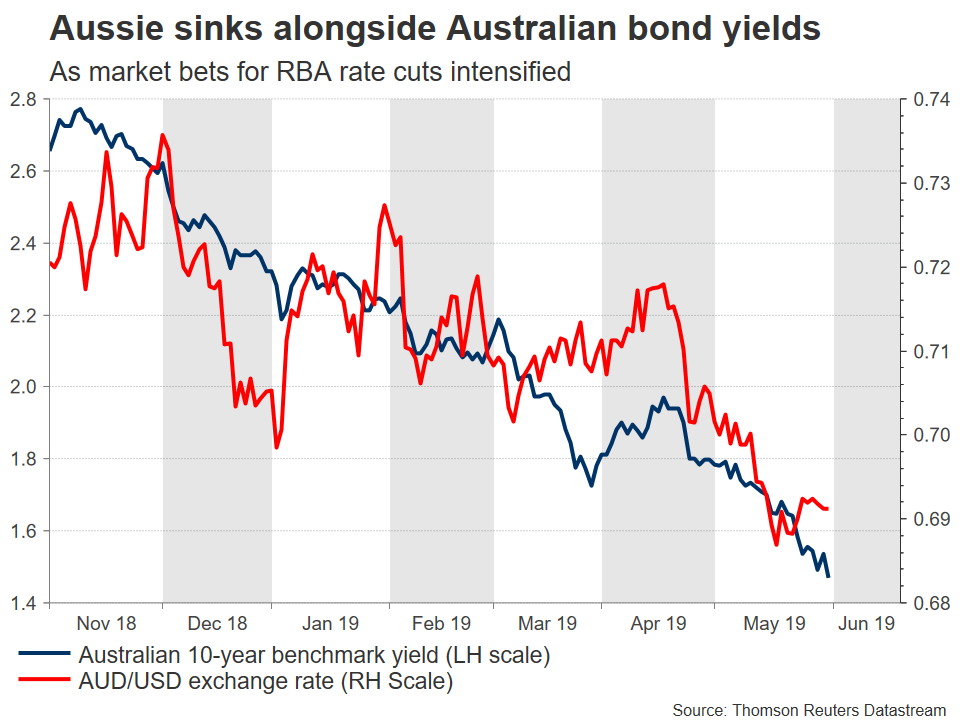
While the central bank is almost certain to cut and leave the door wide open for more, it’s questionable whether it will go as far as provide the ultra-dovish signals the market is looking for. Policymakers typically prefer to retain some optionality and not pre-commit to anything far in the future. More importantly, the recent election result implies more expansionary fiscal policy than previously anticipated, which will take the ‘heavy lifting’ off the RBA’s shoulders. Similarly, the nation’s prudential regulator just announced plans to loosen lending rules, which may fuel borrowing.
All the above don’t go to say that the RBA won’t ultimately slash rates deeper than what’s currently priced. Rather, that the Bank is unlikely to feel the urgency to signal such extraordinary easing so early, which may disappoint the bears given the already-dovish pricing. Therefore, it wouldn’t be a surprise to even see the aussie spike higher on the decision, if officials indicate that further easing will depend on the data for example.
In the bigger picture, however, the outlook for the currency is still negative, not least due to the possibility of a further escalation in trade tensions, and the effect that may have on Australia both directly via dwindling export volumes and indirectly through softer commodity prices. Hence, even in case of a rebound, any positive reaction may remain fairly short-lived.
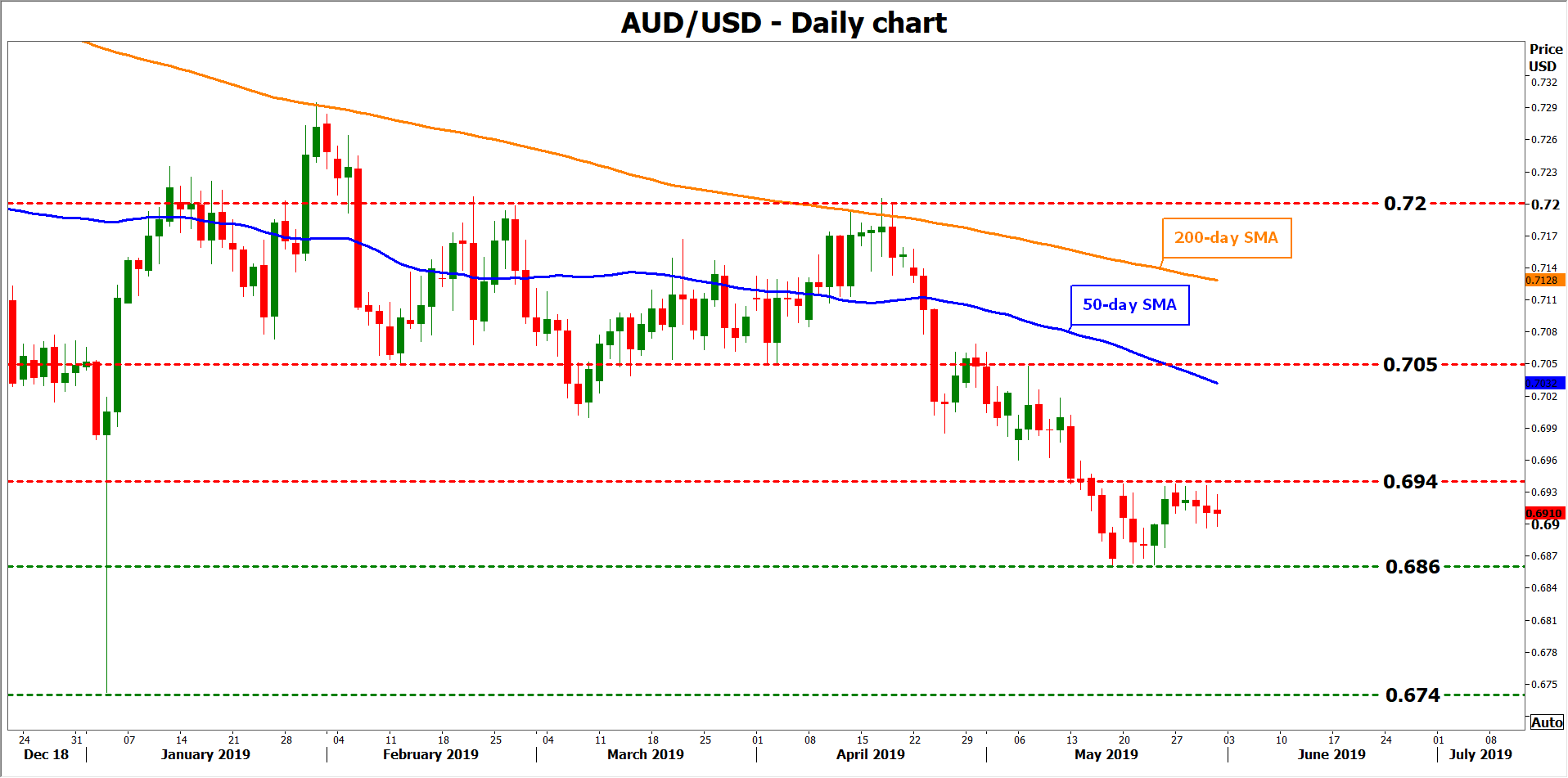
Technically, a potential spike up in aussie/dollar could stall at 0.6940, with an upside break opening the door for 0.7050. On the downside, declines may find support near 0.6860, where a bearish violation would turn the focus to 0.6740.
Finally, note that the nation’s retail sales for April will be released a few hours ahead of the rate decision, while GDP data for Q1 are due the next day.
Week Ahead – RBA and ECB Meetings in Focus; US Jobs Report Eyed Amid Runaway Dollar
As the US dollar heads for fresh two-year highs, next week’s nonfarm payrolls report could be key in deciding whether the dollar’s persistent strength will hold out for much longer. The Australian dollar will also be under the spotlight as the country’s central bank could make its first rate cut in three years. The European Central Bank will meet too as the Eurozone struggles to escape the dark clouds hanging over it. In Canada, the latest employment report will be important after the Bank of Canada reiterated its data-dependent stance.
RBA to cut rates as growth expected to slow
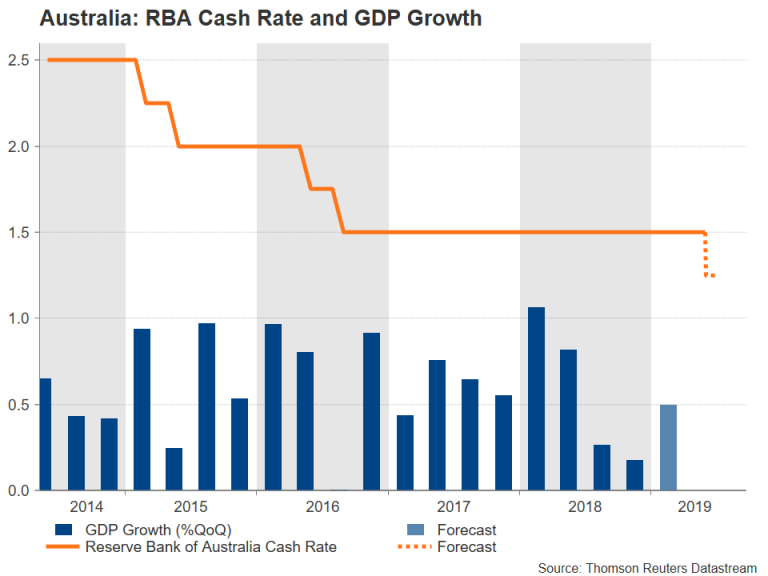
It’s going to be a crucial week for the Australian dollar next week as first quarter growth figures will be published, and the Reserve Bank of Australia could make its first rate reduction in three years. GDP data due on Wednesday is projected to show the Australian economy grew by 0.5% quarter-on-quarter in the first three months of the year. Ahead of the GDP report, there will be plenty of clues on what to expect from it as Q1 business inventories numbers are out on Monday, followed by Q1 net exports contribution on Tuesday.
The barrage of economic stats does not stop there as monthly retail sales, trade and housing finance figures will be released too, on Tuesday, Thursday and Friday, respectively.
But it will probably require a big upside surprise in the data to convince the RBA it does not need to cut rates given that inflation remains stubbornly low and shows no sign of picking up. The RBA is anticipated to lower its cash rate from 1.50% to 1.25% when it meets on Tuesday.
The aussie is therefore likely to face some selling pressure next week, though the extent of the downside will depend on whether the RBA signals further rate cuts in the future. Rising iron ore prices have halted the aussie’s recent slide, and with a rate cut now mostly priced in, only a very dovish RBA or a further escalation in trade tensions risk driving the local dollar to fresh yearly lows.
Disappointing PMIs from China – Australia’s biggest trading partner – is another possible drag on the aussie. The Caixin/Markit manufacturing PMI is due on Monday and is forecast to slip from 50.2 to 50.0 in May, pointing to stagnant growth in manufacturing during the month.
Q1 capital expenditure due from Japan
Japan’s economy may have grown more than expected in the first quarter but that was mostly down to a sharp fall in imports. A more detailed release of quarterly capital expenditure on Tuesday should provide investors with better insight into how business spending fared in specific sectors and whether there is any change to the preliminary reading of -0.3% q/q, which would be an indication of a possible revision to the initial GDP estimates.
Household spending and earnings numbers for April will be watched too on Friday, particularly, the pay growth figures. Earnings in Japan slumped by 1.9% year-on-year in March despite a tight labour market. Further weakness in consumption and wage growth in April would not bode well for Q2 growth.
Nevertheless, the yen looks set to stay supported by safe-haven flows for some time yet so is unlikely to come under much pressure from any worrying data out of Japan.
Can the ECB get more dovish?
The Eurozone calendar will be quite busy in the coming week with the final IHS Markit PMIs for May out on Monday and Wednesday, the euro area unemployment rate on Tuesday, retail sales and producer prices on Wednesday, as well as revised Q1 GDP figures on Thursday. The highlights in terms of economic releases, however, will be the flash inflation print for May on Tuesday and German industry indicators later in the week. But the main focal point for traders will be the ECB’s policy meeting on Thursday.
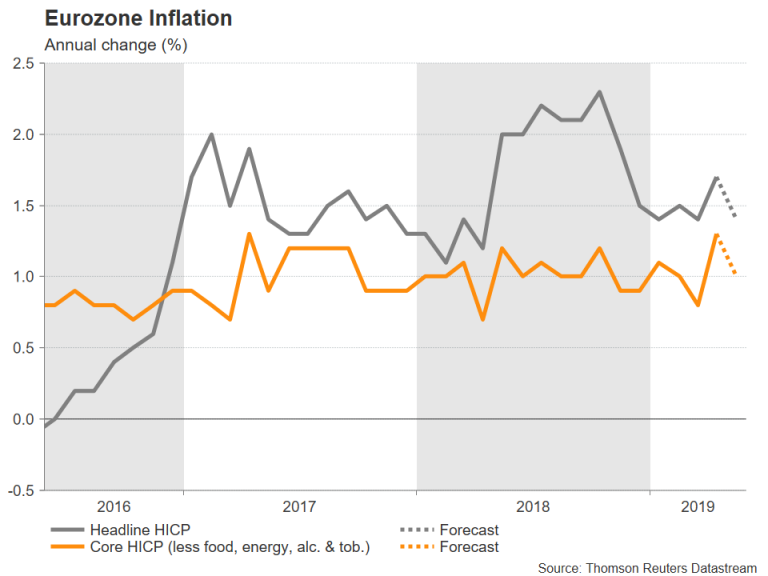
Eurozone inflation is expected to ease from 1.7% to 1.3% y/y in May, suggesting it continues to be a tough battle for the ECB to meet its price goal. German industrial orders and output figures for April will be monitored closely on Thursday and Friday, respectively, for signs Europe’s largest economy is on the mend.
ECB President Mario Draghi is sure to comment on the Eurozone economy at his press conference on Thursday, which will follow the ECB’s latest policy announcement. The central bank is expected to keep interest rates unchanged but will probably outline the details of its latest round of Targeted Long-Term Refinance Operations (TLTRO), which will launch in September. Updated economic projections will also be published, so a more dovish sounding ECB cannot be ruled out if growth and inflation forecasts are revised lower.
That would pose downside risks for the euro, which is nearing its 2-year trough plumbed earlier this month.
UK PMIs sole focus for pound as Brexit bill is scrapped
The UK Parliament was due to vote on Theresa May’s fourth version of her Withdrawal Agreement bill next week, but with her resignation comes the demise of her deal. Instead, British politicians will have the pleasure of hosting US President Trump on a state visit, who may have a thing or two to say himself about Brexit whilst he’s there.
But as traders anxiously await who the Conservative party will vote as its next leader, effectively replacing May as prime minister, the latest PMI reports should provide an update on the damage the Brexit drama is doing to the UK economy. The manufacturing PMI for May is up first on Monday, followed by the construction PMI on Tuesday and the services PMI on Wednesday.
The data are unlikely to be of much comfort to the pound even if there are positive surprises, but in the absence of any other news, could provide some near-term direction.
Will NFP report be another catalyst for a strong dollar?
Not even (in what is appearing to be) a complete breakdown in US-China trade talks is able to keep a lid on the greenback’s advances, with the dollar index fast approaching last week’s 2-year highs. And as the US economy so far manages to maintain good momentum, next week’s set of key indicators are not expected to change that picture.
The first big release out of the US is the ISM manufacturing PMI on Monday. The index is forecast to rise from 52.8 to 53.3 in May. The more-important ISM non-manufacturing PMI will follow on Wednesday and is predicted to increase from 55.5 to 56.0. If the numbers come in as expected, they could help 10-year Treasury yields recover from 20-month lows – not that this decline has been much of a deterrent for the dollar bulls.
In other data, April factory orders and the ADP employment report will be watched on Tuesday and Wednesday, respectively, before attention turns to Friday’s nonfarm payrolls report.
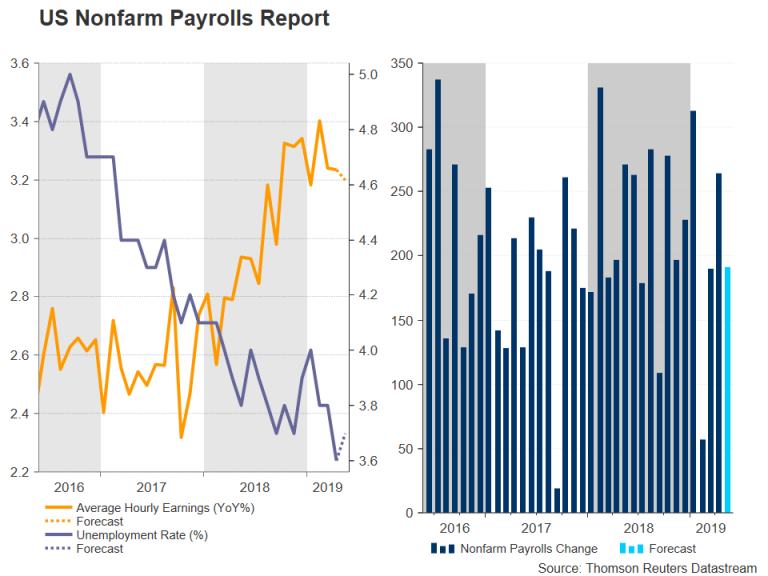
The May jobs report is anticipated to be another healthy one for employment growth but lacklustre in terms of wage growth. Total nonfarm payrolls probably slowed somewhat from 263k in April to 190k in May, which is still impressive given that only 100k jobs are needed a month to keep up with population growth and that the economy is in the late stages of the business cycle. The jobless rate is forecast to tick up slightly to 3.7%, but disappointingly, wage growth is forecast to remain unchanged at 3.2% y/y in May.
Without faster wage growth, it will be incredibly difficult for the Fed to lift inflation closer to its 2% target. Investors will be hoping to hear more on the Fed’s stance on inflation and the economy on June 4-5 when a number of Fed regional presidents, as well as Chairman Powell and Vice Chairman Clarida attend the Fed Listens Conference in Chicago.
Jobs numbers eyed in Canada too
The Bank of Canada said it was increasingly confident the slowdown in late 2018/early 2019 was temporary as it kept rates on hold this week. But this wasn’t enough to convince traders that further rate hikes could be on the horizon in the near future, triggering a plunge in the loonie against the US dollar.
Still, the BoC has made it clear it remains very much data dependent. Thus, employment figures for May out on Friday could help the Canadian dollar recoup some of this week’s losses if they are anywhere near as strong as last month’s surge of 106.5k jobs.