

Sample Category Title
EUR/USD Mid-Day Outlook
Daily Pivots: (S1) 1.1113; (P) 1.1143; (R1) 1.1161; More.....
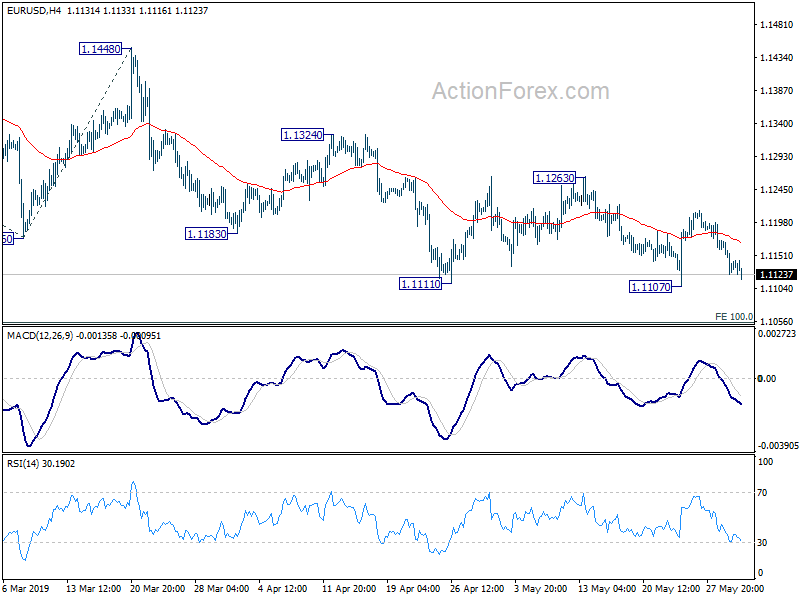
EUR/USD is holding above 1.1107/1111 support zone and intraday bias remains neutral first. Consolidation from 1.1111 could extend further. In case of another rise, upside should be limited by 1.1263 resistance to bring down trend resumption. On the downside, firm break of 1.1107 will target 100% projection of 1.1448 to 1.1183 from 1.1324 at 1.1059. However, sustained break of 1.1263 resistance will now be an early sign of trend reversal and turn bias to the upside for 1.1448 key resistance.
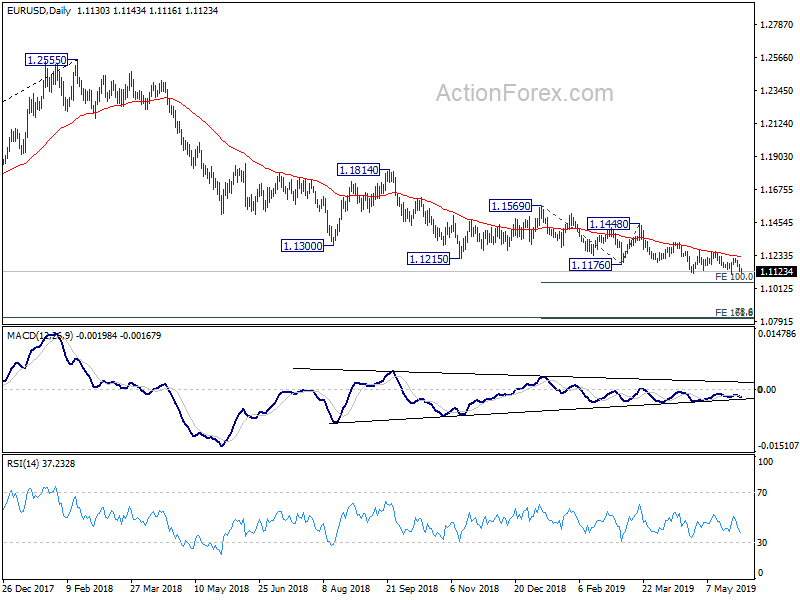
In the bigger picture, down trend from 1.2555 (2018 high) is still in progress. Such decline would target 78.6% retracement of 1.0339 (2016 low) to 1.2555 (2018 high) at 1.0813 next. Sustained break there will pave the way to retest 1.0339. On the upside, break of 1.1448 resistance is needed to be the first sign of medium term bottoming. Otherwise, outlook will stay bearish in case of rebound.
USD/CHF Daily Outlook
Daily Pivots: (S1) 1.0058; (P) 1.0073; (R1) 1.0096; More...
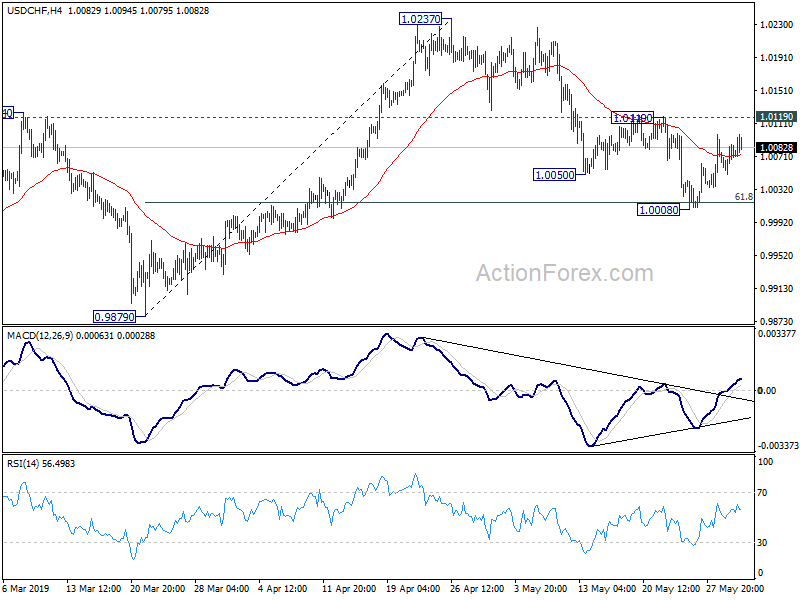
Intraday bias in USD/CHF remains neutral at this point. On the upside, decisive break of 1.0119 resistance will suggest that decline from 1.0237 is merely a correction and has completed. Intraday bias will be turned back to the upside for retesting 1.0237. That will also retain medium term bullishness in the pair. On the downside, however, firm break of 1.0008 should pave the way to retest 0.9879 key support next.
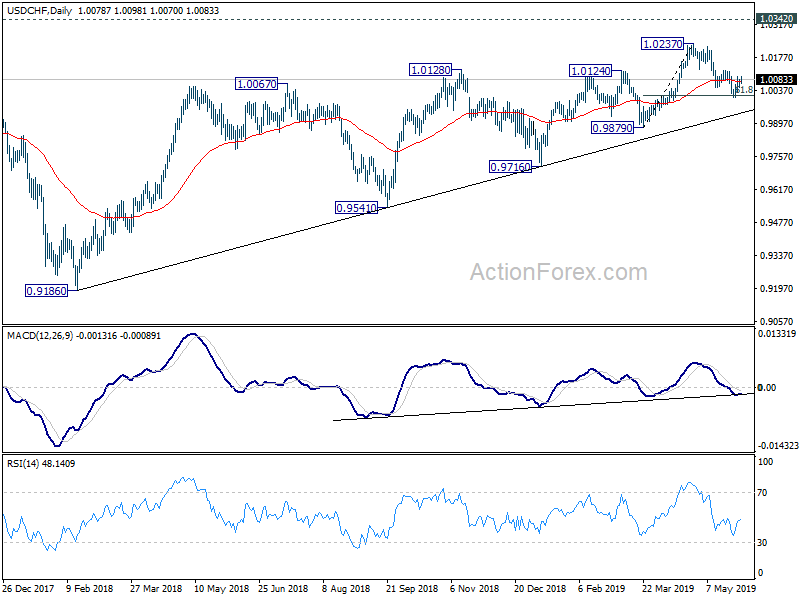
In the bigger picture, USD/CHF is losing upside momentum ahead of 1.0342 key resistance (2016 high). There is no clear sign of reversal yet. But even in case of another rise, we'd be cautious on strong resistance from 1.0342 to limit upside. On the downside, break of 0.9879 support will suggest that larger rise from 0.9186 (2018 low) has completed. Deeper fall will be seen to 0.9716 support for confirmation.
US Core PCE Data Cements Rate Cuts this Summer; Oil Report Next; Bitcoin Eyes $10K
US stocks are poised to open slightly higher as the global bond market rout takes a break, despite the latest escalation from China and a wrath of US data that cements a Fed rate cut should be coming this summer.
China, the biggest soybean buyer in the world, reportedly decided to hold off on soy purchases, which is most likely another negotiating tactic in the escalating trade war. China is not canceling the orders, just waiting for trade negotiations to improve. Global bond yields improved overnight, but the 10-year Treasury yield resumed its slide after the US data, falling 0.7 basis points to 2.253%, while the Italian 10-year remains volatile, surging after Deputy Premier Salvini noted he is ready to end Italy coalition with Five Star if the don’t work with him. The dollar is mixed against its major trading partners, while gold prices softened but still stuck in its recent trading range.
- USD – Fed’s favorite inflation measure falls to 1.0%
- Lira – Off the highs after Turkey considers putting S-400s on Mediterrean
- Oil – EIA report expecting a draw of 1.1 million barrels
- Gold – Struggles despite rate cut bets
- Bitcoin – Eyes $10,000
USD
The writing is on the wall, the Fed now has data that warrants rate cuts. There could be no point in debating rate hikes anymore, yes believe it or not, there is a camp of economists calling for a rate hike as the next move. The Fed’s favorite inflation measure, Core PCE’s second reading for the first quarter showed inflation fell to 1.0%, well below the 2% target.
The first quarter GDP reading was also revised lower from 3.1% to 3.0%. First quarter profits also declined 2.8%, much worse than the 0.4% drop seen in the prior quarter. The weekly jobless claims came in-line with expectations, with the 4-week moving average at 216.75K in the week ending May 25th.
The Fed can capitulate this summer, officials may want to see a final Core PCE reading, but with the 10-year Treasury yield trading so far below the Fed’s target range, the FOMC will have an easy decision.
Lira
The Turkish lira is 1.7% higher against the dollar, off its strongest levels after news they are contemplating placement of a Russian missile-defense system along the country’s southern coast. Tensions are high with Cyprus over gas exploration and this could escalate this situation.
The US has already been putting pressure on Turkey for acquiring the Russian missile system and this will likely raise tensions, despite the Turkey’s release of the US NASA scientist after years in prison. US sanctions appear inevitable for Turkey.
Oil
Oil prices have given back most of their overnight gains as markets await the next development in the trade war and whether the EIA report shows crude inventories posted another multi-million-barrel build. Current expectations are for a draw of 1.1 million barrels, with a range of estimates from a 3.5 million draw to a 1.5 million build. So far in 2019, forecasters have not been to accurate in predicting the volatile report. Yesterday’s API inventory report showed a draw of 5.3 million barrels. If we also see a million plus draw with today’s EIA numbers, that should help oil stabilize here
Gold
Gold remains stuck in a tight range, failing to capitulate on the trade war escalation and Fed rate cut bets. The market is pricing three rate cuts between now and next year. Gold needs the dollar fall, but right now US duration appears to be heavily supported in the bond markets.
Bitcoin
Bitcoin is up 0.9% in early trade, poised for the longest monthly winning streak since 2017. Bullish momentum appears to have eyes set for $10,000 and that could become a reality. No negative news is good news for crypto fans.
USD/JPY Mid-Day Outlook
Daily Pivots: (S1) 109.26; (P) 109.48; (R1) 109.81; More...
USD/JPY's recovery from 109.15 extends higher today and further rise might be seen. But it's seen as in consolidation pattern from 109.02. Thus, upside should be limited by 110.67 resistance to bring fall resumption eventually. On the downside, break of 109.02 will resume the fall from 112.40 and target 61.8% retracement of 104.69 to 112.40 at 107.63 next. Nevertheless, firm break of 110.67 will argue that fall from 112.40 could be completed and turn focus back to this resistance.
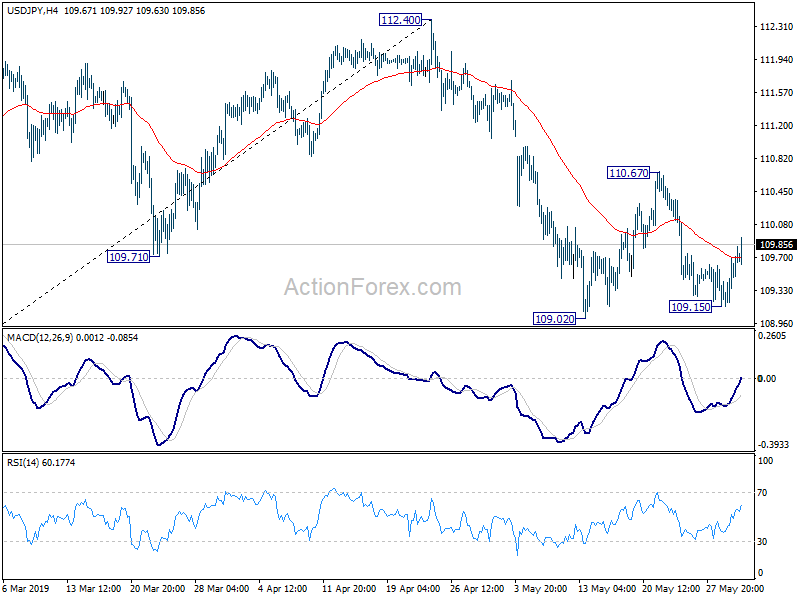
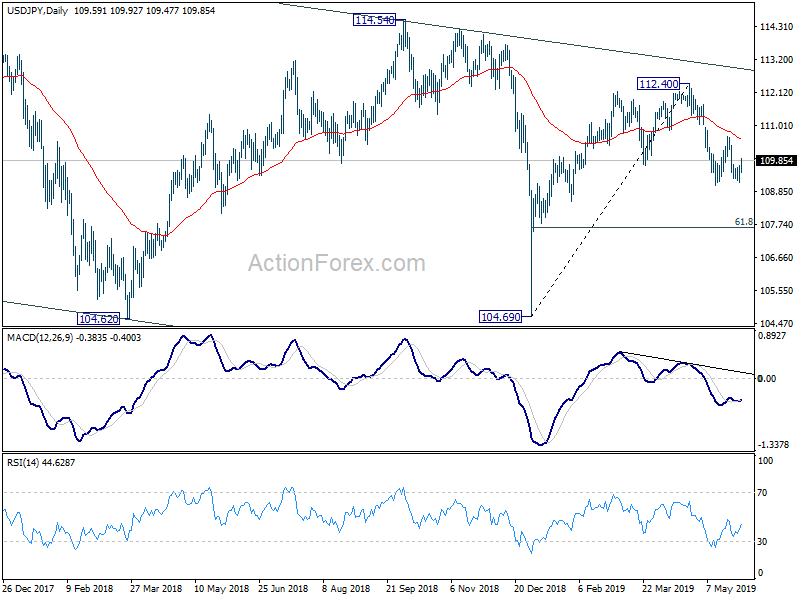
In the bigger picture, USD/JPY is staying inside falling channel from 118.65. Current development suggests that rebound from 104.69 is only a corrective move. And fall from 118.65 is not completed yet. Decisive break of 104.69 will extend the down trend towards 98.97 support (2016 low). For now, we'd expect strong support above there to bring rebound.
USD/JPY Extends Recovery on Solid US Data, Trade Spats Shrugged
Dollar trades generally higher today as risk markets stabilized, partly helped by recovery in treasury yields too. Economic data from US generally matched expectations. Markets also shrugged off repeated comments from US and China regarding trade war. Though, at the time of writing, Canadian Dollar is the strongest one, lifted by rebound in oil price. Yen is the weakest one as stocks are recovering..
Technically,current developments suggests that USD/JPY's consolidation from 109.02 low is in its third leg and further rise is in favor. That might help lift EUR/JPY higher today. Meanwhile, GBP/USD continues to gyrate towards 1.2605 support. EUR/GBP also refuses to retreat deeper below 0.8805 temporary top. The Pound is vulnerable to around of selloff. And that could limit any recovery attempt in GBP/JPY. It's a bit early to call for a breakout. But EUR/USD is edging lower towards 1.1107 support and this level will be watched.
In other markets, US stocks open generally higher, with DOW trading up 65 pts at the time of writing. 10-year yield is also up 0.037 at 2.273. We'll see if the recovery could sustain for the whole session. In Europe, FTSE is currently up 0.56%. DAX is up 0.59%. CAC is up 0.56%. German 10-year yield is up 0.014 at -0.161. Earlier in Asia, Nikkei dropped -0.29%. Hong Kong HSI dropped -0.44%. China Shanghai SSE dropped -0.31% to 2905.81, holding on to 2900 handle. Singapore Strait Times dropped -0.64%. Japan 10-year JGB yield rose 0.0114 to -0.081.
Trump: Americans paying very little of tariffs, China is subsidizing
On trade war with China, Trump insisted things are going well. He told reports at the White House that "China would love to make a deal with us. We had a deal and they broke the deal. I think if they had it to do again they wouldn't have done what they did." On the tariffs, he said "China is subsidizing products, so the United States taxpayers are paying for very little of it." And pointed to the little impact of tariffs on inflation. Trump also said, "I think we're doing very well with China."
China open to sell rare earths to other countries, halted US soy purchases
China continued its hard line rhetorics on the topic of US-China trade war. Commerce industry repeated the pledge to fight till the end if US keeps escalating tensions. And China will firmly defend its own national interests. There is no indication of more talks as China said US sincerity is in doubt.
In addition to the usual stuffs, the Commerce industry also said China is willing to meet reasonable demand for rare earths from other countries. Though, it would be unacceptable that countries using Chinese rare earths to manufacture products would turn around and suppress China.
Separately, it's reported that China has halted soy purchases from the US already. Government data indicates China bought about 13 million metric tons of US soybeans since December. While there is no cancellation of previous orders, there is no further orders to continued the so called goodwill buying.
US Q1 GDP growth revised down to 3.1%, price index rose 0.8%
US Q1 GDP growth was revised down to 3.1% annualized, from first estimate of 3.2%, matched expectations. GDP price index was revised down to 0.8% down from 0.9% and missed expectation of 0.9%.
Looking at the details, there were positive contributions from PCE, private inventory investment, exports, state and local government spending, and non-residential fixed investment. Imports also decreased. There was negative contribution from residential fixed investment.
The acceleration in GDP growth reflected an upturn in state and local government spending, accelerations in private inventory investment and in exports, and a smaller decrease in residential investment. These were partly offset by decelerations in PCE and nonresidential fixed investment, and a downturn in federal government spending.
US trade deficit widened slightly to USD 72.1B, both exports and imports contracted
US trade deficit widened slightly to USD 72.1B in April, up from USD 71.9B. Looking at the details, pretty much all category of of both exports and imports contracted. Overall exports dropped -4.2% to USD 134.6B. Imports dropped -2.7% to USD 206.7B.
Initial jobless claims rose 3k to 215k in the week ending May 25, slightly above expectation of 214k. Four-week moving average of initial claims dropped -3.75k to 216.75k. Continuing claims dropped -26k to 1.657M in the week ending May 18. Four-week moving average of continuing claims dropped -3.5k to 1.673M.
BoE Ramsden: Most financial stability risks from no-deal Brexit mitigated
BoE Deputy Governor Dave Ramsden said in case of a smooth Brexit with transition, the MPC expected UK growth to pick up, leading to excess demand and building domestic inflationary pressure. In such case, further monetary tightening is appropriate. Ramsden's GDP growth expectation was "a little more pessimistic". However, he also saw "downside risks to productivity, while he's also "less optimistic on investment recovery". Thus, his overall view on monetary policy was broadly in line with the MPC.
Ramsden noted that the "biggest risk to the UK economy and UK financial stability, remains that of a Brexit outcome of no deal and no transition." But he emphasized that "most risks to financial stability that could arise have been mitigated", even though "a no deal, no transition Brexit could still be expected to bring significant market volatility, as well as economic instability."
BoJ Sakurai: Shouldn't recklessly seek to hit price target with additional easing
BoJ board member Makoto Sakurai said the central bank "shouldn't recklessly seek to achieve our price target with additional easing". Instead, the best monetary policy approach was to "patiently maintain" the current stimulus program. He acknowledged that "achievement of our price target is being delayed". But that's because "the relationship between monetary policy and price moves are changing and becoming more complex."
Sakurai also said BoJ should be very mindful of the negative effects of the ultra-loose monetary policy. He added, "while financial institutions' capital-to-asset ratios are sufficient from a regulatory standpoint, what's important to note is that they are declining as a trend." Hence, "the BoJ must make appropriate policy decisions by scrutinizing the merits and demerits, including the risk our policy is building up financial imbalances."
Australia building approvals dropped -4.7% mom, capital expenditure dropped -1.7%
Australia dwelling approvals contracted by -4.7% mom in seasonally adjusted terms in April. That's well below expectation of 0.0% mom. Regionally, the decline was driven by falls in Tasmania (19.1%), Victoria (16.1%), Western Australia (6.7%) and South Australia (3.3%). Private dwellings excluding houses fell 6.5% while private house approvals decreased 2.6%.
Seasonally adjusted new capital expenditure dropped -1.7% in Q1, also way below expectation of 0.5% qoq. Buildings and structures fell -2.8% while equipment, plant and machinery fell -0.5%
USD/JPY Mid-Day Outlook
Daily Pivots: (S1) 109.26; (P) 109.48; (R1) 109.81; More...
USD/JPY's recovery from 109.15 extends higher today and further rise might be seen. But it's seen as in consolidation pattern from 109.02. Thus, upside should be limited by 110.67 resistance to bring fall resumption eventually. On the downside, break of 109.02 will resume the fall from 112.40 and target 61.8% retracement of 104.69 to 112.40 at 107.63 next. Nevertheless, firm break of 110.67 will argue that fall from 112.40 could be completed and turn focus back to this resistance.
In the bigger picture, USD/JPY is staying inside falling channel from 118.65. Current development suggests that rebound from 104.69 is only a corrective move. And fall from 118.65 is not completed yet. Decisive break of 104.69 will extend the down trend towards 98.97 support (2016 low). For now, we'd expect strong support above there to bring rebound.
Economic Indicators Update
| GMT | Ccy | Events | Actual | Forecast | Previous | Revised |
|---|---|---|---|---|---|---|
| 22:45 | NZD | Building Permits M/M Apr | -7.90% | -6.90% | -7.40% | |
| 01:30 | AUD | Private Capital Expenditure Q1 | -1.70% | 0.50% | 2.00% | 1.30% |
| 01:30 | AUD | Building Approvals M/M Apr | -4.70% | 0.00% | -15.50% | -13.40% |
| 12:30 | CAD | Current Account Balance (CAD) Q1 | -17.35B | -17.9B | -15.5B | -16.6B |
| 12:30 | USD | GDP Annualized Q/Q Q1 S | 3.10% | 3.10% | 3.20% | |
| 12:30 | USD | GDP Price Index Q1 S | 0.80% | 0.90% | 0.90% | |
| 12:30 | USD | Initial Jobless Claims (MAY 25) | 215K | 214k | 211k | 212K |
| 12:30 | USD | Advance Goods Trade Balance Apr | -72.1B | -72.0B | -71.4B | -71.9B |
| 12:30 | USD | Wholesale Inventories M/M Apr P | 0.70% | 0.10% | -0.10% | |
| 14:00 | USD | Pending Home Sales M/M Apr | -1.50% | 0.50% | 3.80% | 3.90% |
| 14:30 | USD | Natural Gas Storage | 98B | 100B | ||
| 15:00 | USD | Crude Oil Inventories | -0.9M | 4.7M |
Trump: Americans paying very little of tariffs, China is subsidizing
On trade war with China, Trump insisted things are going well. He told reports at the White House that "China would love to make a deal with us. We had a deal and they broke the deal. I think if they had it to do again they wouldn't have done what they did."
On the tariffs, he said "China is subsidizing products, so the United States taxpayers are paying for very little of it." And pointed to the little impact of tariffs on inflation.
Trump also said, "I think we're doing very well with China."
EURCAD Forms Symmetrical Triangle; Neutral in Short Term
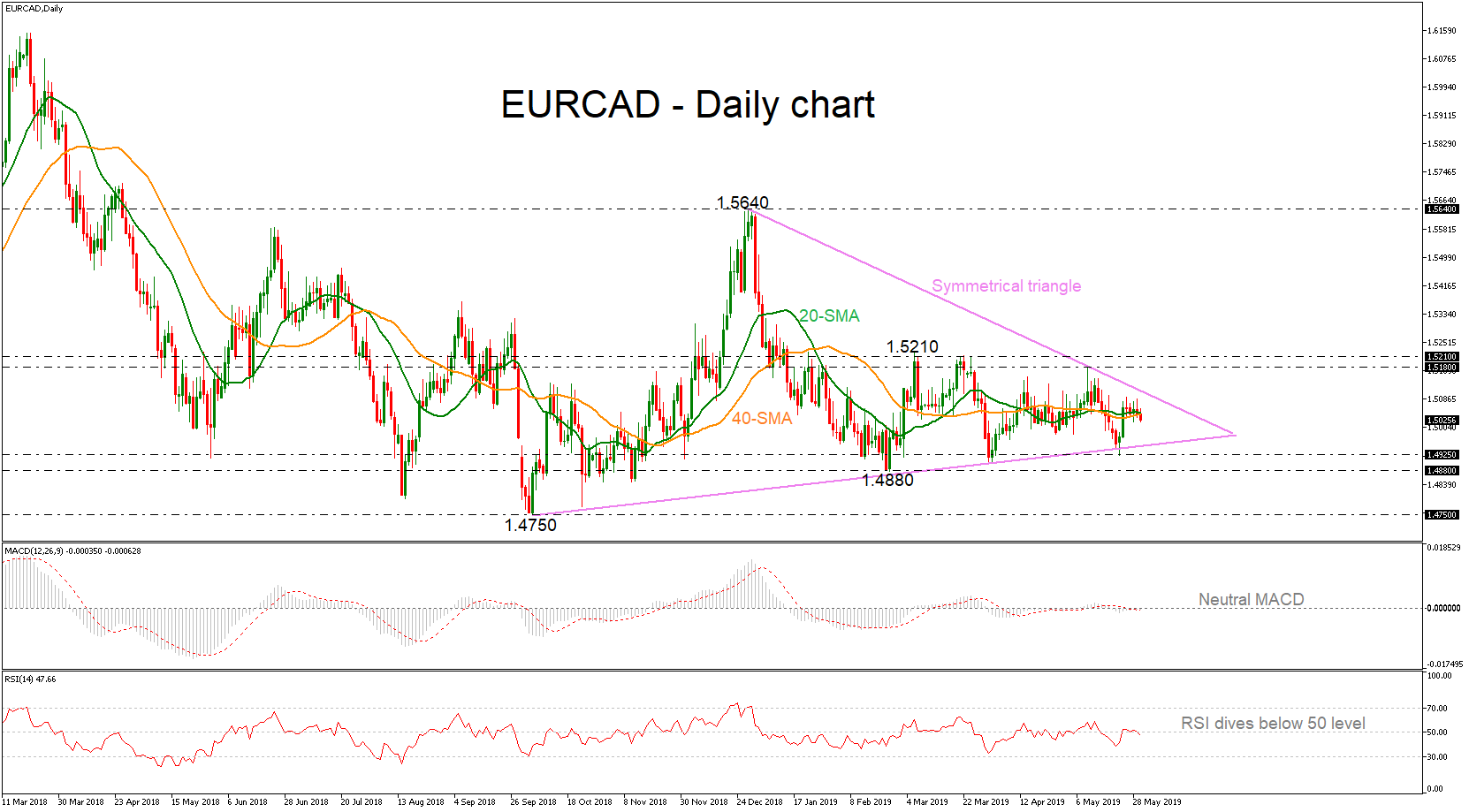
EURCAD has been moving in a symmetrical triangle over the last seven months following the soft rebound on the 1.4750 support level. In the short-term, the market could maintain consolidation if the RSI keeps moving around 50 and the MACD near its zero line. Regarding the trend, this is likely to remain flat in the near-term as the 20- and 40-day simple moving averages (SMAs) continue to lose strength.
An extension to the downside and below the moving averages could meet the area between the rising line and the 1.4925 support ahead of the 1.4880 trough reached February 22. Further down, key level could run towards the 1.4750 area, taken from the bottom on October 2018, penetrating the symmetrical triangle to the downside.
On the other hand, if the pair gains ground, the falling line would be immediate resistance for the bulls around 1.5100. Even higher, a violation of the formation could open the door for the 1.5180 – 1.5210 resistance area.
Regarding the medium-term picture, traders should wait for a completion of the symmetrical triangle for placing orders as the market is lacking direction at the moment.
US: First Quarter Growth Largely Unchanged, But Inflation Softer than Expected
- Revisions to first quarter real GDP were fairly uneventful, with growth in the quarter as a whole revised down one tick to 3.1% (annualized). This was slightly better than the 0.2 percentage point (pp) downward revision markets were expecting. The most noteworthy revision was to core inflation, the Fed's preferred measure, which was revised down to a 1.0% annualized pace in Q1, from 1.3% in the advance estimate.
- As in the advance release, real GDP was boosted by temporary factors. The combination of net exports and an inventory build contributed 1.6 pp to growth, down very slightly from the 1.7 pp contribution in the advance estimate.
- Consumer spending remained soft in the second estimate, if revised up slightly to 1.3% (from 1.2%), as all categories of spending were revised up slightly.
- Strength in PCE was partly offset by a downward revision to business investment, which rose 2.3% (versus 2.7% previously). The subcomponents were a mixed bag. Spending on structures was stronger +1.7% (-0.8% prev.), equipment was weaker (-1.0%, vs 0.2% prev.), as intellectual property (+7.2% vs +8.6% prev.).
- Residential investment was a bit worse than initially reported (-3.5% vs. -2.8% prev.).
- Government spending was revised up one tick to 2.5%.
- Corporate profits are released with the second estimate of GDP, and profits fell $65.4 billion in Q1, on top of a $9.7 billion decline in Q4. Corporate profits before taxes are now up only 3.1% on a year-on-year basis, a notable deceleration from a 10.4% pace as recently as Q3 2018.
Key Implications
- The revisions to the growth side of the economy were fairly staid. The story of strong headline growth in the first quarter boosted by temporary factors remains intact. As the temporary factors reverse in Q2, growth is likely to slow below 2%.
- The bigger story is that inflation softness in Q1 was more pronounced than expected. Tomorrow we will get income and spending data for April, along with the PCE inflation data, and will see whether the inflation soft spot at the start of the year was indeed transitory, or if the Fed needs to more seriously consider the prospect of insurance rate cuts
USDTRY Tumbles Below 38.2% Fibonacci and 50-SMA
USDTRY is aggressively diving to a fresh one-month low today, below the 38.2% Fibonacci retracement level of the downfall from 7.1135 to 5.1330 around 5.8855. Looking at the technical indicators, the RSI is slipping below the 50 level, suggesting a downward correction in the daily chart, while the MACD is still falling below the trigger line.
Should the pair stretch south and penetrates the 5.8460 support and the 50-day moving average, the April 17 low of 5.7060 could provide immediate support before the pair touches the 23.6% Fibonacci mark of 5.5970, switching the bullish profile to neutral.
On the flipside, if traders buy the pair, the price could rise until the 5.9855 resistance, while steeper increases could also touch the 50.0% Fibonacci of 6.1200. If the buying interest extends, attention could then turn to the seven-month high of 6.2440.
Overall, the recent bearish action turned the weak momentum to a more aggressive one, with the price increasing distance below the shorter-term moving averages, so we could expect further decline in the market.
Gold Looking Soft But Could Still be a Bullish Case
The dollar is once again being favoured during the escalation of the trade spat, as yields on US Treasuries continue to head lower.
Whether this is a sign of Treasuries being the preferred safe haven during the stock market sell-off or a belief that the US will be least worse off, it’s very much consistent with what we’ve seen previously.
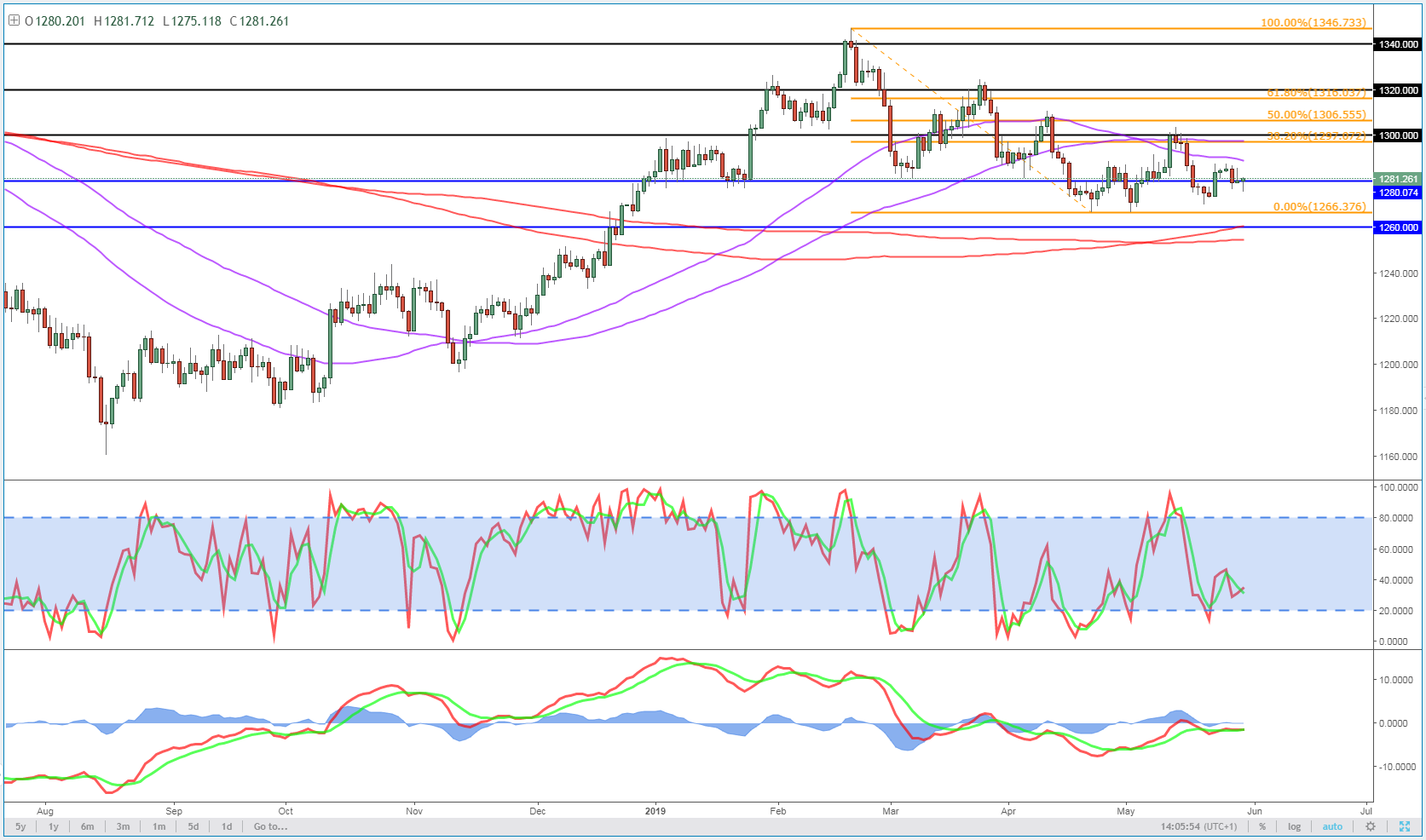
What’s more, it’s making life tough for the other traditional safe haven, gold. While the yellow metal typically performs well during periods of risk aversion, it also responds strongly to movements in the greenback and is therefore being dragged lower recently by movements in the currency. Gold is trading back below $1,280 today putting the focus back around the $1,265 lows of the last couple of months.
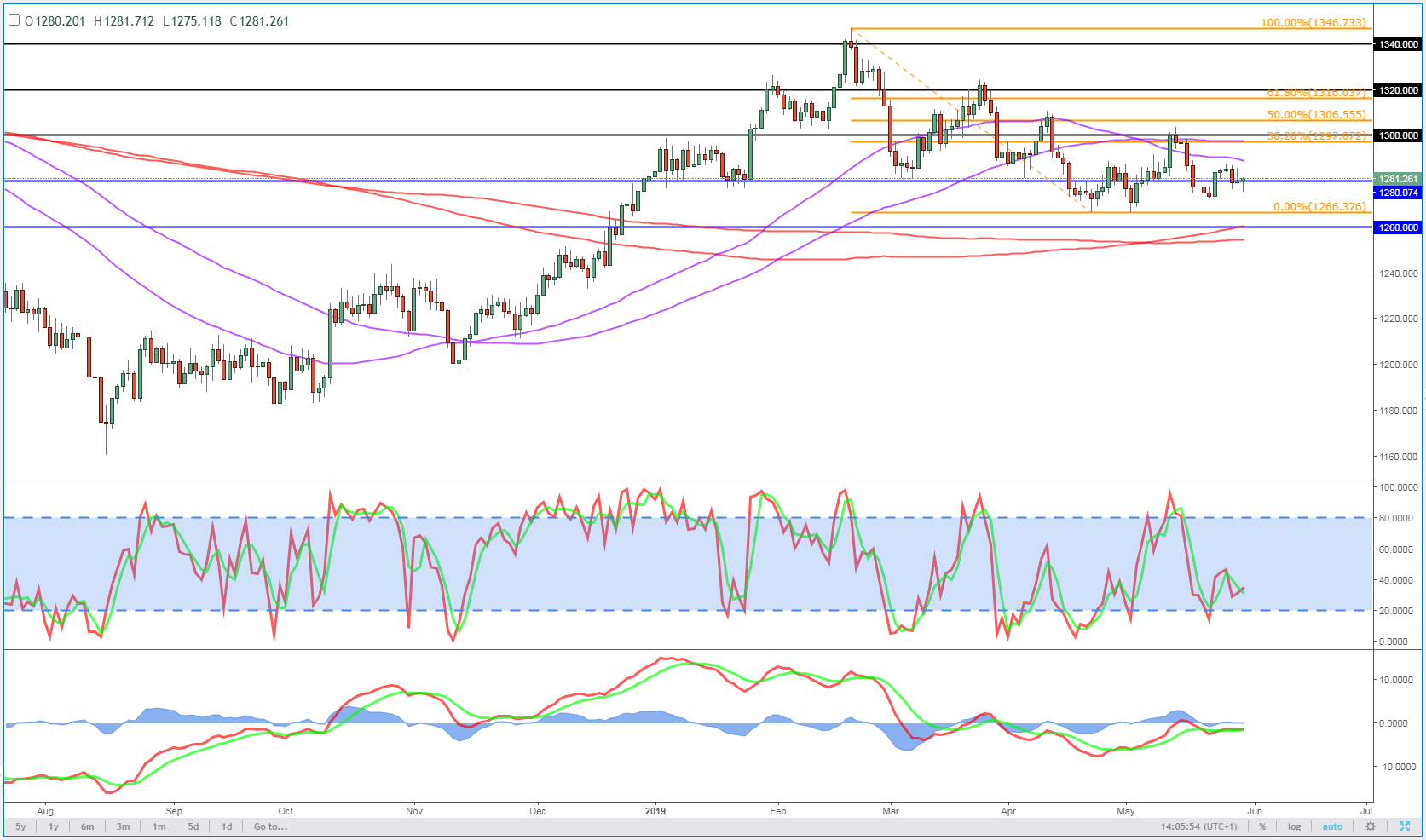
One bullish case for gold at the moment is that it performed well during the fourth quarter after a stuttered start, perhaps that’s what we’re seeing now. The recent trend isn’t particularly favourable though and if $1,265 breaks, it may signal that this time is different. That’s obviously a big “if” for a level that’s currently being strongly defended.