Sample Category Title
USD/CAD Analysis: Bullish Markets
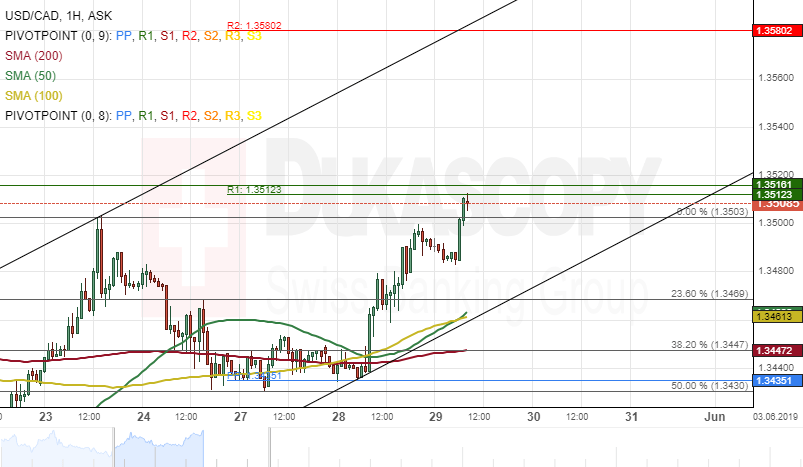
During the past 24 hours, the US Dollar has appreciated about 75 base points against the Canadian Dollar. The pair was pressured up by the three SMAs, which were providing support for the rate at 1.3447.
The currency pair was trading near a resistance cluster formed by the weekly and the monthly PPs at 1.3512 during the first half of Wednesday's trading session.
If the exchange rate passes the resistance cluster, buyers would be ready to push the pair towards the 1.3550 marks in the short-term.
However, if the resistance cluster as mentioned earlier holds, a re-tests of the 50.00% Fibonacci retracement level at 1.3430 will be possible today.
ECB Rehn: Central scenario is not recession despite soft patch in economy
ECB Governing Council member Olli Rehn told Reuters today that the "central scenario is not a recession," despite the "soft patch in the economy." Though, he reiterated the unified message that an ample degree of stimulus is still appropriate for now. Policymakers are going to wait for the new economic forecasts, to be released next week, before debating on adjusting monetary policies.
Regarding the policy framework, Rehn said the definite of price stability should be loosened. Currently ECB sees inflation target as being close to 2%, below 2%. But Rehn said "My view is that 2% is not a ceiling and inflation can deviate in both directions."
Italian Deputy Prime Minister Matteo Salvini called for a new role for ECB to "guarantee" government debt in order to keep bond yields low. Rehn bluntly responded saying it goes against the principal of modern central banking that we are forbidden to do monetary financing."
NZD/USD Analysis: Targets At 0.6504
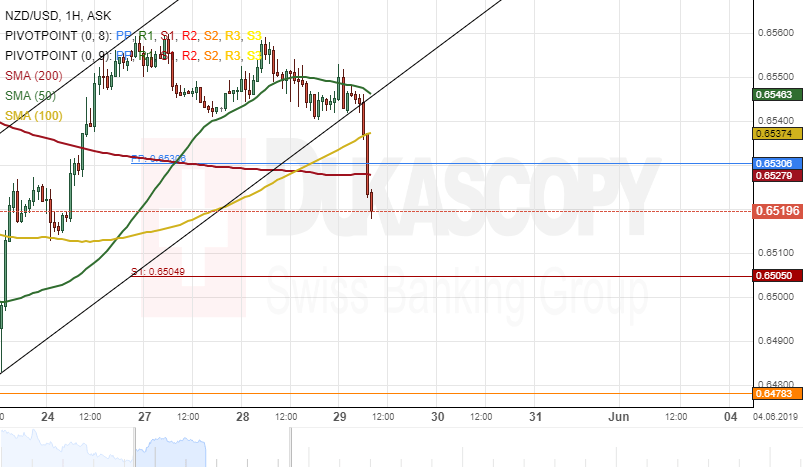
During the last 24 hours, the New Zealand Dollar has depreciated about 37 base points against the US Dollar. A breakout occurred through the lower boundary of an ascending channel pattern at 0.6546 during the morning hours of Wednesday's trading session.
Given that a breakout had occurred, it is likely that the NZD/USD currency pair will continue its decline today. The potential downswing target for bearish traders will be at the weekly S1 at 0.6504.
Meanwhile, technical indicators flash bearish signals on both the smaller and the larger time-frame charts.
EUR/USD Analysis: Could Maintain Its Decline
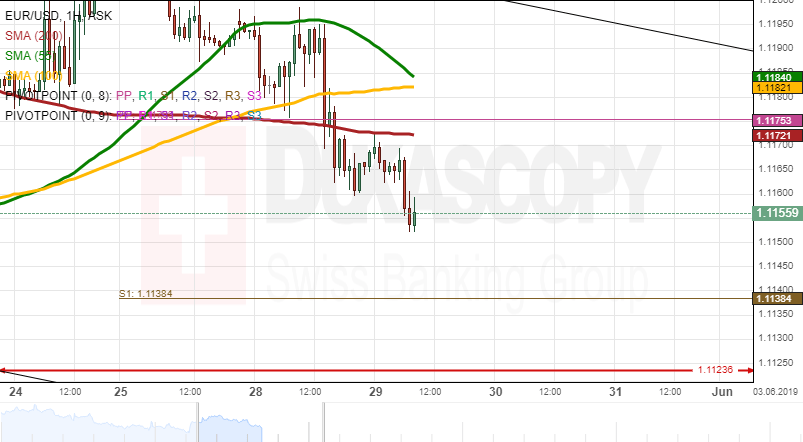
Yesterday, the EUR/USD currency pair declined to the psychological level at the 1.1160 mark.
Given that the pair is pressured by the 55-, 100– and 200-hour SMAs, currently located in the 1.1172/1.1184 range, it is likely, that bears could prevail in the market in the short term. A possible downside target is the weekly S1 at 1.1138.
If the given support does not hold, it is expected, that the exchange rate could decline to the 2018/2019 minimum at 1.1124. Otherwise, it is likely, that a reversal north could occur.
GBP/USD Analysis: Might Tumble To Weekly S1
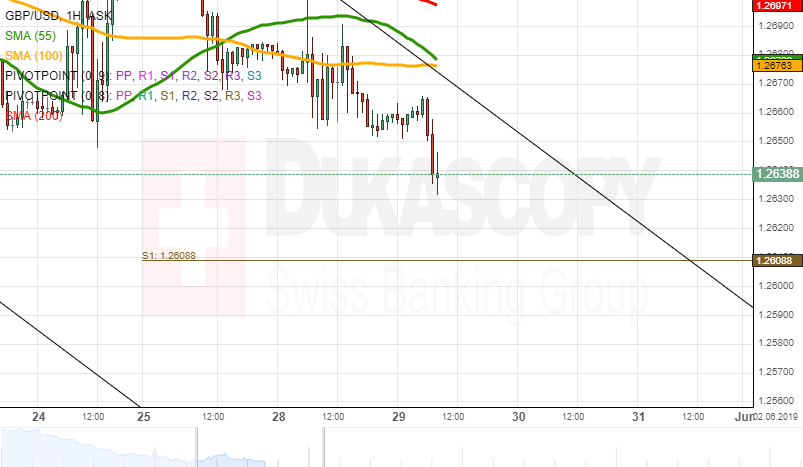
On Tuesday, the GBP/USD exchange rate tried to surpass the psychological level at 1.2660. During today's morning, the rate tumbled to the 1.2640 level.
From a theoretical point of view, it is expected, that the currency pair could maintain its decline, as the pair is trading within the short-term descending channel. A possible downside target is the weekly S1 at 1.2609.
It is unlikely, that some upside potential could prevail in the market, as the pair is pressured by the resistance cluster formed by the 55-, 100– and 200-hour SMAs, as well the weekly PP and the monthly S2 in the 1.2676/1.2712 range.
USD/JPY Analysis: Pressured By 55– And 100-Hour SMAs
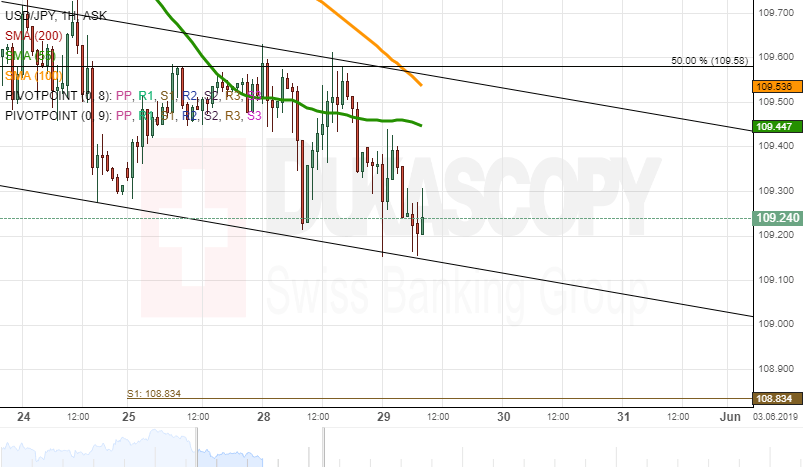
During the previous trading session, the USD/JPY currency pair tried to surpass the resistance level formed by the Fibonacci 50.00% retracement at 109.58. During Wednesday's morning, the pair was trading near the support level—the monthly S3 at 109.12.
From the one hand, it is likely, that the exchange rate could trade sideways between the given support and resistance in the nearest future.
However, note, that the rate is pressured by the 55– and 100-hour SMAs, located circa 109.50. Thus, if the given support doe not hold, it is expected, that the pair could reach the 109.00 level.
XAU/USD Analysis: Supported By Moving Averages
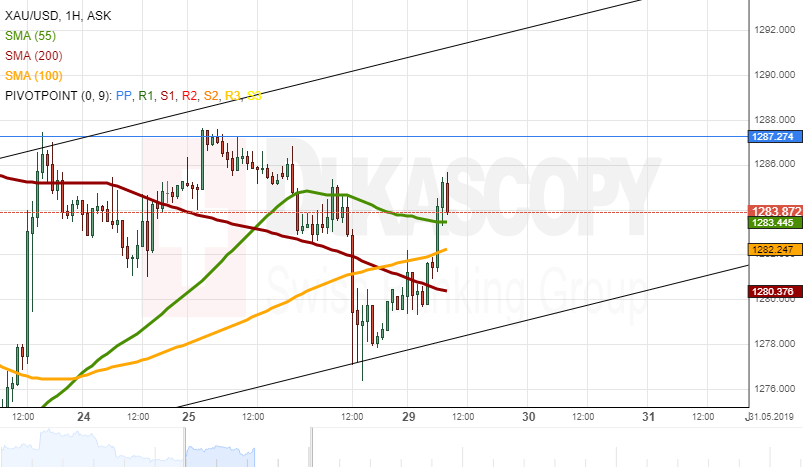
During Monday, the XAU/USD exchange rate reversed north from the lower boundary of the short-term ascending channel at 1,277.35. During today's morning, the rate skyrocketed to the 1,284.00 level.
Given that the price for gold is supported by the 55-, 100– and 200-hour SMAs, it is likely, that bulls could continue to prevail in the market. In this case, the rate has to surpass the monthly PP at 1,287.27.
On the other hand, the price for gold could trade sideways, trying to surpass the given moving averages, currently located in the 1,280.38/1,283.45 range.
Global Bond Rally Continues
Notes/Observations
- Global bond rally continued aided by persistent concerns over the US-China trade war and its impact on the world economy (10-year JGB at 3-year lows; Aussy 10-year below RBA rate)
- German May Unemployment Change rose for the 1st time in almost two years (+60K v -8Ke) but labor Agency played down the data as an adjustment
- Some constructive EU data (France Q1 Final GDP revised higher; Italian Confidence beats expectations; Sweden Q1 GDP beat consensus)
Asia:
- China National Development and Reform Commission (NDRC) Spokesperson stated that China would give priority to domestic needs for rare earth, not ruling out using rare earths in trade dispute with US - China PBoC Open Market Operation (OMO) saw its largest injection since Jan 17th (Injected CNY270B in 7-day reverse repos with a net of CNY250B injection)
Europe/Mideast:
- EU's Juncker stated that EU Leader Summit would not make decision on his successor at the May 28th meeting. Reiterated that there will be no renegotiation of the Brexit withdrawal agreement
- Germany Chancellor Merkel noted that the EU Leader summit on top EU positions was good and harmonious; would like to see EU Commission president candidate settled by June summit
- EU Parliament President Tajani stated that it would take years before EU could reach the point of sanctioning Italy over debt
- Greek government spokesperson: Greek snap elections due to be held July 7th
Americas:
- Treasury Department issued its Semi-annual Current Report which again did not name any major trading partner a currency manipulator (even China). Italy, Ireland, Singapore, Malaysia, Vietnam now on watch list . Monitoring List increased to 9 (from 6) to include China, Germany, Ireland, Italy, Japan, Korea, Malaysia, Singapore, and Vietnam. Switzerland was been removed from the Monitoring List. Treasury lowered 2 of the 3 thresholds used to designate FX manipulators
- Brazil Special Pensions Committee Chair Ramos stated that the Govt did not have 308 votes in the Lower House to pass pension reform; President Bolsonaro had to do much
SPEAKERS/FIXED INCOME/FX/COMMODITIES/ERRATUM
Equities
- Indices [Stoxx600 -1.45% at 370.58, FTSE -1.37% at 7,169.25, DAX -1.36% at 11,863.18, CAC-40 -1.86% at 5,213.80, IBEX-35 -1.48% at 9,055.41, FTSE MIB -1.48% at 19,960.50, SMI -1.32% at 9,551.50, S&P 500 Futures -0.66%]
- Market Focal Points/Key Themes: European Indices trade sharply lower, following a weaker session in Asia and lower US index futures. Trade tensions continue to weigh on markets, with US President Trump saying he is not ready for a trade deal with China, and continues to consider tariff raises on Chinese goods following his trip to Japan. On the corporate front shares of Elior decline 6% following earnings and a cut outlook, with Seabird Exploration and Hoegh LNG also declining on earnings. Elekta gains over 16% following a beat on the top and bottom line, with Stobart Group another notable gainer following earnings. Elsewhere Aroundtown and Rocket Internet also gain on earnings. In other news ArcelorMittal declines as the company prepares for further production cuts in Europe and continues to warn on weak market demand. UK Supermarket names Ocado and Tesco are among the decliners following Kantar supermarket data; Casino also falls after announcing it will not pay any dividend for the year, while ProSiebenSat gains following athe acquisition of a 9.6% stake from Mediaset. Looking ahead notable earners include retailers Abercrombie and Fitch and Dick's Sporting Goods.
Equities
- Consumer discretionary: Elior [ELIOR.FR] -6% (earnings; outlook cut), Ocado Group [OCDO.UK] -3%, Tesco [TSCO.UK] -2% (Kantar sales), Casino Guichard-Perrachon [CO.FR] -3% (pays no dividend)
- Materials: ArcelorMittal [MT.NL] -5% (prepares for further production cuts)
- Healthcare: Elekta [EKTAB.SE] +14.5% (earnings)
- Industrials: Stobart [STOB.UK] +10% (earnings), Knorr-Bremse [KBX.DE] +0.5% (earnings; raises outlook)
- Technology: Prosieben SAT.1 [PSM.DE] +7% (Mediaset to acquire stake), Rocket Internet [RKET.DE] +2.5% (earnings)
- Telecom: Nokia [NOKIA.FI] -2.5%, Ericsson [ERICB.SE] -2% (awarded 5G contracts from Softbank)
Speakers
- ECB Financial Stability Review: Economic recovery had been delayed but not derailed. Weaker growth, trade tensions could hit asset prices. Euro bank profitability to remain low with leveraged loans sector susceptible to weaker earnings.
- ECB's Rehn (Finland): ECB should review its monetary policy strategy for the medium and long-term but not its mandate. Reiterated that ECB was maintaining an ample degree of stimulus If region faced a recession then was prepared to adjust and use all of our instruments. First ECB rate rise was now further away than it was a few months ago
- ECB's De Guindos (Spain) reiterated that trade tensions were main risk to growth. Lesson from Italy was to respect fiscal rules; country's problems stemmed from low growth. On financial stability he noted that low bank profitability was a structural issue and not due to negative rates. Saw small decrease in banking ROE in 2019; ratio was below cost of capital. Implementing countercylical buffers was appropriate in some countries
- Italy PM Conte said to seek support from League leader Salvini on maintaining the current govt coalition
- Italy Dep PM Di Maio (5-Star): To seek an online vote on his role as "political leader" of the Five Star Movement on Thursday, May 30th
- Russia 1st Dep PM stated that had made arguments for both for and against any extension of the OPEC+ oil agreement
- Thailand Palang Pracharat party chief (backed by military): Govt coalition talks are continuing; sees no problems or delays from various blocs
- Monetary Authority of Singapore (MAS) stated that it did not engage in currency manipulation nor use FX rate to achieve current account surplus
- Bank of Korea (BoK) official noted of herd behavior in FX as 'excessive'; concerns over US/China trade dispute 'excessive'
- White House NSA Bolton: Very confident that UAE, Saudi and US were all on same page about the priority and risk of an Iran with nuclear weapons. Believed Iran behind[recent] attacks on tankers in the Gulf.
Currencies/Fixed Income
- The theme yesterday was risk off again as we saw the US dollar index futures continue its march higher towards the 98 handle as fears of a global slowdown continue. Unless more bad news comes out about the economy, we will more than likely see the USD index trade sideways as the Fed appeared to be comfortable with where rates were from the last minutes of the FOMC meeting.
- EUR/USD Tensions between the EU and Italy continue to be stressed as Italy made comments about guaranteeing government debt for countries like Italy and Italy's Salvini saying they will not raise taxes but will reply to the recent EU letter. The Euro continued its slow grind lower as it trends towards the 1.11 handle.
- GBP/USD The cable was lower again yesterday as it traded lower for a 3rd day straight and approaches the 1.26 handle. Comment wise we have seen all participants that are looking to take over for May comment on Brexit with the leaders appearing to be Boris Johnson, Jeremy Hunt and Michael Gove. Unless major comments come out about Brexit, we will likely see the cable trade sideways in between 1.26 and 1.27 as the rest of the week for news is quiet
Economic Data
- (NL) Netherlands May Producer Confidence: 4.7 v 6.7 prior
- (FI) Finland Q1 GDP Q/Q: 0.2% v 0.5%e; Y/Y: 1.2% v 2.2% prior
- (DK) Denmark Q1 Preliminary GDP Q/Q: 0.2% v 0.3%e; Y/Y: 2.2% v 2.6% prior
- (DK) Denmark Apr Gross Unemployment Rate: 3.7% v 3.7% prior; Unemployment Rate (Seasonally Adj): 3.1% v 3.1% prior
- (NO) Norway Apr Retail Sales (with auto/fuel) M/M: 1.8% v 0.3%e
- (NO) Norway Apr Credit Indicator Growth Y/Y: 5.7% v 5.8%e
- (FR) France Q1 Final GDP Q/Q: 0.3% v 0.3%e; Y/Y: 1.2% v 1.1%e
- (FR) France May Preliminary CPI M/M: 0.2% v 0.3%e; Y/Y: 1.0% v 1.1%e
- (FR) France May Preliminary CPI EU Harmonized M/M: 0.2% v 0.3%e; Y/Y: 1.1% v 1.2%e
- (FR) France Apr PPI M/M: -0.6% v 0.0% prior; Y/Y: 1.2% v 1.9% prior
- (FR) France Apr Consumer Spending M/M: 0.8% v 0.4%e; Y/Y: 1.2% v 0.6%e
- (ES) Spain Mar Total Mortgage Lending Y/Y: 23.2% v 31.2% prior; House Mortgage Approvals Y/Y: 15.8% v 9.2% prior
- (CH) Swiss May KOF Leading Indicator: 94.4 v 96.0e
- (HU) Hungary Apr Unemployment Rate: 3.5% v 3.6%e
- (AT) Austria Q1 Final GDP Q/Q: 0.4% v 0.3% prelim; Y/Y: 1.4% v 1.1% prelim
- (AT) Austria Apr PPI M/M: +0.2% v -0.1% prior; Y/Y: 1.4% v 1.5% prior
- (SE) Sweden Q1 GDP Q/Q: 0.6% v 0.2%e; Y/Y: 2.1% v 1.7%e
- (SE) Sweden Mar Non-Manual Workers Wages Y/Y: 2.5% v 2.4% prior
- (DE) Germany May Unemployment Change: +60K v -8Ke; Unemployment Claims Rate: 5.0% v 4.9%e 4.9% prior
- (IT) Italy May Consumer Confidence Index: 111.8 v 110.0e; Manufacturing Confidence: 102.0 v 100.4e; Economic Sentiment: 100.2 v 98.8 prior
- (CH) Swiss May Credit Suisse Expectations Survey: -14.3 v -7.7 prior
Fixed Income Issuance
- (IN) India sold total INR200B vs. INR200B indicated in 3-month, 6-month and 12-month bills
- (IT) Italy Debt Agency (Tesoro) sold total €6.5B vs. €6.5B indicated in 6-month bills; Avg Yield: -0.048% v -0.028% prior; Bid-to-cover: 1.65x v 1.89x prior
Looking Ahead
- 05:30 (UK) Weekly John Lewis LFL Sales data
- 05:30 (DE) Germany to sell €3.0B in 0.00% Apr 2024 BOBL
- 05:30 (EU) ECB alloment in 3-month LTRO operation
- 05:30 (ZA) South Africa announces details of next bond auction (held on Tuesdays)
- 05:40 (NO) Norway Central Bank (Norges) Gov Olsen
- 06:00 (IE) Ireland Apr Retail Sales Volume M/M: No est v -0.8% prior; Y/Y: No est v 4.9% prior
- 06:00 (CZ) Czech Republic to sell CZK3.0B in 1% 2026 bonds
- 06:00 (RU) Russia OFZ bonds auction
- 06:30 (IS) Iceland to sell Bills
- 06:45 (US) Daily Libor Fixing
- 07:00 (US) MBA Mortgage Applications w/e May 24th: No est v 2.4% prior
- 07:00 (UK) Weekly PM Question Time in House of Commons
- 07:45 (US) Weekly Chain Store Sales
- 08:00 (BR) Brazil Apr PPI Manufacturing M/M: No est v 1.2% prior; Y/Y: No est v 8.1% prior
- 08:00 (UK) Baltic Dry Bulk Index
- 08:55 (US) Weekly Redbook Retail Sales
- 09:00 (BE) Belgium Q1 GDP Q/Q: No est v 0.2% prior; Y/Y: No est v 1.1% prior
- 10:00 (CA) Bank of Canada (BOC) Interest Rate Decision: Expected to leave Interest Rates unchanged at 1.75%
- 10:00 (US) May Richmond Fed Manufacturing Index: 7e v 3 prior
- 11:30 (US) Treasury to sell 2-year Floating Rate Notes
- 13:00 (MX) Mexico Central Bank (Banxico) Quarterly Inflation Report (QIR)
- 13:00 (US) Treasury to sell 7-year notes
- 13:30 (BR) Brazil Apr Total Outstanding Loans (BRL): 3.281Te v 3.267T prior' M/M: 0.4%e v 0.7% prior; Personal Loan Default: No est v 4.7% prior
- 16:30 (US) Weekly API Oil Inventories
Safe-Haven Assets In Demand, CAD Under Pressure
Safe-haven assets better bid as tension rises
On Wednesday morning, the Swiss franc and the Japanese yen were the only currency to gain ground against the greenback as investors fled from risky assets amid heightened tensions between the US and China. USD/CHF erased partially yesterday gains as it returned towards parity, down 0.20% to 1.0060. Similarly, the Japanese yen edged higher with USD/JPY testing the 109.10 support for the second time since the beginning of the month. However, the situation seems to have calmed down following the European opening. On the equity side, investors have massively sold their long positions and taken shelter in sovereign bonds. US treasuries yields fell across the board with 10-year yields sliding to 2.2230%, the lowest since September 2017. On the front-end of the yield curve, 2-year yields fell to a 15-month as it reached 2.0705%. In addition, the 3-month and 10-year yield curve inverted as the spread fell below 10 basis yesterday.
The last time the spread fell below that threshold was in early 2006, a year later the global financial crisis started. According to the money market, investors have raise bets that Jerome Powell will trim short-term interest rate no later than this year. According to OIS prices, the probability of a cut rose to 57.7% for the September meeting, 68% for October and 84% for December. Nevertheless, investors remain doubtful that the Fed would cut rate in June (probability of only 24%). It is worth noting that a recession often occurs after the Fed initiates a new easing cycle.
Global financial markets are torn between trusting central banks in their ability to support financial markets by flooding them with free liquidity and the appeal of common sense. Economies across the global have expanding for more than 10 years, 2 key indicators have send negative signals, geopolitical tensions are emerging across the globe. It looks like it is time.
BoC to stay on hold
The trend in USD/CAD has been quite dull since last month Fed meeting. The pair has remained within the range of 1.35 – 1.34 (+0.40% month-to-date) despite acceleration in trade war headlines. Yet the trend is about to change as today’s Bank of Canada monetary policy meeting, although not showing major changes in forward guidance, should benefit the greenback. The cautious wording of the BoC's statement regarding the trade dispute between the United States and China and the risks to economic growth are the main factors.
Since its 24 April 2019 meeting, the BoC has been following the Fed’s footsteps, removing the prospect of a potential rate hike and emphasizing a more accommodative policy stance instead while lowering its growth forecast from 1.70% to 1.20%. Furthermore, the drop in April manufacturing PMI to contraction territory at 49.7 (prior: 50.5), lowest since February 2016, due to softer client demand, does not bode well for the oil currency if the trade situation worsens. For now, it seems that inflation is maintained in the 1-3% target range, with core and headline April CPI given at 1.80% and 2% and is therefore not an issue for the BoC. In addition, considering the recent development of talks with the US, it seems that concerns over trade discords are addressed as the US is willing to lift tariffs on both Canadian and Mexican steel and aluminum exports, paving the way towards ratification of a new USMCA deal. We would however remain cautious, as downside risks on loonie are rising.
USD/CAD is trading at 1.3505, approaching 1.3521 short-term.
Q1 GDP Was Weak
GDP Q1 19. At face value, Q1 GDP was considerably stronger than our projection, coming in at 0.6% q/q/2.6% y/y (our estimate was -0.3% q/q/1.3% y/y).
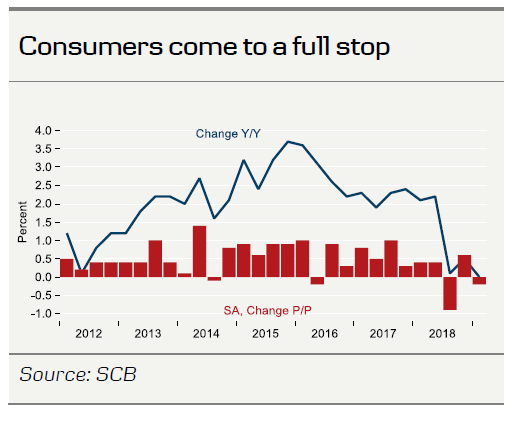
Underneath the surface. We argue that demand was undoubtedly on the soft side of what we thought, For instance, consumer spending fell (0.2%) from Q4; the same was the case for fixed investments (down 0.4% q/q). In both cases, we were looking for small increases. Exports came in somewhat on the high side of our estimate but the big reason for higher GDP was a considerably softer number for imports, which slumped (down 0.7%). Overall, this is a weak GDP report from a domestic demand perspective and this is reflected in a steep decline in imports, so while exports held up reasonably well, the result is an OK GDP number.
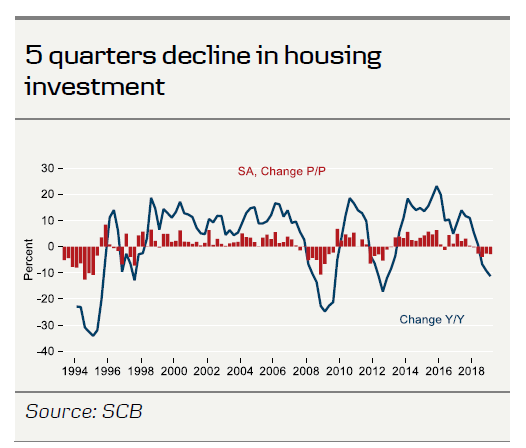
Other observations. (1) Consumer spending is remarkably weak registering a quarteron- quarter decline and being flat in year-on-year terms. Spending held up well until Q2 18 but then something happened. Then again, considering that consumer confidence has been surprisingly weak of late (yesterday's number was a multi-year low), maybe this is not so strange after all. (2) The fixed investment cycle has no doubt peaked. Part of that story relates to housing construction, which on a quarterly basis registered the fifth consecutive decline. The year-on-year rate in Q1 was -11.3% (the peak was +23.2% in Q4 15).
Riksbank. The GDP figure was higher than the Riksbank forecast of 1.7% but we feel sure that it will make a similar analysis to us. Domestic demand is weakening markedly and this is why import demand has slumped. We would say that to the extent the Riksbank has had some concerns about downside growth risk, it should be more worried now.
SEK. For the SEK, this is not a game changer, in our view. The knee-jerk reaction was to send the cross to 10.65ish, but given the details, it is fair that the move reversed to pre-data levels. As it was mainly net exports that surprised, one could think that it is an SEK effect. However, given that it was due to weaker services imports and weaker goods exports, we are not so sure about this.