

Sample Category Title
Sunset Market Commentary
Markets
Global core bonds gained ground today with US Treasuries outperforming German Bunds. Risk sentiment was again fragile this morning as hopes of a US-Sino trade agreement are fading by the day. Both sides are raising the stakes by searching for alternative ways to take action. Risk-off prevailed on global markets, with equities falling at the EU opening bell and core bonds finding new support. The eco calendar was of second-tier importance and printed too close to expectations to have a real impact. German Bunds traded in a tight range with a cautious upward bias. Italian BTP’s erased opening losses as the country’s (consumer and manufacturing) confidence both beat expectations. However, later on the day the EU confirmed that Italy is at risk of disciplinary measures. BTP’s lost again some ground. The German yield curve is moving lower with changes in the range of -0.1 bp (5-yr) to -1.3 bps (30-yr). The upward move in US Treasuries was more convincing. US Secretary of State Pompeo said the US “may or may not get a deal” with China, but remains very convinced that the US economy will continue to grow. At the time of writing, the US yield curve edges lower with yields losing up to -4.8 bps (2-yr). Peripheral spreads are tightening with Greece (-5 bps) outperforming.
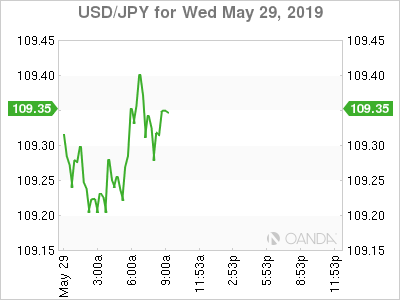
As was the case earlier this week, EMU and US eco data were only of second tier significance for FX trading. The focus was on the developing trade saga. Both the US and China are putting additional ammunition in place to be used if the trade dispute would escalate. In this respect, the US Treasury’s foreign exchange report yesterday didn’t label any of its trading partners as a currency manipulator (yet). However, the US sharpened the criteria for countries to be placed on its ‘watchlist’. This move, combined with other recent decisions/communication suggest that the US wants a weaker currency and that it is prepared to take action if necessary. Of late the US currency lost significant interest rate support against most other majors as markets anticipate substantial Fed rate cuts further out. For now, this doesn’t hurt the dollar much as confidence in the likes of the euro remains fragile, too (e.g. due to uncertainty on Italy). Still the topic, on ‘what kind of strong dollar the US wants’, especially in case of less favorable eco conditions, will probably return to the spotlights in a not too distance future. For now, EUR/USD hovers in the mid 1.1150 area, within reach of the key 1.11 support. USD/JPY is changing hands in the 109.30 area.
No important UK data or major developments in the Brexit occurred today. Sterling is still trading within reach of recent lows against the euro and the dollar. EUR/GBP is changing hands in the low 0.88 area. The 0.88840 resistance survived again. Cable hovers in the low-to-mid 1.26 area.
News Headlines
Swedish GDP grew a stronger than expected 0.6% QoQ (2.1% YoY) during the first quarter of 2019. However, growth composition was disappointing. Exports were boosted but private investments declined and households even cut back on spending. The Swedish krona briefly strengthened but came back on its steps soon afterwards.
An EU official confirmed that the European Commission has sent a letter to Italy, stipulating the country has not made enough progress in reducing the budget deficit and debt level. Italy now has until May 31 to provide explanations which the EC will take into consideration in its assessment.
(BOC) Bank of Canada maintains overnight rate target at 1 ¾ per cent
The Bank of Canada today maintained its target for the overnight rate at 1 ¾ per cent. The Bank Rate is correspondingly 2 per cent and the deposit rate is 1 ½ per cent.
Recent Canadian economic data are in line with the projections in the Bank's April Monetary Policy Report (MPR), with accumulating evidence that the slowdown in late 2018 and early 2019 is being followed by a pickup starting in the second quarter. The oil sector is beginning to recover as production increases and prices remain above recent lows. Meanwhile, housing market indicators point to a more stable national market, albeit with continued weakness in some regions.
Continued strong job growth suggests that businesses see the weakness in the past two quarters as temporary. Recent data support a pickup in both consumer spending and exports in the second quarter, and it appears that overall growth in business investment has firmed. That said, inventories rose sharply in the first quarter, which may dampen production growth in coming months.
The global economy is also evolving largely as expected since April, although the recent escalation of trade conflicts is heightening uncertainty about economic prospects. In addition, trade restrictions introduced by China are having direct effects on Canadian exports. In contrast, the removal of steel and aluminum tariffs and increasing prospects for the ratification of CUSMA will have positive implications for Canadian exports and investment.
Inflation has evolved in line with the Bank's April projection. The Bank expects CPI inflation to remain around the 2 per cent target in the coming months. Core inflation measures all remain close to 2 per cent.
Overall, recent data have reinforced Governing Council's view that the slowdown in late 2018 and early 2019 was temporary, although global trade risks have increased. In this context, the degree of accommodation being provided by the current policy interest rate remains appropriate. In taking future policy decisions, Governing Council will remain data dependent and especially attentive to developments in household spending, oil markets and the global trade environment.
Information note
The next scheduled date for announcing the overnight rate target is July 10, 2019. The next full update of the Bank's outlook for the economy and inflation, including risks to the projection, will be published in the MPR at the same time.
Copper Outlook: Bears Accelerate on Fresh Threats of Escalation of Trade War
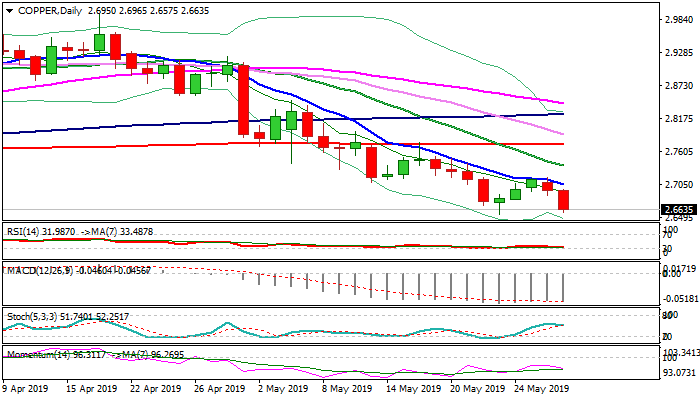
Copper price slumped on Wednesday (down 1.43% since Asian opening and ahead of US session). The metal extends weakness into second straight day on threats of escalation of US/China trade conflict that would hurt economic growth and reduced demand. Fresh negative signals on China's threats to use rare earth minerals as a reaction in trade war pushed metal's price sharply lower. In the situation that the US is imposing tariffs and China retaliates by signals of possible ban on the export of rare earths, there are little chances for any upside action, but rather turning focus fully to the downside. Fresh weakness that emerged after falling 10SMA capped recovery, is on track to fully retrace three-day recovery from $2.6535 (23 May low, the lowest since mid-Jan), with break of $2.6535 pivot to open strong support at $2.6251 (200WMA) and look for full retracement of $2.5420/2.9933 (3 Jan / 17 Apr rally). Firmly bearish daily studies add to negative sentiment on bearish fundamentals, Falling 10SMA ($2.7048) continues to track the downtrend and marks solid resistance which is expected to cap potential upticks.
Res: 2.6870; 2.6965; 2.7046; 2.7155
Sup: 2.6575; 2.6535; 2.6251; 2.6155
EUR/USD Mid-Day Outlook
Daily Pivots: (S1) 1.1146; (P) 1.1173; (R1) 1.1186; More.....
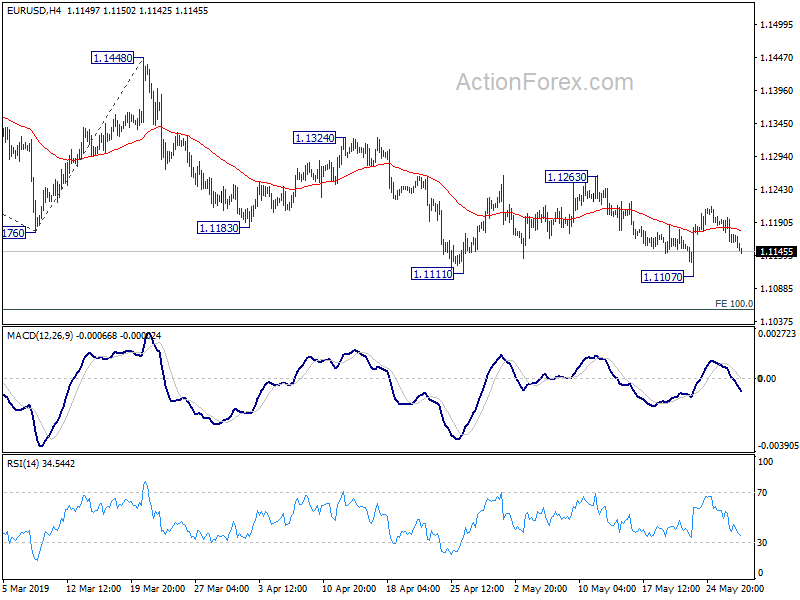
EUR/USD is staying in consolidation from 1.1111 despite today's decline. Intraday bias stays neutral first. In case of another rise, upside should be limited by 1.1263 resistance to bring down trend resumption. On the downside, firm break of 1.1107 will target 100% projection of 1.1448 to 1.1183 from 1.1324 at 1.1059. However, sustained break of 1.1263 resistance will now be an early sign of trend reversal and turn bias to the upside for 1.1448 key resistance.
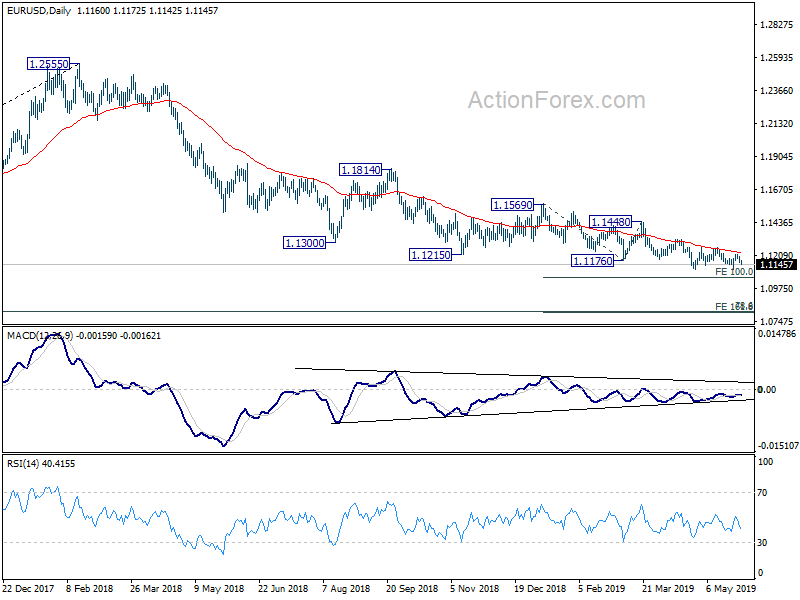
In the bigger picture, down trend from 1.2555 (2018 high) is still in progress. Such decline would target 78.6% retracement of 1.0339 (2016 low) to 1.2555 (2018 high) at 1.0813 next. Sustained break there will pave the way to retest 1.0339. On the upside, break of 1.1448 resistance is needed to be the first sign of medium term bottoming. Otherwise, outlook will stay bearish in case of rebound.
GBP/USD Mid-Day Outlook
Daily Pivots: (S1) 1.2634; (P) 1.2668; (R1) 1.2687; More....
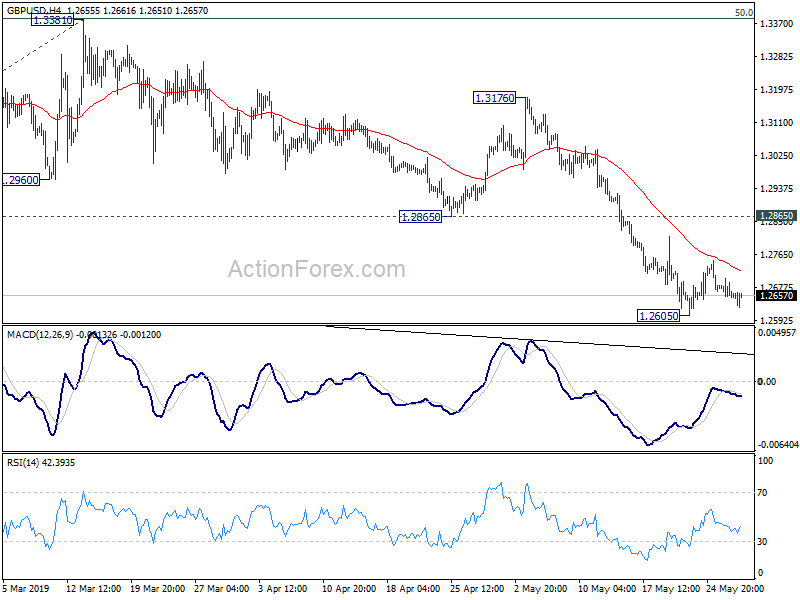
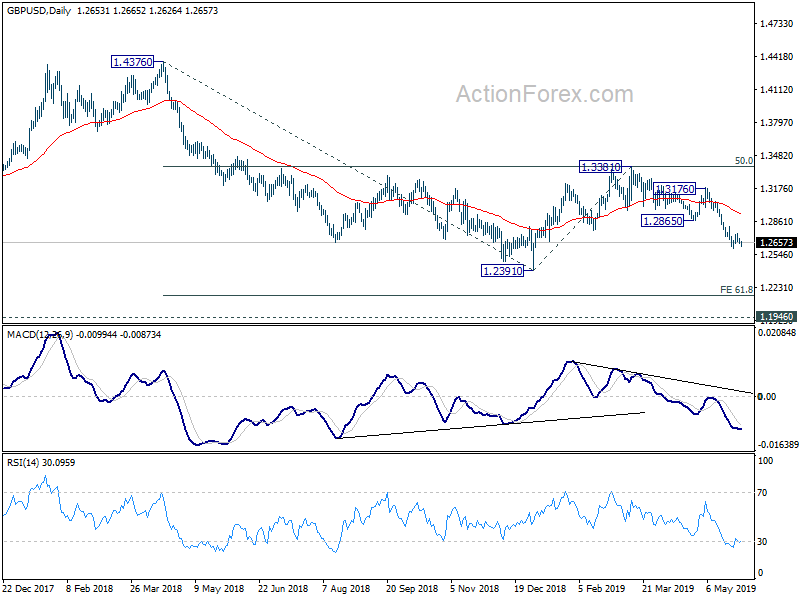
Intraday bias in GBP/USD remains neutral and consolidation from 1.2605 might extend. In case of another recovery, upside should be limited by 1.2865 support turned resistance to bring fall resumption. On the downside, break of 1.2605 will target a test on 1.2391 low first. Firm break there will resume larger down trend to 61.8% projection of 1.4376 to 1.2391 from 1.3381 at 1.2154 next.
In the bigger picture, current development suggests that medium term decline from 1.4376 (2018 high) is not completed, and is possibly ready to resume. Decisive break of 1.2391 would target a test on 1.1946 long term bottom (2016 low). For now, we don't expect a firm break there yet. Hence focus will be on bottoming signal as it approaches 1.1946. In any case, medium term outlook will stay bearish as long as 1.3381 resistance holds, in case of strong rebound.
USD/CHF Mid-Day Outlook
Daily Pivots: (S1) 1.0040; (P) 1.0070; (R1) 1.0106; More...
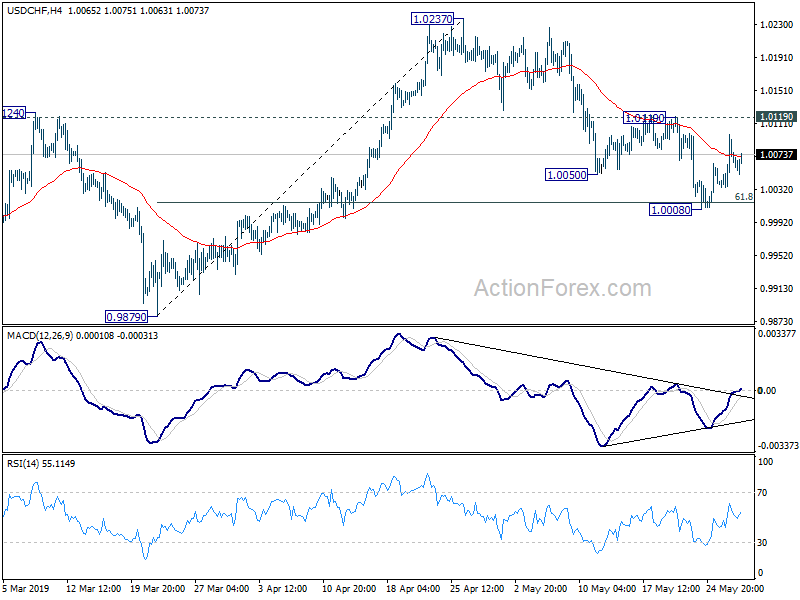
Intraday bias in USD/CHF remains neutral for the moment. On the upside, decisive break of 1.0119 resistance will suggest that decline from 1.0237 is merely a correction and has completed. Intraday bias will be turned back to the upside for retesting 1.0237. That will also retain medium term bullishness in the pair. On the downside, however, firm break of 1.0008 should pave the way to retest 0.9879 key support next.
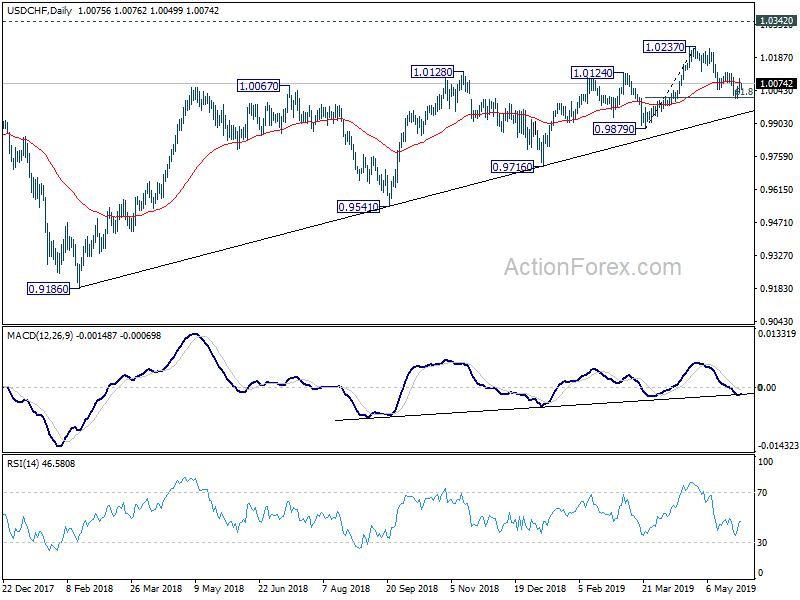
In the bigger picture, USD/CHF is losing upside momentum ahead of 1.0342 key resistance (2016 high). There is no clear sign of reversal yet. But even in case of another rise, we'd be cautious on strong resistance from 1.0342 to limit upside. On the downside, break of 0.9879 support will suggest that larger rise from 0.9186 (2018 low) has completed. Deeper fall will be seen to 0.9716 support for confirmation.
USDCHF Still Holds above Rising Trend Line
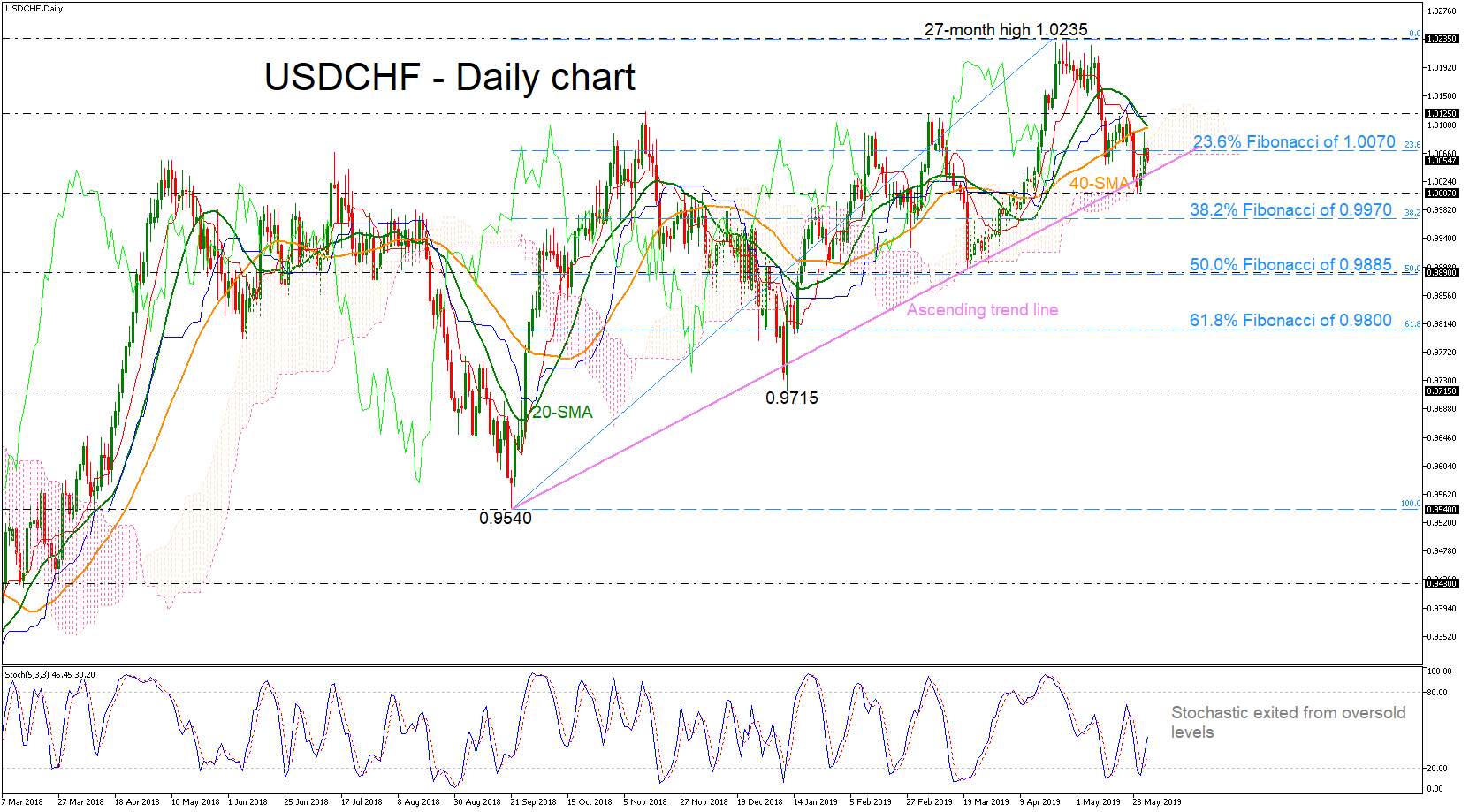
USDCHF rebounded on the 1.0007 support level in the preceding week, remaining above the ascending trend line, which has been holding since September 2018. The stochastic oscillator has come off from the negative level indicating positive movements despite the bearish cross within the 20- and 40-day moving averages near the current market action.
The pair entered the Ichimoku cloud but is moving lower today, edging towards the rising trend line and the 1.0007 barrier. Falling below the diagonal line, the risk would shift from the current bullish outlook in the medium-term to a neutral one, challenging the 38.2% Fibonacci of 0.9970.
If the pair gains some more positive momentum and surpasses the SMAs, immediate resistance is coming from the 1.0125 barrier. The next target for the bulls would be the 27-month high of 1.0235
In brief, USDCHF has been developing in an upside tendency over the last year and traders should continue positive orders until a significant violation of the ascending trend line.
Stocks Drop as Recessionary Pressures Build
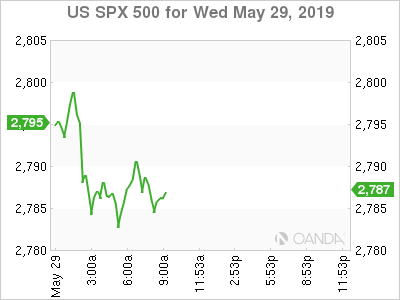
The global bond market rout continues as markets selloff as Chinese media claims Beijing is ready cut rare earths exports to the US. China has been handling roughly 80% of US imports of rare earths, a commodity that is needed in the automobile, electronics and defense sectors. It appears the financial markets are convinced the trade war is not going to yield anything promising anytime soon and new risks are emerging. If China does follow through on its rare export ban, the effect would cripple high tech manufacturing and disrupt earnings figures for many S&P 500 companies for several quarters. Chinese consumers may also boycott US goods and that would also be another catalyst for a drastic downgrade with earnings forecasts. Ten-year Treasury yields are lower by 4.0 basis points to 2.226%, just off the lowest levels since October 2017. US stocks are poised to open sharply lower, with the Nasdaq leading the way down with a 0.85% decline. Dow futures are 0.79% and the S&P 500 is lower by 0.68%
Fed
When will the Fed capitulate? The bond markets are taking the 10-year Treasury yield on a fast path to 2.0% and possibly below, while the Fed has remained consistent with their patient approach, but that should not last much longer. The data-dependent central bank should quickly pivot once the data turns ugly and we should start seeing that shortly. This week we will get a second glimpse at the US first quarter GDP reading, but the market may closer attention to see if the Core PCE reading stays steady at 1.3%. Since the US is slowly building a positive output gap, disinflationary pressures should win out and prove inflation is not transitory and allow the Fed to cut rates. We may see a downward revisions this week with PCE, but most likely we will need to see the second quarter GDP and Core PCE deteriorate to confirm the Fed’s capitulation.
USD/JPY Mid-Day Outlook
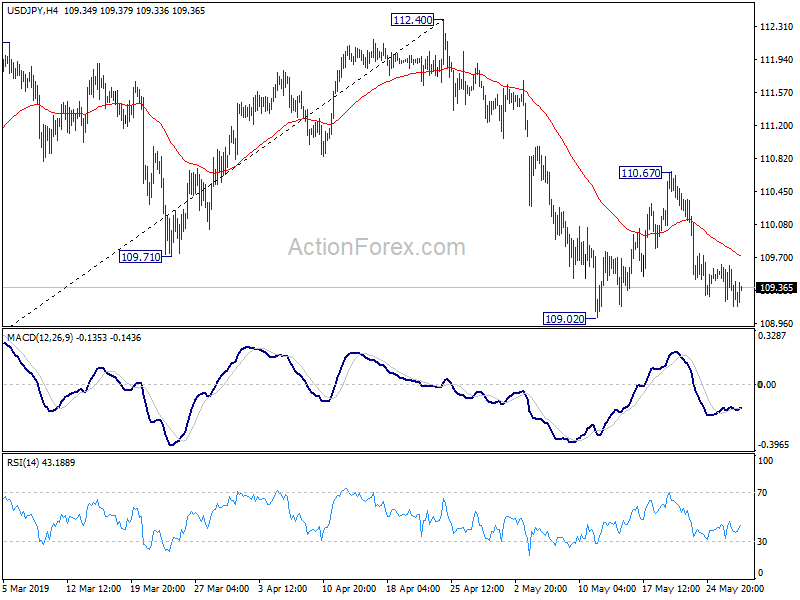
Daily Pivots: (S1) 109.17; (P) 109.40; (R1) 109.59; More...
USD/JPY stays soft today but it's held above 109.02 support. Intraday bias remains neutral at this point. Consolidation from 109.02 could still extend further. In case of another rise upside should be limited below 110.67 resistance to bring fall resumption eventually. On the downside, break of 109.02 will resume the fall from 112.40 and target 61.8% retracement of 104.69 to 112.40 at 107.63 next.
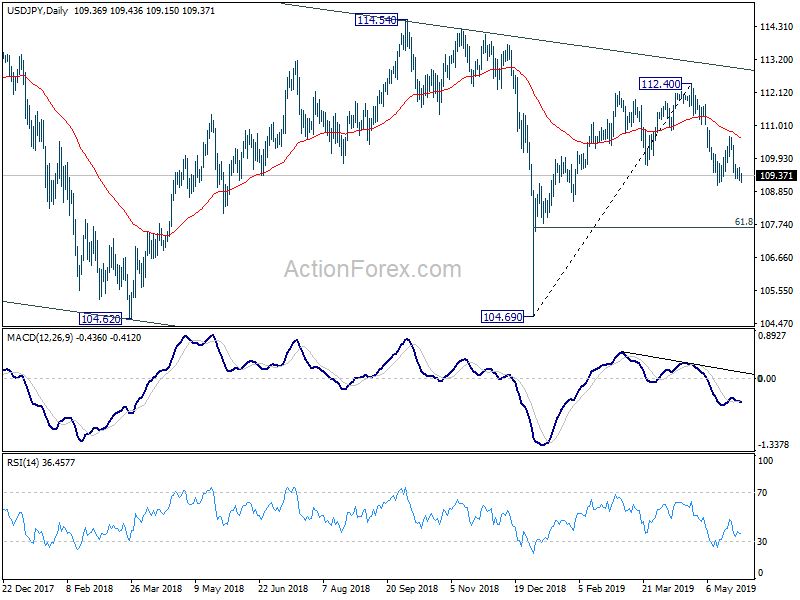
In the bigger picture, USD/JPY is staying inside falling channel from 118.65. Current development suggests that rebound from 104.69 is only a corrective move. And fall from 118.65 is not completed yet. Decisive break of 104.69 will extend the down trend towards 98.97 support (2016 low). For now, we'd expect strong support above there to bring rebound.
Risk Aversion Stays With Persisting Trade Worries, Franc and Yen Strong Again
Risk aversion stays in the global financial markets today but it's not in the most intense state yet. A trigger for selloff in stocks and decline in yield is China's threat to squeeze supply of rare earths to the US as part of a countermeasures in trade war. However, it's also widely know that Japan has discovered huge source of rare earths last year that could act as semi-unlimited supply to the whole world. Hence, the impact of China's move is highly doubtful. Though, it's for sure that US-China trade war is going to drag on longer, much longer.
In the currency markets, Swiss Franc and Yen are so far the strongest ones for today. In particular, more upside is in favor in both, following free fall in treasury yields. US 10-year yield has realistic chance of breaking 2.2 handle in the very near term. For now, Australian Dollar is the third strongest, rather unmoved by risk aversion. On the other hand, New Zealand Dollar is the weakest one. Euro follows as European Commission is said to have sent the formal warning letter to Italy on its budget deficit already. Canadian Dollar is mixed, awaiting BoC rate decision and statement.
Technically, EUR/JPY and GBP/JPY are both extending recent decline. It's now time for USD/JPY to follow with a break through 109.02 support. USD/CAD's rally attempt is limited by 1.3521 resistance so far. This level will be closely watched to confirm up trend resumption.
In Europe, currently, FTSE is down -1.56%. DAX is down -1.49%. CAC is down -1.95%. German 10-year yield is down -0.004 at -0162. Earlier in Asia, Nikkei dropped -1.21%. Hong Kong HSI dropped -0.57%. China Shanghai SSE rose 0.16%. Singapore Strait Times dropped -0.06%. Japan 10-year JGB yield dropped -0.0229 to -0.094.
ECB Rehn: Central scenario is not recession despite soft patch in economy
ECB Governing Council member Olli Rehn told Reuters today that the "central scenario is not a recession," despite the "soft patch in the economy." Though, he reiterated the unified message that an ample degree of stimulus is still appropriate for now. Policymakers are going to wait for the new economic forecasts, to be released next week, before debating on adjusting monetary policies.
Regarding the policy framework, Rehn said the definite of price stability should be loosened. Currently ECB sees inflation target as being close to 2%, below 2%. But Rehn said "My view is that 2% is not a ceiling and inflation can deviate in both directions."
Italian Deputy Prime Minister Matteo Salvini called for a new role for ECB to "guarantee" government debt in order to keep bond yields low. Rehn bluntly responded saying it goes against the principal of modern central banking that we are forbidden to do monetary financing."
ECB: Growth outlook central to all main risks to financial stability
ECB warned in the Financial Stability Review that "uncertainty about global economic growth prospects has contributed to bouts of high volatility in financial markets". And, "weaker than expected growth and a possible escalation of trade tensions could trigger further falls in asset prices".
The report noted that materialization of downside risks to economic growth could spark greater financial market volatility. Persistent downside risks to growth reinforce the need to strengthen balance sheets of highly indebted firms and governments . Bank profitability prospects are subdued given slow progress in addressing structural issues
ECB Vice President Luis de Guindos said in the statement, "if downside risks to the growth outlook were to materialize, risks to financial stability may arise. And "the growth outlook is central to all the main risks to financial stability."
Swiss KOF dropped to 94.4, economy developing rather sluggishly
Swiss KOF Economic Barometer dropped to 94.4 in May, down from 96.2 and missed expectation of 96.2. The reading dived further below its long-term average. KOF noted "Swiss economy is developing rather sluggishly." And, majority of sets of indicators are tending downwards.
The indicators for banking and insurance, consumption and foreign demand have developed negatively. The prospects for accommodation and food service activities and the other service providers have become gloomier. In the manufacturing sector, the outlook hardly changed compared to the previous month. For the construction sector, the outlook has improved.
France Q1 GDP growth confirmed at 0.3%, exports growth decelerated sharply
France GDP grew 0.3% qoq in Q1, unrevised from first estimate. Looking at the details, Households disposable income rose 0.9%. However, household consumption expenditure just grew 0.4%. Total gross fixed capital formation slowed down a bit to 0.5%. Overall, final domestic demand excluding inventory changes kept increasing at the same pace. Imports jumped 1.4% due to fuel. Exports growth decelerated sharply to 0.4%, down from 2.0%. Foreign trade balance contributed negatively to GDP growth: -0.3%.
From Germany, unemployment rose 60k in May versus expectation of -8k. Unemployment rate rose 0.1% to 5.0%, above expectation of 4.9%.
BoJ Kuroda: Best to manage inflation expectations with flexible targeting framework
In academic conference organized by BoJ, Governor Haruhiko Kuroda expressed his openness to flexible inflation targeting. Former ECB President Jean-Claude Trichet also emphasized that medium- to long-term inflation expectations are what really matter.
Kuroda said "If missing inflation comes from structural factors such as globalization and digitalization, central banks should continue examining how best to manage inflation expectations .. within the flexible inflation targeting framework." He also noted the need to expand the policy tools to fight the next downturn. "While policy makers have developed a wide range of unconventional policy tools, their effectiveness and transmission mechanisms may differ depending on financial conditions and economic structure," Kuroda said.
Trichet also said it's not necessary for central banks to target exactly the same level of inflation in a set period of time. Instead, "there is a consensus among central banks that real success is to solidly anchor inflation expectations in the medium- to long-term in line with their definition of price stability."
New Zealand ANZ business confidence improved to -32.0
New Zealand ANZ Business Confidence rose to -32.0 in May, up from -37.5. But all sectors remained deeply negative, with agriculture confidence worst at -63.9. Activity Outlook also improved to 8.5, up from 7.1. Manufacturing scored best in activity at 21.5.
ANZ noted that "how quickly the economy will bounce back is a key question. If the forward indicators start to suggest that the Reserve Bank's relatively sharp V-shaped recovery is overly optimistic, it will be game on for further OCR cuts this year."
USD/JPY Mid-Day Outlook
Daily Pivots: (S1) 109.17; (P) 109.40; (R1) 109.59; More...
USD/JPY stays soft today but it's held above 109.02 support. Intraday bias remains neutral at this point. Consolidation from 109.02 could still extend further. In case of another rise upside should be limited below 110.67 resistance to bring fall resumption eventually. On the downside, break of 109.02 will resume the fall from 112.40 and target 61.8% retracement of 104.69 to 112.40 at 107.63 next.
In the bigger picture, USD/JPY is staying inside falling channel from 118.65. Current development suggests that rebound from 104.69 is only a corrective move. And fall from 118.65 is not completed yet. Decisive break of 104.69 will extend the down trend towards 98.97 support (2016 low). For now, we'd expect strong support above there to bring rebound.
Economic Indicators Update
| GMT | Ccy | Events | Actual | Forecast | Previous | Revised |
|---|---|---|---|---|---|---|
| 21:00 | NZD | RBNZ Financial Stability Report | ||||
| 23:01 | GBP | BRC Shop Price Index Y/Y May | 0.80% | 0.40% | ||
| 1:00 | NZD | ANZ Business Confidence May | -32 | -37.5 | ||
| 6:45 | EUR | French GDP Q/Q Q1 F | 0.30% | 0.30% | 0.30% | |
| 7:00 | CHF | KOF Economic Barometer May | 94.4 | 96.2 | 96.2 | |
| 7:55 | EUR | German Unemployment Change (000's) May | 60K | -8K | -12K | |
| 7:55 | EUR | German Unemployment Claims Rate May | 5.00% | 4.90% | 4.90% | |
| 8:00 | EUR | ECB Financial Stability Review | ||||
| 14:00 | CAD | BoC Rate Decision | 1.75% | 1.75% |