Sample Category Title
USD/CAD Daily Outlook
Daily Pivots: (S1) 1.3385; (P) 1.3414; (R1) 1.3433; More...
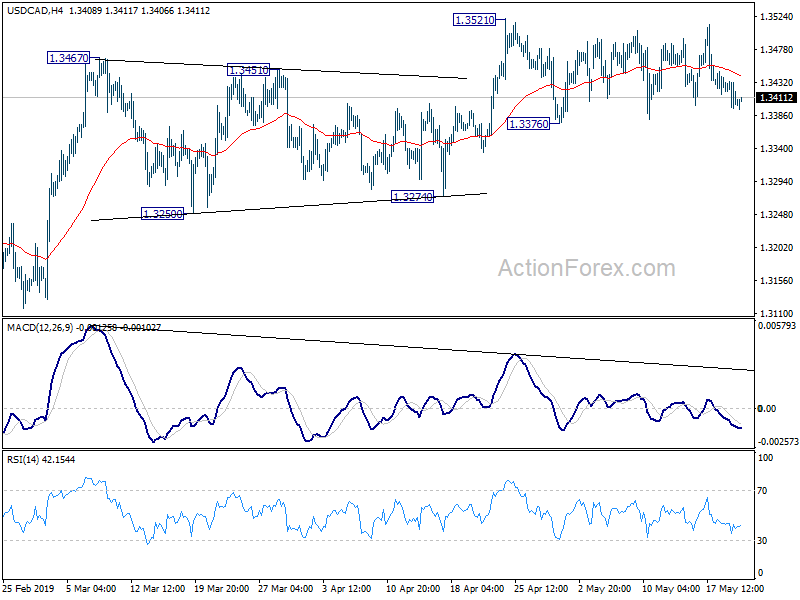
USD/CAD is staying in consolidation from 1.3521 and intraday bias remains neutral first. Such consolidation could extend with deeper fall. But downside should be contained above 1.3274 support to bring rally resumption. On the upside, firm break of 1.3521 will resume the whole rise from 1.3068 to retest 1.3664 high. However, decisive break of 1.3274 support will indicate completion of rise from 1.3068 and turn outlook bearish.
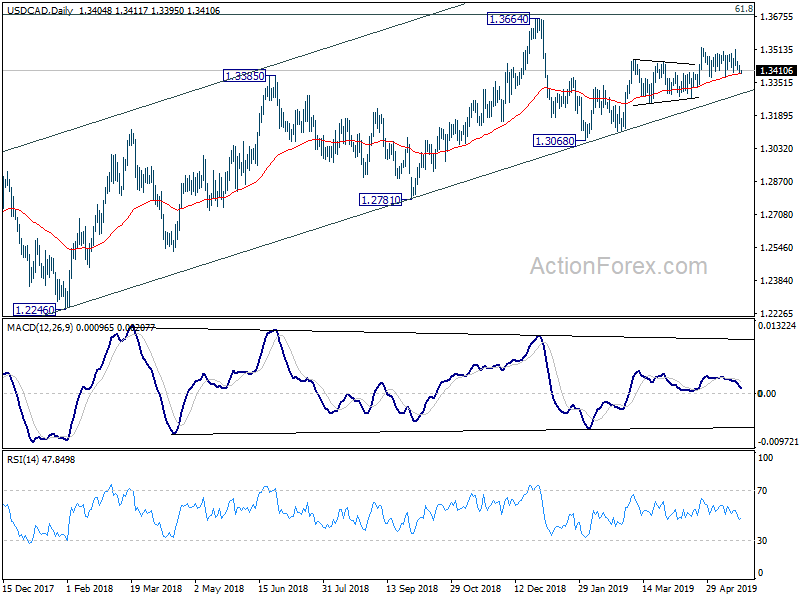
In the bigger picture, USD/CAD is staying well inside medium term rising channel (support at 1.3296). Thus, the up trend from 1.2061 (2017 low) should be in progress. On the upside, decisive break of 61.8% retracement of 1.4689 (2016 high) to 1.2061 at 1.3685 will pave the way to 78.6% retracement at 1.4127 next. This will remain the favored case as long as 1.3068 support holds. However, sustained break the channel support will be the first sign of medium term reversal. Firm break of 1.3068 would confirm.
Markets Mixed as Brexit and Trade War Remain Unresolved
Direction isn't very clear in the financial markets today as they're generally in consolidative mode. Sterling was lifted briefly overnight by UK Prime Minister Theresa May's new Brexit plan. But it was quickly back to square one after the plan was overwhelmingly rejected by MPs. For now, Canadian Dollar is so far the strongest one for the week but it has yet to break out from recent range against Dollar. Australia Dollar had a roller-coaster ride but stays above 0.6864 temporary low against Dollar. Yen pulled back mildly this week but there is no follow through selling, except versus Dollar. Though, the greenback also struggles to extend gains against Euro.
Stocks are also in consolidation mode on trade war concerns. The move to suspend Huawei ban gave sentiments a brief lift only. After all, there is no sign of a breakthrough in trade talks and we're not expecting Trump nor Xi to back down on their stance. Despite yesterday's near 200pts recovery, DOW is staying below 55 day EMA while keep risks on the downside. China Shanghai SSE is also flip-flopping around 2900 handle.
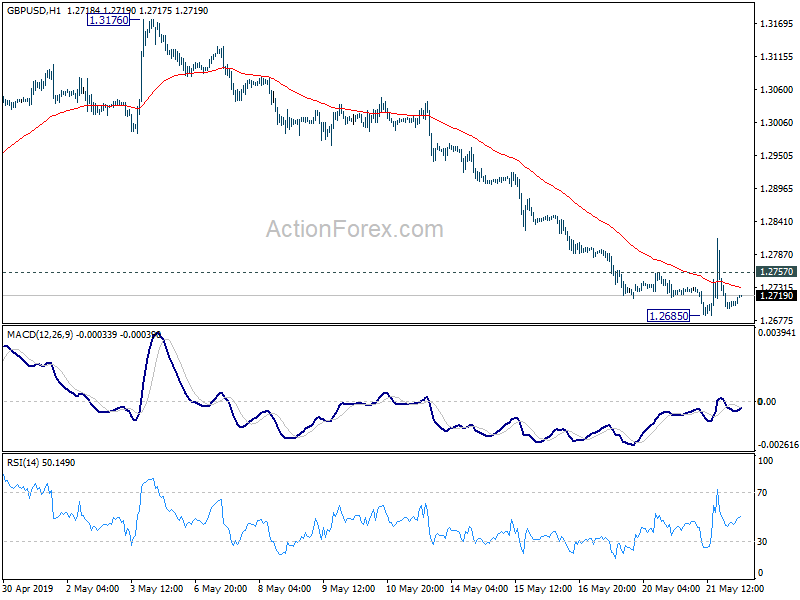
Technically, after yesterday's brief spike, focus is back on 1.2685 temporary low in GBP/USD and 0.8789 temporary top in EUR/GBP. Break will resume recent selloff in Sterling. AUD/USD is still eyeing 0.6864 temporary low for decline resumption. A focus today is on whether Canadian retail sales can push USD/CAD outlook of range of 1.3376/3521.
In Asia, currently, Nikkei is up 0.12%. Hong Kong HSI is up 0.17%. China Shanghai SSE is down -0.43%. Singapore Strait Times is up 0.22%. Japan 10-year JGB yield is down -0.0053 at -0.05. Overnight, DOW rose 0.77%. S&P 500 rose 0.85%. NASDAQ rose 1.08%. 10-year yield rose 0.010 to 2.426.
40% US manufacturers moving out of China on trade war, only 6% back to US
American Chamber of Commerce in Shanghai and China carried a joint survey on the impact of US-China tariffs. Results showed that the negative impact of tariffs is clear and hurting the competitiveness of American companies in China. 74.9% os respondents said the tariffs hikes are having a negative impact to their business. Among them, manufacturers suffered most with 81.5% for US tariffs and 85.2% for Chinese tariffs. Impacts include lower demand (52.1%), higher manufacturing costs (42.4%) and higher sales prices (38.2%).
Also, companies are increasingly adopting an "In China, for China" strategy (35.3%), or delaying and canceling investment decisions (33.2%). However, 40.7% are considering or have relocated manufacturing facilities outside China. For those moving, Southeast Asia (24.7%) and Mexico (10.5%) are the top destinations. Only 6% said they're relocating back to the US.
On non-tariff measures, 20.1% said there were "increased inspections" in China, and "slower customs clearance (19.7%). 14.2% said there was " slower license approvals and 14.2% said there were increased regulatory scrutiny. But 53.1% said there was no increase in non-tariff retaliatory measures by the Chinese government.
Fed Rosengren: No clear need to alter slightly accommodative interest rates
Boston Fed President Eric Rosengren said in a speech that "today, the two elements of the Fed's mandate are sending opposing signals for monetary policy". That is, low unemployment suggests "a bit tighter policy" while low inflation "the opposite". But there is "no clarion call" to alter current policy in near term. He viewed current policy as "slightly accommodative" consistent with lifting inflation back to target over time. He added "the Fed can afford to wait to see if that forecast does indeed materialize."
On the economy, Rosengren is relatively optimistic and he expects unemployment rate to fall further. He noted that the significant decline in equity markets in Q4 has largely recovered. Worries over Brexit and China slowdown "appear to have subsided since the beginning of the year". Also, Q1 growth in US was "stronger than many forecasters expected".
On trade, he said "I am optimistically assuming that both sides in the trade negotiations will work to reach an agreement". And, "I am also assuming that while the uncertainty is not helpful, it will be transitory, and thus have only a modest effect on the forecast for the U.S. economy overall."
May's new Brexit plan received terrible responses
Sterling was lifted briefly by UK Prime Minister Theresa May's "new" Brexit plan. But recovery in Pound quickly faded as the plan was terribly received by MPs across the House. In short, under the new 10-point plan, the most important part is guaranteeing a vote on whether to call a second referendum on the Brexit deal. However, the pre-condition for the vote on referendum is the passage of the Brexit deal itself in the Commons.
Labour leader Jeremy Corbyn was quick to reject the proposal as "largely a rehash" and pledged "we won't back a repackaged version of the same old deal". Former foreign minister Boris Johnson and ex Brexit minister Dominic Raab said they'd oppose the deal. Pro-Brexit Cabinet ministers including Michael Gove, Andrea Leadsom and Chris Grayling opposed the idea of a "free vote". Northern Ireland's Democratic Unionist Party was concerned that "fatal flaws" of the original Brexit deal remained, which could split Northern Ireland with the rest of UK.
Despite the desperate final gamble, there is still practically no chance for May to get her Brexit deal through Commons in the June. A fourth humiliating defeat is more likely than not.
BoJ Harada: If weak economy deteriorates, should strengthen easing without delay
BoJ dove Yutaka Harada said today that "the economy has been weak recently, and the same can be said about prices". Also, "there's a risk the current sluggishness observed in prices will spill over to inflation expectations, further delaying a pick-up in inflation." In addition, "the impact of the consumption tax hike scheduled for October this year also is a concern."
Harada warned "if the economy deteriorates to the extent that achieving our price target in the long-term becomes difficult, it's necessary to strengthen monetary easing without delay." He also dismiss claims that the ultra-loose monetary policy hurts banks' profits. He said "the deterioration of banks' profitability is actually caused by a structural problem, which is that they are accumulating deposits despite a lack of borrowers."
Released from Japan, trade surplus narrowed to JPY 60.4B in April. Exports dropped -2.4% yoy while imports rose 6.4% yoy. In seasonally adjusted terms, trade deficit narrowed to JPY -110.9B.Exports rose 0.6% while imports dropped -0.1%. Machine orders rose 3.8% mom in March, above expectation of 0.0% yoy.
Also released, New Zealand retail sales rose 0.7% qoq in Q1 versus expectation of 0.6% qoq. Core retail sales rose 0.7% qoq versus expectation of 0.9% qoq. Austalia Westpac leading index dropped -0.1% mom in April. Construction work done dropped sharply by -1.9% in Q1.
Looking ahead
UK inflation data will be the main focus in European session, with CPI, PPI and house price index featrued. Public sector net borrowing will also be be featured. Later in the day, Canada retail sales will be a focus and let's see if it can trigger a range breakout in USD/CAD. FOMC minutes will also be a focus. Fed Chair Jerome Powell talked down the chance of a rate cut after last meeting. Recent comments from Fed officials also suggest that there is no case for a cut yet. The minutes will likely echo these views.
USD/CAD Daily Outlook
Daily Pivots: (S1) 1.3385; (P) 1.3414; (R1) 1.3433; More...
USD/CAD is staying in consolidation from 1.3521 and intraday bias remains neutral first. Such consolidation could extend with deeper fall. But downside should be contained above 1.3274 support to bring rally resumption. On the upside, firm break of 1.3521 will resume the whole rise from 1.3068 to retest 1.3664 high. However, decisive break of 1.3274 support will indicate completion of rise from 1.3068 and turn outlook bearish.
In the bigger picture, USD/CAD is staying well inside medium term rising channel (support at 1.3296). Thus, the up trend from 1.2061 (2017 low) should be in progress. On the upside, decisive break of 61.8% retracement of 1.4689 (2016 high) to 1.2061 at 1.3685 will pave the way to 78.6% retracement at 1.4127 next. This will remain the favored case as long as 1.3068 support holds. However, sustained break the channel support will be the first sign of medium term reversal. Firm break of 1.3068 would confirm.
Economic Indicators Update
| GMT | Ccy | Events | Actual | Forecast | Previous | Revised |
|---|---|---|---|---|---|---|
| 22:45 | NZD | Retail Sales Ex Inflation Q/Q Q1 | 0.70% | 0.60% | 1.70% | |
| 22:45 | NZD | Retail Sales Core Q/Q Q1 | 0.70% | 0.90% | 2.00% | |
| 23:50 | JPY | Trade Balance (JPY) Apr | -0.11T | -0.12T | -0.18T | |
| 23:50 | JPY | Machine Orders M/M Mar | 3.80% | 0.00% | 1.80% | |
| 00:30 | AUD | Westpac Leading Index M/M Apr | -0.10% | 0.20% | 0.30% | |
| 01:30 | AUD | Construction Work Done Q1 | -1.90% | 0.00% | -3.10% | -2.10% |
| 08:30 | GBP | CPI M/M Apr | 0.70% | 0.20% | ||
| 08:30 | GBP | CPI Y/Y Apr | 2.20% | 1.90% | ||
| 08:30 | GBP | Core CPI Y/Y Apr | 1.90% | 1.80% | ||
| 08:30 | GBP | RPI M/M Apr | 0.90% | 0.00% | ||
| 08:30 | GBP | RPI Y/Y Apr | 2.80% | 2.40% | ||
| 08:30 | GBP | PPI Input M/M Apr | 1.20% | -0.20% | ||
| 08:30 | GBP | PPI Input Y/Y Apr | 4.40% | 3.70% | ||
| 08:30 | GBP | PPI Output M/M Apr | 0.30% | 0.30% | ||
| 08:30 | GBP | PPI Output Y/Y Apr | 2.30% | 2.40% | ||
| 08:30 | GBP | PPI Output Core M/M Apr | 0.20% | 0.00% | ||
| 08:30 | GBP | PPI Output Core Y/Y Apr | 2.20% | 2.20% | ||
| 08:30 | GBP | House Price Index Y/Y Mar | 1.00% | 0.60% | ||
| 08:30 | GBP | Public Sector Net Borrowing (GBP) Apr | 5.1b | 0.8b | ||
| 12:30 | CAD | Retail Sales M/M Mar | 1.00% | 0.80% | ||
| 12:30 | CAD | Retail Sales Ex Auto M/M Mar | 0.80% | 0.60% | ||
| 14:30 | USD | Crude Oil Inventories | 5.4M | |||
| 18:00 | USD | FOMC Minutes May |
BoJ Harada: If weak economy deteriorates, should strengthen easing without delay
BoJ dove Yutaka Harada said today that "the economy has been weak recently, and the same can be said about prices". Also, "there's a risk the current sluggishness observed in prices will spill over to inflation expectations, further delaying a pick-up in inflation." In addition, "the impact of the consumption tax hike scheduled for October this year also is a concern."
Harada warned "if the economy deteriorates to the extent that achieving our price target in the long-term becomes difficult, it's necessary to strengthen monetary easing without delay." He also dismiss claims that the ultra-loose monetary policy hurts banks' profits. He said "the deterioration of banks' profitability is actually caused by a structural problem, which is that they are accumulating deposits despite a lack of borrowers."
Released from Japan, trade surplus narrowed to JPY 60.4B in April. Exports dropped -2.4% yoy while imports rose 6.4% yoy. In seasonally adjusted terms, trade deficit narrowed to JPY -110.9B.Exports rose 0.6% while imports dropped -0.1%. Machine orders rose 3.8% mom in March, above expectation of 0.0% yo.
EUR/USD Declining While USD/JPY Gathering Momentum
EUR/USD started a strong downward move from well above the 1.1250 level. USD/JPY is currently moving higher and it could continue to rise towards the 110.80 level.
Important Takeaways for EUR/USD and USD/JPY
- The Euro failed to stay above the 1.1250 level and declined below the 1.1200 support area.
- There is a key bearish trend line in place with resistance near 1.1170 on the hourly chart of EUR/USD.
- USD/JPY started a strong upward move above the 110.00 and 110.20 resistance levels.
- There is a major bullish trend line formed with support near 110.30 on the hourly chart.
EUR/USD Technical Analysis
The Euro started a strong downward move after it failed to gain pace above 1.1260 against the US Dollar. The EUR/USD pair declined heavily and broke many supports such as 1.1240, 1.1220 and 1.1200.
The pair even broke the 1.1180 support level and the 50 hourly simple moving average. It traded as low as 1.1141 on FXOpen and started an upside correction. It moved above the 1.1160 level and the 23.6% Fib retracement level of the recent decline from the 1.1223 high to 1.1141 low.
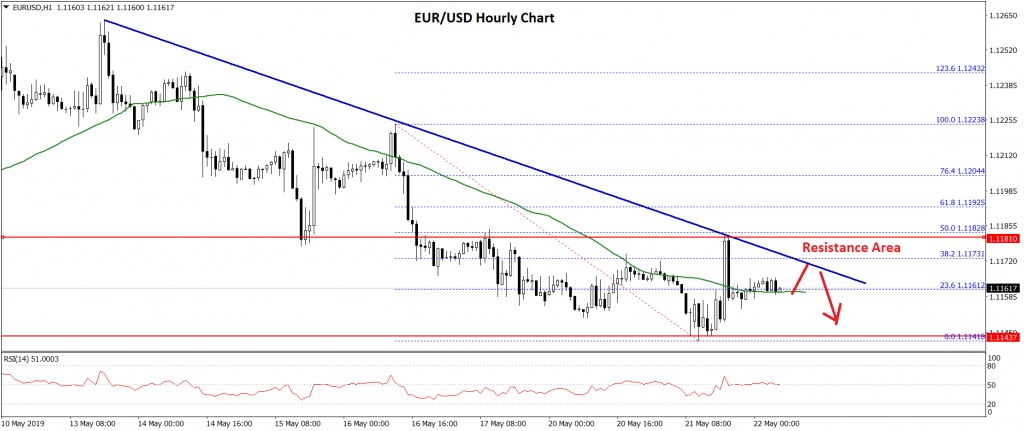
On the upside, there are many hurdles for the bulls near the 1.1170 and 1.1180 levels. There is also a key bearish trend line in place with resistance near 1.1170 on the hourly chart of EUR/USD.
The pair was recently rejected near the trend line and the 50% Fib retracement level of the recent decline from the 1.1223 high to 1.1141 low.
A proper close above the trend line could open the doors for more gains above the 1.1200 resistance level in the near term. The next key resistances are near the 1.1220 and 1.1240 levels.
On the downside, an initial support is near the 1.1150 level. If there is a downside break below the 1.1150 support, there are chances of more losses below the 1.1140 and 1.1120 levels.
USD/JPY Technical Analysis
The US Dollar formed a strong support base near the 109.00 level against the Japanese Yen. The USD/JPY pair started a steady rise and climbed above the 109.80 and 110.00 resistance levels.
There was a proper close above the 110.00 level and the 50 hourly simple moving average. The pair recently gained pace above the 110.40 level and traded as high as 110.67.
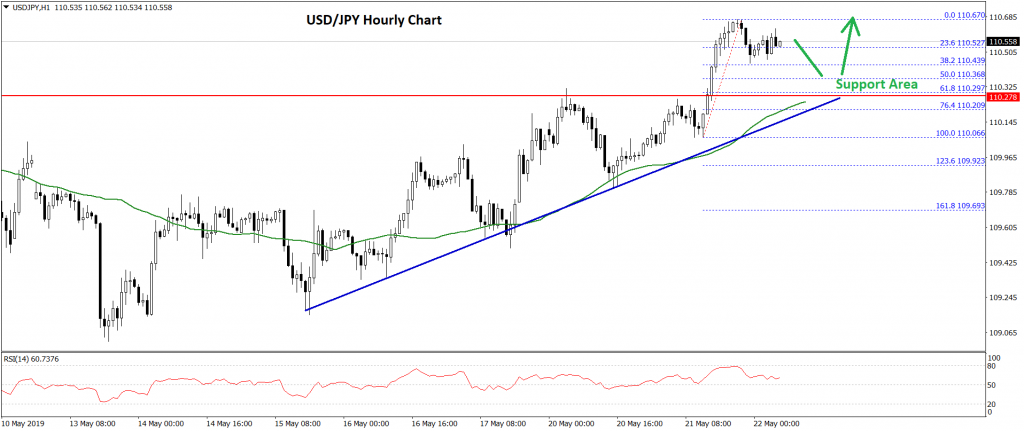
It is currently correcting lower below the 110.50 level and the 23.6% Fib retracement level of the recent wave from the 110.06 low to 110.67 high.
However, there are many supports on the downside near the 110.35 and 110.20 levels. The 50% Fib retracement level of the recent wave from the 110.06 low to 110.67 high is also near the 110.38 level to act as a support.
Moreover, there is a major bullish trend line formed with support near 110.30 on the hourly chart. If there is a downside break below the 110.20 level, the pair could continue to decline.
An immediate support below 110.20 is at 110.00, below which the pair may perhaps trade below the 109.80 level in the near term.
On the upside, an initial resistance is near the 110.65 level, above which USD/JPY could continue to move higher. If there is a break above 110.65 and 110.80, there could be a push above 111.00.
Market Morning Briefing: Aussie Has Fallen Below 0.69
STOCKS
The US relaxing some restriction on the Chinese firm Huawei has given some breather to the global equities. The Dow and DAX have recovered after its fall on Monday. Asians are also trading in green. In India, the Sensex and Nifty has supports near current levels which has to hold in order to avoid further profit taking ahead of the election results tomorrow.
Contrary to our expectation for a fall Dow (25,877.33 +197.43 +0.77%) has bounced yesterday. The key near-term resistance at 26000 can be tested which if broken can take the index further highe to 26250 in the short term.
DAX (12,143.47 +102.18 +0.85%) looks mixed in the near term. It has equal chances for either a rise to 12200-12250 or fall to 12000 in the near term. However, from a medium-term perspective while the DAX remains above 12000, the outlook is positive for a rally to 12400.
Nikkei (21354.17, +81.72, +0.38%) has bounced above 21250 again. It can test 21500 and 21750 in the coming days while it remains above 21250.
Shanghai (2902, -3.86, -0.13%) is retaining its 2850-2950 sideways range. A rise to 2950 -the upper end of the range is likely in the near term.
Sensex (38969.80, -382.87, -0.97%) has support at 38800 while the Nifty (11709.10, -119.15, -1.01%) has support near current levels at 11700. While these supports hold, a bounce to 39500-39600 on the Sensex and 11800-11850 on the Nifty is possible today.
COMMODITIES
Strong dollar and a recovery in equities continue to weigh on gold which can push its prices further lower in the coming sessions. Silver remains stable. Copper remains bearish for further fall. Oil has dipped. Brent and WTI can test is key near-term supports and will need a close watch to see if the support holds or not.
As expected, Gold (1273.4) fell yesterday to test 1270. The near-term view remains bearish to test 1265. Resistances are at 1275 and 1280.
Silver (14.42) remains stable around 14.40. A corrective bounce to 14.60 is likely in the short term before we see a fresh fall to 14 over the medium term.
Copper (2.715) is hovering above its range support at 2.71. The view remains bearish for it to test 2.68 in the coming sessions after which a bounce is possible.
Brent (71.86) has dipped below 72 and is turning mixed in the near term. Immediate support is at 71.60 which if holds can trigger a bounce to 73 again. But a break below 71.60 can drag Brent to 71 and 70.50 in the coming sessions.
WTI (62.63) has a crucial support at 62 which is likely to be tested in the coming sessions. We will have to wait to see if this support at 62 holds or not to get a cue on the next move.
FOREX
US Dollar continues to trade strong. Pound and Aussie look bearish in the near term as they tend to trade near important support levels which seem to be breaking on the downside. Dollar-Yen is likely to rise while Yuan may remain stable. Euro looks bearish while Dollar Index moves up to test 98.50.
Dollar Index (98.02) has moved up to 98 and could head towards resistance at 98.50 in the coming sessions. Note that 98.50 and 99 are two important resistance levels that seem likely to hold for the near term.
Euro (1.1162) is slowly inching down towards 1.11 and would be important to see if it breaks below 1.11 within the current down move. Immediate preference is for a rise form support at 1.11 but in case we see a fall below 1.11, the currency could turn bearish for the longer run.
Euro-Yen (123.38) has moved up above 123.20 and while it trades higher, it could test 124 or higher in the coming sessions. The currency pair looks bullish while above 122.
Dollar Yen (110.54) is headed towards 111 in the near term. Near term looks bullish.
Aussie (0.6880) has fallen below 0.69 and could test immediate daily support at 0.6850. A break below 0.6850 could take it further down towards 0.68-0.67 in the medium term. A short corrective bounce from 0.6850 looks possible.
Pound (1.2715) is testing important support at 1.27 which if breaks could make Pound vulnerable to further fall towards 1.25 in the longer run.
USDCNY (6.9064) is slightly trading higher today. 6.90 is an immediate short term support which could keep the pair stable within 6.90-6.95 for a few sessions before Yuan strengthens towards 6.87/85 in the near term.
USDINR (69.72) was almost stable yesterday, trading below resistance near 69.80. We may have to allow for a rise towards 70.00/10 in the near term before a sharp fall targeting 69.50/25 could be seen. If Nifty comes down towards 11600 today, Rupee may see some weakness towards 69.80 or higher.
INTEREST RATES
The US yields have risen as expected. The 30Yr (2.85%), 10Yr (2.43%), 5Yr (2.23%) and 2Yr (2.26%) are trading higher and has some more room on the upside for 1-2 sessions before the yields start falling again. The 30YR could test 2.87% while the 10Yr, 5YR and 2Yr may rise towards 2.47%, 2.26% and 2.30% respectively.
The US 10-5Yr differential (0.20%) is heading towards support at 0.19% from where a bounce could be expected. The bounce in the differential could indicate that the 10Yr could start rising faster compared to the 5YR yield in the near term.
The German-Japan 10Yr spread (-0.02%) has risen from support and looks bullish towards 0.03% in the near term. This is indicative of a rise in Euro-Yen in the near term.
The Indian 10Yr GOI (7.4265%) is trading above 7.40% and while the rise sustains, it could eventually move higher towards 7.50/55%.
The UK yields have risen further. The 5Yr (0.80%), 10Yr (1.09%) and 20Yr (1.54%) are up about 2-3bps and could see some more upmove towards 0.83%, 1.15% and 1.60% in the near term.
The German 10Yr (-0.06%) has risen as expected and could test 0% before again falling from there.
EUR/JPY Rebound Facing Uphill Task
Key Highlights
- The Euro tested the 122.00 support area and corrected higher against the Japanese Yen.
- EUR/JPY traded above a key bearish trend line with resistance near 122.75 on the 4-hours chart.
- The Euro Area Consumer Confidence in May 2019 (Prelim) increased from -7.3 to -6.5.
- ECB’s President Draghi speech today could impact EUR/USD and EUR/JPY.
EURJPY Technical Analysis
Earlier this month, there was a sharp decline in EUR/JPY below the 124.00 and 123.20 support levels. The Euro tested the 122.00 support area and recently started a decent rebound against the Japanese yen.
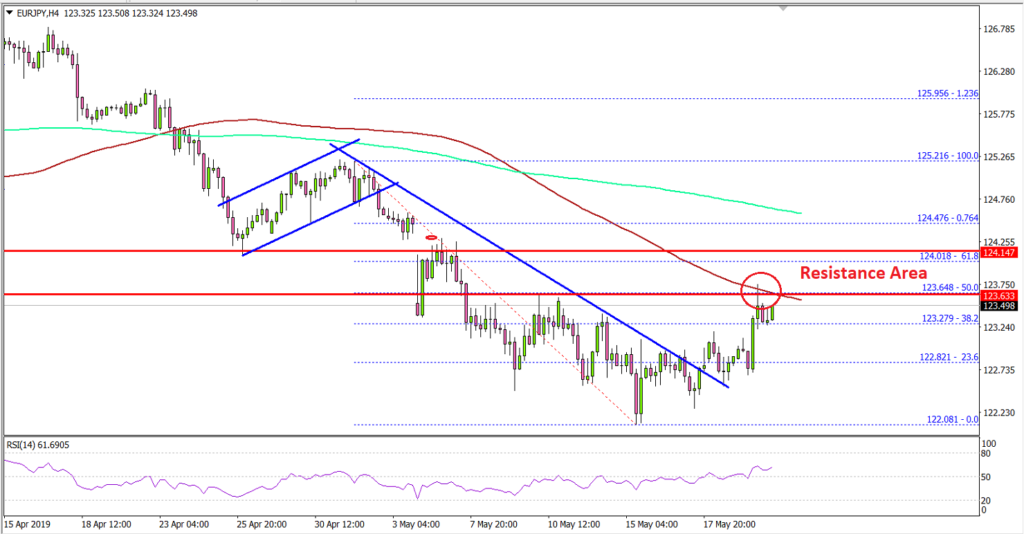
Looking at the 4-hours chart, the pair traded as low as 122.08 and settled below the 100 simple moving average (4-hours, red). It started an upward move and climbed above the 122.80 resistance and the 23.6% Fib retracement level of the drop from 125.21 to 122.08.
Moreover, the pair traded above a key bearish trend line with resistance near 122.75 on the same chart. The pair tagged the 100 SMA and the 50% Fib retracement level of the drop from 125.21 to 122.08.
If there is an upside break above the 123.80 and 124.00 resistance levels, there could a strong upward move towards the 125.00 resistance area.
Conversely, if EUR/JPY fails to move above the 124.00 resistance, there could be a fresh decline below the 123.00 support area. The next key supports are near 122.40, 122.10 and 122.00.
Fundamentally, the Euro Area Consumer Confidence report for May 2019 (Prelim) was released by the European Commission. The market was looking for a minor rise from -7.9 to -7.6.
The actual result was better than the forecast, as there was an increase to -6.5. Besides, the last reading was revised from -7.9 to -7.3.
The report added:
At −6.5 points (euro area) and −6.2 points (EU), both indicators are well above their respective long-term averages of −10.7 (euro area) and −10.0 (EU).
Overall, EUR/JPY is showing positive signs, but it must climb above the 124.00 resistance area to start a strong upward move.
Economic Releases to Watch Today
- UK Consumer Price Index April 2019 (YoY) – Forecast +2.2%, versus +1.9% previous.
- UK Core Consumer Price Index April 2019 (YoY) – Forecast +1.9%, versus +1.8% previous.
- ECB’s President Draghi Speech.
40% US manufacturers moving out of China on trade war, only 6% back to US
American Chamber of Commerce in Shanghai and China carried a joint survey on the impact of US-China tariffs. Results showed that the negative impact of tariffs is clear and hurting the competitiveness of American companies in China. 74.9% os respondents said the tariffs hikes are having a negative impact to their business. Among them, manufacturers suffered most with 81.5% for US tariffs and 85.2% for Chinese tariffs. Impacts include lower demand (52.1%), higher manufacturing costs (42.4%) and higher sales prices (38.2%).
Also, companies are increasingly adopting an "In China, for China" strategy (35.3%), or delaying and canceling investment decisions (33.2%). However, 40.7% are considering or have relocated manufacturing facilities outside China. For those moving, Southeast Asia (24.7%) and Mexico (10.5%) are the top destinations. Only 6% said they're relocating back to the US.
On non-tariff measures, 20.1% said there were "increased inspections" in China, and "slower customs clearance (19.7%). 14.2% said there was " slower license approvals and 14.2% said there were increased regulatory scrutiny. But 53.1% said there was no increase in non-tariff retaliatory measures by the Chinese government.
Daily Markets Broadcast
Wall Street rebounds on Huawei relief
Tech stocks rebounded yesterday after US President Trump dialed back the blacklisting of Huawei, granting limited relief for consumers and carriers that do business with them. Other US indices also tracked higher though the cloud of the trade talks slowed gains.
US30USD Daily Chart
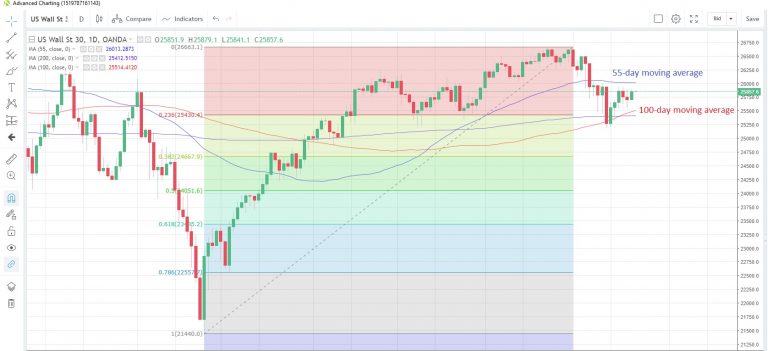
The US30 index snapped a two-day losing streak on the Huawei pause
The index is sandwiched between 55-day moving average resistance at 26,013 and 100-day moving average support at 25,514
The minutes of the last FOMC meeting will be released late in the US session and will be scrutinised to learn the latest economic themes being considered by the Fed.
DE30EUR Daily Chart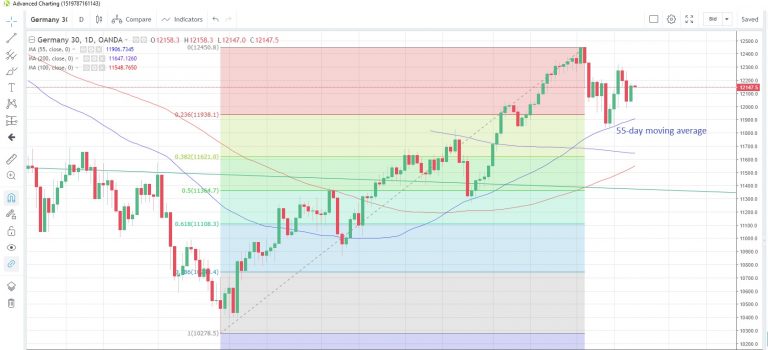
The Germany30 index also snapped a two-day losing streak after Euro-zone chip makers were given a temporary reprieve from the Huawei sanctions
The 55-day moving average at 11,906 continues to support prices, as it has done on a closing basis since February 8
There are no major data releases from either the Euro-zone or Germany scheduled for today. ECB's Draghi is scheduled to speak at 0730GMT.
CN50USD Daily Chart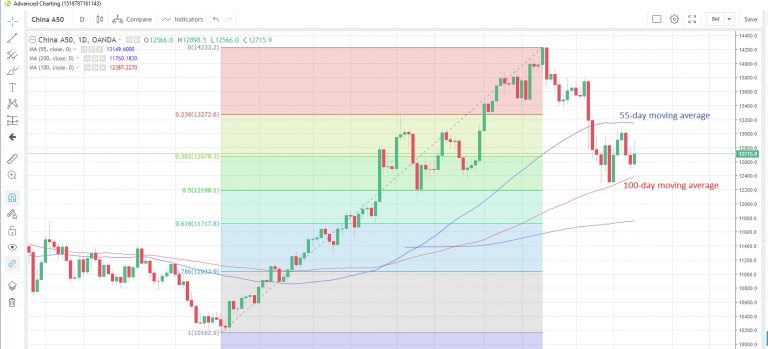
The China50 index looks set to advance for a second day as global markets breathe a (maybe temporary) sigh of relief
The index is trapped between 55-day moving average resistance at 13,150 and 100-day moving average support at 12,387. The 100-day average has supported prices since January 22
China's ambassador to the US has reiterated that China remains ready to hold trade talks and is ready to address trade imbalances with the US by buying more US goods and services.
Fed Rosengren: No clear need to alter slightly accommodative interest rates
Boston Fed President Eric Rosengren said in a speech that "today, the two elements of the Fed's mandate are sending opposing signals for monetary policy". That is, low unemployment suggests "a bit tighter policy" while low inflation "the opposite". But there is "no clarion call" to alter current policy in near term. He viewed current policy as "slightly accommodative" consistent with lifting inflation back to target over time. He added "the Fed can afford to wait to see if that forecast does indeed materialize."
On the economy, Rosengren is relatively optimistic and he expects unemployment rate to fall further. He noted that the significant decline in equity markets in Q4 has largely recovered. Worries over Brexit and China slowdown "appear to have subsided since the beginning of the year". Also, Q1 growth in US was "stronger than many forecasters expected".
On trade, he said "I am optimistically assuming that both sides in the trade negotiations will work to reach an agreement". And, "I am also assuming that while the uncertainty is not helpful, it will be transitory, and thus have only a modest effect on the forecast for the U.S. economy overall."
May’s new Brexit plan received terrible responses
Sterling was lifted briefly by UK Prime Minister Theresa May's "new" Brexit plan. But recovery in Pound quickly faded as the plan was terribly received by MPs across the House. In short, under the new 10-point plan, the most important part is guaranteeing a vote on whether to call a second referendum on the Brexit deal. However, the pre-condition for the vote on referendum is the passage of the Brexit deal itself in the Commons.
Labour leader Jeremy Corbyn was quick to reject the proposal as "largely a rehash" and pledged "we won't back a repackaged version of the same old deal". Former foreign minister Boris Johnson and ex Brexit minister Dominic Raab said they'd oppose the deal. Pro-Brexit Cabinet ministers including Michael Gove, Andrea Leadsom and Chris Grayling opposed the idea of a "free vote". Northern Ireland's Democratic Unionist Party was concerned that "fatal flaws" of the original Brexit deal remained, which could split Northern Ireland with the rest of UK.
Despite the desperate final gamble, there is still practically no chance for May to get her Brexit deal through Commons in the June. A fourth humiliating defeat is more likely than not.