

Sample Category Title
False Dawns
False dawns
Wall Street equities bounced overnight following the US Government's three-month reprieve for Huawei's official blacklisting. The delay itself is more an administrative move allowing US companies to get their houses in order with the Chinese telecom giant, than a magnanimous one by Washington DC. Not one to let reality get in the way of a good story, equity markets ratcheted higher as the street interpreted the move as an easing in trade frictions. Beijing may still see it quite differently.
It's been a mixed bag this morning in Asia Pacific with New Zealand's retail sales rising 0.70% q/q – a solid if not stunning result. Japan's May Tankan survey rose to 12, beating the previous month's print of eight. The just-released Japanese balance of payments showed an unexpected fall in the April surplus to JPY60.4 billion, while March machinery orders rose an unexpected 3.8%. A rising yen likely explains the falling surplus, but overall, the data shows an economy relatively untouched by trade frictions. If only they could find some inflation, last seen 30 years ago.
Indonesia may gain some unwelcome attention today with protests against the Presidential election results scheduled in Jakarta and losing candidate, Prabowo Subianto set to challenge the results in the Constitutional Court. However, the incumbent President Joko Widodo was the clear winner, likely meaning any nerves on the local stock market and Indonesian rupiah should be transitory.
Early tomorrow morning, the FOMC minutes will be released, and the street will pick them apart, searching for clues as to whether the Federal Reserve is about to blink and cut rates. I suspect they will be disappointed.
FX
The US dollar remained strong overnight, rising against the euro and notably, the yen after the Huawei stay of execution by Washington DC. The USD/JPY pair has been on a consistent upward trend for the week, bottoming at 109.00 as the yen safe-haven trade ran out of steam. The dollar rose to 110.55 overnight with resistance likely to be found around 111.00.
Sterling spiked more than 100 points to 1.2810 overnight as Prime Minister May hinted that a second referendum could be packaged up as part of her Brexit deal. However, the British pound fell just as quickly fell back to its 1.2710 starting point as politicians from all sides trashed her proposals, leaving GBP mired at four-month lows while the Prime Minister awaits her end of days. A settlement remains as distant as ever.
Equities
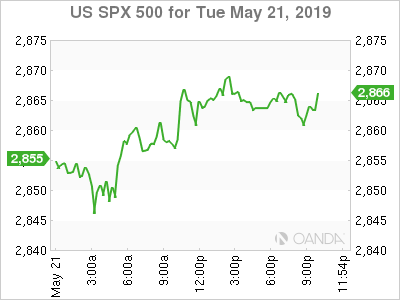
The Huawei deferral sparked a rally among under-pressure tech and semiconductor firms overnight. The Nasdaq jumped 1.10%, the S&P 500 rose 0.85%, and the Dow Jones climbed 0.75%, marking a dramatic 24-hour reversal in sentiment.
I won't dwell on the nuances of the words delay, deferred and permanent – standing in front of short-term sentiment is never a good trading plan unless you have deep pockets. Suffice to say, it should come as no surprise if Asian stock markets jump on the hope-versus-reality train and move higher today on a perceived drop in trade friction.
The street will, of course, be vulnerable to headline bombs. Most notably, China has been very, very quiet on its intended retaliatory measures against the US. Make no mistake, they've not gone away, and any unexpected announcement by Beijing on that front could turn sentiment very quickly indeed.
Oil
A slow news day on the trade front and an even quieter one in the Middle East for a change saw both Brent Crude and WTI trade aimlessly. Brent Crude remained almost unchanged at USD72.15 a barrel, while WTI fell slightly by 0.50% to USD62.40 a barrel.
Perhaps worth noting, at these prices both contracts are sitting on short-term technical support levels. A break below USD72.00 on Brent opens up a correction to the USD70.00 region. WTI has traced out solid resistance at USD63.75 a barrel, and a fall below USD62.00 could open up a further correction to USD60.00.
Oil will trade nervously at these levels in Asia, with any negative trade news likely to see stop-loss sellers come to the market.
Gold
Gold fell to USD1,270.00 an ounce overnight, before bouncing back to USD1,275.00 an ounce to close out New York in a volatile session. Although traders could take heart that USD1,270.00 held the first time, the bounce is anaemic at best, and the daily chart does not paint a pretty picture.
Gold suffered from a stronger greenback and reduced trade-tensions, albeit temporarily, and is struggling to find friends, even at these levels. The USD1,265.00 an ounce region is the key technical support zone, and a daily close implies a much deeper pullback is on the horizon.
USD/CAD Canadian Dollar Rises As USMCA Ratification Near
The Canadian dollar rose 0.16 percent after a long weekend. The loonie benefited from rising risk appetite and given that the US reached an agreement with Canada and Mexico to cancel steel and aluminum tariffs the currency was exempt from trade war tensions.
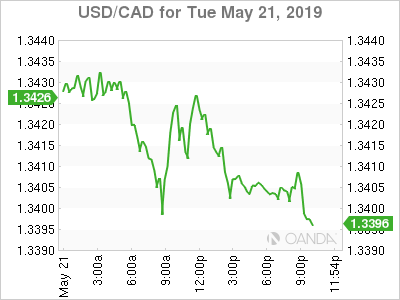
The Bank of Canada has kept rates unchanged in 2019 and given how economic data has been mixed there is little expectation of a rate move in either direction this year. The central bank joined the dovish choir, despite impressive job gains as trade headwinds could still pressure the economy.
Next week’s economic calendar in Canada will be low on events. Retail sales data on Wednesday, May 22 is the most relevant, with a 0.8 percent gain expected. Canadian data has been mixed with the employment report giving a huge boost to the loonie that will probably not be repeated in the short term.
The US dollar is higher against most major pairs on Tuesday. The Canadian dollar was the outlier as it gained 0.16 percent versus the greenback.
OIL – Crude Mixed Awaiting US Weekly Inventories
Oil prices were mixed on Tuesday. Brent gained 0.22 percent and West Texas Intermediate lost 0.21 percent. Supply disruptions continue to support current price levels. Geopolitical, weather and operational factors have reduced crude supply levels. The OPEC+ agreement has been the major factor and with the upcoming June end of the deal there is uncertainty if an extension is coming.
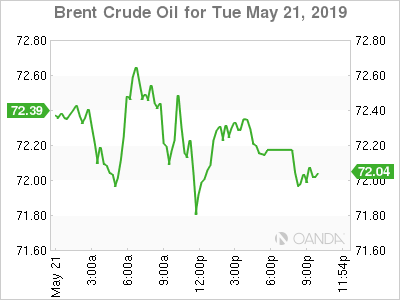
Russia has sent mixed signals and the effectiveness of a production output cut would be limited if it does not rejoin the group. Saudi Arabia has carried a heavy load to soak up excess supply and will steward the group form committing the same mistakes that lead to a free fall in crude prices.
The US is impacting prices in two ways. Sanctions against Iran and Venezuela for political reasons have boosted prices as it reduced supply. US-China trade disputes have a negative effect on global growth forecast reducing energy demand going forward.
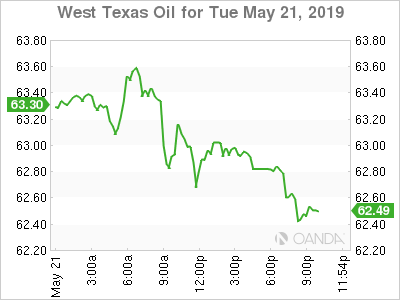
Crude traded flat on Tuesday as both limited supply and downgrades in energy demand cancelled each other out as lack of details are not giving traders enough information to commit to a position. US-China trade negotiations are expected to restart soon, but no firm date is on the table.
GOLD – Gold Drops on Easing Trade Concerns and Rise of Dollar
Gold fell 0.24 percent on Tuesday. The strength of the US dollar and a rebound in risk appetite hit the yellow metal which touched a two-week low. As investors abandon their safe havens in search for higher yields the metal is getting sold. Given the decision by the Trump administration the decision to focus its attention on the US-China trade dispute, by delaying or reaching an agreement with other partners, has put the greenback as the go-to safe haven if uncertainty rises.
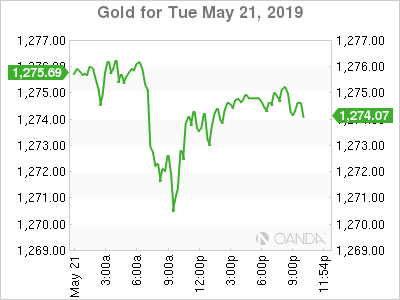
US data and Fed speakers have been mixed leaving the U.S. Federal Reserve to keep on pause and await the data for signs of improvement. The Fed minutes to be released will bring details on how dovish Fed members are, but from the statement we know that a rate hike is unlikely to happen in 2019. A rate cut in the other hand has been rising in probability as disappointing data and geopolitical anxiety could be signalling lower growth than expected.
STOCKS – Equities Rebound After Huawei Sanctions Temporary Lifted
The temporary exceptions announced by US officials on Huawei triggered a rebound in risk appetite and benefited directly the tech sector. The US-China trade war continues to have a negative impact on markets as uncertainty on a deal between the two largest economies does not appear to be close.
The minutes from the April/May FOMC will be released on Wednesday with investors keen to get some clues on the internal debates at the Fed. The US central bank changed course at the beginning of the year and has shelved its plans to lift interest rates in 2019. The market continues to price in a probable rate cut, it the economy does not ramp up this year. The CME FedWatch tool shows only a 34.3 percent probability that the Fed funds rate will remain at the current level by December.
The Fed has been mixed as it remains hawkish on the economy, but dovish on headwinds and its impact on growth. Fed members have talked to both sides of the equation, with the majority subscribing to the center. Minnesota’s Neil Kashkari has been the most outspoken dove, with his comments about rate hikes “were not called for” as inflation remains low.
The Fed hiked 4 times in 2019 and that commitment to rate normalization was one of the reasons that triggered a fall in the stock market in December. Equities have rebounded, but if the Fed remains on the sidelines for the rest of the year, investors will not be concerned with tighter monetary policy.
Australia: Leading Index Well Below Trend
The six month annualised growth rate in the Westpac– Melbourne Institute Leading Index, which indicates the likely pace of economic activity relative to trend three to nine months into the future, declined from –0.13% in March to –0.47% in April.
The Index growth rate has been consistently negative over the last five months, a clear signal that economic growth through the three quarters of 2019 is likely to be below trend.
As noted last month, the improved signal in March was entirely due to a sharp lift in one component – dwelling approvals – which saw a spike in high rise activity drive a 19.1% surge. A 15.5% fall back in this component accounts for almost all – 0.32ppts out of 0.34ppts – of this month’s lapse in the Leading Index growth rate to more negative territory.
This consistent ‘below trend’ signal from the Index is in line with Westpac’s growth forecast for 2019 of 2.2%. We note that the Reserve Bank has recently lowered its growth forecast for 2019 from 3% to 2.6%. That adjustment is in the right direction and is official recognition that growth in 2019 will be below trend (generally accepted as around 2.75%).
The Index growth rate has swung sharply over the last six months, from +0.48% in November to –0.47% in April. Six of the eight components have driven the turnaround, led by a weaker pulse from US industrial production (–0.66ppts) and a narrowing yield spread (–0.25ppts) with drags from a levelling out in commodity prices (–0.14ppts); a softening in the Westpac-MI Unemployment Expectations index (–0.12ppts); dwelling approvals (–0.11ppts) and the Westpac-MI CSI Expectations Index (–0.11ppts).
The only significant offsetting positive has been from a sustained rally in the ASX 200, an 8.5% lift over the last six months adding +0.43ppts to the six month Leading Index growth rate. The contribution from the last component – aggregate monthly hours worked – has been unchanged.
The Reserve Bank Board next meets on June 4. On February 21 Westpac forecast that the RBA would cut the cash rate by 25 basis points at the August and November Board meetings.
Recently we have seen an even sharper than expected slowdown in inflation while prospects for the labour market have weakened. These disappointing outcomes culminated in a speech from the Reserve Bank Governor on May 21 where he appears to have committed to a rate cut at the June meeting.
Consistent with our original view, that there will be two cuts in this cycle, we have moved forward our rate cut timetable from August and November to June and August.
This is a little earlier than we expected back in February but we are pleased that we have been able to provide our customers with a consistent rate cut theme for most of this year.
Eco Data 5/22/19
[php_everywhere instance="1"]
Sterling recovers further on prospect of a second referendum on the Brexit deal
Sterling is given a lift as UK Prime Minister Theresa May outlines her "new" plan regarding Brexit. One key element is that her Brexit bill will include a requirement to hold a vote on whether or not to have a second referendum on the deal. That is, if MPs want a second referendum, they must vote for the bill. The prospect of a second referendum is apparently the thing that shoots the Pound higher.
Here is a summary of May's 10-point plan:
"So our New Brexit Deal makes a ten-point offer to everyone in Parliament who wants to deliver the result of the referendum.
- The government will seek to conclude alternative arrangements to replace the backstop by December 2020, so that it never needs to be used.
- A commitment that, should the backstop come into force, the government will ensure that Great Britain will stay aligned with Northern Ireland.
- The negotiating objectives and final treaties for our future relationship with the EU will have to be approved by MPs.
- A new workers' rights bill that guarantees workers' rights will be no less favourable than in the EU.
- There will be no change in the level of environmental protection when we leave the EU.
- The UK will seek as close to frictionless trade in goods with the EU as possible while outside the single market and ending free movement.
- We will keep up to date with EU rules for goods and agri-food products that are relevant to checks at border protecting the thousands of jobs that depend on just-in-time supply chains.
- The government will bring forward a customs compromise for MPs to decide on to break the deadlock.
- There will be a vote for MPs on whether the deal should be subject to a referendum.
- There will be a legal duty to secure changes to the political declaration to reflect this new deal.
Al of these commitments will be guaranteed in law – so they will endure at least for this parliament."
Euro Could Have a Cold June
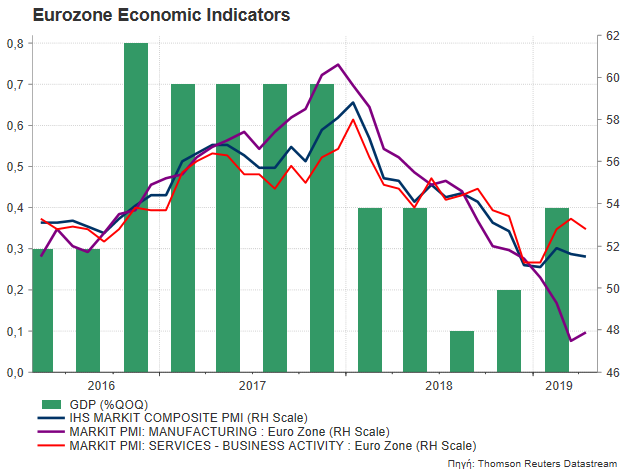
The Eurozone’s currency has been driving on a slippery road for more than a year now and even if the 19-member bloc doubled its growth in the first quarter of 2019, downside risks in both the political and economic spheres continue to linger in the background, flagging another tough month for the euro.
In the first three months of the year, GDP growth in the Eurozone was 0.4% q/q, which was twice the increase in the fourth quarter of 2018 according to Eurostat’s second estimates despite the Brexit turmoil, the threat of US import tariffs and a slower expansion in China. Specifically, the biggest surprise was Italy which managed to return to growth (0.2% q/q) after two consecutive negative quarters put the country in technical recession, while the stagnating Germany, also had a reason to smile as economic activity heated up, marking an expansion of 0.4% q/q.
Consumers seem to be propping the expansion amid a lower unemployment rate and improvements in wage growth even if views on future spending remain negative. Yet all eyes are fixated on factories which are still in contraction according to the Markit Manufacturing PMI and the culprits are mainly the Brexit chaos and US trade protectionism.
Brexit deal to return to Parliament
Having already been rejected three times in the British parliament, the UK Prime Minister, Theresa May, is still facing difficult times to persuade her own party and the opposition Labour Members of Parliament to accept her adjusted withdrawal plan out of the European union, a month after postponing the exit deadline to October 31.
The so far unfruitful talks have even brought her Conservative colleagues to their limits last week, forcing her to set a date next month for stepping down. The UK leader is now having another chance on June 3 to get her plan through the parliament before the summer break but the large divisions among lawmakers who are debating over a no deal Brexit, a second referendum or no Brexit at all, suggests that the results would likely be disappointing once again. Bet even if lawmakers find common ground, May’s political career could still come to an end this summer as she has promised to leave her position in case her plan is approved.
Do not forget the trade war
Directly or indirectly, developments on the trade front may also complicate economic conditions in the bloc. While a month ago markets were confident that China and the US – the EU’s major trade partners – are heading for an agreement, Trump’s warning over higher tariffs on $200 billion Chinese goods, potentially as of June 1, and his ban on the Chinese telecom giant Huawei revealed that controversies in key issues remain and therefore threats to the global economy are still alive.
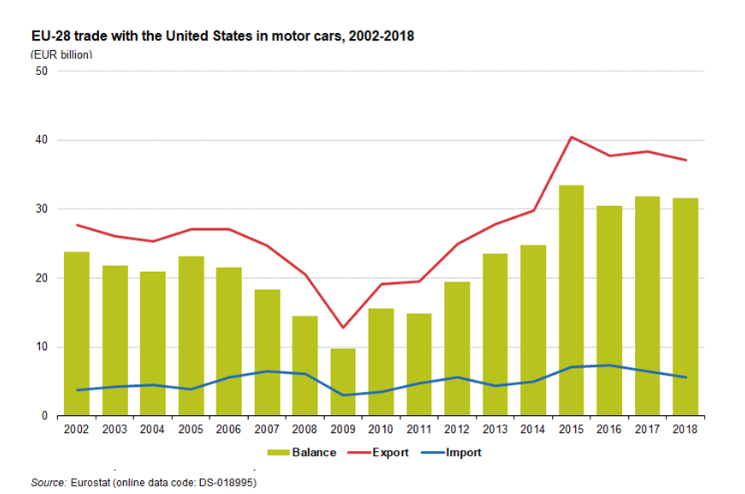
Despite getting an exemption from the US metal tariffs, the European Union is likely to re-join the trade battle itself as well, as a report by the US Commerce department concluded that EU car imports hurt US national security and steal market share from American auto businesses. EU’s car surplus with its biggest export partner has been indeed rising rapidly since 2009, however, Washington decided last week to postpone a 25% import tariff on EU cars for up to six months and give room for negotiations. The G20 meeting in Japan on June 28-29 may next determine how cold or hot the trade war is going to get.
European parliamentary elections could be the pivot point in politics
The Europeans, including the Britons, will head to the polls on 24-26 May to elect a new Parliament for the next five years and while the event usually attracts little interest as proven by the low turnouts, the media will be closely monitoring the results this time amid a growing public perception that the traditional pro-European political groups have failed to deliver on migration, globalization and labour rights.
It is not only that the mainstream EU party groups such the centre-right EPP (which includes Merkel’s party) and the centre-left S&D (includes the British Labour Party) will lose the majority but the parliament may appear more fragmented if the share of seats for Eurosceptic parties including the Italian League and Mari Le Pen’s National Rally rise, potentially complicating future decision-making . In the case of Italy, such an outcome could give more power to the Five-Star Movement, as Deputy PM Matteo Salvini recently said that Rome should be willing to violate the EU’s deficit limit of 3.0% of GDP and increase debt to 140% if necessary. In France, the results could work as a vote of confidence for the President Macron whose tax reforms led to violent protests.
The UK has also committed to participate in the elections but after disappointing local elections for the governing Conservatives and the opposition Labour party, voters may turn towards harder-Brexiteers such as Nigel Farage’s month-old Brexit Party which wants a breakup from the EU and also changes in domestic politics. Yet British lawmakers may not take their seats if the UK government secures an exit deal before July 2, reducing the overall parliamentary positions from 751 to 705.
Market reaction
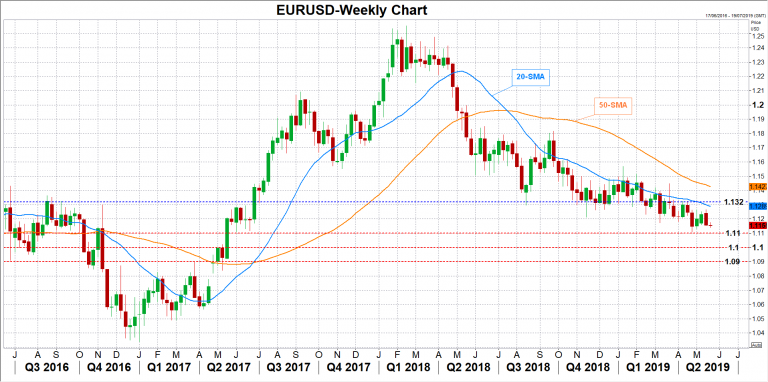
Blending all the above notes, the risk for the euro at least for the next month is skewed to the downside, giving little reason for the European Central Bank to change its accommodative monetary policy at its June 6 meeting.
An unexpected deterioration in European economic and political conditions may push EURUSD back to the 1.1100 bottom, while a bigger negative surprise may also open the way towards the 1.10-1.095 support area.
Any upside in the market may find it hard to exceed the 1.1320 resistance.
Japanese Exports to Remain Weak, Inflation to Inch Higher in April
Following the unexpectedly strong Q1 GDP data out of Japan this week, the focus now turns to April trade numbers on Wednesday (Tuesday, 23:50 GMT) and inflation figures on Friday (Thursday, 23:30 GMT). Despite the impressive growth figures, worries remain about the outlook for Japan’s economy as the October sales tax hike nears and trade tensions escalate. Investors will therefore be watching carefully how the economy evolves over the next few months for signs the Bank of Japan would need to step in again to kick start growth.
Japan’s first quarter GDP growth may have beaten even the top estimates, coming in at 0.5% quarter-on-quarter, but under the surface, there was less to cheer about. Both private and business spending fell over the quarter, while exports tumbled by 2.4%. The only ‘bright spot’ was that imports plunged by even more than exports to produce a positive contribution from net trade of 0.4% to GDP growth. This puts the focus on Wednesday’s trade data to see whether the exports picture improved at all in April.
Slide in exports probably continued in April
But that’s unlikely to have been the case as exports are forecast to have declined by 1.8% year-on-year in April, easing only marginally from the prior 2.4% drop. There could be some good news from imports, however, as they are expected to have increased by 4.8% over the year versus 1.2% in the previous month, possibly signalling strengthening domestic demand.
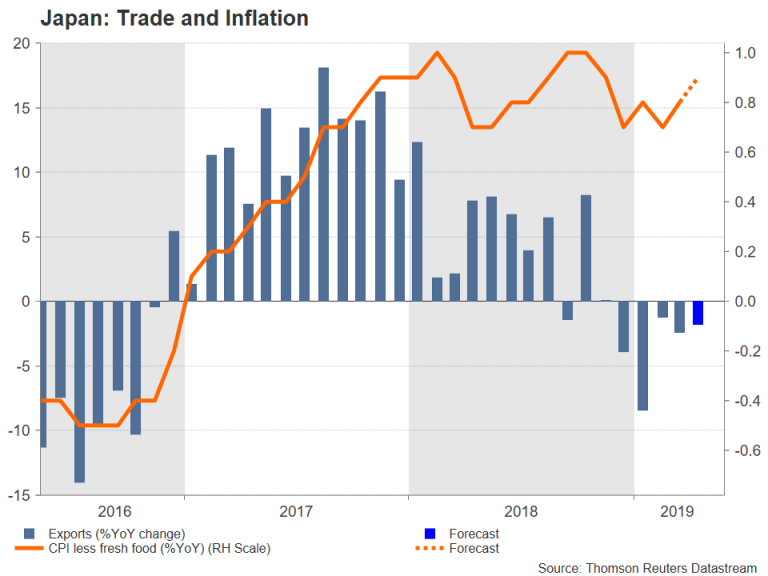
Turning to Friday’s inflation release, core CPI is forecast to rise from 0.8% to 0.9% y/y in April, which would make it the highest since November 2018. The core CPI rate excludes fresh food prices and is what the Bank of Japan targets for its 2% inflation goal. But the measure has been moving sideways after peaking at 1.0% in February 2018. The BoJ has repeatedly said it would consider additional easing if inflation lost momentum in rising towards the target. Should core CPI continue to edge higher in the coming months, the BoJ is more than likely to stay on the sidelines.
Intensifying trade war poses a major risk
However, with the growth outlook becoming gloomy again as US-China trade tensions intensify, the risks to the Japanese economy are tilted to the downside. China is Japan’s largest export destination, followed by the United States, so weakening demand in either of those economies, as well as a disruption to the global supply chain from the trade war could have a significant negative impact on Japan.
Another risk for growth is the planned sales tax hike in October. If the darkening clouds from trade tensions haven’t cleared by then and the government presses ahead with its tax increase, the BoJ may be forced to ramp up its stimulus.
Data not anticipated to move the yen
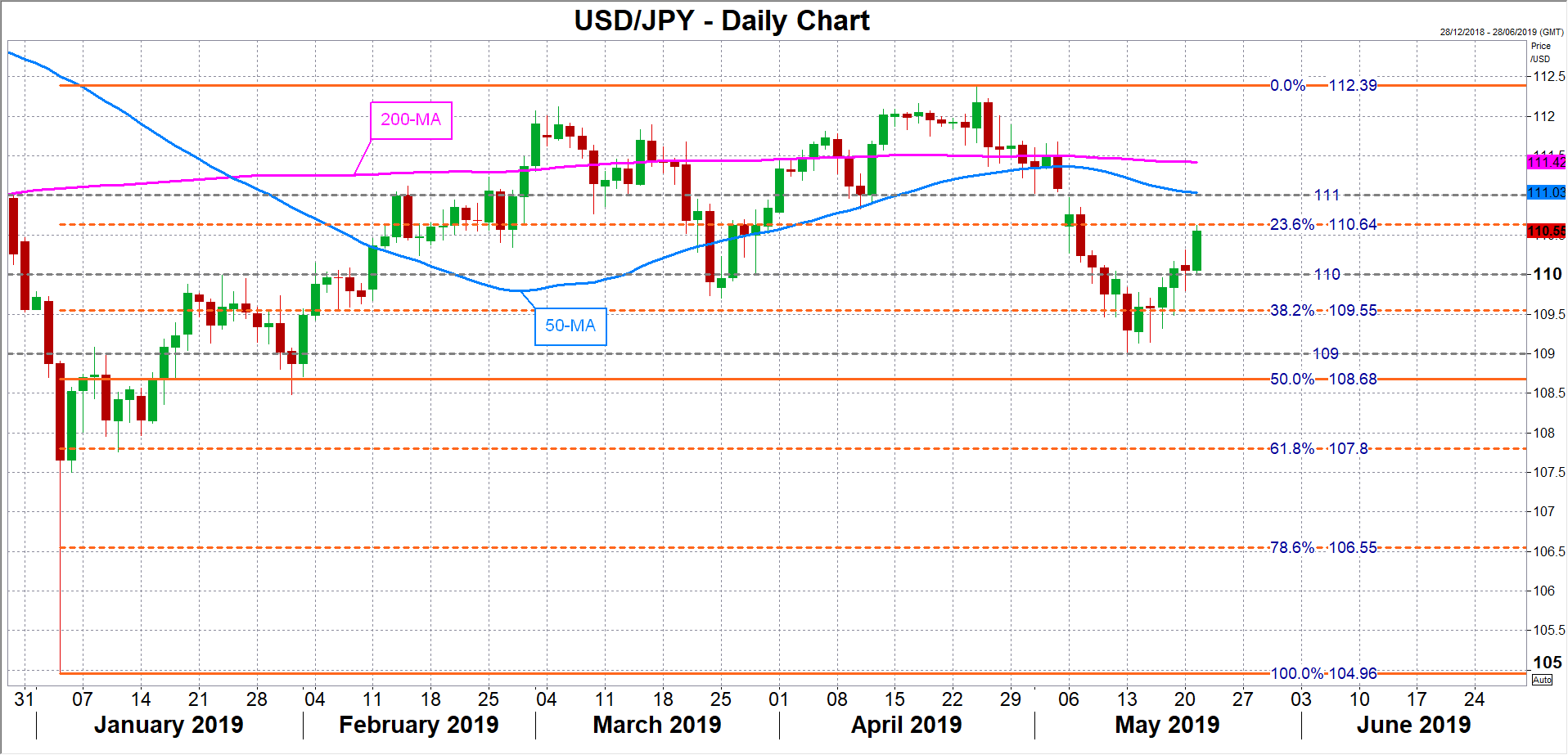
Until such a scenario starts to develop, however, the yen is unlikely to move much to domestic economic indicators, with any reaction to this week’s releases expected to be limited. Potential resistance for the yen to stronger-than-expected numbers could arrive initially at the 38.2% Fibonacci retracement of the upleg from 104.96 to 112.39 at 109.55 per dollar, followed by the 109 level. But weak figures could see the yen breaking below immediate support at the 23.6% Fibonacci at 110.64 per dollar and head towards the 50-day moving average near the key 111 level.
FTSE Rebounds as U.S. Lowers Flames in Huawei Tussle
The FTSE index has reversed directions on Tuesday, after losses on Monday. In the North American session, the pair is at 7,325, up 0.216% on the day. On the release front, Mark Carney’s testimony on inflation before a parliamentary committee has been cancelled. British CBI Industrial Order Expectations slipped to -10, weaker than the estimate of -6. This marked the lowest score since November, as manufacturing orders continue to decline.
U.S-China trade tensions continue to trigger volatility in the equity markets. On Friday, the Trump administration had announced it was imposing trade sanctions on the Chinese telecom giant Huawei, a move which sent stock markets reeling on Monday. However, the U.S. Commerce Department has taken a step back, saying that it will provide 3-month exemptions to U.S. companies that sell to Huawei. The tussle over Huawei has exacerbated the trade war between the two economic giants, and risk appetite will remain soft until the sides resume negotiations.
Brexit has not been in the headlines of late, but that could change later in the week, when European Parliament elections take place. The election for the European Parliament could boost anti-Brexit parties, as the Conservatives are expected to make a poor showing. Key issues in the election, which covers all 28 member EU states, include the economic slowdown, the migrant crisis and the rise in Euroskpeticism. Euro-skeptics increased their representation in parliament from 12% to 25% in the last election, and with the dramatic increase in strength of populist parties, this trend could well continue. This could weigh on the British pound which plunged 2.1% last week, while boosting the FTSE, as investors seek alternatives to the wobbly British currency.
MARKET WRAP: Stocks Back In Green, Sterling On The Move
The global stock market recovered its losses despite heightened trade war concerns, the dollar moved higher while gold continued its downtrend
Stocks
- The S&P 500 Index recovered its losses from yesterday and moved higher by 0.65% as of 15:19 London time; the Nasdaq 100 gained 0.77%.
- The Stoxx Europe 600 Index increased by 0.7%.
- The U.K.’s FTSE 100 Index increased by 0.18% of its value
- The MSCI Emerging Market Index followed the global equity market trend and soared by 0.5%.
Currencies
- The Dollar Spot Index moved higher ahead of the Fed Evan speech and increased by 0.18%.
- The Euro remained below the level of 1.13 and dropped further by 0.15% to $1.1151.
- The British pound recovered some its losses on hopes of some May’s deal. The sterling-dollar pair gained 0.05% to $1.2717.
- The Japanese yen, the safe haven is out of demand today and lost 0.51% to 110.53 per dollar.
Bonds
- The yield on 10-year Treasuries soared by three basis point to 2.41%.
- Germany’s 10-year yield jumped by one basis point to -0.08%.
- Britain’s 10-year yield advanced two basis points 1.071%.
Commodities
- Gold declined again by 0.29% to $1,272 an ounce.
- West Texas retraced from its yesterday’s high and lost nearly 0.05% to $63.07 a barrel.
Fed Minutes May Give the Dollar a Helping Hand
The minutes of the latest Fed meeting are due out at 18:00 GMT on Wednesday. Chairman Powell was less cautious than markets had anticipated back then, downplaying the prospect of rate cuts. The minutes could echo a similar message, particularly since this gathering took place before the latest escalation in trade tensions. If so, that may trigger a slight unwinding of market rate-cut bets, lifting the dollar.
Fed Chairman Powell ‘calmed’ investors back at the May meeting, indicating that the recent shortfall in inflation is likely to be only transitory and that his central bank is comfortable keeping its policy unchanged indefinitely. He struck a firmly neutral tone, which was a long way off from the cautious bias traders expected, causing market bets for rate cuts to be pared back.
Trade war resumes
That didn’t last, though. US-China trade tensions escalated just a few days later, which traders interpreted as raising the likelihood for the Fed to ease. Indeed, a prolonged trade war would likely take its toll on economic growth, and the central bank may try to cushion that impact by slashing rates. In this context, a quarter-point Fed rate cut by December has now been fully priced in, according to the Fed funds futures.
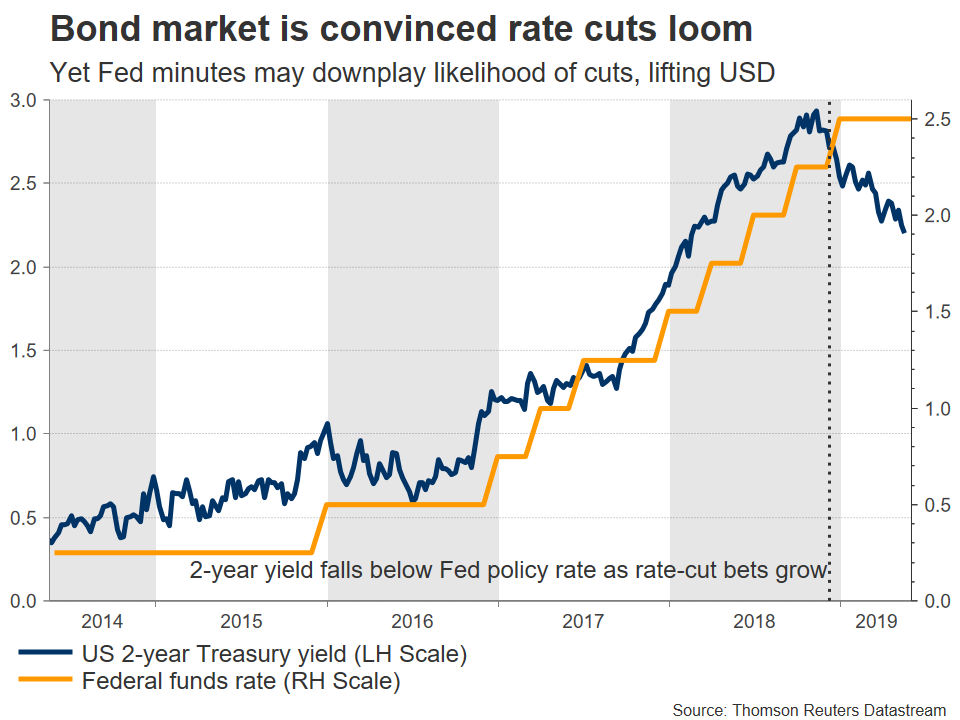
Yet, the upcoming minutes probably won’t reflect any heightened trade worries, given that the meeting took place before tensions intensified. Instead, they may echo Powell’s neutral tone, underscoring that the Fed is firmly on hold until – and if – something changes drastically enough to require action. Given how dovish market pricing is, a neutral bias could trigger a slight unwinding of rate-cut bets, lifting the dollar.
No alternative, for now
In the bigger picture, the outlook for the dollar remains bright even despite speculation for Fed cuts. There’s simply no viable alternative for now, with most other major currencies being unattractive. The euro is tormented by growth concerns, the pound by Brexit, while the aussie and the kiwi have been hit by trade uncertainty as well as rate cut expectations. The yen has shined amid risk aversion, but the ultra-low interest rates in Japan are keeping a lid on its appeal, too.
For the dollar to weaken, one of these gloomy narratives needs to change, with the most important being the European growth story. In that sense, the euro area PMIs that will be released on Thursday could play a pivotal role in deciding whether the dollar will remain ‘king’ of the FX market for a while longer, or whether the euro will start to regain its luster.
Technical picture
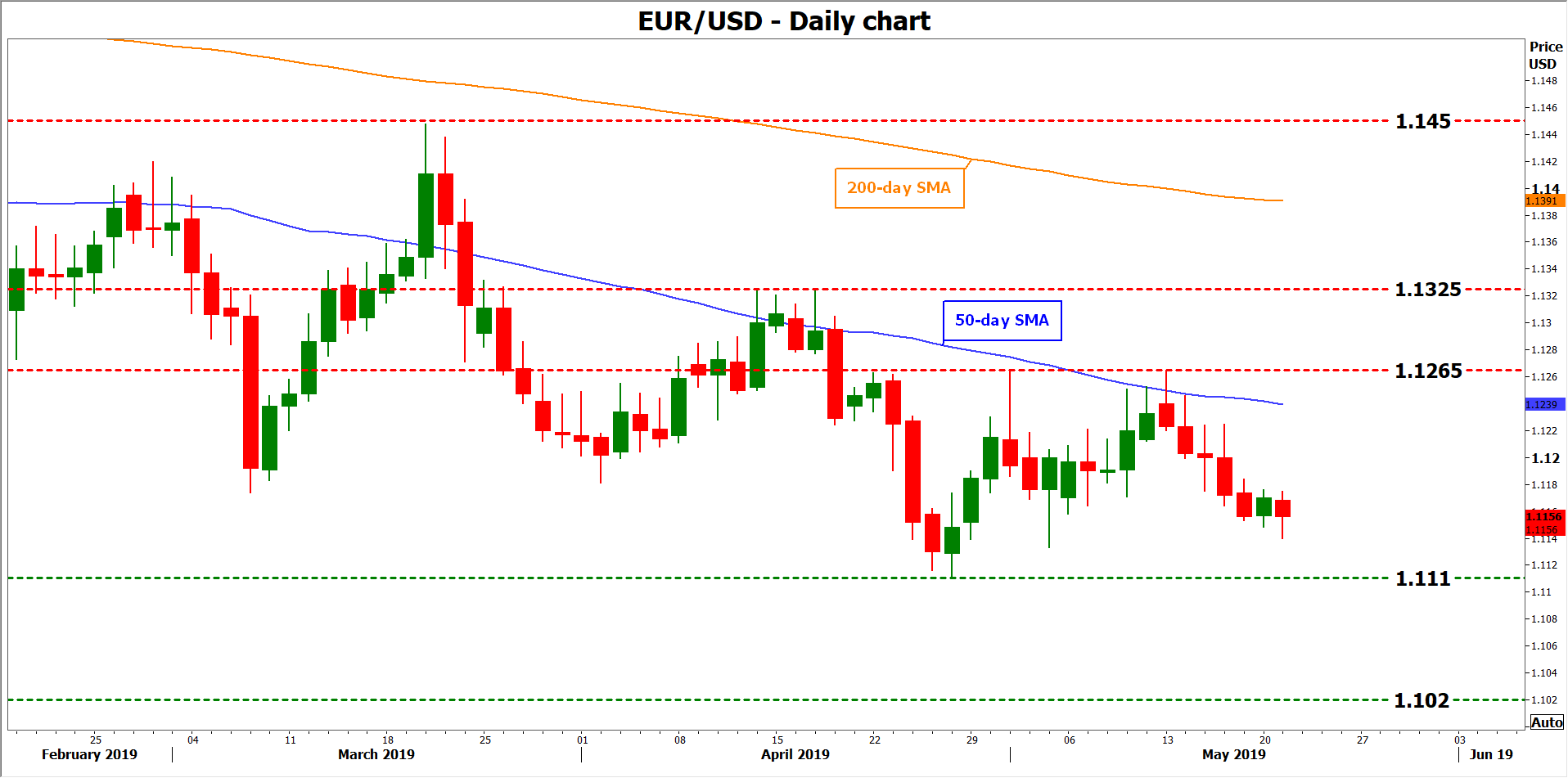
Further declines in euro/dollar could meet support near the 2-year low of 1.1110, with a downside break opening the door for a test of 1.1020.
On the flipside, a reversal higher may stall at the 50-day SMA, currently at 1.1239. If the bulls overcome that, attention would turn to the May 13 high of 1.1265.