

Sample Category Title
GBP/USD – Pound Under Pressure As Manufacturing Orders Sink
After a flat start to the week, GBP/USD has edged lower on Tuesday. Currently, the pair is trading at 1.2694, down 0.23% on the day. On the release front, Mark Carney’s testimony on inflation before a parliamentary committee has been cancelled. British CBI Industrial Order Expectations slipped to -10, weaker than the estimate of -6. This marked the lowest score since November, as manufacturing orders continue to decline. In the U.S., existing home sales is projected to climb sharply to 5.35 million.
Brexit has been on the backburner in recent weeks, but the upcoming election for the European Parliament could boost anti-Brexit parties. Key issues in the election, which covers all 28 member EU states, include the economic slowdown, the migrant crisis and the rise in Euroskpeticism. Euro-skeptics increased their representation in parliament from 12% to 25% in the last election, and with the dramatic increase in strength of populist parties, this trend could well continue. The U.K. will participate in the vote, although the country is on its way out of the EU. The Conservatives are expected to have a poor showing, while anti-Brexit parties could make major gains. This could weigh on the British pound which plunged 2.1% last week.
U.S.- China trade tensions continues to simmer, which has boosted the safe-haven U.S. dollar. On Friday, the Trump administration had announced it was imposing trade sanctions on the Chinese telecom giant, a move which sent stock markets reeling on Monday. However, the U.S. Commerce Department has taken a step back, saying that it will provide 3-month exemptions to U.S. companies that sell to Huawei. The tussle over Huawei has exacerbated the trade war between the two economic giants, and risk appetite will remain soft until the sides resume negotiations.
EURNZD Flirts With 4-Month Peak, Bullish Rally Continues
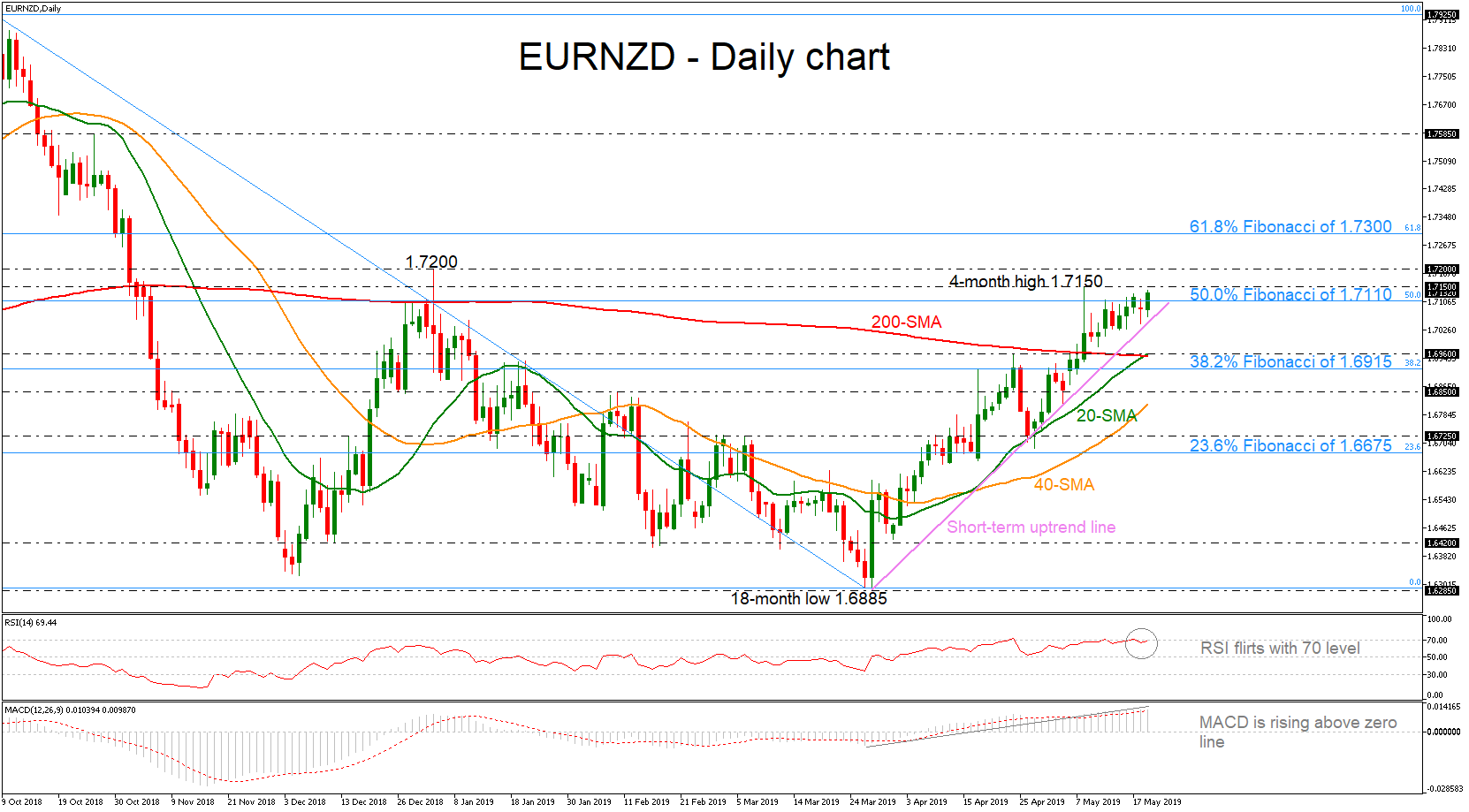
EURNZD is hovering above the 50.0% Fibonacci retracement level of the downleg from 1.7925 to 1.6885 around 1.7110 and is approaching the four-month high of 1.7150. The RSI is growing distance above the 50 level and is standing near the overbought zone, while the MACD is holding well above the zero line, increasing speculation for more upside pressure in the short-term.
In case the pair maintains its short-term direction to the upside after the bounce off the 18-month bottom of 1.6885, the bulls will probably challenge a new multi-month high around 1.7200. A break higher could last until the 61.8% Fibonacci of 1.7300.
On the flipside, a decline below the short-term ascending trend line could send the market until the 200-day simple moving average (SMA), which overlaps with the 1.6960 support level. A penetration of this key zone may drive the price towards the 38.2% Fibonacci of 1.6915.
Summarizing, if the price surpasses the four-month high it could turn the focus for more bullish orders until the next resistance.
OECD lowers global growth forecast on trade tension, but upgrades US
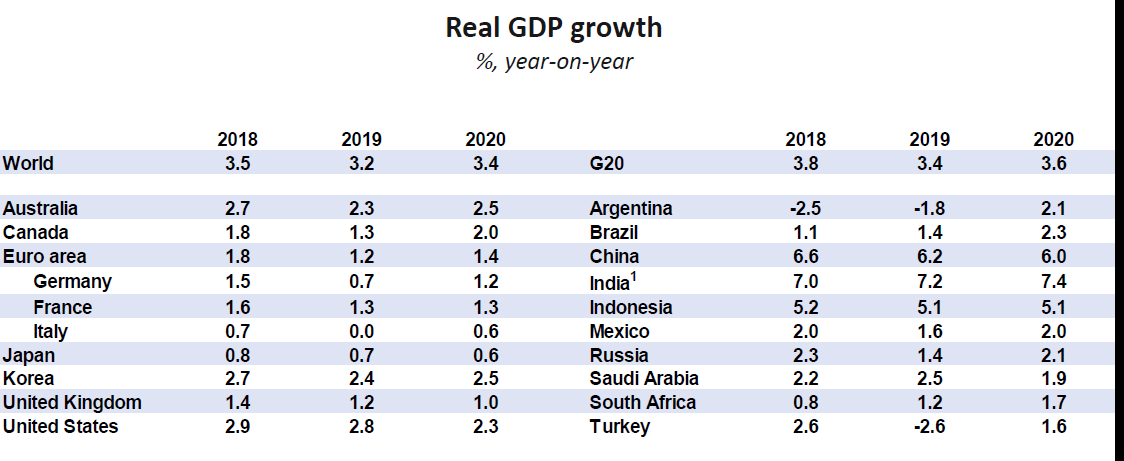
OECD lowered global growth forecast to 3.2% in 2019, down from March projection of 3.3%. Chief Economist Laurence Boone warned that "the fragile global economy is being destabilized by trade tensions." And, growth is stabilizing but the economy is weak and there are very serious risks on the horizon. Governments need to work harder together to ensure a return to stronger and more sustainable growth."
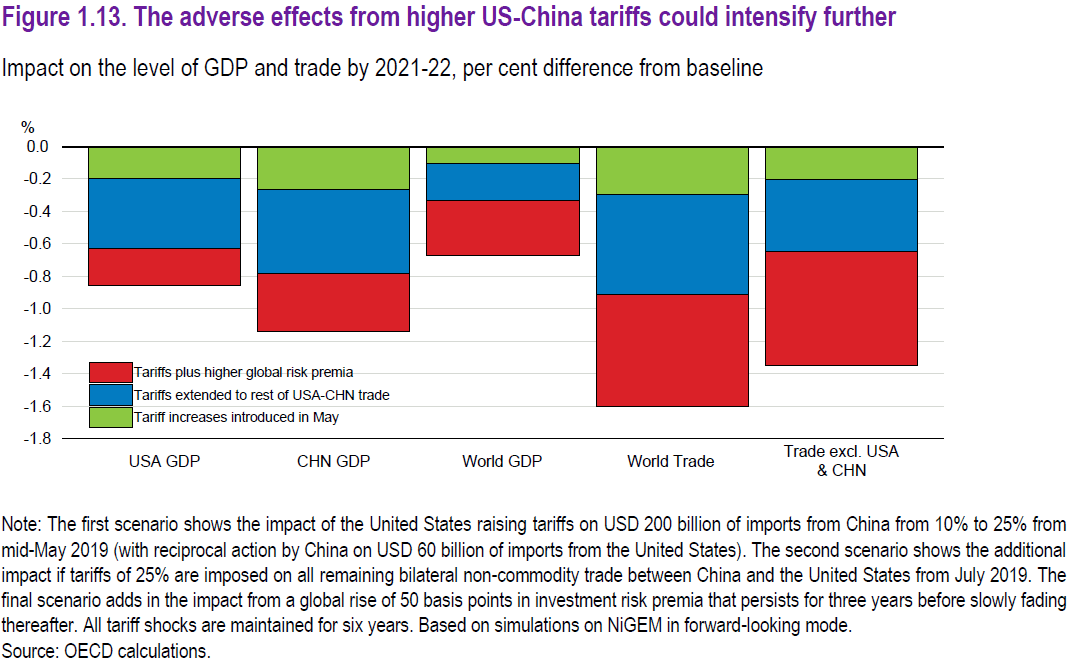
On US-China trade war, OECD warned that an intensification of trade restrictions would have significant costs. The new tariffs and measures announced this month could reduce GDP growth in US and China by 0.2-0.3% on average by 2021 and 2022. Under the scenarios of additional 25% tariffs on essentially all remaining bilateral trade between US and China, "the short term costs are considerably higher and broader". Global trade could be reduced by 1% by 2021. US GDP could dropped by 0.6% while China GDP could drooped by 0.8%.
However, it should also be noted that GDP growth projection was revised up by 0.2% to 2.8% in 2019 and by 0.1% to 2.3% in 2020. OECD said "in the absence of further shocks, the economy is on track to continue its solid expansion and grow
somewhat faster than the rest of the OECD on average".
Summary of new growth projections :
- 2019 global at 3.2%, down from 3.3% (March forecast)
- 2020 global at 3.4%, unchanged
- 2019 US at 2.8%, up from 2.6%
- 2020 US at 2.3% up from 2.2%.
- 2019 Eurozone at 1.2%, up from 1.0%
- 2020 Eurozone at 1.4% up from 1.2%
- 2019 Japan at 0.7%, down from 0.8%
- 2020 Japan at 0.6%, down from 0.7%
- 2019 UK at 1.2%, up fro 0.8%
- 2020 UK at 1.0%, up from 0.9%
- 2019 China at 6.2%, unchanged
- 2020 China at 6.2%, unchanged
Cable Falls To 5 Month Low As PM May Attempts To Gain Support For Her Brexit Withdrawal Bill
Notes/Observations
Asia:
- Chinese Foreign Min Spokesman Lu Kang: Trade deal Trump referring to was never in place, China never broke any deal A trade deal should be based on equality, mutual benefit
- China said to have extended ban on imports of medium to heavy rare earths, including dysprosium oxide and terbium oxide, from Myanmar; raised rare earth import tariffs from the US to 25% from 10%
- The RBA May minutes revealed a softening in language with outlook less favorable with an easing policy in the next 6 months (replacing prior wording of not a strong case for near term adjustment In monetary policy)
- RBA Gov Lowe said the board will consider case for a rate cut in June
Europe/Mideast:
- OECD cuts 2019 Global GDP forecast, while maintaining the 2020 forecast. Raises 2019 and 2020 Eurozone GDP forecast; Global growth to remain subpar amid trade tensions
- Cable drops to 5 month low as PM May faces Cabinet ministers today in a last ditch attempt to sway them to support her Brexit deal; MP Rees-Mogg says he will not be backing her Withdrawal agreement Bill, saying it is a very bad deal.
- Commons leader Leadsom actively considering to be party leader when PM May steps down, continues to support PM May deal.
SPEAKERS/FIXED INCOME/FX/COMMODITIES/ERRATUM
Equities
- Indices [Stoxx600 +0.37% at 378.86, FTSE +0.47% at 7,345.56, DAX +0.63% at 12,117.25, CAC-40 +0.26% at 5,372.76, IBEX-35 +0.21% at 9,219.00, FTSE MIB +0.50% at 20,642.50, SMI +0.25% at 9,605.80, S&P 500 Futures +0.25%]
- Market Focal Points/Key Themes: Equities European Indices trade slightly positive across the board after strong Asian session on news that Huawei said to be granted temporary 90-days license in U.S. and U.S. Commerce Department comments that it may soon scale back the trade restrictions placed on company. U.S. futures also trade in positive territory with NASDAQ futures contracts up half a percent. On the corporate front, Infineon trade about 1% higher after Huawei founder comments that Infineon has not stopped supplying chips to Huawei refuting earlier Nikkei press reports. Major British retailer Tesco trades lower after announcement that it is actively exploring options to sell its existing mortgage portfolio. On the earnings front, Ceconomy in Germany trades 3.5% higher after earnings and affirmed outlook. Telecom Italia also trades higher on earnings reported yesterday after the European close. Galliford Try, WH Smith, Homeserve among notable risers this morning on earnings releases and trading updates. In other news, Evotec trades 3% higher on acquisition. Looking ahead, notable earners include Home Depot, J.C. Penney, AutoZone, Kohl's Corporation and many others.
- Consumer discretionary: WH Smith [SMWH.UK] +1% (trading update; CEO steps down), Tesco [TSCO.UK] -1.5% (exploring options to sell its existing mortgage portfolio), Electrocomponents [ECM.UK] -2% (earnings), Galliford Try [GFRD.UK] +12% (trading update)
- Industrials: Ceconomy [CEC.DE] +3.5% (earnings), Homeserve [HSV.UK] +2.5% (earnings), Scapa [SCPA.UK] -9% (earnings; CEO steps down)
- Healthcare: Evotec [EVT.DE] +3% (acquisition)
- Technology: Infineon [IFX.DE] +1% (Huawei founder comments)
- Telecom: Telecom Italia [TLIT.IT] +3% (earnings)
- Materials: Fresnillo [FRES.UK] +1% (trading update)
Speakers
- (CN) China Foreign Min Spokesman Lu Kang: Trade deal Trump referring to was never in place, China never broke any deal
- (UK) Commons leader Leadsom: Actively considering to be party leader, will make an announcement when PM May stands down
- (IT) Italy Fin Min Tria: expect higher economic growth in H2, next year, In next budget govt has to find alternative measures to avoid VAT hike
- (US) Energy Sec Perry: U.S. going to impose sanctions on Nord Stream 2
- (JP) Japan Automobile Association: 'Profoundly' disappointed by US President Trump's announcement that imported vehicles and parts threaten national security
- (EU) ECB's de Guindos (Spain): Slower growth momentum we are seeing increases the risk of tail events
Currencies/Fixed Income
- The USD is strengthening against most major pairs as Fed Chair Powell made comments overnight saying that he sees business risk lending as moderate and that job creation and wages are strong. We see the 10 Year treasury trading lower for the past 3 days increasing yields mildly. AUD/USD earlier we saw the minutes which sent the Aussie trading lower after the RBA lowered its growth forecast and saying that its outlook would be less than favorable without an easing policy. Prior levels around the 0.6830 a level set back in 2015 and the low over the past 10 years. EUR/USD The Euro continues to trade sideways as it remains below the 1.12 handle as it eyes decade long low of 1.1120. Yields for Bunds continue to remain negative as the Bund futures dip back below the 167 handle. GBP/USD The cable now trades below 1.27 handle as Brexit talks continue to go nowhere and we approach tomorrow's CPI numbers and the hearings regarding inflation expectations
Economic Data
- (DK) Denmark May Consumer Confidence Indicator: 5.9 v 3.7 prior
- (NL) Netherlands Apr House Price Index M/M: 0.4% v 0.4% prior; Y/Y: 7.7% v 7.7% prior (CH) Swiss Apr M3 Money Supply Y/Y: 3.5% v 3.8%e
- (ZA) South Africa Mar Leading Indicator 104.5 v 105e
- (PL) Poland Apr Employment M/M: 0.0% v 0.1%e; Y/Y: 2.9% v 3.0%e
- (GR) Greece Mar Current Account: -€1.5B v -€1.0B prior
Fixed Income Issuance
- None seen
Looking Ahead
- 05:30 (SL) Sri Lanka Apr National CPI (NCPI) Y/Y: No est v 2.9% prior
- 05:30 (UK) Weekly John Lewis LFL Sales data
- 07:45 (US) Weekly Chain Stores Sales data
- 08:00 (UK) Daily Baltic Dry Bulk Index
- 08:55 (US) Weekly Redbook LFL Sales data
- 10:00 (US) Apr Existing Home Sales: No est v 5.21M prior
- 10:00 (EU) Euro Zone May Advance Consumer Confidence: No est v # prior
- 10:00 (MX) Mexico Weekly International Reserve data
- 10:30 (NZ) Fonteraa Dairy Auction
- 16:30 (US0 Weekly API Oil Inventories
DAX Recovers As U.S. Softens Sanctions On Huawei
The volatility continues for the DAX index this week. Currently, the index is at 12,176, up 1.1% on the day, after falling 1.6% on Monday. For a second successive day, there are no major German or European events on the schedule. The eurozone releases consumer confidence, which is expected to remain in negative territory, with a forecast of -8.
The DAX had a dismal start to the week, but has rebounded on Tuesday, as the U.S. lowered tensions over the Huawei crisis. The Trump administration had announced it was imposing trade sanctions on the Chinese telecom giant, a move which sent stock markets reeling on Monday. However, the U.S. Commerce Department has taken a step back, saying that it will provide 3-month exemptions to U.S. companies that sell to Huawei. The tussle over Huawei has exacerbated the trade war between the two economic giants, and risk appetite will remain soft until the sides resume negotiations.
Voters in all 28 members of the European Union will head to the polls for a 4-day election, beginning on Thursday, to elect members to the European Parliament. Election turnout has been on the decline, with only 43% of eligible voters casting a vote in 2014. Key issues included the economic slowdown, the migrant crisis and the rise in Euroskpeticism. Euro-skeptics increased their representation in parliament from 12% to 25% in the last election, and with the dramatic increase in strength of populist parties, this trend could well continue. A strong showing by parties with an anti-EU agenda could weaken the euro. As well, the outcome of the vote could have an impact on the choice of the new head of the ECB, as Mario Draghi steps down in October, after an eight-year term.
Dow Futures Pop 150 Points After US Eases Trade Restrictions On Huawei
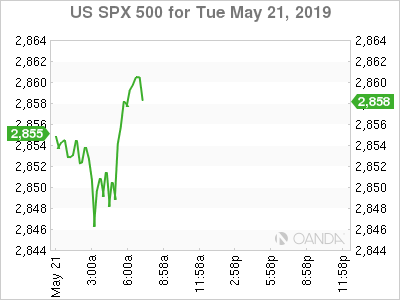
U.S. stock index futures were higher Tuesday morning, as market participants continue to monitor trade developments between the world’s two largest economies.
At around 6:20 a.m. ET, Dow futures indicated a positive open of about 150 points. Futures on the S&P and Nasdaq were both seen higher, as well.
On Monday, the U.S. government temporarily eased some trade restrictions imposed on China’s Huawei Technologies last week. The move sought to minimize disruption for the telecom company’s customers around the world.
The U.S. Commerce Department said it would allow Huawei to purchase American-made goods in order to maintain existing networks and provide software updates to existing Huawei handsets until August 19.
The temporary easing of trade restrictions won some respite with market participants ahead of Tuesday’s opening bell. However, an increasingly fraught atmosphere between Washington and Beijing has continued to keep financial markets on edge, with investors abandoning any hopes of an early resolution to the protracted trade dispute.
On the data front, the Philadelphia Fed non-manufacturing survey for May is set to come out at around 8:30 a.m. ET, followed by existing home sales figures for April at around 10 a.m. ET.
In corporate news, Home Depot, AutoZone, and TJX Cos.are among some of the companies expected to release their latest quarterly results before the opening bell.
Nordstrom, Toll Brothers, and Pure Storage are all set to report their latest figures after market close.
Sterling Trades At Five Month Lows On Brexit Worries
Tuesday May 21: Five things the markets are talking about
European equities along with U.S. futures are trading a tad higher following a mixed session in Asia overnight as the Sino-U.S trade-war rhetoric and actions continue. The ‘big’ dollar remains better bid in a contained trading range while U.S Treasury yields are steady.
Yesterday, U.S markets ended broadly lower amid focus on Huawei suppliers and chipmakers, however, granting tech equities relief overnight was the White House permitting a temporary three-month reprieve to U.S companies doing business with Huawei.
In FX, the AUD has erased most of its surprise weekend election gains as the RBA minutes indicated the possibility of a rate cut at next month’s monetary policy meeting, while in Turkey, authorities again made another attempt to support the beleaguer TRY. In the U.K, sterling has fallen to a new five month low as PM May attempts to gain support for her Brexit Withdrawal Bill.
In commodities, crude oil remains better bid on signs that OPEC+ will extend production cuts beyond next month.
Note: Bank of England (BoE) Governor Mark Carney’s planned inflation hearing appearance before Parliament today has been postponed and has yet to be rescheduled.
On tap: NZD retail sales (May 21), U.K CPI, CAD retail sales & FOMC meeting minutes (May 22), Fr. & Gr. flash services & manufacturing PMI, Day 1 EUR parliamentary elections (May 23), GBP retail sales, Day 2 EUR parliamentary elections & U.S durable goods (May 24), Day 3 EUR parliamentary elections (May 25).
1. Stocks mixed performance
In Japan, the Nikkei slipped overnight as the U.S blacklisting of Huawei took a heavy toll on suppliers to the Chinese telecoms’ equipment maker, but the downside was limited after the U.S temporarily postponed trade restrictions. The Nikkei ended -0.1% lower, while the broader Topix dropped a deeper -0.3%.
Down-under, Aussie shares advanced overnight, supported by financials after mortgage rules were eased in a bid to spur borrowing and the chance of an RBA June interest rate cut increased. The S&P/ASX 200 index closed out +0.4% higher. In S. Korea, the Kospi stock index ended firmer, snapping eight sessions of net selling, with gains in heavyweight Samsung supporting the benchmark. The index closed up +0.24%.
In China, stocks gained as investors “took heart” from the temporary easing of U.S trade restrictions on Chinese telecoms firm Huawei. At the close, the Shanghai Composite index was up +1.23%, while the blue-chip CSI300 index ended +1.35% higher.
In Hong Kong, investors had a different reaction. The Hang Seng index ended at its lowest close in nearly 16 weeks as investors worried about the risk of escalating Sino-U.S trade tensions and this despite a temporary easing of restrictions on China’s Huawei. At the close of trade, the Hang Seng index was down -0.47%, while the Hang Seng China Enterprises index closed +0.01% higher.
In Europe, regional bourses are trading mostly positive on news that Huawei has been granted a temporary 90-days license in the U.S.
U.S stocks are set to open in the ‘black’ (+0.25%)
Indices: Stoxx600 +0.37% at 378.86, FTSE +0.47% at 7,345.56, DAX +0.63% at 12,117.25, CAC-40 +0.26% at 5,372.76, IBEX-35 +0.21% at 9,219.00, FTSE MIB +0.50% at 20,642.50, SMI +0.25% at 9,605.80, S&P 500 Futures +0.25%
2. Oil higher on escalating U.S-Iran tensions
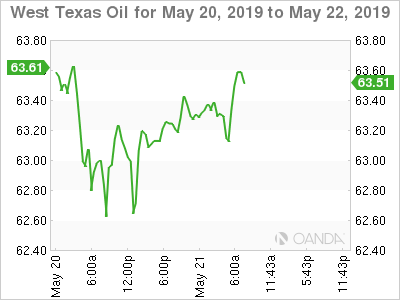
Oil remains better bid on escalating U.S-Iran tensions and amid market expectations that OPEC+ will continue to withhold supply this year. However, gains are been capped by investor concerns that a prolonged Sino-U.S trade war could lead to a global economic slowdown.
Brent crude futures are at +$72.18 per barrel, up +21c, or +0.3% from yesterday’s close. While West Texas Intermediate (WTI) crude futures are up +31c, or +0.5% at +$63.41 per barrel.
After a rocket attack in Iraq’s capital Baghdad yesterday, President Trump has threatened Iran with “great force” if it attacked U.S interests in the Middle East. Iran has said today “that it would resist U.S pressure,” declining further talks under current circumstances.
The crude market has already been tight, supported by OPEC+ withholding supply since the start of this year.
Note: An OPEC+ meeting has been scheduled for June 25-26 to discuss the policy, but the group is now considering moving the event to July 3-4, as the Studies signal a willingness to continue withholding output.
Prices have been capped by investor worries that the U.S and China are “digging in for a long, costly trade war” that could result in a broad global slowdown.
Ahead of the U.S open, gold prices have eased a tad after touching their two-week low yesterday, on increasing bets that the Fed will ‘not’ cut interest rates this year which is supporting the USD and hurting the ‘yellow metals’ safe-haven appeal. Spot gold edged -0.1% lower to +$1,275.81 per ounce, while U.S gold futures have also eased -0.1% to +$1,275.40 an ounce.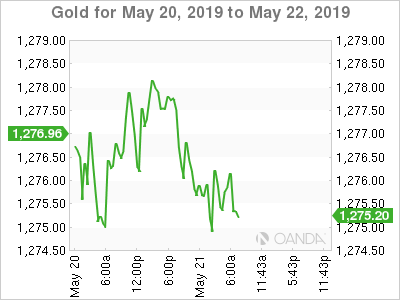
3. German Bund yields edge up but remain in negative territory
German 10-year Bund yields have backed up a tad, but remain comfortably in negative territory, as range-trading continues. Macroeconomic and political risks have been sovereign bonds key drivers, with supply emerging as another potential mover. The 10-year Bund yield trades at -0.08%, up +0.6 bps.
E.U bond issues have seen strong demand this year given a backdrop of weak economic growth and expectations that the ECB will maintain its “ultra-easy” monetary policy stance for the foreseeable future.
Global yields have fallen sharply on the back of renewed U.S./China trade tensions and Brexit uncertainty, however, a perception that central banks will have to take further action to support means that any rise in yields should be limited for now.
Elsewhere, the yield on U.S 10-year Treasuries is unchanged at +2.42%, the highest in more than a week. In the U.K, the 10-year Gilt yield has gained +1 bps to +1.067%, while in Italy, the 10-year BTP yield increased +1 bps to +2.709%.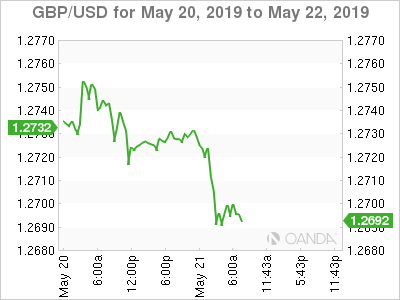
4. Cable falls to new five-month low
The ‘big’ dollar is holding atop of its three-week high as we head stateside, supported by higher U.S yields and as intensifying trade frictions between the U.S and China support investors’ appetite for the “safe-haven” greenback.
Sterling (£1.2693) has dropped to a new five-month low as PM May faces her cabinet ministers today in a last effort to convince them to support her Brexit deal. MP Rees-Mogg says he will not be backing her Withdrawal Agreement Bill, saying it is a “very bad deal.” The pound remains the worst-performing currency in the G10 this month. PM May is also expected to update her cabinet on the progress of cross-party talks with the Labour party which ended last week.
Note: May’s Conservatives are expected to experience a defeat of “historic proportions” at this week’s EU parliamentary elections on May 23.
Down-under, the Reserve Bank of Australia (RBA) minutes overnight revealed a softening in language with outlook “less favorable” with an easing policy in the next six-months. RBA Governor Lowe said the “board will consider the case for a rate cut in June.” AUD is -0.39% lower at A$0.6880.
TRY (-0.31% at $6.0455) is weaker after the CBoT lowered the swap market lira interest rate and opened a repo auction for the first time in a fortnight, reversing a policy tightening step it had taken to support the currency.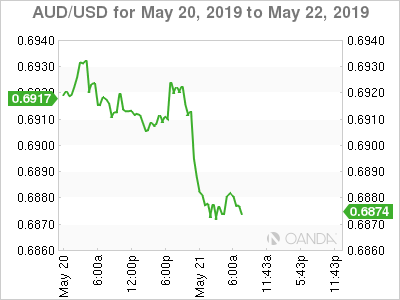
5. U.S/China need to reverse course in trade row to help economy
According to a report by the OECD this morning, economic growth in China and the U.S could be -0.2-0.3% lower on average by 2021 and 2022 if the “two countries do not row back on tit-for-tat tariffs” in their dispute that has dampened the global economic outlook.
In its biannual Economic Outlook, the OECD said that “the global economy would grow by only +3.2% this year as growth in trade flows is nearly halved this year to only +2.1%.”
That would be the slowest pace of global economic growth in three years and was down marginally from their last forecast in March for growth of +3.3%.
However, they expect the world economy “should fare slightly better next year with a growth rate of +3.4%, but only if the U.S and China pull back from tariff hikes announced this month.”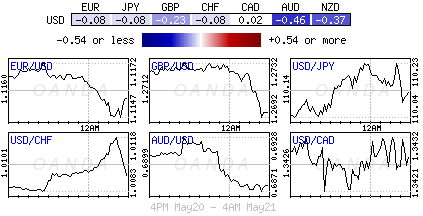
USDTRY Outlook: Turkish Lira Stabilizes On CBRT’s Easing, All Eyes On Q1 GDP
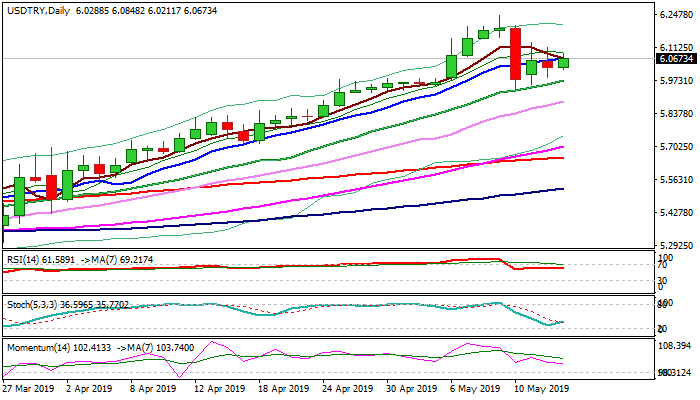
The Turkish lira stabilizes within narrow range between rising 20SMA and south turning 10SMA, with threats of fresh weakness following post-intervention rally, fading.
The CBRT's decision to undo tightening and lower interest rates by 150 bp to 24% provides temporary relief.
The step can be argued by current economic situation in the country, however, the situation in the market is not supportive for such decision.
The central bank aimed to stabilize the national currency ahead of release of Turkey's Q1 GDP data on 31 May, as the country slipped into recession in 2018 (Q4 -3.0%), as further negative results would additionally weigh on lira.
USDTRY's overall picture is bullish, but bulls lost pace following last week's pullback from new 2019 high.
Further negative signals can be expected on sustained break below rising 20SMA (6.0178) and 30SMA (5.9366), but reversal signal would require deeper fall and close below 5.8851 pivot (Fibo 38.2% of 5.3037/6.2445).
Conversely, eventual close above 10SMA (6.0596) would risk further extension of recovery from post-intervention low at 5.9378.
Res: 6.0912, 6.1274, 6.2018, 6.2445
Sup: 6.0177, 6.0000, 5.9864, 5.9378
ECB de Guindos: Slower growth momentum increases tail risks
ECB Vice President Luis de Guindos urged Eurozone banks to build extra capital buffers to mitigate the risk of unexpected shocks. He said "the slower growth momentum we are seeing increases the risk of tail events, in other words, shocks that are unlikely to occur, but would have a significant impact on the financial system and the economy if they did."
"The continued build-up of buffers could therefore be justified, especially in those countries where the long upturn may have led to an underestimation of credit risk or where private indebtedness is particularly high or rising."
UK CBI: Investment down, stockpiling up, threat of a no-deal ever present, viable Brexit deal desperately need
UK CBI trends total orders dropped to -10 in May, down from -5 and missed expectation of -5. 23% of manufacturers reported total orders books above normal. 32% said they were below normal. The -10 balance was the worst since October 2016, but stayed broadly in line with long-run average of -13.
Anna Leach, CBI Deputy Chief Economist, said: "With investment down, stockpiling up, and the threat of a no-deal ever present, we desperately need parliament to thrash out a viable deal in the national interest. Where the cross-party talks failed, Parliament must succeed, or continued economic paralysis will see us hurtle ever closer to disaster."