Sample Category Title
What Is Next After SEC’s Bitcoin ETF Decision?
It was largely expected in the market that the United States Securities and Exchange Commission isn’t going to bring the Christmas early for Hodlers. In their latest decision on the Bitcoin ETF, the department decided to kick the can down the road. They used the same lame excuse for gathering more information.
On May 20, the SEC delayed its decision on the VanEck bitcoin ETF and added another 35 day period of gathering more information. The SEC’s decision should not be taken as a negative sign for two reasons: firstly, they have not denied the approval, so there is still hope. Finally, the SEC wants to gauge the public opinion on this, and the only reason Bitcoin is still alive today is because of the massive support it has among its community.
Thus, it may be appropriate to think that approval of Bitcoin ETF is only a matter of time and the day isn’t too far when the sun will shine. In other words, bears need to recalibrate their thinking. The fact is that the United States Securities and Exchange Commission in no rush to take any hasty steps in relation to the approval of the Bitcoin ETF. They can continue to keep kicking the can down the road as many times as they like. This is because there is no hard and fast rule for such. For the SEC, the most important thing is to take appropriate measures in order to reduce the risk to the financial system, and in order to achieve this, if they have to delay the approval process, so it be.
For now, the SEC is going to remain in the information gathering mode and they will continue to assess the volatility of Bitcoin. Speaking of volatility, one major use case of Bitcoin futures among professional traders is that they utilize the Bitcoin futures in market neutral strategy. What I mean by that is when these professional traders are involved in Credit Default Swaps products and their strategy is market neutral, they use Bitcoin futures to increase the delta in their strategy and this enables them to earn money because of higher volatility.
Remember it wasn’t long ago when Bitcoin futures hit the record level of 33,700 contracts with a notional value of nearly $1.23 billion and this happened on the heal of higher volatility. It is also important to keep in mind that Bitcoin isn’t the beast which is known for its higher volatility only because there is a strong evidence of suppressed volatility period as well. In fact, there had been a few periods when Bitcoin’s volatility was lower than the NASDAQ index.
For the last few days, especially after the consensus event over in New York, we have witnessed lower volatility for Bitcoin, and it appears that the price has entered in a consolidation mode. For now, the resistance of $8,300 is strong, and the price needs some strong catalyst to continue its move towards the 10K level.
Nonetheless, the major question is how the future SEC decision can impact the price of Bitcoin in the future?
Well, there are three scenarios which are of significant importance: firstly, if the SEC continues to keep kicking the can down the road, it is likely that the price will remain in some sort of range. Basically, more of the consolidation period. Secondly, if and whenever the SEC delivers a negative verdict on the ETF, it is likely to push the price lower and the previous support levels will gain the most amount of attention. These major support levels are $6,000, $5,000, $4,000 and $3,130.
Finally, if the SEC decides that it is about time to let things go and turn on the green light for the Bitcoin ETF, it will create a major FOMO, Fear Of Missing Out, among investors which could lead the price ripping to the upside.
AUD/USD Outlook: Dovish RBA Pushes Aussie Towards New Multi-Month Low
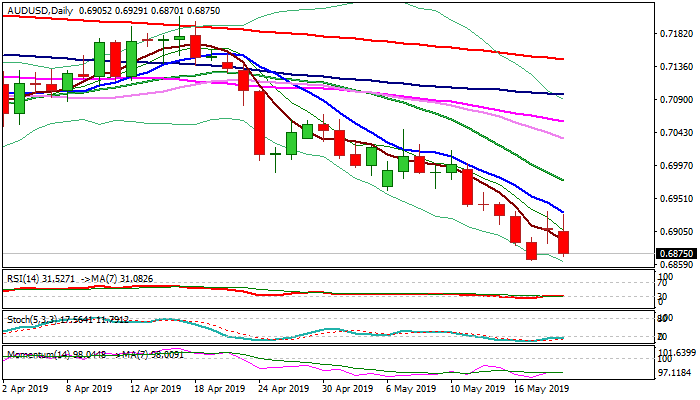
The Australian dollar fell back towards last Friday's new 4 ½ month low on Tuesday, following dovish stance from RBA.
Central bank's Governor Lowe pointed to rate cut on next month's meeting that would boost hiring to lower unemployment rate, in attempts to push inflation towards its target levels.
The RBA already lowered its GDP growth forecast, warning of weakening Australian economy.
Fresh easing filled Monday's gap, after short-lived rally on surprise election results stalled under key barriers at 0.6940 zone (Fibo 38.2% of 0.7068/0.6864 / falling 10SMA), shifting near-term focus back to the downside after Monday's action ended in long-legged Doji.
Dovish RBA adds to existing negative sentiment as overall picture is bearish.
Bears look for retest of 0.6864 low, violation of which would signal continuation of larger downtrend towards initial support at 0.6845 (Fibo 76.4%) and possible further bearish acceleration as below 0.6845 there are no obstacles on the way towards 0.6706 support 3 Jan spike low).
Caution on oversold daily stochastic which may slow bears.
Res: 0.6893, 0.6913, 0.6932, 0.6942
Sup: 0.6864, 0.6845, 0.6750, 0.6706
Dovish RBA Sinks Aussie, Dollar Shines
- Aussie gives up election gains as RBA rate cuts come in focus
- US calms nerves by temporarily easing sanctions on Huawei
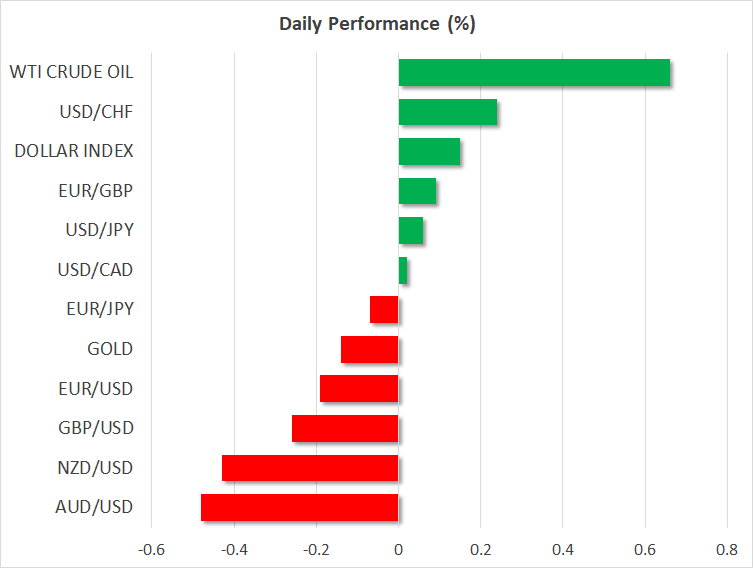
- Dollar advances as other currencies lose shine
Aussie reverses lower as RBA rate cut bets soar
The election-related boost that the aussie received yesterday proved short-lived, with the currency giving back nearly all its gains early on Tuesday, following the release of minutes from the latest RBA meeting and some remarks by Governor Lowe. The minutes played up the prospect of a rate cut unless the labour market improves substantially, while Lowe clearly stated they'll consider cutting rates at the next meeting on June 4.
Recall that employment data were released after this latest meeting took place and disappointed, so investors saw this as all but confirming rates will be cut next month. The implied probability for such action soared to ~75%, from roughly a coin flip earlier. Indeed, a cut looks quite likely, otherwise Lowe would have refrained from providing such explicit signals. Combined with the risk for more ‘posturing' in the US-China trade saga, speculation for a cut could keep the aussie under pressure heading into the June gathering.
The kiwi is also down today, largely in sympathy to the aussie, as there haven't been any headlines out of New Zealand.
Stocks drift lower amid resurgent trade worries
In the broader market, concerns that China will soon retaliate against the blacklisting of Huawei weighed on US equities, with the likes of the S&P 500 (-0.67%) being dragged down by tech heavyweights such as Apple (-3.13%). The mood has improved today, with Chinese markets closing in the green and US stock futures pointing to a positive open, following news that the US will temporarily ease some restrictions on Huawei to minimize disruption for the company's existing customers.
Besides seeking to limit disruptions, this may also be an olive branch by the Trump administration aimed at restarting negotiations. However, rhetoric out of China has grown increasingly confrontational lately, with Beijing vowing that it won't be bullied and that it will retaliate to recent actions, so the risks still seem skewed towards more escalation. Hence, the worst may not be over for risky assets like stocks or trade-sensitive currencies such as the aussie and kiwi.
Dollar climbs as investors flee other currencies
The world's reserve currency continues to outperform most of its major peers, with the dollar index once again approaching the 2-year highs it recorded last month. The reasoning is quite simple: the US isn't perfect, but its economy is in much better shape than its key counterparts. In this sense, the outlook for the dollar remains bright overall, even in the face of market speculation for Fed rate cuts.
For the dollar to weaken, one of the gloomy narratives in the other major economies needs to change substantially, with the most important being the European growth story. In that respect, the euro area PMIs – due on Thursday – could play a pivotal role in deciding whether the dollar will remain ‘king' of the FX market for a while longer, or whether the euro can start regaining some of its shine.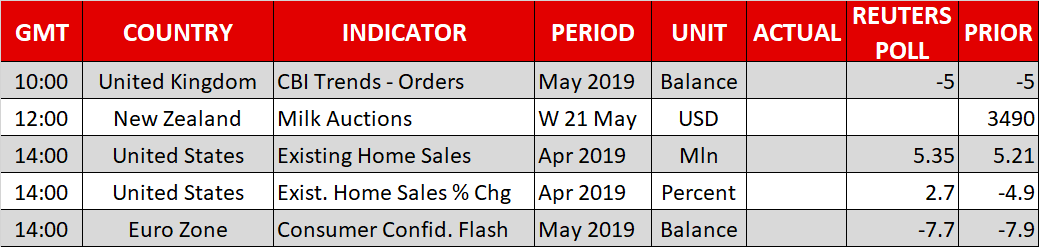
Gold Eases As Geopolitical Tensions Soften
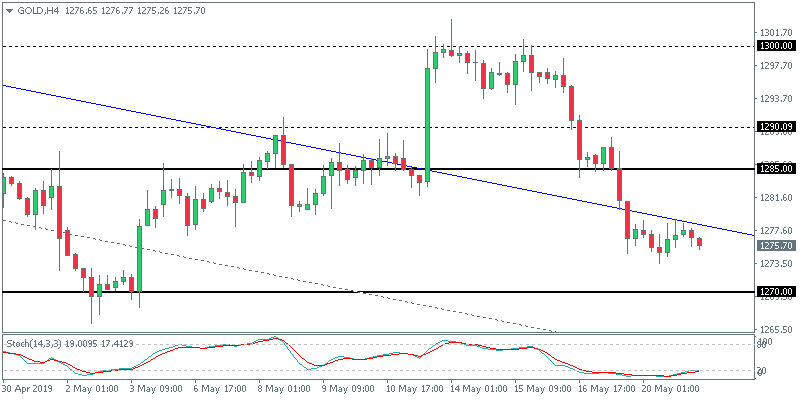
Gold prices continued to retreat as trade tensions eased. In the overnight session, Fed Chair, Jerome Powell was speaking at an event. However, his speech did not impact the markets much. Powell mostly discussed the corporate debt levels in the US and that the Fed was keeping a steady watch to assess any risks.
XAUUSD Closes with a Doji
Gold prices were trading flat on Monday as price action closed with a doji near the 200- day moving average. Price action indicates a potential rebound unless gold extends declines sharply below the current levels. The lower support at 1270 could temporarily hold the declines. To the upside, a retest of the 1285 level for resistance could confirm the downside bias in gold
GBP Awaits Further Clues
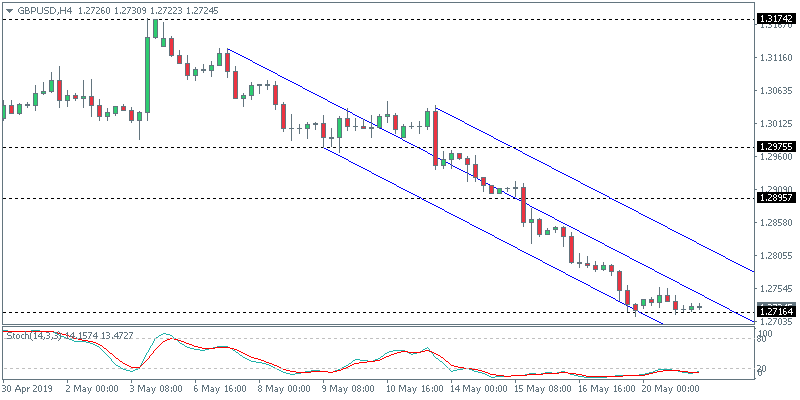
The British pound continued its descent, but price seems to have steadied for the moment. Economic data remains sparse with only the inflation report hearing due later in the day. This comes ahead of the inflation due later in the week. Headline inflation is forecast to rise 2.2% on a year over year basis in April. Stalemate on Brexit talks continues with no agreement in sight within the UK's parliament.
Can GBPUSD Hold Steady Near Current Lows?
The GBPUSD has been consolidating near the support level of 1.12716. While the Stochastics oscillator remains very oversold, there is scope for an upside bounce. A close above 1.2755 could potentially confirm a corrective move. The initial target is seen at 1.2897 followed by 1.2975.
Tariff Hikes Remain a Concern for the Eurozone
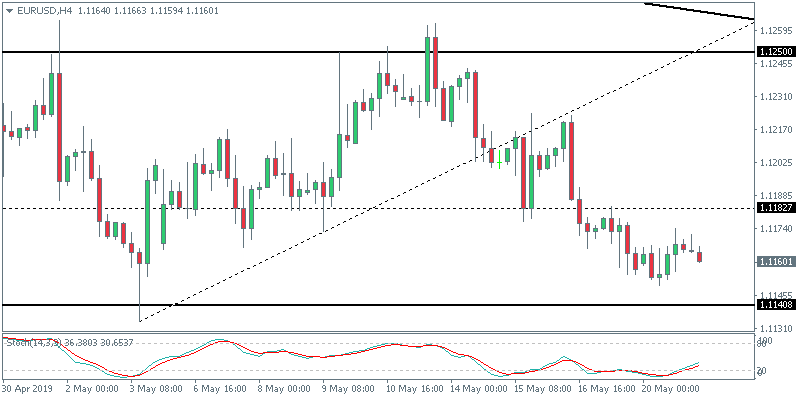
Although the US administration put off the potential hike in tariffs on European automobile imports, concerns still remain. Compared to the 22% duty on US car imports to the eurozone, the US currently has a 2.5% duty on automobile imports. Concerns about a hike in tariffs saw the European equity markets closing in the red on Monday.
EURUSD Stays Subdued
Price action in the EURUSD currency pair was subdued on Monday. The euro managed to close with some modest gains forming a possible spinning bottom pattern. A bullish follow- through is required in order to confirm a short term correction to the upside. Price is, however, likely to extend lower to test the 1.1140 support.
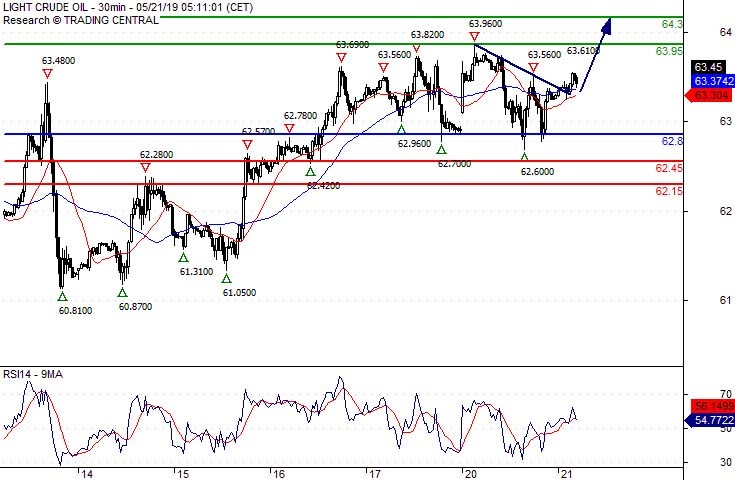
Crude Oil 64.30 Expected
Pivot (invalidation): 62.80
Our preference Long positions above 62.80 with targets at 63.95 & 64.30 in extension.
Alternative scenario Below 62.80 look for further downside with 62.45 & 62.15 as targets.
Comment The RSI is bullish and calls for further upside.
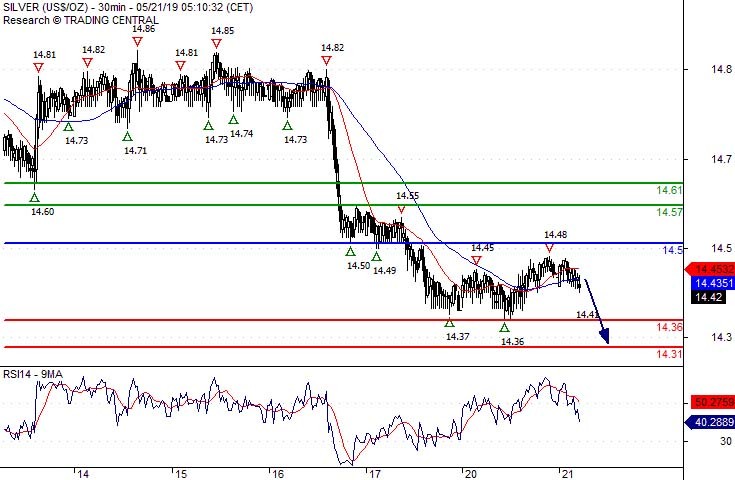
Silver Spot 14.3100 Expected
Pivot (invalidation): 14.5000
Our preference Short positions below 14.5000 with targets at 14.3600 & 14.3100 in extension.
Alternative scenario Above 14.5000 look for further upside with 14.5700 & 14.6100 as targets.
Comment As Long as 14.5000 is resistance, expect a return to 14.3600.
BoJ Kuroda: Persisting US-China trade war has widespread impact of global and Japanese economies
BoJ Governor Haruhiko Kuroda warned of the impact of US-China trade war again in the parliament today. He said "if trade tensions persist, they would have a widespread impact on global and Japanese economies via business sentiment and market developments." And, "we hope the United States and China engage in constructive discussions."
Finance Minister Taro Aso also told the parliament that "we're seeing some manufacturers delaying capital expenditure plans." However, "corporate profits are high and the fundamentals supporting domestic demand remain solid."
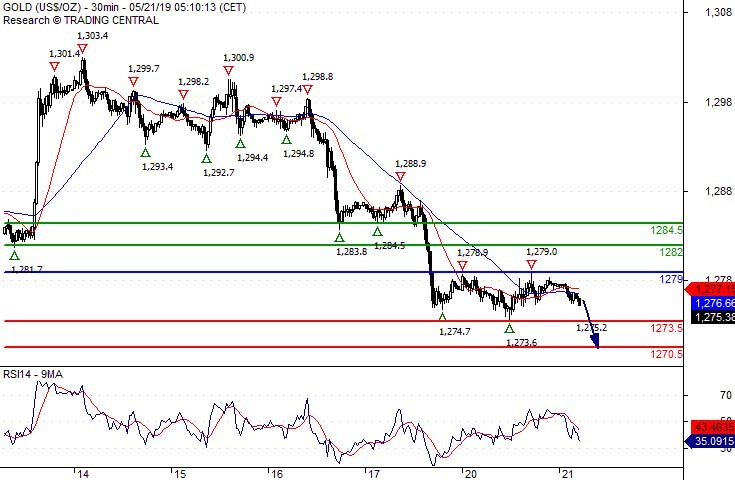
Gold Spot Key Resistance At 1279.00
Pivot (invalidation): 1279.00
Our preference Short positions below 1279.00 with targets at 1273.50 & 1270.50 in extension.
Alternative scenario Above 1279.00 look for further upside with 1282.00 & 1284.50 as targets.
Comment A break below 1273.50 would trigger a drop towards 1270.50.