

Sample Category Title
AUD/USD Bears Market
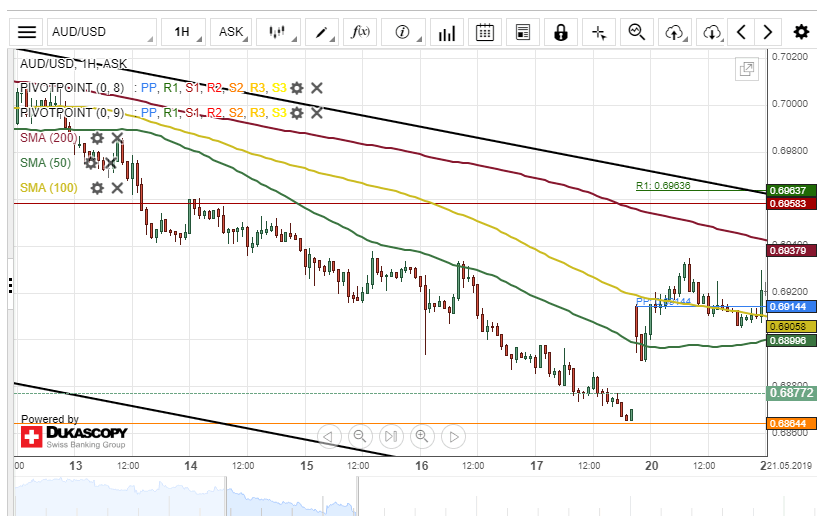
During the last 24 hours, the Australian Dollar has depreciated about 62 base points against the US Dollar. Bears have regained their lost positions during the morning hours of today's trading session.
As for the near future, it is likely that the currency exchange rate will continue its downward movement. The potential downside target will be near a support level at 0.6820.
However, a support line formed by the monthly S2 at 0.6864 could hinder bears from driving the AUD/USD further south.
USD/CAD Sets For Breakout
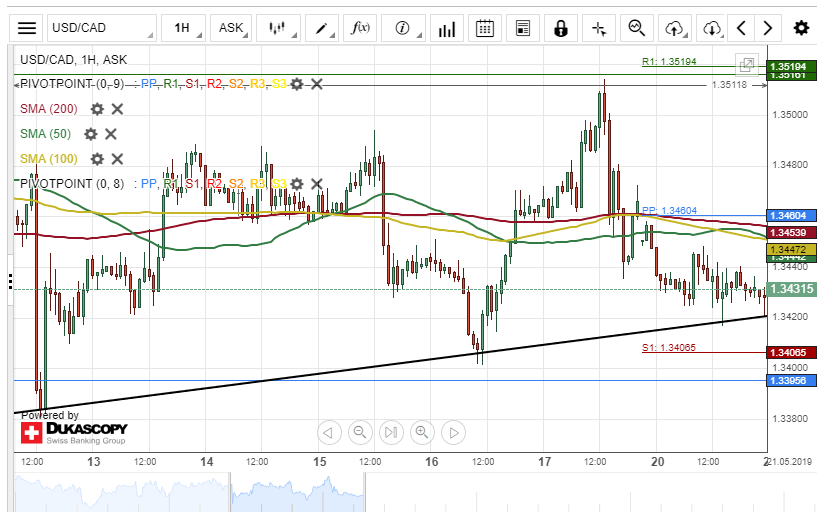
The US Dollar traded with low volatility against the Canadian Dollar on Monday. The currency pair breached the lower boundary of a medium-term ascending channel pattern at 1.3420.
A breakout through the bottom border of the medium-term descending channel pattern could be expected within this session.
If this breakout occurs, a decline towards the weekly and the monthly pivot points at 1.3395 might be the target.
However, if the channel pattern holds, the currency exchange rate could aim for a resistance level formed by the 50-, 100– and 200-hour SMAs at 1.3448 today.
NZD/USD Moving Towards Target
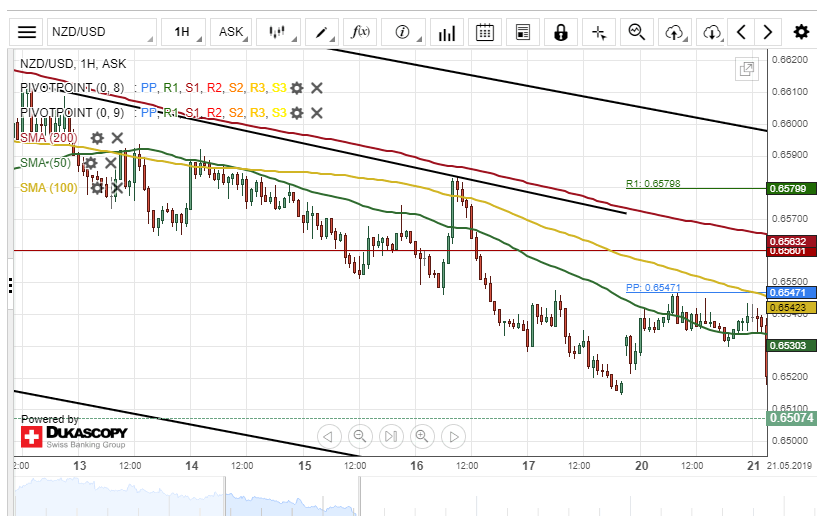
The New Zealand Dollar has depreciated about 43 base points against the US Dollar since yesterday's trading session. The currency pair has been guided by the three moving averages since May 14.
As for the near future, it is likely that the NZD/USD exchange rate will continue its downward swing in the short term. The pair might aim for a support cluster formed by the weekly and the monthly pivot points at 0.6452.
Bearish traders might push the currency exchange rate towards a support level set by the weekly S1 at the 0.6485 area today.
EUR/USD Likely To Trade Down
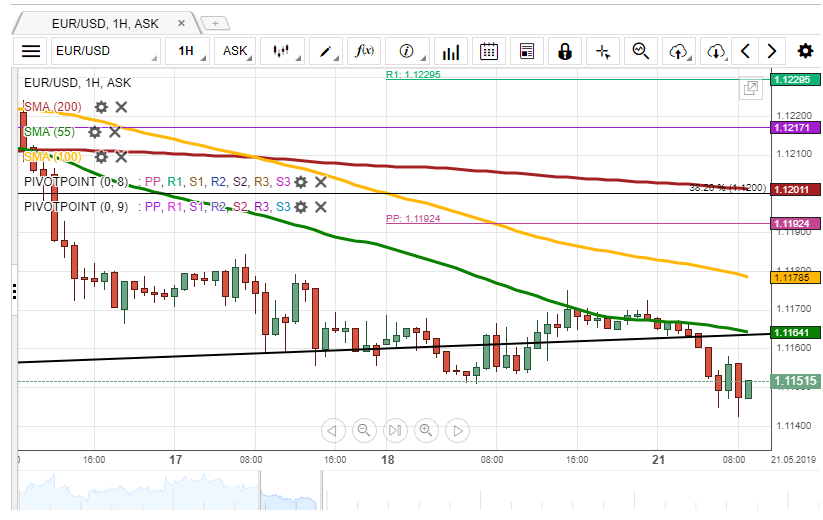
During Monday's trading session, the EUR/USD currency pair tried to breach the short-term ascending channel south. During today's morning, the pair declined to the 1.1150 mark.
Given that the exchange rate is pressured by the 55-hour moving average, it is likely, that bears could continue to prevail in the short run. Note, that the nearest support level is located at the 1.1124 level.
It is unlikely, that some upside potential could prevail in the market in the nearest future due to the resistance cluster formed by the 100– and 200-hour SMAs, as well the weekly PP and the Fibo 38.20% in the 1.1180/1.1200 range.
GBP/USD Could Trade Sideways
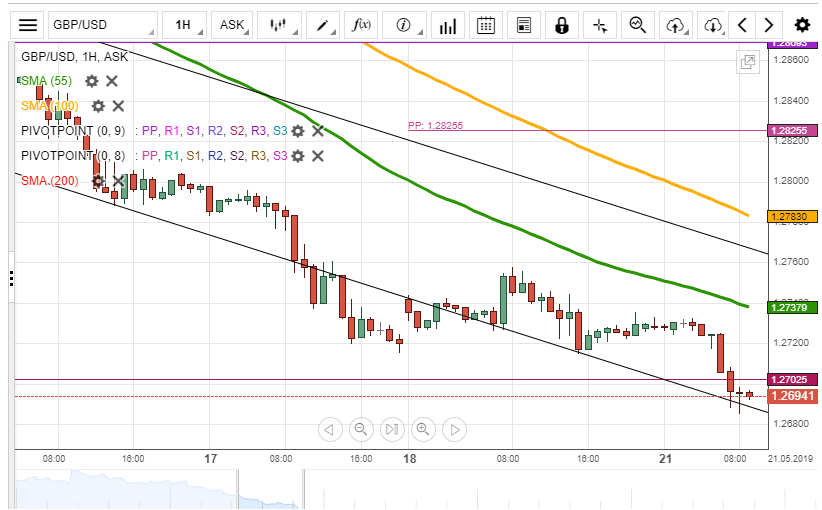
Yesterday, the GBP/USD exchange rate traded sideways around the 1.2740 level. During Tuesday's morning, the rate traded near the 1.2720 mark.
Note, that the rate is squeezed by the monthly S2 and the 55-hour moving average, located at 1.2703 and 1.2743 respectively. If the given resistance and support hold, it is expected, that the currency pair continues to trade sideways.
However, if the given support does not hold, it is expected, that some downside potential could prevail in the market. A possible bearish target is the psychological level at the 1.2650 mark.
USD/JPY Tests Short-Term Channel
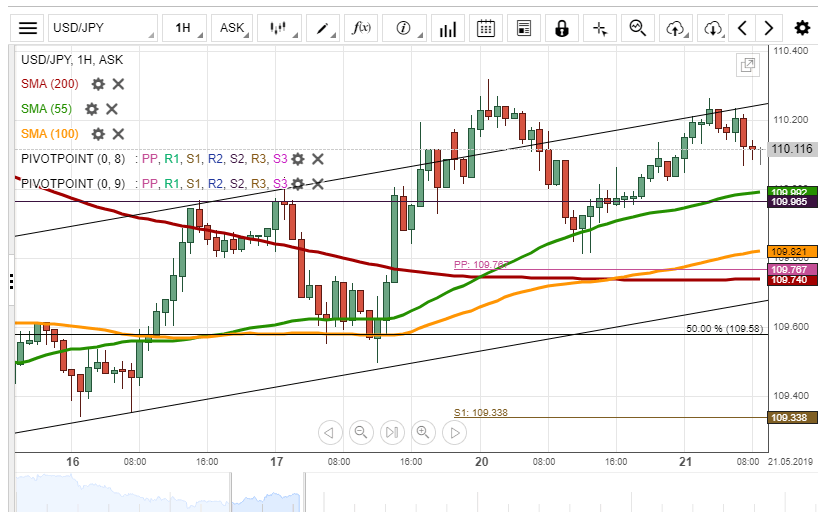
On Monday, the USD/JPY currency pair went upwards and reached the upper boundary of the short-term ascending channel at 110.20. During today's morning, the pair was testing the given line.
From a theoretical perspective, it is expected, that a reversal north could occur in the nearest future. In this case, the exchange rate would be supported by the 55-hour SMA and the monthly S2 at 109.97.
However, if the given channel does not hold, a breakout north could occur in the following hours. The pair could surpass the 110.40 level. Note, that the nearest resistance level is the weekly R1 at 110.51
XAU/USD: Two Scenarios Likely
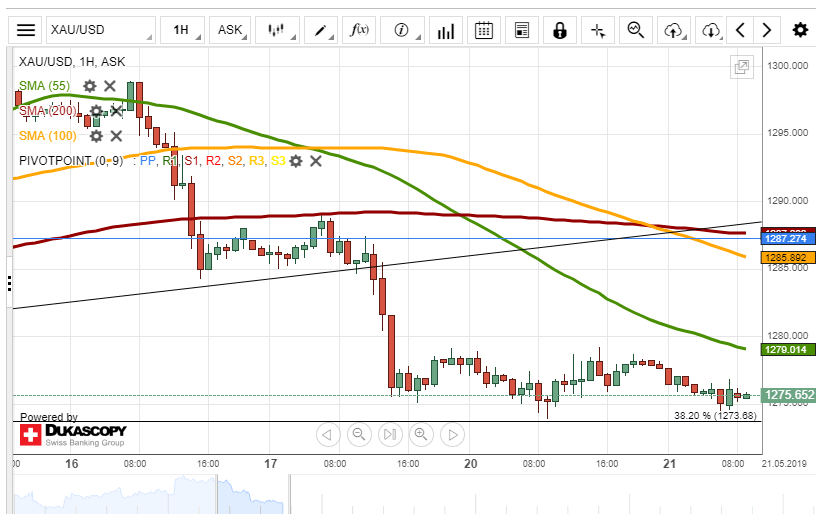
Yesterday, the XAU/USD exchange rate traded sideways between the Fibonacci 38.20% retracement at 1,273.68. and the 1,280.00 level.
Given that gold is pressured by the 55-hour moving average, currently located at 1,279.39, it is unlikely, that bulls could prevail in the market in the short term.
If the given support level holds, it is expected, that the price for gold could maintain its consolidation.
Otherwise, it is expected, that some downside potential could prevail in the market, and the rate could target the psychological level at 1,270.00.
GBP/USD Outlook: Pound Extends Weakness Below 1.2700 Handle
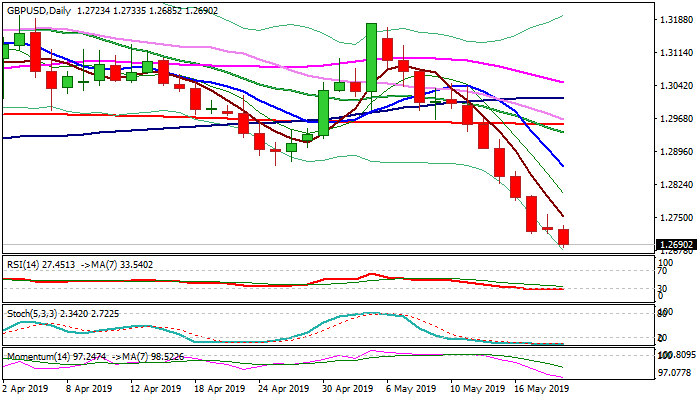
Cable accelerated lower on Tuesday after bears took a breather for narrow consolidation on Monday.
Fresh weakness probes below 1.2700 round-figure support and eyes target at 1.2668 (15 Jan spike low), driven by persisting fears of no-deal Brexit.
Additional pressure comes from concerns about who will replace Theresa May as Prime Minister, as betting favorite to win, Boris Johnson, supports scenario of leaving EU without a deal.
Weak sentiment and bearish daily/weekly techs can push pound lower, as bears may accelerate on triggering stops below 1.2668.
Oversold daily studies warn of adjustment, but without firmer signals for now.
Broken key Fibo support at 1.2773 (61.8% of 1.2397/1.3381) now marks solid resistance which should ideally cap upticks.
Res: 1.2733, 1.2753, 1.2773, 1.2801
Sup: 1.2668, 1.2629, 1.2615, 1.2580
AUD Weakens On Prospect Of RBA Rate Cut
The Aussie weakened during today's Asian session, as both the RBA meeting minutes and Governor Lowe send dovish signals. The minutes implied that an interest rate cut would be appropriate if there is no further improvement in the labour market. The minutes seem to have also skipped the line that there is “no strong case” for a near term move in policy. Later on, RBA governor Philip Lowe in a speech more or less confirmed what traders suspected, that the bank would consider a rate cut in its June meeting, providing a second hit for the Aussie. We maintain a bearish outlook for the Aussie especially against the USD, as the prospect of a rate cut and intensifying trade wars could weaken further the currency. AUD/USD dropped during today's Asian session, distancing itself from the 0.6925 (R1) resistance line. Given the bearish momentum of the pair's price action we could see it retreating further, reopening a bearish leg. Should the pair remain under the selling interest of the markets, we could see it breaking the 0.6840 (S1) support line and aim for lower grounds. Should the pair's long positions be favoured, we could see it breaking the 0.6925 (R1) resistance line and aim for the 0.7000 (R2) resistance level.
USD remains strong amid deepening trade frictions
The USD remains strong against a number of its counterparts, as trade tensions between the US and China seem to rise further. The USD Index remained near last month's 2 year high as it also got a slight boost from rising treasury yields. On the contrary, Fed Chairman Powell's contribution was little to the rise of the USD, as he said in speech early this morning that it was premature to make judgement about the impact that trade and tariffs would have on monetary policy. On the flip side, BoJ's Governor Kuroda send out a clear warning that escalating U.S.-China trade tensions could hurt business sentiment and inflict widespread damage on the economy. In the latest episode of the US-Sino trade wars, China's Huawei seems to be the next victim as Google is about to stop providing software updates required for its software. We expect the USD to currently maintain the role of a safe haven and could get some further support. USD/JPY maintained a sideways motion, between the 110.30 (R1) resistance line and the 109.75 (S1) support line. We could see the pair maintaining a range bound motion in the next couple of days, yet it may prove sensitive to any new headlines about trade frictions and financial releases. Should the bulls dictate the pair's direction, we could see the pair breaking the 110.30 (R1) resistance line and aim for the 110.90 (R2) resistance level. Should the bears take over, we could see the pair breaking the 109.75 (S1) support line and aim for the 109.15 (S2) support level.
Other economic highlights, today and early tomorrow
In the European session, we get UK's CBI trends for May. In the American session, we get the number of US existing homes sold for April and Eurozone's preliminary consumer confidence for May. In tomorrow's Asian session we get Japan's trade balance for April and machinery orders growth rate for March. As for speakers, please note that ECB's De Guidos, Chicago Fed President Evans, Boston Fed President Rosengren and BoJ's Harada are scheduled to speak.
AUD/USD H4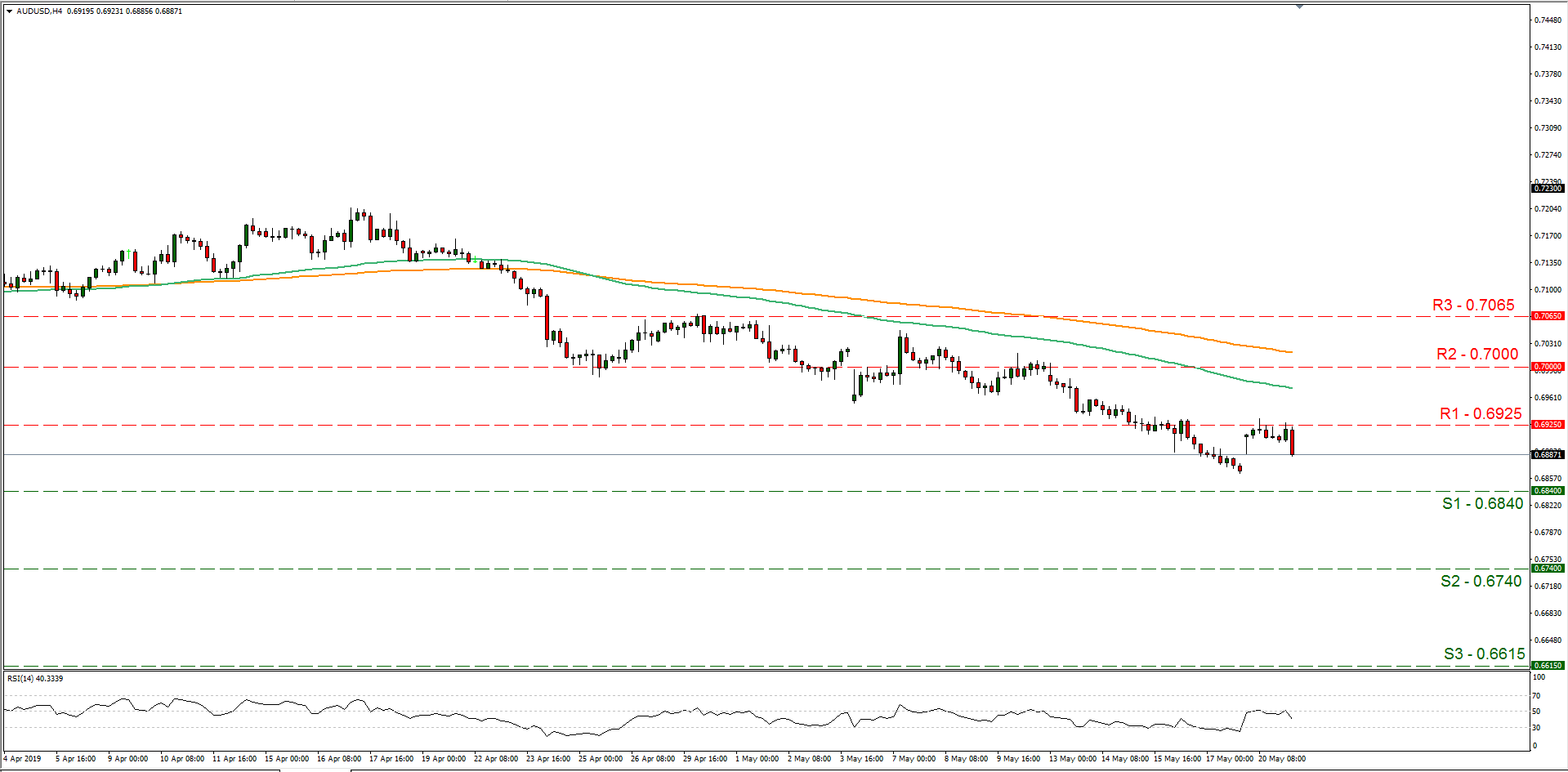
Support: 0.6840 (S1), 0.6740 (S2), 0.6615 (S3)
Resistance: 0.6925 (R1), 0.7000 (R2), 0.7065 (R3)
USD/JPY H4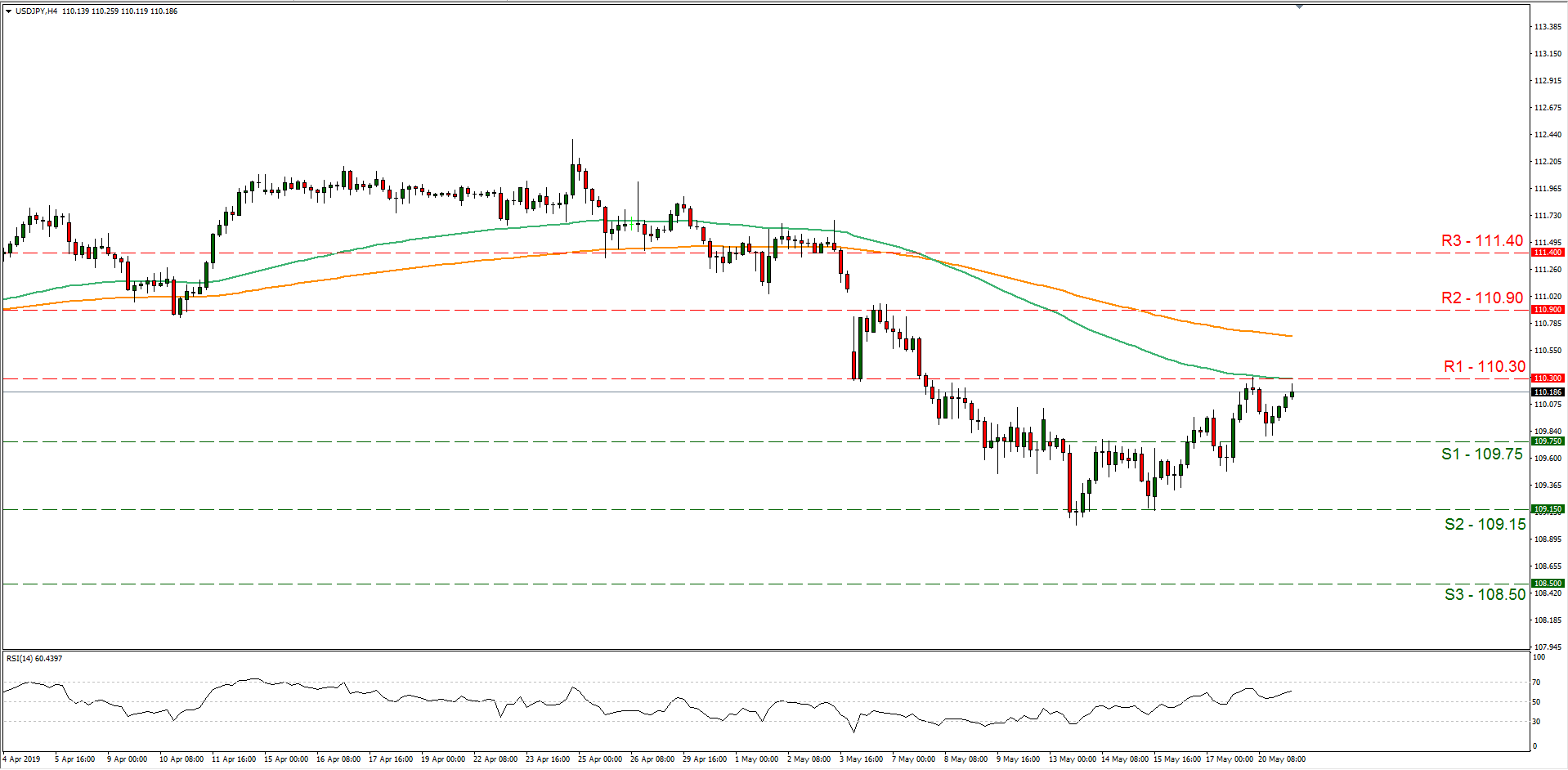
Support: 109.75 (S1), 109.15 (S2), 108.50 (S3)
Resistance: 110.30 (R1), 110.90 (R2), 111.40 (R3)
Westpac Moves Rate Profile Forward to June and August
Westpac has revised the forecast it released on February 21 that the RBA would cut the cash rate in August and November to June and August.
On February 21 Westpac forecast that the Reserve Bank would cut the cash rate by 50 basis points in two tranches – August and November. Since then markets and forecasters have largely moved in that direction.
We have not changed that forecast since that date.
However, today, we are announcing an adjustment to the forecast to bring forward the first cut to the June Board meeting with the second cut to follow in August.
We then expect the cash rate to remain on hold through 2020.
This change in forecast reflects the lift in the unemployment rate for April from 5.1% to 5.2% and the confirmation from the Governor that the Board would be closely following developments in the labour market with the primary focus on the unemployment rate.
The Governor’s thinking has evolved over the year to accept that, as we have observed in other countries, upside inflation risks are consistent with a lower unemployment rate than had previously been assessed. For Australia the Bank had believed that the key unemployment rate was 5% - he now accepts that he can drive the economy harder with an associated lower unemployment rate without risking any inflation overshoot.
Recall that the current forecast for the unemployment rate is 5% to end 2020, (falling to 4.75% by June 2021), based on market pricing, which in the May Board Minutes is assessed as “the cash rate was expected to be lowered by 25 basis points within the next three months and again by the end of 2019”.
In his speech “the Economic Outlook and Monetary Policy”, released today, he gives the strong guidance that “at our meeting in two weeks’ time, we will consider the case for lower rates".
Recall that other aspects of the Bank’s current forecasts are underwhelming despite the assumption around lower rates – 2.6% growth in 2019; 1.75% trimmed mean inflation in 2019; and 5% unemployment rate by end 2019.
With the June rate cut virtually locked in the issue is why we expect a follow up move in August.
Firstly, that timing is a little more aggressive than was used in the May SOMP and therefore could reasonably be associated with somewhat more optimistic forecasts.
Secondly, we expect that the June quarter trimmed mean inflation print (released on July 31) will be 0.4% indicating that underlying inflation will print 0.7% for the first half of 2019, making it difficult to persist with a 1.75% forecast for underlying inflation in 2019 – downgrading the underlying inflation forecast to 1.5% in 2019 will make it difficult for the RBA to credibly forecast a return to 2% inflation in 2020. The Bank may choose to persist with overly optimistic forecasts but will need to ease again to emphasise its inflation targeting credentials.
This second cut would also be consistent with the assumptions that have underpinned the May forecasts .
Key to Westpac’s rate cut forecast on February 21 was the expectation that the unemployment rate was likely to reach 5.4% by end 2019. Our work around the weakness in the cyclical parts of the labour market ( around 60% of employment) which is already apparent and recent trends in the business surveys signal that the softening in the labour market can be expected to become more apparent in the next few months.
We also expect that the March quarter GDP report (released June 5) will confirm the Bank’s recent downbeat assessment of the consumer ( consumer spending growth in 2019 revised down from 2.5% in February to 2.0% in May) and note that the May Minutes see downside risks to the consumption forecasts.
Note also that the May Minutes point to downside risks for the global economy and confirmed in today’s speech.
Looking further out it is important that the Governor stressed the importance of the exchange rate in the monetary policy transmission mechanism. Accordingly, in order to extract ongoing “dividend” from the rate cut cycle it seems likely that the August RBA decision will not preclude further action.
However, our current assessment is that with the housing market stabilising in 2020 and the RBA uncertain about the impact of sub 1% cash rate on the economy the eventual low point in the cycle will prove to be 1%. This view is consistent with our original call back in February this year.
Our forecast low point of USD0.68 for the AUD which printed in our report on February 21 was predicated on the two cuts – the change in the timing of the cuts does not materially affect that call.