

Sample Category Title
NIESR: Post-Brexit customs union means GBP 800 loss per person per year
The National Institute of Economic and Social Research (NIESR) published a report regarding the economic impact of post-Brexit customs union solution for the UK. Comparing with staying with in EU, the customs solution way will means around GBP 800 loss per person per year after 10 years.
The reported noted that "the terms on which the UK will trade with the EU after Brexit will not be as favorable to the UK as they are now". And, "this would discourage investment in the UK and ultimately mean that UK workers were less productive than they would have been if the UK had stayed in the EU.”
Also, NIESR economist Garry Young said "leaving the EU for a customs union will make it more costly for the UK to trade with a large market on our doorstep, particularly in services which make up 80 percent of our economy."
Kuroda: BoJ won’t do anything on exchange-rate, it’s MOF’s job
BoJ Governor Haruhiko Kuroda told parliament today that the biggest factor on markets' trust in Yen is BoJ's commitment to price stability. He said "currency rates move on various factors, so it’s hard to judge market trust in the yen by looking at exchange-rate fluctuations alone.” Instead, “confidence in the central bank’s policy is a big factor behind market trust in the country’s currency".
Kuroda also said BoJ is watching exchange-rate moves carefully. However, currency policy falls under the jurisdiction of the Ministry of Finance. Thus, "BOJ would not do something for exchange-rate stability".
RBNZ Orr: Get ahead of the curve with this week’s rate cut
RBNZ Governor Adrian Orr toned down the chance of another rate cut after yesterday's, as he addressed a parliamentary committee today. He noted that "at the moment we see in the outlook for interest rates as...balanced". Regarding yesterday's cut, Orr pointed out that “the reason for the cut is global economic growth has slowed." “Growth has come off rapidly in Europe, in China, though that’s stabilized more recently, and Australia ... so key trading partners.”
Separately, Orr also told the Morning Report that the cut was "sensible" as our "forward projection [showed] a lower rate. And the question for the committee was "do we wait or do we move now". Orr said "Moving now is the best choice for us as far as we consider because it means we get ahead of the curve - we aren't chasing the economy in cycles, we're actually getting ahead and removing the cycles."
AUD/USD Positioned In Downtrend Below 0.7050
Key Highlights
- The Aussie Dollar declined recently below the 0.7070 and 0.7040 supports against the US Dollar.
- A key bearish trend line is formed with resistance near 0.7030 on the 4-hours chart of AUD/USD.
- China’s Trade Balance posted a surplus of $13.84B, well below the $35.00B forecast.
- The US PPI in April 2019 could rise 0.2% (MoM), less than the last +0.6%.
AUDUSD Technical Analysis
After a close below the 0.7100 support, the Aussie Dollar extended losses below 0.7050 against the US Dollar. The AUD/USD pair corrected higher from 0.6967, but upsides remain capped below 0.7050.
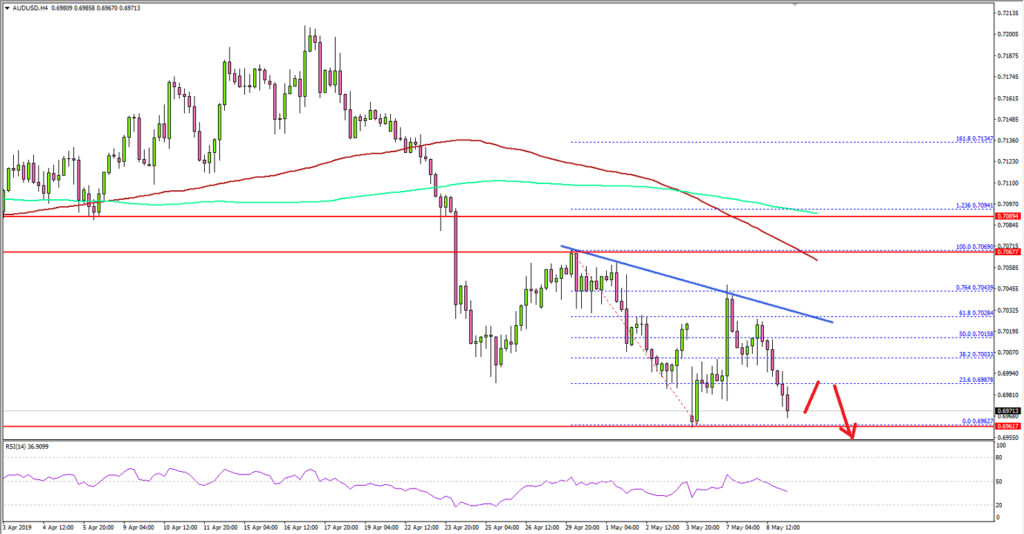
Looking at the 4-hours chart, the pair even traded below the 0.7000 support area in the recent decline. The price traded close to the 0.6960 level and settled well below the 100 simple moving average (red, 4-hours).
A swing low was formed at 0.6967 and recently the pair recovered above the 0.7000 level, and the 50% Fib retracement level of the last decline from the 0.7069 high to 0.6962 low.
However, AUD/USD struggled to surpass the 0.7050 resistance and failed near the 76.4% Fib retracement level of the last decline from the 0.7069 high to 0.6962 low. There is also a key bearish trend line formed with resistance near 0.7030 on the same chart.
Therefore, the pair could continue to struggle unless it rebounds above the 0.7030 and 0.7050 resistance levels. Still, there are many hurdles, waiting near 0.7070, the 100 SMA, 0.7090, and the 200 SMA (green).
Only a successful close above the 0.7100 level and the 200 SMA is likely to start a decent uptrend in the coming days. If not, there is a risk of more losses below 0.7000 and 0.6960 in the near term.
Fundamentally, China’s Trade Balance report was released by the General Administration of Customs of the People’s Republic of China. The market was looking for a trade surplus of around $35.00B in April 2019, up from the last $32.64B.
However, the actual result was well below the market forecast, as the trade surplus was only $13.84B. The last reading was revised from $32.64B to $32.67B. Exports of goods and services in April 2019 (YoY) were down 2.7%, whereas the market was looking for a 2.3% rise.
Clearly, there was a contraction, resulting in a minor downside reaction in EUR/USD, GBP/USD and AUD/USD. Overall, the US Dollar bulls still remain in control and both Euro and British Pound are facing many hurdles.
Economic Releases to Watch Today
- US Producer Price Index April 2019 (MoM) – Forecast +0.2%, versus +0.6% previous.
- US Producer Price Index April 2019 (YoY) – Forecast +2.3%, versus +2.2% previous.
- US Initial Jobless Claims – Forecast 220K, versus 230K previous.
Market Morning Briefing: Dollar Yen Is Nearing Our Mentioned Support Of 109.70
STOCKS
A confirmation on the US-China trade talks happening gave a breather to the US equities overnight. But Trump's comment that China has broken the deal in the on-going negotiation has triggered a fresh sell-off in the Asian markets in the early trades today. As the trade talk begins, volatility is guaranteed and we need to watch the market closely for the next couple of days to get a clarity on whether the corrective fall that has begun will extend into next week or not.
The support at 25850 on the Dow (25967.33, +2.24, +0.01%) is holding well for now. But a strong rise past 26250 is needed to bring back to positive sentiment. Else Dow will be vulnerable for a fall to 25500 or even lower.
DAX (12179.93, +87.19, +0.72%) can consolidate between 12100 and 12300 for some time before falling to 12000 and 11900.
Nikkei (21340.02, -236.66, -1.1%) has declined below 21500 and keeps the bearish outlook intact for a test of 21000 and 20900.
Shanghai (2874.10, -19.65, -0.68%) is continuing to move down but at a slower pace. Near-term view is negative for it to test 2850-2830.
Given the sell-off seen in the Asian markets early morning, Nifty (11359.45, -138.45, -1.20%) might break the support at 11350 and fall to 11300 and 11200 in the coming sessions. But in case if Nifty manages to hold above 11350, a corrective rally to 11420-11450 can be seen.
Sensex (37,789.13, -487.50, -1.27%) remains weaker than Nifty with strong resistance at 38100 and remains vulnerable to test 37500 and even 37000 in the coming days.
COMMODITIES
Surprising to see Gold not gaining momentum as a safe haven at this time on uncertainty which reflects the inherent weakness in it. The sideways range is intact and it can fall within this range in the near term. Copper remains bearish and can extend its fall in the coming sessions. Oil trades stable by getting support from the US Crude inventory data that showed a decrease in inventories by 4 million barrels as against the expectation for an increase of 1.2 million barrels.
Contrary to our expectation for a rise to 1300, Gold (1280.8) has come-off from 1292.8 itself. A fall to 1270-1266 looks possible again as the 1266-1292 range is still intact.
Silver (14.81) has failed to break the psychological level of 15 and looks vulnerable to test 14.70 in the coming sessions.
Copper (2.76) has declined below 2.78 and keeps the bearish outlook intact for a test of 2.70 in the short term.
WTI (61.69) oscillates around 62 and has equal chances for either a rise to 64 or a fall to 61-60.50 in the near term.
Similarly, Brent (69.01) can either move up to 71 or fall to 68 from current levels. But the broader picture remains bearish for Brent to break 68 and fall eventually to 66-65.
FOREX
All eyes on the US-China talks for the next 2-sessions of the week. Movements in Dollar Index and USDCNY is important and could impact the other currencies as well. Euro, Euro-Yen, Aussie, Rupee all looks weak against the US Dollar for the near term.
Dollar Index (97.62) has been trading along the support trend line on the daily candles and looks bullish in the near term targeting 98-99 on the upside.
Euro (1.1188) continues to hold stable for now and could be seen trading within the 1.1250-1.1100 region just now. A sharp rise in dollar Index from current levels, if seen could take Euro towards 1.11.
Euro-Yen (122.92) could test 122 or slightly lower in the coming sessions while it trades below 124. Near term looks weak.
Dollar Yen (109.87) is nearing our mentioned support of 109.70. It would be important to see if the pair manages to break below 109.70 as that would be significant and may indicate bearishness for the medium term. We would wait to see price confirmation at 109.70 to decide on further direction. Our preferred view would be a bounce from 109.70 but the US-JGB 10Yr spread (Refer interest rates section below) looks bearish and indicates a possibility of a further fall in Dollar Yen.
Aussie (0.6971) is unable to sustain above 0.70 and has fallen again to trade below 0.70. This is indicative of upcoming bearishness towards 0.6950-0.6900 in the near term. Only a sustained rise above 0.70 would keep the possibility of a rise towards 0.71 intact.
USDCNY (6.7940) is heading towards 6.81, the high seen in Jan’19 where a small pause could be seen. But overall in the medium to long term, there is scope of testing 6.85 before coming off from there.
Dollar-Rupee (69.72) closed near the day’s high yesterday. Note that 69.80 is a crucial resistance above current levels now which if holds could limit further sharp rise in Dollar Rupee. We would keep a close watch for any news from the US-China trade talks. Any trigger could take USDINR higher towards 70.Above 69.80, 70.25/50 would come into the picture.
INTEREST RATES
Overall bond yields are trading low and look bearish for the near term.
Slight bounce is seen on the US Yields. The 30Yr (2.88%), 10Yr (2.46%) and 5Yr (2.27%) are trading higher by 1bps but overall have scope of falling in the medium term. The corrective bounce seen just now is short lived as the yields would soon turn around to move down soon.
The German-JGB 10Yr (0.01%) has scope of falling towards -0.5% which if seen could pull down Eur-Yen further from current levels.
The US-JGB 10Yr (2.52%) ha scope towards 2.50/45% in the near term and looks weak just now. This is indicative of a bearish Dollar-Yen for the next few sessions.
The German yields are coming down from immediate resistances. The 5Yr (-0.46%), 10Yr (-0.043%) and the 30YR (0.602%) are down from -0.454%, -0.041% and 0.637% seen previously. Near term looks bearish for the German yields as the 5Yr, 10Yr and the 30Yr could target -0.48%, -0.07% and 0.57% respectively.
The UK yields are also falling and look bearish in the coming sessions. The 5YR (0.83%), 10Yr (1.14%0) and the 20Yr (1.58%) could fall towards 0.75%, 1% and 1.50% respectively. This could indicate a fall in Pound too in the near term.
The Indian 10Yr GOI (7.4695%) is trading above 7.45%. A break below 7.45% could take it lower to test 7.40% which is an important near term support.
Daily Markets Broadcast
Wall Street steadies with trade tariff threat finely balanced
US indices steadied at lower levels yesterday as Friday’s tariff threat deadline nears. China has threatened retaliation if the tariffs go ahead but at least they are still at the negotiating table. Crude oil held above $60 per barrel.
US30USD Daily Chart
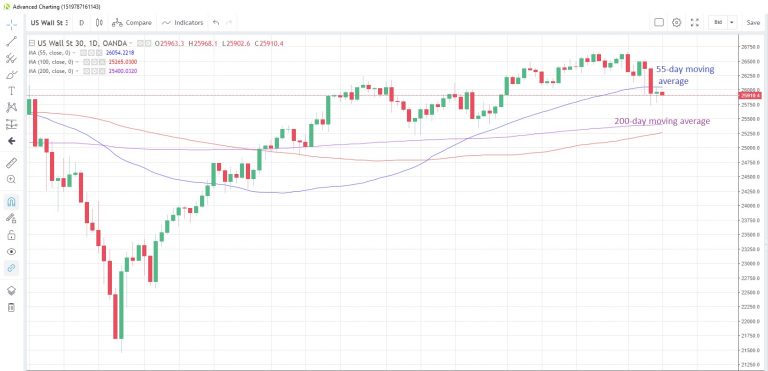
The US30 index clawed back early losses to snap a two-day losing streak yesterday after posting the biggest one-day loss in four months on Tuesday
The index is hovering below the 55-day moving average at 26,055 with the 200-day moving average at 25,400
The US trade deficit is expected to widen to $50.2 billion in March from $49.4 billion in February. Fed’s Powell is scheduled to speak at 12:30GMT.
DE30EUR Daily Chart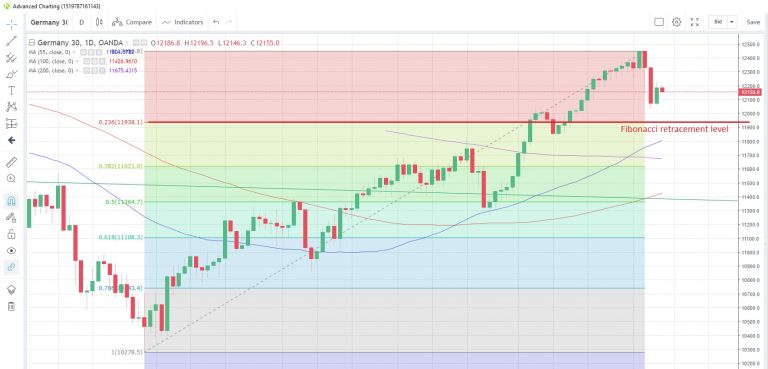
The Germany30 index snapped a two-day losing streak after industrial production data out of Germany beat estimates and echoed the positive shift in factory orders
The index is still holding above the 23.6% Fibonacci retracement of the rally since December at 11,938
There are no major German or Euro-zone economic releases scheduled for today. ECB’s Draghi said he will not accept defeat regarding the inflation target, nor will he change it.
WTICOUSD Daily Chart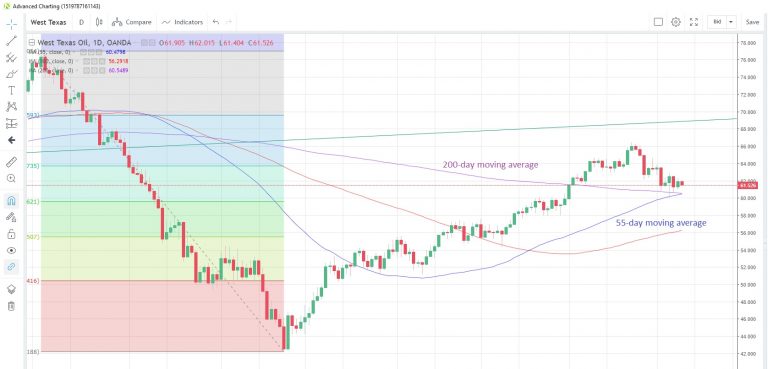
WTI rose yesterday as weekly official US inventory data showed a surprise drop. The rally has been tempered today somewhat after Saudi Arabia announced it would fill all the orders for June that it has, including from those countries that used to buy from Iran
Oil held above the 200-day moving average at 60.55, as it has on a closing basis since April 1. The 55-day moving average looks poised to cross above the 200-day moving average this week
EIA crude stocks fell by 3.96 million barrels in the week to May 3, data released yesterday showed.
Neutrality Is Not Stability
Neutrality is not stability
A sense of uneasy calm pervades the financial markets ahead of the resumption of the US-China trade talks in Washington today. Judging by the overnight price action, most asset classes appear to have reached a point of neutrality as the street moves to wait-and-see mode. That said, from here the markets could move sharply, either way, depending on the news flows, with equities and oil the most vulnerable to the outcome of the trade talks, whether that be concrete progress or Presidential tweets. Neutrality does not mean stability in this case, we’re merely seeing a temporary balance has been achieved.
Wall Street finished almost flat after a choppy session with the S&P 500 falling 0.16%, the Nasdaq down 0.26% and the Dow Jones unchanged. Currency markets were much the same story with the dollar index unchanged overnight. The most noticeable mover being the British pound (GBP), which gave up all of its recent gains, falling 0.45% to 1.3005 as hopes of a cross-party Brexit deal faded.
China releases its inflation data at 0930 today, followed by Japan consumer confidence at 1330 hours, both Singapore standard time. Neither is likely to cause more than a passing ripple as the street awaits the main event in Washington DC today.
Currencies
As stated, the GBP was the primary mover overnight and now lurks ominously near the 1.3000 pivot level. The New Zealand dollar (NZD) also stabilised at 0.6585 after its Reserve Bank-induced sell-off, with most of the dovish news baked into the price for now.
It is hard to see Asia doing anything but following Wall Street’s lead in today’s session, likely preferring to wait on the sidelines for events in DC to take their course.
Equities
China, Hong Kong and Japan all fell by just over 1% yesterday, and this cloudy tone may continue today as investors lighten holdings ahead of this evening’s trade talks.
Oil
Oil gained some temporary relief as official US inventory data showed a surprise drop. Brent Crude rose 0.60% to USD70.50 a barrel and WTI jumped 0.97% to 61.95. We expect the rally to be transitory with oil the most vulnerable to sharp moves – up or down – on trade talk news.
Gold
Gold fell three dollars to USD1,281.10 an ounce overnight marking another zero volatility session. Most concerning is the complete lack of risk-aversion rallies, and if the trade talks make positive progress, the downward pull on gold could grow a lot stronger. Key levels remain USD1,265.00 and USD1,290.00 an ounce.
GBPUSD Looks To Weaken Further On Bear Threats
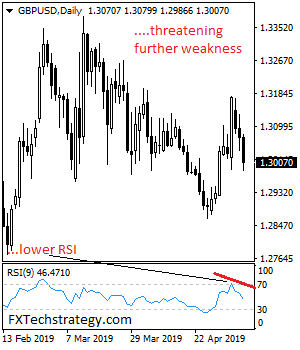
GBPUSD looks to weaken further on bear threats as it closed lower for a third day in a row. Support lies at 1.2950 as it look for more weakness. Below that level will open the door for more decline towards 1.2900 level. Further down, support comes in at the 1.2850 level where a break will turn focus to the 1.2800 level. Further down, support lies at the 1.2850 level. On the upside, resistance stands at the 1.3050 with a turn above here allowing for additional strength to build up towards the 1.3100 level. Further out, resistance stands at the 1.3150 level followed by the 1.3200 level. On the whole, GBPUSD looks to weaken further on bear threats.
Eco Data 5/9/19
[php_everywhere instance="1"]
Preview – US-China Talks: Decision on Friday Tariff Increase to be Crucial
On Thursday, US and Chinese negotiators will be face to face for the first time since the trade talks hit a huge bump in the road on Sunday when President Trump announced he would impose tariffs on China on Friday.
The talks on Thursday will be crucial for the next steps in the US-China trade conflict. It will be critical whether the two sides can resolve the challenges and avoid the tariff increase on Friday. If not, it is a sign that the two sides are 'digging in' and we could then be faced with a period of very high uncertainty and further declines in stock markets. We see it as 50-50 whether we get the tariff increase or not.
What we know:
- Tariff increase: On Monday US Trade Representative Robert Lighthizer and Treasury Secretary Stephen Mnuchin confirmed that the current plan is to raise tariffs on Friday at 12:01 am (06.01CEST Friday morning). They did not comment on the other part of Trump's tweet that said tariffs of 25% on another Chinese imports of USD325bn would be implemented shortly.
- What could change this? According to Mnuchin the tariffs would go up unless the Chinese delegation brings a new proposal that would satisfy the US side.
- Reason for the U-turn: According to Lighthizer and Mnuchin, the reason for the turn of events was China retreating on previous offers. According to sources close to the US side, China had made 'systemic edits' to a nearly 150-page draft trade agreement that would blow up months of negotiations, see Reuters 8 May. Specifically, a change that would mean certain parts of the deal would not be written into Chinese Law would have triggered fury on the US side. According to the sources, China's top negotiator Liu He told the US team last week that they needed to trust China to fulfil its pledges through administrative and regulatory changes. However, the US has very little faith that China will live up to the changes unless they are written into law.
- Timing of trade talks: The talks in Washington are scheduled for Thursday and Friday. China confirmed on Tuesday that Liu He would come to Washington on Thursday, one day delayed from the original plan.
- China's response to the tariff threat: After being silent for a while, Chinese state media started to release a response to the tariff threat and the view was mostly defiant. The strongest words came from People's Daily's WeChat account Tuesday: "Things we think are advantageous for us, we will do it even without anyone asking " adding that "Things that are unfavourable to us, no matter how you ask, we will not take any step back. Do not even think about it ", see SCMP 7 May. Other articles highlighted the resilience of the Chinese economy and that China had measures to keep the economy stable. An article in the generally more nationalistic Global Times had the headline "China ready for any outcomes in trade talks with US", Global Times 8 May. The article says "No matter what the US side wants to do in the negotiations, China has the confidence to handle it. The worst-case scenario is that the negotiations break down and Washington comprehensively raises tariffs. Even if this happens, the Chinese economy will be able to withstand it." However, China has also stated it is open to continue talks for mutual benefit, hoping that the two sides can "meet each other half way".
What to expect?
So the key question is where this leaves us for the possibility of getting trade talks back on track. In a long tweet on Wednesday afternoon Trump among other things tweeted that “China has just informed us that they (Vice-Premier) are now coming to the U.S. to make a deal. We'll see, but I am very happy with over $100 Billion a year in Tariffs filling U.S coffers… great for U.S., not great for China”.
The talks on Thursday will be crucial. If the two sides can meet each other sufficiently for Trump to cancel, or at least postpone, the tariff increase, then it is probably a sign that a deal is still believed to be within reach by the two sides.
However, if Trump decides to move on with the tariff increase, then there is a very high risk we get a breakdown of the talks and the Chinese delegation pack their bags and go home on Friday without continuing the talks. It will be hard for a Chinese Vice Premier to continue negotiations in what could be seen as a humiliation domestically in China. It could leave a period without new scheduled talks and, worst case, that Trump quickly starts the process of imposing 25% tariffs on USD325bn as he has threatened to do.
Who has the strongest hand – and how far apart are the two sides?
A couple of factors will be important for the outcome. First, how far apart are the two sides really from each other and is China willing to give Trump enough for him to be happy? Second, which of the sides believe they have the strongest hand? If Trump believes he holds the best cards, he will be inclined to use more tariffs to put more pressure on China. Using maximum leverage has always been his way of negotiating. However, it also depends on how good a chess player he is and whether he thinks two to three moves ahead. A tariff increase and further escalation risks sending stock markets down significantly, and he needs to be willing to take this pain for the leverage to work. Last year he apparently wasn't willing to take this pain and he started negotiating with China before following through on his threat to put tariffs on all imports from China.
China also may believe that they can weather another escalation through stimulus and that Trump will be more in need of a deal soon due to the upcoming Presidential election. So China might have an interest in resuming the game of chicken and bet on Trump eventually having to turn in order to avoid the risk of a sharp slowdown and market declines.
Going into the talks, both sides have an interest in sounding as tough as possible to scare the other. Brinkmanship is an art where you cannot show weakness. But how far they are really willing to go is almost impossible to say.
Risk off if tariffs go up
If Trump moves on with the tariff increase, it would likely trigger a more or less immediate retaliation from China which would likely include a similar increase in tariff rates to 25%. In addition, China can be expected to put a halt to purchases of agricultural goods as they did last year in response to the US tariffs (they started buying again early this year as part of the ceasefire). This would be a clear escalation and likely to trigger a further sell-off in equity markets and push bond yields lower. Other risk assets and currencies vulnerable to risk would also be hurt.
On the other hand if Trump cancels or postpones the tariff increase it would probably lead to a short-term relief rally in stocks as markets would see it as a bluff and expect a trade deal to still be in reach.
Our baseline scenario is still that we have a trade deal by the end of Q2 as we doubt Trump is willing to take the pain from a strong escalation of the trade conflict. But as we wrote on Monday, uncertainty has increased significantly