

Sample Category Title
GBP/JPY Mid-Day Outlook
Daily Pivots: (S1) 143.53; (P) 144.45; (R1) 145.05; More...
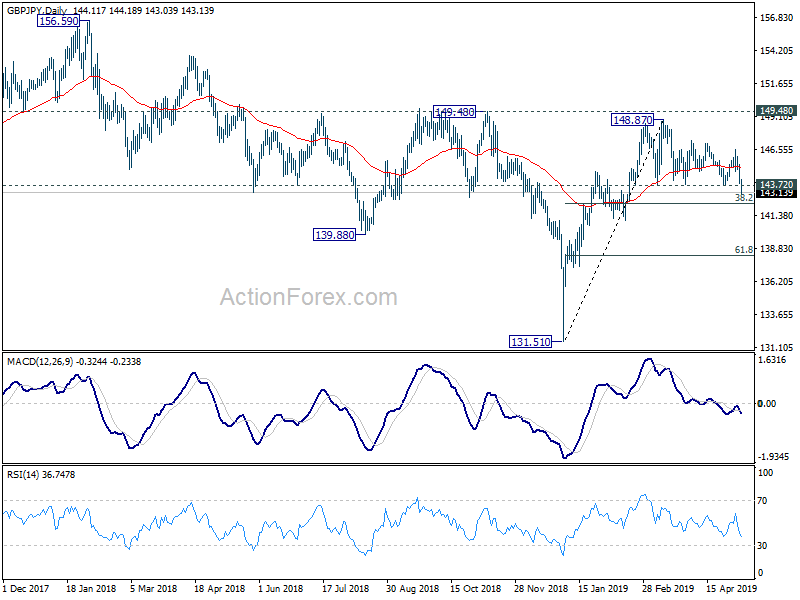
GBP/JPY drops sharply to as low as 143.03 so far today. Firm break of 143.72 support suggests that whole rebound from 131.51 has completed at 148.87, ahead of 149.98 key resistance. Intraday bias is now on the downside for 38.2% retracement of 131.51 to 148.87 at 142.23 first. Break will target 61.8% retracement at 138.14. On the upside, in case of recovery, near term outlook will stay cautiously bearish as long as 146.50 resistance holds.
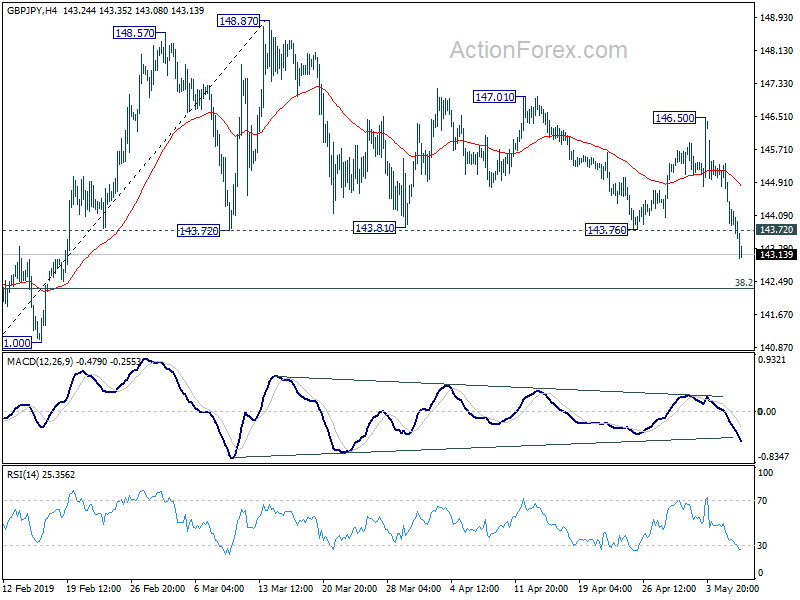
In the bigger picture, current development suggests that GBP/JPY was rejected by 149.98 key resistance. And medium term fall from 156.59 is still in progress. Break of 131.51 will target 122.36 (2016 low). On the other hand, decisive break of 149.98 should confirm that medium term fall from 156.59 (2018 high) has completed at 131.51 already. Further rally would be seen back to 156.59 resistance and above.
USD/JPY Mid-Day Outlook
Daily Pivots: (S1) 109.98; (P) 110.43; (R1) 110.70; More...
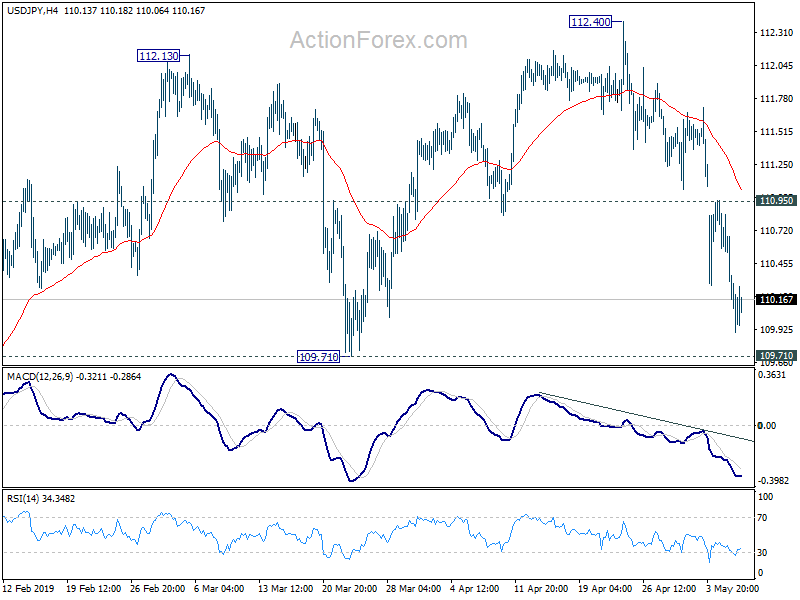
Intraday bias in USD/JPY remains on the downside for 109.71 support. As noted before, rebound from 104.69 has completed at 112.40 on bearish divergence condition in daily MACD. Decisive break of 109.71 will confirm this bearish case and target retesting 104.69 low. On the upside, break of 110.95 resistance is needed to confirm completion of the fall. Otherwise, outlook will now remain cautiously bearish in case of recovery.
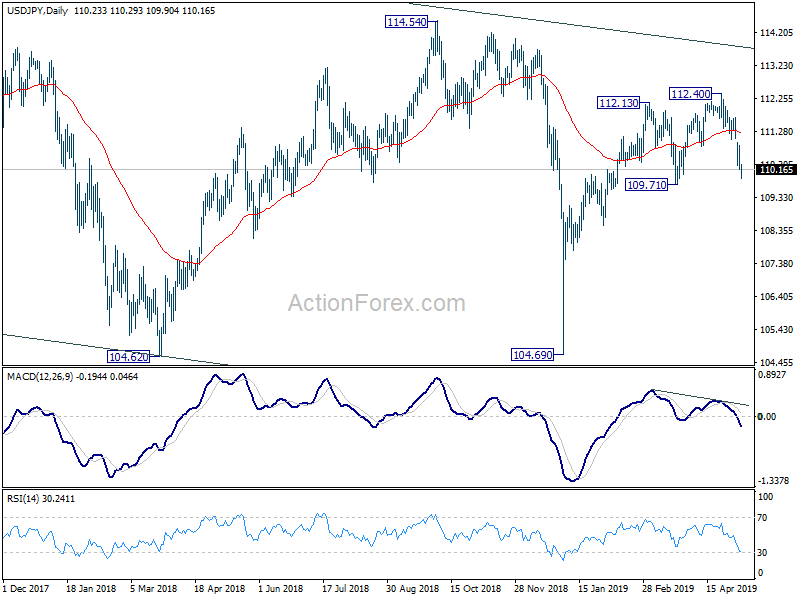
In the bigger picture, medium term outlook in USD/JPY remains a bit mixed as it's staying inside falling channel from 118.65, but there are signs of bullish reversal. On the upside, break of 114.54 resistance will revive the case the corrective fall from 118.65 has completed with three waves down to 104.69. And whole rise from 98.97 (2016 low) is resuming for 118.65 and above. However, sustained break of 109.71 will raise the chance that fall from 118.65 is still in progress for another low below 104.62.
USD/CHF Mid-Day Outlook
Daily Pivots: (S1) 1.0160; (P) 1.0194; (R1) 1.0227; More.....
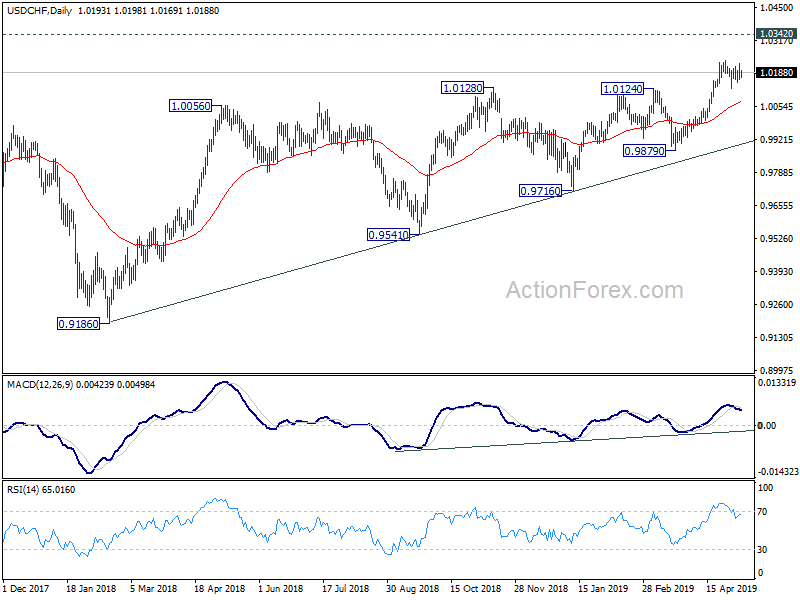
Intraday bias in USD/CHF remains neutral as it's staying in consolidation from 1.0237. Outlook remains unchanged too. On the upside, break of 1.0237 will resume larger rise from 0.9186 to 1.0342 key resistance. However, break of 1.0126 will turn bias to the downside for deeper decline to 55 day EMA (now at 1.0076).
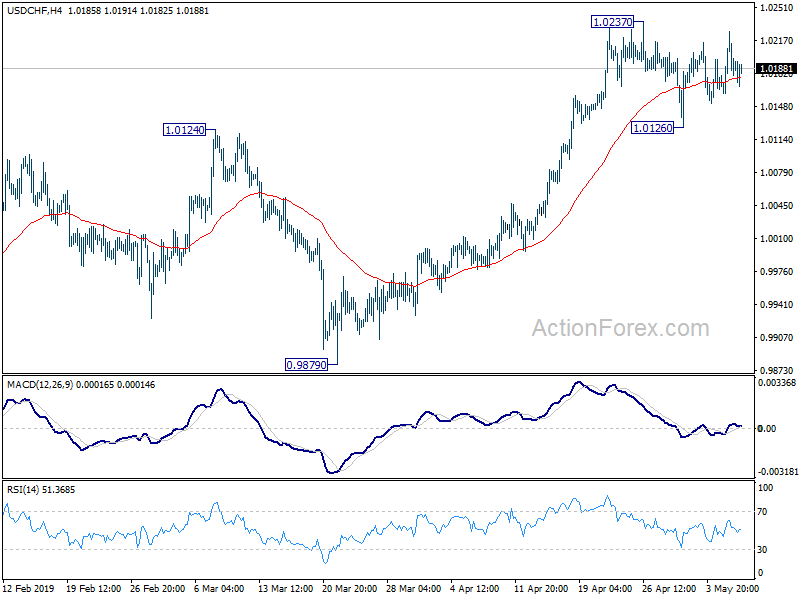
In the bigger picture, medium term up trend from 0.9186 is extending. Current rise should target 1.0342 resistance next. For now, we'd be cautious on strong resistance from there to limit upside, until we see medium term upside acceleration. On the downside, break of 0.9879 support is needed to indicate reversal. Otherwise, outlook will stay bullish in case of deep pull back.
EUR/USD Mid-Day Outlook
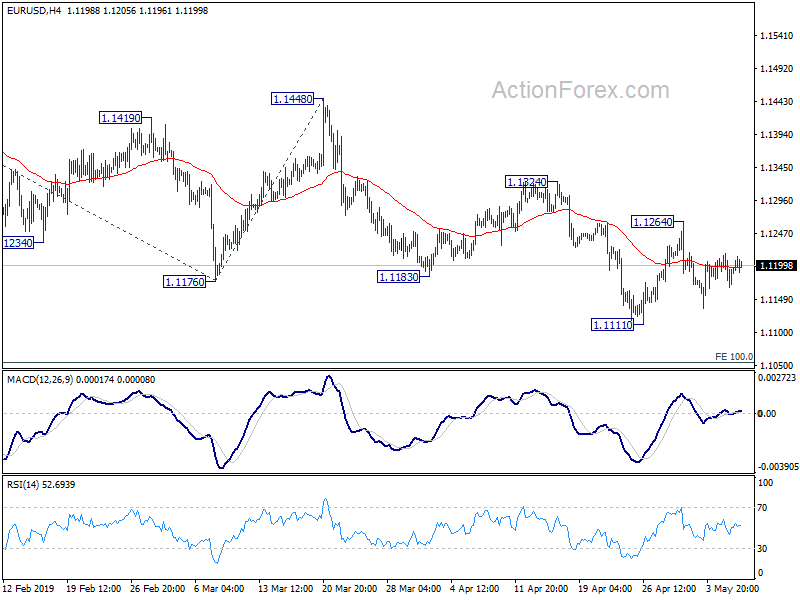
Daily Pivots: (S1) 1.1166; (P) 1.1193 (R1) 1.1219; More.....
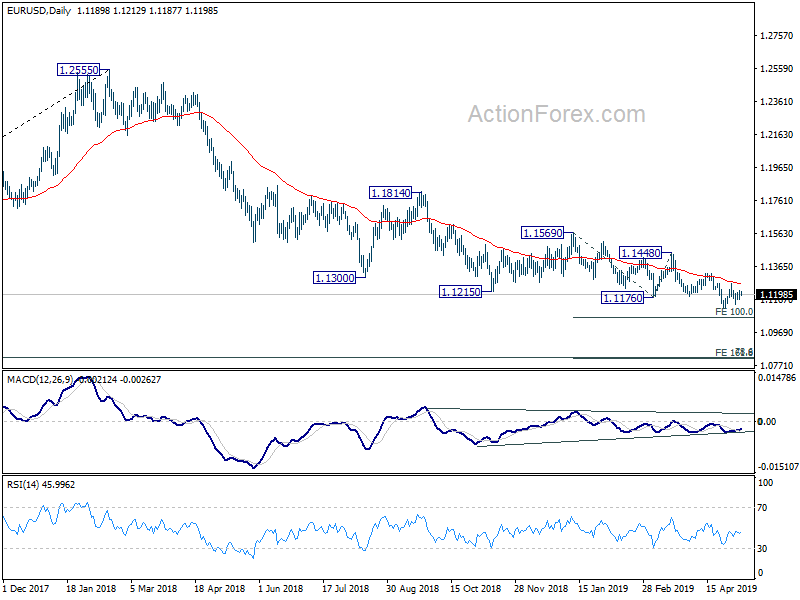
Intraday bias in EUR/USD remains neutral as it's staying in consolidation from 1.1111. Near term outlook stays bearish with 1.1324 resistance intact. Further decline is expected. On the downside, break of 1.1111 low will target 100% projection of 1.1569 to 1.1176 from 1.1448 at 1.1105 next.
In the bigger picture, down trend from 1.2555 (2018 high) is still in progress. Current fall should now target 78.6% retracement of 1.0339 (2016 low) to 1.2555 (2018 high) at 1.0813. Sustained break there will pave the way to retest 1.0339. On the downside, break of 1.1448 resistance is needed to be the first sign of medium term bottoming. Otherwise, outlook will stay bearish in case of rebound.
Canada Housing Starts Surge in April
Canadian housing starts blew away expectations, jumping to 23% m/m to 235.5k (annualized) units in April from an unrevised 192.5k units in March. On a six month moving average basis, starts ticked higher to 206.1k units from 202,4k units in March.
Both single-detached and multi-family starts were higher during April, although the gain was much stronger for the latter. Single-detached starts rose 6% to 56k units, building on March's gain. Meanwhile, construction of multi-family units jumped 29% (+40k) to 179.5 units in April.
Homebuilding was higher in seven of ten provinces.
Ontario accounted for the majority of the national gain, with starts rising by 26.7k to 87.7k units. The bulk of Ontario's increase came outside of Toronto, where starts increased by 5.9k to 38k units.
In the Prairies, homebuilding picked up in Alberta (+6.2k to 26.0k units) and Manitoba (+0.7k to 6.6k units) while dipping slightly in Saskatchewan (-0.1k to 1.8k units). Despite gains in Alberta and Manitoba in April, homebuilding remains soft in the Prairies, weighed on by soft economic conditions and inventory overhang.
Starts eased in slightly in Quebec (-6.0k units to 54.9k) after surging to their highest level since 2012 in March.
Starts increased in B.C. (+15.7k to 51.1k units), buoyed by a 13.0k gain in multi-family starts in Vancouver.
Starts were up modestly in the Atlantic Region (+0.3k to 7.4k units for the Region overall) , as gains in New Brunswick, PEI and Newfoundland and Labrador offset a drop in Nova Scotia.
Key Implications
Homebuilding got off on the right foot to begin the second quarter, consistent with our forecast for starts to tick higher after Q1's weather-induced chill. The increase in Ontario is especially heartening, particularly after couple of soggy months in February and March. April's healthy print also represents some catch up to permits, which have outpaced starts in recent months.
It's early days, but April's increase in homebuilding bodes well for residential investment and overall economic growth in Q2.
These positives aside, on a trend basis, home building has slowed from last year's robust pace. This is consistent with our forecast calling for starts to cool in 2019. Still, the level should remain healthy, buoyed by ultra-strong population growth, solid labour markets, past gains in pre-construction sales and low rental vacancy rates in large urban markets. The recent drop in borrowing costs will also provide support, although with a lag.
GBP/USD Mid-Day Outlook
Daily Pivots: (S1) 1.3032; (P) 1.3082; (R1) 1.3124; More...
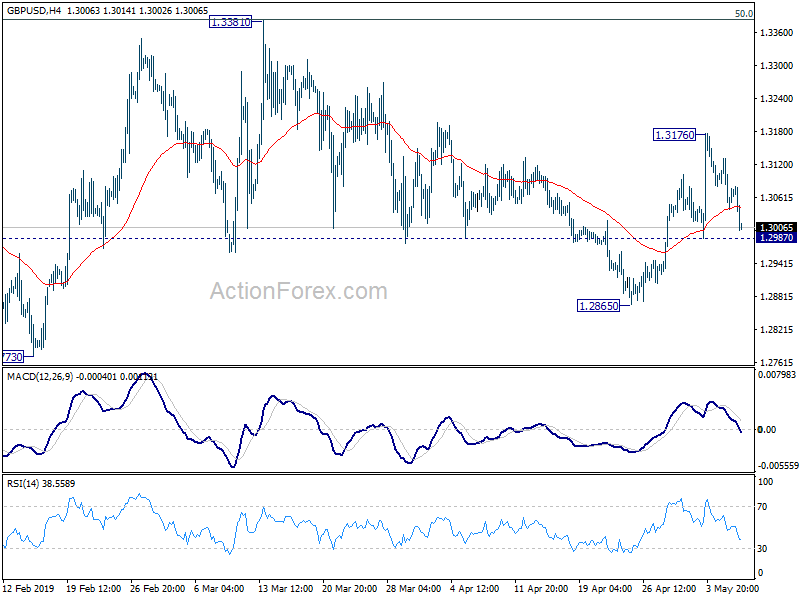
GBP/USD's fall from 1.3176 accelerates lower today and focus is now back on 1.2987 minor support. Firm break there will confirm that rebound from 1.2865 has completed at 1.3176 already. More importantly, this will revive that bearish case that rebound from 1.2391 has completed at 1.3381. And intraday bias will be turned to the downside for 1.2865 support for confirming bearishness. Nevertheless, on upside, above 1.3176 will target a retest on 1.3381 high next.
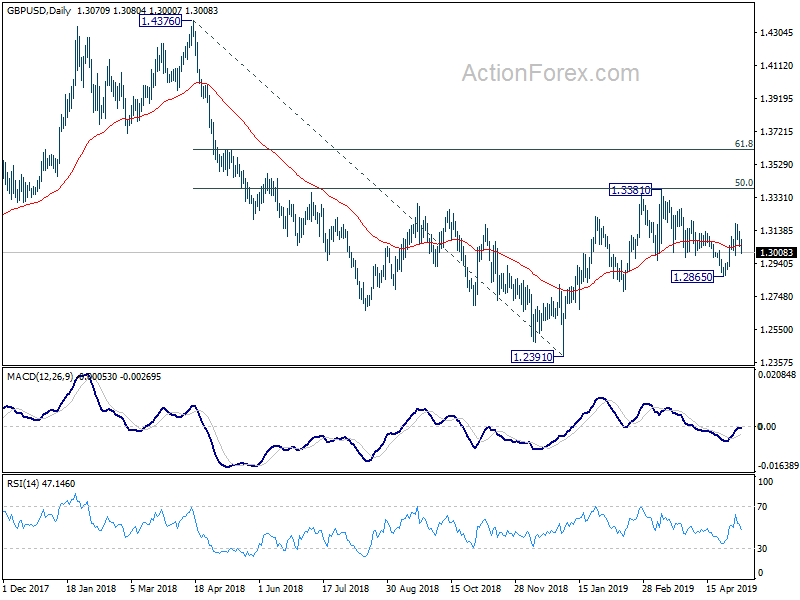
In the bigger picture, medium term decline from 1.4376 (2018 high) halted and made a medium term bottom after hitting 1.2391. Rebound from 1.2391 is seen as a corrective move for now. In case of another rise, strong resistance could be seen around 61.8% retracement of 1.4376 to 1.2391 at 1.3618 to limit upside. On the downside, break of 1.2773 support will suggests that such corrective rise is completed and bring retest of 1.2391 low first.
Sterling Tumbles on Brexit Impasse Again, Yen Stays Strong
Sterling suffers steep selling today after the UK Government conceded that there will be no Brexit compromise with opposition Labour any time soon. Thus, UK is prepared to participate in European election on May 23. New Zealand Dollar pared back much of the post RBNZ rate cut spike losses. Though, it remains the second weakest for today.
Yen is at this point, the strongest one for today, but it's really a tie with Euro and Swiss Franc. Risk aversion clearly dominates the markets on concerns over China trade war. Trump's latest tweet indicates that he's not going to back down with China and hailed that he'd be happy with over USD 100B a year in tariffs.
Technically, GBP/JPY's strong break of 143.72 support aligns its outlook with USD/JPY and EUR/JPY. That is, recent rebound from 131.51 has completed and outlook is turned bearish that could eventually bring retest of this low. 1.2987 support is now an immediate focus in US session. Break will dampen original bullish view and put focus back to 1.2865 support.
In Europe, FTSE is currently down -0.28%. DAX is up 0.40% as supported by German data. CAC is flat. German 10-year yield is down -0.0099 at -0.045, a clear sign of risk aversion. Earlier in Asia, Nikkei dropped -1.46%. Hong Kong HSI dropped -1.23%. China Shanghai SSE dropped -1.12% to 2893.76, back below 2900. Singapore Strait Times dropped -0.87%. Japan 10-year JGB yield was flat at -0.05.
Sterling accelerates down as cross party Brexit talk said to be near to collapse
Sterling’s decline picks up momentum earlier on news that the UK government conceded that they couldn’t finish Brexit negotiation with opposition labor soon. And hence, Cabinet Minister David Lidington confirmed European parliament elections will go ahead in UK on May 23.
Then there were even reports that the discussion between Prime Minister Theresa May and opposition leader Jeremy Corbyn was close to a collapse. Though, May told the parliament that the government is "indeed talking with the Labour Party", and "we are working on agreement that can command the majority" of the Commons.
China backtracked on all aspects of trade commitments with US
According to a Reuters report, China has back tracked on nearly all aspects of their commitment in trade negotiation with the US. In each of the seven chapters of the 150-page draft trade deal, China deleted its comments regarding law changes that addresses US complaints. It’s seen by the US as undermining the “core architecture” of the trade deal. A private sector source said “China got greedy” and “on a dozen things, if not more.” And, China appears to be miscalculating with the US administration even after 20 years dealing with them.
Chinese Vice Premier Liu He will arrive in Washington of Thursday to save the trade agreement. At the same time, new round of tariffs will take effect at 0001 Friday, if no deal is agreed. There’s speculation that Liu could agree to scrap the latest proposed text changes and agree to making new laws. But at this point, it’s unsure what level of authority and constraints Liu has got from President Xi Jinping Thus, no one knows what results Liu could achieve.
China exports to US dropped -9.7% from Jan to Apr, imports dropped -30.4%
Latest trade data from China showed that growth in exports in other regions in 2019 so far was merely enough to offset contraction of -9.7% ytd yoy in exports to US. Total export grew a mere 0.2% ytd yoy. On the other hand, total exports contracted -2.5% ytd yoy, as dragged down by -30.4% ytd yoy contraction in exports from US. Trade with EU remained relatively healthy.
In USD terms, in April: Total trade grew 0.4% to USD 373.14B. Exports contracted -2.7% yoy to USD 193.49B. Import rose 4.0% yoy to USD 179.65B. Trade surplus came in at USD 13.84B
In USD terms, from January to April total: Total trade contracted -1.1% yoy to USD 1399.82B. Exports rose 0.2% yoy to USD 744.61B. Imports dropped -2.5% to USD 655.21B. Trade surplus came in at USD 894.0B.
With US, from January to April total: Total trade contracted -15.7% yoy to USD 161.2. Exports to US contracted -9.7% yoy to USD 122.4B. Imports from US dropped -30.4% yoy to USD 39.8B. Trade surplus came in at USD 82.6B.
With EU, from January to April total: Total trade grew 5.9% yoy to USD 220.1B. Exports to EU rose 8.3% yoy to USD 131.5B. Imports from EU rose 2.5% yoy to USD 88.5B. Trade surplus came in at USD 43B.
With AU, from January to April total: Total trade grew 6.65 yoy to USD 51.1B. Exports to AU rose 3.4% to USD 14.3B. Imports from AU rose 7.9% to 36.8B. Trade deficit came in at USD -36.8B.
More on China: Decline in Chinese Exports Signals Global Demand Slowdown. Renewed Trade War Forces PBOC to Ease Further
RBNZ cuts OCR to 1.50%, projects below target inflation for longer, sees need for more easing
RBNZ lowers official cash rate by -25bps to 1.50% as widely expected. In the accompanying statement, RBNZ noted that:
There was a “consensus” that lower path of OCR relative to February MPS was “appropriate”. That reflects “weaker domestic spending” and “projected ongoing growth and employment headwinds”. A key downside risk to growth was “larger than anticipated slowdown in global economic growth, particularly in China and Australia, New Zealand’s largest trading partners.”
In the latest economic projections, RBNZ projected that inflation will stay below target for longer then in February MPS. CPI won’t breaks 2% level until 2022. CPI forecasts for 2019 and 2021 were both revised down. On growth, RBNZ sees slower GDP growth in 2019 and 2020. But GDP growth is expected to pick up solidly in 2021 before dipping in 2022. On the net, RBNZ sees the need for further rate cut with average OCR hitting 1.4% in 2021 before bottoming.
OCR year average (vs Feb projections): 2019 at 1.8% (unchanged); 2020 at 1.6% (revised down from 1.8%); 2021 at 1.4% (revised down from 1.8%); 2022 at 1.6% (revised down from 2.2%);
CPI (vs Feb projections): 2019 at 1.5% (revised down from 1.6%); 2020 at 1.9% (revised up from 1.7%); 2021 at 1.9% (revised down from 2.1%); 2022 at 2.1% (unchanged).
GDP growth(vs Feb projections): 2019 at 2.6% (revised down from 2.8%); 2020 at 2.6% (revised down from 2.9%); 2021 at 3.1% (revised up from 2.8%); 2022 at 2.5% (revised up from 2.3%).
More on RBNZ:
- RBNZ Cut Policy Rate to 1.5%, Resuming Rate Cut for the First Time since 2016
- RBNZ: One And Done, Or More To Come?
- First Impressions: RBNZ Cuts the OCR to 1.50%
- RBNZ Cut Rates To A Historic Low | NZD/USD
- RBNZ projects below target inflation for longer, sees need for more easing
BoJ Minutes: Firm domestic demand offset drag from overseas slowdown
Minutes of the March 14/15 BoJ meeting noted that members "concurred" that the economy will continue to its "moderate expansion". "domestic demand was likely to follow an uptrend", including fixed investment and private consumption. That should offset weakness in exports and product as dragged down by overseas slowdown.
On prices, members reiterated that CPI 'continued to show relatively weak developments compared to the economic expansion and the labor market tightening." But CPI is still "likely to increase gradually" toward 2% target.
On monetary policy, members agreed that it was "appropriate" to persistently continue with the powerful monetary easing under the current guideline. On member warned of the "side effects" of maintaining current easing. One member warned that if downside risks were materializing, BoJ should be prepared to make policy responses. One member also noted the importance to "preemptive policy responses" in case of phase shift in developments.
Also from Japan, monetary base rose 3.1% yoy in April versus expectation of 3.6% yoy.
GBP/USD Mid-Day Outlook
Daily Pivots: (S1) 1.3032; (P) 1.3082; (R1) 1.3124; More...
GBP/USD's fall from 1.3176 accelerates lower today and focus is now back on 1.2987 minor support. Firm break there will confirm that rebound from 1.2865 has completed at 1.3176 already. More importantly, this will revive that bearish case that rebound from 1.2391 has completed at 1.3381. And intraday bias will be turned to the downside for 1.2865 support for confirming bearishness. Nevertheless, on upside, above 1.3176 will target a retest on 1.3381 high next.
In the bigger picture, medium term decline from 1.4376 (2018 high) halted and made a medium term bottom after hitting 1.2391. Rebound from 1.2391 is seen as a corrective move for now. In case of another rise, strong resistance could be seen around 61.8% retracement of 1.4376 to 1.2391 at 1.3618 to limit upside. On the downside, break of 1.2773 support will suggests that such corrective rise is completed and bring retest of 1.2391 low first.
Economic Indicators Update
| GMT | Ccy | Events | Actual | Consensus | Previous | Revised |
|---|---|---|---|---|---|---|
| 23:01 | GBP | BRC Retail Sales Monitor Y/Y Apr | 3.70% | 2.40% | -1.10% | |
| 23:50 | JPY | BOJ Minutes Mar | ||||
| 23:50 | JPY | Monetary Base Y/Y Apr | 3.10% | 3.60% | 3.80% | |
| 02:00 | NZD | RBNZ Rate Decision | 1.50% | 1.50% | 1.75% | |
| 03:00 | NZD | RBNZ Press Conference | ||||
| 03:00 | CNY | Trade Balance (USD) Apr | 13.8B | 33.7B | 32.6B | |
| 03:00 | CNY | Imports (USD) Y/Y Apr | 4.00% | -2.00% | -7.60% | |
| 03:00 | CNY | Exports (USD) Y/Y Apr | -2.70% | 3.00% | 14.20% | |
| 03:00 | CNY | Trade Balance (CNY) Apr | 94B | 235B | 221B | |
| 03:00 | CNY | Imports Y/Y (CNY) Apr | 10.30% | -3.00% | -1.80% | |
| 03:00 | CNY | Exports Y/Y (CNY) Apr | 3.10% | 8.00% | 21.30% | |
| 05:45 | CHF | Unemployment Rate Apr | 2.40% | 2.40% | 2.40% | |
| 06:00 | EUR | German Industrial Production M/M Mar | 0.50% | -0.50% | 0.70% | 0.40% |
| 12:15 | CAD | Housing Starts Apr | 235.5K | 194K | 193K | |
| 14:30 | USD | Crude Oil Inventories | 1.1M | 9.9M |
US Dollar Index Retreats Below 23-Month High
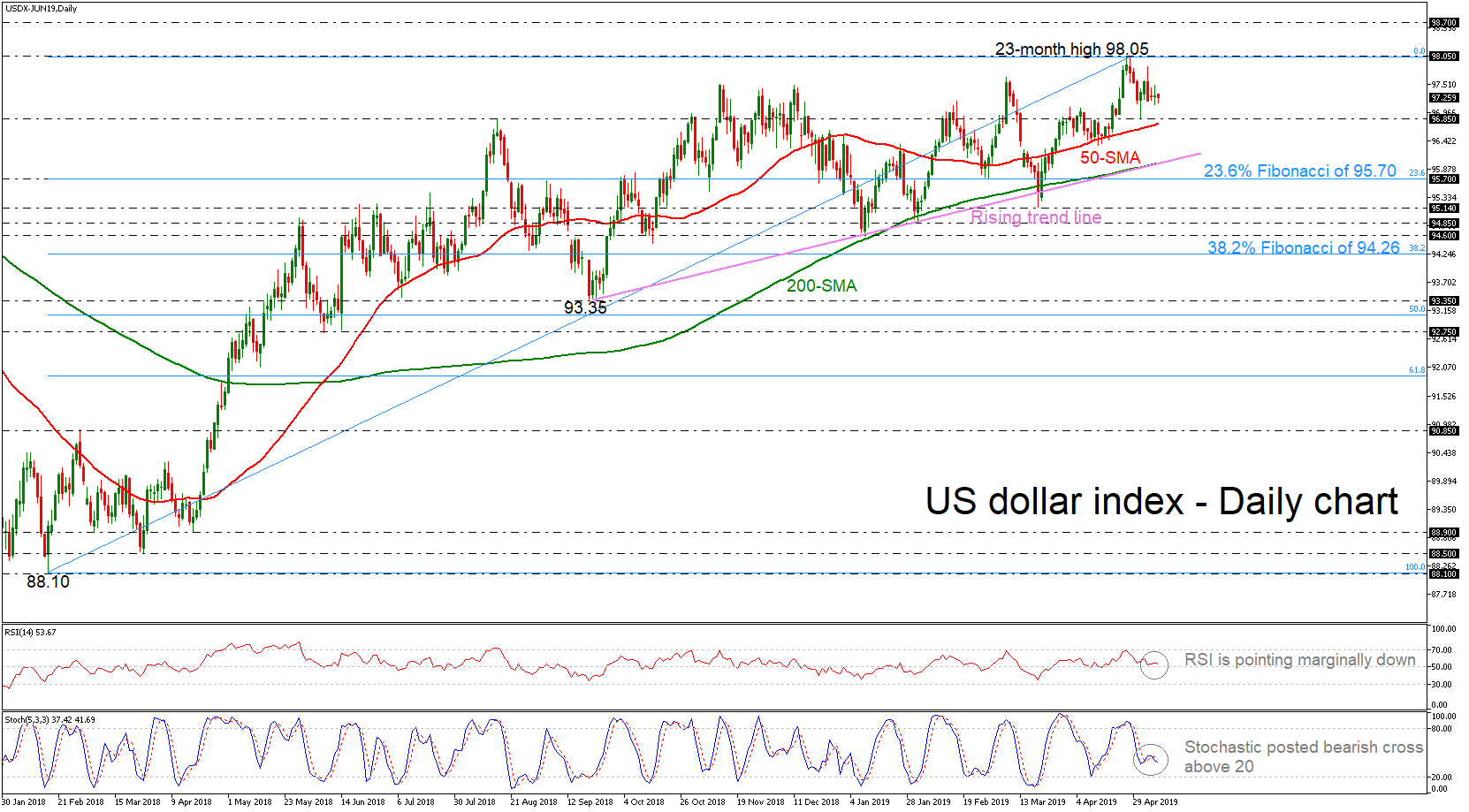
The US dollar index has reversed back down after finding resistance at the 23-month high of 98.05 achieved on April 25. However, the price has remained above the 50-day simple moving average (SMA) over the last five weeks as well as above the uptrend line, which has been standing since September 2018, suggesting upside tendency in the medium term.
The short-term bias is tilted to the downside as the RSI indicator is turning marginally lower near its 50 level, while the stochastic oscillator posted bearish crossover within the %K and %D lines above the oversold territory.
If the price continues the bearish retracement, support is coming at the 96.85 level, which stands slightly above the 50-day SMA. More losses could challenge the uptrend line, which overlaps with the 200-day SMA, currently at 95.95.
On the other hand, if the index returns higher, the 23-month high of 98.05 could attract traders’ attention and any violation above this hurdle could open the way for the 98.70 resistance, posting a higher high in the long term.
In the bigger picture, the dollar index has held in an upside tendency, however, looking at the very short-term, the price is posting a bearish correction and there is a chance of hitting the ascending line once again, before returning higher.
Canadian Housing Starts Jumped Higher in April
- Housing starts jumped to 235,000 annualized units in April, continuing to pick up from a multi-year low of 167,000 in February when we think wintry weather restrained activity
- The increase was led by multi-unit starts which rose to a record high 176,000 annualized units
Economists (including ourselves) were perhaps a bit shy to pencil in such a strong increase in housing starts in April, though the rapid pace of permit issuance in recent months and potential for weather-delayed starts to show up in the spring means today’s report isn’t a total surprise. Signs of stabilization in at least some major resale markets and ongoing strength in homebuilding—particularly the multi-unit segment—suggest the housing sector is shifting to a more neutral force in Canada’s economy after acting as a sizeable drag last year.
Into US session: Sterling weakest on Brexit deadlock, Yen strongest on trade war risk aversion
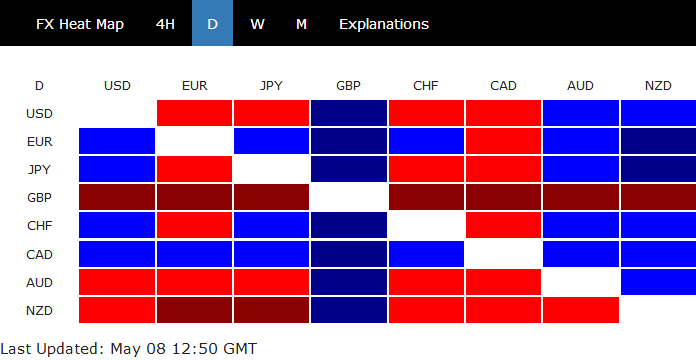
Entering into US session, Sterling is overwhelmingly the weakest one for today, even worse that New Zealand Dollar. The Pound is weighed down by talks that the cross-party Brexit negotiation between Conservatives and Labour nearly collapsed. Prime Minister Theresa May insisted to the Commons that she's still working on an agreement. But at least there won't be a solution soon as UK is already prepare to take part in European Election on May 23. New Zealand Dollar follows as the second weakest after RBNZ cut interest rate to 1.50%. Though, Kiwi pared back much of the losses as the day goes.
Meanwhile, Yen remains the strongest one for today on risk aversion, over concern of US-China trade war. According to a Reuters report, China has backtracked on nearly all aspects of its commitments in the latest draft agreement sent to the US team last weekend. It's unsure whether Vice Premier Liu He will withdraw those changes or offer something else. Swiss Franc follows as the second strongest, and then Canadian.
In Europe, currently:
- FTSE is down -0.28%.
- DAX is up 0.25%.
- CAC is down -0.10%.
- German 10-year yield is down -0.011 at -0.047.
Earlier in Asia:
- Nikkei dropped -1.46%.
- Hong Kong HSI dropped -1.23%.
- China Shanghai SSE dropped -1.12% to 2893.76, back below 2900.
- Singapore Strait Times dropped -0.87%.
- Japan 10-year JGB yield was flat at -0.05.