

Sample Category Title
UK GDP Growth to Get Extra Boost in Q1 Despite Brexit Chaos
Despite the ongoing Brexit drama, Friday is expected to be a good day for the British economy as flash GDP growth for the first quarter of the year, industrial output and trade balance figures are all awaited to show improvement at 0830 GMT. The move in sterling, however, is still heavily dependent on the progress of the UK-EU negotiations and even if the data surprise to the upside, sterling could only gain temporarily unless the sides resolve their differences; a scenario regarded unlikely at the moment.
What to expect from GDP growth numbers?
The first quarter of the year could be described fruitful for the UK as the consumer-dependent economy witnessed a strong rebound in core retail sales and further reduction in the unemployment rate. Wage growth held at decade highs and above the inflation rate which continued to slow below the Bank of England’s (BoE) 2.0% price target, raising speculation that demand could advance in coming months.
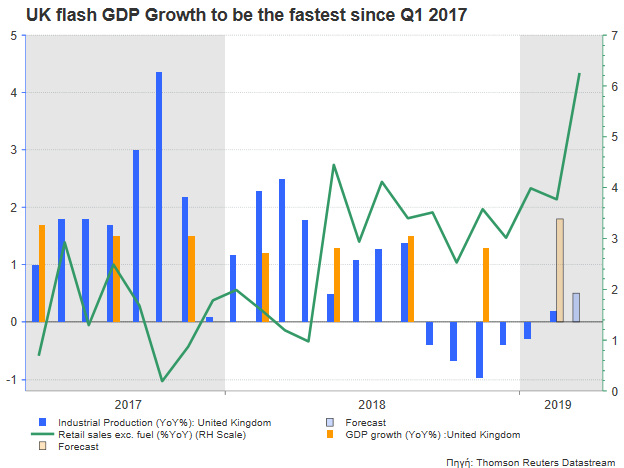
On the business side, the Brexit deadlock may have probably forced companies to bring purchases and orders forward at the start of the year amid rising fears that the government would potentially leave the bloc without a deal and costs for shipments would go up as the previous deadline of March 29 was nearing. As such, industrial production could have been larger in March as forecasts suggest, recording a yearly growth of 0.5% in March versus 0.1% in the preceding month, while the trade deficit may have also narrowed from 14.11bln pounds to 13.8bln. Recall that British exports and imports with the EU jumped to decade-highs in the three months to February.
Putting the above pieces together, a stronger GDP growth in Q1 could be expected even under the cloud of Brexit uncertainty. Particularly, preliminary estimates suggest that the quarterly expansion quickened from 0.2% to 0.5%, while compared to the same quarter a year ago, growth is said to have surged by 0.4 percentage points to 1.8%, the fastest since Q1 2017.
What does the BoE believe about growth?
The BoE anticipates GDP growth to heat up in the corresponding period as well but is also aware that the timing of the UK withdrawal from the EU and the type of the exit agreement are important for a more lasting expansion, admitting that its projections are relying on a soft Brexit scenario.
Currently, developments around the topic are pointing to a harder Brexit as the talks between the Conservative UK Prime Minister, Theresa May, and the rival Labor leader Jeremy Corbyn, which entered the sixth week, have so far proved ineffective to lead towards a compromise, especially on the shape of the customs union, making a breakthrough unlikely this week. Complicating the picture, the two major parties lost significant public support in the local elections last week, reducing their chances for a strong showing in the European Parliamentary elections on May 23-26.
How could the pound react?
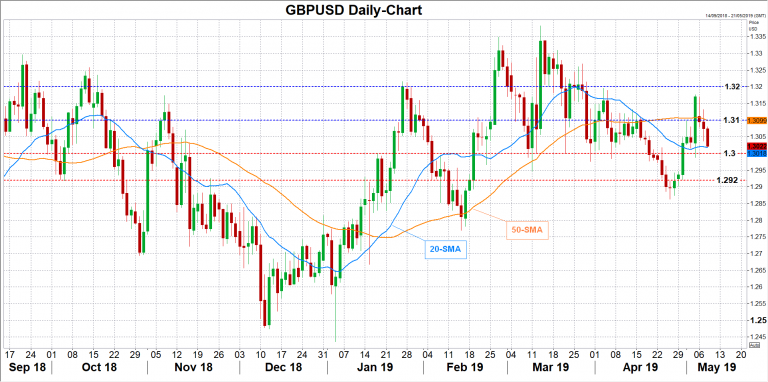
The pound could recoup this week’s losses against the dollar if the figures beat expectations but the rally is believed to be temporary and contained within the 1.31-1.32 area as long as the Brexit issue remains unresolved. This also reduces the chances for a rate hike this year despite the words of BoE Governor, Mark Carney saying that markets are underestimating future rate rises. Friday’s peak of 1.3175 for GBPUSD could act as a decent resistance in this case.
Otherwise, a smaller-than-expected pickup in GDP growth could push the pair down to the 1.30-1.2920 key area.
Elliott Wave Analysis: USDZAR and Crude Oil Beautiful Patterns
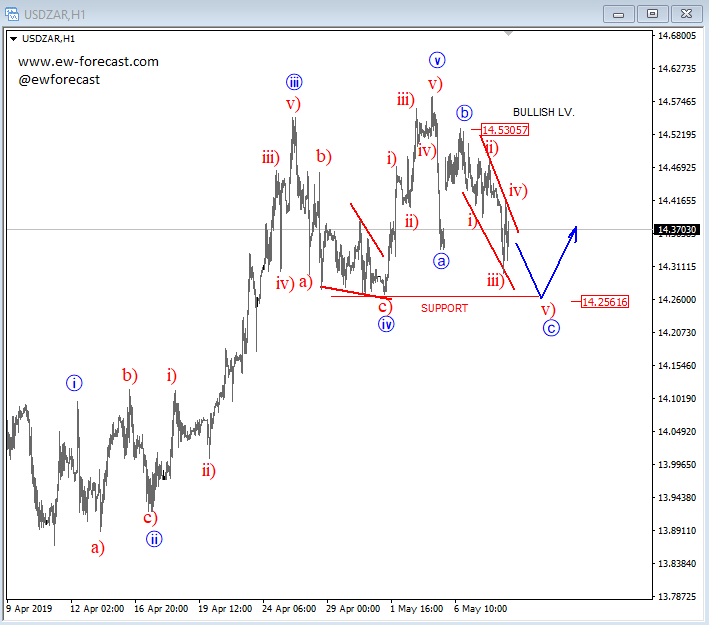
USDZAR is trading bullish but currently price may slow down in an a-b-c correction, where ideal support would be around previous wave »iv« and 14.25 level. But, any earlier strong rise back above 14.53 region would be an indication of a completed correction within uptrend.
USDZAR, 1h
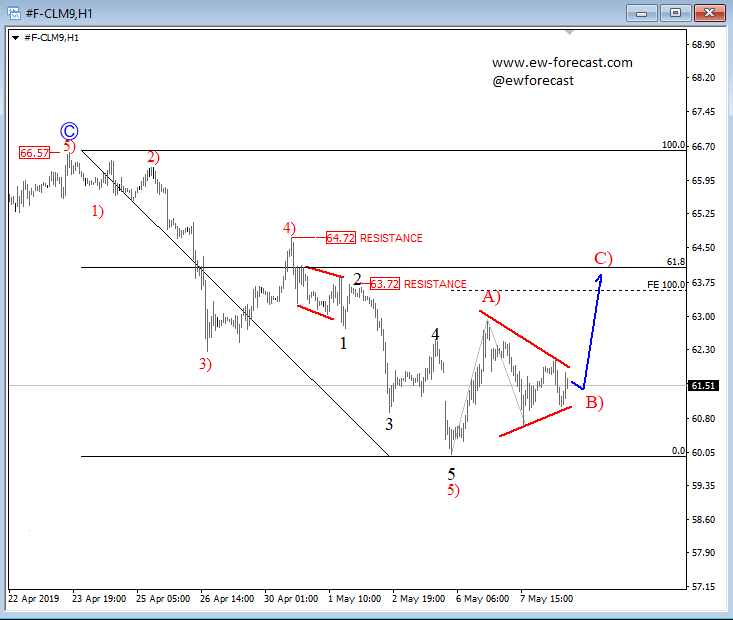
OIL can be finishing a small bullish triangle in wave B) that can send the price towards 61,8% Fibo. retracement and 63.70 – 64.70 resistance area for wave C), where a bigger three-wave correction within downtrend may come to an end.
Crude oil, 1h
Kiwi Dalls to 6-Month Low as RBNZ Slices Rates
The New Zealand dollar remains under pressure, as pair has dropped close to 1.0% since Monday. In Wednesday’s North American session, NZD/USD is trading at 0.6587, down 0.21% on the day. On the release front, the Reserve Bank of New Zealand surprised the markets, cutting the benchmark rate from 1.75% to 1.50%. There are no major events in the U.S. on the calendar. On Thursday, the U.S. releases producer price index reports and unemployment claims.
After Australia’s central bank defied expectations on Wednesday and maintained interest rates, the RBNZ followed suit and unexpectedly cut the benchmark rate by 25 basis points. This marked the first rate cut since November 2016, and has added to the pressure on the New Zealand dollar. Earlier on Wednesday, NZD/USD touched a low of 0.6527, its lowest level since the end of October. The RNBZ issued a dovish rate statement, saying that the rate cut was necessary to boost employment and inflation forecasts. Rate-setters noted the uncertainty over the global economy and that both global and domestic growth had slowed since mid-2018, dampening New Zealand’s economy. The statement added that the rate cut “provides a more balanced outlook for interest rates”.
Adding to the kiwi’s troubles this week is the escalation in trade tensions between China and the U.S. On Sunday, U.S President Trump said that the U.S. would raise tariffs on $200 billion worth of Chinese goods as early as Friday, from 10% to 25%. Chinese officials had said it would cancel the talks, but this turned out to be an empty threat. Chinese Vice Premier Liu He is scheduled to lead a Chinese delegation to Washington. Will the new U.S. tariffs be rescinded? Treasury Secretary Steve Munchin said that the tariffs could be cancelled when the talks resume. Such a move would kick-start risk appetite,which would be good news for the New Zealand dollar.
Australian Dollar Steady, Investors Eye Chinese CPI
AUD/USD has ticked higher in the Wednesday session. Currently, the pair is trading at 0.7003, up 0.08% on the day. On the fundamentals front, there are no Australian releases. China posted a trade surplus of 94 billion yuan ($13.8 billion), in April, well short of the forecast of 235 billion yuan ($33.7 billion). On Wednesday, Chinese CPI is projected to improve to 2.5% in April. In the U.S., there are no key events until Thursday, with the release of producer price index reports and unemployment claims. The RBA issues its monetary policy statement, which is released quarterly.
The trade war between the U.S. and China has taken a heavy toll on the Chinese economy. China’s trade surplus fell sharply in April, dropping from 221 billion yuan to 94 billion ($32.6 billion to $13.8 billion). As well, Chinese exports declined 2.7% in April, on a year-to year basis. This was a sharper drop than the estimate of a 2.3% decline. A slowdown in China has damaged the Australian economy, as China is Australia’s number one trading partner.
The RBA held the course on Tuesday, surprising the markets, which had expected the bank to cut rates to 1.25%. The markets had priced in a rate cut at close to 50%, so the decision to hold rates boosted the Aussie close to 1.0%. However, the currency was unable to consolidate and gave up most of these gains in European trade. Despite a slowdown in economic activity and weak inflation, the RBA is sticking to its wait-and-see stance, hopeful that the economy will find its feet without the help of a rate cut.
Fed Brainard: Inflation make up policy unproven
Fed Governor Lael Brainard talked about the "new normal in the economy. One feature equilibrium interest rates will likely remain low in the future. That presents a "challenge" for "traditional ways" of conducting monetary policy. There would be "less room to cut interest rates" in recessions, and thus "less room to buffer" the economy using conventional tools. Also, inflation "doesn't move as much with economy activity and employment" as it has in the past. The "very flat" Phillips curve makes it "more difficult to boost inflation" to target on sustainable basis.
Brainard explored some issues. One idea is so called "average inflation targeting". That is, Fed would target inflation over a "longer period of time". Thus, Fed would aim at inflation above target during recovery and expansion phase of a cycle, making up for the short fall during a recession. She warned that "While such approaches sound quite appealing on their face, they have not yet been implemented in practice. There is some skepticism that a central bank would in fact prove able to support above-target inflation over a sustained period without becoming concerned that inflation might accelerate and inflation expectations might rise too high."
Another idea is that after short-term interest rates hit zero, Fed might turn to targeting "slightly longer-term interest rates", using its balance sheet. And, similar to make-up policies, such an approach could help communicate publicly how long the Federal Reserve is planning to keep rates low.
Separately, Richmond Federal Reserve president Tom Barkin said "it is hard to have a recession when unemployment is this low and interest rates are this low". On the economy, he added "I still see us on a pretty strong course".
ECB Draghi: Be patient and persistent with accommodative policy and inflation will come
Talking to students in Frankfurt, ECB President Mario Draghi noted people say "it's been so long when we haven’t reached the below but close to 2 percent, why don’t you lower inflation to something lower and accept defeat". He then emphasized " that's exactly why we are not doing it, because we don’t accept defeat."
Draghi also admitted it's "taking longer" for transmission of higher nominal wages growth into a higher inflation. And one of the reasons is that "profit margins are being compressed". But he also reiterated "it's a matter of being patient and persistent with the accommodative monetary policy and it will come, it will happen".
USDCHF Consolidates but Holds Near 2-Year Highs
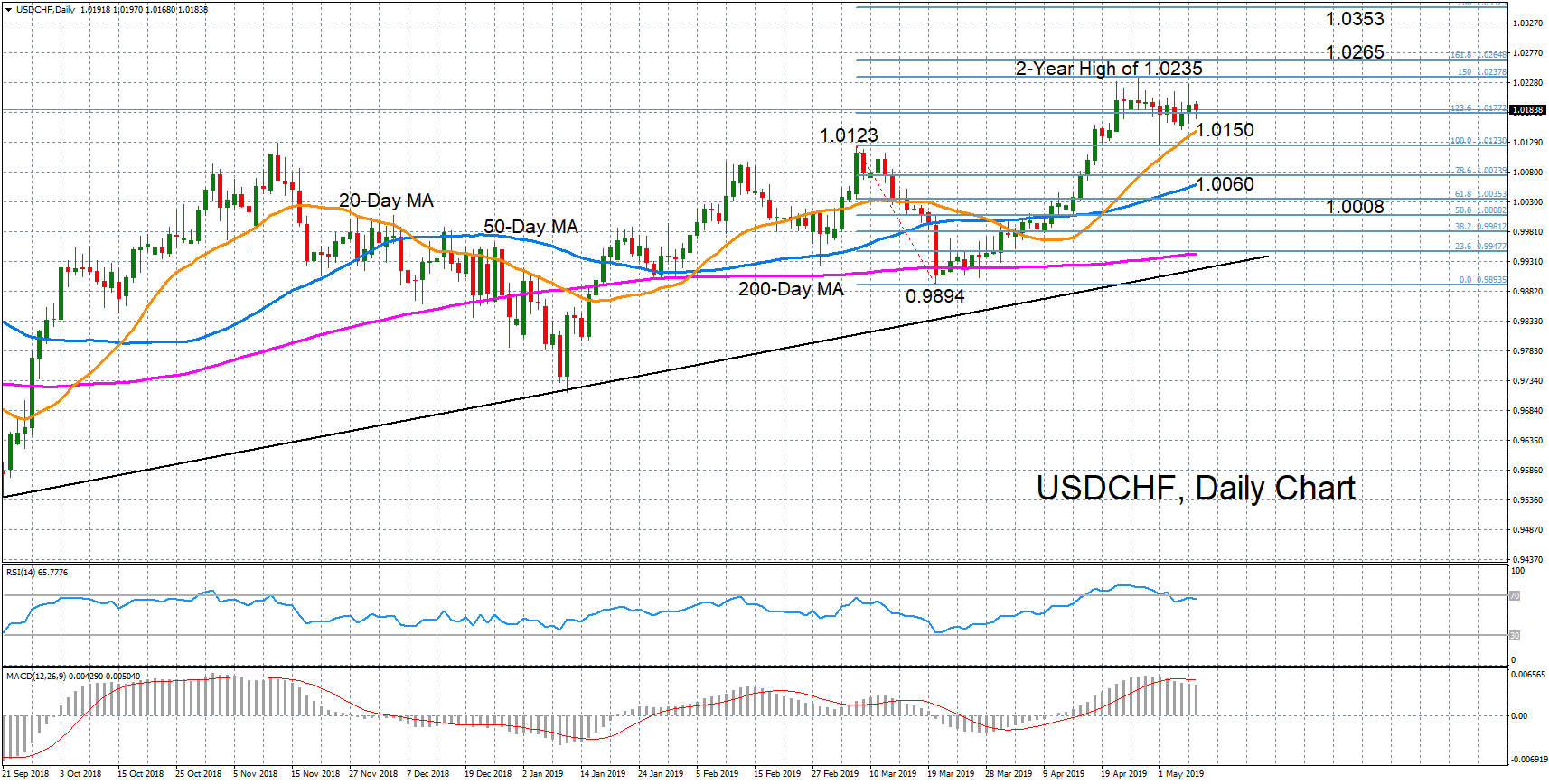
USDCHF is lacking near-term direction as the pair continues to consolidate after touching a two-year high of 1.0235 in April. The RSI has come off from overbought levels and the MACD histogram has crossed below its red signal line, pointing to some downside risks. However, the declines have been gradual and both indicators are looking steady, suggesting more sideways movement in the short term.
If the pair drifts downwards, immediate support is likely to come from the 20-day moving average (MA) around 1.0150. A drop below this mark would open the way for the 1.0123 level, which was the March top, followed by the 50-day MA in the 1.0060 region. Falling below the 50-day MA, and subsequently below the 50% Fibonacci retracement of the 1.0123-0.9894 downleg at 1.0008, would risk shifting the current bullish picture in the medium term to a neutral one.
However, if USDCHF regains some positive momentum, the immediate target for the bulls would be the 2-year high of 1.0235 before aiming for the 161.8% Fibonacci extension at 1.0265. Climbing above this level would reinforce the bullish outlook and bring the 200% Fibonacci at 1.0353 into scope.
WTI Crude – How Big a Correction Will We See?
Risk appetite hits oil prices
Oil prices are not having much fun in the current risk environment which shouldn’t come as much of a surprise considering global growth fears and their impact on risk are intrinsically linked to future oil demand.
It’s one of the often more overlooked drivers of oil prices but the correlation is clear. Oil has been on a slide since Trump claimed to have called OPEC regarding oil prices, which came at a time when the market was already looking rather stretched to the upside.
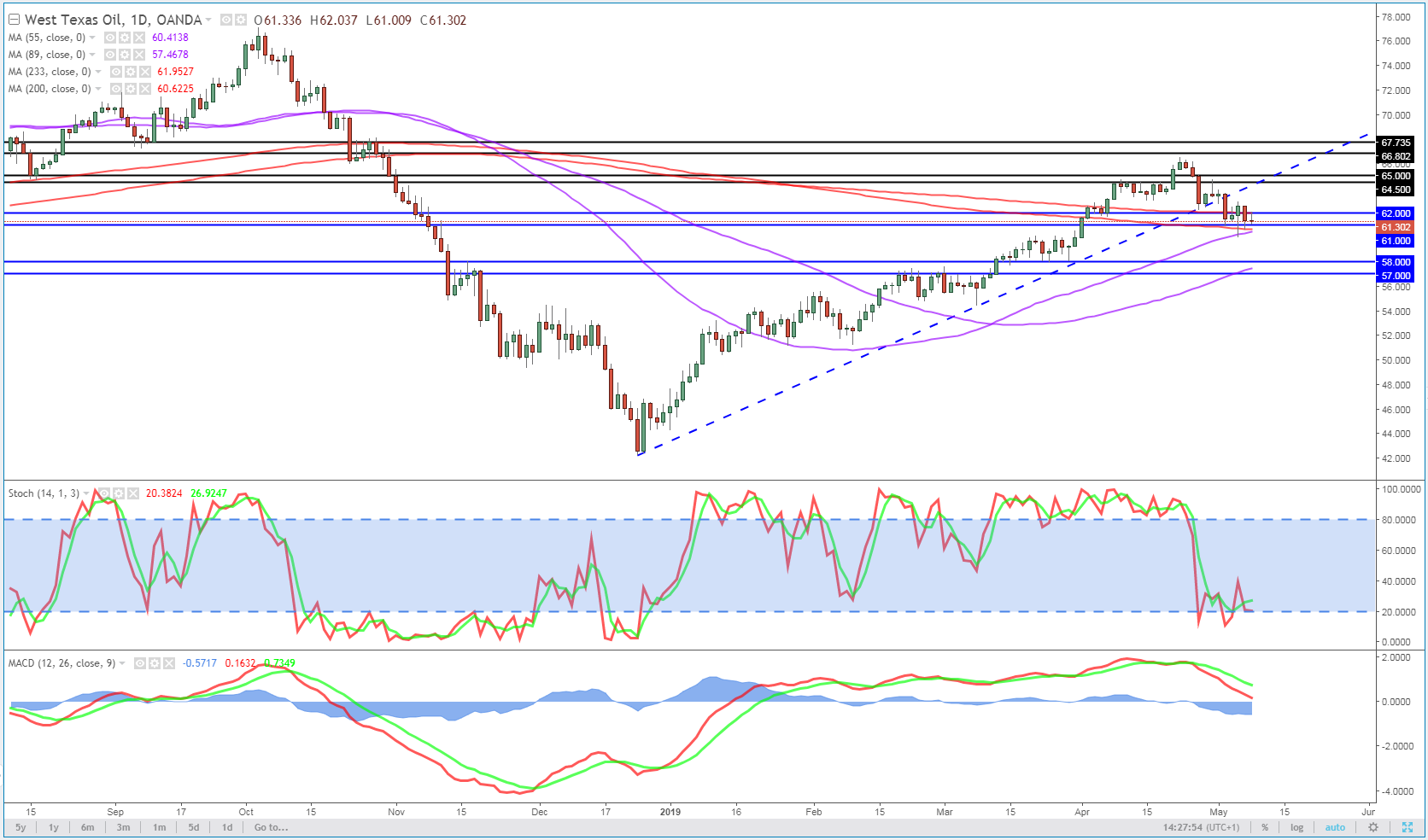
We’ve seen a bit of a corrective move since then – just shy of 10% – but that may increase. We’re currently trading at a very interesting level – around $69-70 in Brent and $60-61 in WTI – a break of which could signal more pain to come. Given the recent shift in risk appetite, this is perfectly feasible.
Copper Outlook: Bears Probe Again through Key 200SMA Support
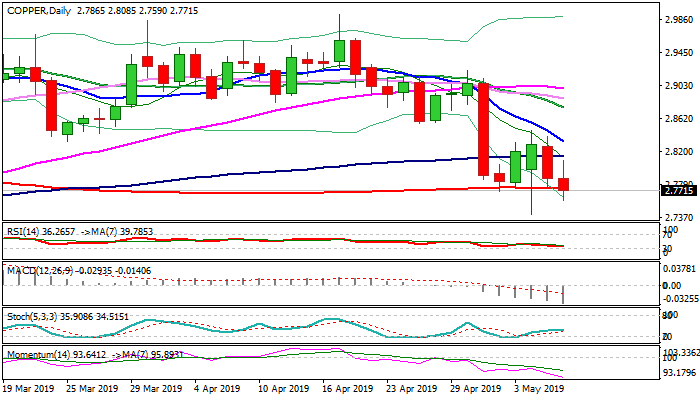
Copper price falls further on Wednesday and probes through key 200SMA support ($2.7741), which held the action of past four days.
The metal trades within larger downtrend from $2.9933 (17 Apr high) which so far retraced 50% of $2.5420/$2.9933 rally and came under increased pressure from concerns of escalation of US/China trade conflict.
Two sides are due to meet later this week in attempts to try to find a deal and avoid strong global consequences of trade war.
However, the US already announced that it will start raising taxes on Chinese imports as from Friday that reduces chances for reaching an agreement. Firmly bearish daily studies and weekly momentum attempting to break into negative territory, add to negative scenario.
Eventual close below 200SMA after four consecutive failure, would generate bearish signal for extension of bear-leg from $2.9933 towards initial support at $2.7405 (Monday's spike low) and $2.7144 (Fibo 61.8% of $2.5420/$2.9933 rally).
Repeated failure to close below 200SMA would keep the price within multi-day congestion and signal prolonged directionless phase.
Res: 2.8085; 2.8146; 2.8328; 2.8470
Sup: 2.7590; 2.7405; 2.7144; 2.7000
Sunset Market Commentary
Markets
Global core bonds gain modest further ground today as the risk-off sentiment is prevailing. US President Trump’s renewed tariff threat got backed by Reuters this morning that said that China tried to renege on key topics. China is said to have deleted commitments from the draft trade deal, undermining close to all enforcement mechanisms the US had been fighting for. It leaves the impression that US President Trump is serious on raising tariffs on Chinese imports on Friday. Core bonds profited and moved higher throughout the day. Before EU openings, better-than-expected German industrial production results had no impact on trading. The German yield curve is moving lower with changes up to -2.4 bps (30-yr). In the run-up to the WS opening bell, US Treasuries reversed part of the intra-day gains as President Trump stated that China had informed him that Chinese VP Liu He is coming to the US tomorrow to make a deal. We advise cautiousness as long as there is no practical evidence of concrete progress, confirmed by the negligible reaction on financial markets. At the time of writing, US Treasury yields are edging lower with losses up to 1.8 bps (2-yr). Peripheral spreads over the German 10-year yield are widening with Italy (+3 bps) and Greece (+11 bps) underperforming. The latter has set its annual primary surplus target to 2.5% of GDP, challenging an agreement with the EU and the IMF that called for a primary surplus of 3.5%.
There was very little news to guide EUR/USD trading today. German March industrial production rebounded more than expected (0.5% vs ‑0.5% ). EUR/USD tried to extend gains north of 1.12 early in European trading, but the move almost immediately ran into resistance. From there, the pair settled in a very narrow range near the 1.12 pivot. Global markets are looking out for next steps in the US-China trade dispute/negotiations. The outcome of this process remains highly uncertain. Even more, EUR/USD traders this week clear didn’t know how to react to this topic in the first place. In this context, today’s EUR/USD stalemate shouldn’t come as a surprise. The USD/JPY correction slowed today. The pair hovered in the low 110 area for most of the day.
UK PM May reiterated that negotiations with the Labour party continue as they try to reach a deal that could reach a majority in Parliament. However, UK politicians (and investors) are losing confidence that a deal might be reached. In the meantime, ever more conservative party members are indicating that they consider to apply their candidacy to succeed PM May. This process probably won’t simplify progress in the Brexit process. Dwindling chances on a (soft) Brexit deal between the Conservative party and Labour are weighing on sterling. EUR/GBP rebounded further in the 0.85/87 consolidation range (currently 0.8605 area). Cable dropped close to the 1.30 area.
News Headlines
Iran responded to US sanctions imposed against the country after Trump’s administration walked out of the 2015 nuclear accord last week. The country set a 60-day deadline for its counterparts to guarantee commitments on oil and banking. Otherwise, Iran threatens to stop restrictions on uranium enrichments.
The US Trade Representative’s office said in a draft federal register note that the US will increase tariffs on $200bn of Chinese imports to 25% from 10% on Friday.
Washington Fed governor Brainard said that she wants to explore targeting explicit levels and slightly longer interest rates as well, if the Fed must cut its policy rate again to zero in a future downturn: “Initially one-year interest rates, for example, and if more stimulus is needed, perhaps moving out the curve to two-year rates".
German industrial production rose by 0.5% M/M in March, beating forecasts (-0.5% M/M) following a downwardly revised 0.4% M/M in February. Construction and consumer goods production supported the March growth, but the outlook remains subdued, proven by eg recent PMI’s or yesterday’s industrial orders.