

Sample Category Title
WTI Oil Outlook: WTI Stands At The Back Foot Despite Rising Tensions Over Iran’s Nuclear Deal
WTI oil eases after recovery attempts in Asian/European session stalled at $62 zone, keeping the action in red for the second straight day, despite threats of escalation of the situation about Iran's nuclear deal, as concerns over deepening US/China trade conflict weigh. Much lower build in US crude stocks (API report showed rise of 2.8 mln bls vs last week's build of 6.8 mln bls) provided little help to oil price, with focus turning towards release of US EIA report today (1.2 mln bls build f/c vs 9.9 mln bls build previous week) which would provide fresh signals. Technical studies remain mixed as bearish momentum continues to rise and helped by multiple bear-crosses of daily MA's (5,10,20,30), while stochastic heads north and converged 55/200SMA's are about to form golden-cross and further support the action. Key levels at the downside lay at $60.57 (55/200SMA's) and $60.03 (Tue's spike low) while falling 10SMA ($62.70) and sideways-moving 30SMA ($63.07) mark upper pivotal points.
Res: 62.08, 62.70, 63.07, 63.61
Sup: 61.06, 60.57, 60.18, 60.03

RBNZ Cuts, VIX Surges, Gold & JPY Firm
Volatility is back in a big way as the VIX hit 4-month highs but we warn you that volatility here means what it exactly says it is: Large daily and intra-day fluctuations in global indices rather than a singular downwards move. NZD lost ground after the RBNZ cut rates. GBP flounders towards 1.30 on eroding hopes that poor local elections results would spur Labour and Conservatives towards a Brexit compromise. Elsewhere, a heavy round of risk aversion hit stock markets, while gold and yen are the biggest gainers. A new Premium trade was issued yesterday, while the stop was moved in another recent trade.
The RBNZ decision to cut by 50 bps interest rates was a surprise as the market was pricing a 40% chance. NZD plunged from 0.66 to 0.6527 before erasing half of those losses. The RBNZ was surprised by the impact of the global slowdown, but its communique did not give reason to expect addional easing in the near-term.
Brexit Cross Party Talks
The latest reports indicate no progress in Brexit negotiations but more talks planned later in the week. There was a small opportunity this week for a breakthrough but it has evidently gone nowhere. It's increasingly clear that all sides are far too dug-into positions to find a compromise and that will leave cable floundering.
US-China Talks at Epicentre
Elsewhere, worries about a US-China trade war hammered equity markets on Tuesday. The S&P 500 fell as much as 66 points before finishing down 48 points. It came after yesterday's tariff talk from Mnuchin and Lighthizer. The trading pattern continues to be that of aggressive declines in the afternoon session, followed by a slight rebound in the final hour. DOW30 closed below its 55-DMA, while SPX remains above its own 55-DMA of 2850, a level meriting extra scrutiny. We're also closely watching the 60 support in US crude oil.
What's notable is that the FX and bond markets were much less volatile that stocks. Yen crosses fell around 0.5% and Treasury yields were down 1-2 bps. That's an indication of a wait-and-see attitude rather than a flight to safety. The USDJPY Premium short is currently 120 pips in the green.
Every decline in the S&P 500 will sap Trump's will to launch the trade war but sometimes flows can take on a life of their own. The focus in the day ahead will continue to be on China's response and posture into this week's planned talks.
EUR/USD Ignores Support Levels
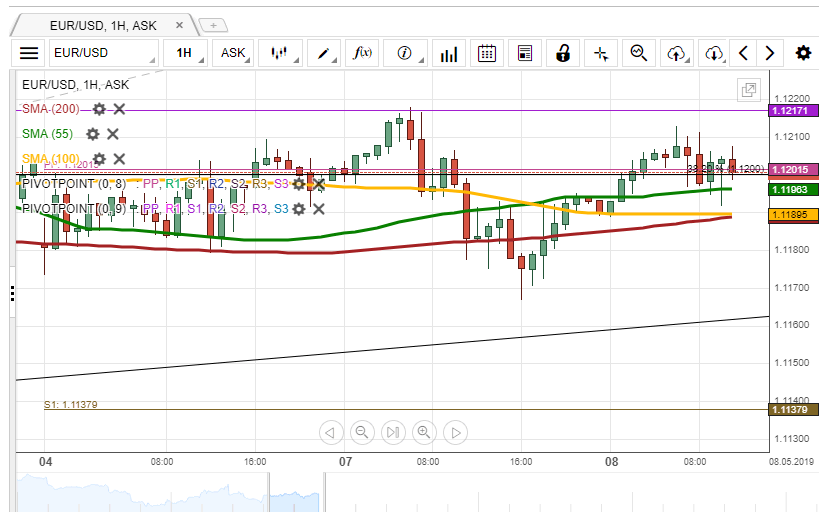
On the hourly chart the EUR/USD had made a big dip down to the 1.1170 level. During the move it revealed that the various technical support levels have only minor strength. Namely, they are not strong enough to keep the pair from falling.
Due to that reason it is expected that the rate could pass the combined support of the 100 and 200-hour simple moving averages. In that case the currency pair would decline afterwards to the 1.1160 level, as there is no technical support down to that level.
On the other hand, the currency exchange could continue to bounce around the 1.1200 level in sudden sharp moves both due to US trade politics and the psychological effect of the 1.1200 level.
GBP/USD Reached Down To 1.3000
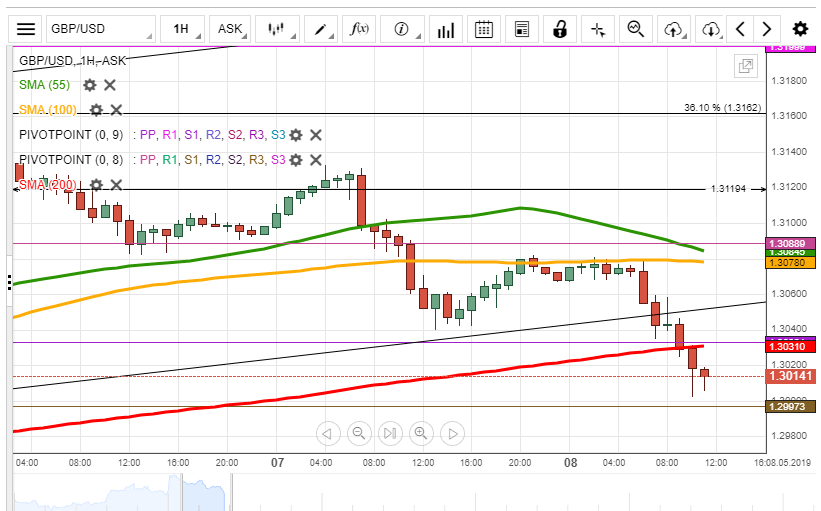
On Wednesday, the GBP/USD broke the support of the previously drawn ascending channel pattern and the combined technical support of the 200-hour simple moving average and a pivot point near 1.3030.
By the middle of the day's London trading session the pair was about to test the support of the weekly S1 at 1.2997 and the psychological support that the 1.3000 level provides.
If this level gets passed, the rate could fall down to the 1.2940 level, where a Fibonacci retracement level is located at.
USD/JPY Drops To 110.00
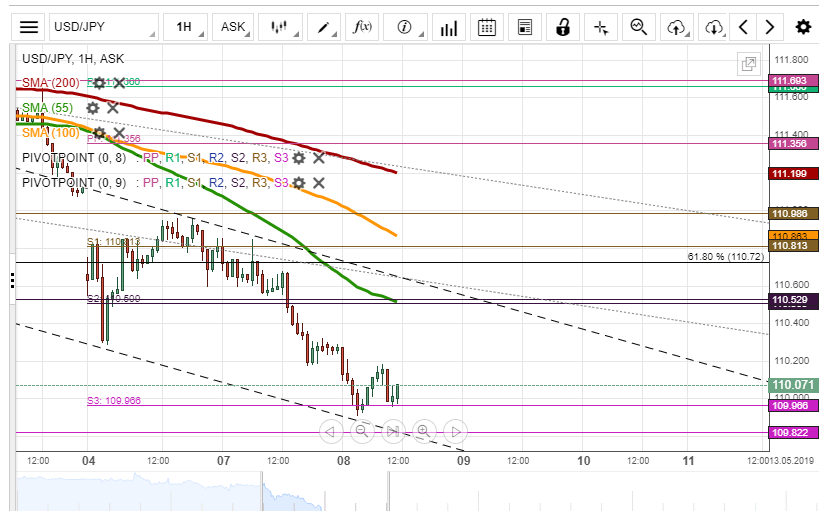
The USD/JPY has reached the 110.00 level. On Wednesday the support of the 110.00 level and the weekly S3 were keeping the rate from falling. In general, there were two short term scenarios most probable for the pair.
The rate could trade sideways between the 110.00 level and the resistance of the 110.20 level until the resistance provided by the 55-hour simple moving average catches up to it.
On the other hand, if the pair drops below the 110.00 level, it will aim at the technical support provided by the 50.00% Fibonacci retracement level at 109.60.
Gold Surges On Wednesday
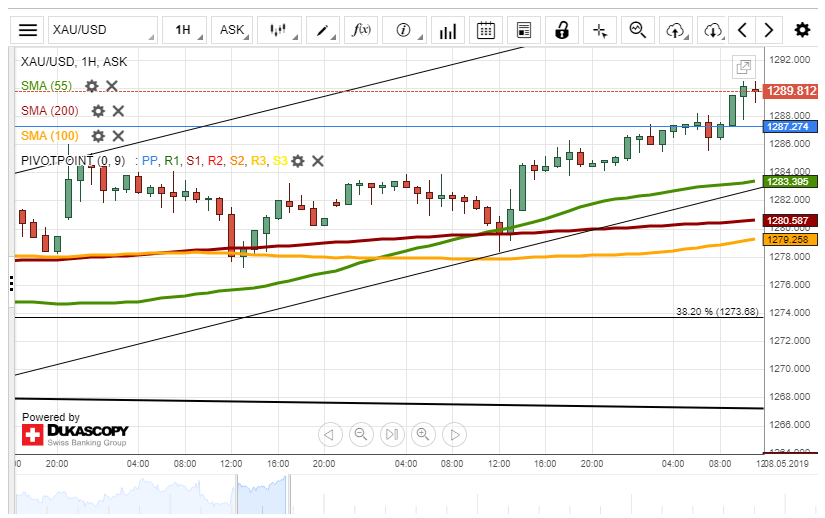
On Wednesday, gold surged. It was set to reach the 1,292.00 level. Moreover, if the 1,292.00 level is broken, the commodity price should reach up to the 1,300.00 mark.
Namely, the metal had passed the resistance of a monthly pivot point at 1,287.27 and was bound to reach an upper trend line of a large scale descending pattern near 1,292.00.
On the other hand the price had overextended its gains. It could consolidate by trading sideways or retreating back down to the monthly pivot point.
European Update – Gold Gains In Risk Averse Trade
Markets in risk aversion mode
We're in risk aversion mode in the markets as investors prepare for the prospect of tariffs on Friday rather than a trade deal between the world's two largest economies.
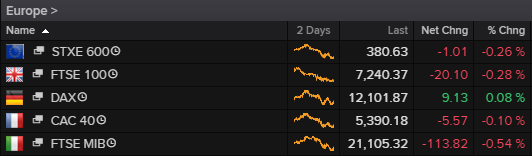
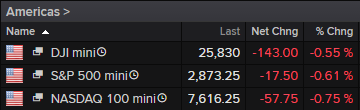
The breakdown in talks has really caught the markets off-guard. It seemed a deal was just widely accepted and basically priced in. Now we're left wondering whether it will happen at all and what impact more tariffs will have on the global economy and markets. The next few days could be massive.
Gold bulls given a new lease of life
Gold is seeing some safe haven support today with a slightly softer dollar also giving it an extra lift. The yellow metal is yet to break through the peak from a couple of weeks ago – around $1,290 – but gold bulls will be very encouraged by recent price action. The failure to break below the low last week was a sign that the trend had weakened – as was its failure to pick up any real momentum after breaking below $1,280 – and now price action may be giving some bullish signals.
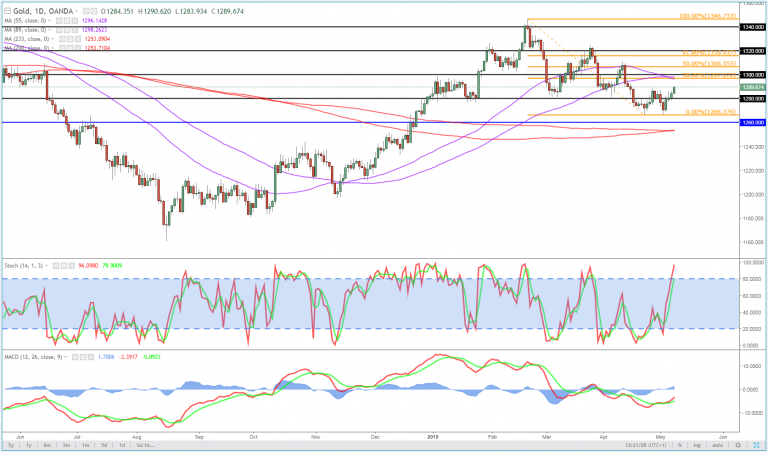
A break above $1,290 could see $1,310 once again come back into focus, which coincides with the April peak. It's worth noting that this doesn't necessarily spell the end of the gold sell-off but just that the correction may be earlier and deeper than you would typically see. The potential breakdown in trade talks between the US and China naturally doesn't help risk appetite and has given gold bulls a new lease of life.
Downgrade To German Growth Sends DAX To 3-Week Low
The DAX index has steadied on Wednesday, after declining 1.6% on Tuesday. Currently, the DAX is at 12,089, down 0.03% on the day. In economic news, German industrial production came in at 0.5%, much stronger than the estimate of -0.5%. Later in the day, the ECB releases the minutes of its April policy meeting.
Investors pulled the plug on European stock markets on Tuesday, in response to a report from the EU, which slashed the 2019 growth outlook for Germany. In February, the EU projected growth of 1.1%, but this has been drastically cut to 0.5%. The downgrade for the eurozone was minor, from 1.5% to 1.4%. The EU noted that the downside risks to the eurozone remain “prominent”, and noted that deadlines for the U.S-China trade talks and Brexit had come and passed, leaving significant uncertainty about the economic outlook. The report warned that “an escalation of trade tensions could prove to be a major shock.” The weak German forecast and pessimistic tone of the report unnerved investors, as the DAX posted its biggest one-day decline since mid-April.
Adding to the DAX’s woes this week was an escalation in trade tensions between China and the U.S. On Sunday, Trump said that the U.S. would raise tariffs on $200 billion worth of Chinese goods as early as Friday, from 10% to 25%. Chinese officials had said it would cancel the talks, but this turned out to be an empty threat. Chinese Vice Premier Liu He is scheduled to lead a Chinese delegation to Washington. Will the new U.S. tariffs be rescinded? Treasury Secretary Steve Munchin said that the tariffs could be cancelled when the talks resume. Such a move would restore investor confidence and could trigger a rebound on the stock markets, after a very rough start to the week.
Sterling accelerates down as cross party Brexit talk said to be near to collapse
Sterling's decline picks up momentum earlier on news that the UK government conceded that they couldn't finish Brexit negotiation with opposition labor soon. And hence, Cabinet Minister David Lidington confirmed European parliament elections will go ahead in UK on May 23. Then there were even reports that the discussion between Prime Minister Theresa May and opposition leader Jeremy Corbyn was close to a collapse.
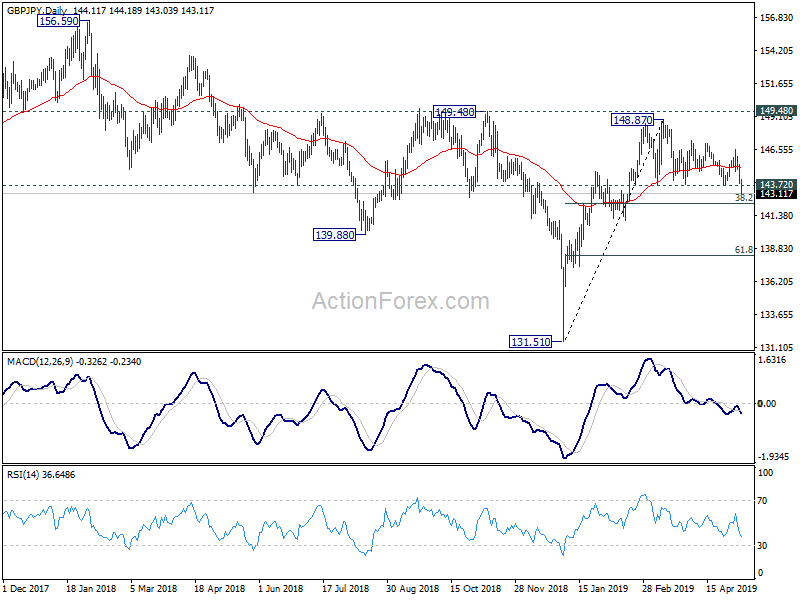
GBP/JPY is one of the weakest pair today on risk aversion too. The break of 143.72 support aligns its outlook with USD/PY and EUR/JPY. That is, rebound from 131.51 has completed at 148.87 already, ahead of 149.48 resistance. Further fall should be seen to 38.2% retracement of 131.51 to 148.87 at 142.23 next.
EUR/USD – Euro Steady As German Industrial Production Beats Expectations
It has been an uneventful week for EUR/USD. Currently, the pair is trading at 1.1201, up 0.08%. On the release front, German industrial production came in at 0.5%, much stronger than the estimate of -0.5%. Later in the day, the ECB releases the minutes of its April policy meeting. For a third straight day, there are no major events in the U.S. On Thursday, the U.S. releases producer price index reports and unemployment claims.
The European Commission has lowered its 2019 growth forecasts for Germany and the eurozone, compared to the forecast back in February. The eurozone downgrade was minor, from 1.5% to 1.4%. However, the forecast for Germany was slashed from 1.1% to 0.5%. The EU noted that the downside risks to the eurozone remain “prominent”, and noted that deadlines for the U.S-China trade talks and Brexit had come and passed, leaving significant uncertainty about the economic outlook. The report warned that “an escalation of trade tensions could prove to be a major shock.” The weak German forecast and pessimistic tone of the report could dampen investor appetite for the euro, although the currency has held steady on Tuesday.
With the eurozone continuing to post lukewarm data, the ECB is in no rush to alter its monetary policy. Rate-setters are in a dovish mood, and the bank recently stated that it had no plans to raise rates prior to the spring of March 2020. The U.S. economy is in much better shape, but the Federal Reserve has shifted to dovish stance so far this year. At last week’s rate meeting, Fed chair Powell said that rate moves could go either way. Economic data will play a major factor in what direction rates move. Recent numbers have looked strong – GDP for Q1 jumped 3.2%, and nonfarm payrolls was unexpectedly strong in April. If this positive trend continues, the Fed could raise rates later this year, and the divergence with the ECB would likely boost the dollar, at the euro’s expense.