Sample Category Title
USD/JPY Squeezed By 55– And 200-Hour SMAs
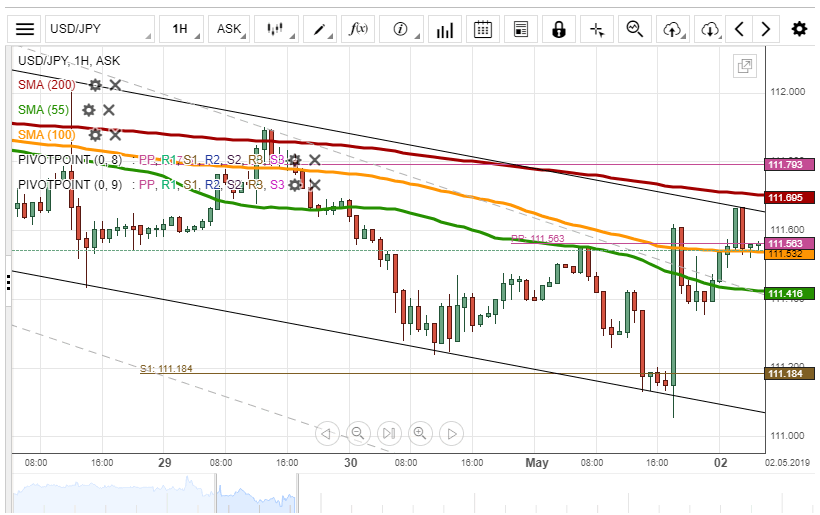
During the previous trading session, the USD/JPY currency pair reached the upper boundary of the short-term descending channel at 111.66.
From a theoretical point of view, it is likely, that the pair reverses south and targets the lower channel line. Important support level to look out for is the weekly S1 located at the 111.18.
However, note, that the exchange rate is squeezed by the 55– and 200-hour SMAs, currently located at 111.42 and 111.70 respectively. If the given moving averages hold, it is expected, that the rate could trade sideways in the short run.
XAU/USD: Two Scenarios Likely
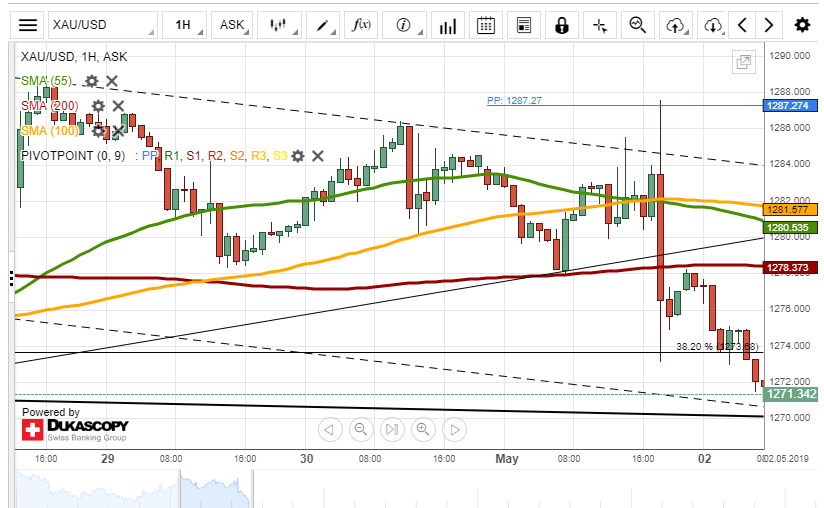
On Wednesday, the XAU/USD exchange rate tumbled to the Fibonacci 38.20% retracement at 1,273.68. During Thursday's morning, the rate declined to the 1,272.00 level.
Given, that the rate is trading near the lower boundary of the falling wedge pattern at 1,270.00, it is unlikely, that bears could prevail in the market.
From a theoretical perspective, a reversal north should occur in the nearest future. In this case, the price for gold could target the 1,276.00 level.
However, if the given pattern does not hold, a breakout south might occur, and the rate might decline to the 1,268.00 mark.
USD/CHF Turning Up From 1.013 Support!
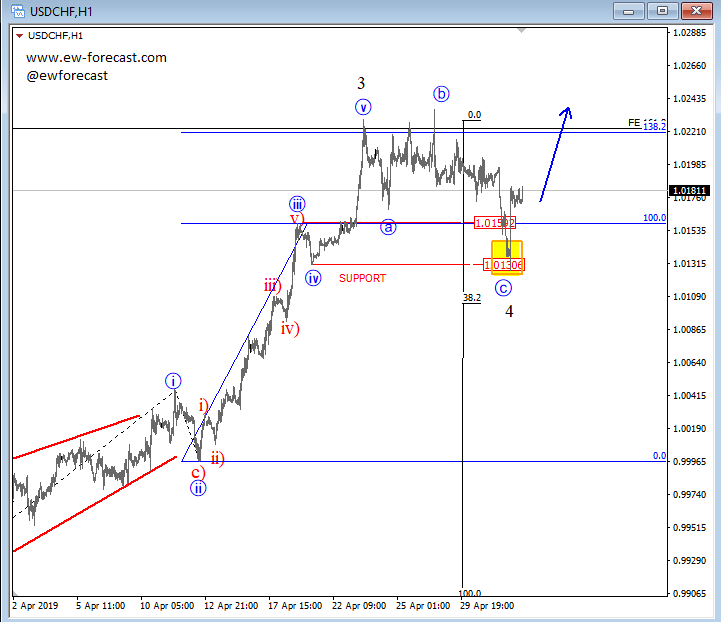
USDCHF made a nice spike lower, right into a fourth wave support area at 1.0130 where price might complete a corrective decline, so we are looking now for a rise back to the highs, ideally wave 5 towards 1.0250 maybe even 1.0300 area.
USDCHF, 1h
USD/JPY Outlook: Close Above 200SMA Needed To Signal Reversal
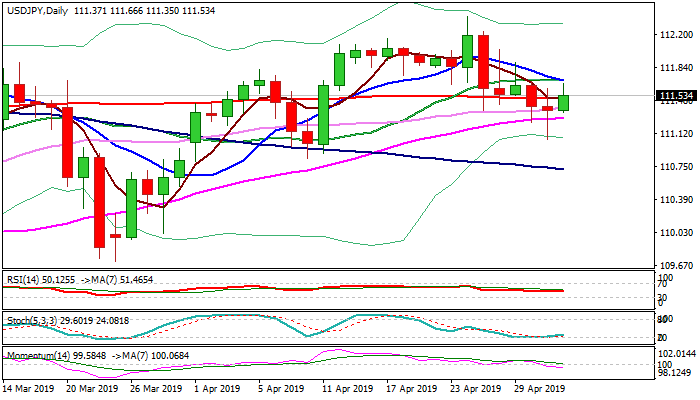
The pair stands at the front foot and probes above pivotal 200SMA (111.50) as steady Fed boosted dollar and near-term bears were strongly rejected at 111.05 on Wednesday.
Subsequent bounce formed bear trap pattern that signals further advance. Fresh recovery needs close above 200SMA to confirm reversal and mark higher low at 111.05.
Converged 10/20 SMA's mark next pivotal barrier at 111.70, violation of which would generate further positive signal for extension towards 111.89 (weekly cloud top).
Caution on failure to clear 200SMA that would keep the downside vulnerable, with return below 30/55SMA's (111.40/29 respectively) to further weaken near-term structure.
Bearish daily momentum adds to scenario.
Res: 111.70, 111.90, 112.03, 112.23
Sup: 111.40, 111.29, 111.05, 110.84
Fed Maintains Neutral Stance, BoE To Follow
The Fed finally sounded less concerned than many market participants had thought initially. The buck has been surging against most peers while safe haven JPY and CHF also appreciated following the announcement. However, things appear to be turning now: the Fed is discounting risks of US-China trade war and a hard Brexit while strong economic growth and a tight labor market should push the inflation back to its target. Consequently, equity markets lost ground across the board after reaching record highs earlier in the day. Today's BoE monetary policy meeting will also not show any major changes.
Indeed, the Fed provided few indications as to where interest rates are heading, stating that current “policy stance is appropriate at the moment”. Yet, despite market expectations of a fall in the Fed’s key rate by year-end, a rate move in the opposite direction can be considered if the global economic recovery sustains. Still, the situation is slightly different for the BoE whose heavy dependence over the Brexit outcome should force it to remain silent – at least until the divorce clauses are revealed. The focus is therefore on Prime Minister Theresa May and Opposition Leader Jeremy Corbyn who seem ready to work on a multi-party agreement. Discussions should ramp up next week.
GBP/USD is trading at 1.3064, approaching 1.3035 short-term.
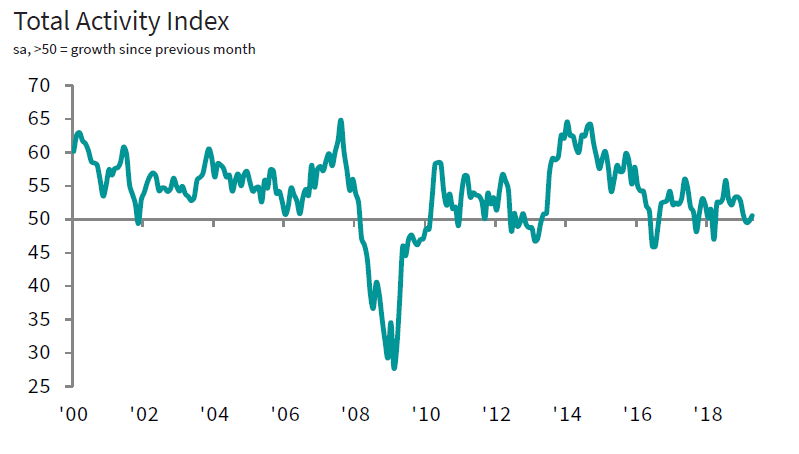
UK PMI construction rose to 50.5, return to growth
UK PMI construction rose to 50.5 in April, up from 49.7 and beat expectation of 50.5. Markit noted that construction output rises for the first time since January. Residential work expands at fastest pace for four months. However, civil engineering and commercial activity fall again.
Tim Moore, Associate Director at IHS Markit, which compiles the survey:
"A return to growth would normally be considered a positive month for the UK construction sector, but the weakness outside of house building gives more than a little pause for thought. Commercial activity and civil engineering both remained on a downward path in April as political uncertainty led to delays with spending decisions.
"Residential work retained its position as the sole driver of growth across the three main segments of construction activity. Survey respondents once again noted that residential projects were buoyed by strong demand for new homes, low mortgages rates and firsttime buyer incentives.
"On the supply side, sub-contractor availability worsened and construction firms continued to report low stocks among suppliers in April. Latest data revealed the greatest lengthening of lead times for construction inputs since February 2015, reflecting ongoing capacity pressures across the supply chain.
"The forward-looking survey indicators remain subdued, with the UK construction sector recording a drop in business optimism during April and the largest fall in new work for over one year. A lack of new work has started to impact on staff recruitment, as signalled by a reduction in payroll numbers for the first time since July 2016. This provides another signal that construction firms are bracing for an extended period of soft demand ahead."
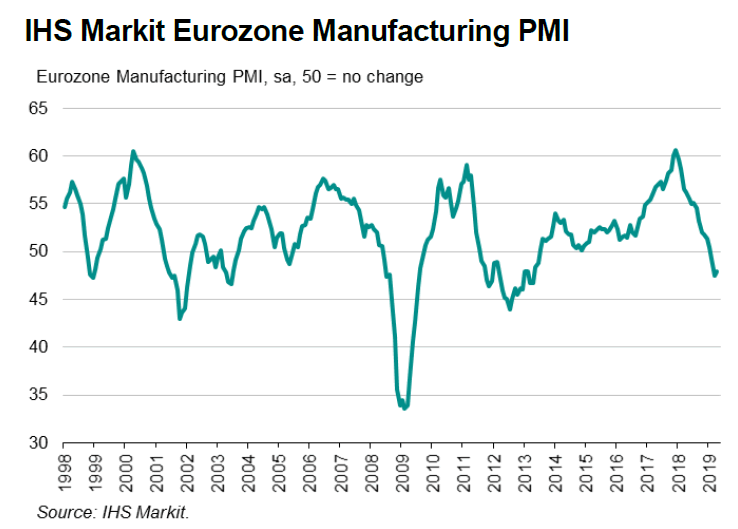
Eurozone PMI manufacturing finalized at 47.9, remained deep in decline, downturn fiercest in Germany
Eurozone PMI manufacturing was finalized at 47.9, revised up from 47.8. It was just a slight improvement from March's six-year low of 47.5. Also, it's in contraction region below 50 for three consecutive months. Markit noted there were further marked fall in new orders recorded. Also, Germany continues to lead downturn but Greece expands at fastest rate in nearly 19 years.
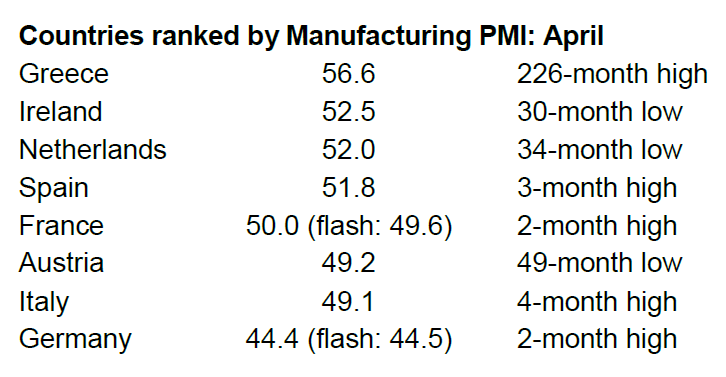
Looking at the member states, German's reading was revised down to 44.4, a two month high but remained close to March's 80-month low at 44.1. Italy and Austria stayed in contraction at 49.1 and 49.2 respectively. France reading was revised up to 50.0, indicating flat activity. Greece reading, though, rose to 226-mont high at 56.6.
Commenting on the final Manufacturing PMI data, Chris Williamson, Chief Business Economist at IHS Markit said:
"The manufacturing sector remained deep in decline at the start of the second quarter. Although the PMI rose for the first time in nine months, the April reading was the second-lowest seen over the past six years, signalling a deterioration of overall business conditions for a third successive month. The survey's output index is indicative of factory production falling at a quarterly rate of approximately 1%, setting the scene for the goods producing sector to act as a major drag on the economy in the second quarter.
"The downturn remains the fiercest in Germany, with Italy and Austria also in decline and France stagnating. Spain's expansion remains only modest.
"Some encouragement can be gained from the PMIs having risen in all four largest euro member states in April, and forward-looking indicators such as future expectations, new order inflows and the orders-to-inventory ratio having all come off their lows. But it remains too early to call a turning point, especially as future sentiment remains around its lowest level since the end of 2012, hinting that the manufacturing downturn will persist in the coming months.
"The surveys continue to see widespread concerns over weak global demand as well as reports of businesses struggling amid rising trade protectionism, Brexit and the subdued auto sector.
"The steepest fall in backlogs of work since late 2012 meanwhile suggests firms will increasingly look for cost-cutting opportunities and exercise increased caution with respect to hiring."
US Dollar Gains After Hawkish Fed Statement
The price of crude oil declined after data from the US energy department showed that inventories rose by a higher margin than expected. In the fourth week of April, inventories rose by more than 9 million barrels. This was higher than the expected gain of just over 1 million barrels. In the third week, inventories had gained by more than 5 million barrels. On Tuesday, data from API showed that the inventories rose by 6 million barrels. The losses were offset by a report that OPEC had reduced production to a four-year low.
The US dollar strengthened after the Federal Reserve delivered its interest rates decision. The bank announced that it was leaving interest rates unchanged at the 1.75% level. Most of the market participants expected this. The main market-moving news was the statement that the Fed was not planning to increase or lower rates this year. A good number of analysts were expecting the Fed to lower rates at some point. In an official statement, the Fed said that:
Consistent with its statutory mandate, the Committee seeks to foster maximum employment and price stability. In support of these goals, the Committee decided to maintain the target range for the federal funds rate at 2-1/4 to 2-1/2 percent. The Committee continues to view sustained expansion of economic activity, strong labor market conditions, and inflation near the Committee's symmetric 2 percent objective as the most likely outcomes. In light of global economic and financial developments and muted inflation pressures, the Committee will be patient as it determines what future adjustments to the target range for the federal funds rate may be appropriate to support these outcomes.
Sterling dropped against the USD following the relatively hawkish statement by the Fed. Today, focus will shift to the Bank of England (BOE) as it prepares to deliver its interest rates decision. The bank is expected to leave rates unchanged at 0.75%. Investors will want to see the number of officials who will vote for a rate hike. The UK is currently in a difficult situation because companies operating in the country are afraid of making investments. International investors are also uncertain about investing in the country due to uncertainties around Brexit.
EUR/USD
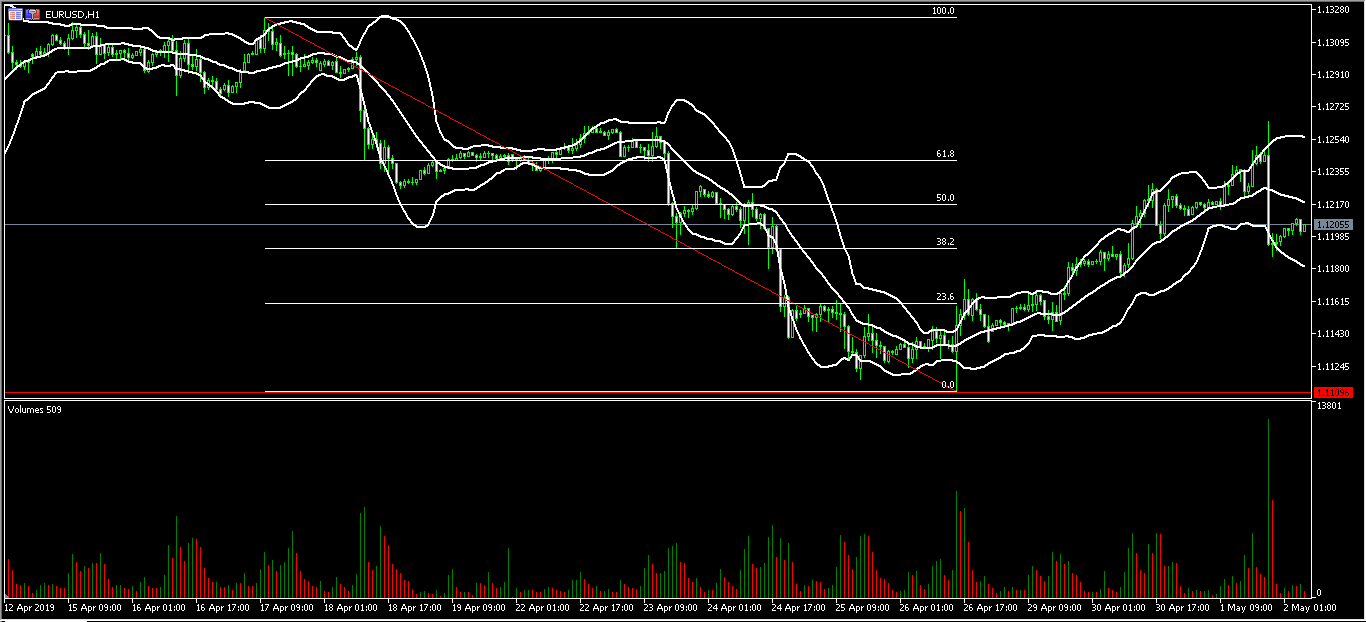
The EUR/USD pair declined after the Fed delivered its interest rates decision. The pair reached a low of 1.1188, which was along the 38.2% Fibonacci Retracement level. In the Asian session, the pair attempted to pare some of the losses, and reached a high of1.1200. This price is between the lower and middle band of the Bollinger Bands while the volumes were relatively subdued. Today, the pair could resume the downward trend and reach the 23.6% Fibonacci level of 1.1160.
GBP/USD
The GBP/USD pair dropped after the Fed decision and ahead of the BOE interest rates decision. On the hourly chart, the pair dropped to an intraday low of 1.3035, which is along the middle line of the Bollinger Bands. The RSI dropped from a high of above 70 to the current 53. The accumulation/distribution indicator too has eased. The pair will likely resume the upward trend and attempt to retest the previous highs.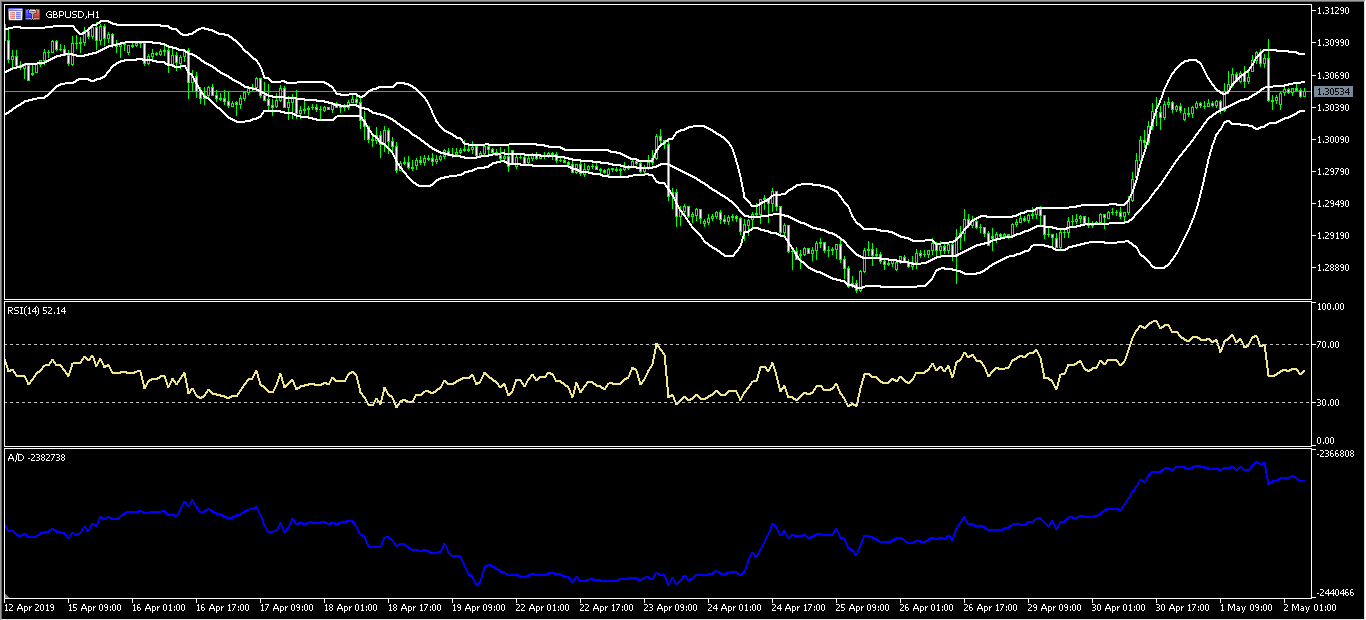
XTI/USD
After rising yesterday, the price of WTI declined slightly after increased inventories data. It is now trading at $63.42, which is along the 25-day moving averages and slightly below the 50-day EMAs. The accumulation/distribution indicator has remained relatively unmoved while the Triple Exponential Average has remained slightly below the neutral level. The pair will likely continue trading along this range as traders get more clarity on OPEC supplies.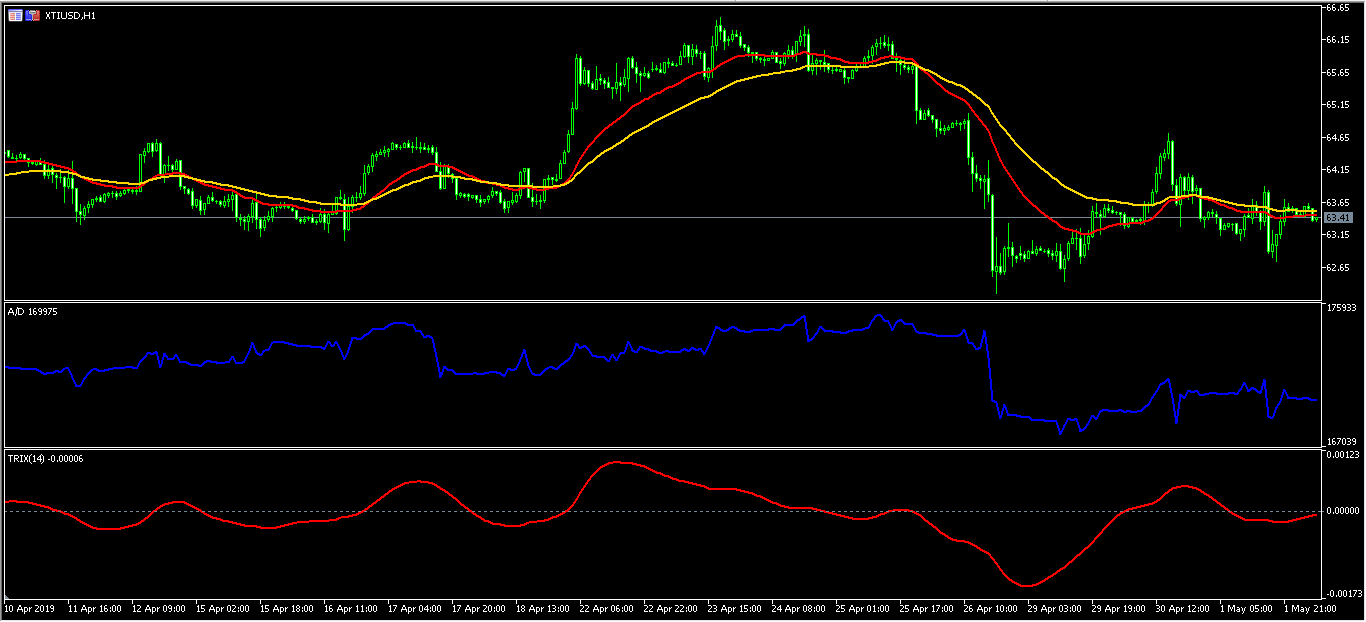
Brexit Updates And BoE Interest Rate Decision Ahead
PM May refused to set date as a deadline on Brexit due to previous failures to reach it. This could be an indication that now, they are willing to turn every stone in their way to find the solution before the extension is over. She also left a No deal Brexit scenario on the table as it could be enforced on the UK (by the EU) if it keeps postponing for a final Brexit deal. Is this a turnaround towards a final solution? May also stated there is common ground between the Labour party and the government on the issue of customs. In our opinion, Therese May and the Labour party agree that some relationship with the EU maybe required to keep job protection and business development in line. Even though the BOE interest rate decision today could be overshadowed by the delayed Brexit, the UK economy seems to be in fairly good hands due to increasing inflation and a tight labour market. Cable got some support yesterday but corrected lower later in the late US session. Cable has been able to advance in the previous days coming back from a two month downfall it had gradually performed since March. In a bullish momentum we may see the pair break above the 1.3070 resistance level and aim higher for the (R2) 1.3175 or even the (R3) 1.3235 resistance hurdles. Of course a break above the (R2) 1.3175 resistance line could signify cable has excessive upward strength since this level has not been surpassed since late March. In the opposite direction, if the pair is to come under selling interest we may see it drop below our (S1) 1.2980 support level. Even lower we could find the (S2) 1.2875 support level with the (S3) 1.2800 support hurdle being even lower.Fundamentally, GBP could keep moving higher if the UK displays some unity within the parliament.
FED remains cautious while US Sino talks remain productive
The FOMC reaffirmed its stance on Wednesday confirming they will remain in this position as they did not see any reason to take action in either direction. The USD gained some strength upon release of the statement. The Fed based their opinion on solid financial growth and a tight labour market while they also believe inflation could return to higher levels. On another front, various reports indicate the United States and China are nearing a trade deal. Chinese officials admitted that an enforcement mechanism is vital, yet they said it should apply for both sides. The talks in Beijing in the previous days where characterized as productive and will continue in Washington next week were analysts believe announcements could be made. XAUUSD edged lower yesterday due the strengthening of the USD upon the FOMC meeting. We must note Gold prices moved higher in the previous sessions surpassing our (R1) 1280.00 resistance line and even tried the (R2) 1287.00 resistance level but was unsuccessful of moving higher. However, an upward movement reaching our (R3) 1294.00 resistance line could indicate a change of the current bearish momentum the precious metal is undergoing. If the selling interest persists we may see the metal moving below the (S1) 1271.50 support level and aim even lower for the (S2) 1260.00 support line. Furthermore, from our point of view the positivity coming from the US Sino talks is easing risks and money from Gold could be moved to other instruments that can generate profits faster.
Other economic highlights, today and early tomorrow
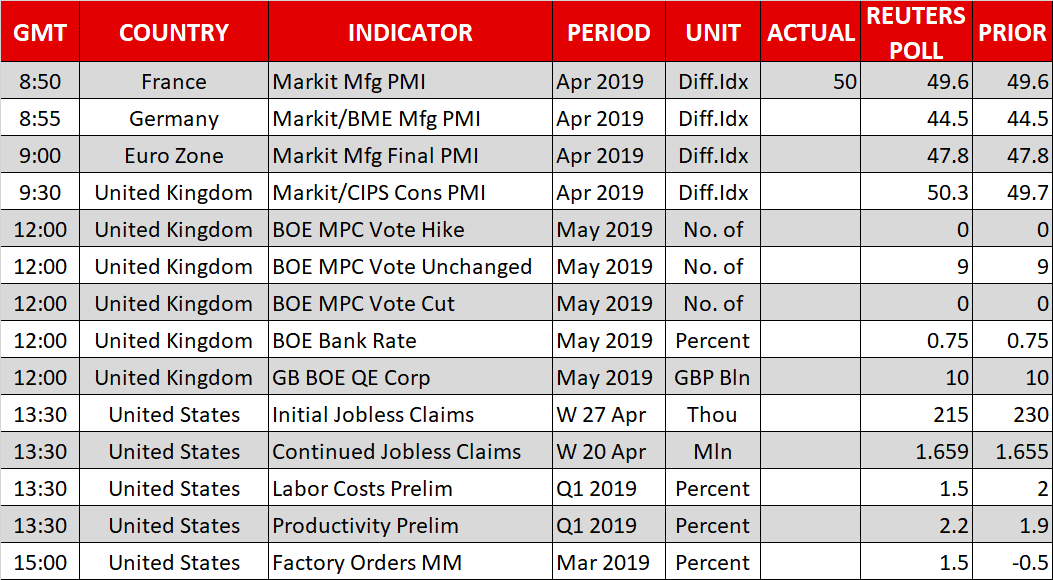
In the European morning, we get from the Eurozone the German Manufacturing PMI and the Eurozone’s Manufacturing PMI both for April. During the European midday session, we get the BoE Interest Rate Decision and at the same time the CNB Interest Rate decision from the Czech Republic. Later on in the US session we get the Factory Orders (MoM) for March. As for speakers please note that German Buba President Weidmann and ECB's Praet Speaks in the late US session.
GBP/USD H4
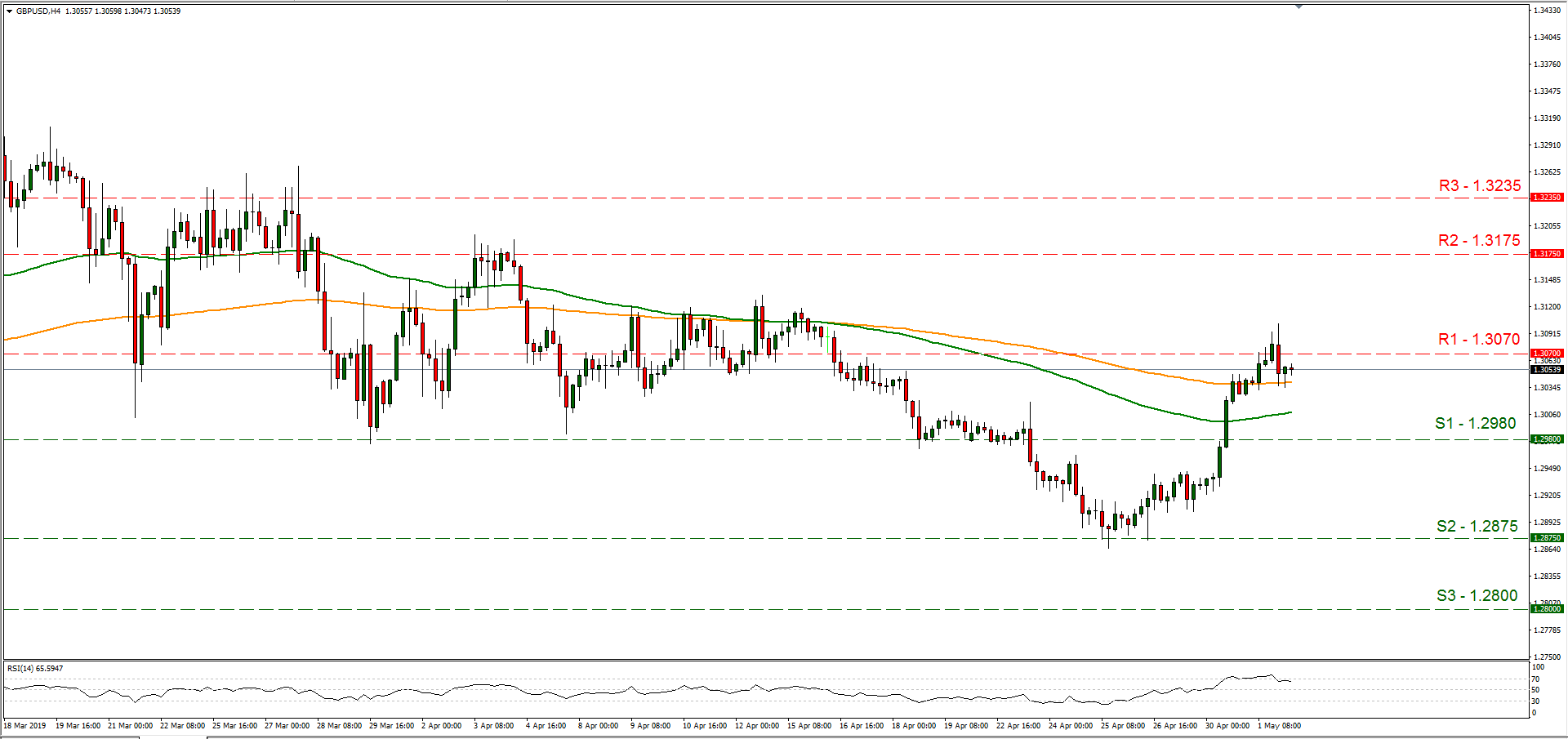
Support: 1.2980 (S1), 1.2875 (S2), 1.2800 (S3)
Resistance: 1.3070 (R1), 1.3175 (R2), 1.3235 (R3)
XAU/USD H4
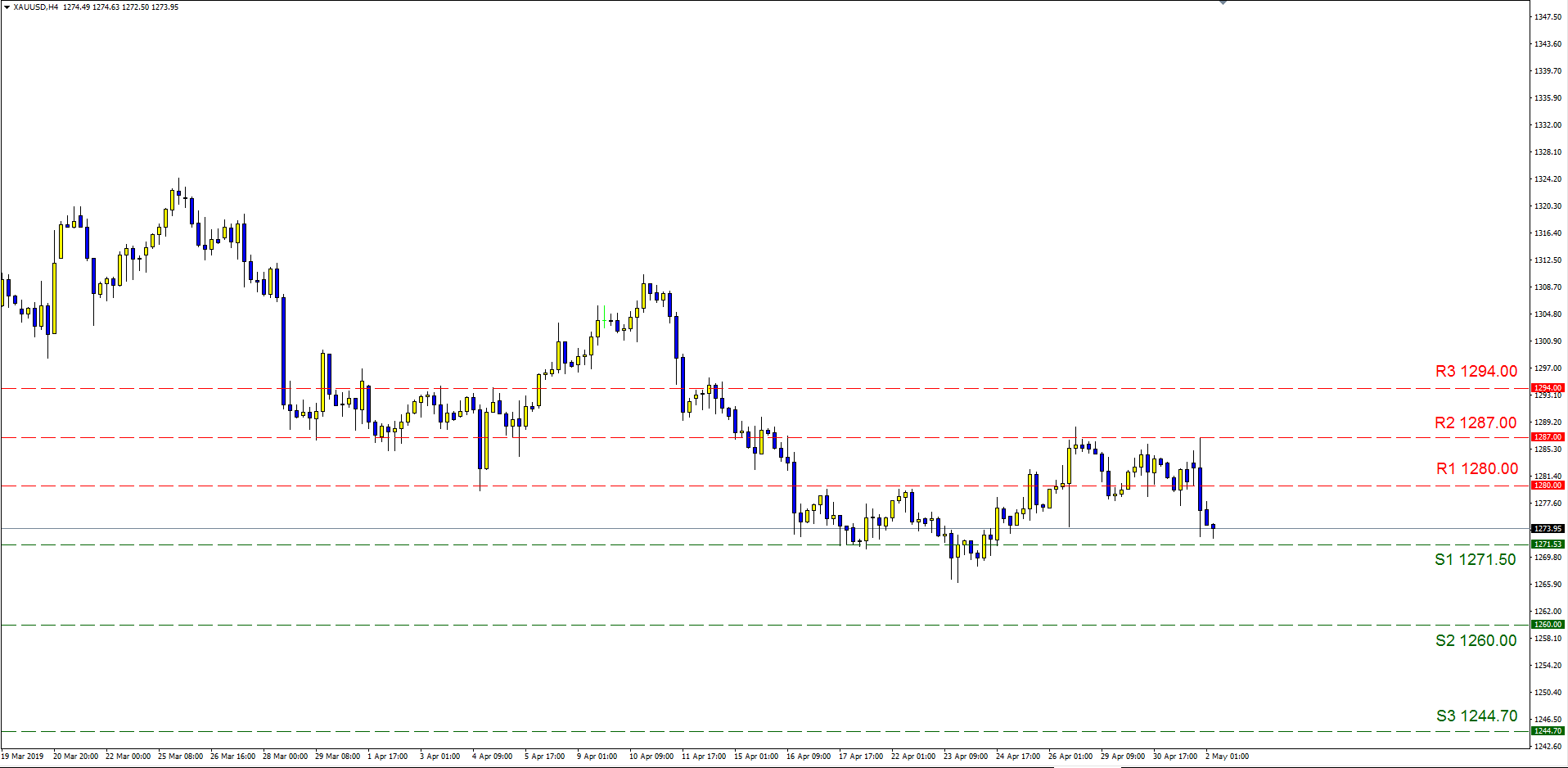
Support: 1271.50 (S1), 1260.00 (S2), 1244.70 (S3)
Resistance: 1280.00 (R1), 1287.00 (R2), 1294.00 (R3)

Dollar Whipsaws After Fed, Pound Holds Firm Ahead Of BoE
- US dollar swings sharply after Powell tones down Fed's dovish statement
- Hawkish Powell puts dent on equities rally
- Pound holds near highs ahead of Bank of England meeting as hopes rise May will agree to a customs union
Rate cut bets ease after Powell's press conference
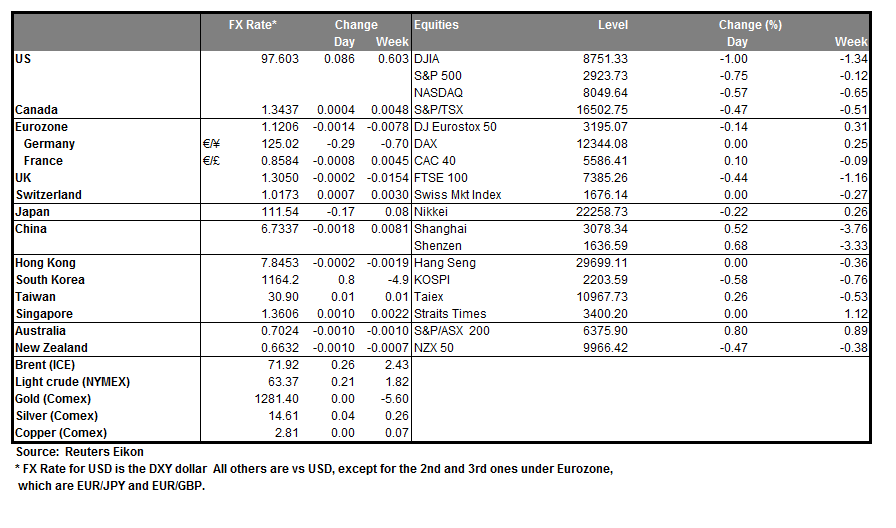
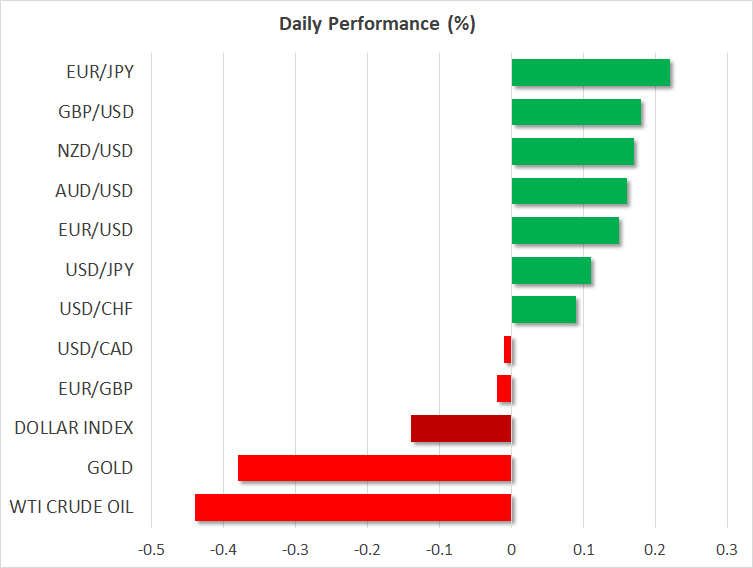
The Federal Reserve kept interest rates on hold yesterday as expected and the dollar initially fell on the announcement as the FOMC statement highlighted the recent decline in inflation. However, the greenback quickly reversed course and shares on Wall Street took a tumble after Fed Chairman Jerome Powell took to the podium. Powell was keen to stress that the current soft patch in inflation was likely due to transitory factors and he sees no near-term case to adjust the federal funds rate from current levels.
Powell's relatively upbeat remarks on inflation and growth in the US contradicted with a somewhat more dovish statement. Speculation that the Fed is getting closer to a rate cut was fuelled from the statement as well as from a 5-basis point reduction by the Fed in the interest paid on excess reserves. However, Powell's remarks dashed hopes of an early rate cut and expectations of a year-end rate reduction receded slightly.
Consequently, yields on US Treasury notes bounced back from lows, with the 2-year yield, which is the most sensitive to short-term changes in the fed funds rate, jumped from a one-month low of 2.206% yesterday to a high of 2.349% earlier today.
In forex markets, the dollar index climbed from a low of 97.15 to recover around 97.70, while against the yen, the greenback was trading around 111.53 at the European open after coming close to dipping below the 111 handle yesterday.
Growth worries persist despite signs of green shoots
Recent stronger-than-expected growth figures from China and the United States, and now from the Eurozone as well, have done little to dispel concerns that a sharper downturn is still on the horizon. Even in the US, where growth has been more resilient to the global slowdown, some data continues to cast doubt over the outlook. The closely-watched ISM manufacturing PMI, released yesterday in the US, fell to a 2½-year low in April. But there was good news from the ADP employment report, which showed stronger-than-expected jobs growth in April and comes ahead of Friday's all-important nonfarm payrolls report.
In the Eurozone, the focus after the impressive Q1 GDP growth figures will move onto the flash inflation prints for April on Friday. Strong CPI data could help the euro regain its positive footing from the GDP boost after coming under pressure yesterday from the dollar's rebound, which pushed the single currency back below the $1.12 level.
The risk-sensitive Australian and New Zealand dollars also slid sharply yesterday but were steadier today. The antipodean pairs could encounter further volatility in the lead up to next week's policy meetings by the Reserve Bank of Australia and the Reserve Bank of New Zealand.
Brexit headlines lift pound again; Bank of England meets
The Bank of England will announce its latest policy decision today following a two-day meeting. In what would normally have been an important day for pound traders as this month's meeting also includes the quarterly inflation report and a press conference, today's ‘Super Thursday' is unlikely to receive a big response in the markets as Brexit continues to remain the main driver for the British currency.
The BoE is widely anticipated to keep policy unchanged and may lower its growth and inflation forecasts. This could weigh on the pound slightly, although if news reports continue to suggest the UK government is warming to the idea of accepting Labour's proposal of a customs union with the EU post-Brexit, a dovish BoE would do little to prevent sterling from surging higher.
The pound briefly topped the $1.31 level after the prime minister, Theresa May, told a parliamentary committee yesterday that the government's customs union plan wasn't that different to Labour's and that she's setting the middle of next week as a deadline to make significant progress in the talks with the opposition.