Sample Category Title
BTCUSD Surpasses Ichimoku Cloud; Indicators Signal Bullish Bias
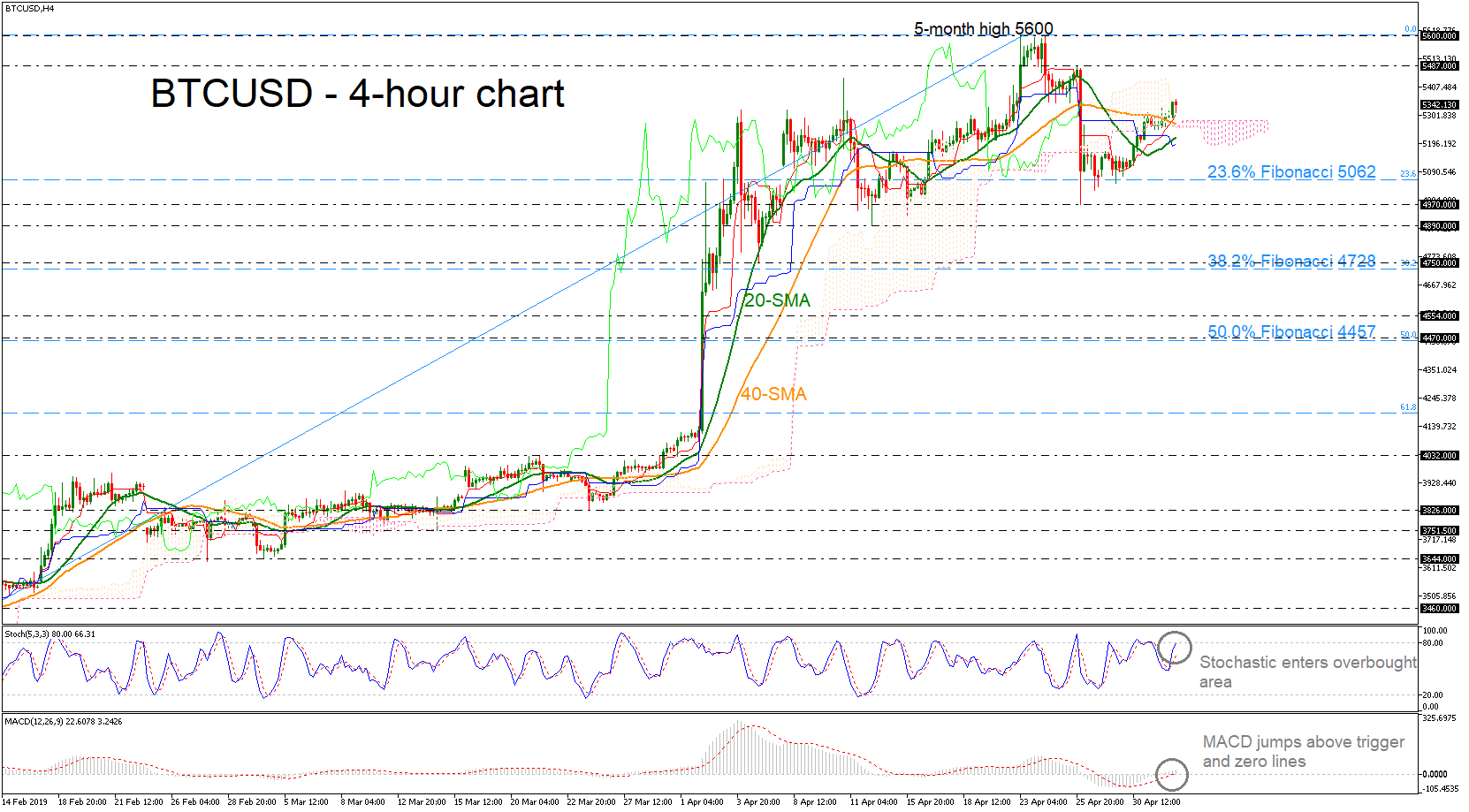
BTCUSD is hovering above the Ichimoku cloud and the 20- and 40-simple moving averages (SMAs) in the 4-hour chart, which are ready to post a bullish cross in the next few sessions. The price found strong support near the 23.6% Fibonacci retracement level of the upward rally from 3313 to 5600, around 5062. The technical indicators suggest that the bearish correction may came to an end in the short term. The stochastic is edging higher entering the overbought zone, while the MACD is moving in the positive area.
In case of another upside run, immediate resistance would come from the 5487 resistance level, taken from the latest highs ahead of the five-month high of 5600.
On the flipside, if bitcoin retreats below the Ichimoku cloud and the SMAs, support would be faced near the 23.6% Fibonacci of 5062. More declines could open the way towards the 4970 support, registered on April 26.
Overall, BTCUSD is creating an upward movement and the indicators suggest a possible positive bias again.
USD/CHF Mid-Day Outlook
Daily Pivots: (S1) 1.0136; (P) 1.0168; (R1) 1.0209; More...
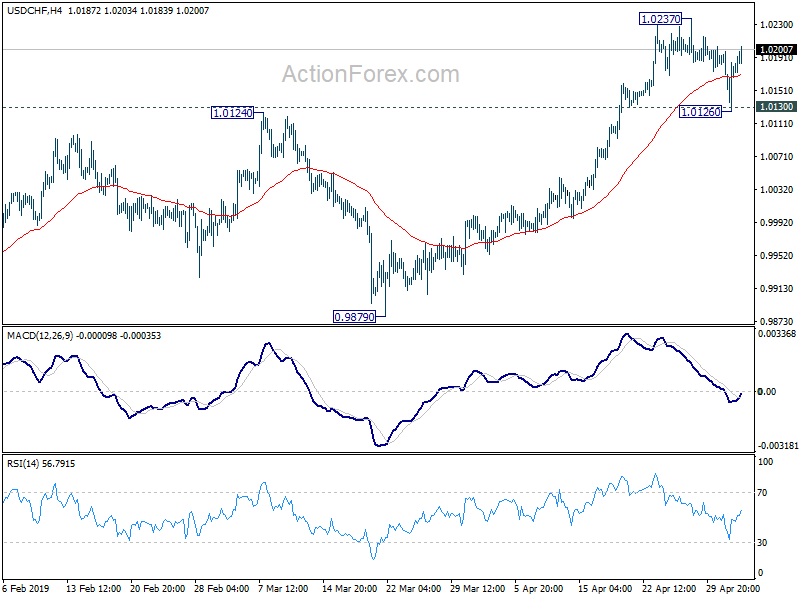
Intraday bias in USD/CHF remains neutral at this point and larger rise is expected to extend as long as 1.0130 support holds. On the upside, break of 1.0237 will resume larger up trend to 1.0342 key resistance. However, sustained break of 1.0130 will confirm short term topping. In that case, deeper pull back would be seen back to 55 day EMA (now at 1.0058) and below.
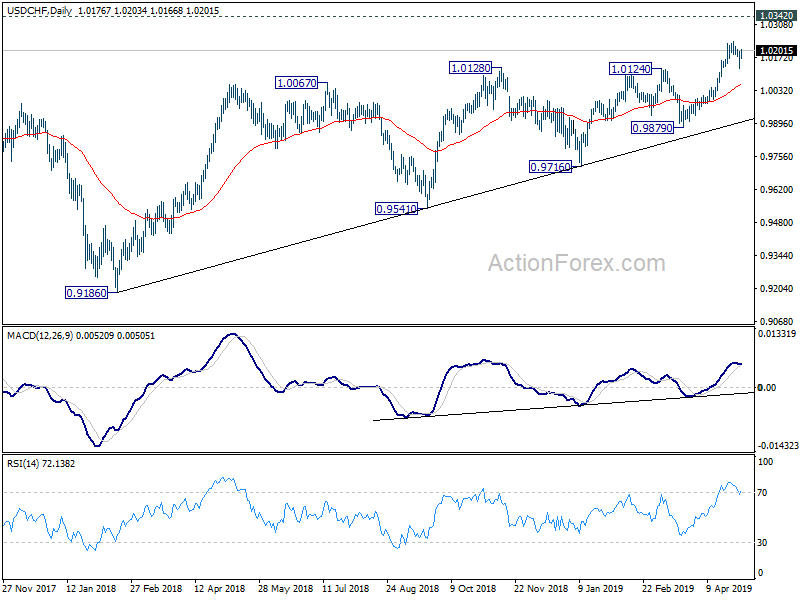
In the bigger picture, medium term up trend from 0.9186 is extending. Current rise should target 1.0342 resistance next. For now, we'd be cautious on strong resistance from there to limit upside, until we see medium term upside acceleration. On the downside, break of 0.9879 support is needed to indicate reversal. Otherwise, outlook will stay bullish in case of deep pull back.
BOE Upgraded GDP Growth Outlook, Warned of Faster- than- Expected Rate Hike Path
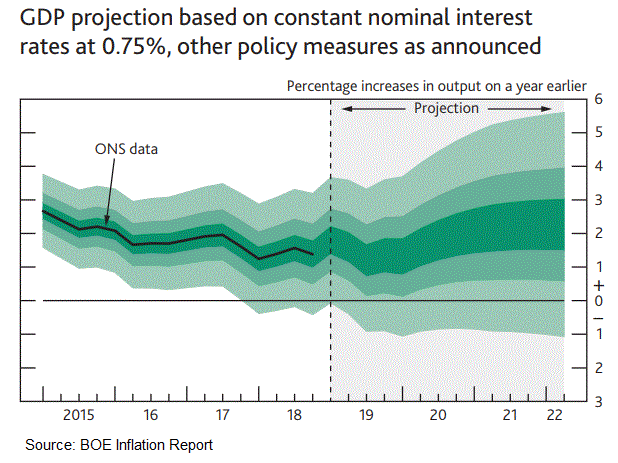
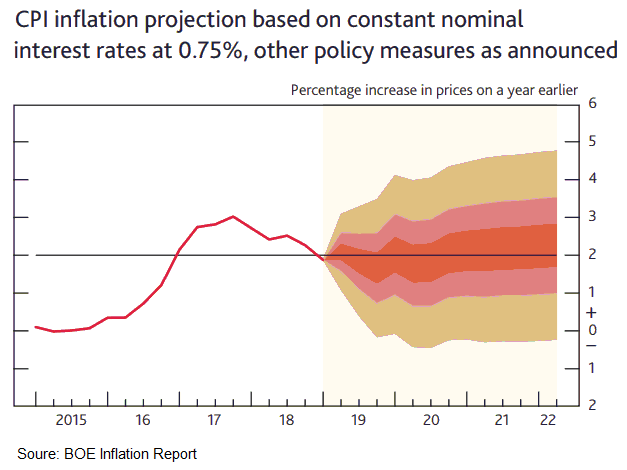
BOE voted unanimously to leave the Bank rate unchanged at 0.75% and the asset purchase program at 435B pound. As expected, the central bank delivered a slightly more hawkish tone as Brexit was delayed to October 31, temporarily lowering the risk of no-deal Brexit. The members are more upbeat on UK’s economic outlook. Besides see the economy to expand +0.5% in 1Q19, up from +0.2% in 4Q18, the staff has upgraded GDP growth in 2019 through 2020. The unemployment rate is expected to fall further from the current multi-decade low level. Meanwhile, inflation forecasts were revised lower.
Higher Growth but Lower Inflation Outlook
The central bank turned more upbeat on the growth outlook, noting that “the underlying pace of GDP growth appeared to be slightly stronger than previously anticipated, but marginally below potential”. Yet, it added that “that subdued pace reflected the impact of the slowdown in global growth and ongoing Brexit uncertainties”. BOE now estimates GDP growth to reach +1.5% y/y this year, compared with February’s projection of +1.2%. The economy would then expand further to 1.6% (February: +1.5%) and +2.1% (February: +1.9%) in 2020 and 2021 respectively. On inflation, the central bank forecast it to reach +1.6% this year, down from +2% projected in February, before recovering to 2% (February: +2.1%) in 2020 and 2.1% in 2021. Unemployment is expected to fall over the two-year forecast period to 3.5%, the lowest since 1973. Better job market would lift wage growth, which is expected to be well above inflation.
Rate hike to Follow Smooth Brexit
On Brexit, Governor Mark Carney noted that the country is “going through this period of uncertainty in the run up to some resolution around Brexit”. He added that if “that resolution is some form of arrangement, with some form of relatively smooth transition to it, it will require interest rate increases over that period and it will require more and more frequent interest rate increases than the market currently expects”.
Rate Hike Pace Could Surprise to Upside
Carney warned that investors might have been under-estimating future BOE rate hikes. He suggested that the current market interest rate curve is “unequal to the task” of achieving the inflation target. That is higher interest rates are needed to prevent inflation overshoot. Yet, Carney affirmed that the pace of rate hike would be gradual.
USD/JPY Mid-Day Outlook
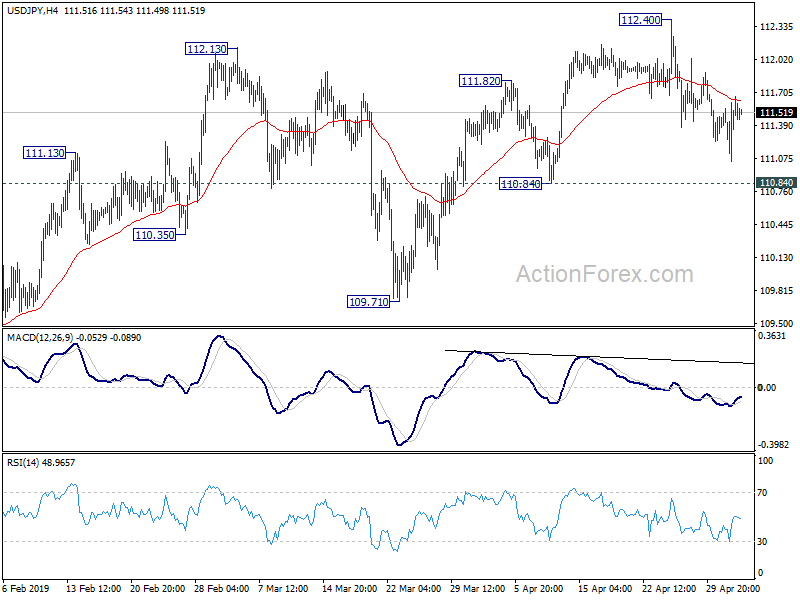
Daily Pivots: (S1) 111.09; (P) 111.35; (R1) 111.65; More...
Intraday bias in USD/JPY remains neutral at this point. Considering bearish divergence condition in daily MACD, risks remain on the downside as long as 112.40 resistance holds. On the downside, decisive break of 110.84 support will add to the case of bearish reversal and target 109.71 support and below. On the upside, firm break of 112.40 resistance will resume the rise from 104.69 instead.
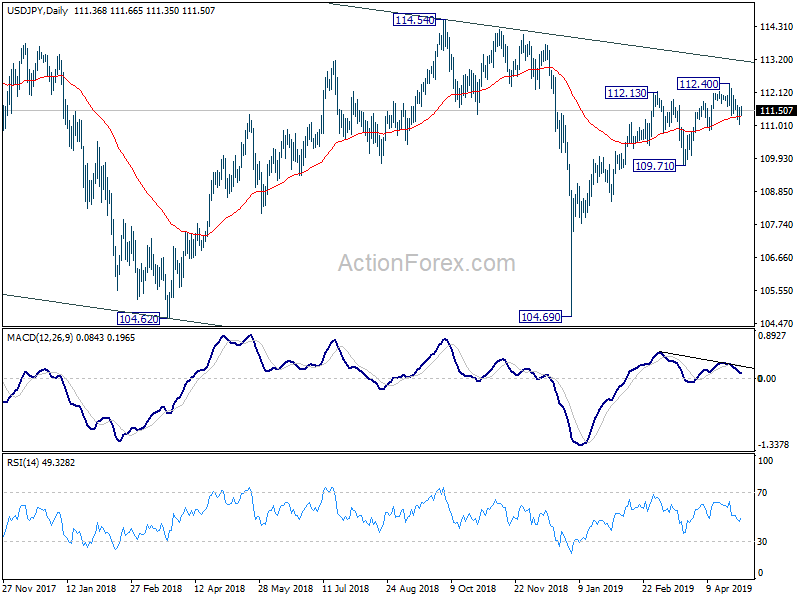
In the bigger picture, medium term outlook in USD/JPY remains a bit mixed as it's staying inside falling channel from 118.65, but there are signs of bullish reversal. On the upside, break of 114.54 resistance will revive the case the corrective fall from 118.65 has completed with three waves down to 104.69. And whole rise from 98.97 (2016 low) is resuming for 118.65 and above. But before that, outlook stays neutral first.
EUR/USD Mid-Day Outlook
Daily Pivots: (S1) 1.1166; (P) 1.1216; (R1) 1.1244; More.....
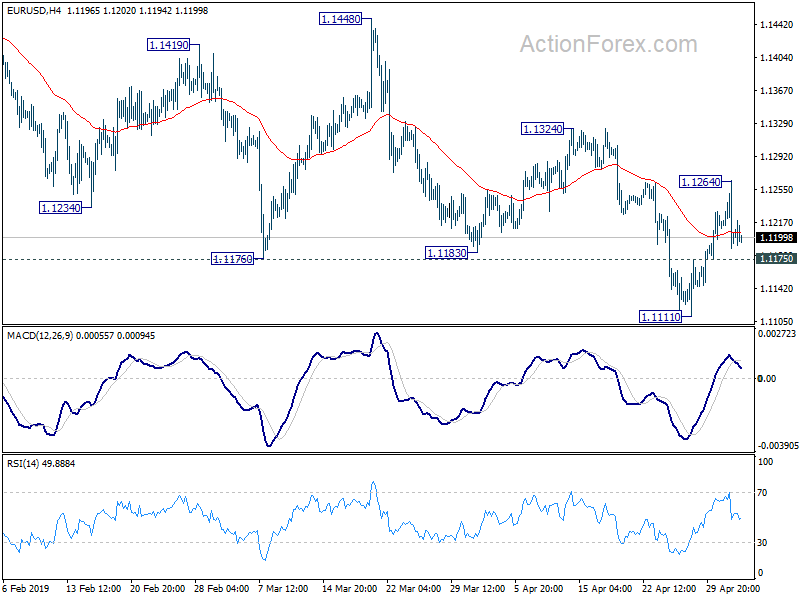
Intraday bias in EUR/USD remains neutral for the moment. Corrective rise from 1.1111 might still extend higher. But upside should be limited well below 1.1324 resistance to bring fall resumption. On the downside, below 1.1175 minor support will turn bias to the downside for 1.1111 first. Break there will resume larger down trend from 1.2555. However, firm break of 1.1324 resistance will be an early indication of larger bullish reversal and turn focus to 1.1448 resistance.
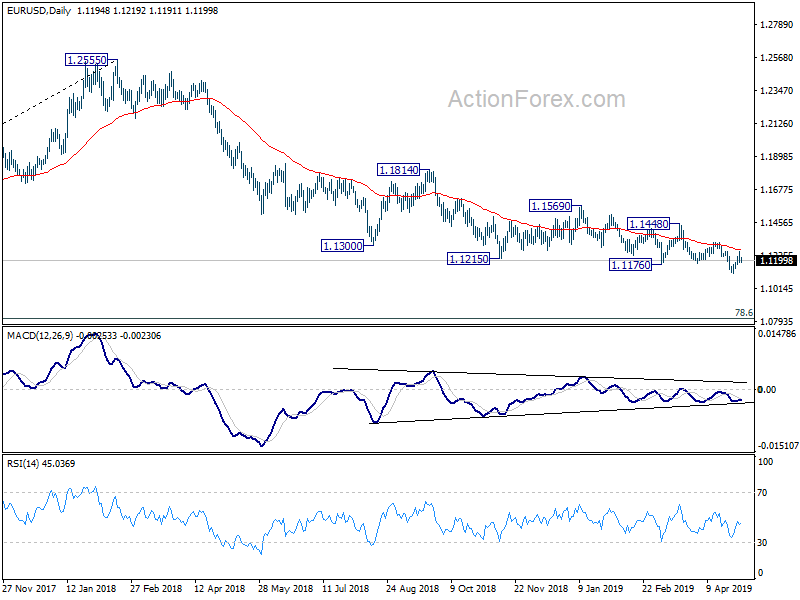
In the bigger picture, down trend from 1.2555 (2018 high) has just resumed. Current fall should now target 78.6% retracement of 1.0339 (2016 low) to 1.2555 (2018 high) at 1.0813. Sustained break there will pave the way to retest 1.0339. On the downside, break of 1.1448 resistance is needed to be the first sign of medium term bottoming. Otherwise, outlook will stay bearish in case of rebound.
Euro Yawns as German, Eurozone Manufacturing PMIs Close to Estimate
EUR/USD is showing little movement in the Thursday session. Currently, the pair is trading at 1.1206, up 0.10% on the day. On the release front, it’s a busy day on both sides of the pond. German and eurozone manufacturing PMIs were within expectations, with readings of 44.4 and 47.9, respectively. German retail sales declined by 0.2%, better than the estimate of -0.5%. In the U.S., unemployment claims is expected to drop to 220 thousand. On Friday, the U.S. releases nonfarm payrolls and wage growth.
Eurozone manufacturing remains soft, and there were no surprises from German and eurozone manufacturing PMIs for April, which remain mired in negative territory. Still, the readings were higher than those for March. Weaker global demand and taken a heavy toll on exports from Germany and the eurozone, which has damaged the manufacturing sectors. German retail sales declined in March, as nervous consumers held tight to their purse strings.
The Federal Reserve maintained the benchmark rate, as expected. The rate statement noted that inflation pressures are muted and that the FOMC would remain patient regarding future rate movements. Jerome Powell reinforced this stance at a follow-up press conference, saying “we don’t see a strong case for moving in either direction”. The Fed is already on record as saying it does not expect to raise rates before 2020, and with inflation levels persistently below the Fed’s target of 2.0%, the Fed can afford to continue its wait-and-see stance.
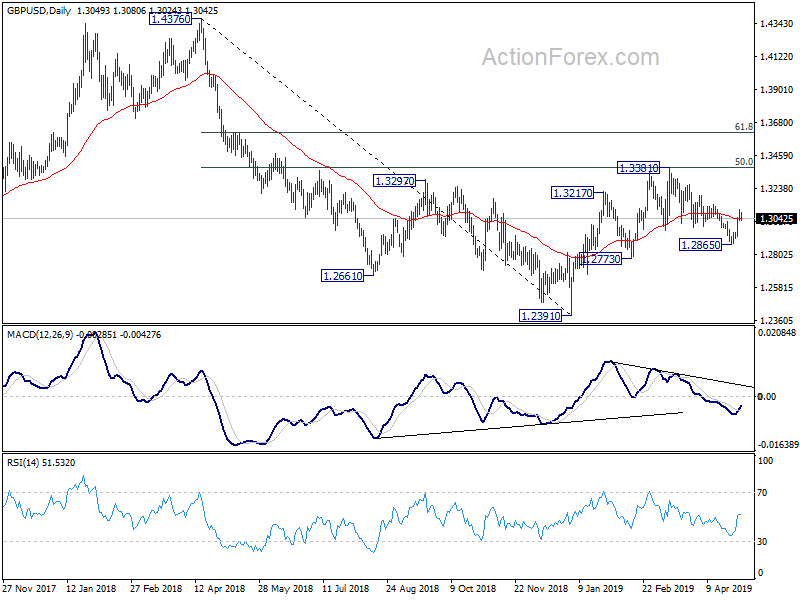
GBP/USD Mid-Day Outlook
Daily Pivots: (S1) 1.3018; (P) 1.3060; (R1) 1.3093; More....
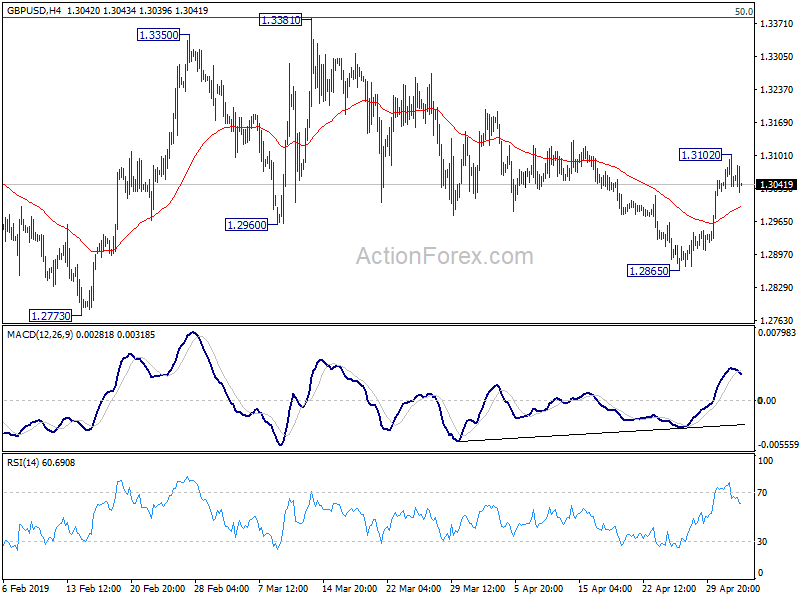
With 4 hour MACD crossed below signal line, a temporary top is in place at 1.3102 in GBP/USD and intraday bias is turned neutral first. Current development suggests that corrective pull back from 1.3381 has completed at 1.2865. Hence, another rise is mildly in favor. On the upside, above 1.3102 will target 1.3381 resistance first. Break will resume whole rebound from 1.2391. On the downside, though, break of 1.2865 will target 1.2773 key support instead.
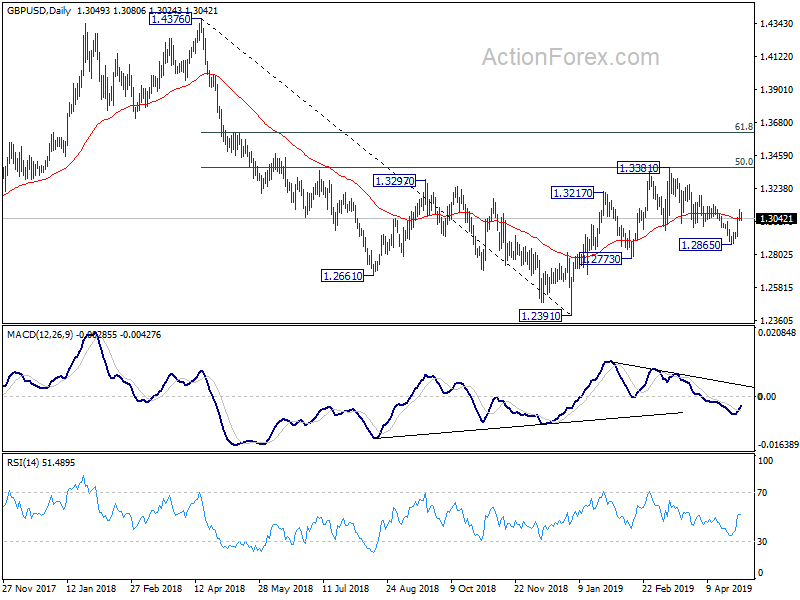
In the bigger picture, medium term decline from 1.4376 (2018 high) halted after hitting 1.2391. The structure of the rebound from 1.2391 suggests that it's a corrective move. In case of another rise, strong resistance could be seen around 61.8% retracement of 1.4376 to 1.2391 at 1.3618 to limit upside. On the downside, break of 1.2773 support will suggests that such corrective rise is completed and bring retest of 1.2391 low first.
BoE Triggers Little Reactions, Forex Markets Staying in Slow Motions
The forex markets are in slow motion today. Major pairs and crosses are bounded inside yesterday's range, with no follow through movement yet. BoE Super Thursday is a high profile event, but triggers no sustainable price actions yet. It's rather hard to react to BoE's new economic projections. Growth forecasts were revised up but inflation forecasts were revised down. Most importantly, BoE painted a much slower rate path and a full 25bps hike in Q4 2021. Meanwhile, there is no follow through buying in Dollar after the short rally yesterday, as Fed Chair Jerome Powell indicated there is no urgency to shift interest rate in either direction.
Technically, 1.1175 minor support is a focus in EUR/USD and break will indicator completion of recent rebound. Dollar could ride on decline in EUR/USD and rally elsewhere. In particular, AUD/USD's recovery from 0.6988 could have completed ahead of 0.7081 resistance. Break of 0.6988 will resumer larger decline from 0.7295. Sterling is lowing some upside momentum against Dollar, Euro and Yen, even though more upside is mildly in favor.
In Europe, FTSE is currently down -0.22%. DAX is up 0.11%. CAC is down -0.45%. German 10-year yield is down -0.005 at 0.011, staying positive. Earlier in Asia, Hong Kong HSI rose 0.83%. China Shanghai SSE rose 0.52%. Singapore Strait Times dropped -0.20%. Japan remained in ultra-long 10-day holiday.
US initial jobless claims unchanged at 230k, above expectations
US initial jobless claims was unchanged at 230k in the week ending April 27, above expectation of 220k. Four-week moving average of initial claims rose 6.5k to 212.5k. Continuing claims rose 17k to 1.671m in the week ending April 20. Four-week moving average of continuing claims dropped -13.75k to 1.674m.
Also released, non-farm productivity rose 3.6% in Q1, much higher than expectation of 1.2%. Unit labor cost dropped -0.9%, much lower than expectation of 2.1%.
BoE projects slower rate hike, faster growth, lower inflation
BoE left Bank Rate unchanged at 0.75% and kept asset purchase target at GBP 435B, on unanimous vote, as widely expected. New economic projections were released with the Quarterly Inflation Report too. One important point to note is that new forecasts are based on slower projected rate path. That is, Bank Rate is projected to rise to 0.9% in 2021 Q2, down from February's projection of 1.1%. In 2022, Q2, Bank Rate is forecast at 1.0%.
Under the slower rate path, growth is projected to be faster from 2019 to 2011. Inflation is projected to be slower in both 2019 and 2020. On growth, BoE forecast annual GDP growth to be: 1.5% in 2019 (revised up from 1.2%); 1.6% in 2020 (revised up from 1.5%); 2.1% in 2011, (revised up from 1.9%). On Inflation, BoE forecast CPI to be at: 1.6% in Q4 2019 (revised down from 2.0%); 2.0% in Q4 2020 (revised down from 2.1%); 2.1% in Q4 2021 (unchanged).
Again, BoE reiterated: "The economic outlook will continue to depend significantly on the nature and timing of EU withdrawal, in particular: the new trading arrangements between the European Union and the United Kingdom; whether the transition to them is abrupt or smooth; and how households, businesses and financial markets respond. The appropriate path of monetary policy will depend on the balance of these effects on demand, supply and the exchange rate. The monetary policy response to Brexit, whatever form it takes, will not be automatic and could be in either direction."
UK PMI construction rose to 50.5, return to growth
UK PMI construction rose to 50.5 in April, up from 49.7 and beat expectation of 50.5. Markit noted that construction output rises for the first time since January. Residential work expands at fastest pace for four months. However, civil engineering and commercial activity fall again.
Tim Moore, Associate Director at IHS Markit said: "A return to growth would normally be considered a positive month for the UK construction sector, but the weakness outside of house building gives more than a little pause for thought.... The forward-looking survey indicators remain subdued... A lack of new work has started to impact on staff recruitment, as signalled by a reduction in payroll numbers for the first time since July 2016. This provides another signal that construction firms are bracing for an extended period of soft demand ahead."
Eurozone PMI manufacturing finalized at 47.9, remained deep in decline, downturn fiercest in Germany,
Eurozone PMI manufacturing was finalized at 47.9, revised up from 47.8. It was just a slight improvement from March's six-year low of 47.5. Also, it's in contraction region below 50 for three consecutive months. Markit noted there were further marked fall in new orders recorded. Also, Germany continues to lead downturn but Greece expands at fastest rate in nearly 19 years.
Looking at the member states, German's reading was revised down to 44.4, a two month high but remained close to March's 80-month low at 44.1. Italy and Austria stayed in contraction at 49.1 and 49.2 respectively. France reading was revised up to 50.0, indicating flat activity. Greece reading, though, rose to 226-mont high at 56.6.
Chris Williamson, Chief Business Economist at IHS Markit said: "The manufacturing sector remained deep in decline at the start of the second quarter.... The survey's output index is indicative of factory production falling at a quarterly rate of approximately 1%... The downturn remains the fiercest in Germany, with Italy and Austria also in decline and France stagnating. Spain's expansion remains only modest."
Also released, German retail sales dropped -0.2% mom in March, versus expectation of -0.5% mom. Swiss retail sales dropped -0.7% yoy in March versus expectation of -0.4% yoy. Swiss PMI manufacturing dropped to 48.5 in April, down from 50.3 and missed expectation of 51.0.
GBP/USD Mid-Day Outlook
Daily Pivots: (S1) 1.3018; (P) 1.3060; (R1) 1.3093; More....
With 4 hour MACD crossed below signal line, a temporary top is in place at 1.3102 in GBP/USD and intraday bias is turned neutral first. Current development suggests that corrective pull back from 1.3381 has completed at 1.2865. Hence, another rise is mildly in favor. On the upside, above 1.3102 will target 1.3381 resistance first. Break will resume whole rebound from 1.2391. On the downside, though, break of 1.2865 will target 1.2773 key support instead.
In the bigger picture, medium term decline from 1.4376 (2018 high) halted after hitting 1.2391. The structure of the rebound from 1.2391 suggests that it's a corrective move. In case of another rise, strong resistance could be seen around 61.8% retracement of 1.4376 to 1.2391 at 1.3618 to limit upside. On the downside, break of 1.2773 support will suggests that such corrective rise is completed and bring retest of 1.2391 low first.
Economic Indicators Update
| GMT | Ccy | Events | Actual | Forecast | Previous | Revised |
|---|---|---|---|---|---|---|
| 22:45 | NZD | Building Permits M/M Mar | -6.90% | 1.90% | 1.70% | |
| 06:00 | EUR | German Retail Sales M/M Mar | -0.20% | -0.50% | 0.90% | 0.50% |
| 06:30 | CHF | Retail Sales Real Y/Y Mar | -0.70% | -0.40% | -0.20% | |
| 07:30 | CHF | PMI Manufacturing Apr | 48.5 | 51 | 50.3 | |
| 07:45 | EUR | Italy Manufacturing PMI Apr | 49.1 | 47.7 | 47.4 | |
| 07:50 | EUR | France Manufacturing PMI Apr F | 50 | 49.6 | 49.6 | |
| 07:55 | EUR | Germany Manufacturing PMI Apr F | 44.4 | 44.5 | 44.5 | |
| 08:00 | EUR | Eurozone Manufacturing PMI Apr F | 47.9 | 47.8 | 47.8 | |
| 08:30 | GBP | Construction PMI Apr | 50.5 | 50.3 | 49.7 | |
| 11:00 | GBP | BoE Rate Decision | 0.75% | 0.75% | 0.75% | |
| 11:00 | GBP | BoE Asset Purchase Target May | 435B | 435B | 435B | |
| 11:00 | GBP | MPC Official Bank Rate Votes | 0--0--9 | 0--0--9 | 0--0--9 | |
| 11:00 | GBP | MPC Asset Purchase Facility Votes | 0--0--9 | 0--0--9 | 0--0--9 | |
| 11:30 | USD | Challenger Job Cuts Y/Y Apr | 10.90% | 0.40% | ||
| 12:30 | USD | Initial Jobless Claims (APR 27) | 230K | 220K | 230K | |
| 12:30 | USD | Nonfarm Productivity Q1 P | 3.60% | 1.20% | 1.90% | 1.30% |
| 12:30 | USD | Unit Labor Costs Q1 P | -0.90% | 2.10% | 2.00% | 2.50% |
| 14:00 | USD | Factory Orders Mar | 1.40% | -0.50% | ||
| 14:30 | USD | Natural Gas Storage | 107B | 92B |
US initial jobless claims unchanged at 230k, above expectations
US initial jobless claims was unchanged at 230k in the week ending April 27, above expectation of 220k. Four-week moving average of initial claims rose 6.5k to 212.5k. Continuing claims rose 17k to 1.671m in the week ending April 20. Four-week moving average of continuing claims dropped -13.75k to 1.674m.
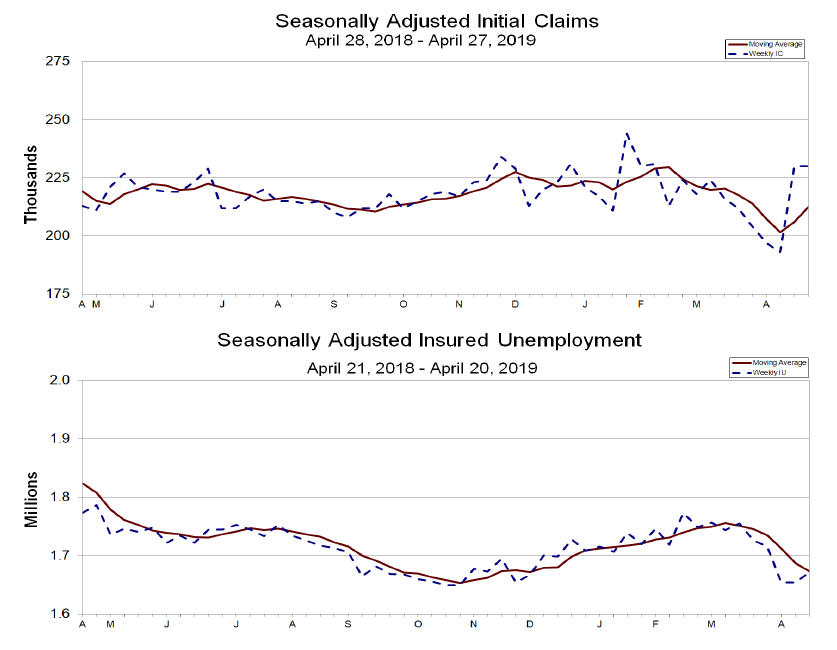
Also released, non-farm productivity rose 3.6% in Q1, much higher than expectation of 1.2%. Unit labor cost dropped -0.9%, much lower than expectation of 2.1%.
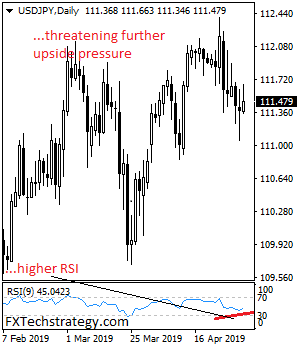
USDJPY Backs Off Lower Prices With Eyes 112.03 Zone
USDJPY backs off lower prices with eyes on 112.03 zone following its price halt. On the upside, resistance comes in at 112.50 level. Above this level will turn attention to the 113.00 level. Further out, we expect a possible move towards the 113.50 level. A cut through here will open the door for more gain towards the 114.00. On the downside, support comes in at the 111.00 level where a break will target the 110.50 level. Below that level will turn focus to the 110.00 level and then lower towards the 109.50 level. On the whole, USDJPY backs off lower prices with eyes on 112.03 zone on corrective recovery.