

Sample Category Title
Silver: White Metal Extends Its Losses In The Morning Session
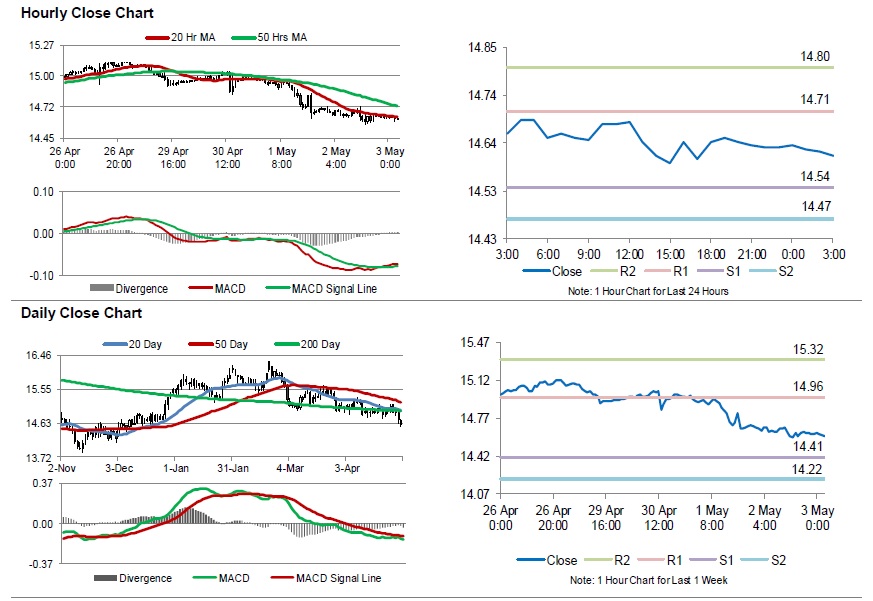
For the 24 hours to 23:00 GMT, Silver declined 0.54% against the USD and closed at USD14.63 per ounce, led by losses in gold prices.
In the Asian session, at GMT0300, the pair is trading at 14.61, with silver trading 0.14% lower against the USD from yesterday’s close.
The pair is expected to find support at 14.54, and a fall through could take it to the next support level of 14.47. The pair is expected to find its first resistance at 14.71, and a rise through could take it to the next resistance level of 14.80.
The white metal is showing convergence with its 20 Hr moving average and trading below its 50 Hr moving average.
Crude Oil: Oil Trading Higher, Ahead Of Baker Hughes Weekly Rig Count Data
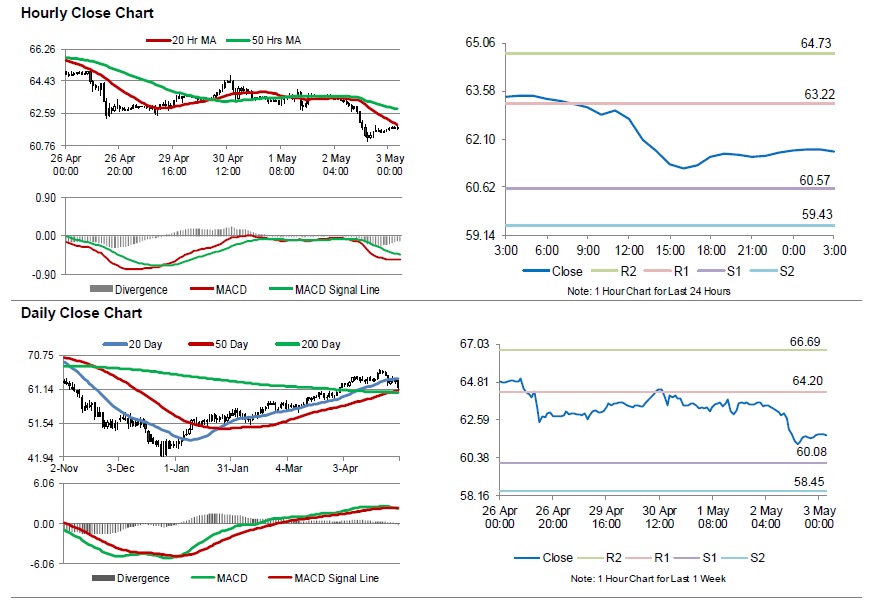
For the 24 hours to 23:00 GMT, Crude Oil declined 2.90% against the USD and closed at USD61.68 per barrel, after the expiry of US waivers on Iran oil sanctions and as an increase in domestic supplies and record US crude production continued to weigh on prices.
In the Asian session, at GMT0300, the pair is trading at 61.70, with oil trading marginally higher against the USD from yesterday’s close.
The pair is expected to find support at 60.57, and a fall through could take it to the next support level of 59.43. The pair is expected to find its first resistance at 63.22, and a rise through could take it to the next resistance level of 64.73.
Crude oil is trading below its 20 Hr and 50 Hr moving averages.
Dollar and yields jumped ahead of non-farm payrolls, some previews
Dollar strengthened overnight with the help from comments of Fed Chair Jerome Powell, as well as rebound in treasury yields. Fund fund futures are now pricing in less than 50% chance of a Fed rate cut after Powell talked down the need for it. 10-year yield also defended a near term structural support level at 2.463. After two day's rally, 10-year yield closed at 2.552 overnight, and revived near term bullishness.
Focus will turn to non-farm payroll reports from the US. Markets are expecting 185k job growth in April. Unemployment rate is expected to be unchanged at 3.8%. Average hourly earnings growth is expected to pick up again to 0.3% mom.
Looking at other job data, the strong growth in ADP employment (275k) and sharp fall in ISM manufacturing employment (from 57.5 to 52.4) looks conflicting. But looking deeper ADP actually reported 223k growth in service jobs and only 52k in manufacturing jobs. The two reports were indeed consistent. If ISM services would be released earlier than today, there would be more confirmation on the picture.
Meanwhile, four-week moving average of initial jobless claims was steady at 212.5k. Conference Board consumer confidence also rose from 124.2 to 129.2. The job related data generally support a solid set of NFP data today.
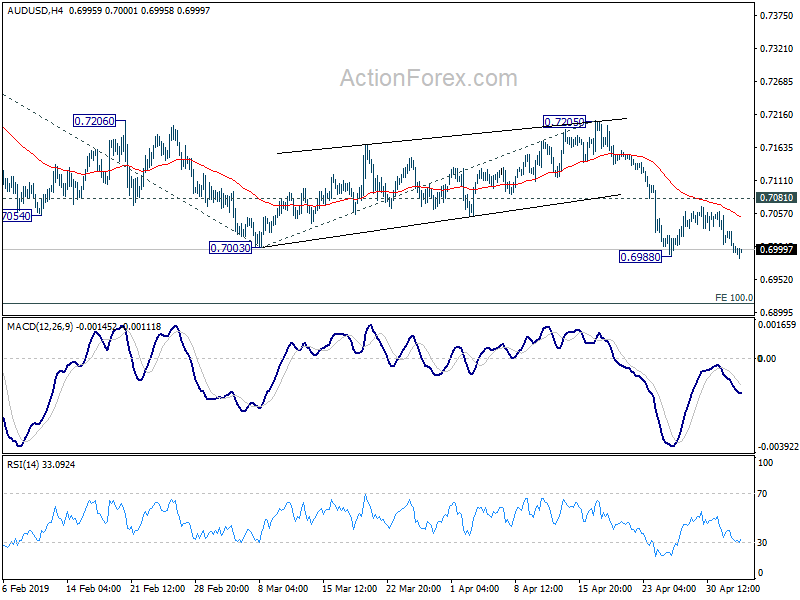
Dollar and treasury yields will likely be lifted if NFP delivers. Stocks could be pressured, in particular if wage growth beat expectations, on reducing chance of Fed cut. USD/JPY's reactions, thus could be mixed. Instead, AUD/USD, which is already pressing 0.6988 support, is a good candidate to sell in such developments.
Here are some suggested readings on NFP:
- US Jobs Report Awaited for Direction after Powell's Comments
- Euro's Close Could Be Key Post-NFP
- NFP Preview: Traders More 'In the Dark' Than Usual
GOLD Price And Crude Oil Turned Short Term Bearish
Gold price topped near the $1,290 level recently and declined below the $1,278 support area. Crude oil price also declined below the $63.00 support and it could extend losses.
Important Takeaways for Gold and Oil
- Gold price declined below the $1,280 and $1,274 support levels against the US Dollar.
- There was a break below a major bullish trend line with support at $1,282 on the hourly chart of gold.
- Crude oil price traded below a couple of important supports near the $63.00 level.
- There is a bearish trend line in place with resistance near $62.70 on the hourly chart of XTI/USD.
Gold Price Technical Analysis
Gold price faced a strong resistance near the $1,290 level against the US Dollar. As a result, the price started a downward move and broke the $1,285 and $1,280 support levels to move into a bearish zone.
There were a couple of swing moves, but the price extended losses below the $1,278 pivot level. To start the drop, there was a break below a major bullish trend line with support at $1,282 on the hourly chart of gold.
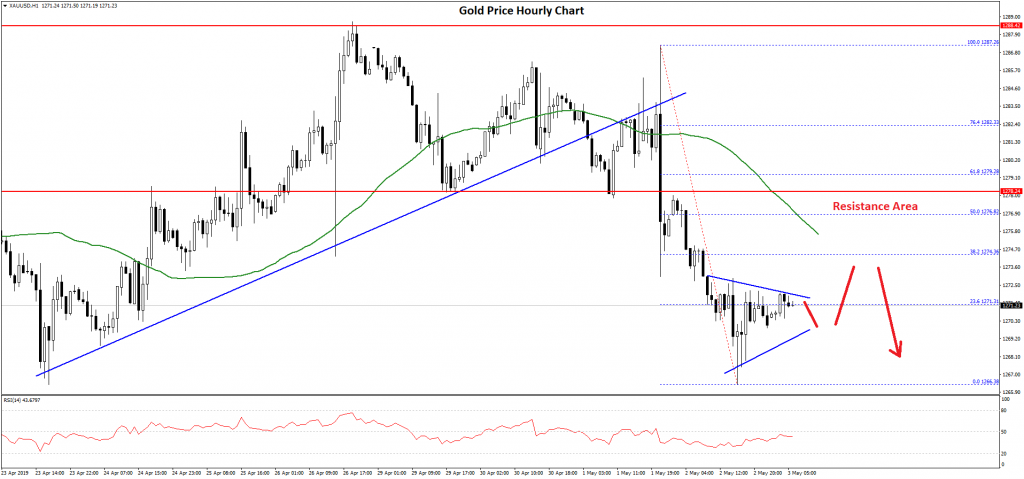
The price even broke the $1,274 support level and settled below the 50 hourly simple moving average. A swing low was formed near the $1,266 level on FXOpen and the price recently started an upside correction.
It traded above the $1,270 level and the 23.6% Fib retracement level of the latest decline from the $1,287 high to $1,266 low. However, there are many resistances on the upside near the $1,274 and $1,275 levels.
The price is likely to struggle near the $1,275 level and the 50 hourly SMA. Besides, the 50% Fib retracement level of the latest decline from the $1,287 high to $1,266 low is also near $1,276.
Therefore, to climb higher, the price must clear the $1,276 and $1,278 resistance levels. On the downside, an initial support is near the $1,270, below which the price may decline back towards the $1,265 support.
Oil Price Technical Analysis
Crude oil price started a slow and steady decline from well above the $65.00 level against the US Dollar. The price broke the $64.00 and $63.50 support levels to move into a bearish zone.
The decline was such that the price settled below the $63.00 support and the 50 hourly simple moving average. It even broke the $62.00 support and traded close to the $61.00 level.
.
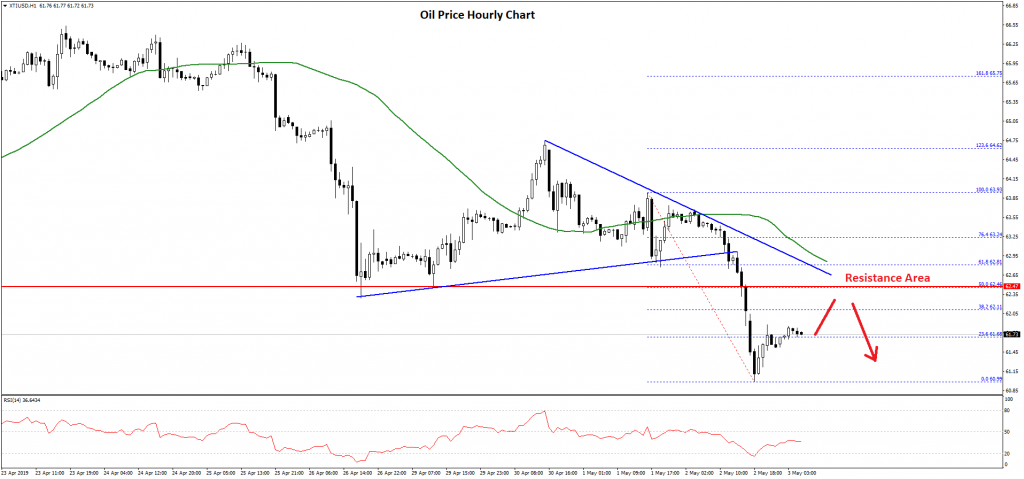
A swing low was formed at $60.99 and the price is currently correcting higher. It traded above the 23.6% Fib retracement level of the recent decline from the $63.93 high to $60.99 low.
However, there are many hurdles on the upside for the bulls near the $62.50 and $62.70 levels. There is also a bearish trend line in place with resistance near $62.70 on the hourly chart of XTI/USD. The 50% Fib retracement level of the recent decline from the $63.93 high to $60.99 low is also near $62.45 to act as a resistance.
Therefore, if the price corrects higher towards $62.50, it is likely to face a strong selling interest. On the downside, an initial support is near the $61.20 level, below which the price may even break $61.00 and trade towards $60.00.
US Jobs Report Awaited for Direction after Powell’s Comments
The widely expected US Nonfarm payrolls report is coming out on Friday at 1230 GMT to direct markets over the path of interest rates as this week’s comments by the Fed chairman, Jerome Powell, did not convince investors that the central bank’s next move is going to be a rate cut.
Following the Federal Open Market Committee (FOMC) policy meeting which left interest rates unchanged on Wednesday, Powell surprisingly claimed at his press conference that the factors behind recent inflationary weakness are “transitory” and therefore the case for a rate cut is not as strong as previously. While some analysts have taken on board this message, the majority continue to believe that borrowing costs could ease by the end of the year, with all eyes turning now to the government’s comprehensive employment data for the month of April for extra clues on whether the Fed could soon change its guidance again.
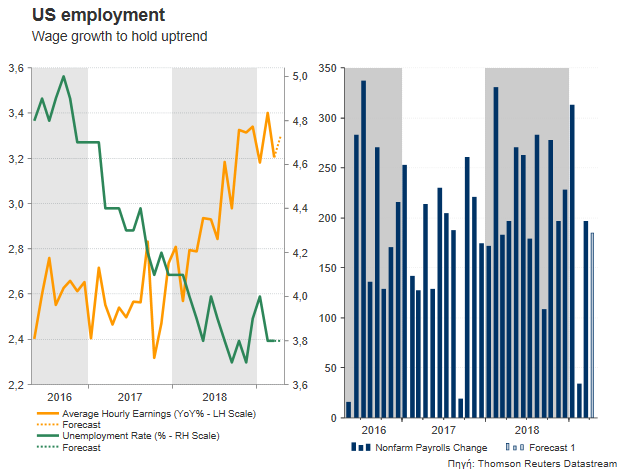
Average hourly earnings are what markets will look at first as any improvement in the wage growth would theoretically translate into higher consumer spending and therefore stronger inflationary pressures. Indeed, forecasts suggest that wage growth rose from 0.1% to 0.3% on a monthly basis in April, driving the yearly gauge slightly up to 3.3% versus 3.2% seen in March. Even though the yearly measure is still under the decade-high of 3.4% reached in January, investors may not get too worried as long as the unemployment rate holds around the 18-year low of 3.8%, indicating a tight labor market. Nonfarm payrolls, however, could be a bit bothersome if the figure drops from 196k to 185k, especially after the ISM survey for the growth-driving manufacturing sector indicated that job creation in the industry remained weak in April after a plunge in March.
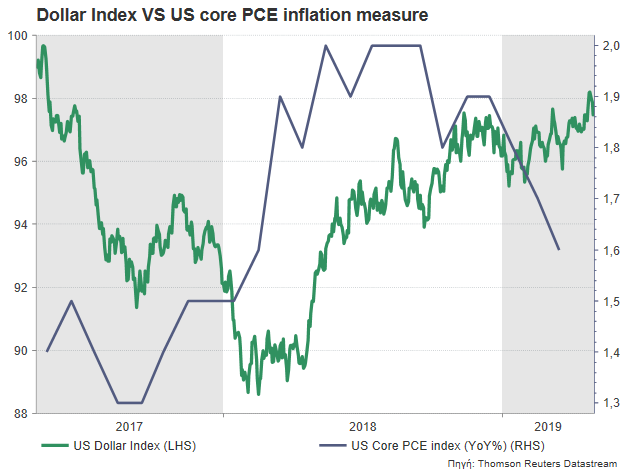
Overall the US labor market is still in good shape and consumption seems to be promising given the recent upbeat data on personal consumption and retail sales. Still, because of the down-trending inflation that has recently dropped further below the Fed’s 2.0% price target, policymakers have no incentive to resume rate hiking. The resilient dollar could be partially blamed for the low inflation. Protected by its safe-haven feature that offsets the negative effects from the US-Sino trade war, and supported by the economic weakness in Europe, the elevated dollar makes imported goods cheaper to US consumers, forcing domestic companies to lower their prices to mitigate competition from abroad. Of course, Trump’s tariffs maybe somewhat inflationary but at the same time they are damaging for businesses which import foreign components to complete an assembled product. Therefore, unless US inflation rebounds and the trade drama comes to an end, the Fed is not likely to push up interest rates.
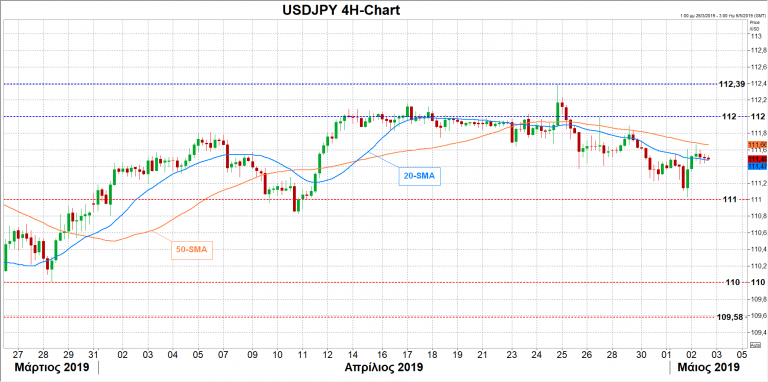
Consequently, the NFP report could bring temporary gains to the dollar if the data beat expectations as the world is still uncertain about the future of global growth, with USDJPY probably rallying to face strong resistance within the 112-112.39 area. Before that, the pair would have to overcome the 50-period simple moving average (SMA) at 111.66.
On the other hand, a miss in forecasts, especially on the wage front, could drive the pair as low as 111. The area between 110 and 109.58 could be a bigger challenge for the bears to overcome.
EU Juncker: Germany, Austria, Netherlands stand in the way of EU reform
European Commission President Jean-Claude Juncker complained that Germany, Austria, Netherlands are hindering Eurozone reforms. He told German newspaper Handelsblatt that "there is no progress with the deepening of the monetary union because the Netherlands, Austria and all too often Germany stand in the way when it comes to solidarity in action and joint responsibility."
On trade negotiations with the US, Juncker said EU is not aiming at a comprehensive deal along the lines of the Trans-Atlantic Trade and Investment Partnership. He also emphasized EU would not want to include agriculture in any trade deal. He added: "The Americans keep trying but we have stood our ground."
Bundesbank Weidmann: Private consumption in Germany to overcome its weakness
Yesterday, Bundesbank President Jens Weidmann talked down risks of recession in Germany, as he spoke in a business forum. He said "given excellent labor market conditions and rising incomes, I expect private consumption in Germany to overcome its weakness". And, there were "early signs of this already as the retail sector recorded strong growth in the first quarter."
On ECB monetary policy, Weidmann said "the task of monetary policy is to ensure price stability... This means reacting to the weak domestic price pressures but also continuing on the path of policy normalization and not postponing unnecessarily if the inflation outlook permits it."
Cliff Notes: Waiting on the RBA
Key insights from the week that was.
With respect to the RBA, last week’s downside surprise for inflation has firmed up rate cut expectations amongst market participants. Two cuts in the cash rate in 2019 has been Westpac’s expectation since February. This view has now become the market consensus, albeit with a difference of opinion still evident on the months the cuts will be delivered.
Market pricing currently points to a May cut being a 45% chance after it peaked at roughly two thirds immediately after the disappointing March CPI outcome. 2016’s rate cuts have been used as justification for immediate action in 2019 given both episodes saw inflation well below target. However, as detailed by Chief Economist Bill Evans this week, we believe 2019 is different for a number of reasons, including the fact that the RBA carried an explicit easing bias into the 2016 May meeting, which is not the case in 2019.
With the trimmed mean March quarter print of 1.6%yr as a starting point, we believe the RBA will continue to forecast a return to the bottom half of the 2-3%yr target range over 2020 and 2021, supported by confidence in the labour market. It also seems most likely that the RBA will forecast at-trend GDP growth in 2019 and near-trend in 2020 in May, only moving to a clear below-trend view for both years in August. This would be consistent with the adoption of an explicit easing bias in May followed by a cut in August. If we are right, then the anticipated follow-up cut will come in November. Note that the RBNZ also meets next week. Our NZ economics team sees a RBNZ cut in May as a 55% chance.
Albeit not as significant for the RBA as inflation, both the March private credit data and April update of CoreLogic dwelling prices pointed to a moderation in the pace of deterioration for the housing sector.
Offshore, the FOMC was the focus this week. The market’s initial reaction to the statement was dovish, owing to explicit recognition by the Committee that core inflation had fallen below their 2.0%yr medium-term target. However, this market reaction subsequently reversed course as Chair Powell made clear in the press conference that core inflation was expected to return to target. Chair Powell and the Committee were also more positive on the outlook for consumption and investment, and viewed downside risks from the global economy as having receded. We foresee little risk of the FOMC doing anything other than remaining on hold over our forecast horizon – 2019 and 2020.
Over in the UK, the Bank of England also held policy steady in May. In their May forecasts, the BoE Committee was more positive on the underlying economy and, despite delays, continued to assume a smooth transition through the Brexit process. However, lower global rates saw the Committee revise down their path for the Bank Rate to a peak of 1.00% – just 25bps above the current level. To our mind: the risks around Brexit are greater than the BoE assumes; and continued delays in the process are damaging to the UK’s long-term growth prospects in their own right. We look for the BoE to remain on hold through 2019 and 2020.
Turning to Europe, growth picked up in the first quarter of 2019, with the first estimate of GDP recording a 0.4% increase. Detail is scarce at this stage, but national estimates indicate Spain rose 0.7%; France gained 0.3%; and Italy emerged from recession, up 0.2%. While annual Euro Area economic growth is tracking at 1.2% – just below long-run potential – the labour market is strengthening. The unemployment rate has maintained its trend lower, coming in at 7.7% in March – not far from the pre-GFC low of 7.2% and down from 8.5% a year ago.
The recent run of data would surely have elicited a sigh of relief from the ECB and stakeholders in the European economy, but uncertainty still shrouds the economic outlook. The European manufacturing sector remains weak on the back of a turn in the global tech cycle, and while some political risk has eased (the Brexit extension, Italy avoiding an S&P downgrade for now, and a benign Spanish election outcome), the 23–26 May European Parliament Election will be closely watched.
Finally in China, the official manufacturing PMI disappointed in April, albeit while holding above the 50 expansion/ contraction level. Versus the average of the past two years, the services outcome was more robust, being only marginally below average in April compared to the manufacturing survey which is more than a point down. While significant in scale and well planned, the 2018/19 stimulus will only slowly improve underlying momentum in China. This is in part due to headwinds from offshore, but also because the quality of growth remains in sharp focus. This is most evident in the slow improvement in the investment detail and the credit data – where accelerating growth is coming from bank lending and market issuance, not shadow lenders.
Market Morning Briefing: Euro Trades Below 1.1200 Again
STOCKS
Equities remain mixed. Dow looks vulnerable to dip in the near term. Dax may consolidate/dip before resume the upmove. Sensex and Nifty remains stuck in a sideways range. Japan's Nikkei and China's Shanghai are closed today.
Dow (26307.79, -122.35, -0.46%) has declined below the key 21-day moving average support level of 26415. The expected rally to 26750-27000 seems to be getting delayed. While below 26415, Dow can fall to 26100-26050 in the near term.
DAX (12345.42, +1.34, +0.01%) has closed on a mixed note. Though the broader picture remains bullish, a strong rise past 12400 is needed for it to move further higher towards 12450-12500. A break below the support at 12280 can drag it to 12200 before we see further rise.
Sensex (38981.43, -50.12, -0.13%) and Nifty (11724.75,-23.40, -0.20%) remains indecisive in the near term and continue to oscillate within their respective range. Sensex is stuck in between 38500 and 39500 while the Nifty between 11550 and 11800. A fall from current levels to the lower end of the range will mean a head and shoulder reversal formation. So we need to watch it closely.
COMMODITIES
Commodities remain bearish but could see some corrective bounce before the downmove resumes. The expected fall in oil towards the important support has happened and we need to watch it closely now to get a cue on the next move.
Gold (1271) fell to 1266 and has bounced from there. While above 1270, a rise to 1277-1280 can be seen. The 1266-1292 sideways range remains intact for now. As mentioned yesterday gold can consolidate for some more time before falling to 1260-1255.
Silver (14.61) is getting support near 14.55. It can consolidate between 14.55-14.75 for some time before we the fall resumes to 14.30 and 14.
Copper (2.78) fell as expected yesterday to test the 2.78-2.77 support zone. The outlook is bearish. But an intermediate bounce to 2.83-2.84 cannot be ruled out before Copper eventually breaks below 2.77 and tumbles to 2.72-2.70 in the coming weeks.
As expected WTI (61.78) and Brent (70.55) fell to 61 and 69.80 respectively and has bounced from there. A corrective rally is possible in the coming sessions before the downtrend resumes. While above 70.20 Brent can move up to 71.30-71.50. WTI can test 62.30-62.50 while it remains above 61.30.
FOREX
US NFP and unemployment data would be important to watch. A stronger data would boost further strength in the US Dollar. Dollar Index looks bullish towards 99 while Euro could come down to 1.11. Aussie may break below 0.70.
Dollar Index (97.8) has risen slightly and is headed towards immediate resistance at 98. It would be important to see if the index manages to break above 98 to test upper resistance near 99. While above support at 97.15/25, there is room for testing 99.
Euro (1.1173) trades below 1.1200 again and may slowly gravitate down to 1.1100. Further downside to 1.10 also possible, but could be a long-drawn move of attrition.
Importantly, in line with our theme since the beginning of the year, the weakness in Euro-Dollar is getting reflected in weakness in Euro-Rupee (77.58), which allows Dollar-Rupee (69.37) to trade weak, even in the face of Euro weakness.
For now, Euro-Rupee can dip further to super-crucial Support at 77.00. Need to be careful to see what happens, how the market behaves, at 77.
The Euro-Yen (124.54) has important long term support near 123.80-124.00 and while that holds, medium term looks bullish. However, we could see some sessions of sideways consolidation within 124-125 before a sharp bounce is seen.
Dollar Yen (111.42) is stable and continues to remain trapped within 112.50-111.00 region. Sideways range trade may continue for some more sessions before we see a clear break on either side. We would wait for price confirmation to get clarity on further direction the pair would take.
Aussie (0.6995) seems to be breaking below the 0.70 support. Contrary to our expectation of a rise towards 0.71-0.7150, the currency could possibly fall towards 0.6950-0.6900 if a decisive break below 0.70 is seen just now.
USDCNY (6.7336) has some room on the upside towards 6.75/76 levels from where a fall back to 6.72/70 is possible. In the medium term Yuan could strengthen again towards 6.70.
Dollar-Rupee (69.37) has turned bearish after a decisive break below 69.50 was seen yesterday. This happened contrary to our expectation of a bounce towards 69.75/70.00. While below 69.50, lower level of 69 comes into the picture and could be tested in the near term. Upside could be capped in the 69.50/60 region just now.
INTEREST RATES
The US Yields have all risen contrary to our expectation of a fall from here. The 2Yr (2.34%), 5Yr (2.35%), 10YR (2.54%) and 30YR (2.93%) are all trading slightly higher today but look bearish in the medium term. Resistances above current levels continue to hold and could eventually push yields lower in the coming week.
The German yields seem to be breaking above immediate resistance levels. The 30YR (0.677%) and 10Yr (0.032%) have moved up, breaking above immediate resistance and could rise for a few more sessions towards 0.7% and 0.05% in the near term.
The UK Gilts are also trading along important near term resistances and could fall in the coming week. The 5Yr, 10YR and 20Yr yields are currently trading near 0.87%, 1.19% and 1.63% respectively.
Daily Markets Broadcast
Wall Street falls on fears of US-China deal stalemate
Rumours circulated yesterday that the lack of detailed progress in this week’s US-China negotiations implies a deeper impasse. Oil prices continued their slide on demand concerns.
US30USD Daily Chart
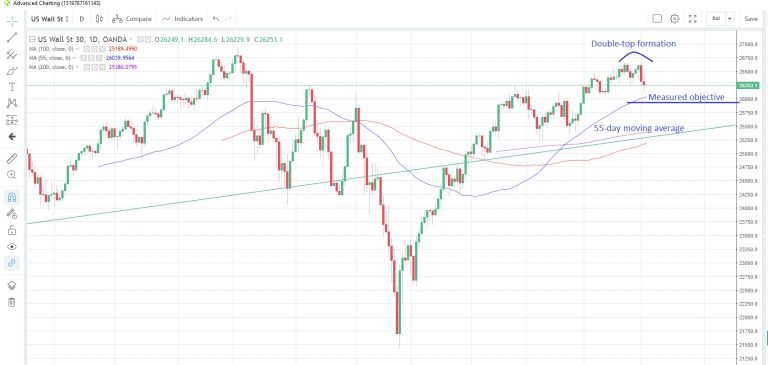
The US30 index fell for a second consecutive day yesterday on trade negotiation concerns. Energy stocks weakened as crude oil crashed more than 3%
Rising 55-day moving average support is at 26,039 today. The index fell through 26,264 support putting a double-top in place with a measured objective of 25,862
The US economy added 185,000 jobs in April, according to the latest survey of economists. A below-forecast number would put additional pressure on Wall Street. The unemployment rate is seen steady at 3.8%.
DE30EUR Daily Chart
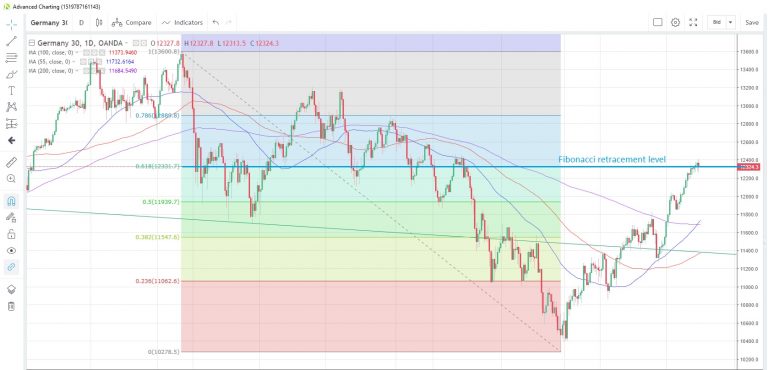
The Germany30 index snapped a three-day winning streak yesterday though losses were limited by an uptick in the Markit manufacturing PMI in April. March retail sales also come in above forecast
The index is testing the 61.8% Fibonacci retracement of the 2018 fall at 12,332
German retail sales fell a less-than-expected 0.2% m/m in March following a 0.5% gain the previous month. The Markit manufacturing PMI was revised higher to 44.4 from 44.1.
WTICOUSD Daily Chart
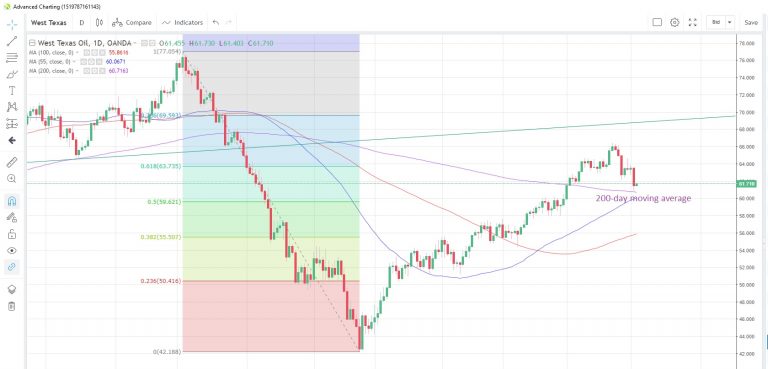
WTI fell 3.2% yesterday as increasing inventories raise concerns about slack demand. Meanwhile supply concerns eased as the Iran sanction waivers expired.
WTI is approaching the 200-day moving average at 60.716, which has supported prices since April 2
Data from the EIA released Wednesday showed an addition of 9.93 million barrels to inventories, the biggest increase since November.