

Sample Category Title
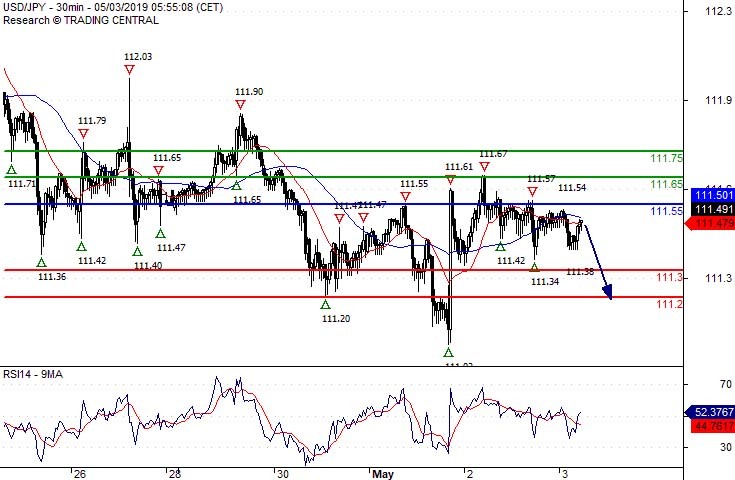
USD/JPY Under Pressure
Pivot (invalidation): 111.55
Our preference Short positions below 111.55 with targets at 111.30 & 111.20 in extension.
Alternative scenario Above 111.55 look for further upside with 111.65 & 111.75 as targets.
Comment As Long as the resistance at 111.55 is not surpassed, the risk of the break below 111.30 remains high.
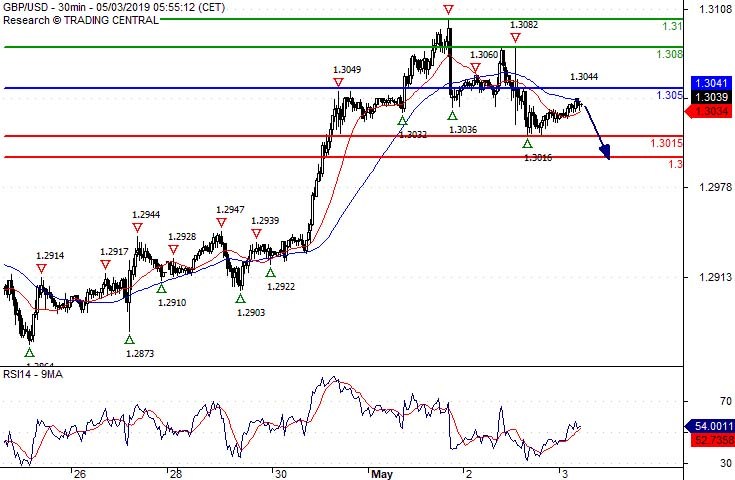
GBP/USD Key Resistance At 1.3050
Pivot (invalidation): 1.3050
Our preference Short positions below 1.3050 with targets at 1.3015 & 1.3000 in extension.
Alternative scenario Above 1.3050 look for further upside with 1.3080 & 1.3100 as targets.
Comment The upward potential is likely to be limited by the resistance at 1.3050.
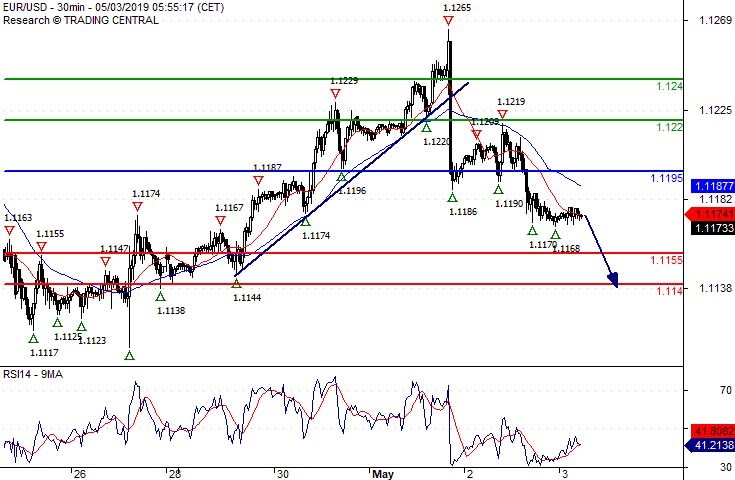
EUR/USD Watch 1.1140
Pivot (invalidation): 1.1195
Our preference Short positions below 1.1195 with targets at 1.1155 & 1.1140 in extension.
Alternative scenario Above 1.1195 look for further upside with 1.1220 & 1.1240 as targets.
Comment As Long as the resistance at 1.1195 is not surpassed, the risk of the break below 1.1155 remains high.
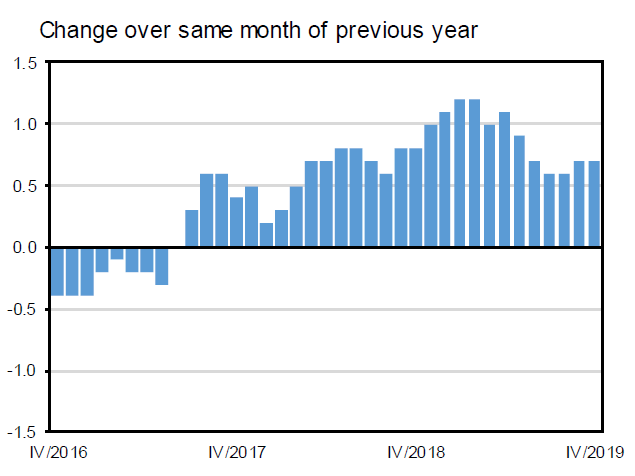
Swiss CPI unchanged at 0.7% yoy, consumer sentiment dropped to -6
Swiss CPI rose 0.2% mom 0.7% yoy in April, matched expectations. Core CPI rose 0.3% mom, 0.5% yoy. The 0.2% mom increase in headline CPI compared with the previous month can be explained by several factors including rising prices for fuel and for air transport. In contrast, prices for hotel accommodation, glasses and contact lenses decreased.
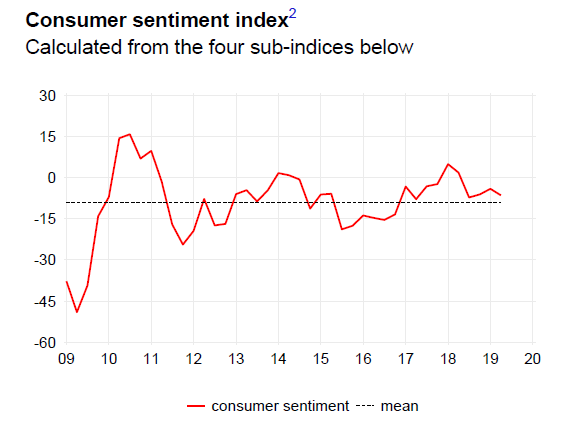
Swiss SECO consumer confidence dropped to -6 in April, down from -4 and missed expectation of -3. SECO noted that: "Swiss consumer sentiment has worsened slightly. The index now comes in only just above average. The labour market has still been assessed positively. However, the likelihood of consumers making major purchases remains low.
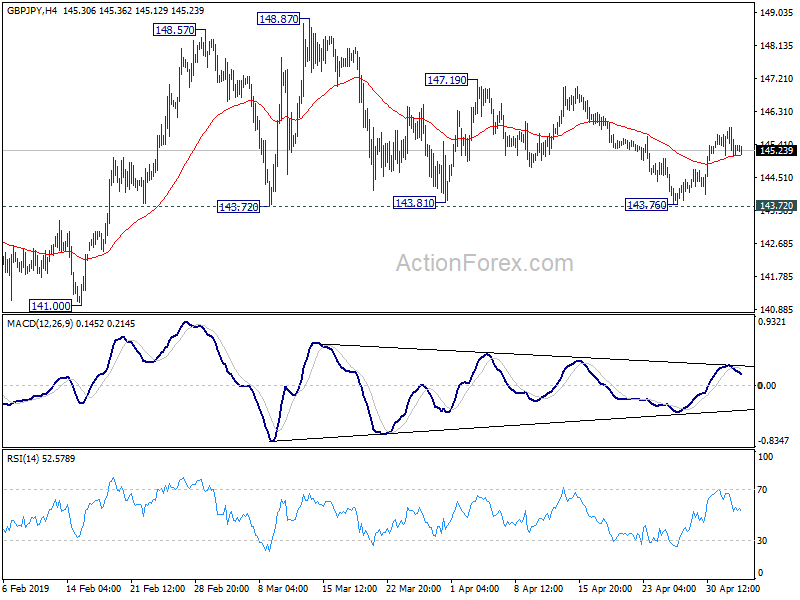
GBP/JPY Daily Outlook
Daily Pivots: (S1) 144.98; (P) 145.43; (R1) 145.78; More...
Intraday bias in GBP/JPY remains neutral first and more consolidative trading could be seen. With 143.72 support intact, near term outlook remains cautiously bullish. That is, rise from 131.51 is in favor to extend. On the upside, break of 147.19 resistance will target 148.98/149.48 resistance zone first. However, on the downside, decisive break of 143.72 will indicate near term reversal, after rejection by 149.48 key resistance. In that case, intraday bias will be turned to the downside for 141.00 support first.
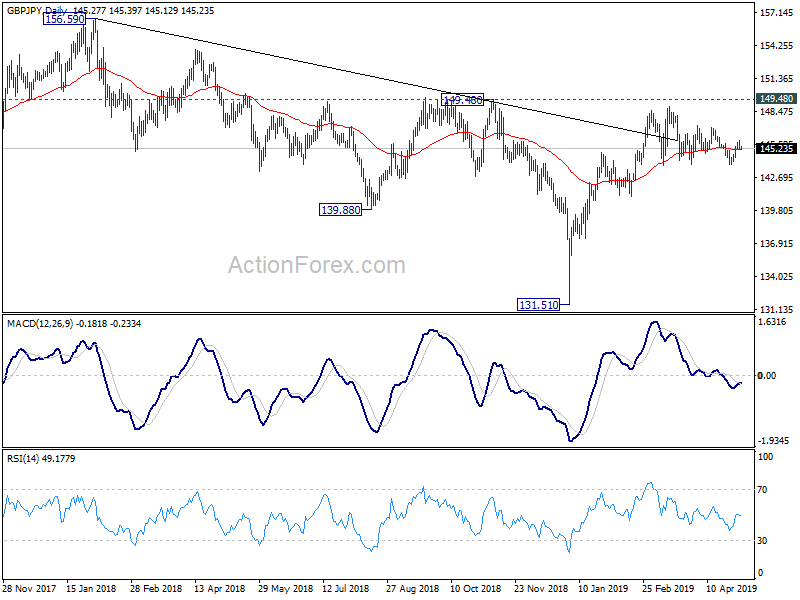
In the bigger picture, focus is staying on 149.98 key resistance. Decisive break there should confirm that medium term fall from 156.59 (2018 high) has completed at 131.51 already. Rise from 131.51 is then seen as the third leg of the corrective pattern from 122.36 (2016 low). GBP/JPY should then target 156.59 and above. However, rejection by 149.98 will retain medium term bearishness and could extend the fall from 156.59 through 131.51 to 122.36.
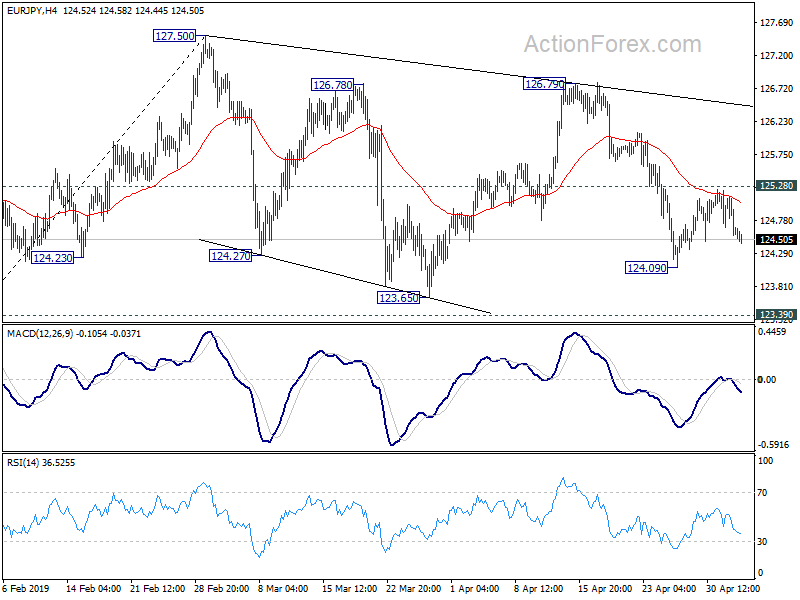
EUR/JPY Daily Outlook
Daily Pivots: (S1) 124.38; (P) 124.76; (R1) 124.96; More....
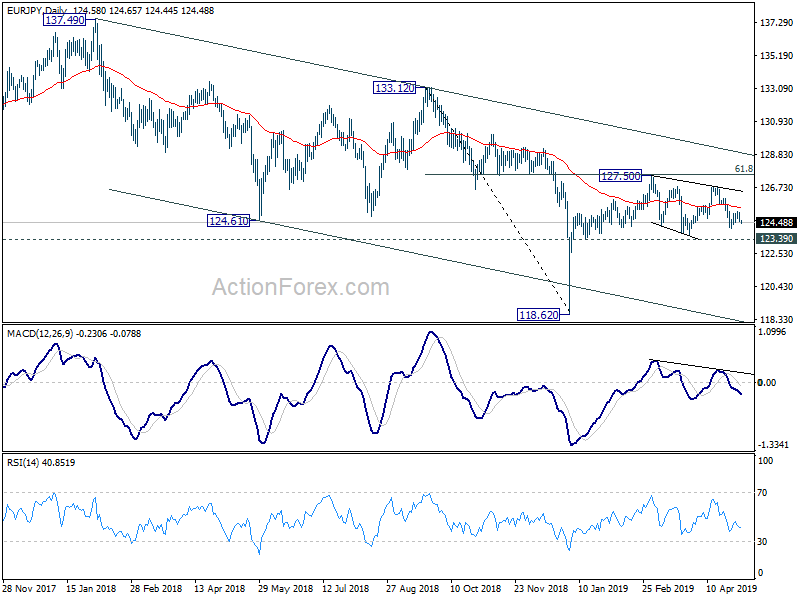
EUR/JPY is staying in consolidation from 124.09 temporary low and intraday bias remains neutral. Upside of the consolidation should be limited by 125.29 resistance to bring another decline. Fall from 126.79 is seen as the third leg of the corrective pattern from 127.50. On the downside, break of 124.09 will target 123.65 support and below. However, sustained break of 125.28 will turn focus back to 126.79 resistance instead.
In the bigger picture, there is no confirmation of completion of the down trend from 137.49 (2018 high) yet. In case of an extension, break of 118.62 will target 109.03/114.84 long term support zone. However, break of 127.50 will solidify the case of medium term bullish reversal. Further decisive break medium term channel resistance will affirm reversal and target 133.12 key resistance and above.
AUD/USD Drops Through 0.70
Weak building data cements slide
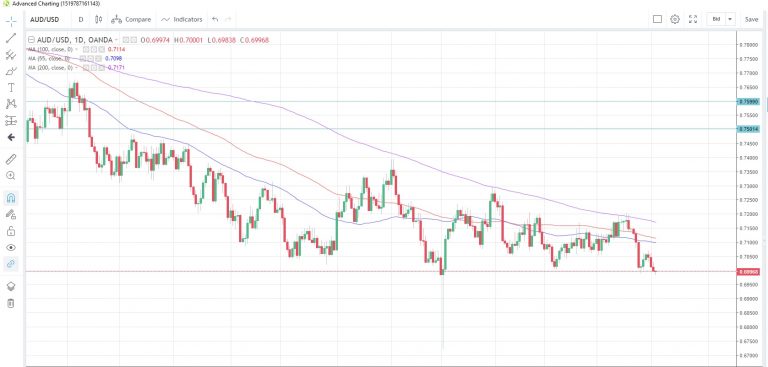
AUD/USD traded below the psychological 0.70 mark late yesterday and the FX pair moved even lower this morning, pressured by weak building permits data. AUD/USD traded to the lowest since January 3, the day of the mini flash crash, after the data. Yesterday’s close below 0.70 was the first time since January 2.
Building permits fell 15.5% m/m, a larger drop than the -14.0% economists had expected and almost wiping out the 19.1% gain posted in February. The data again questions the state of the Australian housing market, which has seen prices in major cities Sydney and Melbourne drop 10% in the year to April.
AUD/USD daily Chart
Nonfarm payrolls to headline
April’s US employment report is due later today and will no doubt be the highlight of a busy week. Economists forecast that the US economy added 185,000 jobs last month, less than the 196,000 recorded in March and below the six-month moving average of 207,000.
The unemployment rate is seen holding steady at 3.8% while average hourly earnings are expected to climb 0.3% m/m.
Aside from the US jobs report, we get to see US wholesale inventories for February, the goods trade balance for April and US ISM services PMIs from Markit and ISM for the same month. Recall the manufacturing sector put in a mixed performance with the Markit reading improving to 52.6 but the ISM reading deteriorating to 52.8.
EURGBP Loses Momentum In A Narrow Range
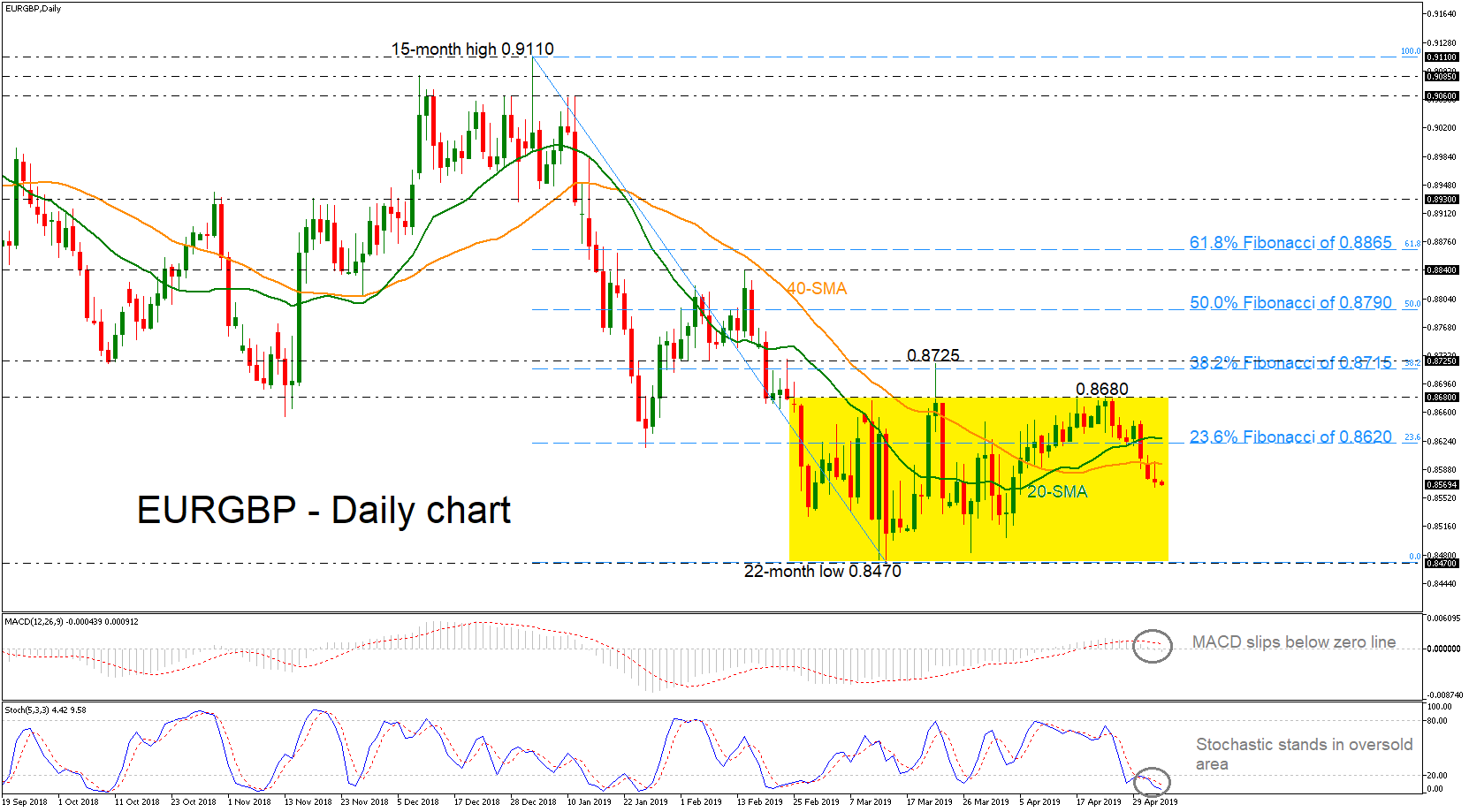
EURGBP has been on a bearish mode for most of the week, tumbling beneath the 23.6% Fibonacci retracement level of the downleg from 0.9110 to 0.8470, around 0.8620. Also, the price is hovering below the 20- and 40-simple moving averages (SMAs), while it has been remaining in a narrow range of 0.8680 – 0.8470 since February 26.
Technically, the price could lose some ground in the short-term as the MACD is changing direction to the downside below its zero line, while the stochastics are warning over an oversold market, increasing bearish sentiment.
Another step lower may reach key support at the 22-month trough of 0.8470, reached on March 13. Should this prove a weak obstacle, the selling could pick up speed until the 0.8380 support, identified by the low on May 2017, breaking the narrow range to the downside.
Alternatively, in case of an upside move, immediate resistance could come from the 40-SMA around 0.8600 before touching the 20-SMA and the 23.6% Fibonacci of 0.8620. Higher, the focus could shift to the 0.8680 (upper band of the range), though a close above this barrier could open the way for a bullish correction until the 38.2% Fibonacci of 0.8715.
In the short-term picture the pair is still neutral as long as it holds in a range and if there is a successful drop below it could endorse the longer-term negative view.
USDCAD Rebounds To Keep Uptrend, Bias Positive-To-Neutral
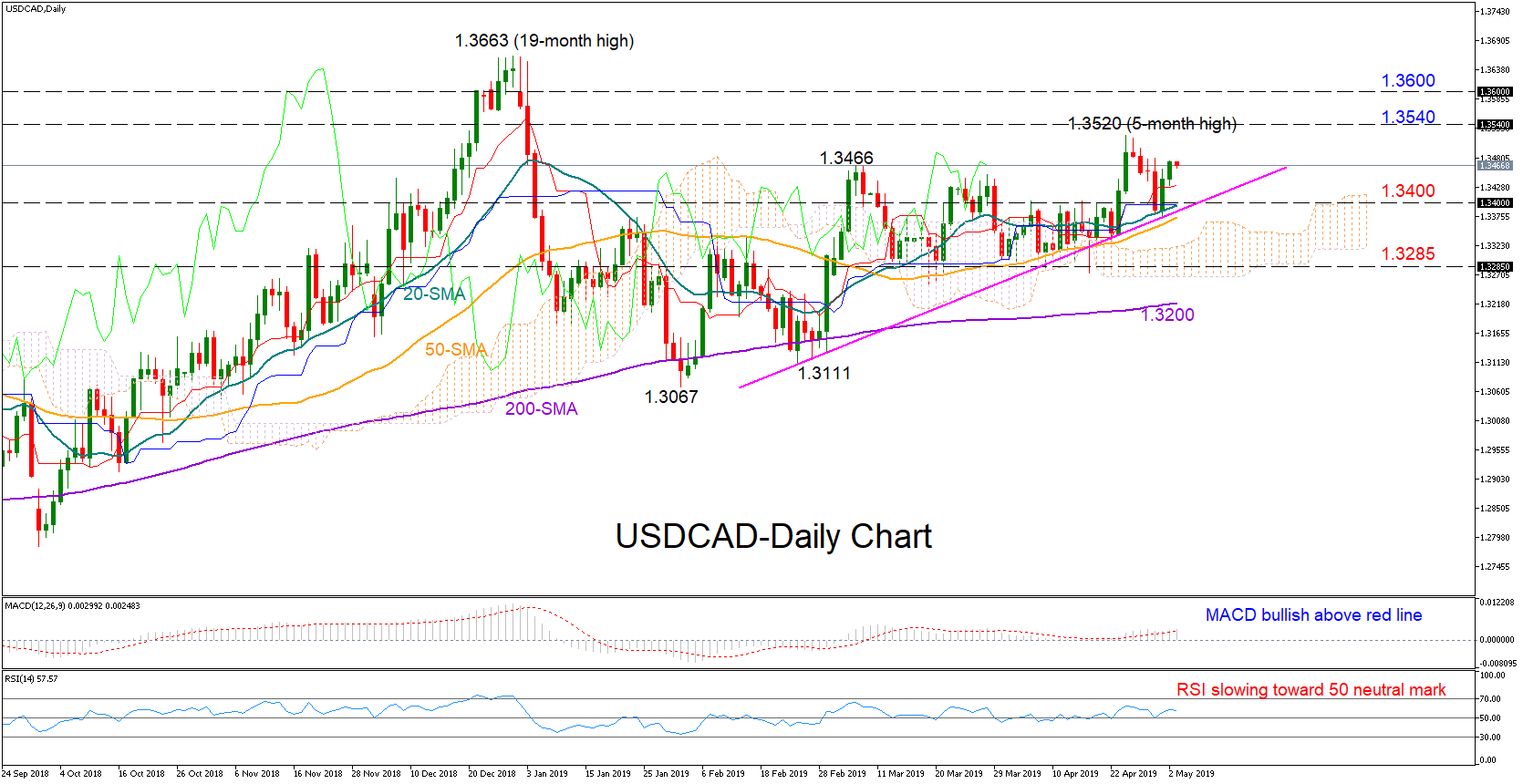
USDCAD bounced on the 20-day simple moving average (SMA) on Wednesday, switching its weekly status from negative to positive, a move that also kept the three-month trend to the upside. The risk is currently viewed as bullish-to-neutral as on the one hand the RSI seems to be changing direction southward to meet its 50 neutral mark, but the red Tenkan-sen is on a sideways move above the blue Kijun-sen and the MACD is increasing strength above its red signal line.
The bulls could set a target between the five-month high of 1.3520 and a former resistance of 1.3540, a break of which would open the way toward the 1.3600 barrier. Beyond the latter, the spotlight will turn to the 1.3663 top, where any close higher would bring the paused September 2017 uptrend back into play.
Otherwise, the 20-day SMA at 1.3400 could be watched in case of a negative correction. Should there be additional losses, the next support could be around the 1.3285 restrictive level. A failure to hold above that number could then lead the price toward the 200-day SMA (1.3220).
Meanwhile in the medium-term picture, USDCAD is weakly positive as long as the pair trades slightly above 1.3375. The positive slope in the 50-day SMA which has recently turned steeper and the increasing distance from the 200-day SMA suggests that a brighter outlook is possible.
Currencies: US (Wage) Data To Decide On Next USD Move
Rates: More room for short term losses on wage data?
US Treasuries reacted to Powell’s suggestion that soft inflation is expected to be transient, suggesting they’ll be sensitive to today’s earnings data as well. The bar of consensus seems rather low, suggesting room for more short term correction lower even if headline payrolls and non-manufacturing ISM will probably have more difficulties to beat estimates.
Currencies: US (wage) data to decide on next USD move.
EMU inflation data might have some intraday impact on EUR/USD trading. However, the US payrolls and non-manufacturing ISM will set the tone for USD trading. The data are expected to confirm that the US economy is in good shape but they probably have to be some kind of ‘perfect’ to trigger a big leap higher of the dollar.
The Sunrise Headlines
- US equities lost ground for a second day yesterday with the DJI (-0.46%) underperforming. Asian shares are trading mixed with mainland Chinese and Japanese bourses still closed.
- Bundesbank chief Weidmann urged the ECB to continue normalization if inflation allows it, as he keeps a positive outlook on the EMU eco outlook, while EC president Juncker endorsed Weidmann to succeed ECB president Draghi.
- Stephen Moore has withdrawn his candidacy for a seat on the Fed’s board of governors. Moore lacked support in the Senate over writings on women and is the 2nd candidate backed by US President Trump’s that had to take a step back.
- The UK local elections resulted in losses for both PM May’s Conservatives and the opposition Labour Party. With only part of the votes counted, Conservatives lost 212 councillors, Labour lost 54 while Liberal Democrats gained 145.
- Oil prices dropped to a monthly low yesterday as a US output is reaching record levels (12.3 mln b/d) and output cuts by OPEC+ remain below targeted levels. The price for one barrel Brent crude oil trades just north of $70.
- Australia’s building approvals fell 15.5% (M/M) in March, worse than the 12% decline expected, leading investors to raise the chances of the RBA cutting interest rates next Tuesday. The Aussie dollar fell to a four-month low.
- Today’s US economic calendar contains payrolls and wage data, while the ISM Non-Manufacturing index (Apr) gets released. An avalanche of Fed speakers take the stage. The EMU prints April inflation data.
Currencies: US (Wage) Data To Decide On Next USD Move
US wage growth data key for next USD move?
US and EMU data were mostly second tier yesterday and had only limited impact on EUR/USD trading. The pair initially hovered sideways in the 1.12 area after Wednesday’s Fed-inspired USD comeback. The interest rate spread between the dollar and the euro widened slightly further. The dollar finally enjoyed some additional follow-through gains in the US trading as investors were looking forward to today’s US payrolls report. EUR/USD closed at 1.1172 (from 1.1196). USD/JPY showed no clear intraday trend and in finished at 111.51 (from 111.38).
Today, Asian equities are trading mixed with Japan and China closed. The Aussie dollar lost slightly ground as building approvals (-27.3% Y/Y) dropped more than expected, raising speculation the RBA might already consider a rate cut next week. AUD/USD is extensively testing the psychological barrier of 0.70. The dollar remains rather well bid across the board (DXY at 97.85; EUR/USD near 1.1170/75).
Later, the EMU CPI is interesting, but the US payrolls will be probably be key for global (FX) trading. EMU headline CPI is expected to rise from 1.4% Y/Y to 1.6% (core 1.0 Y/Y from 0.8%). A slight upward surprise, if any, shouldn’t be a big surprise after the German release. We doubt that the figure will be strong enough to really support the euro. April US job growth is expected at a near trend 190K. Markets will also keep a close eye at the wage growth data (AHE expected 0.3% M/M). Investors will challenge Powell’s assessment that recent decline in inflation might be transient. The dollar probably needs strong data to extend its comeback. Later the non-manufacturing is expected to rise from 56.1 to 57. We don’t see much reason for an outright negative surprise from the US data. Still we maintain the view that the EUR/USD 1.1110 support area won’t be that easy to break unless US data are exceptionally strong.
Yesterday, the BoE left its policy rate unchanged, but BoE ‘s Carney indicated that rates will probably have to be raised faster than the markets expects if Brexit is solved in an orderly manner. However, the impact on sterling was modest. EUR/GBP closed at 0.8575 (from 0.8580). Today, the UK services PMI is expected to rebound back above the 50 level. Both the conservative party and labour lost seats in the local elections. Question is whether this will help both parties to find a Brexit compromise anytime soon. For now we expect more technical EUR/GBP trading in the 0.85/0.87 corridor
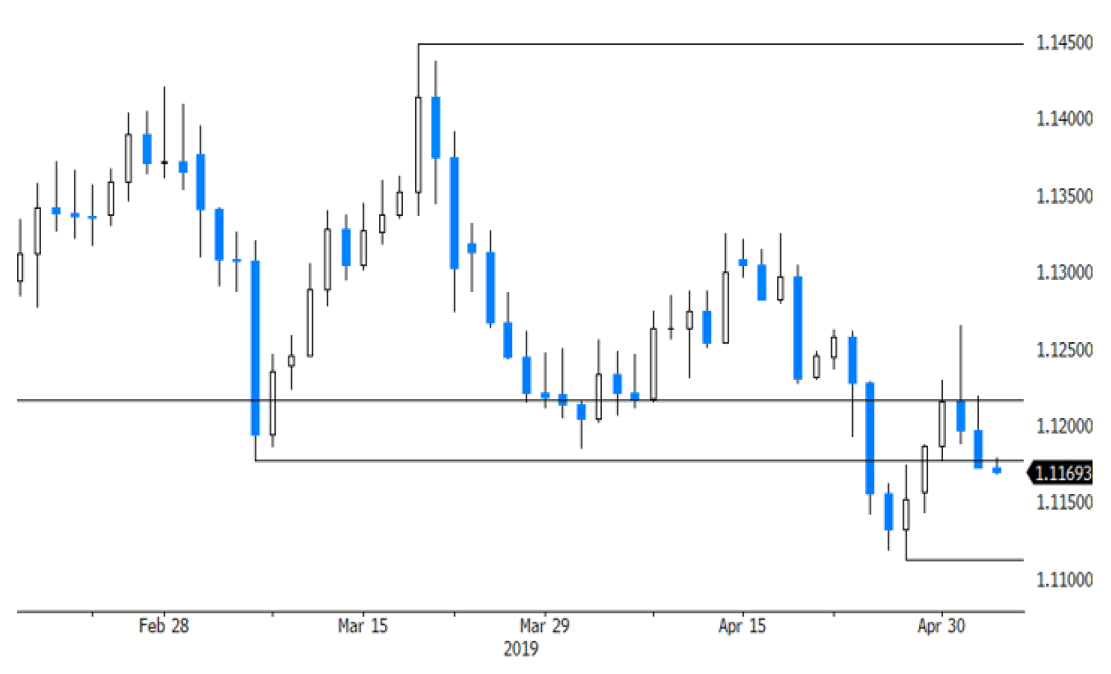
EUR/USD: will US data be strong enough further dollar to retest the 1.110 support area?