Sample Category Title
Into US session: Little reactions to BoE, markets stuck in tight range
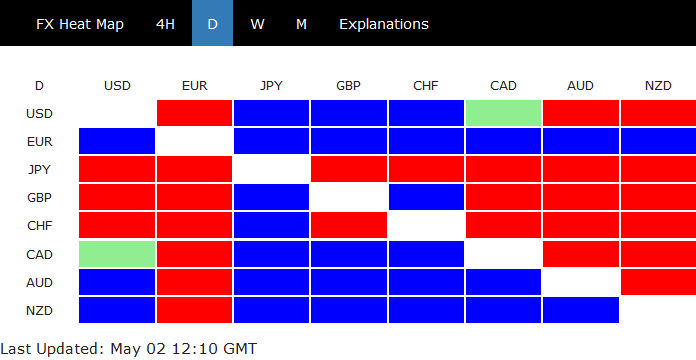
Entering into US session, the forex markets remain steady today, with major pairs and crosses bounded inside yesterday's range. Euro is so far the strongest one, followed by New Zealand and then Australian Dollars. Yen is the weakest one, followed by Swiss Franc and then Sterling. But it's actually not too meaningful to name them as strongest and weakest considering the tight range the pairs are in.
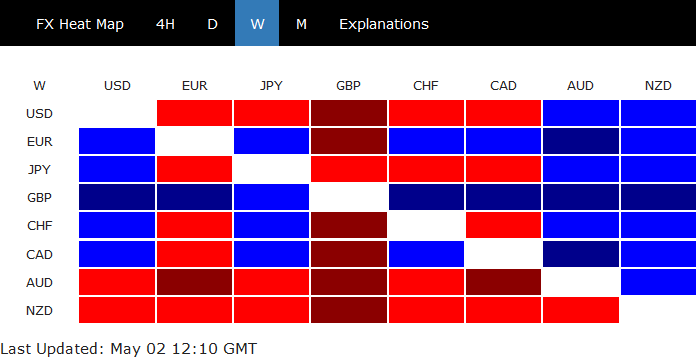
For the week, Sterling is the strongest one so far. It's rather hard to react to BoE's new economic projections. Growth forecasts were revised up but inflation forecasts were revised down. Most importantly, BoE painted a much slower rate path and a full 25bps hike in Q4 2021, comparing Q3 2020. Euro is the second strongest, followed by Canadian. New Zealand Dollar and Australian Dollar are the weakest. Dollar pared back much losses after Fed Chair Jerome Powell indicated there is no urgency to shift interest rate in either direction. But there is no follow through buying after that.
In Europe:
- FTSE is down -0.10%.
- DAX is up 0.13%.
- CAC is down -0.41%.
- German 10-year yield is down -0.0046 at 0.011, staying positive.
Earlier in Asia:
- Hong Kong HSI rose 0.83%.
- China Shanghai SSE rose 0.52%.
- Singapore Strait Times dropped -0.20%.
- Japan remained in ultra-long 10-day holiday.
BoE projects slower rate hike, faster growth, lower inflation
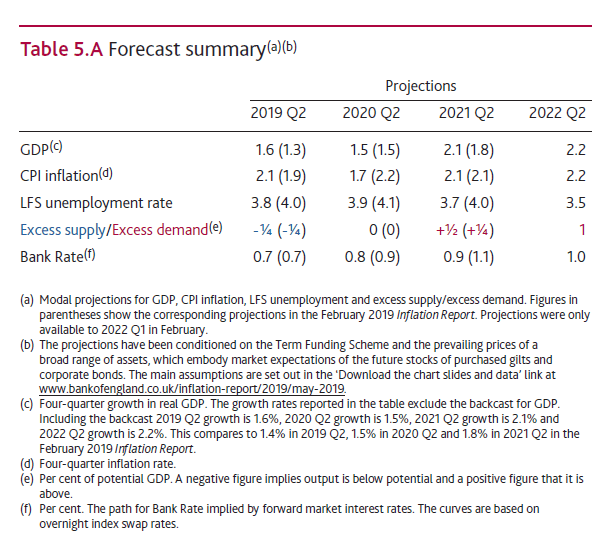
BoE left Bank Rate unchanged at 0.75% and kept asset purchase target at GBP 435B, on unanimous vote, as widely expected. New economic projections were released with the Quarterly Inflation Report too. One important point to note is that new forecasts are based on slower projected rate path. That is, Bank Rate is projected to rise to 0.9% in 2021 Q2, down from February's projection of 1.1%. In 2022, Q2, Bank Rate is forecast at 1.0%
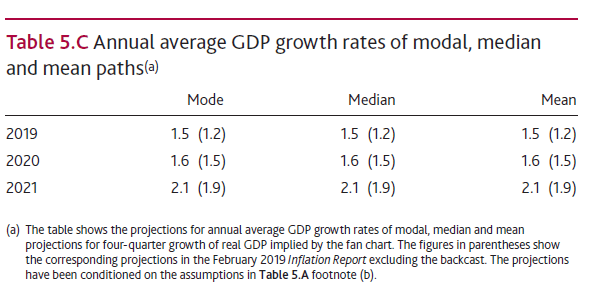
On growth, BoE forecast annual GDP growth to be:
- 1.5% in 2019 (revised up from 1.2%);
- 1.6% in 2020 (revised up from 1.5%);
- 2.1% in 2011, (revised up from 1.9%);
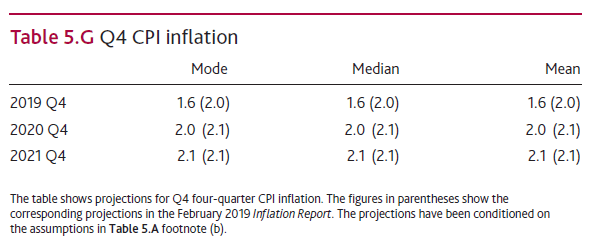
On Inflation, BoE forecast CPI to be at:
- 1.6% in Q4 2019 (revised down from 2.0%);
- 2.0% in Q4 2020 (revised down from 2.1%);
- 2.1% in Q4 2021 (unchanged);
Again, BoE reiterated: "The economic outlook will continue to depend significantly on the nature and timing of EU withdrawal, in particular: the new trading arrangements between the European Union and the United Kingdom; whether the transition to them is abrupt or smooth; and how households, businesses and financial markets respond. The appropriate path of monetary policy will depend on the balance of these effects on demand, supply and the exchange rate. The monetary policy response to Brexit, whatever form it takes, will not be automatic and could be in either direction."
BoE Governor Mark Carney press conference live stream
https://www.youtube.com/watch?v=W9DKeFAfIEE
BoE kept Bank Rant unchanged at 0.75%, full statement
BoE kept Bank Rate unchanged at 0.75% as widely expected. Asset purchase target was also held at GBP 435B. The decisions were both made by unanimous vote. Sterling is steady after the announcement.
Full statement below.
Bank Rate maintained at 0.75%
Our Monetary Policy Committee has voted unanimously to maintain Bank Rate at 0.75%. The committee also voted unanimously to maintain the stock of corporate bond purchases and UK government bond purchases.
The Bank of England's Monetary Policy Committee (MPC) sets monetary policy to meet the 2% inflation target, and in a way that helps to sustain growth and employment. At its meeting ending on 1 May 2019, the MPC voted unanimously to maintain Bank Rate at 0.75%.
The Committee voted unanimously to maintain the stock of sterling non-financial investment-grade corporate bond purchases, financed by the issuance of central bank reserves, at £10 billion. The Committee also voted unanimously to maintain the stock of UK government bond purchases, financed by the issuance of central bank reserves, at £435 billion.
The Committee's updated projections for activity and inflation are set out in the accompanying May Inflation Report. They assume a smooth adjustment to the average of a range of possible outcomes for the United Kingdom's eventual trading relationship with the European Union. They are also conditioned on a path for Bank Rate that rises to around 1% by the end of the forecast period, lower than in the February Report. As with UK financial conditions more generally, that path has been heavily influenced by recent global developments, with forward interest rates in the United States and the euro area falling markedly.
The MPC has noted previously that UK data could be unusually volatile in the near term, due to shifting expectations about Brexit in financial markets and among households and businesses. GDP is expected to have grown by 0.5% in 2019 Q1, in part reflecting a larger-than-expected boost from companies in the United Kingdom and the European Union building stocks ahead of recent Brexit deadlines. That boost is expected to be temporary, however, and quarterly growth is expected to slow to around 0.2% in Q2. Smoothing through those developments, the underlying pace of GDP growth appears to be slightly stronger than previously anticipated, but marginally below potential. That subdued pace reflects the impact of the slowdown in global growth and ongoing Brexit uncertainties. The latter is having a particularly pronounced impact on business investment, which has been falling for a year. The MPC judges that there is currently a small margin of excess supply in the economy.
In the MPC's central projection, global growth stabilises around its potential rate and Brexit uncertainties subside gradually. Four-quarter UK GDP growth begins to pick up next year and rises to over 2% by the end of the forecast period. Business investment recovers and household spending continues to support demand growth, sustained by rising real incomes. GDP growth picks up above the subdued pace of potential supply growth, such that excess demand begins to build. Excess demand rises above 1% of potential output by the end of the forecast period, notably higher than in the February Report, reflecting the support to demand provided by lower market interest rates and easier financial conditions more generally.
CPI inflation was 1.9% in March and is expected to be slightly further below the MPC's 2% target during the first half of the forecast period, largely reflecting lower expected retail energy prices. The labour market remains tight, with the unemployment rate projected to decline to 3½% by the end of the forecast period. Annual pay growth has remained around 3½% and unit labour cost growth has strengthened to rates that are above historical averages. As excess demand emerges, domestic inflationary pressures are expected to firm, such that CPI inflation picks up to above the 2% target in two years' time and is still rising at the end of the three-year forecast period.
The Committee continues to judge that, were the economy to develop broadly in line with its Inflation Report projections, an ongoing tightening of monetary policy over the forecast period, at a gradual pace and to a limited extent, would be appropriate to return inflation sustainably to the 2% target at a conventional horizon. The MPC judges at this meeting that the current stance of monetary policy is appropriate.
The economic outlook will continue to depend significantly on the nature and timing of EU withdrawal, in particular: the new trading arrangements between the European Union and the United Kingdom; whether the transition to them is abrupt or smooth; and how households, businesses and financial markets respond. The appropriate path of monetary policy will depend on the balance of these effects on demand, supply and the exchange rate. The monetary policy response to Brexit, whatever form it takes, will not be automatic and could be in either direction. The Committee will always act to achieve the 2% inflation target.
(BOE) Bank Rate maintained at 0.75%
Our Monetary Policy Committee has voted unanimously to maintain Bank Rate at 0.75%. The committee also voted unanimously to maintain the stock of corporate bond purchases and UK government bond purchases.
The Bank of England's Monetary Policy Committee (MPC) sets monetary policy to meet the 2% inflation target, and in a way that helps to sustain growth and employment. At its meeting ending on 1 May 2019, the MPC voted unanimously to maintain Bank Rate at 0.75%.
The Committee voted unanimously to maintain the stock of sterling non-financial investment-grade corporate bond purchases, financed by the issuance of central bank reserves, at £10 billion. The Committee also voted unanimously to maintain the stock of UK government bond purchases, financed by the issuance of central bank reserves, at £435 billion.
The Committee's updated projections for activity and inflation are set out in the accompanying May Inflation Report. They assume a smooth adjustment to the average of a range of possible outcomes for the United Kingdom's eventual trading relationship with the European Union. They are also conditioned on a path for Bank Rate that rises to around 1% by the end of the forecast period, lower than in the February Report. As with UK financial conditions more generally, that path has been heavily influenced by recent global developments, with forward interest rates in the United States and the euro area falling markedly.
The MPC has noted previously that UK data could be unusually volatile in the near term, due to shifting expectations about Brexit in financial markets and among households and businesses. GDP is expected to have grown by 0.5% in 2019 Q1, in part reflecting a larger-than-expected boost from companies in the United Kingdom and the European Union building stocks ahead of recent Brexit deadlines. That boost is expected to be temporary, however, and quarterly growth is expected to slow to around 0.2% in Q2. Smoothing through those developments, the underlying pace of GDP growth appears to be slightly stronger than previously anticipated, but marginally below potential. That subdued pace reflects the impact of the slowdown in global growth and ongoing Brexit uncertainties. The latter is having a particularly pronounced impact on business investment, which has been falling for a year. The MPC judges that there is currently a small margin of excess supply in the economy.
In the MPC's central projection, global growth stabilises around its potential rate and Brexit uncertainties subside gradually. Four-quarter UK GDP growth begins to pick up next year and rises to over 2% by the end of the forecast period. Business investment recovers and household spending continues to support demand growth, sustained by rising real incomes. GDP growth picks up above the subdued pace of potential supply growth, such that excess demand begins to build. Excess demand rises above 1% of potential output by the end of the forecast period, notably higher than in the February Report, reflecting the support to demand provided by lower market interest rates and easier financial conditions more generally.
CPI inflation was 1.9% in March and is expected to be slightly further below the MPC's 2% target during the first half of the forecast period, largely reflecting lower expected retail energy prices. The labour market remains tight, with the unemployment rate projected to decline to 3½% by the end of the forecast period. Annual pay growth has remained around 3½% and unit labour cost growth has strengthened to rates that are above historical averages. As excess demand emerges, domestic inflationary pressures are expected to firm, such that CPI inflation picks up to above the 2% target in two years' time and is still rising at the end of the three-year forecast period.
The Committee continues to judge that, were the economy to develop broadly in line with its Inflation Report projections, an ongoing tightening of monetary policy over the forecast period, at a gradual pace and to a limited extent, would be appropriate to return inflation sustainably to the 2% target at a conventional horizon. The MPC judges at this meeting that the current stance of monetary policy is appropriate.
The economic outlook will continue to depend significantly on the nature and timing of EU withdrawal, in particular: the new trading arrangements between the European Union and the United Kingdom; whether the transition to them is abrupt or smooth; and how households, businesses and financial markets respond. The appropriate path of monetary policy will depend on the balance of these effects on demand, supply and the exchange rate. The monetary policy response to Brexit, whatever form it takes, will not be automatic and could be in either direction. The Committee will always act to achieve the 2% inflation target.
European Update – BoE To Spring Surprise?
Mixed start after Fed opts for patience
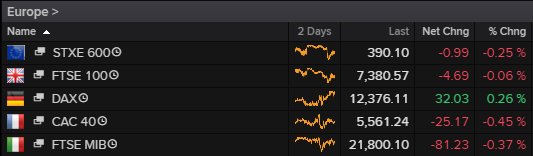
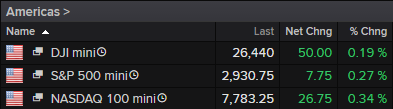
Another mixed start to trading in Europe on Thursday, while US futures are pushing little higher, partially offsetting Wall Street’s decline on Wednesday.
Clearly investors did not take too kindly to the Fed refusing to bow to public – and more importantly political – pressure to at least signal a willingness to be more accommodative. The central bank has already dramatically softened its monetary policy position, having signaled no rate hikes this year and only one next and policy makers clearly believe this is sufficient to deal with the challenges the economy is facing. Clearly the data supports this view.
BoE to offer hawkish surprise?
The Bank of England is up next and the widely held belief appears to be that it’s going to fall in line with its peers and do nothing. While I don’t expect a rate hike today, I do question the logic behind just waiting for Brexit to be resolved. It made sense from August last year but what if the can is kicked down the road again, are we set for an indefinite pause?
Given the data, I wouldn’t be surprised if the BoE retains a hawkish stance and maybe even suggests there could be a hike later in the year once everything has settled down. Brexit has already delayed the tightening cycle considerably, I don’t think it will want this to continue
European PMI Readings Continued The Trend Of Stabilization In The Regions’ Data
Notes/Observations
- European PMI manufacturing data helped to smooth concerns over the region's growth outlook (Beats: Euro Zone, France, Italy, Spain; Misses: Germany)
- Less dovish FOMC as Fed to stay patient on rates as economy remained solid while inflation was muted
Asia:
- US and China said to be near deal to roll back some tariffs and could announce a deal by the end of next week
Europe/Mideast:
- PM May said to be considering staying in the EU customs union in order to secure a deal with Labour. Under the terms of a tentative agreement PM May said to be close to signing up to a long-term customs Union with the EU in all but name in return for Labour supporting her withdrawal agreement.
- United Kingdom Defense Sec fired for allegedly leaking security council discussions regarding Huawei role in 5G infrastructure
Americas:
- FOMC keeps Key policy rates steady (as expected) while cutting IOER by 5bp to 1.35%; in a unanimous decision. IOER move was intended to keep funds rate in the target range. Expected healthy GDP growth over rest of 2019; core inflation drop in early 2019 was unexpected and might be transitory factors at work Labor market remained strong and that economic activity rose at a solid rate. Job gains had been solid, on average, in recent months, and the unemployment rate had remained low. Growth of household spending and business fixed investment slowed in the first quarter
- BOC Gov Poloz stated that negative developments had created a detour for the Canadian economy; impact was temporary and growth would pick up. Reiterated reason to believe that the economy would accelerate in H2 2019. If headwinds dissipate, then rates would naturally rise
SPEAKERS/FIXED INCOME/FX/COMMODITIES/ERRATUM
Equities
- Indices [Stoxx600 -0.25% at 390.18, FTSE +0.01% at 7,386.00, DAX +0.16% at 12,363.94, CAC-40 -0.34% at 5,567.25, IBEX-35 -0.39% at 9,533.00, FTSE MIB -0.40% at 21,794.50, SMI 0.00% at 9,769.50, S&P 500 Futures +0.23%]
- Market Focal Points/Key Themes: European Indices trade mixed, coming off earlier lows, tracking higher US futures as markets return from holidays yesterday amid a very busy morning for corporate earnings and the FOMC rate decision yesterday. The Dax trades near session highs on the back of strong results for car giant Volkswagen which trades higher by almost 5%. Profits and Revenue handily beat estimates whilst affirming their outlook. BNP Paribas also rises on strong Revenue, while Royal Dutch Shell gains after beating forecasts. Other notable risers include Axa, Veolia, Geberit and Orexo. Meanwhile Hugo Boss declines on a Revenue miss, Andritz, Paddy Power, Lloyds and Legrand among other names declining on earnings. Elsewhere AMS continues to rally after strong earnings on Tuesday, rising a further 6% in sympathy with results from Apple; Bayer trades higher following affirmation from the EPA that Glyphosate is not carcinogenic, while Porsche trades higher following operating profit results and US car sales figures. Looking ahead notable earners include Cigna, Teva Pharma, Dunkin Brands, Kellogg, PG&E and Under Armor among others.
Equities
- Consumer discretionary: Hugo Boss [BOSS.DE] -5% (earnings), Zalando [ZAL.DE] -2% (earnings), Carlsberg [CARLB.DK] -1% (earnings), Paddy Power Betfair [PPB.UK] -4.5% (earnings), McBride [MCB.UK] -11.5% (CEO steps down; second profit warning)
- Energy: Royal Dutch Shell [RDSA.NL] +1% (earnings; buyback)
- Financials: BNP Paribas [BNP.FR] +2.5% (earnings), Metro Bank [MTRO.UK] -12.5% (earnings)
- Healthcare: Bayer [BAYN.DE] +2.5% (US EPA reaffirms that Glyphosate is not carcinogenic), Transgene [SNG.FR] +10% (collaboration with Astrazeneca), Fresenius SE [FRE.DE] -0.5% (earnings), Smith and Nephew [SN.UK] +3.5% (earnings)
- Industrials: Volkswagen [VOW3.DE] +5% (earnings), Rolls Royce [RR.UK] +1% (earnings), Andritz [ANDR.AT] -10.5% (earnings), Porsche [PAH3.DE] +4.5%, Fiat Chrysler [FCA.IT] -2.5% (car sales), Geberit [GEBN.CH] +7% (earnings)
- Technology: AMS [AMS.CH] +5.5% (Apple earnings)
Speakers
- ECB's Nowotny (Austria): Monetary policy review would make sense for the ECB (**Note: On May 1st ECB's De Guindos (Spain) stated that ECB had not discussed changing their target in response to question whether if the new president might want to review it)
- Sweden Central Bank (Riksbank) Gov Ingves testified in Parliament that unusual monetary policy has had effect. Important to analyst the SEK currency developments
- Taiwan Central Bank (CBC) Mar Minutes: Members concerned about local investments. One member did not see the need to cut rates; One member saw no grounds to raise rates while one member was concerned about slowing of M2 money supply growth
- Russia Apr oil production at 11.23M bpd v 11.30M bpd m/m
- OPEC Sec Gen Barkindo: Watching Venezuela oil situation carefully; OPEC+ working to avoid any supply crisis
Currencies/Fixed Income
- European PMI manufacturing data helped to sooth concerns over the region's growth outlook and helped the EUR/USD stay above the 1.12 level.
- GBP was slightly firmer in the session around the 1.3070 area with focus on the BOE rate decision later in session. Some participants believe BOE could surprise the market with a hawkish tilt
- Overall the USD was basically steady after the Fed reiterated patience on Wed but its statement dented any expectations of coming rate cuts.
Economic Data
- (IN) India Apr PMI Manufacturing: # v 51.8
- (DE) Germany Mar Retail Sales M/M: -0.2% v -0.5%e; Y/Y: -2.1% v +.9%e
- (SE) Sweden Apr PMI Manufacturing: 50.9 v 52.8e
- (CH) Swiss Mar Real Retail Sales Y/Y: -0.7% v -0.4%e
- (NO) Norway Apr PMI Manufacturing: 53.8 v 56.8e (10th month of expansion)
- (HU) Hungary Apr Manufacturing PMI: 54.9 v 51.5e (41st month of expansion)
- (PL) Poland Apr PMI Manufacturing: 49.0 v 48.7e (6th straight contraction)
- (TR) Turkey Apr PMI Manufacturing: 46.8 v 47.2 prior (13th straight contraction)
- (HU) Feb Final Trade Balance: €0.8B v €0.9B prelim
- (ES) Spain Apr Manufacturing PMI: 51.8 v 51.2e (2nd straight expansion)
- (CH) Swiss Apr PMI Manufacturing: 48.5 v 51.0e (1st contraction in 40 months)
- (CZ) Czech Republic Apr PMI Manufacturing: 46.6 v 47.6e (5th straight contraction)
- (TH) Thailand Apr Business Sentiment Index: 49.2 v 51.4 prior
- (IT) Italy Apr Manufacturing PMI: 49.1 v 47.8e (7th straight contraction)
- (FR) France Apr Final Manufacturing PMI: 50.0 v 49.6e (moved back into expansion)
- (DE) Germany Apr Final Manufacturing PMI: 44.4 v 44.5e (confirmed 4th straight contraction)
- (EU) Euro Zone Apr Final Manufacturing PMI: 47.9 v 47.8e (confirmed 3rd straight contraction)
- (GR) Greece Apr Manufacturing PMI: 56.6 v 54.7 prior (22nd month of expansion)
- (BR) Brazil Apr FIPE CPI (Sao Paulo) M/M: 0.3% v 0.3%e
- (UK) Apr Construction PMI: 50.5 v 50.3e
- (HK) Hong Kong Q1 GDP Q/Q: 1.2% v 0.7%e; Y/Y: 0.5% v 1.9%e
- (ZA) South Africa Apr Manufacturing PMI: 47.2 v 45.8e (4th straight contraction)
- (IS) Iceland Q1 Unemployment Rate: % v 2.4% prior
Fixed Income Issuance
- (FR) France Debt Agency (AFT) sold total €B vs. €7.0-8.5B indicated range in 2029, 2034 and 2039 bonds
- Sold €3.957B in 0.50% May 2029 Oat; Avg Yield: 0.37% v 0.39% prior; Bid-to-cover: 3.11x v 2.06x prior
- Sold €2.633B in 1.25% May 2034 Oat; Avg Yield: 0.78% v 0.80% prior; Bid-to-cover: 2.29x v 3.29x prior
- Sold €1.896B in 1.75% Jun 2039 green Oat; Avg Yield: 1.04% v 1.25% prior; Bid-to-cover: 2.01x v 2.09x prior
- (SE) Sweden sold SEK500M vs. SEK500M indicated in I/L 2027 Bonds; Avg yield: -1.7686% v -1.6260% prior; Bid-to-cover: 3.23x v 3.36x prior
- (VN) Vietnam sold total VND2.7T vs. VND4.0T target in 5-year, 10-year, 15-year and 30-year bonds
Looking Ahead
- (UK) UK holds Local Elections
- (NO) Norway Central Bank (Norges) Dep Gov Nicolaisen
- (ZA) South Africa Apr Naamsa Vehicle Sales Y/Y: No est v -3.1% prior
- (RO) Romania Apr International Reserves: no est v $35.9B prior
- 05:30 (HU) Hungary Debt Agency (AKK) to sell 12-month bills
- 06:00 (IE) Ireland Apr Live Register Monthly Change: No est v -2.3K prior; Live Register Level: No est v 194.8K prior
- 07:00 (UK) Bank of England (BOE) Interest Rate Decision: Expected to leave Interest Rates unchanged at 0.75%
- 07:00 (UK) Bank of England (BOE) Apr Minutes
- 07:00 (UK) Bank of England (BOE) Quarterly Inflation Report (QIR)
- 07:00 (CZ) Czech Central Bank (CNB) Interest Rate Decision: expected to raise 2-Week Repurchase Rate by 25bps to 2.00%
- 07:00 (ZA) South Africa Mar Electricity Production Y/Y: No est v -1.9% prior; Electricity Consumption Y/Y: No est v -1.0% prior
- 07:30 (US) Apr Challenger Job Cuts: no est v 60.6K prior; Y/Y: No est v 0.4% prior
- 07:30 (UK) BOE Gov Carney post rate decision press conference
- 08:00 (CZ) Czech Apr Budget Balance (CZK): No est v -9.2B prior
- 08:00 (UK) Baltic Bulk Index
- 08:15 (CZ) Czech Central Bank Gov Rusnok to hold post Rate Decision press conference
- 08:30 (US) Initial Jobless Claims: 215Ke v 230K prior; Continuing Claims: 1.66Me v 1.655M prior
- 08:30 (US) Q1 Preliminary Nonfarm Productivity: 2.3%e v 1.9% prior; Unit Labor Costs: 1.5%e v 2.0% prior
- 08:30 (US) Weekly USDA Net Export Sales
- 09:00 (BR) Brazil Apr PMI Manufacturing: No est v 52.8 prior
- 10:00 (US) Mar Factory Orders: +1.5%e v -0.5% prior; Factory Orders (ex-transportation): No est v 0.3% prior
- 10:00 (US) Mar Final Durable Goods Orders: No est v 2.7% prelim; Durables Ex-transportation: No est v 0.4% prelim; Capital Goods Orders (Non-defense/ex-aircraft): No est v 1.3% prelim; Capital Goods Shipments (Non-defense/ex-aircraft): No est v -0.2% prelim
- 10:00 (MX) Mexico Mar Total Remittances: $2.8Be v $2.4B prior
- 10:00 (MX) Mexico Central Bank Economist Survey
- 10:30 (MX) Mexico Apr PMI Manufacturing: No est v 49.8 prior
- 10:30 (US) EIA Weekly Natural Gas Inventories
- 11:30 (US) Treasury to sell 4-week and 8-week bills
- 11:00 (DK) Denmark Apr Foreign Reserves (DKK): No est v 454.1B prior
- 12:00 (CA) Canada to sell 2-year bonds
- 13:00 (MX) Mexico Apr IMEF Manufacturing Index: 50.2e v 50.2 prior; Non-Manufacturing Index: 51.1e v 51.2 prior
- 13:30 (BE) ECB's Praet (Belgium, outgoing economist)
- 14:15 (BR) Brazil Apr Trade Balance: $6.9Be v $5.0B prior; Total Exports: $20.5Be v $18.1B prior; Total Imports: No est v $13.1B prior
- (IT) Italy Apr Budget Balance: No est v -€20.2B prior
- (AR) Argentina Apr Government Tax Revenue (ARS): No est v 327.9B prior
- (BR) Brazil Mar CNI Capacity Utilization: No est v 78.0% prior
The Fed Has Returned Faith In The Dollar To The Market
The FED's «patience» has supported the markets this year. But yesterday the same mood led the retreat of stocks and raised the dollar, as the markets were set for further softening of the rhetoric.
The Federal Reserve, as expected, did not change the policy and disappointed the stock markets, noting that does not see needs to change the policy in any direction in the near future. Moreover, in its comments, the Fed noted that it retains confidence in the economy and expects inflation to rise due to a strong labour market. This caused a jump in the dollar by 0.6% and took away more than 1% from the S&P 500. This is a contradictory signal for the markets and a positive one for the dollar.
On Thursday morning, futures for US indices are carefully recovering against the background of optimism around the economy. But as for the dollar and debt markets, there is a lot of room for manoeuvre as market participants are pricing in one rate cut in the next 12 months. From now they may start seriously adjust their expectations. The development of this scenario will cause the growth of long-term bond yields, strengthening the dollar purchase.
Another important point is the standoff between Trump and the Fed. As expected, on the eve of the meeting the U.S. President noted that the economy could go "up like a rocket" with the help of lower rates and quantitative easing. Trump noted that in this case "the national debt will look small." This is possible with the much lower dollar, which would seriously question the financial stability.
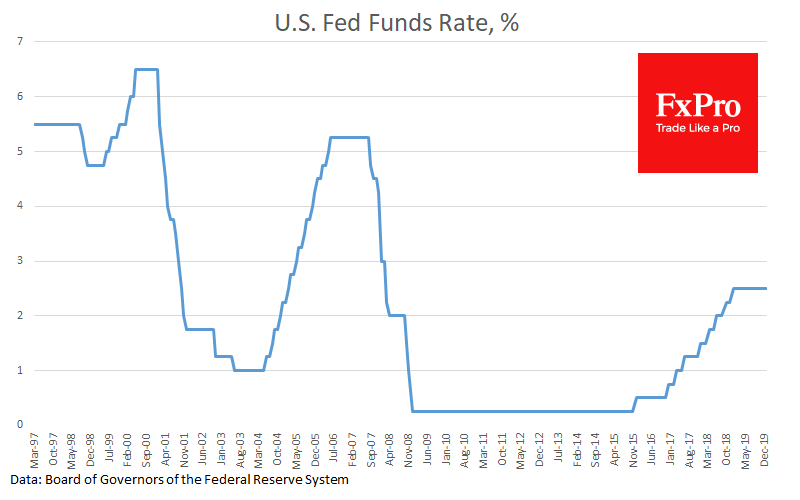
Therefore, the "patience" of the Fed, in this case, should be taken a stoic calm, which can return confidence to the dollar.
ILLUSTRATION
S&P 500 declined from historic highs by 1.5% by the end of trading on Wednesday, offsetting all growth gained from the end of last week. On Thursday, there are cautious purchases of stocks.
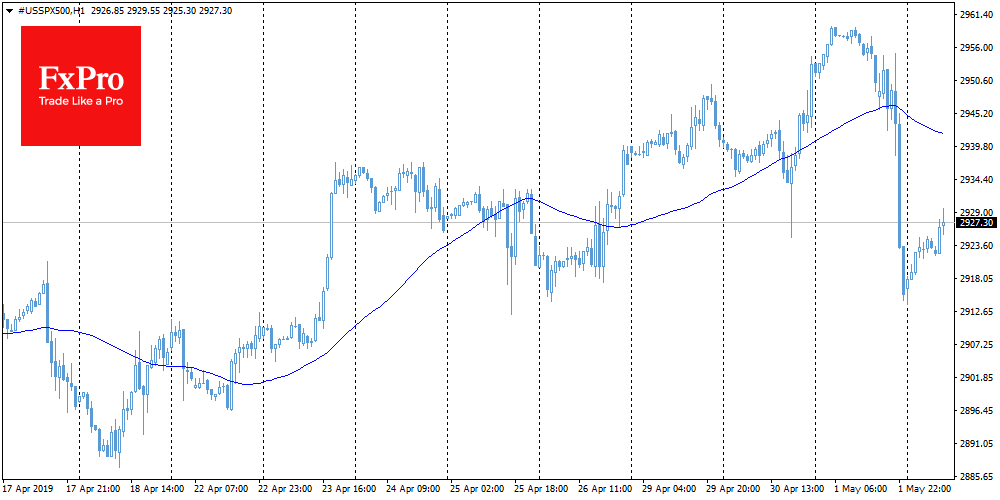
The wait-and-see approach of the markets may persist until the release of Friday statistics on the labour market. The data released this week form a contradictory picture. Very strong employment growth of +275K by ADP vs expected 181K. Manufacturing ISM fell from 55.0 to 52.8, to a two-and-half year's lows.
ILLUSTRATION
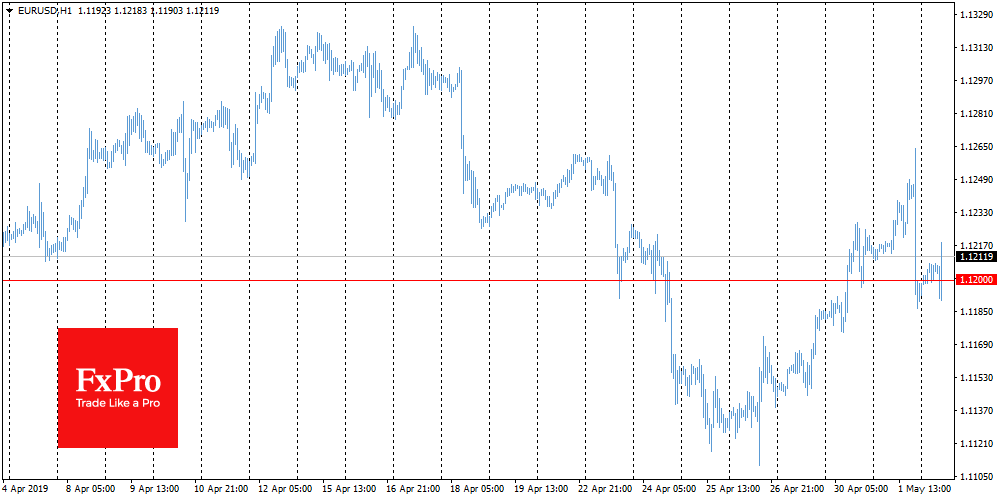
The Fed's patience has stopped the EURUSD growth in one step from the 50-day MA and returned it to levels under 1.1200 at one point. On Thursday morning, the pair demonstrates growth attempts, trading at 1.1210. Traders should remain cautious, as there is still a number of important data that can affect the course of trading on the foreign exchange market, including the BoE's MPC decision and the U.S. statistics.
BoE To Offer Hawkish Surprise?
Another mixed start to trading in Europe on Thursday, while US futures are pushing little higher, partially offsetting Wall Street's decline on Wednesday.
Clearly investors did not take too kindly to the Fed refusing to bow to public – and more importantly political – pressure to at least signal a willingness to be more accommodative. The central bank has already dramatically softened its monetary policy position, having signaled no rate hikes this year and only one next and policy makers clearly believe this is sufficient to deal with the challenges the economy is facing. Clearly the data supports this view.
BoE to offer hawkish surprise?
The Bank of England is up next and the widely held belief appears to be that it's going to fall in line with its peers and do nothing. While I don't expect a rate hike today, I do question the logic behind just waiting for Brexit to be resolved. It made sense from August last year but what if the can is kicked down the road again, are we set for an indefinite pause?
Given the data, I wouldn't be surprised if the BoE retains a hawkish stance and maybe even suggests there could be a hike later in the year once everything has settled down. Brexit has already delayed the tightening cycle considerably, I don't think it will want this to continue.
Should oil bulls be worried?
Oil prices are coming under pressure again today, with this week's inventory data knocking the stuffing out of oil bulls, especially when combined with record US production figures and a stronger dollar. WTI had looked toppy for a few weeks prior to the recent difficulties and last Friday's outsized reaction to Trump's OPEC phone call claim was a clear signal that traders were looking for a reason to abandon ship.
We're still seeing some resilience in oil prices but that may quickly fade if WTI breaks below the $61-62 region, bringing $58-59 into focus. Tomorrow's oil rig data will be very interesting in light of the US output hitting a new record of 12.3 million barrels per day at the end of April. Until then, bulls may have a real fight on their hands with WTI threatening to break a four month uptrend which would be another blow.
Gold bulls looking nervous
Gold is heading south again on Thursday, with yesterday evening's pop in the dollar primarily responsible for the moves. This was always likely to be a big week for the greenback - and therefore gold - and it's not over yet. The refusal by the Fed to bow to pressure, particularly from the White House, and at least signal a willingness to be more accommodative sent the dollar higher on Wednesday which was a major drag on gold sending it back towards last week's lows.
Gold is under pressure again despite the dollar actually paring gains which could be some insight into traders mentality when it comes to gold at the moment. It was threatening to potentially make a comeback but price action over the last 24 hours hasn't give bulls much cause for optimism which looks to have taken its toll. Gold recently found support around $1,266 but around $1,260 is key area for me. A break of this could make things very interesting.
USDJPY Bulls Target 111.60 Level
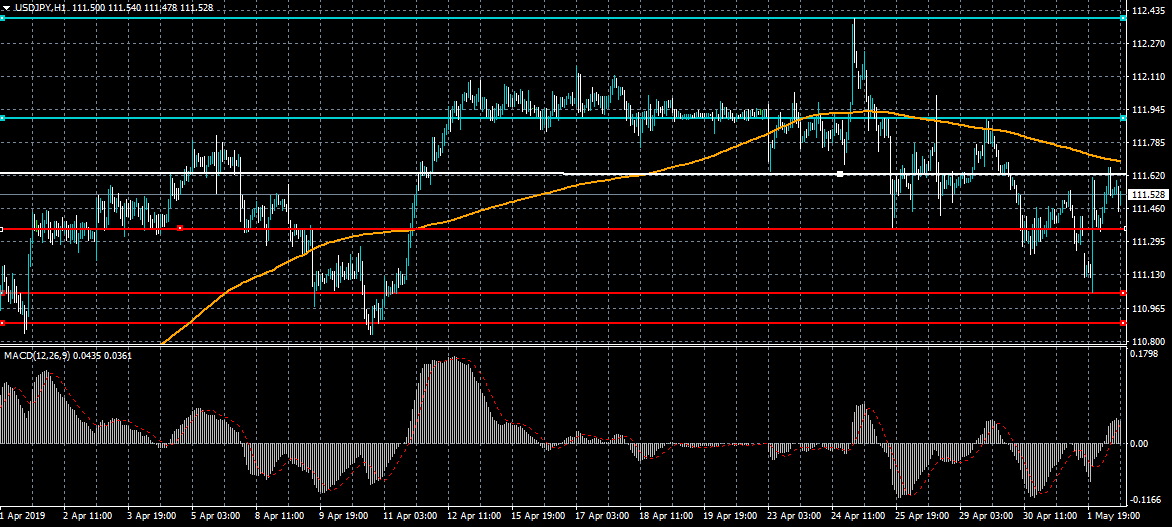
The US dollar has made a strong recovery higher against the Japanese yen currency, following bullish reports coming from Sino-US trade negotiations. USDJPY buyers now need to move price above the 111.60 level to encourage fresh technical buying in the pair. A bullish pattern could start to emerge on the four-hour time frame now that the head and shoulders pattern has reached its bearish target.
The USDJPY pair is only bearish while trading below the 111.60, key intraday support is found at the 111.35 and 111.00 levels.
If the USDJPY pair trades above the 111.60 level, key intraday resistance remains at the 111.88 and 112.40 levels.