

Sample Category Title
USD/JPY: Two Scenarios Likely
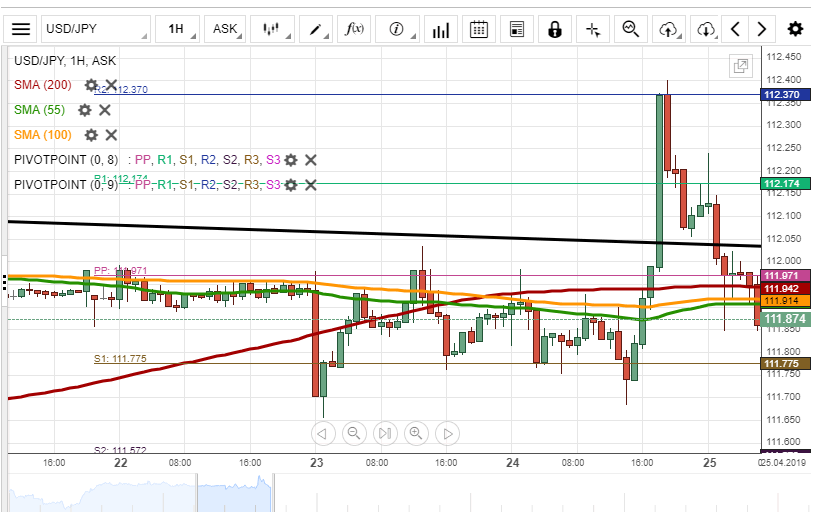
On Wednesday, the USD/JPY currency pair skyrocketed to the weekly R2 at 112.37, and dropped dramatically to the 111.85 level.
Given that the pair is being pressured by the 55-, 100– and 200-hour SMAs, currently located circa 111.90, it is likely, that some downside potential prevails in the market. In this case, the pair has to surpass the weekly S1 at 111.78.
However, if the given resistance does not hold, it is expected, that the exchange rate trades down. A possible upside target is the resistance cluster formed by the weekly and the monthly R1s in the 112.11/112.17 range.
XAU/USD Likely To Trade Sideways
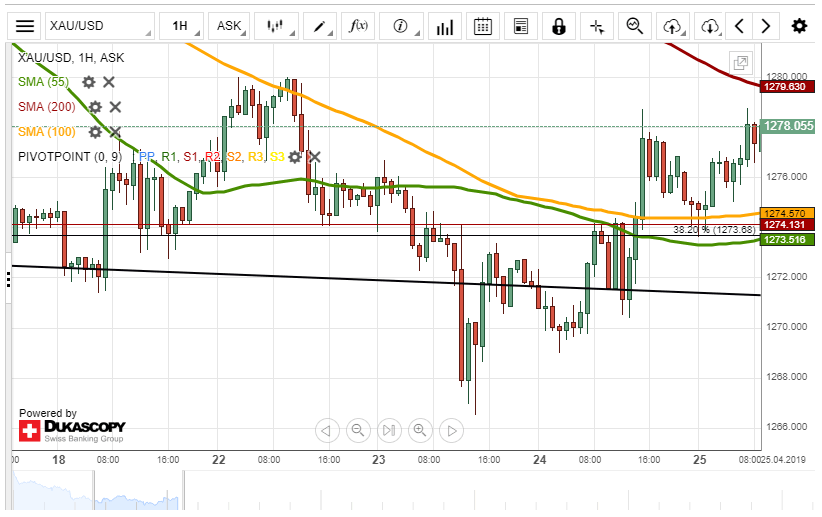
Yesterday, the XAU/USD exchange rate extended gains and reached the psychological level at 1,278.00.
From a technical perspective, it is unlikely, that the price for gold could maintain its growth due to the resistance of the 200-hour SMA at 1,279.71.
Thus, it is likely, that the rate could trade sideways between the given resistance and the support level formed by the 55– and 100-hour SMAs, as well the monthly S1 and the Fibo 38.20% at 1,273.68.
If the given resistance does not hold, the price for gold could reach the psychological level at 1,282.00.
NZD/USD Bearish Formation At W L4 Camarilla Pivot
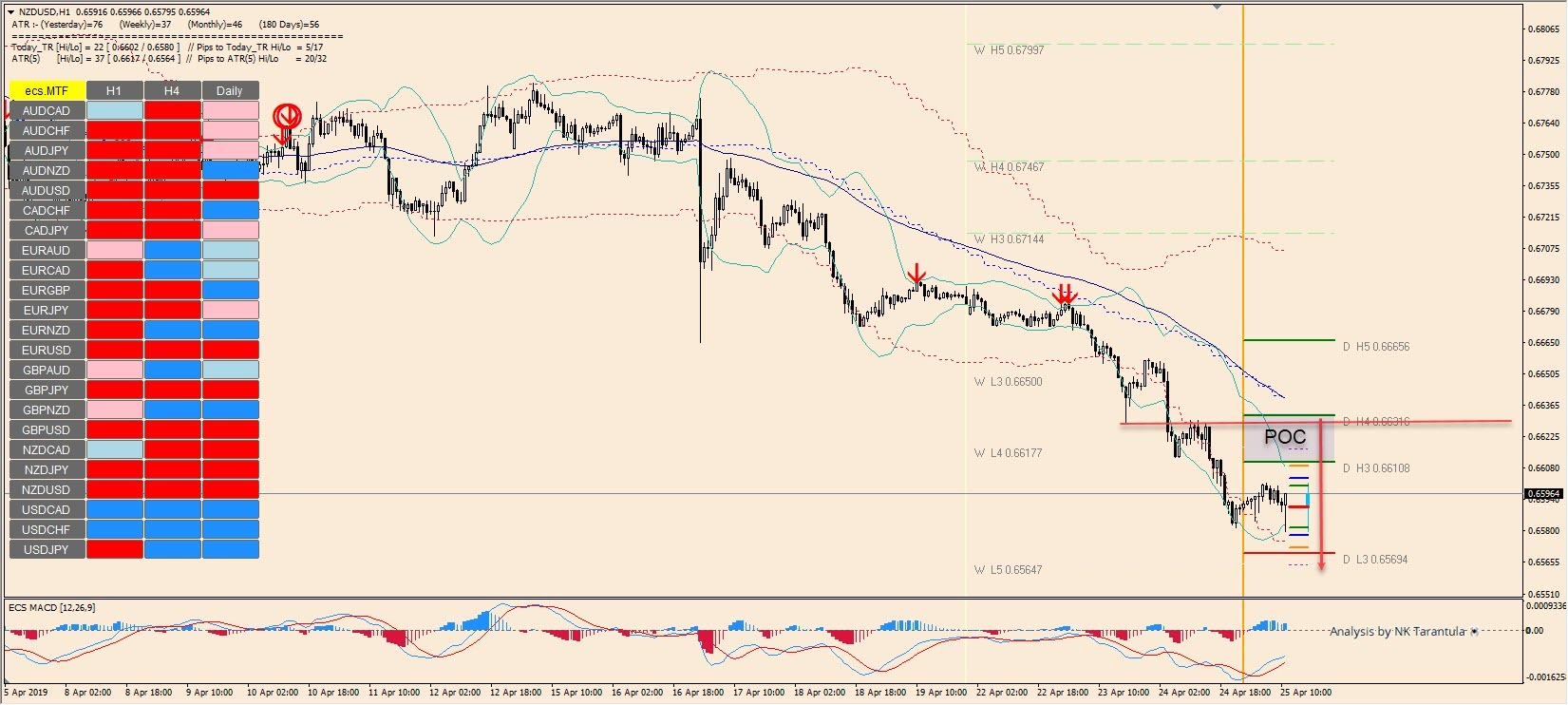
The NZD/USD is showing a strong downtrend where all the entries are shown with a red arrow. The trend is still strong but the price approaches the strongest weekly support – W L5 pivot point-->
We might see a bounce due to a strong W L5 support and ATR projection low. A bounce towards 0.6617-30 is likely, so traders might watch for a reversal patterns in the zone. A rejection from the POC will show up fresh sellers and the price might go again in the southern direction towards 0.6564. A close below will give us the cue that the trend is even stronger then. Only a close above 0.6656 will put the pair into neutral mode.
USDCAD Breaks Triangle To The Upside
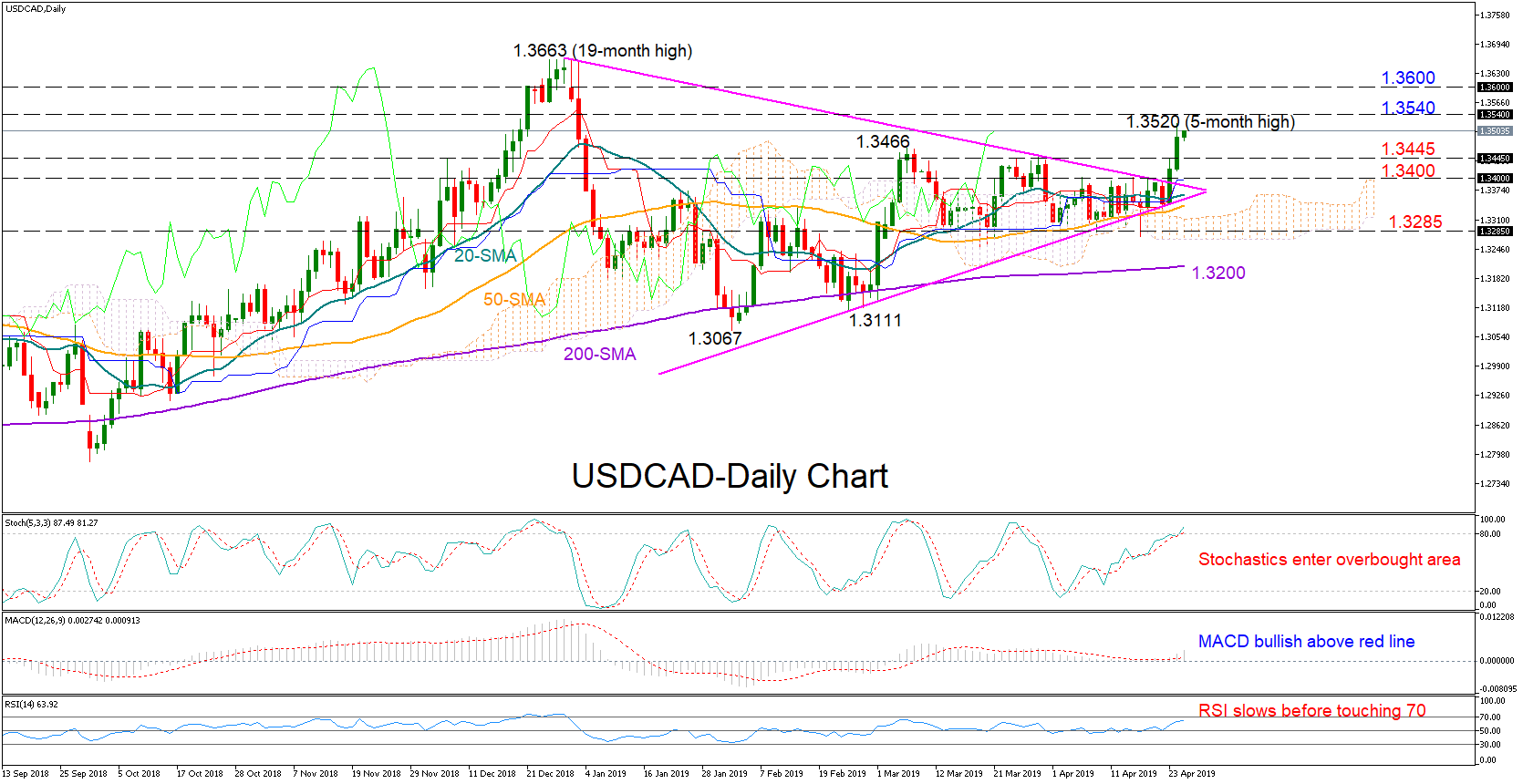
USDCAD has successfully broken the upside border of the symmetrical triangle on Tuesday, letting the bulls to comfortably run as high as 1.3520 on Wednesday – near five-month highs. The market, however, seems to be nearing overbought zone according to the fast Stochastics that are searching for a bearish cross above 80, with the slowing RSI backing this view as well. Still, any weakness could prove short-lived if the MACD keeps strengthening above its red signal line.
The area between 1.3540-1.3600 has been a key resistance during 2016-2017 and any violation may welcome fresh bullish action, with the 1.3663 peak being the next target on the way. Should the pair beat that ceiling, the focus will shift straight to the 2017 highs of 1.3769 and 1.3792.
Otherwise, a failure to return above 1.35 may increase selling orders towards the 1.3445-1.3400 restrictive region, while slightly lower, the 1.3285 mark could be the trigger point for a steeper decline that could lead the price down to the 200-day moving average (1.3200).
In the medium-term timeframe, yesterday’s close above the 1.3466 number shifted the outlook slightly positive in the three-month picture. Traders, however, would likely wait for the price to pierce above 1.3540 to confirm the outlook reversal.
In brief, USDCAD is bullish and close to overbought levels in the short-term picture, while in the medium-term, the view has turned slightly positive from neutral. Yet a confirmation for the latter is still needed.
BOC Remained Dovishly On Hold
The Loonie weakened yesterday, as the BoC remained dovishly on hold at +1.75%. The bank abandoned any rate hike plans for the near future as it “judges that an accommodative policy interest rate continues to be warranted”. On the other hand, BoC sees increasing growth in household spending and growth picking up pace in the second half of 2019. In the following press conference, BoC governor Poloz, said that he expects the slowdown to be temporary and that the setting of rates will give the bank a positive outlook with stronger growth ahead. We expect the decision to continue to weigh on the Loonie for the next couple of days, unless there is a positive surprise in the oil market. USD/CAD rose yesterday as the Loonie weakened, testing the 1.3510 (R1) and later correcting lower. We could see the pair continue to rise today, as the US financial releases could be providing another boost for the USD side of the pair. Also the pair may prove sensitive to any developments in the oil market. Please note that the pair’s RSI indicator in the 4 hour chart has surpassed the reading of 70, implying a rather overcrowded long position. Should the pair find fresh buying orders along its path, we could see it breaking the 1.3510 (R1) resistance line and aim for the 1.3590 (R2) resistance level. Should on the flip side, the pair come under the selling interest of the market, we could see it breaking the 1.3425 (S1) support line and aim for lower grounds.
EUR weakens on weak German prospects
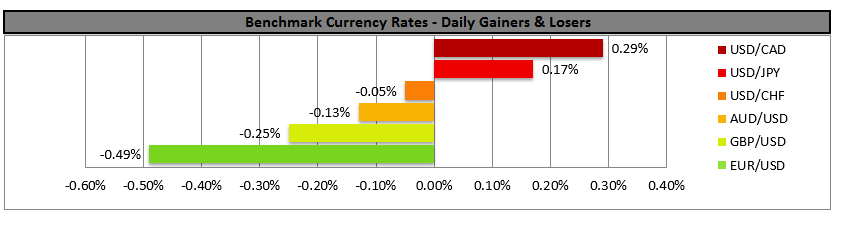
German business climate worsened in April as it was evident by the drop of the Ifo business climate indicator, released yesterday, hence the common currency weakened. Against the USD, the EUR hit a 22 month low suffering the biggest daily loss since early March when the ECB delayed plans for a rate hike near the end of the year. Worries about the prospects of the German economy and their effect regarding a possible slowdown in the Eurozone have increased. On the flip side, analysts point out that the weak economic performance of the euro area and other countries, tends to underscore the dominance of the US economy at least at the current stage. We see the case for the growth in the area picking up pace the second half of 2019, to be dependent on the global trade conditions and especially the trade conditions of various economies (including the Eurozone) with the US. We expect the common currency to remain data depended in the near term and worries about growth in the Eurozone could weigh on its direction. EUR/USD dropped yesterday, breaking the 1.1175 (R1) support line (now turned to resistance). We could see the pair dropping even lower should investor sentiment continue to weigh on the EUR. Please note that the RSI indicator in the 4 hour chart, has dropped below the reading of 30, implying a rather overcrowded short position for the pair. Should the bears continue to dictate the pair’s direction, we could see it breaking the 1.1125 (S1) support line and aim for the 1.1075 (S2) support barrier. Should the bulls take over, we could see it breaking the 1.1175 (R1) resistance line and aim for the 1.1220 (R2) resistance hurdle.
Other economic highlights, today and early tomorrow
Today during the European session we get Riksbank’s interest rate decision, which is expected to remain on hold at -0.25%. Should the bank decide to postpone its rate hike which is planned later this year or expand its QE program, we could see the SEK weakening. Also during the European session, we get from Turkey CBRT’s interest rate decision. In the American session, we get the US durable goods orders growth rates for March. In the early Asian session tomorrow we get New Zealand’s trading data and later on, from Japan, Tokyo’s Core CPI rate for April, the unemployment rate for March, the preliminary industrial output growth rate for March and the retail sales growth rate for March. Be advised that also during tomorrow’s Asian session, we get Australia’s PPI rate for Q1. As for speakers, BoJ’s governor Kuroda will be giving a press conference during the European session today regarding the bank’s decision to remain on hold earlier today, while later ECB’s De Guidos will also be speaking.
EUR/USD H4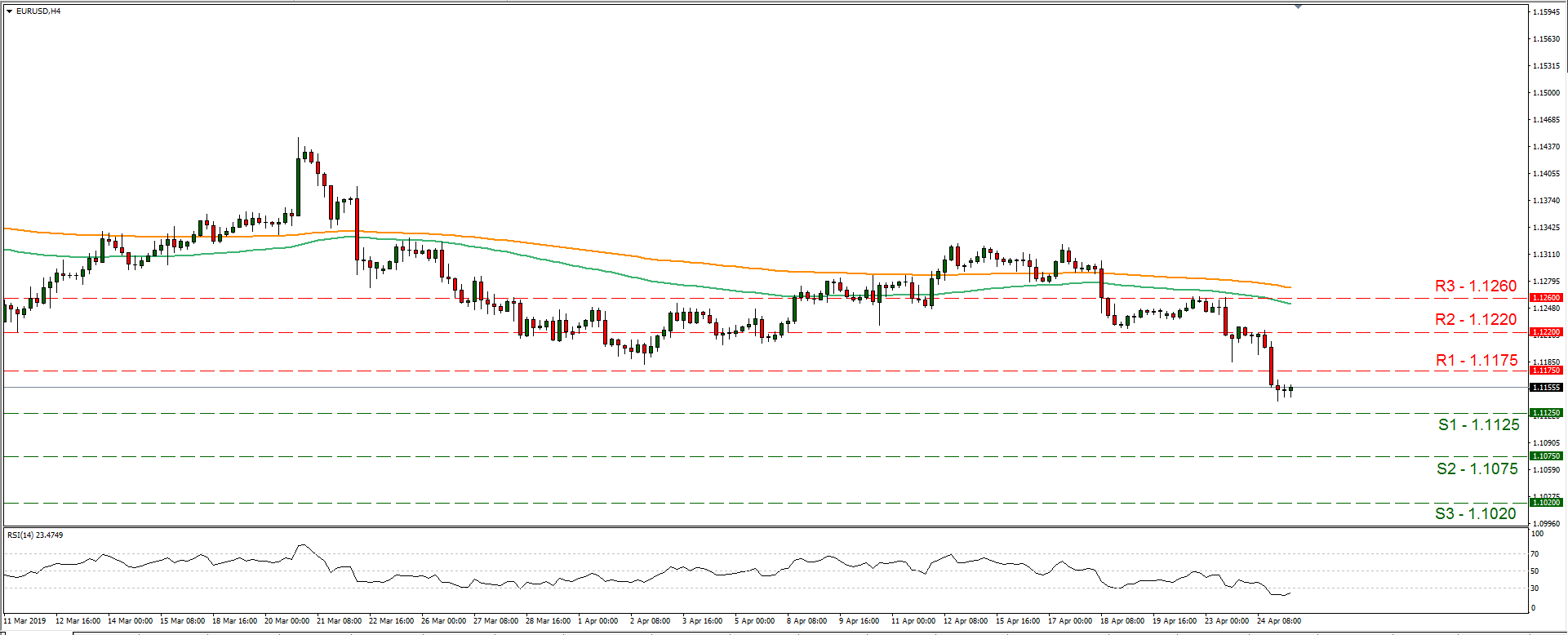
Support: 1.1125 (S1), 1.1075 (S2), 1.1020 (S3)
Resistance: 1.1175 (R1), 1.1220 (R2), 1.1260 (R3)
USD/CAD H4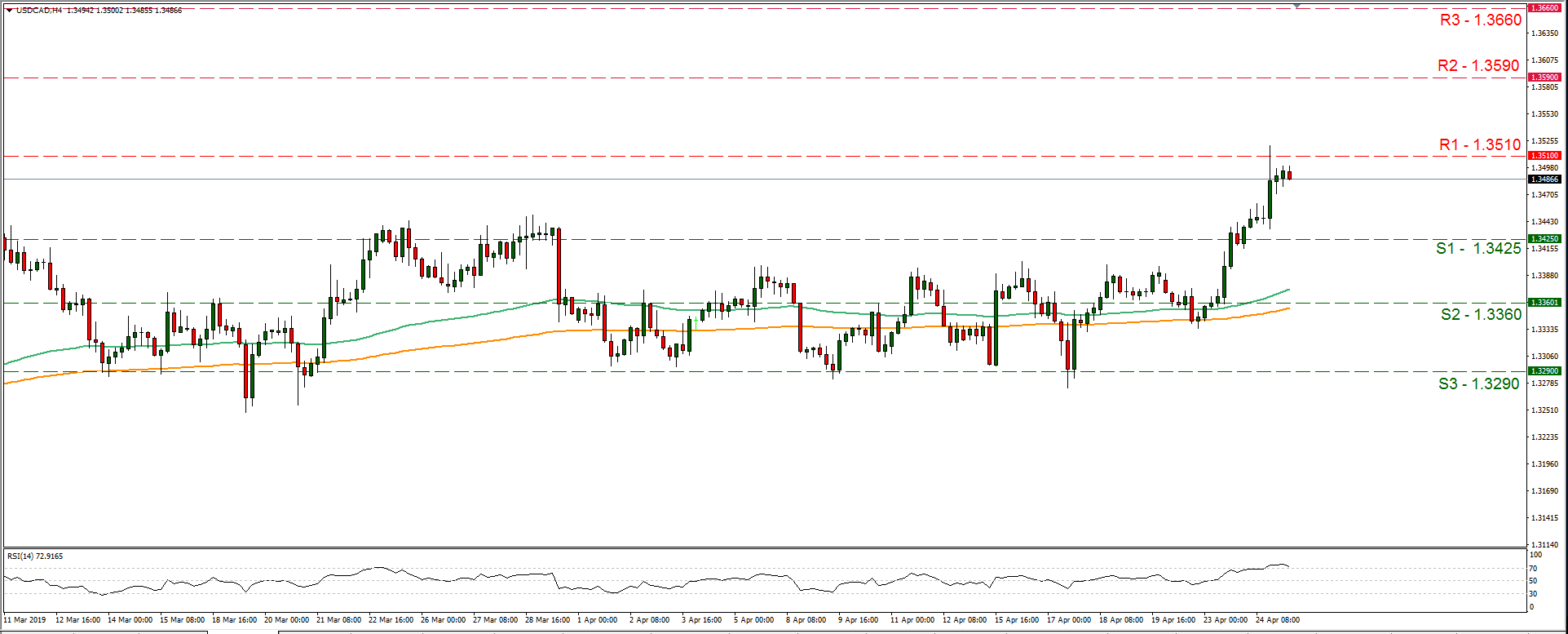
Support: 1.3425 (S1), 1.3360 (S2), 1.3290 (S3)
Resistance: 1.3510 (R1), 1.3590 (R2), 1.3660 (R3)
DAX Gains Ground Despite Soft German Business Confidence
The DAX index has dipped lower on Thursday. Currently, the DAX is at 12,282, down 0.23% on the day. There are no German or eurozone events on the schedule. On Friday, the U.S. releases the initial reading for first-quarter GDP, with an estimate of 2.2%.
Recent German numbers have been lukewarm, as the eurozone’s largest economy is experiencing a slowdown. This has weighed on the euro, but the blue-chip DAX index shows no signs of slowing down. The index has soared in April, with gains of 6.7%. This is on track for the highest monthly gain since December 2016. On Wednesday, German Ifo Business Climate dipped to 99.2, shy of the estimate of 99.6 points. The indicator has softened since 2018, as weaker economic conditions have weighed on business confidence. Nonetheless, the DAX posted strong gains on Wednesday.
The ECB released its economic bulletin on Wednesday, which provided a somber assessment of the eurozone economy. The ECB took note of the global trade war and the downside risk to the eurozone. The report noted that large negative effects could materialise if “trade tensions were to escalate further. Uncertainty related to protectionism is weighing on economic sentiment and it may raise further, potentially eroding confidence and affecting the euro area and the global economy more significantly.”
The global trade war, which has included new tariffs between the EU and the U.S., have damaged the German and eurozone manufacturing sectors. Manufacturing PMIs are mired in negative territory, pointing to a continuing decline in manufacturing.
EUR/USD – Euro Slips To 22-Month Low As German Business Confidence Dips
EUR/USD is unchanged on Thursday, after sustaining considerable losses on Wednesday. Currently, the pair is trading at 1.1152, down 0.02% on the day. On the fundamentals front, there are no German or eurozone events. In the U.S., durable goods orders is expected to rebound with a gain of 0.7%, after a sharp drop of 1.6% in the previous release. Core durable goods is projected to gain 0.2%. As well, unemployment claims is forecast to rise to 199 thousand. On Friday, the U.S. releases the initial reading for first-quarter GDP, with an estimate of 2.2%. We’ll also get a look at UoM consumer sentiment, which is expected to drop to 97.1 points.
The euro was shaken out of its Easter week slumber on Wednesday, with EUR/USD recording a loss of 0.65%, its sharpest decline since early March. The euro has dropped to a level not seen since June 2017. The sharp drop was triggered by a soft German business confidence release. Ifo Business Climate fell to 99.2, shy of the estimate of 99.9 points. Although the indicator remains close to the 100-level, it has softened considerably since 2018. Investors are nervous about the economic outlook in the eurozone, and the euro is vulnerable to key German releases that miss expectations.
The ECB released its economic bulletin on Wednesday, which provided a somber assessment of the eurozone economy. The ECB took note of the global trade war and the downside risk to the eurozone. The report noted that large negative effects could materialise if “trade tensions were to escalate further. Uncertainty related to protectionism is weighing on economic sentiment and it may raise further, potentially eroding confidence and affecting the euro area and the global economy more significantly.”
The U.S-China trade war continues to weigh on global markets, and the EU and the U.S. are also engaged in a tariff war. The German and eurozone manufacturing sectors have been particularly hard hit, and manufacturing PMIs are mired in negative territory, pointing to a continuing decline in manufacturing
SNB Back In The Green
SNB back in the green
After reporting a loss of CHF 14.9 billion for the year 2018, the Swiss National Bank comes back in the green for the first quarter of 2019 as it reports a profit of CHF 30.7 billion. This is no surprise as it has been an excellent quarter for equity investors, while in the FX market the Swiss franc lost ground against most of its peers. The profit on foreign currency positions reached CHF 29.3bn, thanks to favourable stock market conditions, which generated a profit of CHF 17.1bn, and a gain of CHF 6.9bn on interest-baring papers. The Swiss franc’s slight devaluation helped to generate a gain of CHF 1.9bn.
The recovery in capital markets that started immediately after last December sell-off was a breath of fresh air for Thomas Jordan and his team. With the equity market almost back to their pre-sell-off levels and global treasury rates having already retraced gains, the outlook is gloomier. However, many central banks are leaning towards further monetary easing measures, which could translate into a stronger equity market. As long as investors believe that central banks have the situation under control, we believe that equities could climb higher. Nevertheless, we noticed that more and more investors are concerned by the dependency of investment assets on central banks’ liquidity. For example, the BoJ owns more than $250bn worth of Japanese equities, which corresponds to more than 75% of Japan’s ETF market and around 5% of the total equity market. The ECB recently opened the door for similar measures; there is therefore a chance that the ECB walks in the BoJ’s footsteps. If investors are confident this is the right move, there are fine days ahead for European equities. In Switzerland, the SNB is not ready to walk down that road. The Swiss central bank would be more keen to rates further into negative territory.
Mixed JPY as BoJ statement overlooked
Recent monetary policy meeting statement made by the Bank of Japan (BoJ) had a muted reaction on the marketplace. The yen is in positive territory as traders are cutting their positions ahead of Japanese Golden Week in anticipation of any potential flash crash risk while the stock index Nikkei 225 closed the day up 0.48%. Without much surprise, the central bank kept its policy rate unchanged, expressing concerns regarding economic and prices outlook amid current global economic developments. However, the BoJ provides more details on the period during which ultra-loose monetary policy should remain, stating a minimum one-year time period after continuously asserting “for the intermeeting period” in prior declarations.
Yet despite the fact that the central bank is expected to maintain the pace of current JGB purchases at JPY 80 trillion ($715 billion), leave 10-year JGB yield flexible along 0% and implement further mechanisms including a lending exchange-traded funds of JPY 6 trillion ($53.65 billion) or an easing of collateral lending conditions, it becomes clear that the BoJ is coming to the end of its sleight of hand after all. The publication of the BoJ quarterly outlook report also confirms that the 2% inflation target won’t be reachable before 3 years and that inflation should reach 1.10% this year. There is therefore little upside potential for the JPY to expect, except in a broader risk-off event.
Currently trading at 111.86, USD/JPY is expected to rebound, heading along 112 short-term.
GBP/USD Outlook: Strong Dollar Keeps Sterling Under Increased Pressure
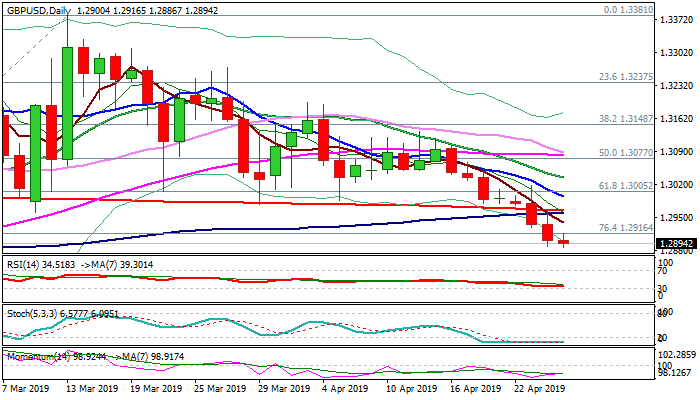
Bears pressure new ten-week low at 1.2886 in early Thursday's trading, as fresh bearish signal, in addition to Tue's break of key 200SMA, was generated on Wednesday's close below Fibo support at 1.2916 (76.4% of 1.2772/1.3381). There are no significant obstacles on the way towards key support at 1.2772 (14 Feb trough), but bears may take a breather on technical corrections, before continuing. Broken Fibo support at 1.2916 now reverted to initial resistance, with stronger upticks expected to remain below broken converged 200/100SMA's (1.2960/63). Politics are also one of pound's key drivers, as lawmakers from Conservative Party are frustrated by PM May's handling Brexit process and work on forcing her from the position of Prime Minister.
Res: 1.2916, 1.2940, 1.2963, 1.2993
Sup: 1.2886, 1.2832, 1.2800, 1.2772
China Buys Gold While Retail Investors Buy Equities
The precious metal, gold touched its lowest level for 2019 yesterday. The price touched the low of $1,266 by extending its losses for the year. The primary reason for this is the strong rally in the global equity markets. The S&P 500 and the Nasdaq index climbed to the record level on Tuesday. Both indices are up 16% and 22% YTD respectively while the yellow metal is down nearly 0.36 percent YTD. Remember the precious metal formed a high of $1346 in February this year and ever since the price has been in a downtrend with lower highs and lower lows.
Gold acts as a safe haven when there is uncertainty in the markets. Today, we do not have enough of that in the markets. The reason is the People Bank Of China is determined to remain accommodative at any cost. The fact is that it is not only the PBOC, but the Fed has adopted a dovish tone.
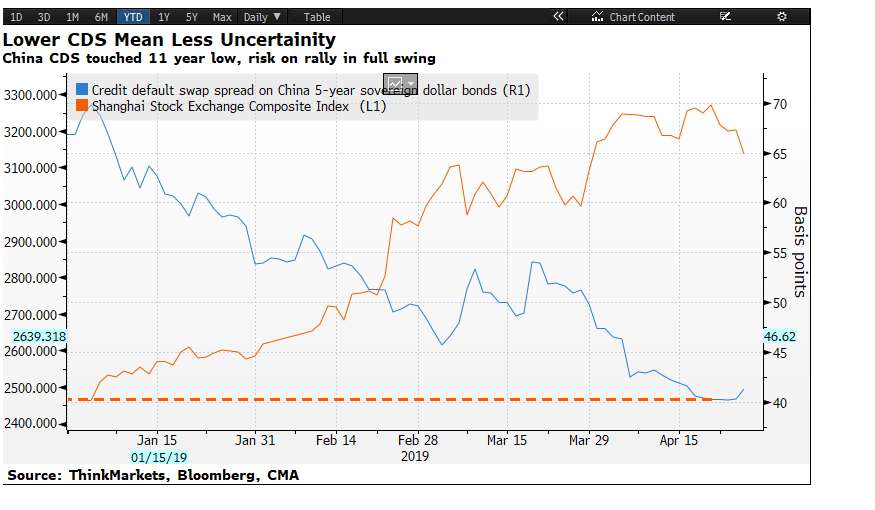
Nonetheless, China is a major factor here. The bank has assured investors it is not going to deviate from its current sailing path in relation to its monetary policy. Hence, the cost to insure the country's 5-year government bond against default has touched the lowest level in nearly 11 years. This has made a major impact on the sentiment, a positive one.
The below chart shows credit default swaps (CDS) spread on China 5-year sovereign dollar bonds has taken a serious dive. This has pushed investors away from a safe-haven. As a result, the Shanghai index has seen some strong upward move. This trend has been very strong over some time, especially since the start of this year. The index is up 25 percent YTD. This explains why retail investors aren’t buying gold.
Having said this, the picture looks very different when we are talking about governments and their purchase of bullion. China continued its purchase of gold for the fourth straight month. The PBOC reserves sit at 60.62 million ounces in March.
One significant take away from this is that China paused its purchase of gold for nearly 6 years from April 2009 and we saw a similar from October 2016 until December 2018. Remember Beijing has always been shy in revealing its gold holding.
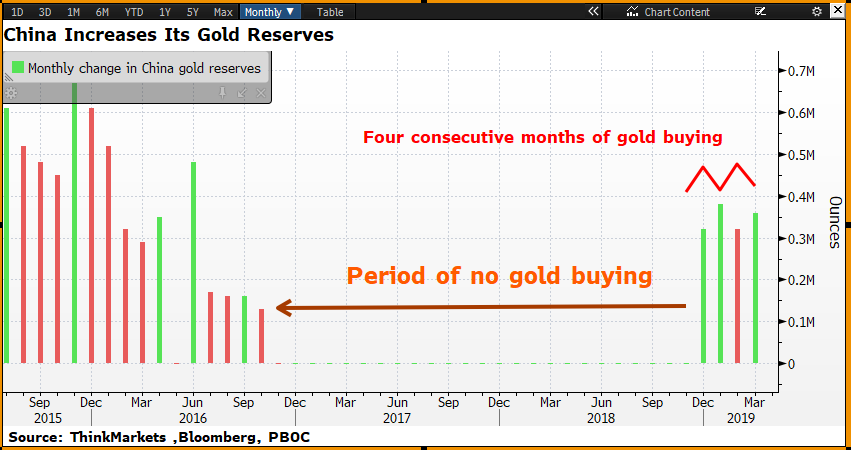
To conclude, I think it is an interesting and alarming factor that investors are not thinking of insuring their portfolio while Beijing is bolstering its gold reserves. The PBOC has pushed the credit default curve lower and yet it is buying protection for itself. Caution should be taken here.