

Sample Category Title
EUR/USD Mid-Day Outlook
Daily Pivots: (S1) 1.1119; (P) 1.1174; (R1) 1.1206; More.....
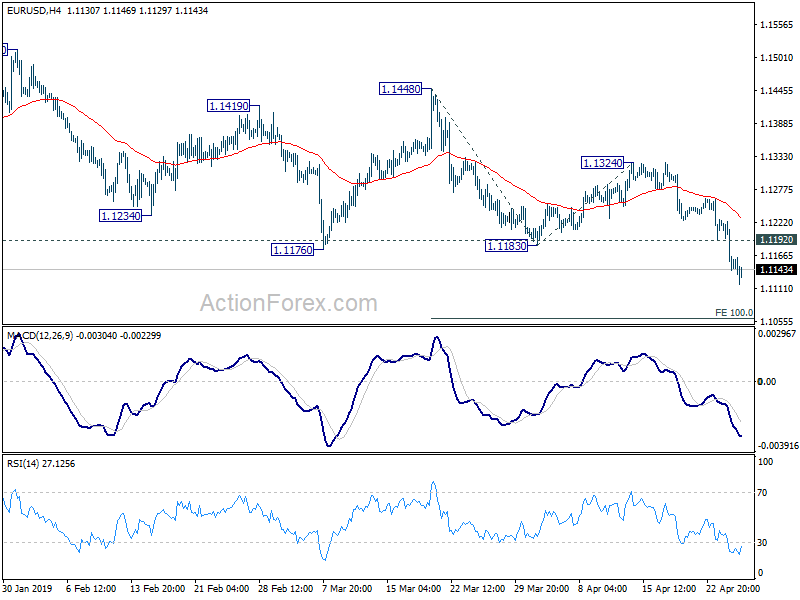
Intraday bias in EUR/USD remains on the downside at this point. Down trend from 1.2555 has just resumed. Further fall should be seen to 100% projection of 1.1448 to 1.1183 from 1.1324 at 1.1059. Break will target 161.8% projection at 1.0895. On the upside, above 1.1192 minor resistance will turn bias neutral and bring consolidations first. But recovery should be limited well below 1.1324 resistance to bring fall resumption.
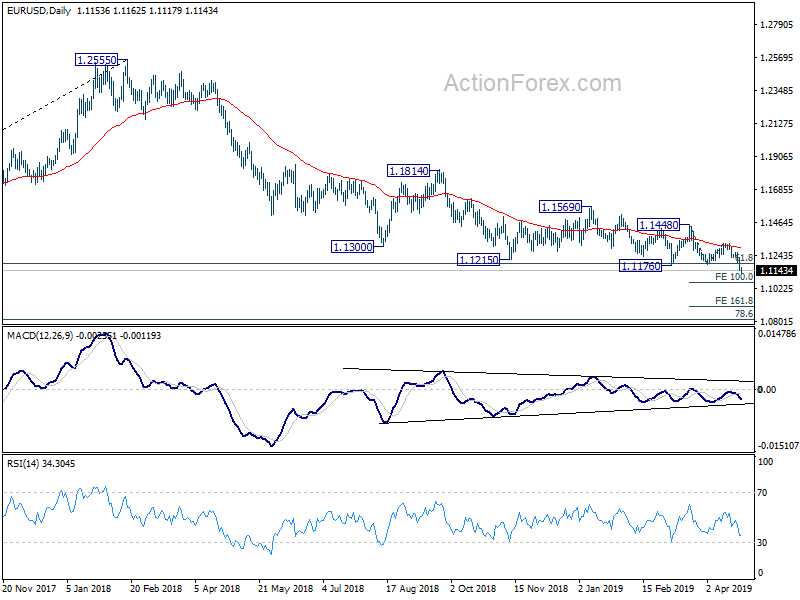
In the bigger picture, down trend from 1.2555 is now resuming with break of 61.8% retracement of 1.0339 (2016 low) to 1.2555 (2018 high) at 1.1186. Medium term also remains with EUR/USD staying well below falling 55 week EMA. Next downside target will be 78.6% retracement at 1.0813. Sustained break there will pave the way to retest 1.0339. On the downside, break of 1.1448 resistance is needed to be the first sign of medium term bottoming. Otherwise, outlook will stay bearish in case of rebound.
GBP/USD Mid-Day Outlook
Daily Pivots: (S1) 1.2873; (P) 1.2918; (R1) 1.2947; More....
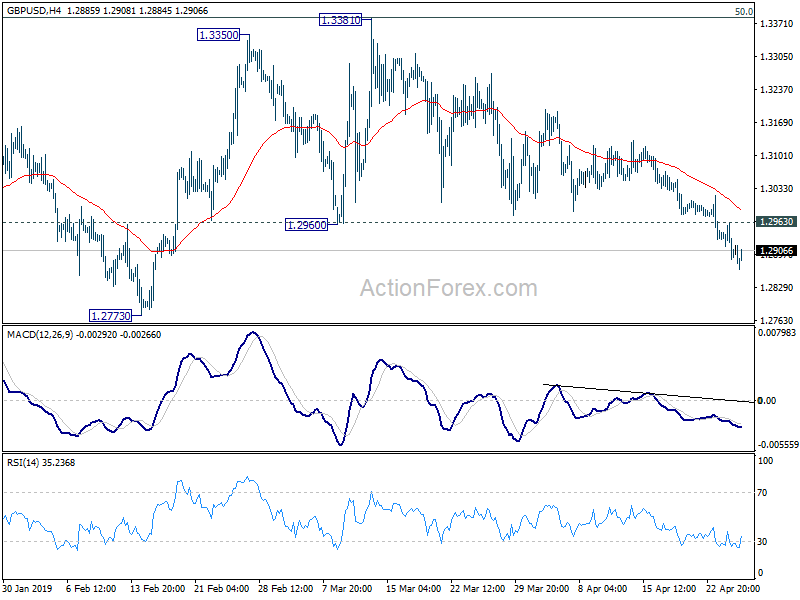
Intraday bias in GBP/USD remains on the downside for 1.2773 support. Decisive break there will confirm that corrective rebound from 1.2391 has completed earlier than expected at 1.3381. Further decline should then be seen to 1.2391 low again. On the upside, though, break of 1.3019 minor resistance will dampen this bearish case and turn bias back to the upside for recovery first.
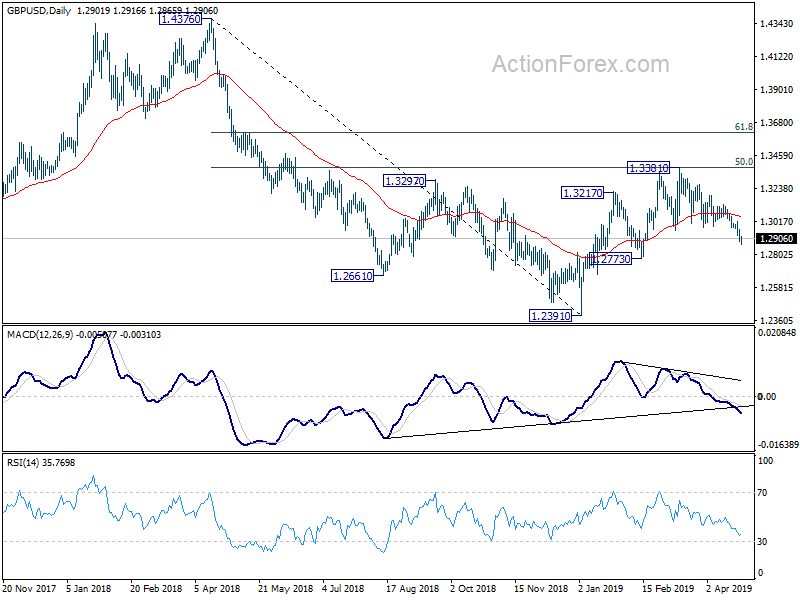
In the bigger picture, medium term decline from 1.4376 (2018 high) halted after hitting 1.2391. Rise from 1.2391 could have completed after just missing 50% retracement of 1.4376 to 1.2391 at 1.338. Such rebound could be a correction to fall from 1.4376 only. Break of 1.2773 support will affirm this bearish case and target 1.2391. Break of 1.2391 will resume the fall from 1.4376 to 1.1946 (2016 low).
USD/JPY Mid-Day Outlook
Daily Pivots: (S1) 111.78; (P) 112.09; (R1) 112.51; More...
Intraday bias in USD/JPY remains neutral for the moment. On the upside, break of 112.40 temporary top and sustained trading above 112.13 will confirm resumption of whole rise from 104.69, for 114.54 resistance. On the downside, however, firm break of 111.65 minor support will indicate short term topping. Intraday bias will be turned back to the downside for 110.84 support. Break will indicate bearish reversal for 109.71 support and below.
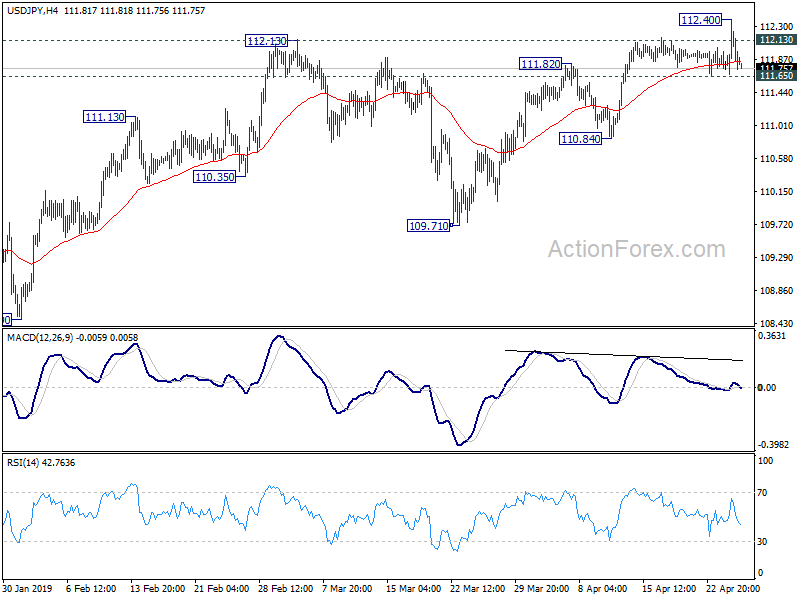
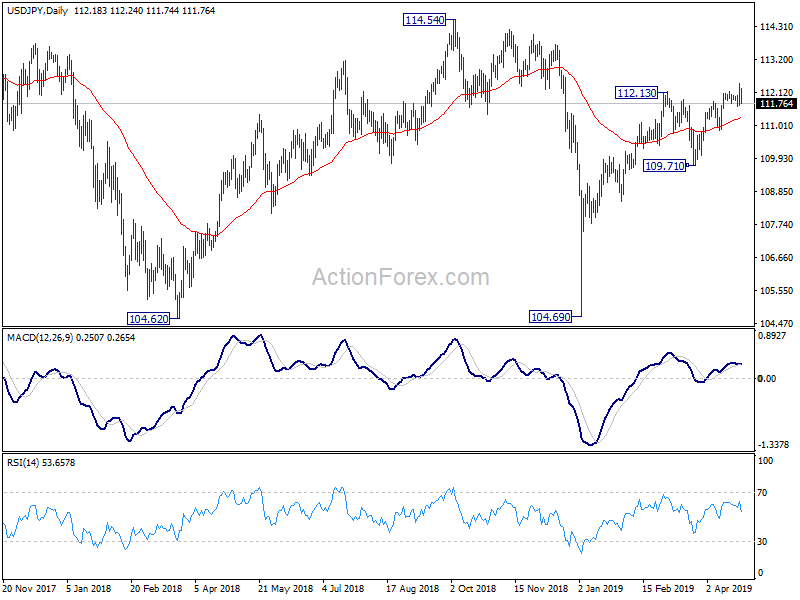
In the bigger picture, medium term outlook in USD/JPY remains a bit mixed as it's staying inside falling channel from 118.65, but there are signs of bullish reversal. On the upside, break of 114.54 resistance will revive the case the corrective fall from 118.65 has completed with three waves down to 104.69. And whole rise from 98.97 (2016 low) is resuming for 118.65 and above. But before that, outlook stays neutral first.
Strong Durable Goods Fail to Boost Dollar, Yen Taking the Driving Seat
Yen takes the driving seat from Dollar today as markets could be turning into risk averse mode. The greenback is still firm and remains the second strongest for the week. But strong US durable goods orders is not giving it enough boost to extend this week's rally. On the other hand, Yen is picking up momentum as European stocks turn south, after notably decline in China.
As for today, Yen is the strongest one, followed by New Zealand and than Canadian Dollar. Euro is the worst performing one, followed by Australian and then Sterling. For the week, Yen is the strongest, followed by Dollar and then Swiss Franc. Aussie is the weakest, then Kiwi and Euro.
Technically, 111.69 minor support in USD/JPY will now be an important level to watch. Break there will at least indicate short term topping in the pair after failing to sustain above 112.13 resistance. That could be triggered by pull back in US stocks, given that both S&P 500 and NASDAQ are close to record highs. Though, even if that happens, Dollar will likely follow closely as a firm one, at least against Euro, Sterling, Canadian and Aussie.
In Europe, currently, FTSE is down -0.66%. DAX is down -0.18%. CAC is down -0.40%. German 10-year yield is up 0.0007 at -0.009, still negative. Earlier in Asia, Nikkei rose 0.48%. Hong Kong HSI dropped -0.86%. China Shanghai SSE dropped -2.43%. Singapore Strait Times dropped -0.36%. Japan 10-year JGB yield rose 0.0069 to -0.029.
US initial claims rose to 23k, down trend broken
US initial jobless claims rose 37k to 230k in the weekending April 20, well above expectation of 199k. Four-week moving average of initial claims rose 4.5k to 206k. More importantly, it appears the down trend since January is broken.
Continuing claims rose 1k to 1.655m in the week ending April 13. Four-week moving average of continuing claims dropped -25k to 1.688m.
US durable goods order jumped 2.7%, ex-transport orders rose 0.4%
US headline durable goods orders rose 2.7% to USD 258.5B in March, much stronger than expectation of 0.7%. Ex-trans orders rose 0.4%, also better than expectation of 0.2% . Ex-defense orders rose 2.3%. Transportation equipment rose 7.0% to USD 93.8B.
UK May requested to lay out timetable to leave if no Brexit deal is approved
In UK, it's reported that Conservative backbench 1922 Committee rejected a proposal for chance in party rules to allow an early vote of no confidence in Prime Minister Theresa May. However, Committee chairman Graham Brady also requested May to set out a timetable for her departure in the event of a Brexit deal not being passed. This is on top of May's promise that she would go after the Brexit deal is passed.
Separately, Cabinet Minister David Lidington, said that the government wants to get the thrice-defeated Brexit deal through the parliament before the new European Union parliament opens in July. But the timing will depend on negotiation with the opposition Labour Party. Meanwhile, Commons Leader Andrea Leadsom announced the business for next week. No items regarding Brexit is included.
UK retail sales grew gain in April, but Brexit uncertainty continues to drag on consumer confidence
UK CBI trends total orders rose to 13 in April, up fro -18 and beat expectation of 0. 49% of retail sales said sales volumes were up in April from a year ago. 36% said they were down, giving a balance of 13%. It's the first time retail sales grew since November 2018.
Rain Newton-Smith, CBI Chief Economist, said: "It's encouraging to see retailers with more of a spring in their step than in recent months. The recent pick up in real wages is a welcome support to the sector, making the pound in people's pockets stretch that bit further. However, this month's sales growth will have been distorted by the later timing of Easter, and falling sales in clothing and department stores underline how challenging underlying conditions remain
Also: "The Brexit extension means an economic crisis has been avoided, for now. However, uncertainty continues to drag on consumer confidence, and many retailers report an impact on their sales. Politicians now owe it to the country – its businesses and people – to come together in a total spirit of compromise, setting aside all party political lines, and agree a way forward to avoid a no deal Brexit."
NIESR expects no BoE hike until August 2020
UK National Institute of Economic and Social Research (NIESR) pushed back their BoE rate expectation by a year in the new forecasts. NIESR economist Garry Young said "now we expect the first increase in Bank Rate to be next August rather than this August."
NIESR also noted that Brexit related uncertainty "has led to investment plans being deferred and increased stockbuilding." Under the main scenario of "soft Brexit", GDP growth will continue at around 1.5% in both 2019 and 2020. Unemployment rate will stay at around 4%. CPI will remain at around 2%.
Regarding different Brexit scenarios, growth will be similar between staying in EU and "soft Brexit". However, growth will be weaker is UK is to stay in the customs union, and even worse in a no-deal Brexit.
BoJ pledges to keep interest rates low at least through Spring 2020
BoJ left monetary policy unchanged today as widely expected. More importantly, the central bank now provides much clearer forward guidance. It's noted that "the Bank intends to maintain the current extremely low levels of short- and long-term interest rates for an extended period of time, at least through around spring 2020". That's based on "uncertainties regarding economic activity and prices including developments in overseas economies and the effects of the scheduled consumption tax hike."
Under the yield curve control framework, short term interest rate is kept at -0.1%. BoJ will continue to purchase JGBs to keep 10-year yield at around 0%, with some flexibility. Annual pace of monetary base expansion is kept at JPY 80T. Y Harada dissented again, proposing to tie forward guidance to price stability target. G Kataoka also dissented too, urging BOJ to commit to take additional easing measures if there is downward revision in medium- to long-term inflation expectations. The vote was by 7-2.
On the economy, BoJ said it's likely to "continue on a moderate expanding trend" despite the impact from overseas slowdown. CPI continued to show "relatively weak developments", comparing to labor market tightening. But it expects CPI to "gradually" increase towards 2% target. Though, there are "high uncertainties regarding the outlook for economic activity and prices including developments in overseas economies".
USD/JPY Mid-Day Outlook
Daily Pivots: (S1) 111.78; (P) 112.09; (R1) 112.51; More...
Intraday bias in USD/JPY remains neutral for the moment. On the upside, break of 112.40 temporary top and sustained trading above 112.13 will confirm resumption of whole rise from 104.69, for 114.54 resistance. On the downside, however, firm break of 111.65 minor support will indicate short term topping. Intraday bias will be turned back to the downside for 110.84 support. Break will indicate bearish reversal for 109.71 support and below.
In the bigger picture, medium term outlook in USD/JPY remains a bit mixed as it's staying inside falling channel from 118.65, but there are signs of bullish reversal. On the upside, break of 114.54 resistance will revive the case the corrective fall from 118.65 has completed with three waves down to 104.69. And whole rise from 98.97 (2016 low) is resuming for 118.65 and above. But before that, outlook stays neutral first.
Economic Indicators Update
| GMT | Ccy | Events | Actual | Forecast | Previous | Revised |
|---|---|---|---|---|---|---|
| 03:30 | JPY | BOJ Rate Decision | -0.10% | -0.10% | -0.10% | |
| 10:00 | GBP | CBI Trends Total Orders Apr | 13 | 0 | -18 | |
| 12:30 | USD | Durable Goods Orders Mar P | 2.70% | 0.70% | -1.60% | -1.10% |
| 12:30 | USD | Durables Ex Transportation Mar P | 0.40% | 0.20% | -0.10% | -0.20% |
| 12:30 | USD | Initial Jobless Claims (APR 20) | 230K | 199K | 192K | 193K |
| 14:30 | USD | Natural Gas Storage | 90B | 92B |
Dollar Extends Rally as Europe Exudes Weakness
- USD – Dollar remains king as Europe remains weak
- Riksbank – Another bank backtracks from tightening
- Turkey – Lira in serious danger
- Stocks – 3M results sink the Dow
- Oil – Russian supply outage drives prices higher
- Gold – Steadies as stocks fail to make fresh highs
USD
Hail to the King dollar. The US economy is not really driving the last part of this greenback rally, it is mainly the rest of the world is still showing weakness. A constant theme coming out of Europe is risks remain to the downside as growth remains weak and we are not seeing many reasons to be optimistic in the short-term.
In Europe, the ECB economic bulletin cemented the view that ample accommodation will remain in place. Europe continues to see slower growth momentum and that does not bode well for the euro.
Early in New York, mixed jobless claims and durable goods data provided no clear catalyst. The dollar held onto gains after the strong 2.7% rise in durable goods, while jobless claims had the biggest rise since 2017.
Riksbank
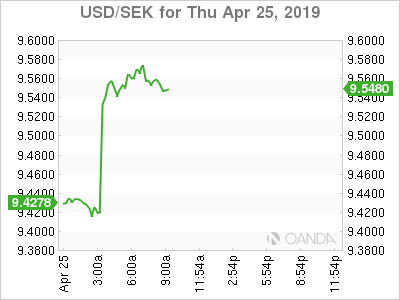
Sweden’s central bank (Riksbank) sent the krona falling after extending their view for the next rate hike. It looks like they will not be raising rates until early 2020 and the bond buying program will now continue till the end of 2020. The krona fell to the lowest level to the dollar since 2002.
Turkey
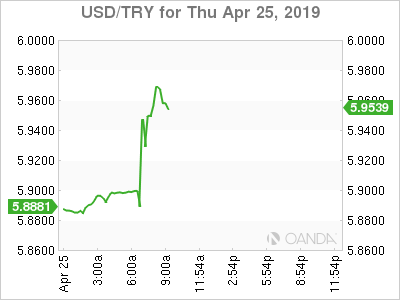
Turkey’s central bank (CBRT) delivered a blow to the lira after they removed the hawkish rate pledge. The slight adjustment to their forward guidance sent the lira down 1.3% to the dollar. This will go down as a dovish pivot, a theme investors are getting all too used too. The lira is down about 6% to the dollar in April and many are questioning the CBRT’s decision to wait for inflation to slow down before cutting rates.
Stocks
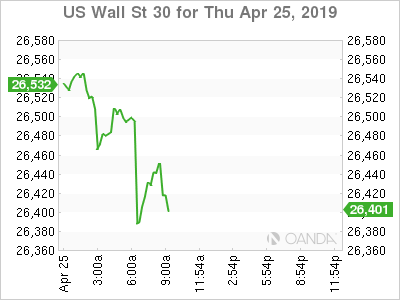
The Dow Jones Industrial Average is expected to open lower following terrible results from 3M. Revenues came in light and the company cut guidance well beyond the lowest analyst estimate. The Minnesota based company also announced they will be cutting 2,000 jobs to cut costs. Shares are down 8%.
Another big earnings report came from healthcare giant, AbbVie. They delivered a clean beat on both the top and bottom line, while raising guidance. The report was not all positive as sales of Humira, which is the best selling drug in the world fell 5.6%, the first year-over-year decline since 2011.
Oil
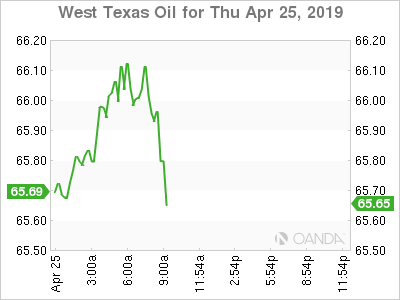
Crude prices resumed the bullish move higher after Russian oil shipments to Europe have been halted due to contamination. Poland has stopped taking on Russian oil for the time being and that has provided a slight bid here for oil prices.
The rally is somewhat small, so we should not be surprised if we do see oil pullback tentatively.
Gold
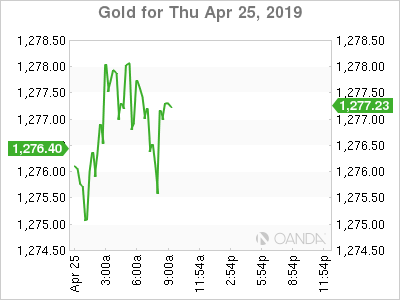
The precious metal refuses to break despite dollar strength. The sour earnings report from 3M and lack of a catalyst for stocks to continue the record run could see gold prices receive a bid here in the short-term.
The longer-term outlook however remains weak for the precious metal as the US economy still remains strong and trade deal optimism could deliver a boost to global growth in the coming months.
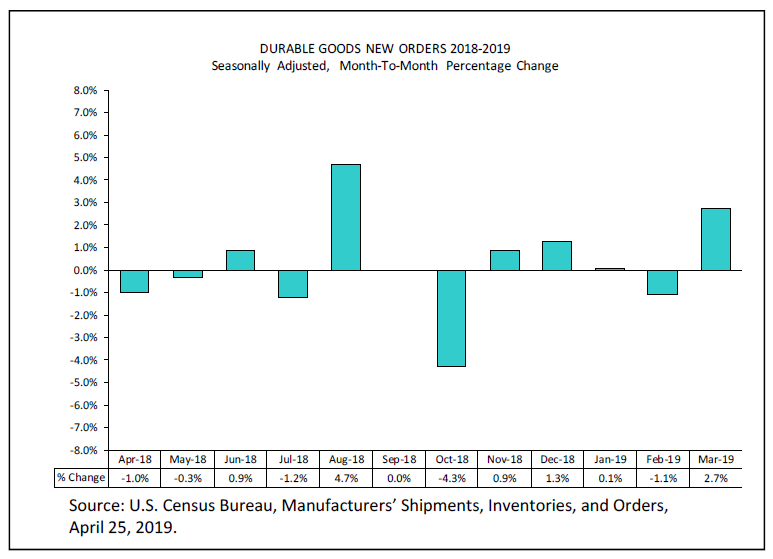
US durable goods order jumped 2.7%, ex-transport orders rose 0.4%
US headline durable goods orders rose 2.7% to USD 258.5B in March, much stronger than expectation of 0.7%. Ex-trans orders rose 0.4%, also better than expectation of 0.2% . Ex-defense orders rose 2.3%. Transportation equipment rose 7.0% to USD 93.8B.
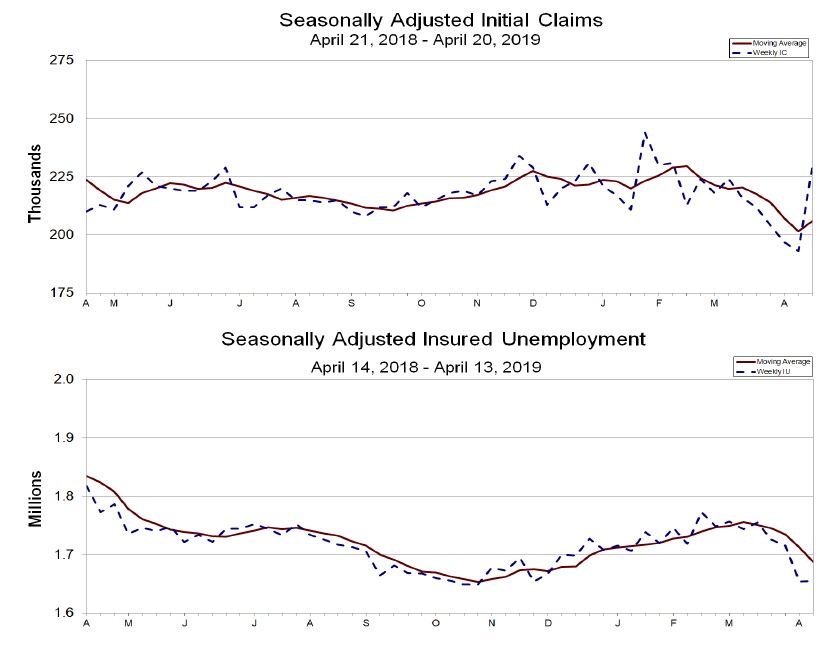
US initial claims rose to 23k, down trend broken
US initial jobless claims rose 37k to 230k in the weekending April 20, well above expectation of 199k. Four-week moving average of initial claims rose 4.5k to 206k. More importantly, it appears the down trend since January is broken.
Continuing claims rose 1k to 1.655m in the week ending April 13. Four-week moving average of continuing claims dropped -25k to 1.688m.
ECB: Eurozone trade regained some momentum but may be short-lived
In the latest monthly bulletin, ECB reiterated that recent data confirms "slower growth momentum extending into the current year". And, "global headwinds continue to weigh on euro area growth developments". Risks remain "tilted to the downside", " on account of the persistence of uncertainties related to geopolitical factors, the threat of protectionism and vulnerabilities in emerging markets." "Ample degree of monetary accommodations remains necessary".
On Eurozone growth, ECB noted that the slowdown in has continued, as incoming data have overall been weaker than expected in the first quarter of 2019. Consumer spending continued to rise, albeit at a lower growth rate than in previous years. However, labour markets remain robust, despite some slowdown. Also, recent short-term labour market indicators continue to point to positive but moderating employment growth in the first quarter of 2019. Private consumption is expected to continue to rise at robust rates.
ECB also noted that and short-term indicators point to a possible further slowdown in business investment. in the first quarter of 2019. Trade regained some momentum at the start of 2019 but according to leading indicators it may be short-lived. Overall, the latest economic indicators suggest a sizeable moderation in the pace of economic expansion. This moderation reflects in part a slowdown in external demand, compounded by some country and sector-specific factors.
Week Ahead – Fed, NFP, Eurozone GDP And BoE To Inject Life Into Subdued FX Markets
After a lacklustre couple of weeks for foreign exchange markets, trading volumes are expected to return to somewhat more normal levels over the next seven days with plenty of risk events on the horizon. But with many European markets shut on Wednesday for Labour Day and Japan closed for the entire week, liquidity might still be in short supply. The US currency and economy will remain at the fore as the Federal Reserve holds a policy meeting and the all-important jobs report is released. The euro and the pound will also be in focus as the initial GDP reading for the first quarter will be available for the Eurozone, while in the UK, the Bank of England will also be meeting to set policy.
Aussie to seek support from Chinese PMIs after bruising week
The Australian dollar looks set to end the week as the worst performing major currency following much weaker-than-expected inflation figures out of Australia. Improving economic indicators from China and the United States have not eased rate cut bets for the Reserve Bank of Australia as stubbornly low inflation could still prompt the central bank to reduce borrowing costs. There could be some support, though, for the aussie next week if the latest manufacturing PMIs from China confirm that the sector is emerging from a rut.
In March, both the official and Caixin/Markit manufacturing PMIs unexpectedly returned to growth, raising hopes that a recovery is underway. However, investors should wait before counting their chickens as the official manufacturing gauge (Tuesday) is predicted to stay unchanged at 50.5 in April, while the Caixin PMI (Thursday) is forecast to edge only marginally higher to 50.9.
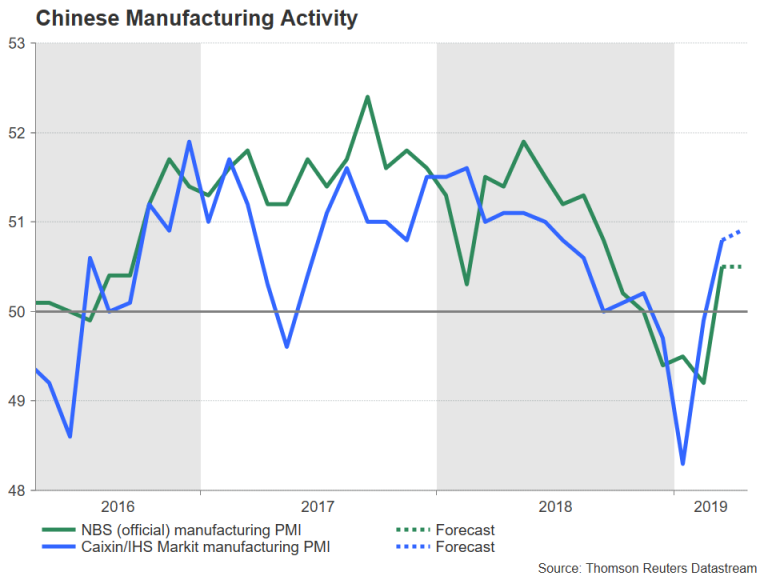
There will also be some domestic data for aussie traders to watch. Private sector lending numbers for March are due on Tuesday and building approvals for the same month will follow on Friday.
Kiwi feeling the heat too
Another underperformer this week has been the New Zealand dollar, which has also been engulfed by rate cut speculation. But unlike for its aussie cousin, the kiwi's declines may be better justified as the Reserve Bank of New Zealand is more likely to cut interest rates than the RBA, which, so far has been more cautious.
Labour market figures due on Wednesday could be key for the RBNZ's next move as the central bank now has a dual mandate to achieve low inflation as well as maximum sustainable employment. First quarter numbers on jobs growth, the unemployment rate and labour costs will be watched closely. The jobless rate had unexpectedly jumped to 4.3% in Q4 2018 so another increase would only fuel rate cut bets.
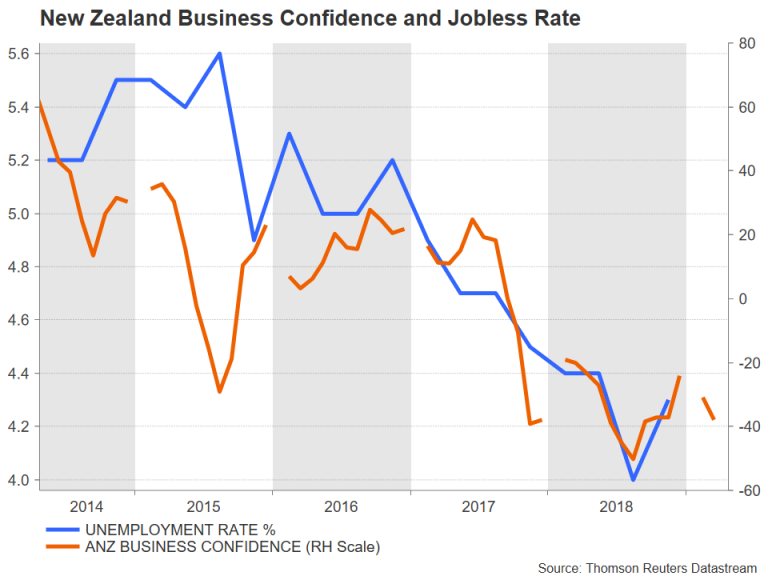
Also significant in New Zealand next week will be the ANZ business outlook survey for April on Tuesday. Weak business sentiment has been a major concern of the RBNZ as it contradicts the actual data, which hasn't been quite as dismal. The bank is worried that persistently low business confidence would eventually drag on economic growth because it tends to hold back corporate investment.
Little upside expected for loonie from monthly growth stats
After this week's Bank of Canada meeting, which saw the bank dropping its tightening bias, attention will turn to Tuesday's monthly GDP estimates. The Canadian dollar tumbled on the BoC's statement and not even a bullish oil market could prevent the loonie from hitting near 4-month lows. There could be more downside for the loonie if GDP growth slows in February from January's surprisingly strong 0.3% month-on-month rate. Slower growth would support the BoC's shift to a neutral stance.
Euro bears eye Eurozone GDP for bigger sell-off
The Eurozone will report its preliminary estimate of GDP growth on Tuesday, but the data is unlikely to follow the same trend as in the US and China where economic pointers have been improving. The euro area economy is projected to have expanded by 0.1% quarter-on-quarter in the first three months of 2019 compared to 0.2% in the prior quarter. A worse figure such as no growth during the period would deepen the pessimism for the Eurozone economy. Ahead of the GDP numbers, a more forward-looking barometer – the economic sentiment indicator – will be monitored on Monday for signs that the downturn began to ease in April.
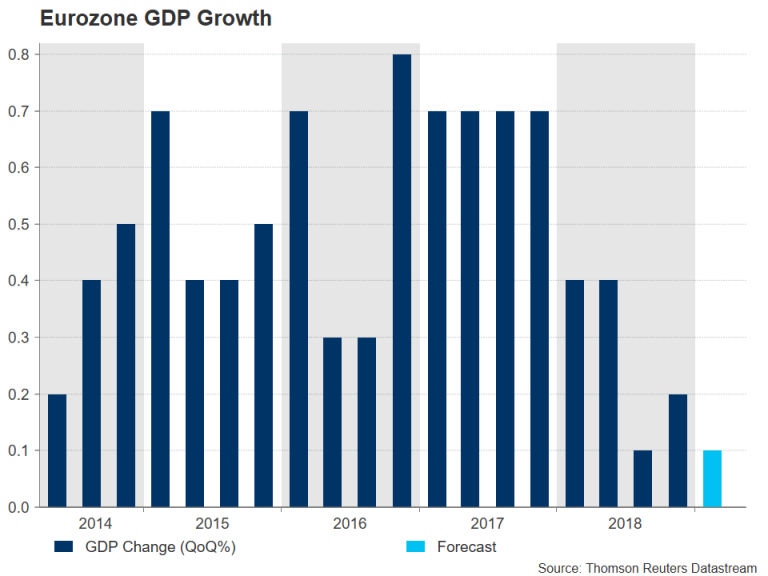
In other data, the flash inflation reading for April will be released on Friday, along with March producer prices. A combination of disappointing GDP and inflation prints would be the worst outcome for the euro, which crumbled below its key support around $1.1180 this week.
Bank of England to hold rates amid Brexit impasse
The ongoing Brexit deadlock has tied the Bank of England's hands and policymakers are almost certain to keep rates unchanged at 0.75% on Thursday when they conclude a two-day policy meeting. However, the May meeting should nonetheless capture some attention as the bank will publish its quarterly inflation report, which includes the latest economic projections. There will also be a press conference by Governor Mark Carney, who is expected to repeat his warnings about the damage to the British economy from the lingering Brexit uncertainty.
The pound is unlikely to see a big reaction to the BoE decision but any dovish tilt either in the bank's outlook or in Carney's remarks could weigh on sterling, which slipped to 10-week lows versus the US dollar this week.
The UK economy has been relatively resilient, despite the Brexit chaos, with the hard data not quite as bad as the more recent gloomy PMI readings. The UK services PMI plunged below 50 in March, pointing to shrinking activity in the economy's largest segment. The construction PMI is also below 50, with only the manufacturing sector expanding in March, though this was on the back of stockpiling by companies on fears of a hard Brexit. The April PMIs for manufacturing, construction and services will be released on Wednesday, Thursday and Friday, respectively.
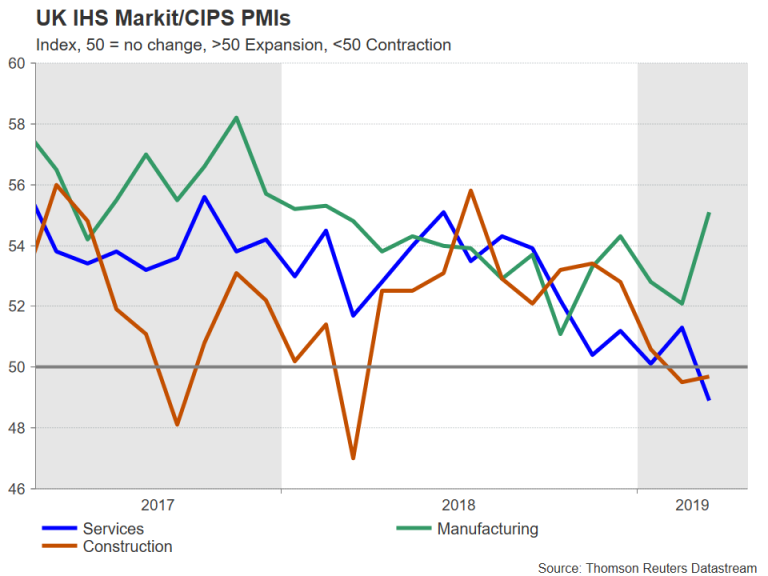
More weak PMI prints would not do the beleaguered pound any favours, but of course, Brexit is still very much the main driver for the British currency. Talks between the government and the opposition Labour party to find a consensus on a way forward with Brexit are reportedly not making much progress and, at the same time, pressure is building on the prime minister, Theresa May, to resign. Hence, the pound will continue to be sensitive to political headlines.
Dollar to remain buoyed by Goldilocks economy, patient Fed
The US dollar has more than recovered from its January lows when the Fed hit the pause button to climb to the highest in 23 months against a basket of currencies this week. The latest indicators from the US suggest the ‘Goldilocks' economy is back, with growth picking up some pace and inflation staying low. The core PCE price index (the Fed's preferred inflation measure) that's due on Monday will likely underscore the muted inflation picture as it's expected to have moderated slightly from 1.8% year-on-year in February to 1.7% in March. Also out on Monday are personal income and spending figures. Both are forecast to have accelerated in March.
On Tuesday, there will be more important releases, including wage growth numbers for the first quarter, the Chicago PMI and the consumer confidence index for April, as well as pending home sales for March. The ISM manufacturing PMI for April will be closely watched on Wednesday following the unexpected rebound in March, but the main highlight will be the FOMC meeting. The Fed is widely anticipated to keep its benchmark rate on hold and will probably stick to recent language in its statement.
Fed chief, Jerome Powell, will no doubt attempt to reiterate the central bank's ‘patient' stance in his press conference even as the US economy regains some momentum. The greenback could come under some selling pressure if Powell appears unfazed by the recent bounce in growth but would likely recoup any losses if next week's data are on the whole solid, particularly Friday's jobs report.
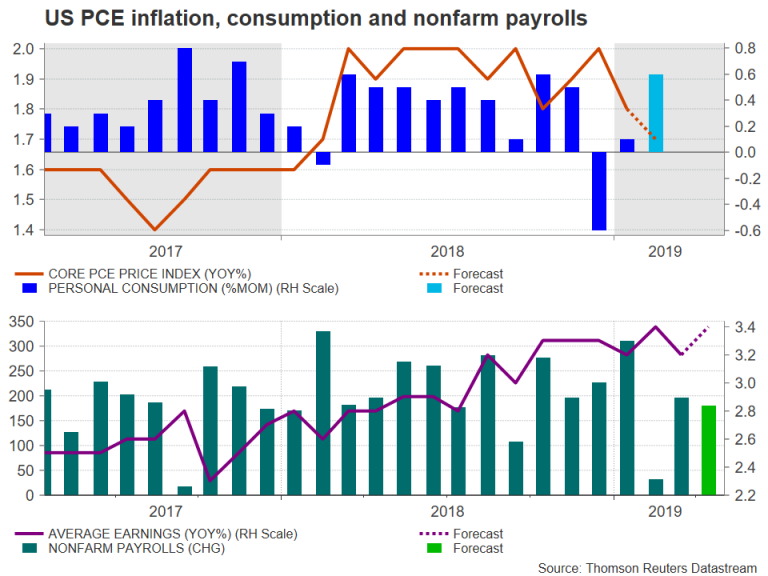
Nonfarm payrolls are forecast to have risen by 180k in April, easing slightly from the prior month. The unemployment rate is expected to have stayed unchanged at 3.8%, while average hourly earnings are forecast to head back up to 3.4% y/y from 3.2% in March.
Factory orders for March and the ISM non-manufacturing PMI for April will round up a data-packed week in the US
Eurozone Flash GDP Growth To Flag A Weak Start To 2019
The buttered euro is expected to come under fresh volatility in the wake of preliminary Q1 GDP growth data out of the Eurozone on Tuesday at 0900 GMT. The consensus is for a very modest growth as lack of progress in political and economic issues have probably kept investors’ interest away from EU markets.
Unlike other regions such as China and the US, the Eurozone seems to have started the year on a disappointing footing in the first quarter, with analysts forecasting only a modest expansion of 0.2% q/q and 1.1% y/y, the same as in Q4 2018. Actually the estimates should not be a big surprise. Given the turmoil around Brexit and recent calls from the Trump administration to unleash fresh tariffs on $11 billion EU products, investors may not feel it is safe to allocate funds in the bloc despite flourishing stock markets.
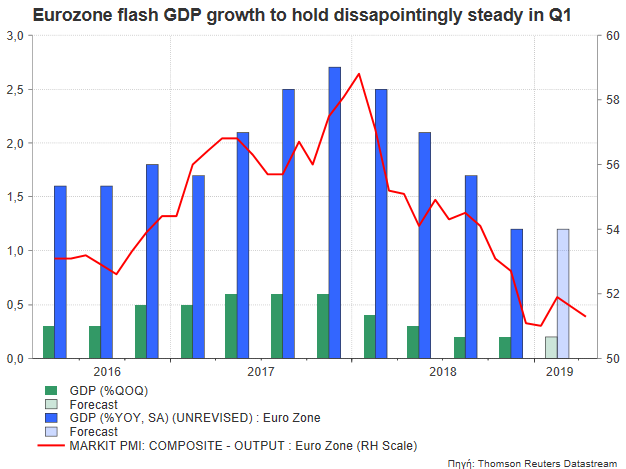
Incoming data especially in the tech-leader and export-led Germany, which barely avoided a technical recession in Q4, is a source of evidence that confidence and therefore economic performance was weak in the first quarter. During the first three months of the year, the German ifo business climate index that measures firms’ projections for the next six months tumbled near three-year lows, while latest readings for the month of April came out discouraging and below expectations, indicating a difficult start to Q2 as well. Manufacturing PMIs were in the worst position as a diminishing car industry and subdued global demand pressured the eurozone gauge far below the 50 level that separates contraction from expansion and towards six-year troughs, with Germany losing the most.
A decent rebound in the services PMI and retail sales readings, however, signaled that consumers are still supporting the economy even if they remain pessimistic about their future spending. Better conditions in the labour market reflected by a falling unemployment rate and a stronger wage growth, have potentially contributed positively to the services sector, leaving the blame for a GDP slowdown to fall entirely to the industrial sector.
On the monetary front, there is not much of a question. The European Central Bank (ECB) has clearly stated at its previous meeting early in April that interest rates will remain steady at current levels at least through the end of 2019 and for as long as necessary to ensure inflation’s convergence towards “the slightly below” 2.0% target. Policymakers have also decided to aid bank lending through a new series of quarterly targeted longer-term refinancing operations (TLTRO-III), starting in September 2019 and ending in March 2021, each with a maturity of two years. They also promised to continue reinvesting the principal payments from maturing securities purchased under the asset purchase program for an extended period of time past the date they start raising interest rates and beyond if needed.
While monetary strategy is not expected to change on May 8th as policymakers seem to have utilized most of their instruments and Draghi’s term as the ECB governor is approaching an end in October, a further slowdown in GDP growth, and particularly below the freshly downgraded 1.1% forecast for 2019 set by policymakers in April, would probably give rise to thoughts for some adjustments. April’s flash core CPI figure for release on Friday would be also reviewed by the central bank.
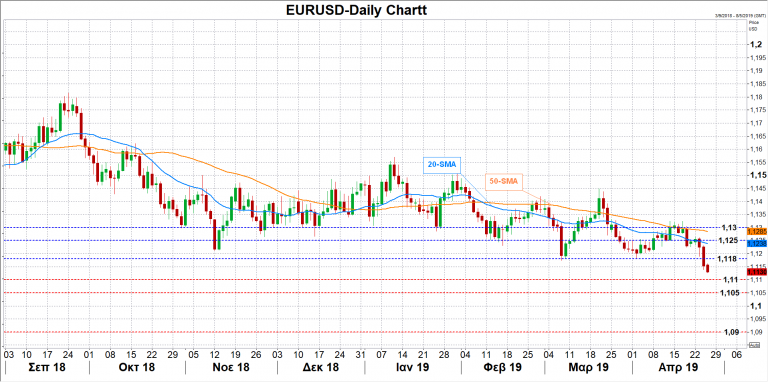
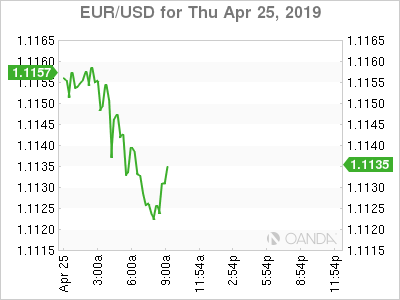
Turning to the possible market reaction, the melting euro could experience further selling if the eurozone economy performs worse than expected, with EURUSD probably diving towards the 1.11 psychological level. A bigger disappointment may open the door for the 1.1050-1.090 area.
Alternatively, the pair could rebound above the 1.1180 key support area in case the data beat analysts’ expectations. Resistance may then emerge between 1.1250 and 1.1300. It is also worth noting that the market is nearing oversold levels.