

Sample Category Title
EURUSD Still Dropping
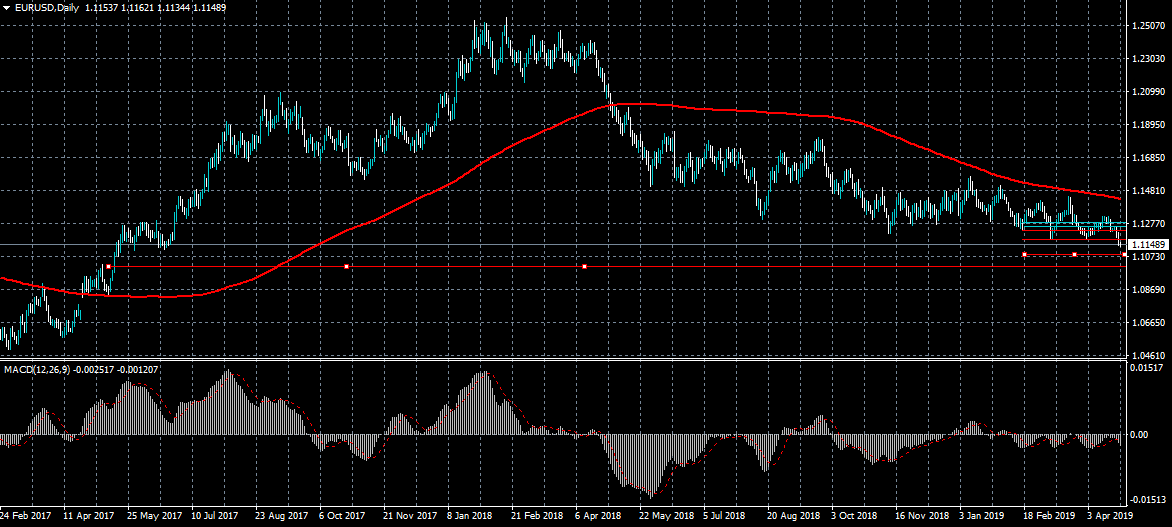
The euro currency has continued to move lower against the US dollar during the European trading session as pair edges closer to the 1.1100 support level. The daily time frame chart is showing that the EURUSD pair has limited support until the 1.1010 level is the 1.1100 level is breached. Technical indicators across the daily time frame continue to signal further losses for the EURUSD.
The EURUSD pair is heavily bearish while trading below the 1.1135 level, key technical support is found at the 1.1100 and 1.1010 levels.
If the EURUSD pair trades above 1.1135 level, key intraday resistance is found at the 1.1155 and 1.1175 levels.
USDJPY Struggling Above 112.00
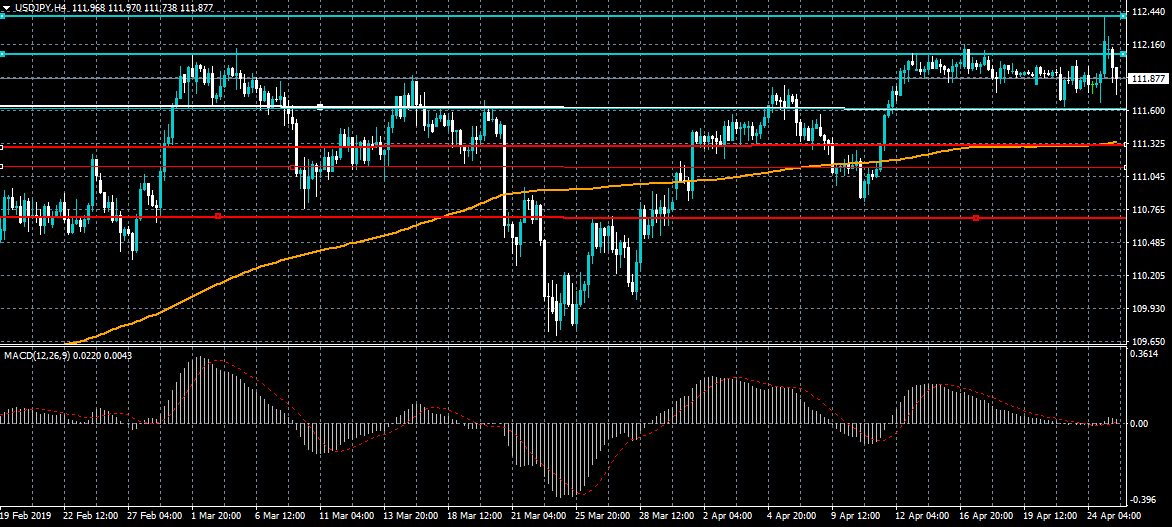
The US dollar has failed to hold onto earlier gains against the Japanese yen after the pair briefly spiked above the 112.00 level following the Bank of Japan rate decision. The 111.60 level is the key intraday pivot, with the USDJPY pair still holding a bullish bias. If the USDJPY pair does fall below the 111.60 level, the 111.30 level offers strong technical support.
The USDJPY pair is intraday bullish while trading above the 111.60, key intraday resistance is found at the 112.00 and 113.40 levels.
If the USDJPY pair trades below the 111.60 level, key intraday support is found at the 111.30 and 111.10 levels.
UK retail sales grew gain in April, but Brexit uncertainty continues to drag on consumer confidence
UK CBI trends total orders rose to 13 in April, up fro -18 and beat expectation of 0. 49% of retail sales said sales volumes were up in April from a year ago. 36% said they were down, giving a balance of 13%. It's the first time retail sales grew since November 2018.
Rain Newton-Smith, CBI Chief Economist, said: "It's encouraging to see retailers with more of a spring in their step than in recent months. The recent pick up in real wages is a welcome support to the sector, making the pound in people's pockets stretch that bit further. However, this month's sales growth will have been distorted by the later timing of Easter, and falling sales in clothing and department stores underline how challenging underlying conditions remain
Also: "The Brexit extension means an economic crisis has been avoided, for now. However, uncertainty continues to drag on consumer confidence, and many retailers report an impact on their sales. Politicians now owe it to the country – its businesses and people – to come together in a total spirit of compromise, setting aside all party political lines, and agree a way forward to avoid a no deal Brexit."
UK May requested to lay out timetable to leave if no Brexit deal is approved
In UK, it's reported that Conservative backbench 1922 Committee rejected a proposal for chance in party rules to allow an early vote of no confidence in Prime Minister Theresa May. However, Committee chairman Graham Brady also requested May to set out a timetable for her departure in the event of a Brexit deal not being passed. This is on top of May's promise that she would go after the Brexit deal is passed.
Separately, Cabinet Minister David Lidington, said that the government wants to get the thrice-defeated Brexit deal through the parliament before the new European Union parliament opens in July. But the timing will depend on negotiation with the opposition Labour Party. Meanwhile, Commons Leader Andrea Leadsom announced the business for next week. No items regarding Brexit is included.
European Update – Markets Unmoved By Earnings
It's been an interesting morning in financial markets, not that you'd guess that based on the mixed trade being seen across Asia and Europe.
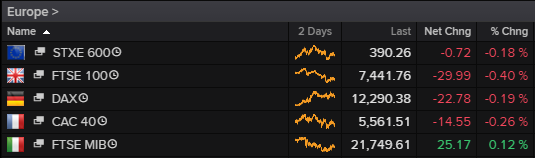
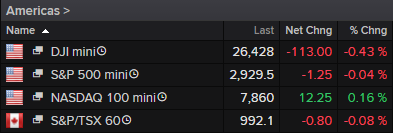
US futures are pointing to a similar start on Wall Street as well, which you'd typically associate with light newsflow but what we're currently seeing is anything but. We're getting earnings reports from a large number of major firms and the report card for the US has so far been far better than expected. Another 62 S&P 500 companies will report including Amazon, Intel and Ford so we're not going to be short of things to talk about.
Failed M&A deals is another common theme today, with the Sainsburys/ASDA merger being blocked by the CMA and talks between Deutsche Bank and Commerzbank being abandoned.
FX Market Dynamics Foreshadows The Possible Troubles
Stock indices struggle to stay on highs, while the forex market gives a sign to the possible downward reversal.
Stocks
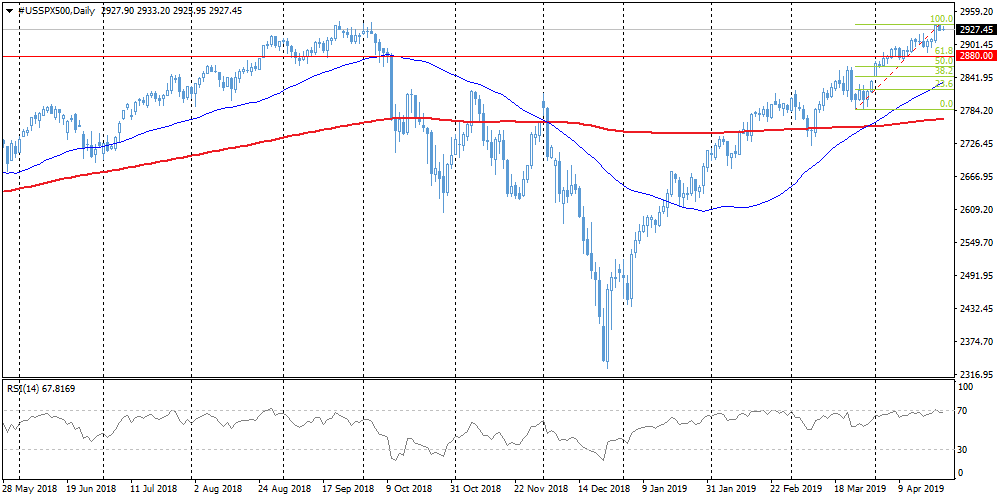
Key US indices, S&P500 and Nasdaq, are declining within 0.2% after touching the historical highs area. Strong corporate earnings in the first quarter had previously supported the growth of the stocks, but now the attention of market participants could switch to future prospects. The slowdown in China and Europe, as well as the American economy inhibition, can increase the market alertness. From the technical analysis, it is worth noting that the relative strength index has returned from the overbought area, which increases the risk of a corrective pullback in the coming days with possible targets at 2880 on SPX.
EURUSD
The single currency declined by 0.8% at some point during Wednesday. Since November, EURUSD received support on downturns to 1.1200, yesterday the pair could not get it, and breaking through an important level of support strengthened the EUR sale. Within the downtrend, the impulse to decline can strengthen in the area of 1.1100. Among the important news that could affect the current impulse of strengthening the dollar, traders should pay attention to the U.S. durable goods orders release.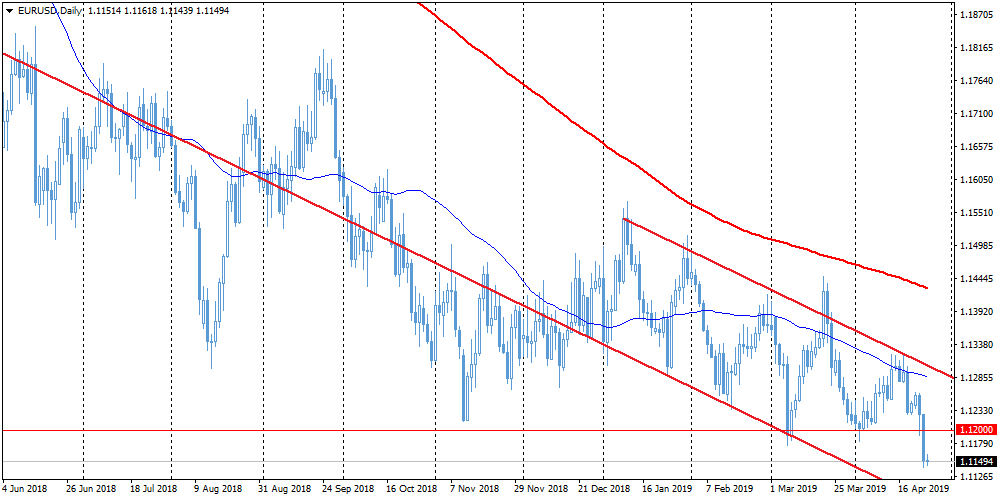
GBPUSD
The British pound declines against the dollar for seven of the last eight trading sessions. The decline under MA (200) increased the pressure on GBPUSD, sending it to two-month lows at 1.2880. The cautious tone of world markets contributes to pressure on the British currency. Among major support levels traders should pay attention to the levels near 1.2800, where the pair received support in February.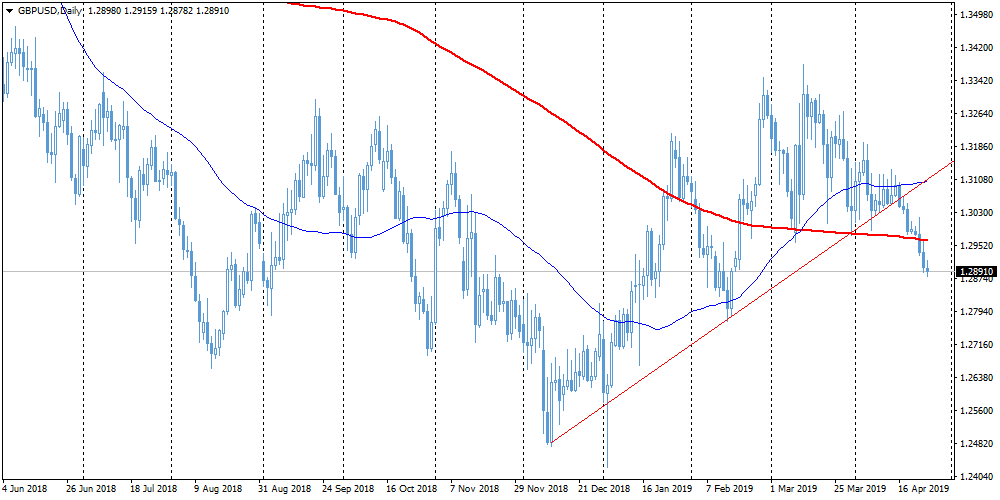
AUDUSD
Bad luck pursued the Aussie. The Australian dollar failed to grow above MA (200) at 0.7200, declined below the uptrend support level at 0.7150 and under MA (50) at 0.7100 at the beginning of the week. Moreover, yesterday AUDUSD fell under serious pressure on disappointment due to an unexpectedly sharp slowdown in inflation. As a result, AUDUSD is testing the level of 0.7000 - an important milestone below which the pair tumbled over the past 15 years only during periods of rapid cooling of global growth.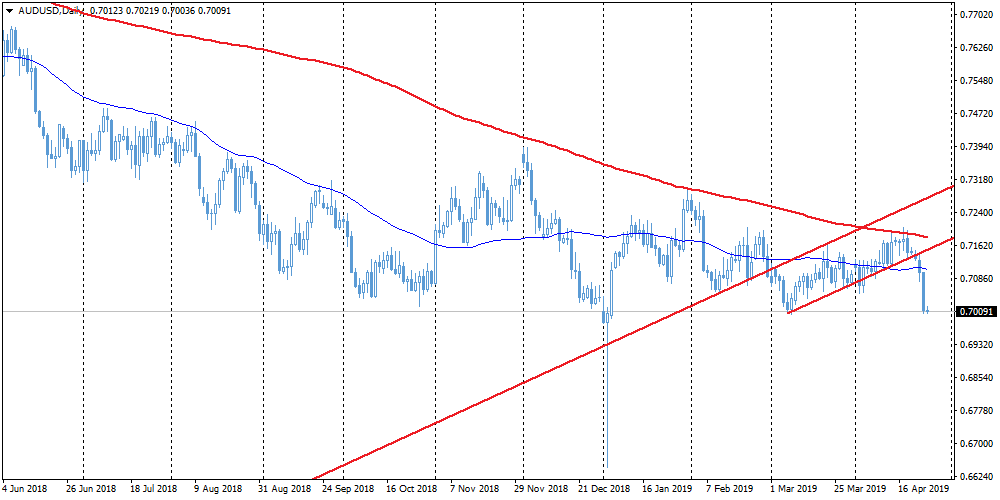
NZDUSD On A Free Fall Near 3-Month Low, Bearish Bias
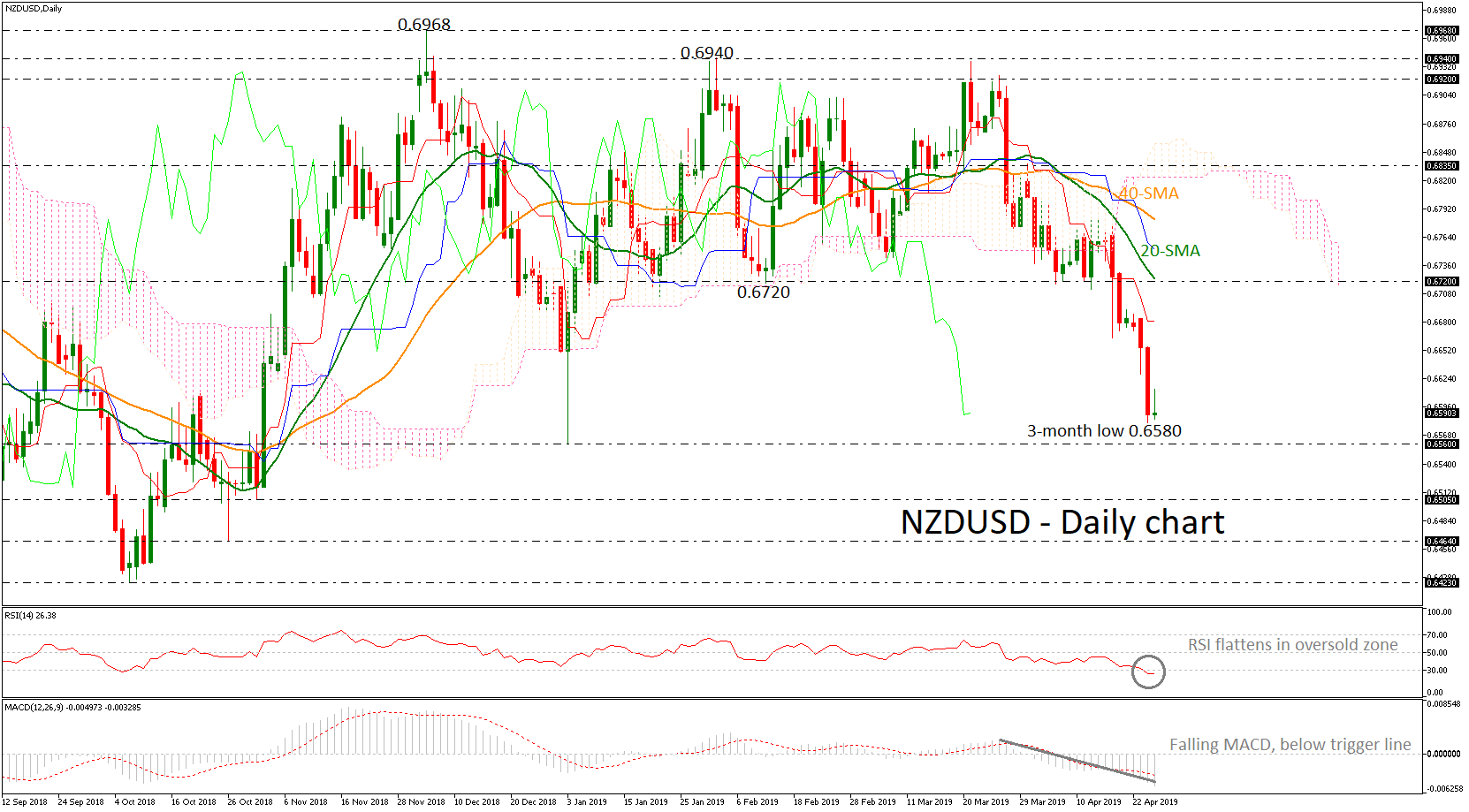
NZDUSD is continuing last week's bounce, posting a new three-month low of 0.6580 and at the same time is in progress to confirm another lower low in the short-term. The short-term bias looks negative as prices are developing beneath the Ichimoku cloud and the 20- and 40-simple moving averages (SMAs). The MACD keeps losing ground below its trigger line, while the RSI seems to be flat in the oversold area.
Should the price strengthen its bearish momentum, the 0.6560 support could provide immediate support. Moving lower, the focus could shift to the 0.6505 support, identified by the bottom on October 2018.
In the alternative scenario, traders would be eagerly looking for a break above the red Tenkan-sen line of 0.6680 to increase buying orders. If that's the case, the rally could last until 0.6720, which stands near the 20-SMA.
The recent bearish action turned the bigger picture more negative as well and with the shorter-term moving averages (MA) increasing distance above the longer-term MAs we could expect further downward extension in the market.
Dovish Central Banks Support The U.S Dollar
Thursday April 25: Five things the markets are talking about
European equites are under pressure while U.S futures tread water as investors continue to analyze a plethora of corporate earnings against a backdrop of global growth concerns.
Note: To date, +80% of S&P 500 companies results have beaten market expectations.
The ‘big' dollar continues to trade atop of its four-month high against G10 currency pairs, while U.S Treasuries are little changed alongside German Bunds which again trade in negative territory.
The EUR is printing new two-year lows outright while the yen found some temporary support after the Bank of Japan (BoJ) cut its economic growth forecasts and committed to keeping rates low. Sterling is little changed despite some Conservative party members wanting to know when PM May would be leaving. The Swedish kroner, similar to the loonie's reaction yesterday, has been stunned by the Riksbank ‘dovish' tone after this morning's interest rate announcement (see below).
On tap: Japan's Shinzo Abe will meet E.U leaders today before flying to the U.S for a summit with Trump. All eyes are on tomorrow's advance Q1 U.S GDP release (08:30 am EDT). Investors are looking for clues on how the U.S economy responded to Trump's government shutdown and fallout from the Q4 market rout.
1. Stocks follow Wall Street lower
In Japan, the Nikkei rallied to a five-month high overnight as a number of corporate earnings turned out to be ‘less bad' than the market had feared. Japan's central bank was also supportive, revising its guidance to say it expected not to increase interest rates for at least another year. The Nikkei 225 rallied +0.48%, while the broader Topix rallied +0.51%.
Down-under, Australia's ASX 200 was closed for ANZAC day. In S. Korea, the Kospi index was down -0.5% after a fourth-straight month of declining exports dragged on the local economy. South Korean GDP shrank in Q1 by -0.3%, its worst performance in more than a decade.
Stocks in China and Hong Kong were also lower even though the People's Bank of China (PBoC) signaled support for the economy by saying it had no intention of tightening monetary policy. At the close, the Shanghai Composite index was down -2.23%, while the blue-chip CSI300 index slipped -2.19%. In Hong Kong, the Hang Seng index was down -0.86%.
In Europe, regional bourses trade mostly lower following a mixed session in Asia overnight, with notable weakness in China.
U.S stocks are set to open little changed (+0.06%).
Indices: Stoxx600 -0.08% at 390.58, FTSE -0.30% at 7,449.21, DAX +0.04% at 12,317.92, CAC-40 -0.10% at 5,570.56, IBEX-35 +0.07% at 9,462.92, FTSE MIB +0.15% at 21,757.50, SMI +0.27% at 9,681.50, S&P 500 Futures +0.06
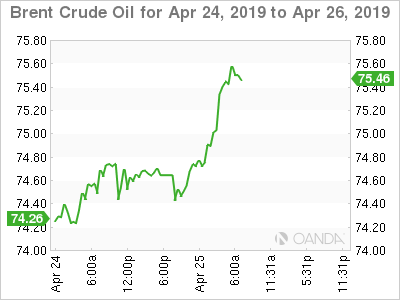
2. Brent oil prints $75 for first time this year amid tighter Iran sanctions
Brent crude (BCO) oil has rallied above +$75 a barrel for the first time this year on the back of tighter sanctions on Iran, while gains in West Texas Intermediate (WTI) have been curtailed by a surge in U.S supply.
Brent crude futures briefly touched +$75.01 per barrel and is currently at +$74.90 per barrel, up +33c or +0.4% from yesterday's close. U.S West Texas Intermediate (WTI) crude futures are at +$65.94 per barrel, up +5c.
Brent has been receiving support from a halt of Russian oil exports to Poland and Germany via a pipeline due to quality concerns and also from the U.S announcement this week that it would end all exemptions for sanctions against Iran, demanding countries to halt oil imports from Tehran from May.
Note: Brent prices are up +40% year-to-date.
Weighing on U.S prices is data from the API last week showing that U.S. crude stocks rose by +6.9M barrels, more than expected, while U.S commercial crude oil inventories hit an October 2017 high of +460.63M barrels according to the EIA's report yesterday. That was a rise of +1.3M barrels.
Ahead of the U.S open, gold prices have edged a tad higher as a dip in equities and weak S. Korean GDP data overnight is raising some red flags about the pace of global economic growth. Nevertheless, a stronger USD is capping gold price gains. Spot gold has rallied +0.2% to +$1,277.72 per ounce, while U.S gold futures are steady at +$1,279.60 an ounce.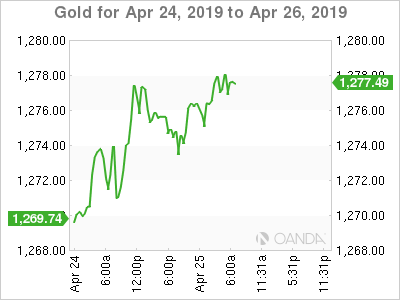
3. Central banks continue with dovish surprise on rate outlook
Earlier this morning Sweden's Riksbank tweaked its forward guidance so that the Repo Rate would remain at current level for somewhat longer period of time than was forecasted back in February – the next potential rate hike is near year-end or in early 2020 (revised from H2 of 2019). The Riksbank also extended its QE program and would buy government bonds for nominal value of SEK45B from July 2019 to December 2020.
In Japan, the Bank of Japan (BoJ) kept its policy steady but clarified its forward guidance to reinforce it will not hike anytime soon. Governor Kuroda in his press conference stated that it was “possible that the time frame under forward guidance could exceed the spring of 2020 thus could keep low rates beyond that time period.” He reiterated that a “virtuous economic cycle was in place but consumer prices had remained somewhat weak,” and expects CPI to pick up towards the +2% target “gradually but likely would take time.”
Elsewhere, German 10-year Bund yields dropped back into negative territory yesterday and are lower this morning at -0.017%. U.S. 10-year Treasury yields also fell yesterday, but are marginally higher ahead of the U.S open at +2.523%.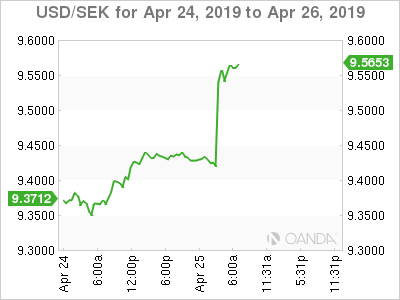
4. Loonie falls as BoC sees slower growth
The USD continues to hold onto its recent gains as weak overseas inflation and GDP data support the ‘buck.'
The Canadian dollar (C$1.3517) is weaker, trading at its lowest level outright, since early January, after the BoC held its key interest rate steady yesterday and lowered its growth forecast for this year, signaling that further rate increases are unlikely in the near term. By dropping any reference to future rate hikes, Governor Poloz delivered his most ‘dovish' signal in two-years.
EUR/USD (€1.1136) is trading softer and is not too far off its July 2017 low print. The recent soft IFO data out of Germany this week is not helping the currency nor are the economic and political concerns in Italy. The ECB's recent economic bulletin also stressed that risks in the Eurozone are “tilted to the downside.”
USD/JPY (¥111.79) could not sustain any momentum above the psychological ¥112 handle despite the BoJ keeping its monetary policy steady and clarifying its forward guidance to reinforce it would not hike anytime soon.
The SEK ($9.5601) has come under extreme pressure outright (down -1.46%) after the Riksbank put a more dovish spin on its rate path. Riksbank tweaked its forward guidance so that the Repo Rate would remain at current level for longer. EUR/SEK is higher by over +1.25% to test above €10.65 level.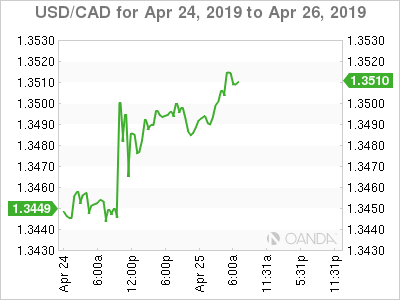
5. UK April CBI retailing reported sales 13 vs. 0e
Data from the Confederation of British Industry (CBI) this morning showed that retail sales grew for the first time since November 2018 in the year to April.
The survey of retailers, showed that sales volumes rose for the first time in five months, likely supported by the later timing of Easter this year.
49% of retailers said that sales volumes were up in April on a year ago, whilst 36% said they were down, giving a balance of +13%. This was broadly in line with expectations (+15%)
Digging deeper, orders placed on suppliers also grew and are expected to pick up further in the month ahead, with sales volumes also set to see somewhat faster growth.
Note: The readings are an indicator of short-term trends in the retail and wholesale sector of the UK economy.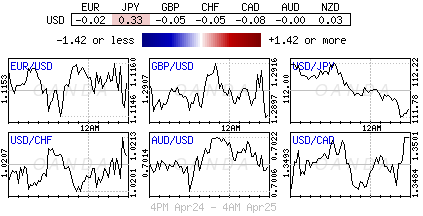
USD/JPY – Japanese Yen Jumpy BoJ Announces Freeze On Rates
USD/JPY is showing some movement on Thursday, continuing the trend seen on Wednesday. Currently, the pair is trading at 111.88, down 0.28% on the day. On the release front, the Bank of Japan maintained interest rate levels. Later in the day, Japan releases Tokyo Core CPI and retail sales. In the U.S., durable goods orders is expected to rebound with a gain of 0.7%, after a sharp drop of 1.6% in the previous release. Core durable goods is projected to gain 0.2%. As well, unemployment claims is forecast to rise to 199 thousand. On Friday, the U.S. releases the initial reading for first-quarter GDP, with an estimate of 2.2%. We’ll also get a look at UoM consumer sentiment, which is expected to drop to 97.1 points.
As expected, the Bank of Japan made no changes to monetary policy, maintaining short and long-term interest rates at extremely low levels. However, the markets reacted after the bank announced that rates would be frozen until the spring of 2020 at the earliest. Despite years of ultra-low rates, inflation remains stubbornly low, as the BoJ target of 2.0% remains elusive. There is a growing perception that policymakers have run out of ideas and tools for creating stimulus. The economic shock of the global trade war has hampered the Japanese economy, which is heavily dependent on trade with the U.S. and China. There have been reports of significant progress in trade talks between the U.S. and Chinese officials, but until a deal is signed, Japan’s economy will likely continue to flounder, making the yen less desirable to investors.
Riksbank Becomes The Latest Central Bank To Put A Dovish Spin On Its Forward Guidance
Notes/Observations
- Central banks continue with dovish surprise on rate outlook amid waning risk appetite and concerns over a global-growth slowdown resurfaced
- Swedish Riksbank tweaked its forward guidance so that the Repo Rate would remain at current level for somewhat longer period of time than was forecasted back in February
- BOJ kept its policy steady but clarified its forward guidance to reinfoirce it will not hike anytime soon
- Weak GDP data from South Korea dashed expectations of any further rate hikes
Asia:
- BOJ left its policy unchanged (as expected) with Interest Rate on Excess Reserves (IOER) unchanged at -0.10%and maintaining its policy framework of "QQE with Yield Control" around 0.00% with asset purchases at annual pace of ¥80T. BOJ revised its forward guidance and now would keep extremely low rates at least through around Spring 2020 (from prior view of to maintain the current extremely low interest rates for an extended period of time)
- BOJ Quarterly Outlook for Economic Activity and Prices cut FY19/20 GDP growth from 0.9% to 0.8% and FY20/21 GDP from 1.0% to 0.9%. It maintained FY19/20 core CPI (ex-sales tax) at 0.9% (affirms including sales tax 1.1%) while cutting FY20/21 core CPI from 1.4% to 1.3% (including sales tax 1.5% to 1.4%)
- South Korea Q1 Preliminary GDP Q/Q: -0.3% v +0.3%e (weakest since late 2008); Y/Y: 1.8% v 2.5%e
- China PBOC Deputy Gov Liu Guoqiang reiterated its prudent monetary policy as overall being appropriate, neither tight nor loose; policy stance had not changed. Market operations were to adjust short term liquidity only
- China PBoC announced it would set up a policy framework to implement relatively low RRR for small and medium banks and would use the funds released to support private and small companies
Europe/Mideast:
- UK Conservative party members said not to be backing the push to change leadership rules that was aimed at launching a new 'no-confidence' vote on PM May - 1922 Committee's Brady confirmed that asking the PM for a departure timetable in the event of a Brexit deal was not passing so MPs had clarity as to when she's leaving if Brexit was not resolved
- National Institute of Economic and Social Research (NIESR) forecasted Q1 UK GDP growth at +0.2%; pushed back forecast for next BOE rate hike until Aug 2020 (from Aug 2019)
Americas:
- BOC Gov Poloz post rate decision press conference noted that the domestic slowdown would prove to be temporary. BOC discussion before the rate announcement was a little bit skeptical of the most negative data and needed to see proof that a slowdown was temporary (reminder BOC kept its policy steady but its Statement dropped reference to future rate hikes and stressed that accommodative policy continued to be warranted)
SPEAKERS/FIXED INCOME/FX/COMMODITIES/ERRATUM
Equities
- Indices [Stoxx600 -0.08% at 390.58, FTSE -0.30% at 7,449.21, DAX +0.04% at 12,317.92, CAC-40 -0.10% at 5,570.56, IBEX-35 +0.07% at 9,462.92, FTSE MIB +0.15% at 21,757.50, SMI +0.27% at 9,681.50, S&P 500 Futures +0.06%]
- Market Focal Points/Key Themes: European Indices trade mostly lower following a mixed session in Asia overnight, with notable weakness in China as the Shanghai composite declined over 2%. US futures trade little changed, with the Nasdaq outperforming following strong results from Microsoft and Facebook after the close. On a busy morning for corporate earnings, shares of German listed Bayer rises on earnings and affirmed outlook; with UBS helping the Swiss SMI outperform wit profits and Revenue ahead of forecasts. Elsewhere Carrefour rises on inline results, with Michelin, ASM International, SSAB, Atlas Copco, Carpetright, among other names rising on earnings. PSA Group shares fall following Q1 Revenue numbers; Nokia declines almost 10% on a miss on the both the top and bottom line, with Societe Bic another notable decliner after missing forecasts, while Barclays, Worldline, Assa Abloy among others decliners on earnings. Elsewhere shares of Sainbury's falls over 5% after the CMA locked its transaction with Asda on competition grounds, while talks with Deutsche Bank and Commerzbank have also discontinued. Deutsche Bank also released up beat prelim Q1 results which sees the shares trade over 4% higher. Looking ahead notable earners include DOW component 3M, as well as Raytheon, UPS, Comcast, Bristol Myers, Abbvie, Hersheys and Southwest Airlines among others.
Equities
- Consumer discretionary: Carrefour [CA.FR] +4% (earnings), Delivery Hero [DHER.DE] +3% (earnings; raised outlook), Metso [METSO.FI] +3.5% (earnings), Carpetright [CPR.UK] +31% (trading update)
- Consumer staples: Sainsbury [SBRY.UK] -5% (merger blocked)
- Energy: Tullow Oil [TLW.UK] -2.5% (trading update)
- Financials: Deutsche Bank [DBK.DE] +2.5%, Commerzbank [CBK.DE] -2.5% (discontinued merger talks; DB prelim earnings), UBS [UBSG.CH] +1.5% (earnings), Barclays [BARC.UK] -1.5% (earnings), Swedbank [SWEDA.SE] -3% (earnings; establishes internal Anti-Financial Crime unit), Royal Bank of Scotland [RBS.UK] -1% (CEO steps down)
- Healthcare: Bayer [BAYN.DE] +3.5% (earnings)
- Industrials: PSA [UG.FR] -0.5% (earnings), SSAB [SSABA.SE] +4.5% (earnings)
- Technology: Dialog Semiconductor [DLG.DE] +2.5% (positive profit alert), ATOS {ATOS.FR] 2.5% (earnings)
- Materials: Wacker Chemie [WCH.DE] -3% (earnings)
Speakers
- ECB Economic Bulletin reiterated that ample degree of accommodation is still necessary
- Sweden Central Bank (Riksbank) Policy Statement revised its view on forward guidance and now saw Repo Rate remaining at current level for somewhat longer period with the next potential rate hike near year-end or in early 2020 (revised from 2nd half of 2019). Riksbank also extended its QE program and would buy govt bonds for nominal value of SEK45B from July 2019 to December 2020. Members Floden, Ohlsson opposed Riksbank Bond purchase extension; consider that further purchases will not contribute to monetary policy target attainment in a clear way. Lastly it noted that strong economic activity in Sweden and rising inflationary pressures abroad indicated that the inflation would continue to remain close to target going forward
- Sweden Central Bank (Riksbank) Gov Ingves post rate decision press conference stated that needed to adjust monetary policy to the economic situation. Economy was about the same compared to Feb but getting harder to predict the consequences of Brexit. Reiterated that Riksbank did not have a target for the exchange rate; had to live with fluctuations in the currency. SEK currency weakness was partly due to monetary policy but had less impact on inflation than expected. Reiterated view that SEK currency would gradually appreciate
- Norway Central Bank (Norges) Q1 Lending Survey: Household and corporate credit standards were broadly unchanged. Banks saw household credit demand rising in Q2
- German Bundesbank took notice that Deutsche Bank and Commerzbank had halted merger talks but adding that both banksweare solid and stable
- Czech Central Bank Vice Gov Mora said to back a interest rate hike at the upcoming policy decision on May 2nd but the vote to depend on updated staff projections
- BOJ Gov Kuroda post rate decision press conference began by expressing he wanted to make clear the stance on persistent easing. Clarification of forward guidance aimed at dismissing expectations for a rate hike after the sales tax increase. He conceded that was fully possible that the time frame under forward guidance could exceed the spring of 2020 thus could keep low rates beyond that time period. Reiterated that virtuous economic cycle was in place but consumer prices had remained somewhat weak. Expected CPI to pick up towards the 2% target gradually but likely would take time. Reiterated that risks were tilted to the downside for both economy and prices. To adjust policy swiftly as needed to maintain momentum towards the inflation target
- Indonesia Central Bank Policy Statement noted that the decision to keep policy steady was consistent with efforts to strengthen external stability. To expand policy to support growth and strengthen liquidity availability for banks
- Iraq Oil Min Ghadhban stated that sought to keep oil prices stable with markets well supplied. Iraq committed to OPEC production cut agreement and would not increase production outside the OPEC+ agreement. Would assess market needs at next OPEC meeting
- IEA chief Birol stated that expected Iraq to add 1.2M bpd in 10 years to reach 6M bpd production in 2030
Currencies/Fixed Income
- The USD held on to its recent gains as weak inflation and growth data overseas propelled the greenback. Central banks continued with dovish surprise on respective rate outlook amid waning risk appetite and concerns over a global-growth slowdown resurfaced.
- EUR/USD was softer below the 1.1150 area and not too far off from its lowest level since July 2017. The recent soft IFO data out of Germany only added to the currency's woes. Dealers also cited that economic and political concerns in Italy were also causing pressure. ECB economic bulletin also stressed that risks in the Euro Zone were tilted to the downside
- USD/JPY could not sustain any momentum to hold above the 112 level for the time being even after BOJ kept its policy steady and clarified its forward guidance to reinfoirce it would not hike anytime soon
- The SEK currency (Kroner) was the session's big loser after the Riksbank put a more dovish spin on its rate path. Riksbank tweaked its forward guidance so that the Repo Rate would remain at current level for somewhat longer period of time than was forecasted back in February and now saw the next rate hike near year-end or in early 2020 (prior was in H2 2019). EUR/SEK was higher by over 1.25% to test above 9.69 level
Economic Data
- (NO) Norway Q1 Industrial Confidence: 6.9 v 9.0 prior
- (FI) Finland Mar Preliminary Retail Sales Volume Y/Y: 1.0 v 1.6% prior
- (DK) Denmark Mar Retail Sales M/M: 0.7% v 0.3% prior; Y/Y: 0.5% v 1.3% prior
- (ES) Spain Q1 Unemployment Rate: 14.7% v 14.5%e
- (ES) Spain Mar PPI M/M: -0.2% v +0.2% prior; Y/Y: 2.4% v 1.7% prior
- (AT) Austria Feb Industrial Production M/M: 0.6% v 0.7% prior; Y/Y: 5.9% v 867% prior
- (SE) Sweden Apr Consumer Confidence: 95.8 v 95.0e; Manufacturing Confidence: 108.4 v 107.0e; Economic Tendency Survey: 102.7 v 101.0e
- (ID) Indonesia Central Bank (BI) left the 7-Day Reverse Repo Rate unchanged at 6.00% (as expected)
- (SE) Sweden Central bank (Riksbank) left the the Repo Rate unchanged at -0.25% (as expected); pushed back its next potential rate hike and expended its QE bond buying program
- (RO) Romania Mar M3 Money Supply Y/Y: 9.0% v 9.2% prior
- (GR) Greece Feb Retail Sales Value Y/Y: -2.3% v -3.2% prior; Retail Sales Volume Y/Y: -3.2% v -2.6% prior
Fixed Income Issuance
- None seen
Looking Ahead
- (AR) Argentina Apr Consumer Confidence Index: No est v 34.8 prior
- (CO) Colombia Mar Industrial Confidence: No est v 5.1 prior; Retail Confidence: No est v 31.8 prior
- 05:30 (ZA) South Africa Mar PPI M/M: 0.5%e v 0.3% prior; Y/Y: 5.5%e v 4.7% prior
- 05:30 (HU) Hungary Debt Agency (AKK) to sell bonds (3 tranches)
- 06:00 (UK) Apr CBI retailing Reported Sales: 0e v -18 prior; Total Distribution: No est v -6 prior
- 06:00 (CA) Canada Apr CFIB Business Barometer: No est v 55.9 prior
- 06:45 (US) Daily Libor Fixing
- 07:00 (TR) Turkey Central Bank (CBRT) Interest Rate Decision: expected to leave One-Week Repo Rate unchanged at 24.00%
- 07:00 (UK) Ukraine Central Bank (NBU) Interest Rate Decision: expected to cut Key Rate by 25bps to 17.75%
- 07:00 (BR) Brazil Apr FGV Consumer Confidence: No est v 91.0 prior
- 08:00 (BR) Brazil Mid-Apr IBGE Inflation IPCA-15 M/M: 0.7%e v 0.5% prior; Y/Y: 4.7%e v 4.2% prior
- 08:30 (US) Initial Jobless Claims: 200Ke v 192K prior; Continuing Claims: 1.68Me v 1.653M prior
- 08:30 (US) Mar Preliminary Durable Goods Orders: +0.8%e v -1.6% prior; Durables Ex Transportation: +0.2%e v -0.1% prior; Capital Goods Orders (Non-defense/ex-aircraft): +0.2%e v -0.1% prior; Capital Goods Shipments (Non-defense/ex-aircraft): +0.1%e v -0.1% prior
- 08:30 (US) Weekly USDA Net Export Sales
- 08:30 (ES) ECB's De Guindos (Spain)
- 09:00 (RU) Russia Gold and Forex Reserve w/e Apr 12th: No est v $491.6B prior
- 09:00 (MX) Mexico Feb Retail Sales M/M: 0.0%e v 1.9% prior; Y/Y: 0.6%e v 0.9% prior
- 09:30 (BR) Brazil Mar Current Account Balance: $0.0Be v -$1.1B prior; Foreign Direct Investment (FDI): $7.9Be v $8.4B prior
- 10:30 (US) Weekly EIA Natural Gas Inventories
- 11:00 (US) Apr Kansas City Fed Manufacturing Activity: 8e v 10 prior
- 12:00 (FR) France Pres Macron: speech on 'Yellow Vest' protesters' demands