

Sample Category Title
USD/CHF Daily Outlook
Daily Pivots: (S1) 1.0188; (P) 1.0208; (R1) 1.0224; More...
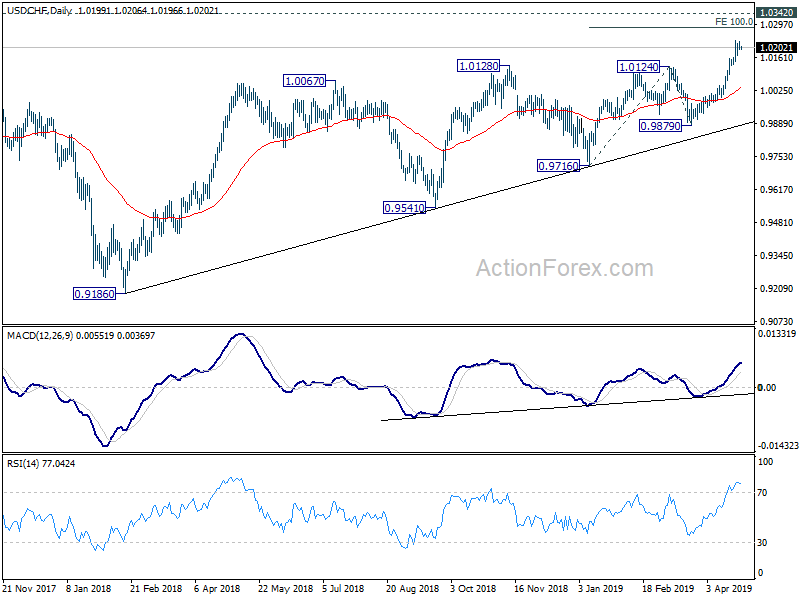
Intraday bias in USD/CHF remains neutral first and consolidation from 1.0230 temporary top might extend. Downside of retreat should be contained by 1.0130 minor support to bring rise resumption. On the upside, above 1.0230 will extend recent rally to 100% projection of 0.9716 to 1.0124 from 0.9879 at 1.0287, and then 1.0342 key resistance. However, break of 1.0130 will indicate short term topping and bring deeper retreat first.
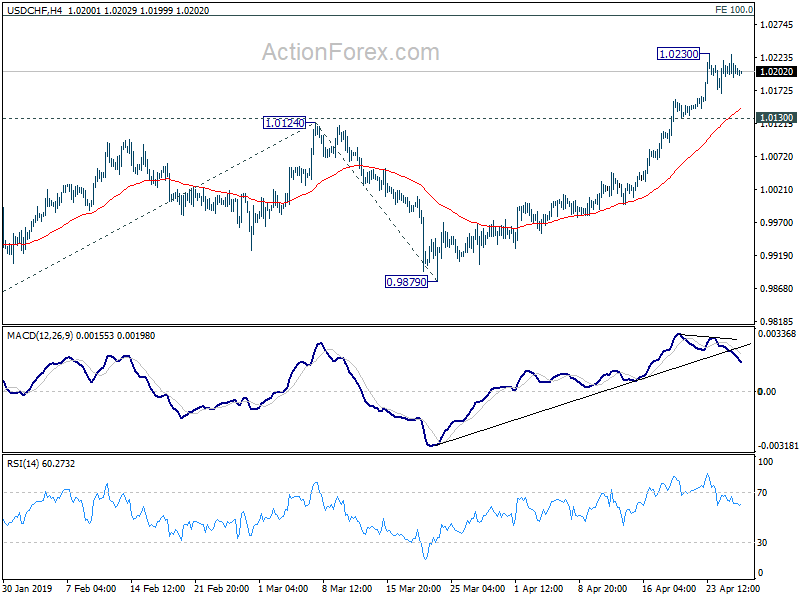
In the bigger picture, medium term up trend from 0.9186 is extending. Current rise should target 1.0342 resistance next. For now, we'd be cautious on strong resistance from there to limit upside, until we see medium term upside acceleration. On the downside, break of 0.9879 support is needed to indicate reversal. Otherwise, outlook will stay bullish in case of deep pull back.
USD/JPY Daily Outlook
Daily Pivots: (S1) 111.24; (P) 111.74; (R1) 112.12; More...
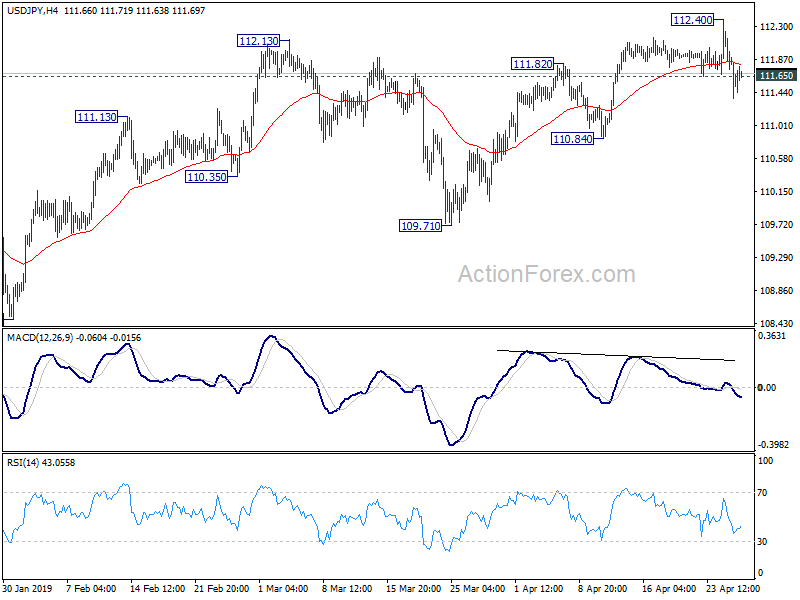
USD/JPY's break of 111.65 minor support suggests short term topping on bearish divergence condition in 4 hour MACD. Intraday bias is turned back to the downside for 110.84 support first. Break will add to the case of reversal and target 109.71 support and below. On the upside, decisive break of 112.40 is needed to confirm resumption of rise from 104.69. Otherwise, risk will stay mildly on the downside.
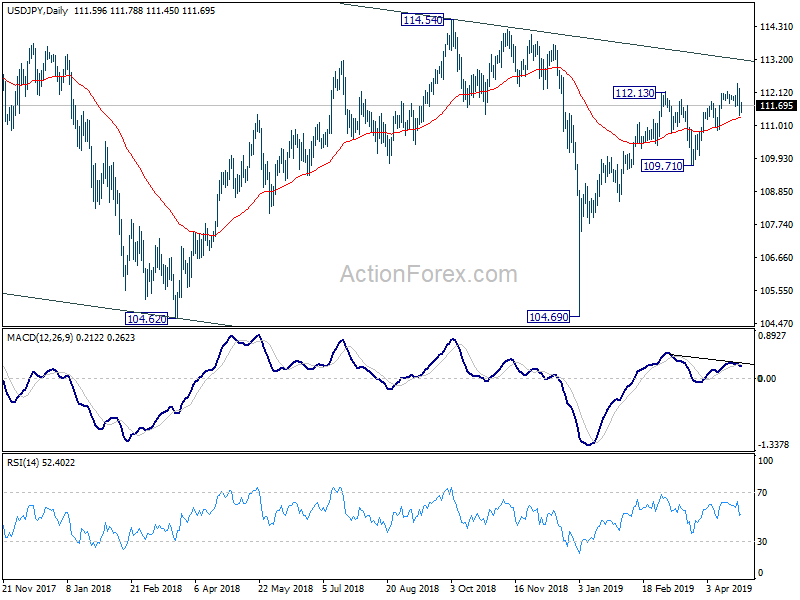
In the bigger picture, medium term outlook in USD/JPY remains a bit mixed as it's staying inside falling channel from 118.65, but there are signs of bullish reversal. On the upside, break of 114.54 resistance will revive the case the corrective fall from 118.65 has completed with three waves down to 104.69. And whole rise from 98.97 (2016 low) is resuming for 118.65 and above. But before that, outlook stays neutral first.
Dollar and Yen Pare Gains as Focus Turns to US Q1 GDP
Commodity currencies recover broadly in Asian session as risk markets somewhat stabilized. US stocks closed mixed with DOW paring much of initial losses overnight. New Zealand Dollar is additional supported by record exports in March, and helps lift Australian too. Yen is the weakest so far for today, followed by Dollar and then Euro.
Nevertheless, for the week, Yen remains overwhelmingly the strongest one, with help from steep decline in US and European treasury yields. Dollar follows as the second strongest on flight-to-quality flow. Australian Dollar is the weakest one as case for RBA cut continued to build up. Euro is, for now, second weakest for the week on gloomy outlook. The race between Dollar and Yen could very much depend on Q1 GDP data from US today.
Technically, USD/JPY's break of 111.65 support overnight is seen as first indication of near term bearish reversal. For now, deeper decline is in favor to 110.84 support for confirmation. EUR/JPY is on track to 123.65 support next, as fall from 126.79 extends. GBP/JPY is pressing 143.72 key support now. Decisive break there will turn near term outlook bearish, aligning with other Yen crosses.
In Asia, currently, Nikkei is down -0.52%, Hong Kong HSI is up 0.08%. China Shanghai SSE is down -0.71%. Singapore Strait Times is up 0.05%. Japan 10-year JGB yield is down -0.0139 at -0.043. Overnight, DOW dropped -0.51%. S&P 500 dropped -0.04%. NASDAQ rose 0.21%. 10-year yield rose 0.012 to 2.534.
Japan: Large contraction in industrial production raises recession risk
In March, Japan industrial production dropped -0.9% mom, below expectation of 0.0% mom. For the whole of Q1, industrial production contracted -2.6% yoy. The overall contraction in industrial production in Q1 was the largest in nearly five years, since Q2 2014. The data suggested that Japanese economy could have suffered a mild recession as external demand was hurt by US-China trade war.
Also released, unemployment rate also rose to 2.5%, up from 2.3% and was higher than expectation of 2.4%. Nevertheless, retail sales rose 1.0% yoy, above expectation of 0.8% yoy. In April, Tokyo CPI accelerated to 1.3% yoy, up from 1.1% yoy and beat expectation of 1.1% yoy.
No discussions on auto restriction, agriculture, currency, monetary policy in US-Japan trade talks
Economy Minister Toshimitsu Motegi met US Trade Representative Robert Lighthizer in Washington yesterday. Jiji news agency reported that currency was not discussed during the trade meeting. Motegi also told reporters there was no demand from US regarding auto import restrictions. Additionally, two sides did not have detailed discussions over agriculture and autos.
Japan Finance Minister Taro Aso met US Treasury Secretary Steven Mnuchin in Washington yesterday too. Aso said he warned Mnuchin currency and monetary policy must not be included in trade talks. Mnuchin mentioned before that he'd like to include a provision to deter currency manipulation in the trade pact with Japan. Aso said he told Mnuchin directly that "Japan cannot agree to any debate linking trade policy with monetary policy". Also, "Japan won't discuss exchange-rate matters in the context of trade talks."
New Zealand exports hit record NZD 5.7B in March, NZD/USD recovers
In March in New Zealand, exports jumped 19% yoy to NZD 5.7B, hitting a record for any month. Imports, on the other hand, dropped -3.4% yoy to NZD 4.8B. Trade balance came in at a NZD 922m surplus, highest since April 2011, and beat expectation of NZD 131m. International statistics manager Tehseen Islam said, "exports to China were the leading contributor to increases in several primary sector commodities including dairy products, beef, lamb, and forestry products."
From Australia, import price dropped -0.5% qoq in Q1 versus expectation of -1.1% qoq. PPI slowed to 1.9% yoy versus expectation of 2.0% yoy.
BoC Poloz: Could resume rate hike some time down the road
BoC Governor Stephen Poloz said in a Maclean's magazine interview yesterday that the central bank could resume rate hike "some time down the road". However, the pre-condition is that incoming data would prove the current slowdown is only temporary. BoC kept interest rate unchanged at 1.75% earlier this week and dropped tightening bias in the statement.
For now, Poloz expected that the slowdown would last "a couple of quarters". He added, "what we have to do then is wait and see if the data proves to us that we were right about that." And, "assuming we are, then sometime down the road we'll be able to say: 'OK, now it's time to start normalizing again,' but that remains to be seen."
On the topic of trade, Poloz also said Trump's trade policies could "certainly" trigger a new global recession. "When you think about the gains in income and living standards that have been created by trade liberalization in a postwar period, to erase even a portion of those would be to risk causing a recession globally," Poloz said.
Looking ahead
UK CBI reported sales and BBA mortgage approvals will be featured in European session. But main focus will be on US Q1 GDP, which is expected to show 2.2% annualized growth.
USD/JPY Daily Outlook
Daily Pivots: (S1) 111.24; (P) 111.74; (R1) 112.12; More...
USD/JPY's break of 111.65 minor support suggests short term topping on bearish divergence condition in 4 hour MACD. Intraday bias is turned back to the downside for 110.84 support first. Break will add to the case of reversal and target 109.71 support and below. On the upside, decisive break of 112.40 is needed to confirm resumption of rise from 104.69. Otherwise, risk will stay mildly on the downside.
In the bigger picture, medium term outlook in USD/JPY remains a bit mixed as it's staying inside falling channel from 118.65, but there are signs of bullish reversal. On the upside, break of 114.54 resistance will revive the case the corrective fall from 118.65 has completed with three waves down to 104.69. And whole rise from 98.97 (2016 low) is resuming for 118.65 and above. But before that, outlook stays neutral first.
Economic Indicators Update
| GMT | Ccy | Events | Actual | Forecast | Previous | Revised |
|---|---|---|---|---|---|---|
| 22:45 | NZD | Trade Balance Mar | 922M | 131M | 12M | -68M |
| 23:30 | JPY | Unemployment Rate Mar | 2.50% | 2.40% | 2.30% | |
| 23:30 | JPY | Tokyo CPI Core Y/Y Apr | 1.30% | 1.10% | 1.10% | |
| 23:50 | JPY | Industrial Production M/M Mar P | -0.90% | 0.00% | 0.70% | |
| 23:50 | JPY | Retail Trade Y/Y Mar | 1.00% | 0.80% | 0.40% | 0.60% |
| 1:30 | AUD | PPI Q/Q Q1 | 0.40% | 0.60% | 0.50% | |
| 1:30 | AUD | PPI Y/Y Q1 | 1.90% | 2.00% | 2.00% | |
| 1:30 | AUD | Import price index Q/Q Q1 | -0.50% | -1.10% | 0.50% | |
| 5:00 | JPY | Housing Starts Y/Y Mar | 10.0% | 5.50% | 4.20% | |
| 8:30 | GBP | BBA Loans for House Purchase Mar | 38675 | 39083 | ||
| 10:00 | GBP | CBI Reported Sales Apr | 0 | -18 | ||
| 12:30 | USD | GDP Annualized Q/Q Q1 A | 2.20% | 2.20% | ||
| 12:30 | USD | GDP Price Index Q1 A | 1.30% | 1.70% | ||
| 14:00 | USD | U. of Mich. Sentiment Apr F | 97 | 96.9 |
New Zealand exports hit record NZD 5.7B in March, NZD/USD recovers
In March in New Zealand, exports jumped 19% yoy to NZD 5.7B, hitting a record for any month. Imports, on the other hand, dropped -3.4% yoy to NZD 4.8B. Trade balance came in at a NZD 922m surplus, highest since April 2011, and beat expectation of NZD 131m.
International statistics manager Tehseen Islam said, "exports to China were the leading contributor to increases in several primary sector commodities including dairy products, beef, lamb, and forestry products."
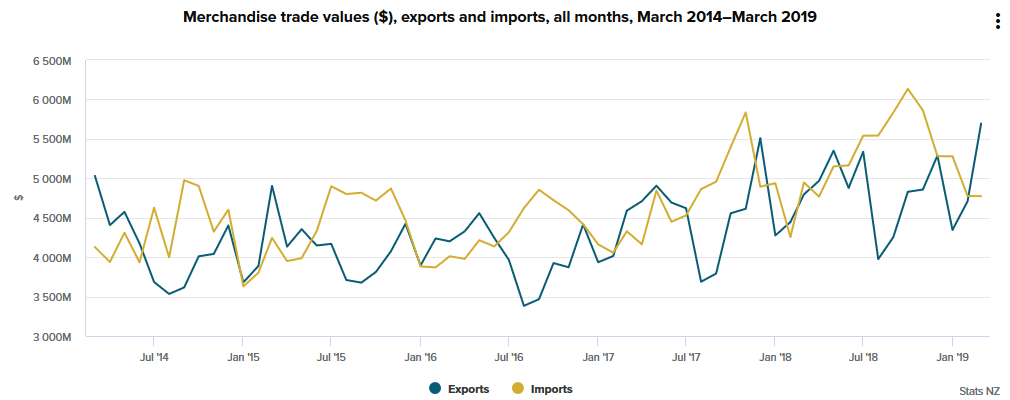
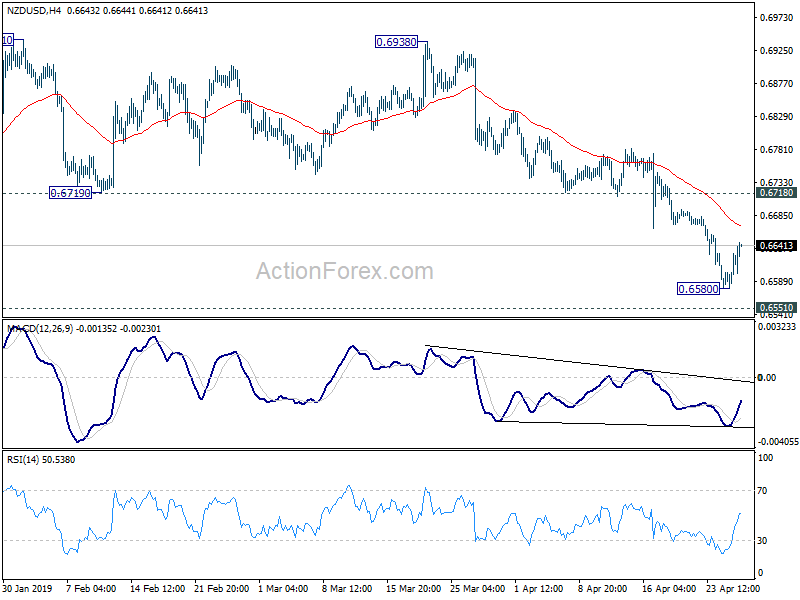
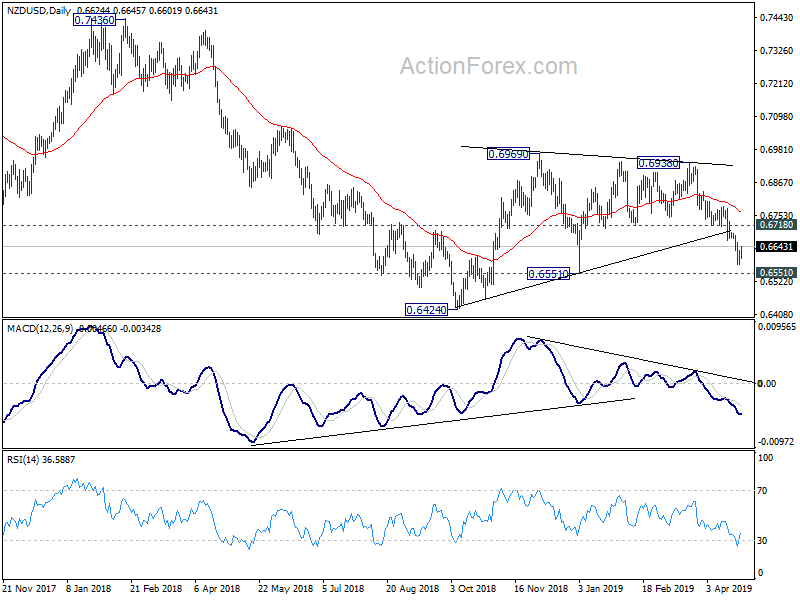
NZD/USD recovers notably after the release. A temporary low should be formed at 0.6580, ahead of 0.6551 support. Some consolidations would be seen first. But near term outlook will remain bearish as long as 0.6718 resistance holds. The corrective pattern from 0.6424 low should have completed. Break of 0.6551 support will likely resume larger down trend through 0.6424 low.
Japan: Large contraction in industrial production raises recession risk
In March, Japan industrial production dropped -0.9% mom, below expectation of 0.0% mom. For the whole of Q1, industrial production contracted -2.6% yoy. The overall contraction in industrial production in Q1 was the largest in nearly five years, since Q2 2014. The data suggested that Japanese economy could have suffered a mild recession as external demand was hurt by US-China trade war.
Also released, unemployment rate also rose to 2.5%, up from 2.3% and was higher than expectation of 2.4%. Nevertheless, retail sales rose 1.0% yoy, above expectation of 0.8% yoy. In April, Tokyo CPI accelerated to 1.3% yoy, up from 1.1% yoy and beat expectation of 1.1% yoy.
No discussions on auto restriction, agriculture, currency, monetary policy in US-Japan trade talks
Economy Minister Toshimitsu Motegi met US Trade Representative Robert Lighthizer in Washington yesterday. Jiji news agency reported that currency was not discussed during the trade meeting. Motegi also told reporters there was no demand from US regarding auto import restrictions. Additionally, two sides did not have detailed discussions over agriculture and autos.
Japan Finance Minister Taro Aso met US Treasury Secretary Steven Mnuchin in Washington yesterday too. Aso said he warned Mnuchin currency and monetary policy must not be included in trade talks. Mnuchin mentioned before that he'd like to include a provision to deter currency manipulation in the trade pact with Japan. Aso said he told Mnuchin directly that "Japan cannot agree to any debate linking trade policy with monetary policy". Also, "Japan won't discuss exchange-rate matters in the context of trade talks."
AUD/USD And NZD/USD Approaching Crucial Hurdles
AUD/USD started an upside correction after trading below the 0.7000 level. NZD/USD recovered nicely above 0.6620, but it seems to be approaching a major hurdle near the 0.6660 area.
Important Takeaways for AUD/USD and NZD/USD
- The Aussie Dollar declined heavily and even spiked below the 0.7000 support against the US Dollar.
- There is a major bearish trend line in place with resistance at 0.7040 on the hourly chart of AUD/USD.
- NZD/USD started a strong upward move after it tested the 0.6580 support area.
- There was a break above a key bearish trend line with resistance at 0.6605 on the hourly chart.
AUD/USD Technical Analysis
There was a strong downward move in the Aussie Dollar from the 0.7150 resistance area against the US Dollar. The AUD/USD pair broke the 0.7080 support level to start a major downtrend.
The pair gained bearish momentum below the 0.7050 support and the 50 hourly simple moving average. There was even a spike below the 0.7000 support and the pair traded as low as 0.6988 on FXOpen.
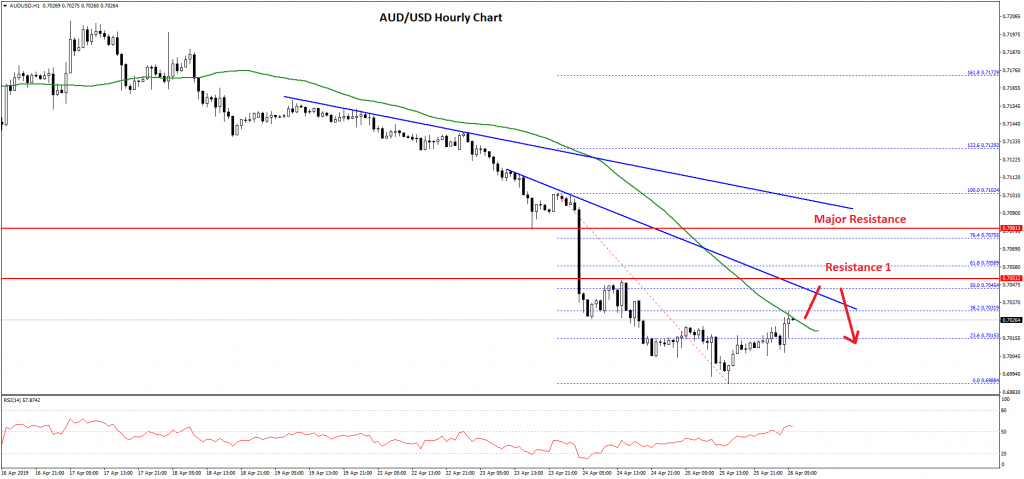
Recently, it started an upside correction and traded above the 0.7000 resistance and the 23.6% Fib retracement level of the recent decline from the 0.7102 high to 0.6988 low. At the moment, the pair is facing resistance near the 0.7030 level and the 50 hourly simple moving average.
Moreover, there is a major bearish trend line in place with resistance at 0.7040 on the hourly chart of AUD/USD. The trend line is near the 50% Fib retracement level of the recent decline from the 0.7102 high to 0.6988 low.
Therefore, it won’t be easy for buyers to clear the 0.7030 and 0.7040 resistance levels. Above 0.7040, the next major resistance is near 0.7090 and another bearish trend line on the same chart.
On the downside, an initial support is at 0.7010, below which the pair could break the 0.7000 support once again. The next major support is near the 0.6975 level.
NZD/USD Technical Analysis
The New Zealand Dollar declined steadily from the 0.6688 swing high against the US Dollar. The NZD/USD pair broke the 0.6600 support level before buyers took a stand near the 0.6580 level.
A swing low was formed at 0.6580 and recently the pair climbed above the 0.6600 level. There was a break above a key bearish trend line with resistance at 0.6605 on the hourly chart.
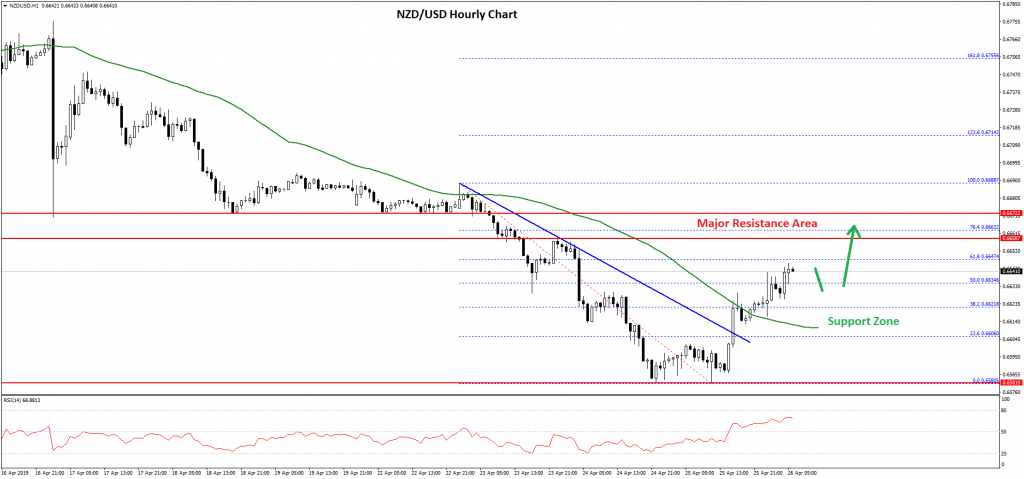
The pair even broke the 0.6620 resistance and the 50 hourly simple moving average. More importantly, there was a break above the 50% Fib retracement level of the recent decline from the 0.6688 high to 0.6580 low.
An immediate resistance is near 0.6650 and the 61.8% Fib retracement level of the recent decline from the 0.6688 high to 0.6580 low. However, the main resistance is near the 0.6660 area, which was a major support earlier and now it could prevent gains.
On the downside, an initial support is near the 0.6625 level. The main support is near 0.6610 and the 50 hourly SMA. If NZD/USD fails to stay above the 50 hourly SMA, there is a risk of a sharp drop towards the 0.6580 or 0.6550 support level in the near term. Today’s GDP release in the US is likely to impact the market sentiment for EUR/USD, GBP/USD, USD/CHF, AUD/USD, NZD/USD and other major pairs.
BoC Poloz: Could resume rate hike some time down the road
BoC Governor Stephen Poloz said in a Maclean's magazine interview yesterday that the central bank could resume rate hike "some time down the road". However, the pre-condition is that incoming data would prove the current slowdown is only temporary. BoC kept interest rate unchanged at 1.75% earlier this week and dropped tightening bias in the statement.
For now, Poloz expected that the slowdown would last "a couple of quarters". He added, "what we have to do then is wait and see if the data proves to us that we were right about that." And, "assuming we are, then sometime down the road we'll be able to say: 'OK, now it's time to start normalizing again,' but that remains to be seen."
On the topic of trade, Poloz also said Trump's trade policies could "certainly" trigger a new global recession. "When you think about the gains in income and living standards that have been created by trade liberalization in a postwar period, to erase even a portion of those would be to risk causing a recession globally," Poloz said.
Market Morning Briefing: The Euro-Yen Is Looking Bearish
STOCKS
Equities looks mixed. Indices like the Dow, DAX has key supports near current levels which will need a close watch. Sensex and Nifty remains sideways but the bias is slightly negative. Shanghai has declined below a key support and has turned bearish. Nikkei retains its sideways range as of now. The Japanese markets are closed for the next ten days (April 27 to May 6) on account of public holidays.
Dow (26462.08, -134.97, -0.51%) has declined below the support at 26500 which we had expected to hold. A key support is at 26250 which can be tested in the near term and is likely to limit the downside. A bounce from there can take the Dow higher to 26500 and 26700 again.
DAX (12282.60, -30.56, -0.25%) has dipped below 12300. Support is in between 12230 and 12200 which can be tested in the near term. The outlook will turn negative for a fall to 12100 and 12000 if the DAX breaks below 12200. But a bounce from the 12230-12200 support zone can take the index higher to 12400-12450.
Nikkei (22139, -168.58, -0.76%) fell within its 22050-22350 sideways range. It has bounced after making a low of 22068 thereby keeping the sideways move intact. While it sustains above 22050, a bounce to 22275-22300 is possible. A break below 22050 will drag the index lower to 21900.
Shanghai (3102.51, -21.32, -0.68%) has broken the 3150-3280 range on the downside. A double-top on the chart has now turned the outlook negative for the index to test 3050-3020 on the downside. A break below 3100 will trigger this fall.
Sensex (38730.86, -323.82, -0.83%) failed to sustain higher and has come-off sharply from its high of 39292.22 yesterday. The daily candles still keep the possibilities alive for a sideways move between 38500 and 39500. But on the 3-day candles the Sensex looks vulnerable to break 38500 and fall to 38100 in the coming days.
Nifty (11641.80, -84.35, -0.72%) has come-off sharply after testing the resistance at 11800. A dip to 11600 and 11550 looks likely. A break below 11550 will be bearish for a fall to 11450 and. 11400
COMMODITIES
Gold is witnessing short-covering bounce. It may consolidate sideways or can move further higher before the downtrend resumes. Copper is turning bearish as it has declined below a key support. It looks vulnerable for a fresh fall. The upmove in oil seems to be losing steam as expected. WTI has declined inline with our expectation and Brent islikely to follow suit.
Gold (1279) bounced to test 1283 as expected yesterday. 1283 is a key resistance. If gold manages to breach this hurdle, the corrective rally can extend to 1292. Else it can fall to 1270 and remain range bound between 1270 and 1283 for some time before falling to 1260.
Silver (14.99) can inch higher to 15.05 and 15.10 while it sustains above 14.90.
Copper (2.87) fell sharply yesterday and has declined below the key support level of 2.88. Inability to bounce from above 2.88 from current levels will be bearish for a fall to 2.84.
WTI (64.85) as mentioned yesterday has fallen to test 64.75. A further dip to test 64.20 looks likely in the coming sessions. A break below 64.2 will increase the likelihood of the fall extending to 63.6
Brent (75.60) spiked to a high of 75.6 and has come-off from there. The crucial resistance around 76 which we have been mentioning over the last few days has been tested now. An intermediate resistance is between 74.70 and 74.80 which can cap the upside now. A fall to 73-72.7 looks likely in the near term.
FOREX
The Dollar Index (98.11) looks bullish on the weekly candles and could test 98.50 in the near term before it could come off from there back to 97.50 or lower. On the weekly candles, 99 is an important resistance. Dollar Index looks bullish for the coming 1-2 weeks as it may test 98.50-99.00 on the upside with some interim dips. US GDP data for Q1 is due today and would be crucial.
The Euro (1.1139) tested 1.1118 yesterday and is trading above 1.11 just now. Note that 1.11 is an immediate support which if holds could pull back Euro towards 1.1175 and higher; else Euro could fall towards 1.1075-1.1055 in the coming sessions. While Dollar Index looks bullish towards 98.50-99.00, Euro has scope of testing 1.1075/50 on the downside.
The Euro-Yen (124.45) is looking bearish. While the Yen remains stable and Euro weakens, Euro-Yen could fall in the near term towards support at 124 from where a bounce is possible.
Dollar-Yen (111.65) could continue trade within 111.5-112.5 just now with scope of possible extension on either side. Unless we get confirmation of a break on either side, it would be difficult to get clarity on further direction that the currency pair might take. On the weekly, there is scope of rising towards 113.
The Aussie (0.7027) has slightly risen and is trading a bit higher today. Although there is room for a fall towards 0.6950, if Aussie bounces back from current level itself, it could start moving up towards 0.71 again.
USDCNY (6.7314) is trading higher as expected. A rise towards 6.74/76 is on the cards.
Dollar-Rupee (70.26) moved up to close at 70.25/26 in line with our expectation. If we see a close today above 70, we could possibly expect the pair to test higher levels of 70.50/60 next week. If 70.25/30 holds today, we could see some interim dip back to 70.10/00. View is bullish for Dollar Rupee in the near term.
INTEREST RATES
The US yields are almost stable. The 2Yr (2.33%), 5Yr (2.33%), 10Yr (2.54%) and 30Yr (2.95%) are stable but could fall in the near term as the yields have tested important near term resistances which are likely to hold.
The US-JGB 10YR (2.57%) looks bearish for the near term. We will have to see if Dollar Yen falls as the spread moves lower. Directionally the spread is likely to move in line with the broad direction of Dollar-Yen.
The 10Yr GOI (7.5649%) is in the middle of the 7.50-7.65% range. Movement on either side looks possible just now.
Cliff Notes: Jobs and CPI Fuel the Debate
Key insights from the two weeks that were (special holiday edition).
In the past two weeks, the RBA minutes framed the conversation on rate cuts while the labour force and CPI data added fuel to the debate. Offshore, a steady China Q1 GDP result indicated policy stimulus is starting to take effect, offering some encouragement against the weak manufacturing conditions in key trading partners.
The April RBA meeting minutes clearly communicated that the Reserve Bank are willing to cut the cash rate if necessary and have set out the conditions for a cut to occur.
In the final section of the minutes, the Board reaffirmed their belief in the stimulatory effect of lower interest rates on the economy via the cash-flow and exchange rate channels. That discounts arguments that suggest there is little benefit from lowering rates further from the already low starting level. In accordance, the Board set out the conditions for a rate cut, “members also discussed the scenario where inflation did not move any higher and unemployment trended up, noting that a decrease in the cash rate would likely be appropriate in these circumstances”.
Given that we have seen conflicting signals from weak GDP growth against strength in the labour market, it would appear that the Board is placing a greater weight on employment from a policy perspective. As we see the labour market as a lagging indicator, we expect slow growth will eventually weigh on employment growth.
In that regard, the ABS March labour force and Q1 CPI releases provided timely updates.
As at March, the labour force remains strong, total employment up 25.7k, beating the market median estimate of 15k. The three month average is now 24k, from 22k in February, indicative of a robust trend in the labour market so far in 2019. Six month annualised employment is 2.5% and the trend unemployment rate has held at 5 per cent.
The CPI, on the other hand, was flat in the March Quarter compared to the market median of 0.2% and Westpac’s 0.1%. The annual rate eased back to 1.3%yr from 1.8%yr in Q4. The average of the core measures rose 0.2%qtr, below market (0.4%) and Westpac (0.3%) expectations – a low for the series, matching the outcomes in March 2016 and September 1997. Incorporating revisions, the six month annualised growth in core inflation is now just 1.2%yr, well below the bottom of the RBA target band and the slowest pace since December 1997.
Overall, the CPI data confirmed that well below target inflation provides the RBA reason to cut the cash rate while the labour force data tempers an absolute reaction. There are still three labour force releases before the August RBA meeting - ample time for our expected weakening in the labour market to materialise. On this basis, along with inflation remaining low and below trend economic growth, we continue to forecast cash rate cuts in August and November.
Similarly across the Tasman, NZ Q1 CPI fell slightly short of expectations, up 0.1% against the consensus +0.2%. The surprise came from a weaker read on tradables, down 1.3% in the quarter and 0.4% in annual terms. Indeed, the major driver of the slowing in annual inflation to 1.5% from 1.9% was due to the pullback in fuel. Nevertheless, core inflation remains subdued with the various measures largely in a range of 1.5-1.7%.
After the release, market pricing shifted to a better than even chance of an OCR cut at the May Monetary Policy Statement. That concurs with our view for a cut at that meeting. But as RBNZ Governor Adrian Orr has emphasised in recent interviews, the outcome of the May review is far from settled. Next week’s labour market data release is critical.
Offshore, China’s Q1 GDP release provided some optimism amidst softness seen in much of the global economy, while partial indicators in the US showed their economy regained some momentum in recent months.
In the lead-up to China’s Q1 GDP release on 17 April, the consensus expectation was for a slowing in the annual pace to 6.3% from 6.4% after the authorities opted for a growth target range of 6.0-6.5% for 2019 compared to the previous year’s target of 6.5%. Instead, growth printed at 6.4% and the March partial data signalled momentum picked up – retail sales 8.7% vs exp. 8.4%, industrial production 8.5% vs exp. 5.9%, and fixed asset investment 6.3% vs exp. 6.3%.
In contrast, softness in China’s major trade partners endures. This was highlighted by this week’s South Korea GDP release reporting a 0.3% contraction in Q1 led by a sharp drop in investment. That is indicative of the broader global manufacturing slowdown with the preliminary estimate of Europe’s manufacturing PMI confirming weakness over there has persisted into the start of Q2. Europe’s saving grace has been a resilient services sector, and the consensus expectation for next week’s Q1 GDP 1st estimate sees the economy avoiding contraction, but nevertheless recording only a modest growth outcome of 0.3%.
Lastly to the US, the last two weeks of data have been positive, with strength seen in retail sales and durable goods orders.
Retail sales jumped 1.6% in March with the control group up 1.0%. Gains were seen across twelve of the thirteen categories with vehicle sales particularly standing out at +3.1%. This was backed up by durable goods orders also showing strength in the month, lifting 2.7% following a 1.1% decline in February – choppiness driven by the volatile aircraft component. While core capital goods shipments declined 0.2% in March, still indicating a soft business investment outcome in Q1, orders rose 1.3%.
The overall result indicates the consumer regained its footing after softness seen at the turn of the year while business investment is likely to pick up in the start of Q2. Tonight’s Q1 GDP 1st estimate is still likely to point to solid growth - the consensus expectation centres on a 2.3% annualised pace while the Atlanta Fed’s nowcast is 2.7%.