Sample Category Title
USD/JPY Near Crucial Juncture Ahead Of US GDP Release
Key Highlights
- The US Dollar spiked higher, but failed to stay above 112.00 against the Japanese Yen.
- An ascending channel is in place with support near 111.30 on the 4-hours chart of USD/JPY.
- The US Durable Goods Orders in March 2019 gained 2.7% (MoM), more than the 0.8% forecast.
- The US Gross Domestic Product in Q1 2019 (Prelim) could increase 2.1%, less than the last 2.2%.
USDJPY Technical Analysis
The US Dollar gained momentum this week above 112.20 against the Japanese Yen. However, the USD/JPY pair failed to retain strength above 112.00 and recently trimmed most its gains.
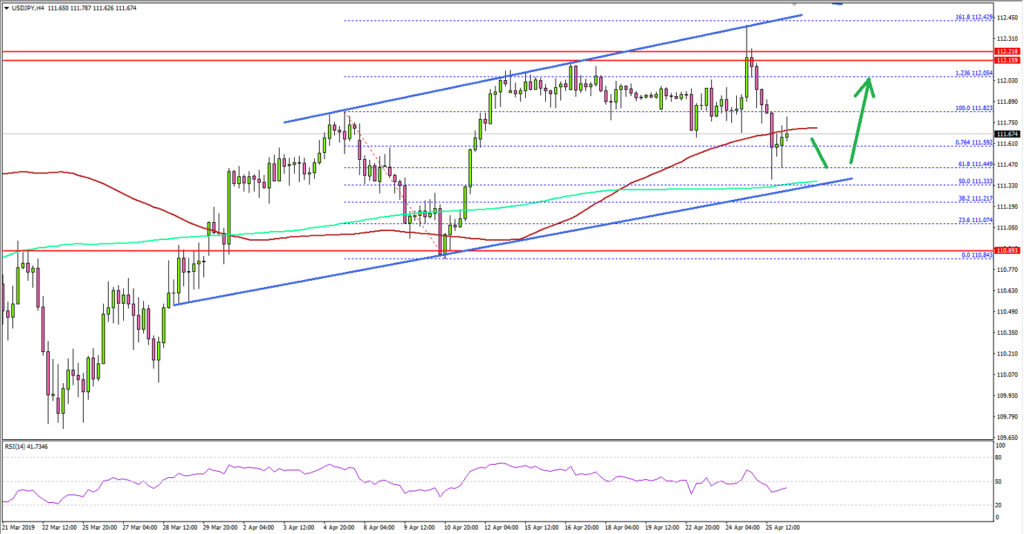
Looking at the 4-hours chart, the pair consolidated below the 112.00 resistance for a few sessions and tested the 1.236 Fib extension level of the last decline from the 111.82 high to 110.84 low.
Finally, there was a strong upward move above the 112.00 and 112.20 resistance levels. However, the pair failed to gain momentum above 112.40 and formed a short term top near the 112.42 level.
It seems like the pair completed the last upward wave close to the 1.618 Fib extension level of the last decline from the 111.82 high to 110.84 low. There was a sharp decline below 112.20 and 112.00.
On the downside, there is a strong support near the 111.30 level and 200 simple moving average (4-hours, green). Besides, there is an ascending channel in place with support at 111.30 on the same chart.
If there is a downside break below the channel support, the pair could revisit the 110.85 support area. On the upside, the 112.00, 112.20 and 112.45 levels are important hurdles for more gains.
Fundamentally, the US Durable Goods Orders report for March 2019 was released by the US Census Bureau. The market was looking for a 0.8% increase in orders compared with the previous month.
The actual result better than the forecast as the US Durable Goods increased 2.7%. Besides, the last reading was revised up from -1.6% to -1.1%.
The report added that:
This increase, up four of the last five months, followed a 1.1 percent February decrease. Excluding transportation, new orders increased 0.4 percent.
Overall, the USD/JPY pair remains supported on dips near 111.30. On the other hand, there were additional losses in EUR/USD and GBP/USD in the past few sessions.
Economic Releases to Watch Today
- US Gross Domestic Product Q1 2019 (Preliminary) – Forecast 2.1% versus previous 2.2%.
- US Personal Consumption Expenditures Prices for Q1 2019 (QoQ) (Preliminary) – Forecast +1.3%, versus +1.5% previous.
- US Core Personal Consumption Expenditures for Q1 2019 (QoQ) (Preliminary) – Forecast +1.6%, versus +1.8% previous.
EURJPY Weakens On Price Sell-Off With Eyes On 123.65 Zone
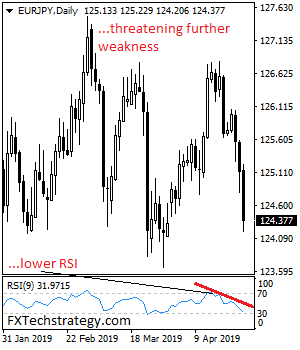
EURJPY weakens on price sell-off following as it holds on its nearer term bear pressure. Support comes in at the 124.00 level where a break if seen will aim at the 123.50 level. A cut through here will turn focus to the 123.00 level and possibly lower towards the 122.50 level. Its daily RSI is bearish and pointing lower suggesting further weakness. On the upside, resistance resides at the 124.50 level. Further out, we envisage a possible move towards the 125.00 level. Further out, resistance resides at the 125.50 level with a turn above here aiming at the 126.00 level. On the whole, EURJPY retains downside nearer term.
Crude Lower As Disruptions Raise Doubts On OPEC+ Extension
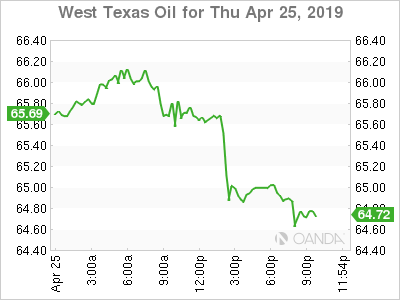
Oil prices fell on Thursday despite news of supply disruptions in European imports of Russian crude. Contamination concerns shutdown the Druzhba pipeline that can ship up to 1 million barrels per day. The issues will most likely be temporary, but it did boost Brent prices above the $75 price level. West Texas Intermediate was stable as the news of Russian disruptions become more widespread, but as the narrative in the background has focused on what the OPEC can do to offset the supply issues, prices are dropping.
The OPEC has partnered with major producers to stabilize prices by limiting production in an effort to soak excess supply. Geopolitical issues such as the US sanctions against Venezuela and Iran as well as the military actions in Libya have also affected the amount of crude in the market. The OPEC+ and geopolitical disruptions have been the two main factors acting against a rising US production keeping prices higher, but as the June deadline for the production cut agreement nears an extension is not a slam dunk.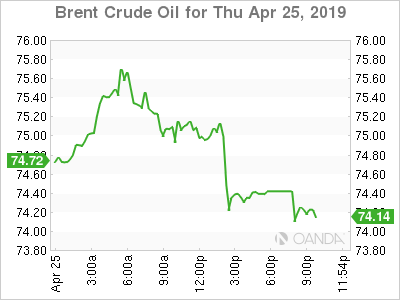
The US will continue to pressure Saudi Arabia to lift its production to cover the supply gap and Russia has not signalled a total commitment to an extension. The June OPEC and major producer ministerial meeting will be the pivotal moment for the energy sector this year.
Eco Data 4/26/19
[php_everywhere instance="1"]
Central Banks Become Extra ‘Dovish’
Rate differentials, global growth concerns and G7 Central Banks ‘extra’ dovish rhetoric this week has provided the U.S dollar ample support to be trading at six-month highs across the board. Even the petro-currencies are having trouble gaining traction despite the elevated crude oil prices. Brent, in particular, has been receiving support from a halt of Russian oil exports to Poland and Germany via a pipeline due to quality concerns and also from the U.S announcement this week that it would end all exemptions for sanctions against Iran, demanding countries to halt oil imports from Tehran from May.
All eyes are now on tomorrow’s advance Q1 U.S GDP release (08:30 am EDT). Investors are looking for clues on how the U.S economy responded to Trump’s government shutdown and fallout from the Q4 market rout.
Central Banks become extra ‘dovish’
On Thursday, Sweden’s Riksbank tweaked its forward guidance so that the Repo Rate would remain at current level for somewhat longer period of time than was forecasted back in February – the next potential rate hike is near year-end or in early 2020 (revised from H2 of 2019). The Riksbank also extended its QE program and would buy government bonds for nominal value of SEK45B from July 2019 to December 2020.
In Japan, the Bank of Japan (BoJ) kept its policy steady but clarified its forward guidance to reinforce it will not hike anytime soon. Governor Kuroda in his press conference stated that it was “possible that the time frame under forward guidance could exceed the spring of 2020 thus could keep low rates beyond that time period.” He reiterated that a “virtuous economic cycle was in place, but consumer prices had remained somewhat weak,” and expects CPI to pick up towards the +2% target “gradually but likely would take time.”
In Canada, the Bank of Canada (BoC) held its key interest rate steady yesterday and lowered its growth forecast for this year, signaling that further rate increases are unlikely in the near term. By dropping any reference to future rate hikes, Governor Poloz delivered his most ‘dovish’ signal in two-years.
Brexit
Nothing really has changed since the Easter holiday break.
There is talk of U.K PM Theresa May trying to pass the Withdrawal Agreement with amendable bills, but nothing major has changed. No votes are planned yet, talks with Labour are ongoing, but not progressing.
Italy credit rating
Italy’s falling bond yields have helped improve debt financing costs, and that will probably shield the country from an S&P downgrade this Friday (expected after 04:30 PM EDT – currently, S&P rates Italy at BBB, two notches above junk, but has a negative outlook on the country). While the consensus expects Italy will maintain its investment-grade status, a cut cannot be ruled out. The 10-year BTP/bund yield spread has widened from last week to +264 bps, but the pace is measured, which suggests that the market probably expects ‘no change’ from the ratings agency.
Trade
On the Sino-U.S trade front, Trade Representative Robert Lighthizer and Treasury Secretary Steven Mnuchin announced earlier this week that they will travel to Beijing for trade talks beginning on April 30.
On the Economic Calendar, no releases are scheduled for this weekend. Japan’s 10-day Golden Week holidays begin this weekend and in Spain, Parliamentary election take place this Sunday (Apr 28).
Current market concerns:
• New trade war fronts opening up US/EU, US/USMCA, US/MEXICO
• U.K/Brexit fallout
• US-China trade deal – details may emerge
• Trans-Atlantic trade tensions to intensify
• OPEC, Saudis, Venezuela & Trump
• Iran is threatening to close the Strait of Hormuz
• Venezuela/Russia/U.S tension
• Geo-political concerns in Russia, Ukraine & France
• India/Pakistan – tension remains high amongst two nuclear nations
• U.S ramps up trade talks with India and Turkey
• ‘Twitter Trump’
• Spanish election expected to deliver a “minority” surprise April 28
Next week: ANZ Business confidence (Apr 29), CAD GDP, consumer confidence & NZD employment change (Apr 30), Bank holiday – CNY, CHF, GER. Fr. & ITL, U.S ISM manufacturing PMI, FOMC monetary policy statement & CNY Caixin manufacturing PMI (May 1), U.K inflation report, BoE monetary policy statement & AUD building approvals (May 2), non-farm payroll (May 3).
US: Durable Goods Orders Rebounded in March
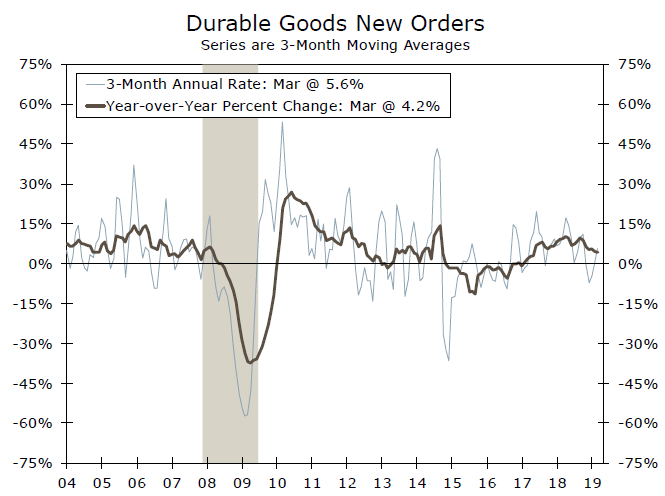
Durable goods orders rose 2.7% in March. Core capital goods orders suggest the economy has momentum going into Q2, but core capital goods shipments still suggest weak business spending in tomorrow's Q1 GDP report.
Orders Rebounded in March, Q1 Business Spending Still Weak
Durable goods orders rose a solid 2.7% in March, and February's decline was upwardly revised to a drag of 1.1% (-1.6% previously). Recent months have been influenced by the volatile commercial aircraft sector; orders jumped 31.2% in March after declining 25.4% in February. Orders excluding transportation rose a more modest 0.4% over the month.
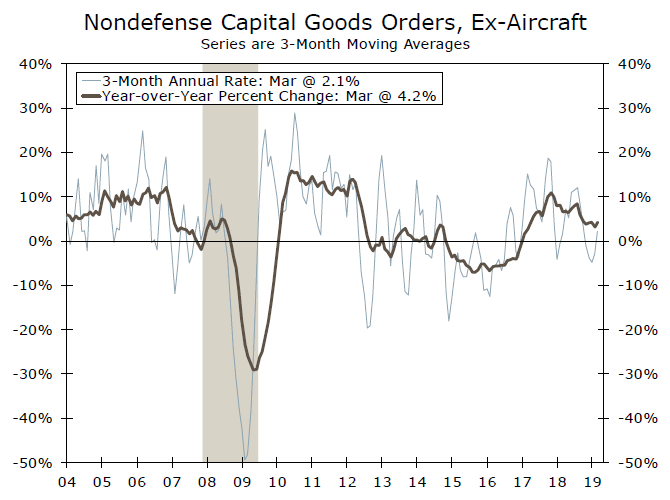
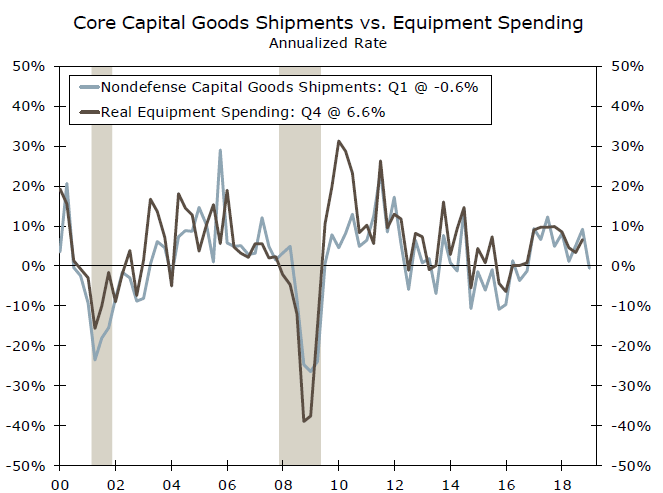
Core capital goods orders—a key leading indicator of future business spending—rose 1.3% in March, suggesting the economy may be carrying momentum into the second quarter. But, the fall in core capital goods shipments (down 0.2%) still suggests a weak outturn for business spending in tomorrow's first estimate of Q1 GDP.
If the jump in core capital goods orders is sustained in coming months, it would suggest stronger business spending in the second quarter—at the very least today's core orders figure suggests business spending is not slowing as rapidly as initially feared.
Impact from Boeing's 737 MAX
At the beginning of March, aviation authorities around the world grounded the 737 MAX aircraft after two fatal crashes, and Boeing announced a halt in deliveries and a production cut to the 737 family. As we have previously written, the total impact on durable goods shipments from the recent halt in deliveries could be substantial. Boeing's 737 MAX has comprised almost half of Boeing's orders in the past few years, and aircraft orders made up almost 10% of total durable goods orders last year.
The solid outturn for durable goods orders in March suggests the grounding of the 737 MAX wasn't a huge factor for March orders. Only one airline has cancelled an order and widespread cancellations remain unlikely, suggesting orders will likely still roll in. The halt of deliveries in mid-March, however, suggests the value of durable goods shipments will be dragged down by aircraft over the next few months. Nondefense capital goods shipments, which were flat in March, still suggest a weak outcome for equipment spending in the first quarter (bottom chart).
Boeing cut production of the 737 from 52 to 42 aircraft per month in mid-April, suggesting we will see an impact from the decreased production in the second quarter. We have cautioned the precise impact to our GDP outlook depends on a number of factors, including how long Boeing produces at the lower rate, when aviation authorities around the world give the airlines the all clear to fly and how quickly Boeing can clear some backlog. Further, given Boeing announced on Wednesday that it was withdrawing its forward financial guidance, the timing of the 737 MAX return remains largely uncertain. Under our current assumption, the 737 decreased production stands to reduce Q2 GDP growth by about 0.2 percentage points.
US update: Yen surges as stocks tumble on 3M warning, DOW risking near term reversal
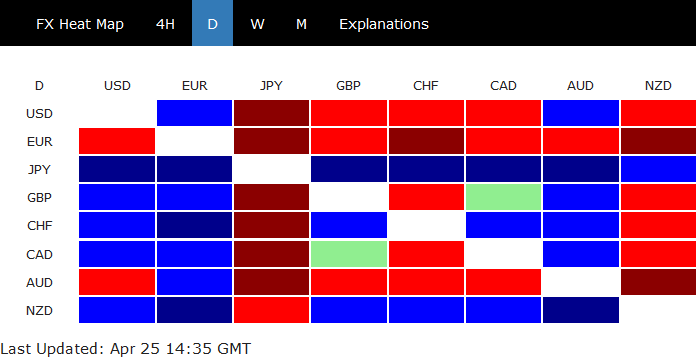
Yen surges broadly while Dollar is under some pressure as US stocks are in steep selloff. Industrial giant 3M is the key driver in the markets as it slashed 2019 full-year guidance and announce 2000 job cuts. It's more than enough to offset the lift by Microsoft, which reported healthy quarterly results yesterday.
At the time of writing, DOW is already down -253 pts, or 0.95%. S&P 500 is down -0.40%. NASDAQ made new record high at 8151.84 but quickly retreated and is down -0.27%.
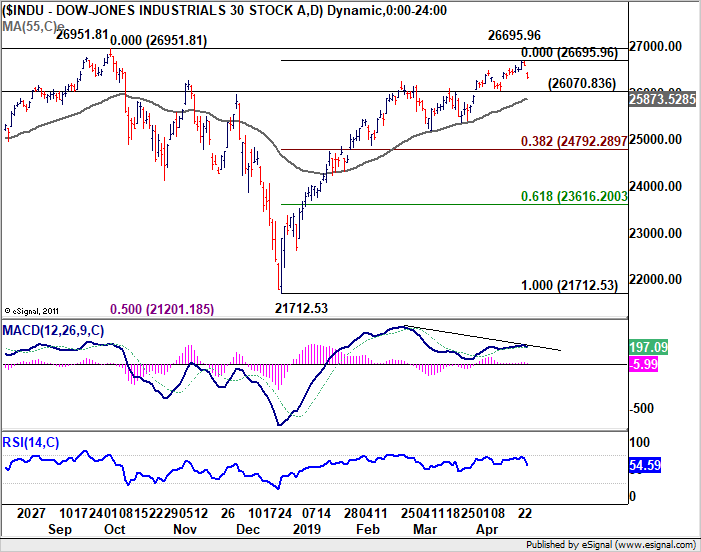
 We'd noted before that we're not convinced that US stocks are ready to resume long term up trend. Risk of reversal, at least for near term, is high with S&P 500 and NASDAQ close to record highs. Break of 2891.90 support in S&P 500 will bring pull back to 55 day EMA (now at 2825.33). Similarly, break of 7950.97 in NASDAQ will bring pull back to 55 day EMA (now at 7710.88.
DOW has been the under performer comparing with the other two major indices. With today's gap down, focus will be on 26070.83. Break will be the first sign that rise from 21712.53 has completed, ahead of 26951.81 record high, on bearish divergence condition in daily MACD. Deeper fall should then be seen, at least, to 38.2% retracement of 21712.53 to 26695.96 at 24792.29. Such development would drag down USD/JPY, as well as other Yen crosses. But we wouldn't expect it to prompt deep selling in Dollar elsewhere.
MARKET WRAP: Stocks Closed Lower, Gold Advanced
The US Core Durable Goods Orders m/m number failed to support the markets. Oil traded mostly mixed.
Stocks
- The S&P 500 Index dropped 0.15 percent as of 15:30 in London.
- The Stoxx Europe 600 Index fell 0.46 percent while the FTSE declined 0.82 percent.
- The MSCI Asia Pacific Index fell 0.91 percent.
Currencies
- The Dollar Spot Index dropped 0.07 percent despite upbeat data, Core Durable Goods number came in at 0.4 percent vs Est 0.2 percent.
- The Euro dropped 0.16 percent to $1.1141, the Spanish unemployment rate ticked higher to 14.7 percent.
- The Japanese yen gained 0.3 percent to 111.59 per dollar.
- The British pound dropped below 1.30 and decreased by 0.12 percent to $1.2907.
Bonds
- The yield on 10-year Treasuries moved higher by one basis points to 2.53 percent.
- Germany’s 10-year yield was unchanged at -0.01 percent.
- Britain’s 10-year yield fell by two basis point to 1.15 percent.
Commodities
- Crude oil dropped 0.12 percent to $65.84 a barrel.
- Gold recovered some of its losses and move higher by 0.41 percent to $1,284 an ounce.
Brent Crude – Where Does the Rally End?
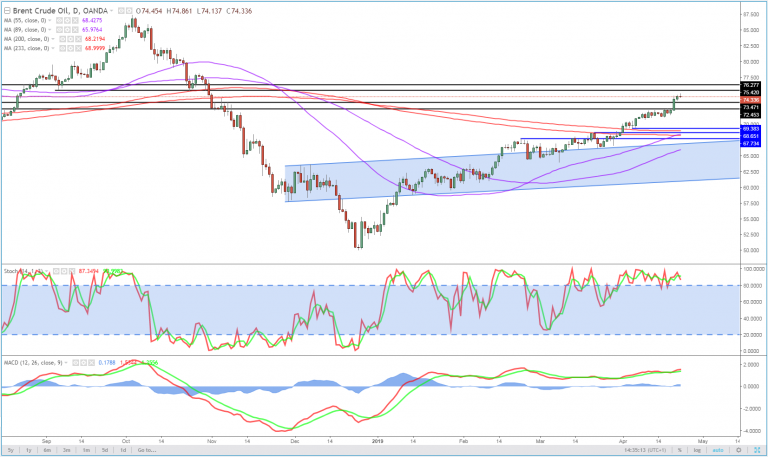
Oil gathering momentum as Brent hits new highs
Oil prices are on the rise again on Thursday, with the inventory data from API and then EIA over the last 48 hours merely causing a pause in the rally despite reporting large increases. It would appear traders are far more interested in oil waivers that were granted by the US to eight countries that expire in May, affecting up to a million barrels of oil purchases each day.
While it was reported that the US, Saudi Arabia and UAE will fill the void left by any shortfall, there are serious doubts about how and when this would be achieved. And when you consider the fact that two of the three are currently actively trying to curb output in order to rebalance the market and lift prices, you have to question the motivation to then step in and turn on the taps.
From a traders perspective, this means fresh six month highs in Brent crude, with WTI lagging slightly behind. What’s interesting is that momentum doesn’t appear to be lacking from the latest moves which suggests prices could continue to rise. Brent could face an interesting test around the $75.50-76.25 range, with resistance above here coming around $79-80.
Gold – Cause for Optimism?
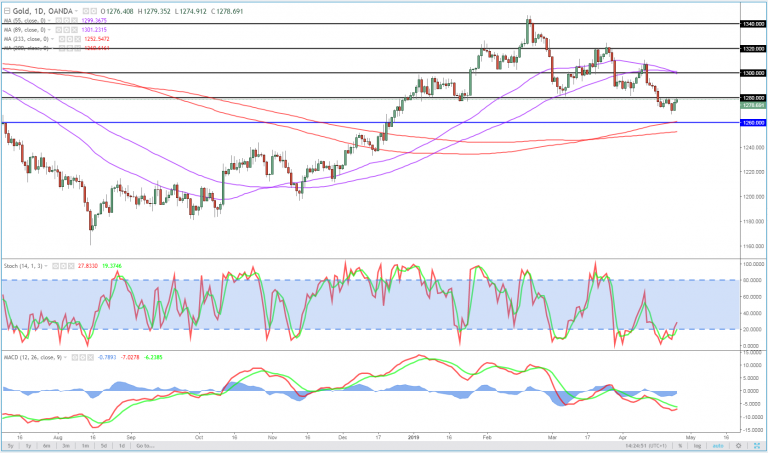
Gold is trading in the green for a second day on Thursday, buoyed by some softness in the dollar.
Gold bulls are also likely boosted by price action on Wednesday when the yellow metal made gains even as the greenback surged to a near two-year high. This is encouraged as the relationship between the two is usually negative but a stronger dollar failed to hold it back.
What’s more, the recent break below $1,280 failed to generate downward momentum and each time a new low has been made it’s quickly been bought into. That is hardly encouraging for those that hoped the breakout would bring about another wave of selling, especially against the backdrop of a stronger dollar. Hope is not entirely lost for bears though.
Gold remains below $1,280 currently despite numerous tests which should be encouraging. What all this means is that $1,260 may in fact be a far more significant support level for the yellow metal, should it be tested.