Sample Category Title
Asian update: Dollar surge on “safe haven” flows, breaks key resistance
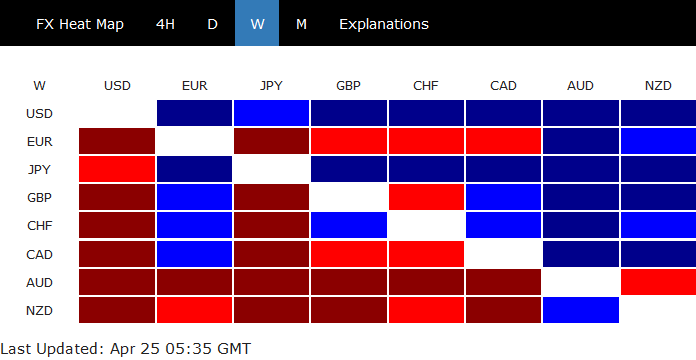
Dollar and Yen are overwhelmingly the strongest ones for the week. The steep declines in bond yields indicate clear "safe haven" flows. In particular, German 10-year bund yield turned negative again. US 10-year yield (TNX) also dived notably by -0.048 to 2.522. TNX was on a verge of reclaiming 2.6 handle just days ago.
However, risk aversion is not apparent in the stock markets yet. DOW, S&P 500 and NASDAQ just closed slightly lower overnight, with the latter two being close to record highs. Major Asian markets are just mixed and showed no response. The greenback was shot higher against after strong US corporate earnings, including Facebook, Microsoft and Visa. But Asian stocks shrugged.
In Asia, currently:
- Nikkei is up 0.52%.
- Hong Kong HSI is down -0.01%.
- China Shanghai SSE is down -0.93%.
- Singapore Strait Times is down -0.18%.
- Japan 10-year JGB yield is up 0.0076 at -0.028.
Overnight:
- DOW dropped -0.22%.
- S&P 500 dropped -0.22%.
- NASDAQ dropped -0.23%.
- 10-year yield dropped -0.0048 to 2.522.
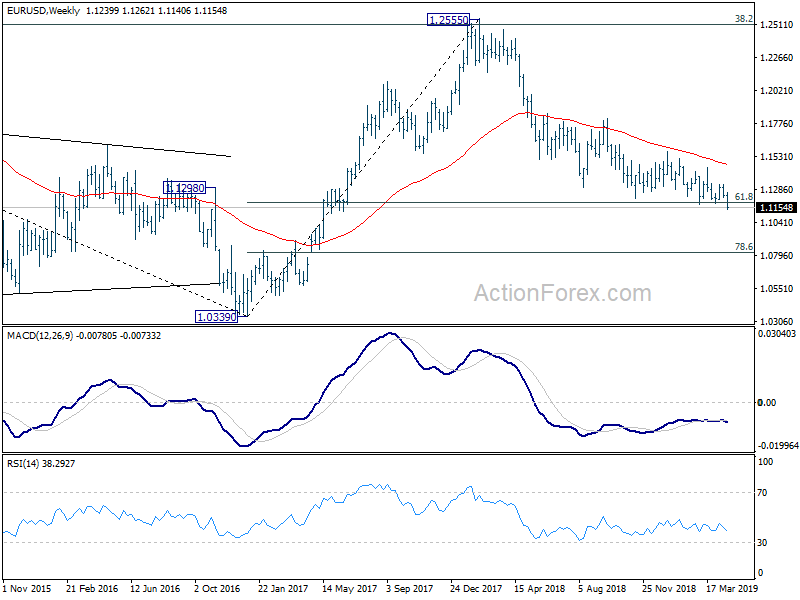
Technically, EUR/USD's break of 1.1176 support yesterday is worth a mention. The down trend from 1.2555 (2018 high) should be resuming. Medium term bearish is also maintained with EUR/USD staying well below 55 week EMA. Next medium term target will be 78.6% retracement of 1.0339 to 1.2555 at 1.0813.
Riksbanken In Focus As The BoJ Lowers GDP Estimates
Market movers today
Riksbanken will publish its monetary policy decision following the April meeting. We look for an unchanged rate path and an end to the QE programme. Although not a high conviction call this could see EUR/SEK move towards 10.35 (see more on page 2).
Also today the Turkish central bank (TCMB) will have its monetary policy meeting and make a decision on policy rates. In line with Bloomberg consensus, we expect the one-week repo rate to remain unchanged at 24.00 as inflation deceleration has stopped and the rising oil price risk is seen as a negative factor for both the Turkish economy and the current account balance.
In Norway Q2 manufacturing confidence is released today (see more on page 2).
In Sweden, apart from the Riksbank, we also get NIER's economic tendency survey (see more on page 2).
Selected market news
Following weaker than expected Australian Q1 CPIs, and a disappointing German Ifo survey, which saw bunds rally 5bp and EURUSD at close to 2y lows, the sights were set on the Bank of Canada's rate decision late in the European session. The market interpreted the BoC's decision as dovish as it firmed its 'on-hold' stance (policy rate unchanged at 1.75%) and markets are now pricing in a 50% probability of rate cuts over the coming 6M, despite the monetary policy report containing several upbeat elements on growth, inflation and capital utilisation. In our view, we would have to see a significant negative global growth shock or a Fed funds target cut for the BoC to cut rates, and thus the market reaction seems overdone. The USDCAD strengthened towards the 1.35 mark, but we still see a stronger CAD going forward on relative rates and higher oil. The decision and preceding events laid the foundation for a rally in US treasuries which saw 10y yields down 5bp.
Staying in the focus of central banks the BoJ kept its QQE with yield curve control unchanged at a meeting ending this morning. It tweaked the forward guidance somewhat though, now saying they "will keep very low-interest rates levels for an extended period of time at least through to around spring 2020". Until now there was now specific time frame for how long rates would be kept at low levels. The BoJ cut its GDP forecast for FY2018 ending in March from 0.9% to 0.6%, which is no surprise considering what looks like a weak Q1. In addition, FY2019 and 2020 GDP and inflation forecasts have been cut slightly. Particularly interesting is the new inflation outlook, which now includes FY2021. BoJ expects CPI inflation to hit 1.6% by then (lowest t+2 inflation forecast since 2013). That is, the BoJ does not expect to meet its inflation mandate within a two to three-year horizon.
Oil could not sustain its recent gains as American crude inventories saw a surprisingly big jump of 5.48 million barrels according the EIA. Also yesterday, according to Bloomberg, US government officials stated that Trump backed the recent attack on Tripoli by the Libyan opposition led by strongman Khalifa Haftar. This could potentially be a long term blow to Libya's growing and stabilising oil exports.
Elliott Wave View: AUD/USD Impulsive Decline
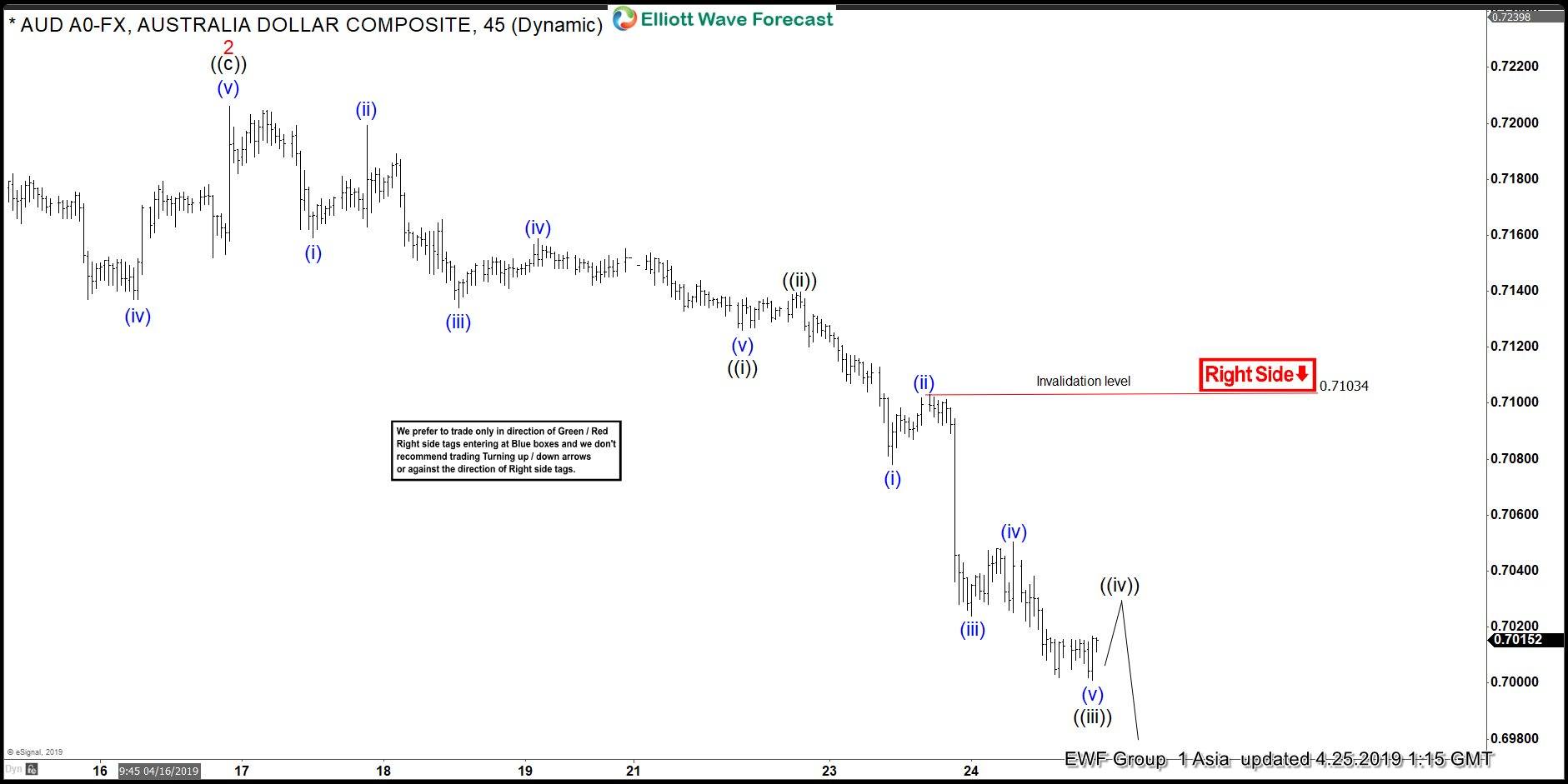
Short term Elliott Wave view in AUDUSD is calling the move lower from April 17, 2019 high (0.7206) as an impulse Elliott Wave structure. In the chart below, we can see rally to 0.7199 ended wave 2 bounce in Minor degree. Wave 3 is in progress and subdivides as an impulse in lesser Minute degree. Down from 0.7199, wave ((i)) ended at 0.7126 and bounce to 0.7139 ended wave ((ii)). Wave ((iii)) ended at 0.7 and while wave ((iv)) bounce fails below 0.714, expect further downside.
Pair is also close to breaking below March 8 low at 0.6999. If pair breaks below the level, it will create a bearish sequence from January 31 high. Wave ((iv)) bounce can potentially reach 23.6 – 38.2% Fibonacci retracement of wave ((iii)) at 0.703 – 0.7054 before the next leg lower. Ideally, the rally should not go more than 50% retracement of wave ((iii)) at 0.707 or the structure can change again. The alternate view calls the move lower from April 17, 2019 high has ended. This is however seems less likely based on the momentum. We don’t like buying the pair and expect rally to fail in 3, 7, or 11 swing.
1 Hour AUDUSD Elliott Wave Chart Asia Update
Germany’s Ifo Business Climate Index Unexpectedly Fell In April
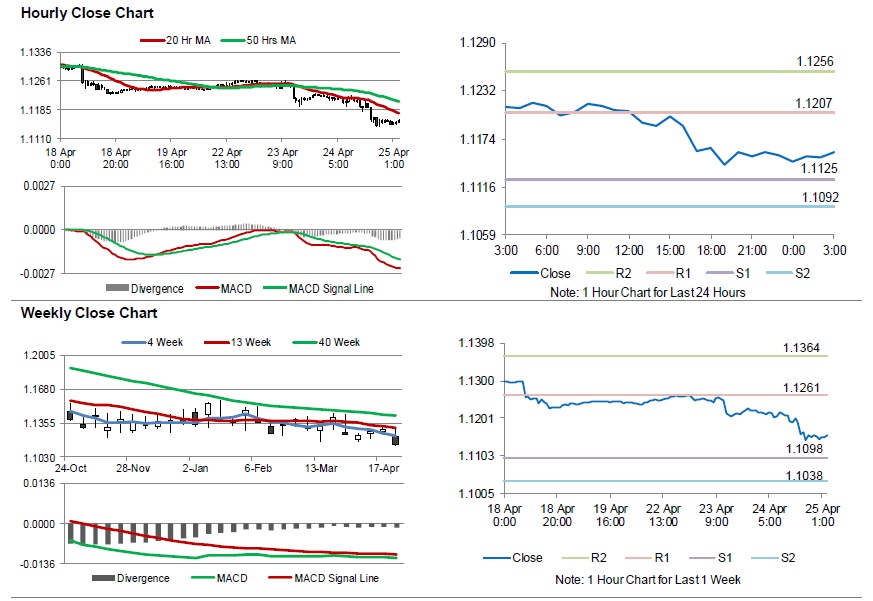
For the 24 hours to 23:00 GMT, the EUR declined 0.61% against the USD and closed at 1.1154.
On the data front, Germany's Ifo business climate index unexpectedly slid to a level of 99.2 in April, compared to a revised level of 99.7 in the previous month. Markets participants had envisaged the index to climb to a level of 99.9. Moreover, the nation's Ifo business expectations index surprisingly declined to a level of 95.2 in April, defying market expectations for a rise to a level of 96.1. In the prior month, the index had registered a reading of 95.6. Also, the Ifo current assessment index fell to a level of 103.3 in April, compared to a revised reading of 103.9 in the previous month. Markets had anticipated the index to register a fall to a level of 103.5.
In the US, data indicated that MBA mortgage applications plunged 7.3% on a weekly basis, in the week ended 19 April 2019, declining to its lowest level in four months and following a fall of 3.5% in the prior week.
In the Asian session, at GMT0300, the pair is trading at 1.1158, with the EUR trading marginally higher against the USD from yesterday's close.
The pair is expected to find support at 1.1125, and a fall through could take it to the next support level of 1.1092. The pair is expected to find its first resistance at 1.1207, and a rise through could take it to the next resistance level of 1.1256.
Amid lack of macroeconomic releases in the Euro-zone today, investors would focus on the US durable goods orders for March along with weekly initial jobless claims, slated to release later in the day.
The currency pair is trading below with its 20 Hr and 50 Hr moving averages.
UK’s Public Sector Net Borrowing Declined To A 17-Year Low In March
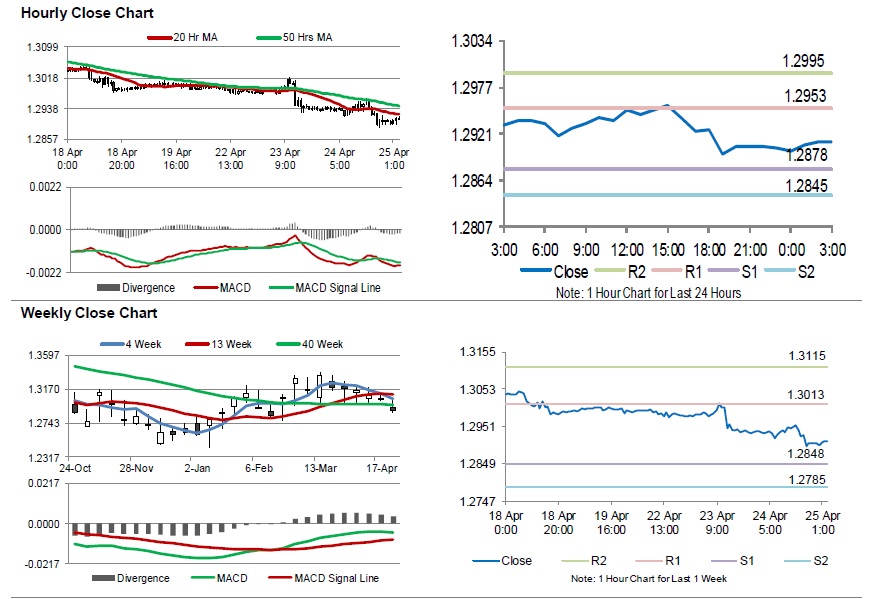
For the 24 hours to 23:00 GMT, the GBP declined 0.25% against the USD and closed at 1.2904.
Data showed that UK's public sector net borrowing posted a deficit of £0.84 billion in March, marking its lowest level in 17-years and defying market consensus for a surplus of £0.40 billion. In the preceding month, the nation registered a revised surplus of £0.51 billion.
In the Asian session, at GMT0300, the pair is trading at 1.2910, with the GBP trading 0.05% higher against the USD from yesterday's close.
The pair is expected to find support at 1.2878, and a fall through could take it to the next support level of 1.2845. The pair is expected to find its first resistance at 1.2953, and a rise through could take it to the next resistance level of 1.2995.
Moving ahead, traders would keep an eye on UK's CBI trends total orders and CBI business optimism for April, set to release in a few hours.
The currency pair is trading below its 20 Hr and 50 Hr moving averages.
The BoJ Left Its Key Interest Rate Unchanged
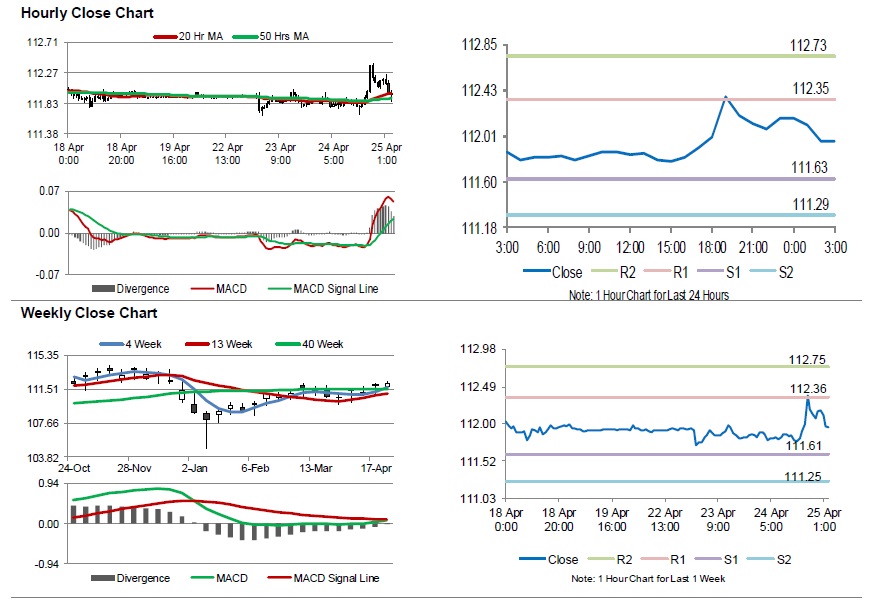
For the 24 hours to 23:00 GMT, the USD rose 0.28% against the JPY and closed at 112.17.
In economic news, Japan’s final leading economic index climbed to a level of 97.1 in February, compared to a reading of 96.5 in the prior month. The preliminary figures had recorded an advance to 97.4. Moreover, the nation’s final coincident index advanced to a level of 100.4 in February, following a level of 98.1 in the previous month. The preliminary figures had recorded an advance to 98.8.
In the Asian session, at GMT0300, the pair is trading at 111.96, with the USD trading 0.19% lower against the JPY from yesterday’s close.
The Bank of Japan (BoJ), at its April monetary policy meeting, opted to leave the interest rate steady at -0.1%, as widely expected and indicated that its interest rates are likely to remain at a very low-level till around the spring of 2020. Moreover, the central bank pledged the yield target for 10-year Japanese government bonds around 0% and kept its short-term interest rate target at -0.1%.
The pair is expected to find support at 111.63, and a fall through could take it to the next support level of 111.29. The pair is expected to find its first resistance at 112.35, and a rise through could take it to the next resistance level of 112.73.
Going ahead, traders would keep an eye on Japan’s jobless rate, industrial production, retail trade and large retailers’ sales, all for March, slated to release overnight.
The currency pair is showing convergence with its 20 Hr and 50 Hr moving averages.
Swiss Franc Trading A Tad Higher In The Morning Session
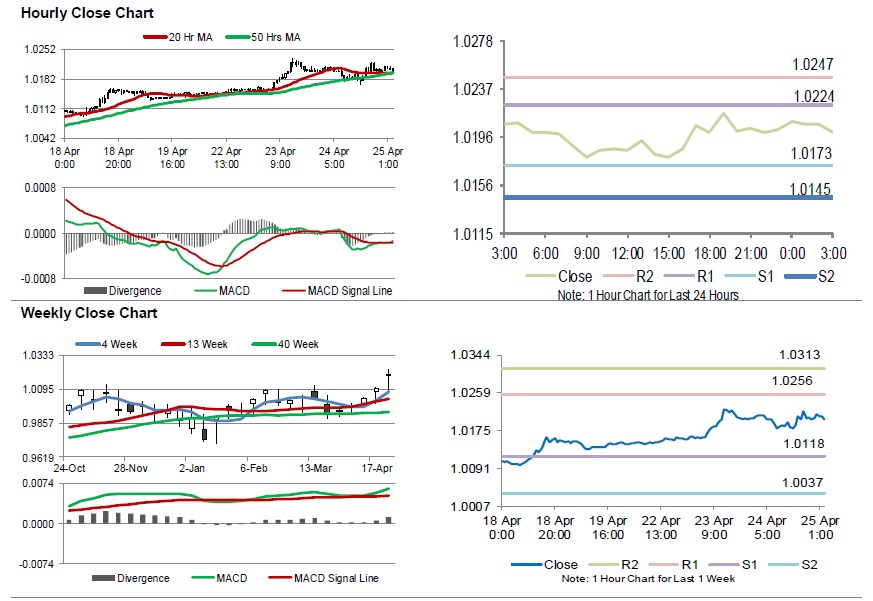
For the 24 hours to 23:00 GMT, the USD slightly rose against the CHF and closed at 1.0203.
In the Asian session, at GMT0300, the pair is trading at 1.0200, with the USD trading marginally lower against the CHF from yesterday’s close.
The pair is expected to find support at 1.0173, and a fall through could take it to the next support level of 1.0145. The pair is expected to find its first resistance at 1.0224, and a rise through could take it to the next resistance level of 1.0247.
With no macroeconomic releases in Switzerland today, investors would look forward to global macroeconomic releases for further cues.
The currency pair is showing convergence with its 20 Hr moving average and trading above its 50 Hr moving average.
The BoC Left Its Key Interest Rate Unchanged At 1.75%
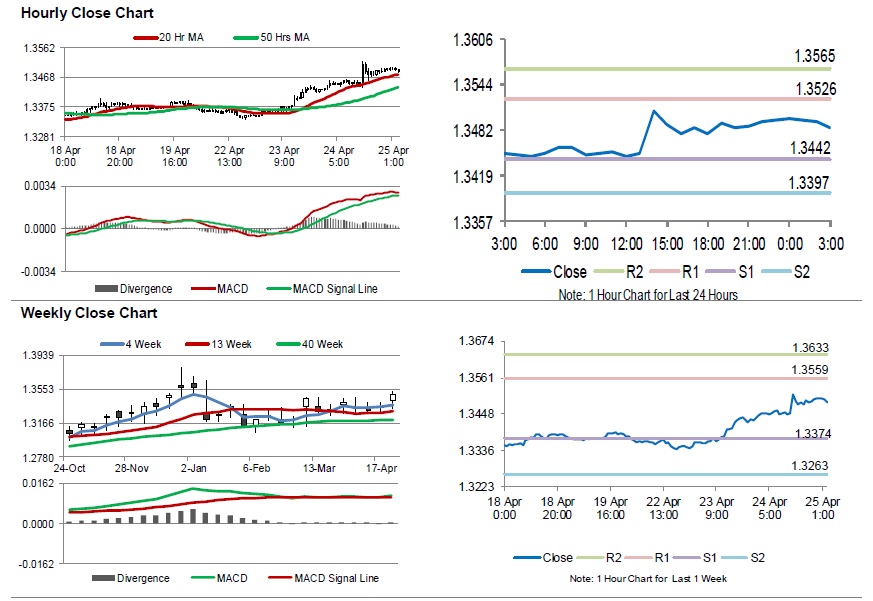
For the 24 hours to 23:00 GMT, the USD rose 0.5% against the CAD and closed at 1.3496.
The Bank of Canada (BoC), in its April monetary meeting, decided to keep its key interest rate unchanged at 1.75%, as widely expected and trimmed its economic forecast to 1.2% from 1.7% in order to observe the impact of its progresses on the household spending, oil markets and global trade.
In the Asian session, at GMT0300, the pair is trading at 1.3486, with the USD trading 0.07% lower against the CAD from yesterday’s close.
The pair is expected to find support at 1.3442, and a fall through could take it to the next support level of 1.3397. The pair is expected to find its first resistance at 1.3526, and a rise through could take it to the next resistance level of 1.3565.
Trading trend in the Loonie today is expected to be determined by Canada’s CFIB business barometer for April, scheduled to release later in the day.
The currency pair is trading above its 20 Hr and 50 Hr moving averages.
Aussie Reverses Its Losses In The Asian Session
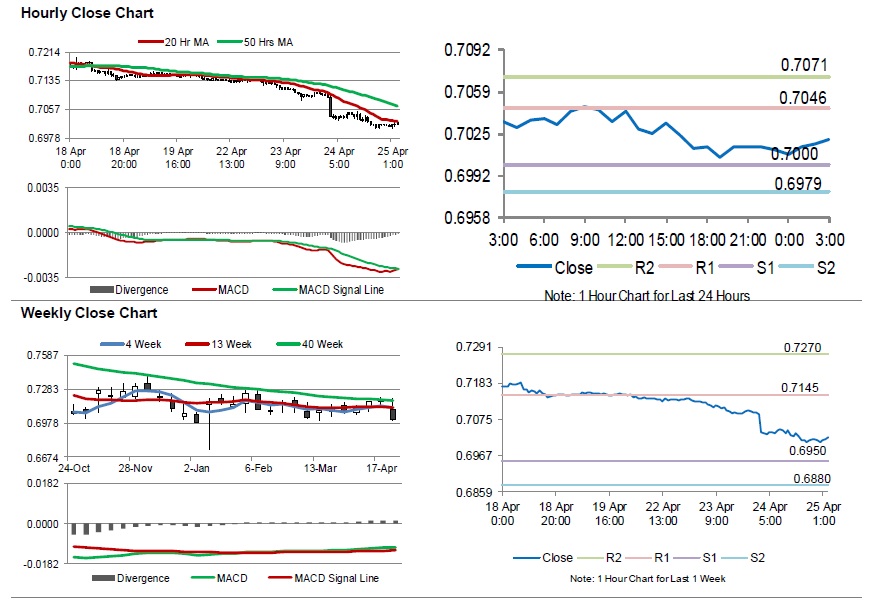
For the 24 hours to 23:00 GMT, the AUD declined 1.20% against the USD and closed at 0.7012.
LME Copper prices rose 0.1% or $7.5/MT to $6437.5/MT. Aluminium prices declined 0.1% or $1.0/MT to $1854.0/MT.
In the Asian session, at GMT0300, the pair is trading at 0.7021, with the AUD trading 0.13% higher against the USD from yesterday’s close.
The pair is expected to find support at 0.7000, and a fall through could take it to the next support level of 0.6979. The pair is expected to find its first resistance at 0.7046, and a rise through could take it to the next resistance level of 0.7071.
Looking ahead, investors would closely monitor Australia’s producer price index for the first quarter of 2019, set to release overnight.
The currency pair is showing convergence with its 20 Hr moving average and trading below its 50 Hr moving average.
Gold: Yellow Metal Extends Its Gains In The Morning Session
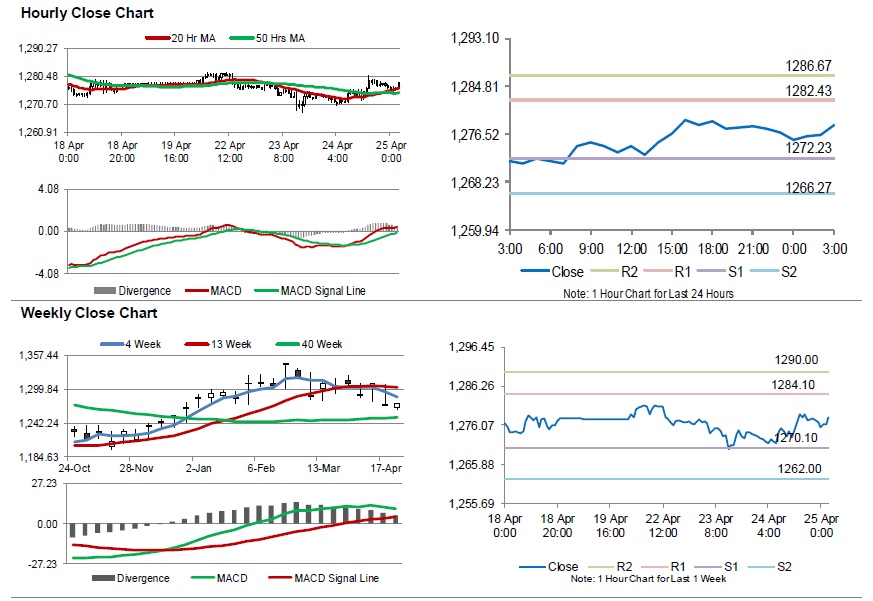
For the 24 hours to 23:00 GMT, Gold rose 0.30% against the USD and closed at USD1277.40 per ounce, as weakness in US stocks boosted demand appeal for the safe haven commodity.
In the Asian session, at GMT0300, the pair is trading at 1278.20, with gold trading 0.06% higher against the USD from yesterday’s close.
The pair is expected to find support at 1272.23, and a fall through could take it to the next support level of 1266.27. The pair is expected to find its first resistance at 1282.43, and a rise through could take it to the next resistance level of 1286.67.
The yellow metal is showing convergence with its 20 Hr moving average and trading above its 50 Hr moving average.