

Sample Category Title
Silver: White Metal Trading Flat This Morning
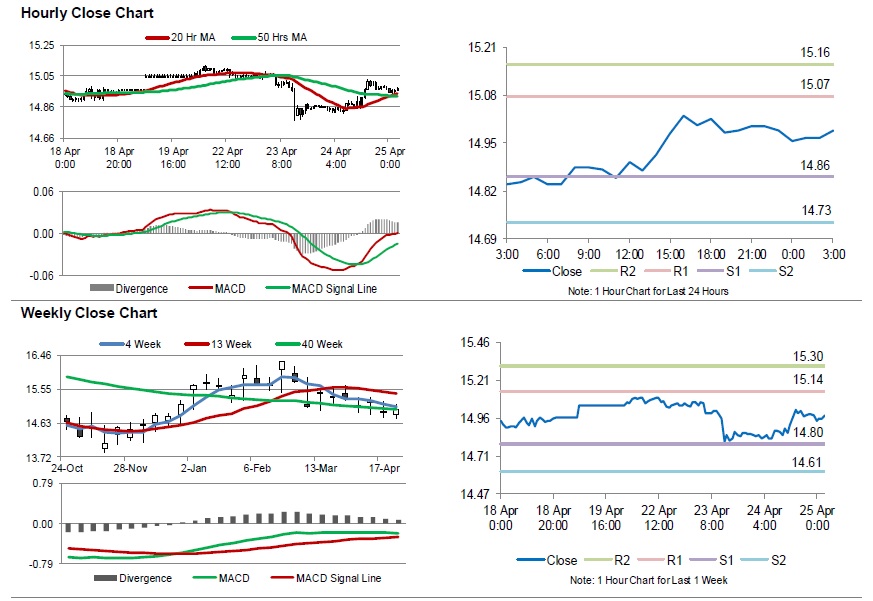
For the 24 hours to 23:00 GMT, Silver rose 0.81% against the USD and closed at USD14.98 per ounce, tracking gains in gold prices.
In the Asian session, at GMT0300, the pair is trading at 14.98, with silver trading flat against the USD from yesterday’s close.
The pair is expected to find support at 14.86, and a fall through could take it to the next support level of 14.73. The pair is expected to find its first resistance at 15.07, and a rise through could take it to the next resistance level of 15.16.
The white metal is trading below its 20 Hr and 50 Hr moving averages.
Crude Oil: Oil Trading Flat In The Asian Session
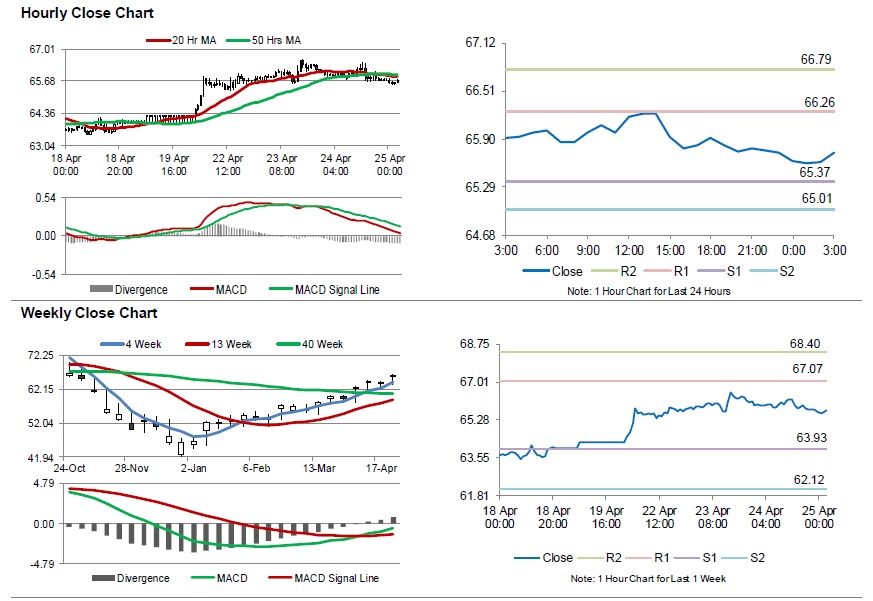
For the 24 hours to 23:00 GMT, Crude Oil declined 0.60% against the USD and closed at USD65.73 per barrel, after the Energy Information Administration (EIA) report indicated that US crude oil stockpiles rose by 5.5 million barrels to 460.6 million barrels in the week ended 19 April 2019, notching its highest level since October 2017.
In the Asian session, at GMT0300, the pair is trading at 65.73, with oil trading flat against the USD from yesterday’s close.
The pair is expected to find support at 65.37, and a fall through could take it to the next support level of 65.01. The pair is expected to find its first resistance at 66.26, and a rise through could take it to the next resistance level of 66.79.
Crude oil is trading below its 20 Hr and 50 Hr moving averages.
Daily Markets Broadcast
Wall Street retreats from highs
Upward momentum stalled on Wall Street yesterday, with only the NAS100 index extending gains, as earnings reports failed to continue the strong trend. Holidays in Australia and New Zealand may impact liquidity during the Asian session.
US30USD Daily Chart
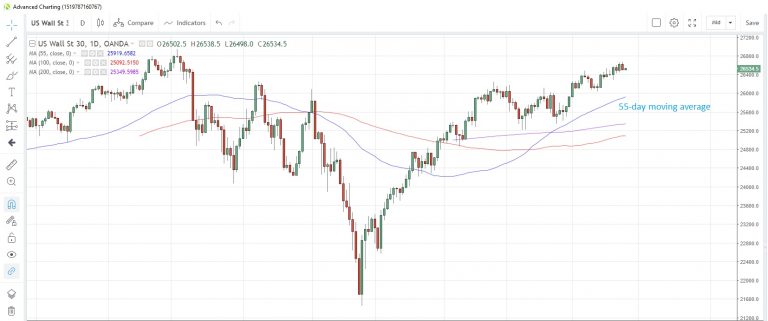
The US30 index touched the highest level since October 5 yesterday before giving back gains to close lower on the day. Boeing and Tesla were drags on sentiment
Rising 55-day moving average support is at 25,919 today
US durable goods orders are expected to rise 0.8% m/m in March, a sharp rebound from February's 1.6% decline, as the volatility in this data series continues.
DE30EUR Daily Chart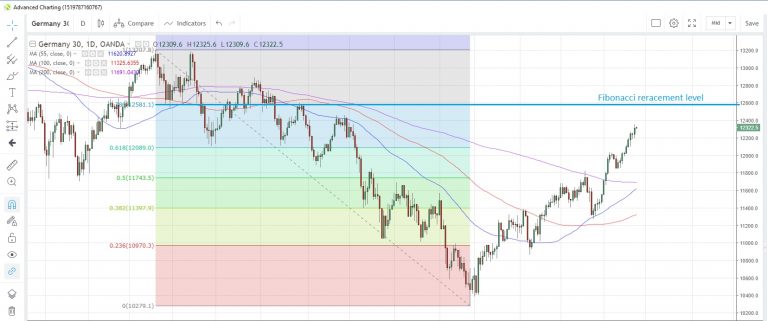
The Germany30 index climbed to a near seven-month high yesterday, despite further disappointments from the IFO surveys, as it took its cue from Wall Street
The index touched the highest since October 1 yesterday. The 78.6% Fibonacci retracement of the May-December drop is at 12,581
Germany's IFO surveys for April were all below forecast with the current assessment slipping to 103.3 from 103.8, the business climate index to 99.2 from 99.6 and the expectations index to 95.2 from 95.6.
CN50USD Daily Chart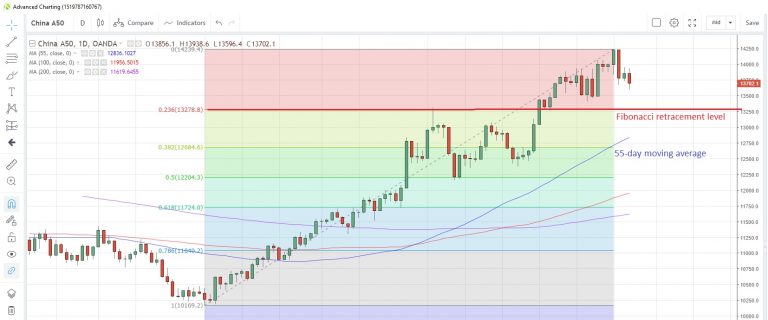
The China50 index slid to an eight-day low yesterday despite local reports of “substantial” progress in the trade talks with the US
Prices are heading toward Fibonacci support at 13,278, which is the 23.6% retracement of the rally to April 19. The 55-day moving average is at 12,836 and the index has traded above this average since January 22
China's Premier Li acknowledged that the domestic economy is facing downward pressure. The government is to keep economic activity within a reasonable range by deepening reforms and cutting taxes.
Market Morning Briefing: The Euro-Yen Has Fallen To 125
STOCKS
Equities broadly remain bullish. Asians are in a consolidation phase within their overall uptrend. DAX looks stronger than others as it has broken above a crucial resistance.
Dow (26597.05, -59.34, -0.22%) has come-off slightly yesterday. But the outlook remains bullish. Key supports are at 26560 and 26500 which can limit the downside in the near term. Dow can test 26750 in the near term and an eventual break above it will take it further higher to 27100 in the coming weeks.
DAX (12313.16, +77.65, +0.63%) has risen past the crucial 12275-12300 resistance region. A further rise to 12400-12450 is possible in the coming days if DAX sustains above 12300
Nikkei (22281, +98.10, +0.44%) has bounced within its 22050-22350 sideways range. We continue to remain bullish and expect the Nikkeit to break the range above 22350 and rise to 22700 in the coming days.
Shanghai (3188.13, -13.49, -0.42%) dipped to test 3150 yesterday and has bounced from there. The 3150-3280 sideways range is holding as of now. But Shanghai has to rise past 3200 to ease the pressure and move higher towards the upper end of the range.
The supports at 38500 on the Sensex (39054.68, +489.80, +1.27%) and 11550 on the Nifty (11726.15, +150.20, +1.30%) has held very well. Both the indices have bounced sharply yesterday. The 3-day candle suggests a sideways move between 38500 and 39500 in the Sensex. Nifty on the other hand, has resistance at 11800 which can be tested in the near term. Whether Nifty breaks above 11800 or not will decide the next move.
COMMODITIES
Gold can continue to consolidate and even rise slightly with the sideways range in the coming sessions before we see a fresh fall. Copper has bounced from the key support and is retaining the sideways range. Among the oils, though Brent has little room on the upside, the WTI has already tested the crucial resistance and is giving early signs of a pull-back move. Crude inventories increasing much more than expectation has capped the upside for the moment.
Gold (1275) is still stuck around 1270 has bounced from 1268. While above 1270, a test of 1280-1283 is possible in the near term. It can continue to consolidate sideways between 1270 and 1283 for some more time before we see a fresh fall to 1260.
Silver (14.92) has bounced from the key support level of 14.75 mentioned yesterday. If it sustains above 14.90, a test of 15.00-15.05 is possible in the coming sessions. A range bound move between 14.75 and 15.05 looks likely in the near term.
Copper (2.91) is bouncing from the key support level of 2.88. This keeps the 2.88-2.99 sideways range intact. A test of 2.92 is likely in the near term. A break above 2.92 will take copper higher to 2.96 and 2.99 - the upper end of the range in the coming days.
Brent (74.35) is stuck in a narrow range between 74 and 74.75 over the last couple of days. We continue to remain cautious as there is a strong resistance near 76. A pull-back from there can trigger a corrective fall to 73-72 going forward.
WTI (65.60) is looking weaker than Brent. It has tested the key resistance around 67 already and is giving early signs of a corrective fall. A test of 64.75-64.5 looks likely in the coming sessions.
FOREX
US Dollar looks strong and could rise towards 99 while Euro may test 1.11-1.10 in the medium term. Yuan and Rupee may weaken while Aussie tests important support at current levels.
The Dollar Index (98.01) moved up sharply yesterday to 98.05, breaking above the weekly horizontal resistance of 98. If 98 holds immediately, it could fall towards 97-96 in the coming weeks; else a further rise towards 99 is likely to be seen soon.
The Euro (1.1158) tested 1.1140, breaking below the daily supports near 1.12 and 1.1150 as seen on the daily candles chart. There is scope of falling towards 1.11-1.10 in the medium term. 1.11 could act as a decent support just now leading to some interim corrective upmoves but overall the longer term trend looks bearish.
The Euro-Yen (125.03) has fallen to 125. As mentioned earlier there is scope of testing 124 or even 123 on the downside. Near term looks bearish.
Dollar-Yen (111.98) tested 112.40 yesterday but has now come back to trade below 112. While we consider a rise towards 112.50-113, both are important resistances above current levels. At the same time near term support is also visible near 111.50 which if holds strong could pull up Dollar Yen. A sharp rise in Dollar Index towards 99 could also pull up Dollar Yen.
The Aussie (0.7021) fell to test support at 0.70. If that holds, Aussie could see some corrective bounce towards 0.71/72. Else a fall towards 0.69 is on the cards for the near term.
USDCNY (6.7260) is looking bullish towards 6.74/76 in the coming sessions and is likely to rise while above 6.72.
Dollar-Rupee (69.88) is likely to test 70.0-70.25 on the upside while the pair holds above 69.75.
EURINR (78.0985) has immediate support at 78 on the daily and lower support at 77 on the weekly charts which is likely to hold in the near term.
INTEREST RATES
The US yields have fallen as expected. The 2Yr (2.32%), 5Yr (2.31%), 10Yr (2.52%) and 30Yr (2.93%) fell from 2.35%, 2.36%, 2.56% and 2.98% seen yesterday, in line with our expectation. The yields look further bearish in the near term. The 5yr, 10yr and 30yr could target 2.29%, 2.48% and 2.90/88% respectively in the next few sessions before pausing.
The US-JGB 10YR (2.56%) is sharply down from 2.60% resistance mentioned yesterday. While the resistance holds, it could fall eventually pulling down Dollar Yen with itself. Watch resistances at 112.50 and 113 on Dollar Yen.
The 10Yr GOI (7.5487%) oscillated around 7.55% yesterday. While we consider a dip to 7.50%, we would look for any immediate bounce to higher levels of 7.60/65% in the near term.
EUR/GBP Remains Supported On Dips Above 0.8600
Key Highlights
- The Euro struggled to break the 0.8680 resistance against the British Pound.
- EUR/GBP recently traded below a bullish trend line at 0.8660 on the 4-hours chart.
- The German IFO Business Climate Index declined to 99.2 in April 2019 from 99.6.
- The US Durable Goods Orders in March 2019 could increase 0.8%, whereas the last was -1.6%.
EURGBP Technical Analysis
The Euro faced a strong resistance near the 0.8680 level and recently declined against the British Pound. However, the EUR/GBP pair remains well supported on the downside near 0.8620 and 0.8600.
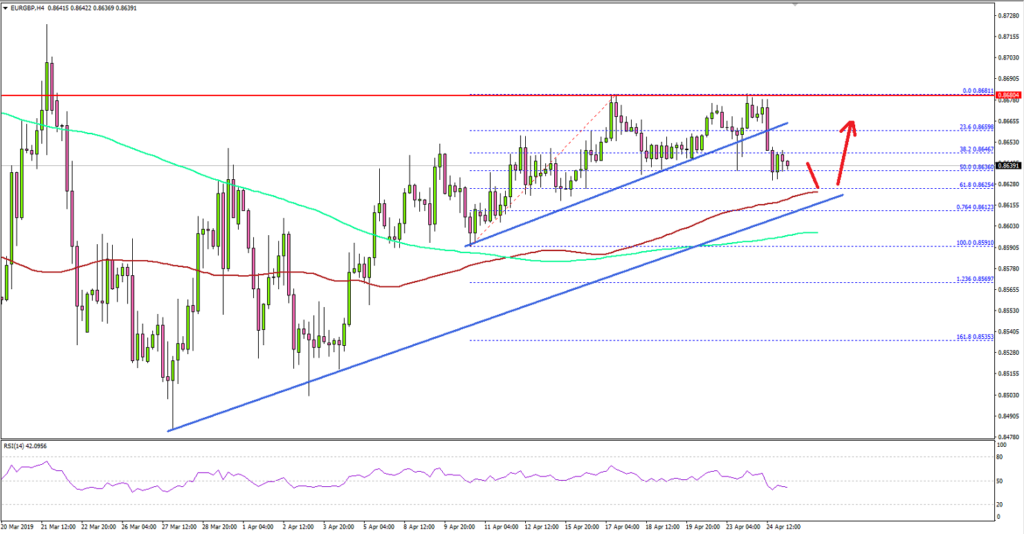
Looking at the 4-hours chart, the pair traded higher steadily after it settled above the 0.8600 resistance and the 100 simple moving average (4-hours, red). The pair climbed towards the 0.8700 level, but it failed to clear the 0.8680 level on two occasions.
As a result, there was a bearish reaction recently below the 0.8670 level and a bullish trend line at 0.8660. The pair tested the 50% Fibonacci retracement level of the last major wave from the 0.8591 low to 0.8681 high.
However, there are many supports on the downside near the 0.8620 and 0.8600 levels. More importantly, the 100 simple moving average (4-hours, red) is positioned near 0.8620 and the 200 simple moving average (4-hours, green) is near 0.8600.
There is also a connecting bullish trend line in place with support near 0.8620 on the same chart. Therefore, as long as EUR/GBP is above 0.8600, it is likely to bounce back in the near term.
On the upside, the main resistance is near 0.8680, above which the pair is likely to climb above 0.8700 and 0.8720.
Fundamentally, the German IFO Business Climate Index for April 2019 was released by the CESifo Group. The market was looking for a minor rise in the index from the last reading of 99.6 to 99.9.
The actual result was below the forecast as there was a decline in the index to 99.2, instead of a rise to 99.9. The IFO Current Assessment index also declined from 103.8 to 103.3.
The report added that:
In manufacturing, the business climate has again worsened markedly. Once more, companies rated their current situation less favorably. Pessimism has also grown regarding the coming months. Capacity utilization fell by 0.8 percentage points to 85.4 percent. This is still higher than the long-run average of 83.7 percent.
Overall, there could be short-term bearish moves in EUR/GBP, but it is likely to gain traction as long as above 0.8600. On the other hand, EUR/USD and GBP/USD traded to new weekly lows recently, and both are currently consolidating losses.
Economic Releases to Watch Today
- US Durable Goods Orders for March 2019 – Forecast +0.8% versus -1.6% previous.
- US Initial Jobless Claims – Forecast 200K, versus 192K previous.
- Tokyo CPI for April 2019 (YoY) – Forecast +0.8%, versus +0.9% previous.
EURUSD Breaks Below 1.1183/75 Support Zone
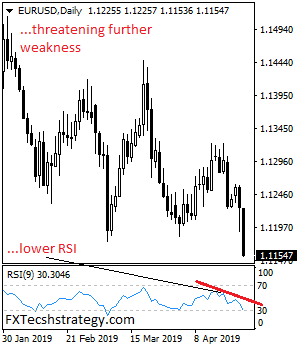
EURUSD breaks below 1.1183/75 support zone leaving risk of more decline on the cards. Support comes in at the 1.1100 where a violation will turn risk to the 1.1050 level. A break below here will target the 1.1000 level. Further down, support sits at the 1.0950. Its daily RSI is bearish and pointing lower suggesting further weakness. Conversely, on the upside, resistance resides at 1.1200 level with a break through there opening the door for further upside towards the 1.1.1250 level. Further up, resistance comes in at the 1.1300 level where a violation will expose the 1.1350 level. All in all, EURUSD continues to threaten further downside pressure.
It’s A Two-Speed World Out There
It's a two-speed world out there
The earnings juggernaut continued on Wall Street today with reports mostly above expectation. However, the major indices had a consolidative look about them after the S&P and Nasdaq had record closes the day before, with the S&P and Dow Jones both falling 0.22%, and the Nasdaq dropping 0.23%.
The main attraction was after hours though, with Facebook, Microsoft and Visa all reporting excellent results, in Facebook's case net of provisioning for fines. Tesla also reported after the bell and disappointed again, cementing a remarkable multi-year display of being consistently disappointing. The positive after-hours results should set up Asian markets for a positive start to the day.
One cloud on the horizon has been the disappointing South Korean GDP data this morning, which shows the economy shrunk by 0.3% in Q1 – the first contraction in five quarters. Further divergence in the global economy was highlighted last night with Germany's IFO disappointing, and the Bank of Canada (BOC) downgrading growth assessments and removing all traces of hiking bias from its post-rate decision statement. This follows low Australian CPI data yesterday.
In all likelihood, Asia's equity markets will ignore the stark warnings today as data and central bank decisions scream two-speed global economy. The global bond markets are certainly not aligned with government bond yields tanking in developed markets such as Canada, Europe and Australia. Time will tell if the US and China lift the rest of the world up or the rest of the world puts the brakes on the US and China. That's a story for another day but will undoubtedly make the second half of 2019 as interesting as the first.
Currency markets roared to life overnight with both the Aussie dollar (AUD) and New Zealand dollar (NZD) tanking on lower-than-expected Australian CPI numbers. The Canadian dollar (CAD) fell 0.45% against the greenback touching 1.3500 after the rate hike surrender by the Bank of Canada. The euro (EUR) and British pound (GBP) vs the dollar both sank following weak German IFO data, hovering just above 1.1200 and 1.2900 respectively.
Once again, it was the day of the dollar, and a look at the US yield vis-a-vis most developed markets implies it could turn into the year of the greenback.
Asia's highlight will be the Bank of Japan (BOJ) rate decision, with no change expected to its overnight rate or JGB yield targeting. Today's decision will be interesting as it comes just before Japan's extended Golden Week holiday this year, which is actually closer to two weeks this time due to the Emperor's abdication. As ever, timing is important here as the BOJ has no set release time. Generally speaking though, the further after midday Tokyo that we don't hear an outcome, the higher the chance there is of a big surprise. It's happened before.
FX
All eyes will be on the AUD and its Kiwi cousin this morning, following yesterday's CPI induced sell-off. The AUD sits at 0.7010, just above long-term support at 0.7000. The Aussie dollar has spent a grand total of one day below 0.7000 in the past three years, so a daily close below this level later this evening will be technically significant – a weekly close below 0.7000 tomorrow night could be even more so. Both Australia and New Zealand are closed for ANZAC Day meaning liquidity will be much reduced.
With the CAD also falling out of bed overnight and disappointing South Korean data this morning, regional currencies may well be on the back foot initially as the US dollar hegemony continues.
Equities
Tesla aside, the sparkling after-hours results from Wall Street will continue the collective sigh of relief felt by regional stock markets this week as US earnings season exceeds expectations. Local bourses will likely enjoy a positive start to the day.
Oil
A much higher-than-expected rise in official US inventories stopped WTI in its tracks overnight, falling 0.85% to US65.85 a barrel. Brent Crude remained unchanged at US74.75 a barrel, in a remarkably sedate day by oil's recent standards. The price action has a consolidative look about it after the recent Iran-induced rallies.
With Brent Crude so firmly in backwardation and the geopolitical risks still alive and kicking, it's hard to see oil's quiet overnight season as anything but a temporary lull.
Gold
Gold traded to the upper end of is recent USD1,270/1,275 .00 an ounce range overnight on no apparent news of note. With Golden Week starting in Japan tomorrow and approaching the 1 May holiday seasons in much of Asia, the yellow metal may benefit from some risk-hedging buyers over the next two days.
USD/CAD Canadian Dollar Falls As Bank of Canada (BoC) Goes Full Dove
The Canadian dollar fell 0.5 percent after the Bank of Canada (BoC) kept its benchmark interest rate unchanged as expected, but went more dovish with its language. The central bank has all but removed the probability of a rate hike in 2019 with monetary policy to remain accommodative.
There was no mixed signals form the BoC it was all dovish, sending the loonie lower and fuelling forecasts of a rate cut, if the economy does not improve. The Bank of Canada (BoC) is forecasting a 1.2 percent GDP gain in 2019, a downgrade from the previous 1.7 percent estimate.
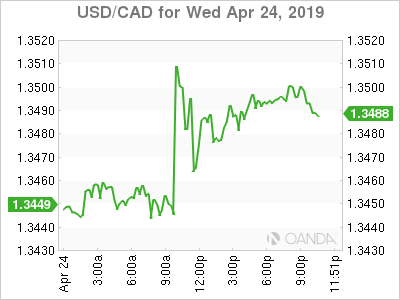
The drop in oil prices offered no support to the Canadian currency as a surprise 5.5 million barrel buildup in US crude inventories hit WTI prices to the downside.
The US dollar remained king of the currency world as German data sapped confidence in the euro and mixed economic data and central bank action showed that the US economy is still steady benefiting the greenback.
Oil Lower After Massive US Crude Buildup
Energy prices were mixed as Brent continued to climb higher and is trading near $74.64 while West Texas Intermediate was hit by a larger than expected buildup as the Energy Information Administration (EIA) weekly crude inventories showed a 5.5 million barrel gain.
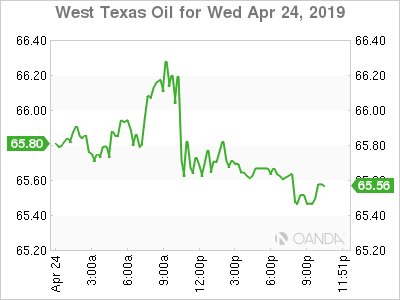
US sanctions have driven prices higher as the White House removed all waivers on Iranian crude, but the rise in American inventories will ease some of the pressure at the pump ahead of driving season. The OPEC+ has worked to stabilized prices by cutting production and seeking to absorb extra supply, but as US shale producers ramp up the battle for market share could hit another important chapter this summer.
The OPEC led by Saudi Arabia and major producers, the most vocal being Russia agreed to limit production but given the supply disruptions of late an extension to the agreement is not a foregone conclusion.
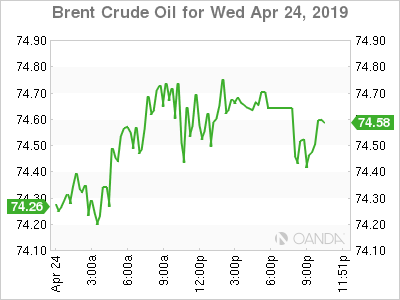
Sanctions against Iran and Venezuela added to Libyan conflict will continue to push prices higher, but only if the OPEC+ agree to keep their production cut program going. If producers do not agree on an extension if they deem the market to have reached a balance more supply could quickly find its way into the market.
Energy demand has been steady, but has not grown enough to be able to offset a sudden rise in supply from the OPEC+. Saudi Arabia is appealing to an extension, but Russia remains on the fence sending mixed signals. The outcome of the OPEC+ Ministerial meeting on June 26 will be the biggest factor in the energy market in 2019.
Gold Rises on Equity Rally Pause
Gold prices rose on Wednesday as the really in equities lost momentum. Commodity prices rose after the dollar found little support from economic indicators, but looking ahead at US durable goods on Thursday and the highlight of the week being the first estimate of Q1 GDP on Friday.
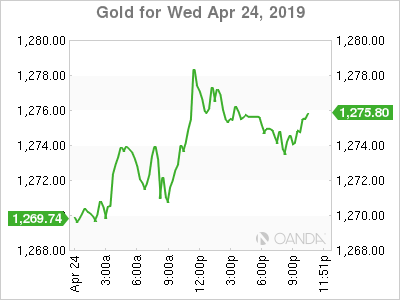
Growth concerns rose after the German Ifo Business Climate underperformed. German businesses are still mostly optimistic but the slight erosion of confidence put pressure on the euro as European growth is still a big question mark.
Gold was able to benefit from a slowdown on the equities rally and the dollar not having a strong fundamental push ahead of critical economic data later this week.
BOC Erases Rate Hike Possibility in Near- to Medium- Term
BOC sent a mixed message in its April meeting. As shown in the accompanying statement, it has turned more dovish as it removed any chance of rate hike in the near- to medium- term. The central bank downgraded GDP growth forecast, both domestically and globally. It also lowered the range of neutral rate. Yet, at the press conference, Governor Stephen Poloz continued to note that, conditional on the temporary nature of recent negative data, “interest rates are more likely to go up than down over time”. Obviously, the market has emphasized the removal of rate hike bias in the statement and dumped the loonie. BOC members pledged to monitor incoming data in order to decide the duration and degree of accommodative monetary policy. The areas they focus on include household spending, oil prices and global trade policy. The central bank left the policy rate unchanged at 1.75%.
Policymakers acknowledged higher uncertainty and risks to growth during the inter-meeting period. The noted “modest widening of the output gap, which will be absorbed over the projection period”. The central bank estimates the output gap to be between -1.25% and -0.25% as of 1Q19, compared with -0.75% to +0.25% in 4Q18. As such, they downgraded the GDP growth forecast for this year to 1.2% y/y, from 1.7% projected in January. Growth in 1Q19 is expected to be at an annualized rate of only +0.3%. Growth is expected to recover to 2% in both of 2020 and 2021. Meanwhile, the members raised the inflation forecast to 1.9% y/y for 2019, from +1.7% previously, before improving to +2% in both 2020 and 2021. Meanwhile, BOC revised lower its neutral rate range to 2.25%–3.25% with a mid-point of 2.75%, all down by -25 bps. Globally, the central bank forecast world GDP to expand by +3.2% this year, down from January’s +3.4%, before growing +3.3% in both 2020 and 2021.
At mentioned above, BOC removed any rate hike bias in the policy statement. Rather, it suggested that “an accommodative policy interest rate continues to be warranted”. It pledged to “evaluate the appropriate degree of monetary policy accommodation as new data arrive”, in particular “developments in household spending, oil markets, and global trade policy”. At the press conference, Poloz suggested that the members were “a little bit skeptical of some of the most-negative data”, though they believed these are a “temporary thing”. He added that “if our forecast is right, which I firmly believe it is, (then) what that means is that interest rates are more likely to go up than down over time”.
BOC has turned more dovish than the previous meeting. Yet, it might not be as dovish as what the market has expected - the chance a rate cut by December jumped to almost 70% after the announcement, compared with 57% prior. given the mixed message sent from the statement and Poloz's comment, it remains uncertain whether BOC's dovish shift would translate to a rate cut later this year,
Eco Data 4/25/19
[php_everywhere instance="1"]