Sample Category Title
Euro Weakens as German 10-Year Yield Threatens to Turn Negative, Swiss Franc Rebound
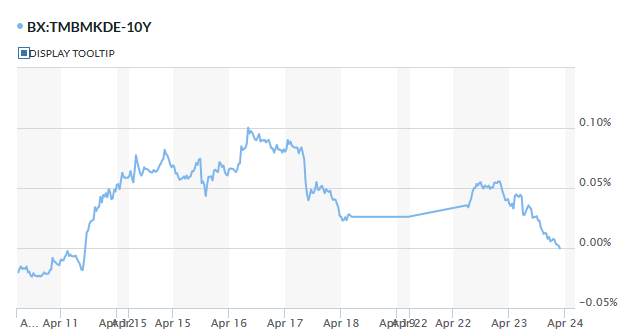
Swiss Franc regains much ground today in mixed financial markets. Optimism over US corporate earnings had virtually no impact in Asian and European markets. Instead, European stocks turned mixed after German Ifo business confidence turned south again after brief recovery last month. German 10-year yield also suffers rather steep decline, and is threatening to turn negative again. Though, Sterling is displaying some resilience, mainly because there's nothing to trade on.
On the handle hand, Australian Dollar remains the weakest one for today as much weaker than expected CPI raises the chance of an RBA rate cut in second half. New Zealand Dollar follows as second as RBNZ could cut even earlier in May. Euro is currently the third weakest as pull back in EUR/CHF extends. Canadian Dollar is turning cautious, awaiting BoC rate decision. BoC is widely expected to keep interest rate unchanged at 1.75%. It's not totally sure if BoC would drop tightening bias today. If not, there is prospect of a rebound in the loonie.
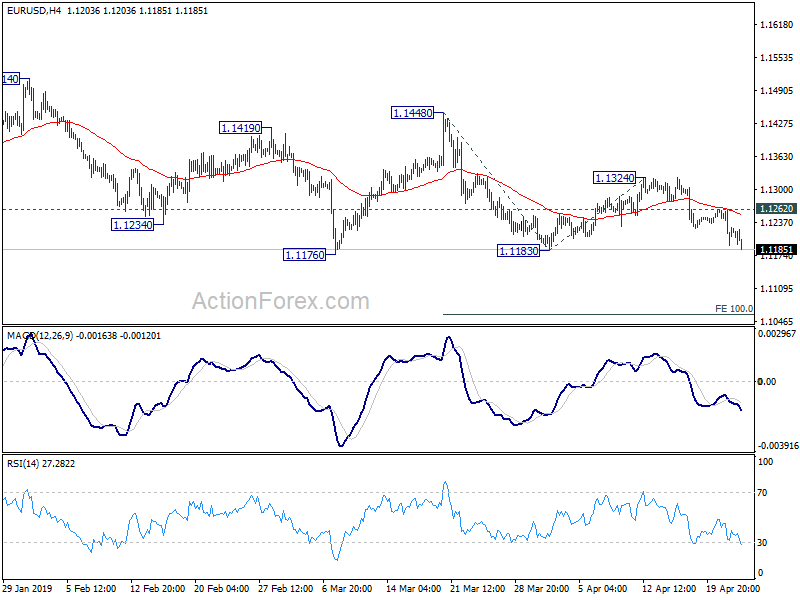
Technically, 1.3467 resistance in USD/CAD will be a major focus in US session. Decisive break will resume whole rebound from 1.3068 towards 1.3664 high. Rejection will delay the bullish case and extend the consolidation from 1.3467 with another fall. EUR/USD might have another attempt towards 1.1176 key support again. Decisive break there will resume larger down trend from 1.2555. AUD/USD is also eyeing 0.7003 support after today's free fall.
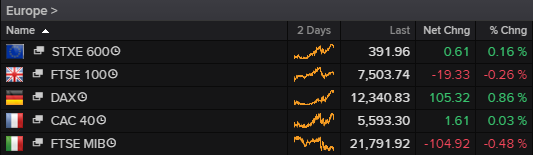
In Europe, currently, FTSE is down -0.60%. DAX is up 0.52%. CAC is down -0.35%. German 10-year yield is down -0.044 at 0.00. Earlier in Asia, Nikkei dropped -0.27%. Hong Kong HSI dropped -0.53%. China Shanghai SSE rose 0.09%. Singapore Strait Times rose 0.27%. Japan 10-year JGB yield dropped -0.0052 to -0.035.
 Quick update: CAD dives after BoC drops tightening bias, slashes growth forecast. More here.
German Ifo dropped to 99.2, March's gentle optimism evaporated
German Ifo Business Climate Index dropped to 99.2 in April, down from 99.7 and missed expectation of 99.9. Expectation Index dropped to 95.2, down fro 95.6 and missed consensus of 96.0. Current Assessment Index also dropped to 103.3, down from 103.8 and missed expectation of 103.6.
Ifo President Clemens Fuest noted that "the mood among German managers became slightly gloomier this month… March's gentle optimism regarding the coming months has evaporated. The German economy continues to lose steam." Ifo economist Klaus Wohlrabe said the data points to 0.8% growth in Germany this year.
Looking at the details, business climate in manufacturing "has again worsened markedly", down from 6.7 to 4.0. It's the eighth straight month of decline. Services continued recovery from 26.1 to 26.3, comparing to cyclic low at 21.5 in February. Trade worsened again from 8.2 to 7.1. Construction improved slightly from 20.4 to 21.4.
Also released UK public sector borrowing rose GBP 0.8B in March, versus expectation of GBP -0.8B.
ECB: Impact of trade tensions escalation could heighten financial stress and lower confidence
In a paper released today, ECB noted that last year's increased in trade tensions and the repercussions of the tariffs implemented pose only a "modest adverse risk" to the global and euro area outlooks. Also, impact of implemented tariffs and tariff announcements owing to uncertainty effects appears to have remained "confined to the targeted sectors" for the time being.
However, if trade tensions were to escalate once again, "the impact would be larger". Model-based simulations indicate that the medium-term direct impact of an escalation could be "sizeable, compounded by heightened financial stress and a drop in confidence." The longer-term effects would be "even more pronounced".
ECB also warned that "although free trade is often seen as one of the factors behind rising inequality both within and across countries, winding back globalisation is the wrong way to address these negative effects." "A retreat from openness will only fuel more inequality, depriving people of the undisputed economic advantages that trade and integration bring.". The paper urged that "countries should seek to resolve any trade disputes in multilateral fora".
Full paper "The economic implications of rising protectionism: a euro area and global perspective".
Big downside surprise in Australia CPI adds to case for RBA cut
Australian Dollar is sold off sharply after much weaker than expected consumer inflation data.
- Headline CPI rose 0.0% qoq, 1.3% yoy in Q1, down from 0.5% qoq, 1.8% yoy, missed expectation of 0.2% qoq, 1.5% yoy. The 1.3% annual rate is also the slowest since September 2016.
- RBA trimmed mean CPI rose 0.3% qoq, 1.6% yoy, below expectation of 0.4% qoq, 1.7% yoy. Annual rate is slowest since December 2016.
- RBA weighted median CPI rose 0.1% qoq, 1.2% yoy, well below expectation of 0.4% qoq, 1.6% yoy.
The weak inflation data heighten the prospect of RBA rate cut in May, together with RBNZ. But for now, it still seems a bit early for RBA to act given relative resilience in job data. May is more an ideal occasion for RBA to turn dovish with new economic projections and SoMP. If it happens, the case for a cut in August would be secured.
Also released in Asian session, Japan corporate service price index rose 1.1% yoy in March versus expectation of 1.0% yoy. All industry index dropped -0.2% mom in February, matched expectation. Leading indicator dropped to 97.1, missed expectation of 97.4.
EUR/USD Mid-Day Outlook
Daily Pivots: (S1) 1.1192; (P) 1.1227; (R1) 1.1261; More.....
EUR/USD drops further to as low as 1.1186 so far today. Intraday bias remains on the downside for 1.1176 key support. Decisive break there will resume whole down trend form 1.2555. Next near term target will be 100% projection of 1.1448 to 1.1183 from 1.1324 at 1.1059. On the upside, above 1.1262 minor resistance will delay the bearish case and bring rebound first.
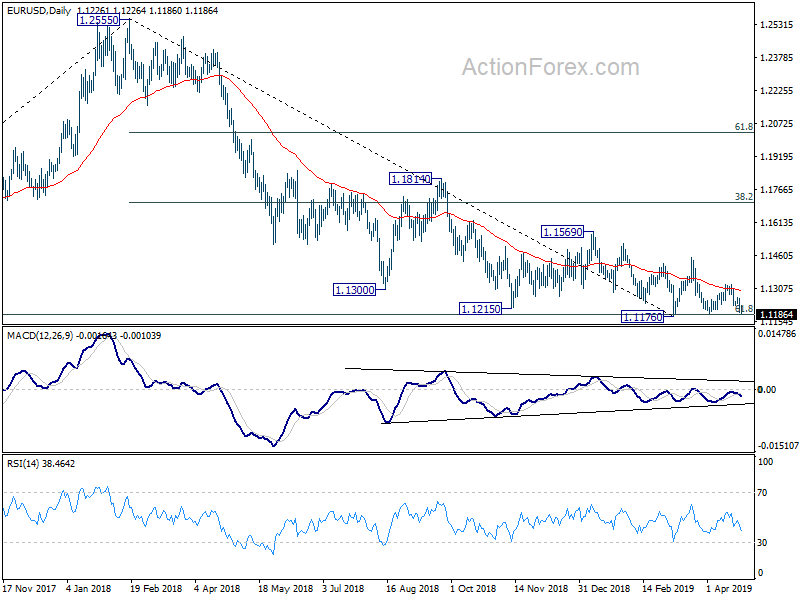
In the bigger picture, EUR/USD has been losing downside momentum around 61.8% retracement of 1.0339 (2016 low) to 1.2555 (2018 high) at 1.1186. But for now, there is no clear sign of medium term reversal yet. Down trend from 1.2555 is expected to resume sooner or later as long as 1.1569 structural resistance holds. Decisive break of 1.1186. could pave the way back to 1.0339 low.
Economic Indicators Update
| GMT | Ccy | Events | Actual | Forecast | Previous | Revised |
|---|---|---|---|---|---|---|
| 23:50 | JPY | Corporate Service Price Y/Y Mar | 1.10% | 1.00% | 1.10% | |
| 1:30 | AUD | CPI Q/Q Q1 | 0.00% | 0.20% | 0.50% | |
| 1:30 | AUD | CPI Y/Y Q1 | 1.30% | 1.50% | 1.80% | |
| 1:30 | AUD | CPI RBA Trimmed Mean Q/Q Q1 | 0.30% | 0.40% | 0.40% | |
| 1:30 | AUD | CPI RBA Trimmed Mean Y/Y Q1 | 1.60% | 1.70% | 1.80% | |
| 1:30 | AUD | CPI RBA Weighted Median Q/Q Q1 | 0.10% | 0.40% | 0.40% | |
| 1:30 | AUD | CPI RBA Weighted Median Y/Y Q1 | 1.20% | 1.60% | 1.70% | 1.60% |
| 4:30 | JPY | All Industry Activity Index M/M Feb | -0.20% | -0.20% | -0.20% | 0.00% |
| 5:00 | JPY | Leading Index CI Feb F | 97.1 | 97.4 | 97.4 | |
| 8:00 | EUR | German IFO Business Climate Apr | 99.2 | 99.9 | 99.6 | |
| 8:00 | EUR | German IFO Expectations Apr | 95.2 | 96 | 95.6 | |
| 8:00 | EUR | German IFO Current Assessment Apr | 103.3 | 103.6 | 103.8 | |
| 8:00 | EUR | ECB Economic Bulletin | ||||
| 8:30 | GBP | Public Sector Net Borrowing (GBP) Mar | 0.8B | -0.8B | -0.7B | -0.5B |
| 14:00 | CAD | BoC Rate Decision | 1.75% | 1.75% | ||
| 14:30 | USD | Crude Oil Inventories | -1.4M |
Dollar Continues March Higher as the Stock Rally Pauses
The dollar continues to march on higher, while global yields fell as markets await the next wrath of earnings. The S&P 500 and Nasdaq both closed above their prior record high closes yesterday and investors are continuing to run to stocks as the Fed appears on hold for the foreseeable future, possibly deep into 2020.
- USD – Six-week rally as euro data continues to disappoint
- AUD – Dismal inflation increases rate cut bets
- Earnings – Boeing and Caterpillar grind higher
- Oil – Lower ahead of inventory data
- Gold – Slight gain following disappointing German data
USD
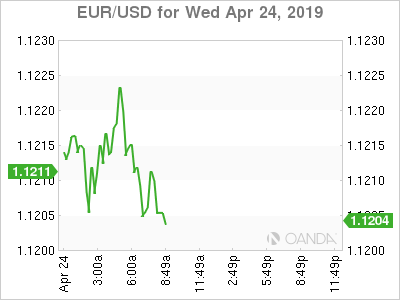
The dollar is higher against the euro after Germany’s IFO survey disappointed once again. Germany can’t seem to show any firm signs of rebounding and the euro remains vulnerable here. The survey showed misses across the board on expectations, current assessment and business climate. Expectations were small that Germany was rebounding after improvements in the latest PMI readings, but today’s reading only provides optimism their situation is only stabilizing.
AUD
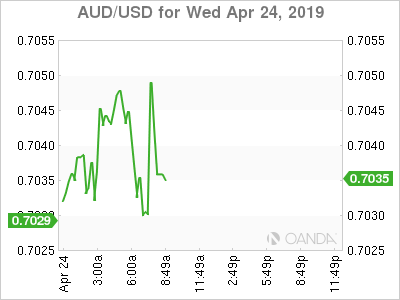
The RBA’s job just got a lot easier following terrible inflation data from down under. The central bank will likely need to deliver a rate cut at the next meeting and more might follow after that. Annual inflation fell to 1.3%, the third consecutive print below the RBA’s target range and the lowest since Q3 of 2016. Markets are expecting two rate cuts in 2019 and the AUD/USD remains vulnerable despite mounting trade deal optimism coming from the US and China.
Earnings
Two giant earnings reports came from Boeing and Caterpillar. Boeing shares initially sold off following the miss on EPS and announcement of the suspension of its annual forecast. Trade remains volatile as buyers quickly emerged and shares now appear poised for a positive open. The removal of guidance was expected by many until they have further clarity on 737 Max returning to service. Boeing beat on cash flow, but all the market cares about is the future production of the 737 Max.
Caterpillar’s stock price jumped following a beat on the both the top and bottom line. The mining and construction equipment maker giant also saw an overreaction to a raise in guidance that was mainly attributed to a tax credit. Shares have given up most of their gains. The results from Caterpillar are a good sign for the economy, mainly signalling that the trade war has not derailed growth.
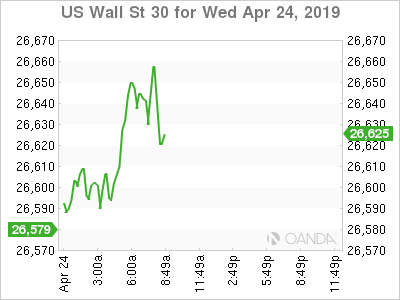
The Dow and S&P 500 are still stuck near yesterday’s closing levels as investors appear unconvinced to take this rally to fresh record highs.
Oil
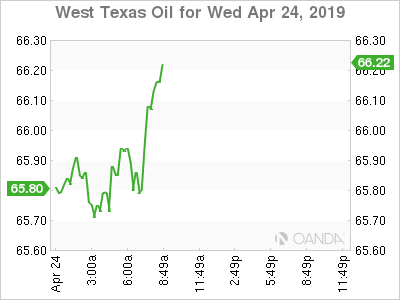
West Texas Intermediate crude is down from the 6-month highs ahead of the API report that is expected to show a build of 6.86 million barrels. The rally that stemmed from waiving of US sanctions for eight countries to buy Iranian crude appears over. Supply side focus is here and if the market is well supplied any steep builds with inventories could help trigger a decent pullback here. Markets will await the Saudis plan on how they will cover the shortfall from Iran. The OPEC + production cut agreement appears to be toast and markets may be waiting to see signs from Russia abandoning cuts before hitting the sell button.
Gold
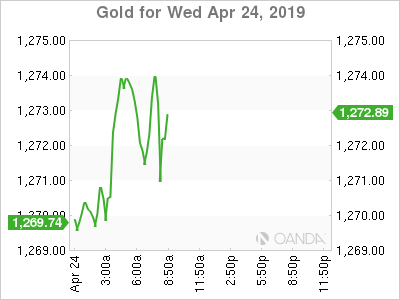
Gold prices appear to be stabilizing, up 0.1% on the session, but more importantly $7 above yesterday’s low. The precious metal benefited from the disappointing economic data from Europe and will likely take a queue from US stocks. Safe-haven demand has not really been given any help thus far from earnings seasons. Gold remains vulnerable on trade optimism, but that could see a small hiccup as China is not happy with the US sanction decision on Iranian crude.
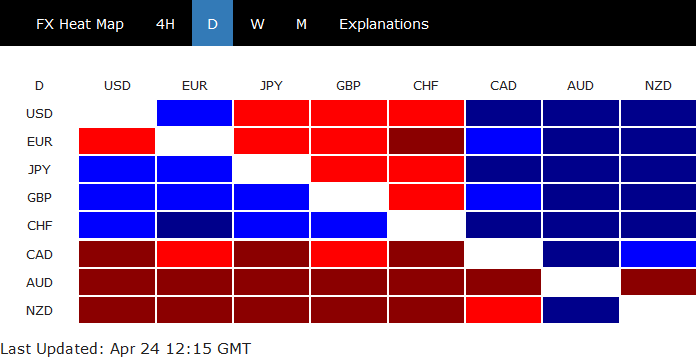
Into US session: CHF strongest, AUD weakest, CAD awaits BoC
Entering into US session, commodity currencies are the weakest ones for today. Australian Dollar leads the decline as much weaker than expected CPI raises the chance of an RBA rate cut in second half. New Zealand Dollar follows as second as RBNZ could cut even earlier in May. Canadian Dollar is the third weakest against of BoC rate decision. BoC is widely expected to keep interest rate unchanged at 1.75% today. It's not totally sure if BoC would drop tightening bias today. If not, there is prospect of a rebound in the loonie.
On the other hand, Swiss Franc is the strongest one, reversing some of recent losses. Technical resistance in EUR/CHF is a factor helping the Franc. Also, German 10-year yield drops notably today, threatening to turn negative again. Sterling is the second strongest, followed by Yen. Dollar is mixed for now. While US stocks jump sharply yesterday with S&P 500 and NASDAQ making new record closes, upside momentum isn't too convincing today. Euro is also mixed even though Ifo business climate reversed some of March's gains and declined to 99.2 in April.
In Europe, currently:
- FTSE is down -0.50%.
- DAX is up 0.64%.
- CAC is down -0.28%.
- German 10-year yield is down -0.0374 at 0.007.
Earlier in Asia:
- Nikkei dropped -0.27%.
- Hong Kong HSI dropped -0.53%.
- China Shanghai SSE rose 0.09%.
- Singapore Strait Times rose 0.27%.
- Japan 10-year JGB yield dropped -0.0052 to -0.035.
USDTRY Challenges 6-Month High, Trades Well Above SMAs
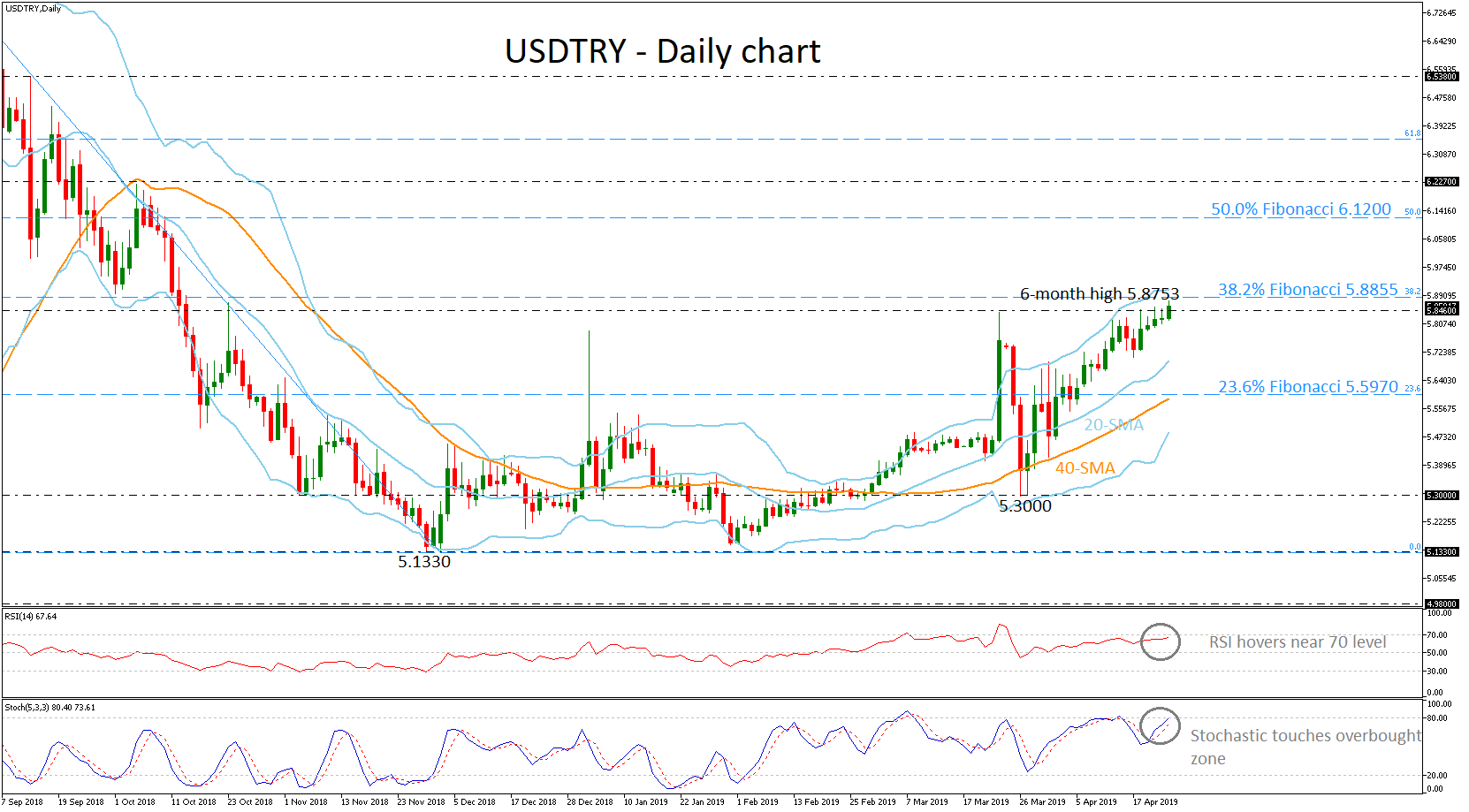
USDTRY has advanced above the 20- and 40-day simple moving averages (SMAs) and the 23.6% Fibonacci retracement level of the sell-off from 7.1135 to 5.1330, hitting a new six-month high of 5.8753.
Looking at the technical indicators, the stochastic is switching to the upside, challenging the overbought territory, while the RSI is approaching the 70 level, confirming the recent bullish tendency in price action in the near-term.
If the market corrects higher, the bullish action may pause initially near the 38.2% Fibonacci of 5.8855 and the upper Bollinger band. A rally on top of the latter would probably stage fresh buying pressure, with the price moving next to the 50.0% Fibonacci of 6.1200.
On the other hand, dropping below the mid-level of the Bollinger band could see losses extending towards the 23.6% Fibonacci of 5.5970. Even lower, the bears could stall around the lower Bollinger band currently at 5.4852.
The recent bullish action turned the weak momentum to a more aggressive one, with the shorter-term simple moving averages (SMAs) increasing distance above the longer-term SMAs, so we could expect further improvement in the market.
European Update – US Earnings Fail To Lift Stocks
Market bounce quickly fades after encouraging earnings
We're seeing another mixed session in Europe on Wednesday, with stocks here and in Asia clearly not encouraged by the earnings reports in the US that prompted a record close in the S&P 500 and NASDAQ
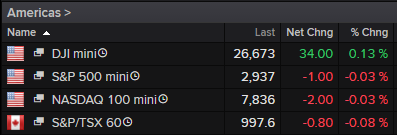
In an otherwise quiet week and at a time when central banks have become much more dovish in response to a more downbeat assessment of the economic outlook, this seasons earnings reports are all the more important. Especially as a driver for market sentiment. So far, investors have reason to be encouraged but it's worth noting that expectations heading in were low.
Even on the back of a good batch of earnings and record closing levels in US indices, futures on Wall Street are pointing to a slightly negative open which suggests the optimism is somewhat limited. Perhaps investors are nervous around the current levels or they aren't hopeful that it's reflective of the overall reporting season and that on average it will revert closer to prior expectations. We'll have to wait and see.
German IFO Survey Continues The String Of Disappointing Data For Region
Notes/Observations
- German Apr IFO survey misses expectations across the board as the domestic economy continued to lose steam
- PBoC chose a special lending tool (TMLF) to try and alleviate a banking-system liquidity shortage; move suggests the PBoC was keen to avoid stock and property bubbles
- RBA rate cut now seen on cards for May after soft inflation data
Asia:
- Australia Q1 CPI data missed expectations and registered its 3rd straight reading below the RBA target range of 2-3% target and pace matched the lowest level since Q3 2016 (Q/Q: 0.0% v 0.2%e; Y/Y: 1.3% v 1.5%e)
- China PBoC conducted a 1-year Targeted Medium-Term Lending facility (TMLF) for its 2d use of such facility; allotted CNY267.4B at 3.15%
Europe/Mideast:
- UK Cabinet ministers reportedly urging PM May to end cross-party talks with Labour Party and force a fourth Commons showdown on Brexit deal next week
- UK PM May spokesman Slack: No specific timetable for end of talks with Labour, Talks serious, difficult in areas. Cabinet agreed on importance of passing withdrawal bill asap
- The 1922 Committee last night failed to reach a decision on a rule change; to hold further talks about whether to change party rules to enable an early leadership challenge to PM May
- Italy coalition government said to find compromise on Rome-debt relief
Americas:
- White House confirmed that USTR Lighthizer and US Treasury Sec Mnuchin to travel to China, trade talks to start on April 30th and cover IP, tech transfer and agriculture
Energy:
- Weekly API Oil Inventories: Crude: +6.9M v -3.1M prior
SPEAKERS/FIXED INCOME/FX/COMMODITIES/ERRATUM
Equities
- Indices [Stoxx600 -0.04% at 391.20, FTSE -0.40% at 7,493.25, DAX +0.40% at 12,284.39, CAC-40 -0.17% at 5,582.31, IBEX-35 -0.36% at 9,492.85, FTSE MIB -0.37% at 21,815.50, SMI +0.42% at 9,675.50, S&P 500 Futures -0.07%]
Market Focal Points/Key Themes:
- European Indices trade mostly lower tracking lower US index futures and mixed Asian Indices as German IFO missed forecasts.
- On a busy morning for corporate earnings Swiss traded Credit Suisse trades higher following a beat on the top and bottom line as well as continued positive momentum through April; Novartis also trades higher after a beat on both the top and bottom line and raised outlook. Strength in Novartis and Credit Suisse helping the Swiss SMI outperform.
- In Germany, SAP trades over 7% higher, helping the DAX outperform as the company beat forecasts and raised outlook, as well as announced a comprehensive review to accelerate operational excellence. Elsewhere ABF, Volvo, ST Micro, Dassault Systems, Randstad and Vinci are among other notable names rising on earnings.
- French traded Renault declines over 3% after Nissan cut their full year outlook; Akzo Nobel and Anglo American also trade lower on earnings.
- In other news Wirecard trades over 8% higher after confirming a €900M investment from Softbank, while Bayer falls as shareholders Blackrock and DWS are said to not support management at the AGM.
- Looking ahead notable earners include Boeing, Caterpillar, Biogen, Northrop Grumman, General Dynamics and Thermo Fisher among others.
Equities
- Consumer discretionary: Heineken [HEIA.NL] -1% (earnings), Remy Cointreau [RCO.FR] -0.5% (earnings), Finnair [FIA1S.FI] -5% (earnings), AB Dynamics [ABDP.UK] +6.5% (earnings), Associated British Foods [ABF.UK] +2% (earnings)
- Materials: Akzo Nobel [AKZA.NL] -3% (earnings)
- Financials: Credit Suisse [CSGN.CH] +2.5% (earnings), Deutsche Bank [DBK.DE] -0.5% (Reportedly DB and UBS asset management arms are in serious merger discussions)
- Healthcare: Novartis [NOVN.CH] +2.5% (earnings; outlook raise), Ingenico [ING.FR] +3.5% (earnings)
- Industrials: Volvo [VOLVA.SE] +2.5% (earnings), Renault [RNO.FR] -4% (Nissan outlook cut), Dassault Systems [DSY.FR] +1.5% (earnings)
- Technology: SAP [SAP.DE] +6% (earnings; Elliott Management comments), Wirecard [WDI.DE] +6.5% (Softbank investment), STMicroelectronics [STM.FR] +3% (earnings), Nordic Semiconductor [NOD.NO] +14% (earnings)
- Telecom: Elior [ELIOR.FR] +3.5% (confirms divestment)
Speakers
- UK Govt to hold interviews over the summer for BOE Gov position (**Reminder: BOE Carney had agreed to extend his term by an additional 7-months until end-Jan 2020)
- UK Debt management Office (DMO) raised its FY19/20 Gilt issuance by £3.7B to £118B
- German IFO economists stated that the domestic economy continued to lose steam
- Thailand Central Bank official Don: H1 GDP growth may be below 3.2% vs. 3.4% forecast due to weak exports
- North Korea Leader Kim: Hoped upcoming visit to Russia would be successful; planned to discuss situation of Peninsula
- China President Xi stated that he hoped China and IMF would deepen cooperation. China welcomed the IMF's participation in Belt and Road.
- China said to maintain Australia coal 'go-slow' until Beijing had assessed government policy in Canberra after federal elections in May. China had been delaying clearance of coal through its ports
- Saudi Energy Min Al-Falih: More debt issuance forthcoming; recent Aramco debt sale was only the beginning. Oil inventories continued to rise despite sanctions
- Iran President Rouhani reiterated that cutting Iran oil exports to zero would never happen
- Iran Supreme Leader Khamenei: Nation would respond to US 'enmity'
Currencies/ Fixed Income
- EUR/USD briefly tested below the 1.12 level in the aftermath of disappointing German IFO data which missed expectations across the board as the domestic economy continued to lose steam. The pair failed to make a fresh 3-week low and saw a slight retracement just ahead of the NY morning to trade around 1.1220 area.
- USD/JPY still unable to break above the 112 level with focus remaining on the upcoming BOJ rate decision.
- Soft Australia inflation data had numerous analysts revise their outlook for the RBA and now expected rate cut as soon as May (next meeting).
Economic Data
- (FI) Finland Mar PPI M/M: 0.0% v 0.1% prior; Y/Y: 2.3 v 1.0% prior
- (FI) Finland Mar Unemployment Rate: 7.0 v 7.4% prior
- (FR) France Apr Business Confidence: 105 v 104e; Manufacturing Confidence: 101 v 102e; Production Outlook Indicator:-2 v -1e; Own-Company Production Outlook: 9 v 13 prior
- (FR) France Apr Business Survey Overall Demand: 2 v 2 prior
- (CZ) Czech Apr Consumer Confidence Index: 1.5 v 2.3 prior; Business Confidence: 15.1 v 14.7 prior; Composite (Consumer & Business): 12.3 v 12.2 prior
- (ZA) South Africa Q1 BER Consumer Confidence: 2 v 6e
- (TR) Turkey Apr Real Sector Confidence (Seasonally Adj): 100.0 v 99.3 prior; Real Sector Confidence NSA (unadj): 105.5 v 102.1 prior
- (TR) Turkey Apr Capacity Utilization:75.0 % v 74.3% prior
- (EU) ECB Economic Bulletin
- (DE) Germany Apr IFO Business Climate Survey: 99.2 v 99.9e; Current Assessment Survey: 103.3 v 103.5e; Expectations Survey: 95.2 v 96.1e
- (ES) Spain Feb Trade Balance: -€2.6B v -€4.5B prior
- (CH) Swiss Apr Credit Suisse Expectations Survey: -7.7 v -26.9 prior
- (PL) Poland Mar Unemployment Rate: 5.9% v 5.9%e
- (PL) Poland Mar Construction Output Y/Y: 10.8% v 9.8%e
- (TW) Taiwan Mar M2 Money Supply Y/Y: 3.1% v 2.9% prior; M1 Money Supply Y/Y: 6.9% v 6.0% prior
- (UK) Mar Public Finances (PSNCR): £8.9B v £0.7B prior; Public Sector Net Borrowing: +£0.8B v -£1.1Be; Central Government NCR: +£22.5B v -£1.7B prior; PSNB ex Banking Groups: £1.7B v £0.4Be
Fixed Income Issuance
- (CY) Cyprus opened its book to sell EUR-denominated 5-year and 30-year bonds via syndicate
- (IN) India sold total INR200B vs. INR200B indicated in 3-month, 6-month and 12-month bills
- (DK) Denmark sold total DKK1.545B in 2029 and 2030 DGB bonds
- (SE) Sweden sold total SEK1.5B vs. SEK1.5B indicated in 2028 and 2029 Bonds
- (IT) Italy Debt Agency (Tesoro) sold €3.5B vs. €3.0-3.5B indicated range in new Jun 2021 Zero Coupon CTZ notes; Avg Yield: 0.697% v 0.288% prior; Bid-to-cover: 1.53x v 1.81x prior
- (IT) Italy Debt Agency (Tesoro) sold €909B vs. €0.5-1.0B indicated range in 1.25% 2032 inflation-linked bonds (BTPei); Avg Yield: 1.93% v 2.24% prior; Bid-to-cover: 1.33x v 1.98x prior
Looking Ahead
- 05:30 (UK) Weekly John Lewis LFL Sales data
- 05:30 (DE) Germany to sell €3.0B in 0.25% Feb 2029 Bunds
- 05:30 (EU) ECB allotment in 3-month LTRO (prior €1.1B with 17 bids recd)
- 05:30 (ZA) South Africa announces details of next bond auction (held on Tuesdays)
- 06:00 (PT) Portugal Mar PPI M/M: No est v 0.0% prior; Y/Y: No est v 1.0% prior
- 06:00 (RU) Russia to sell 2024 and 2023 OFZ bonds
- 06:45 (US) Daily Libor Fixing
- 07:00 (US) MBA Mortgage Applications w/e Apr 19th: No est v -3.5% prior
- 07:00 (UK) Weekly PM May question time in House of Commons
- 07:15 (BR) Brazil Mar Total Formal Job Creation: +80.0Ke v +173.1K prior
- 09:00 (BE) Belgium Apr Business Confidence Index: -0.7e v -0.7 prior
- 09:00 (CL) Chile Mar PPI M/M: No est v 0.7% prior
- 09:00 (EU) Weekly ECB Forex Reserves: no est v €286.6B prior
- 09:30 (BR) Brazil Mar tax Collections (BRL): 113.9Be v 115.1B prior
- 10:00 (CA) Bank of Canada (BOC) Interest Rate Decision: expected to leave Interest Rates unchanged at 1.75%
- 10:30 (US) Weekly DOE Crude Oil Inventories
- 11:30 (US) Treasury to sell 2-Year Floating Rate Notes
- 13:00 (US) Treasury to sell 5-Year Notes
- 15:00 (AR) Argentina Mar Trade Balance: $0.5Be v $0.5B prior; Total Exports Y/Y: No est v $4.5B prior; Total Imports Y/Y: No est v $4.0B prior
WTI Outlook: Takes A Breather After Hitting Fresh 2019 High
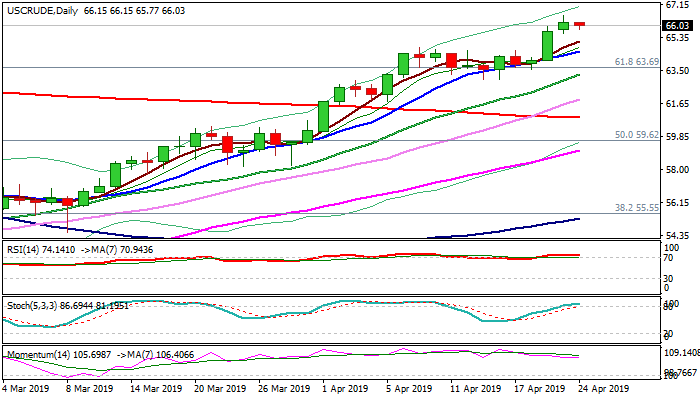
WTI oil price consolidates under new 2019 high at $66.58 (posted on Tuesday) as bulls started to reduce pace on reports that oil markets remain adequately supplied, despite sanctions on Iran and OPEC+ output reduction.
Surprise build of US crude stocks (API report on Tuesday showed rise of 6.9 mln bls vs 3 mln bls draw previous week) added to negative signals, along with overbought daily studies.
Consolidation was so far narrow as daily RSI / stochastic are still holding in overbought territory, with markets focusing on today’s release of EIA crude inventories report (1.2 mln bls build f/c vs 1.3 mln bls draw previous week) for fresh signals.
Overall structure remains bullish and suggests limited dips as positioning for fresh attempts higher, with rising 10SMA ($64.55) expected to contain and prevent deeper correction.
Res: 66.58, 67.24, 67.67, 68.73
Sup: 65.77, 65.57, 64.77, 64.32
Dollar Remains The Dominant Force
Wednesday April 24: Five things the markets are talking about
European and Asian equites are/have been under pressure this Wednesday morning, while U.S stocks are pointing to a nondescript open, one day after a new registered record close. U.S Treasuries are climbing, and the dollar is slowly extending its rally to a six-week high.
Note: Both the S&P 500 index and the Nasdaq posted record closing highs yesterday after a plethora of better-than-expected earnings reports eased investor concerns about a U.S economic slowdown.
Elsewhere, sterling is coming under renewed pressure as U.K PM Theresa May is expected to push hard to get some sort of a Brexit deal through Parliament by the end of this month, while emerging-market and oil pegged currencies are on the back foot after a few sessions of gains.
On the Sino-U.S trade front, Trade Representative Robert Lighthizer and Treasury Secretary Steven Mnuchin announced yesterday that they will travel to Beijing for trade talks beginning on April 30.
On tap this week: Stateside, Amazon, Facebook, Twitter, Microsoft and Tesla report earning’s this week. In Europe, bank earnings from Deutsche Bank, UBS, Barclays, Credit Suisse and Swedbank. On the monetary policy front, the Bank of Japan (BoJ), Bank of Canada (BoC) and Sweden’s Riksbank (April 24) set monetary policy. Japan’s Shinzo Abe will meet EU leaders Thursday before flying to the U.S for a summit with Trump. On Friday, advanced U.S GDP should keep markets busy.
1. Stocks lose some of their luster
In Japan, the Nikkei edged lower in choppy trade overnight as investors remain cautious during earnings season, but the index remained atop of its five-month high as sentiment remains somewhat supported by a rally in equities stateside. The Nikkei share average ended -0.3% lower, while the broader Topix dropped -0.7%. With a number of earnings reports due out at the end of the week, don’t expect investors to be taking on large positions ahead of Japan’s 10-day Golden Week holiday starting this weekend.
Down-under, Aussie stocks ended at a 12-year high overnight with banking and healthcare stocks leading the gains, as weak CPI data (+0.3% vs. +0.4% q/q) this week supported the prospects of a Reserve Bank of Australia (RBA) interest rate cut as early as next month. The S&P/ASX 200 index rallied +1% – the benchmark also gained +1% on Tuesday. In S. Korea, the Kospi stock index fell -0.88% overnight as fragile corporate earnings and a weakening currency weighed on the market. KRW lost -0.8% outright overnight.
In China, stocks rallied a tad, recouping early losses, supported by a late rally in tech shares that seems to have offset investor concerns that the PBoC could scale back the scope of further policy easing. At the close, the blue-chip CSI300 index rose +0.3%, while the Shanghai Composite Index gained +0.1%. In contrast, in Hong Kong, stocks came under pressure. The Hang Seng index fell -0.5%, while the China Enterprises index lost -0.6%.
In Europe, regional bourses trade mostly lower tracking lower U.S futures and mixed Asian Indices as German IFO missed forecasts (see below).
U.S stocks are set to open in the ‘red’ (-0.7%).
Indices: Stoxx600 -0.04% at 391.20, FTSE -0.40% at 7,493.25, DAX +0.40% at 12,284.39, CAC-40 -0.17% at 5,582.31, IBEX-35 -0.36% at 9,492.85, FTSE MIB -0.37% at 21,815.50, SMI +0.42% at 9,675.50, S&P 500 Futures -0.07%
2. Oil falls from six-month high on signs market not tight enough
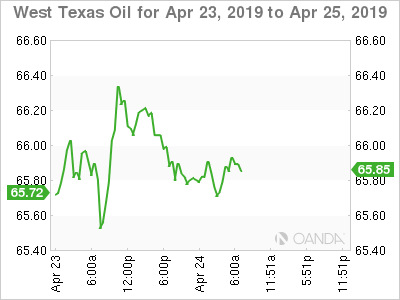
Oil prices are under pressure this morning on a report that seems to be easing market worries about tightening supply. It has temporarily put an end to this recent rally that has taken prices to their highest level since Q4 2019, driven by OPEC+ output cuts and sanctions.
Brent crude futures are at +$74.18 per barrel, down -33c from Tuesday’s close. U.S West Texas Intermediate (WTI) crude futures are at +$65.89 per barrel, down -41c from their previous settlement.
Putting pressure on the ‘black stuff’ was the IEA statement yesterday indicating that markets are “adequately supplied” and that “global spare production capacity remains at comfortable levels.”
Also weighing on prices was data from the API last week showing that U.S. crude stocks rose by +6.9M barrels last week, more than expected. Expect dealers to take direction from today’s EIA stock data due at 10:30 am EDT.
Ahead of the U.S open, gold prices have eased, but remain atop of their four-month low print from yesterday as the ‘big’ dollar remains strong. Spot gold has fallen -0.1% to +$1,270.40 per ounce, having hit its lowest since the end of 2018 at +$1,265.90 on Tuesday. U.S gold futures are -0.1% lower at +$1,272.50 an ounce.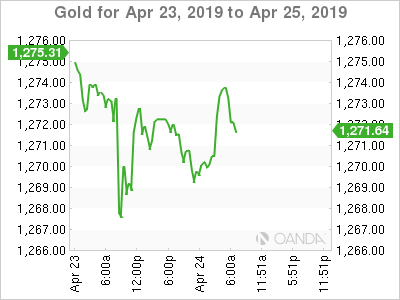
3. Bank of Canada (BoC) to remain on hold
The Bank of Canada (BoC) is expected to keep its key interest rate on hold for the remainder of this year later this morning (10:00 am EDT). Governor Poloz and company are expected to stand pat, leaving the benchmark overnight rate at +1.75%. Dealer consensus is not pricing in another rate change before the end of 2019, as policy makers assess the impacts of ongoing trade tensions and a weaker outlook for domestic growth.
Expect all eyes will be on the accompanying statement, updated forecasts, and Governor Poloz’s tone. Markets seem to be expecting an overly ‘dovish; message, and while the Bank is indeed likely to appear cautious overall, it is unlikely to go as far as abandon its rate-hike plans completely. Currently, the loonie (C$1.3450) is getting very little love from eight-month high oil prices.
Elsewhere, the yield on 10-year Treasuries have fallen -1 bps to +2.55%, the lowest in a fortnight. In Germany, the 10-year Bund yield has dipped -1 bps to +0.03%, while in the U.K the 10-year Gilt yield has fallen -2 bps to +1.204%.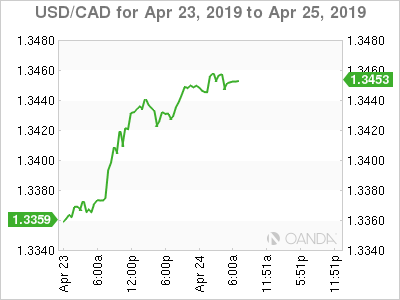
4. Dollar remains the dominant force
The dollar index has jumped another +0.3% in the overnight session to its highest print in nearly two months.
EUR/USD (€1.1213) briefly tested below the psychological €1.12 level (€1.11945) in the aftermath of disappointing German IFO data (see below) which missed expectations across the board as the domestic economy continued to lose steam. Nevertheless, the pair failed to make a fresh new three-week low and has since retraced to above €1.1210.
USD/JPY (¥111.87) is still unable to break above the key ¥112 level with focus remaining on the upcoming Bank of Japan (BoJ) rate decision later this evening.
Overnight, Aussie Q1 CPI data missed expectations and registered its third consecutive reading below the RBA’s target range of +2-3% and matched the lowest level since Q3 2016 (Q/Q: +0.0% vs. +0.2%e; Y/Y: +1.3% vs. +1.5%e). The softer data has a number of analysts revising their outlook for the RBA and now expect a rate cut as soon as next month (A$0.7043).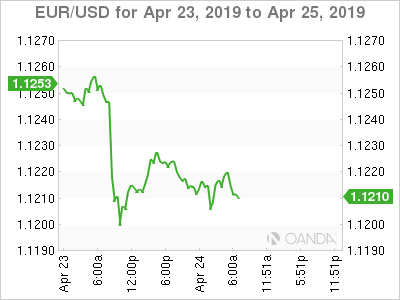
5. German IFO survey continues the string of disappointing data for region
Data this morning showed that German business sentiment deteriorated somewhat this month as the mood among manufacturers “worsened markedly,” accordingly to the Ifo Institute.
“The German economy continues to lose steam,” said Ifo president Clemens Fuest, after the Ifo business-climate index unexpectedly slipped to 99.2 from a revised 99.7 points in March.
Market expectations were looking for a small increase to 99.9 or 100 for this month.
Note: The German economy has had a weak start to 2019, narrowly avoiding recession in H2 2018, a trend that prompted the government last week to slash its growth forecast for this year to +0.5% from an earlier estimate of +1.0%.
The ZEW research institute’s latest measure of economic expectations, point to towards a “mild pickup” in economic activity in the coming months.
Net, the Ifo survey confirms that “the export-driven industry is in recession, while the domestic economy remains rather healthy.”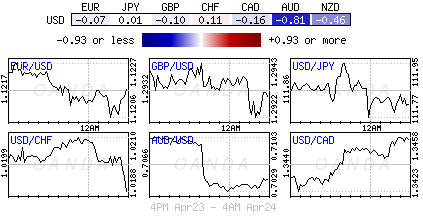
EURUSD Still Under Pressure
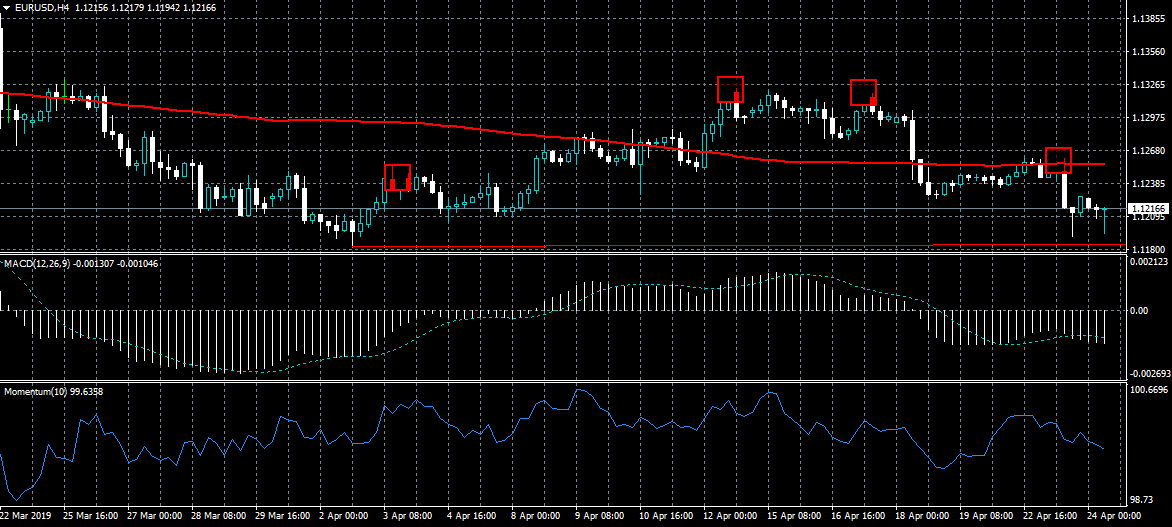
The euro currency remains under pressure against the US dollar following the release of more weaker than expected economic data from the German economy during the European session. Technical indicators on the four-hour time frame are still trending lower and point to further short-term losses for the EURUSD pair. A bearish head and shoulders pattern is also still present across the four-hour time frame.
The EURUSD pair is heavily bearish while trading below the 1.1216 level, key technical support remains at the 1.1175 and 1.1130 levels.
If the EURUSD pair trades above 1.1230 level, key intraday resistance is found at the 1.1260 and 1.1280 levels.
USDJPY Awaiting Rate Decision
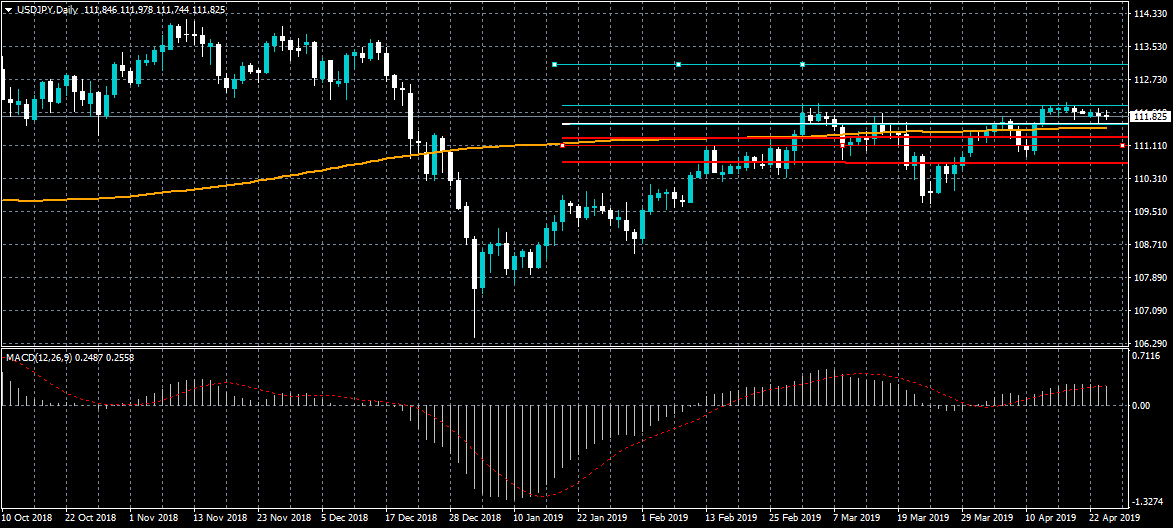
The US dollar continues to trade in a narrow price range against the Japanese yen currency as traders remain cautious ahead of the Bank of Japan interest rate decision. If buyers can finally move price above the 112.00 resistance level, the bullish pattern on the four-hour is showing that a strong technical breakout could occur. If the USDJPY falls below the 111.68 level the 111.30 level offers strong technical support below.
The USDJPY pair is intraday bullish while trading above the 111.80, key intraday resistance is found at the 112.00 and 113.20 levels.
If the USDJPY pair trades below the 111.68 level, key intraday support is found at the 111.30 and 110.90 levels.