Sample Category Title
EURGBP Could Keep Upside In Short Term, Bearish In Medium Term
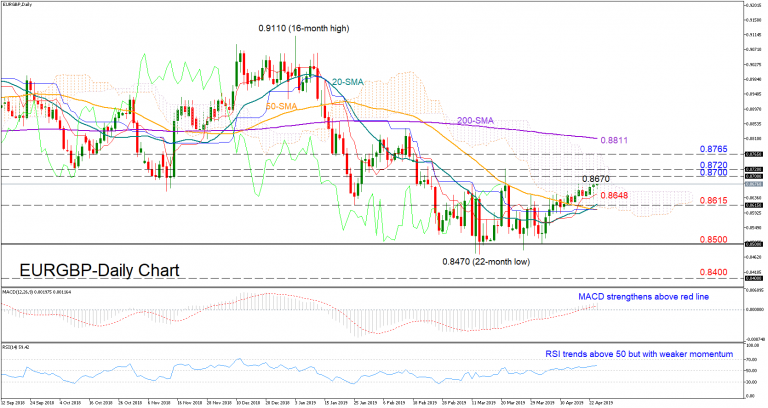
EURGBP has been steadily rising this month, piercing its short-term simple moving averages (SMA) and the Ichimoku cloud. The bias is still positive as the red Tenkan-sen is trending northward and above the blue Kijun-sen, while the MACD is increasing strength above its red signal line. The RSI is also fluctuating in bullish zone (above 50),though with weaker momentum, suggesting that some softness is possible.
Next resistance to upside movements could emerge between 0.8700 and 0.8720. A descent rally above the 0.8765 level and the top of the Ichimoku cloud, however, could be more persuasive to the buyers, while a break above the 200-day SMA (0.8811) may confirm further bullish action.
Moving lower, the 0.8648-0.8615 region could halt downside corrections before the market hits a floor around 0.8500. In case the latter proves a weak obstacle, all eyes will turn to the 0.8470 trough which if broken could then open the door for the 0.8400 psychological mark, last seen in April 2017.
In the medium-term picture, the market is still in bearish correction mode since the start of the year, with the falling 50-day SMA giving little hope for an outlook reversal.
ECB: Impact of trade tensions escalation could heighten financial stress and lower confidence
In a paper released today, ECB noted that last year's increased in trade tensions and the repercussions of the tariffs implemented pose only a "modest adverse risk" to the global and euro area outlooks. Also, impact of implemented tariffs and tariff announcements owing to uncertainty effects appears to have remained "confined to the targeted sectors" for the time being.
However, if trade tensions were to escalate once again, "the impact would be larger". Model-based simulations indicate that the medium-term direct impact of an escalation could be "sizeable, compounded by heightened financial stress and a drop in confidence." The longer-term effects would be "even more pronounced".
ECB also warned that "although free trade is often seen as one of the factors behind rising inequality both within and across countries, winding back globalisation is the wrong way to address these negative effects." "A retreat from openness will only fuel more inequality, depriving people of the undisputed economic advantages that trade and integration bring.". The paper urged that "countries should seek to resolve any trade disputes in multilateral fora".
Full paper "The economic implications of rising protectionism: a euro area and global perspective".
German Ifo dropped to 99.2, March’s gentle optimism evaporated
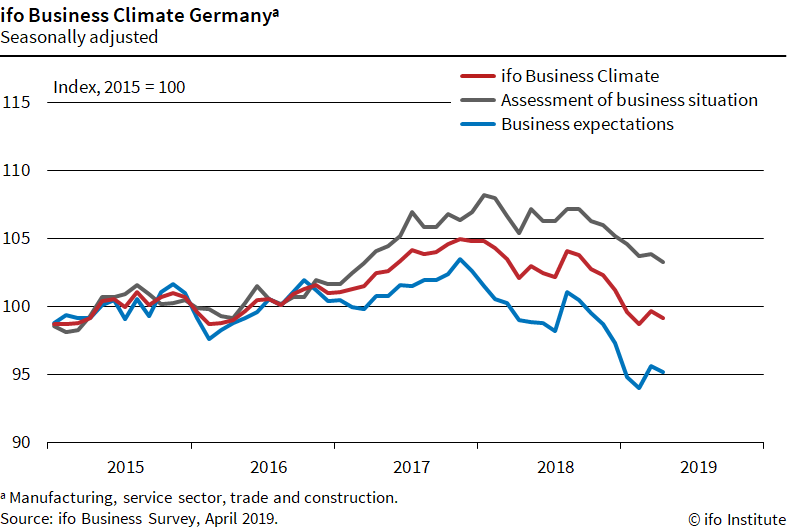
German Ifo Business Climate Index dropped to 99.2 in April, down from 99.7 and missed expectation of 99.9. Expectation Index dropped to 95.2, down fro 95.6 and missed consensus of 96.0. Current Assessment Index also dropped to 103.3, down from 103.8 and missed expectation of 103.6.
Ifo President Clemens Fuest noted that "the mood among German managers became slightly gloomier this month... March's gentle optimism regarding the coming months has evaporated. The German economy continues to lose steam." Ifo economist Klaus Wohlrabe said the data points to 0.8% growth in Germany this year.
Looking at the details, business climate in manufacturing "has again worsened markedly", down from 6.7 to 4.0. It's the eighth straight month of decline. Services continued recovery from 26.1 to 26.3, comparing to cyclic low at 21.5 in February. Trade worsened again from 8.2 to 7.1. Construction improved slightly from 20.4 to 21.4.
Gold Prices Fall As Risk Appetite Gains
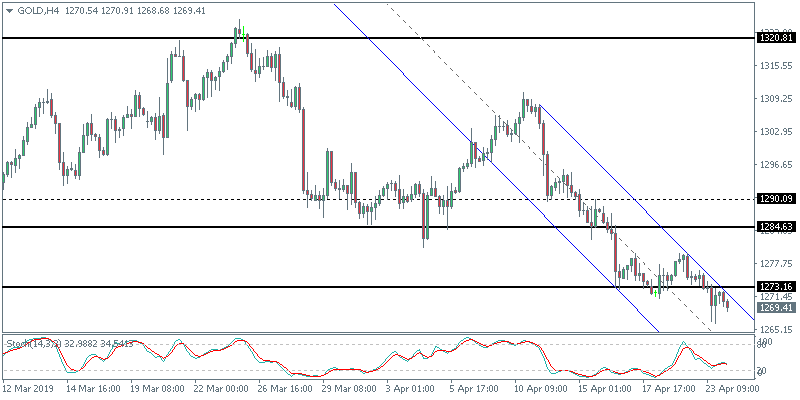
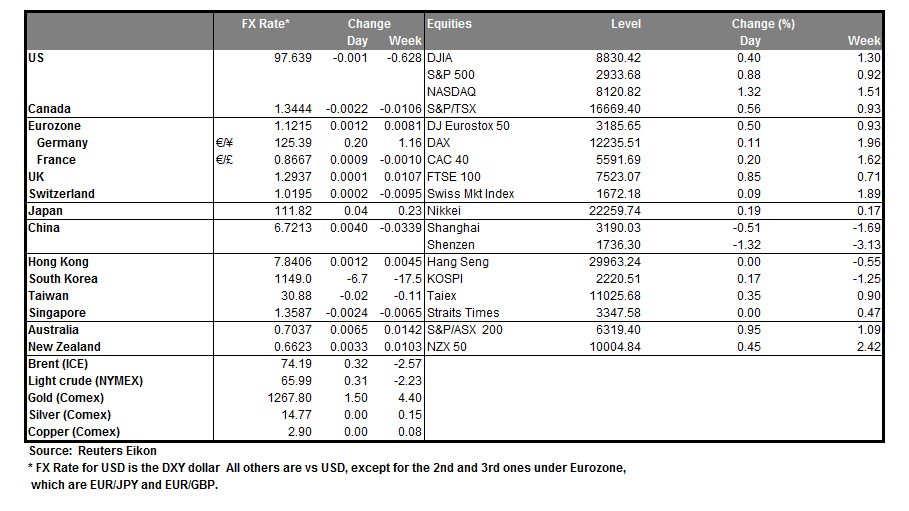
The precious metal resumed the declines on Tuesday amid an improving risk appetite in the markets. Gold prices eased to a four-month low as the USD bounced back and the equity markets closed near record highs. Spot gold fell 0.1% on the day to hit the lowest levels of $1266 before pulling back.
What’s Next for XAUUSD?
With the precious metal failing to capitalize earlier on its consolidation above 1273, the declines mark further downside. The 200-day EMA has failed to keep a floor on the declines leading to the intraday losses. The next main target for XAUUSD comes in at the 1240 – 1250 handle. This level is very likely to provide support to the downtrend. In the near term, any rebound in prices could still see a move to the 1285 support which can be tested for resistance.
Oil Holds Steady At The Top
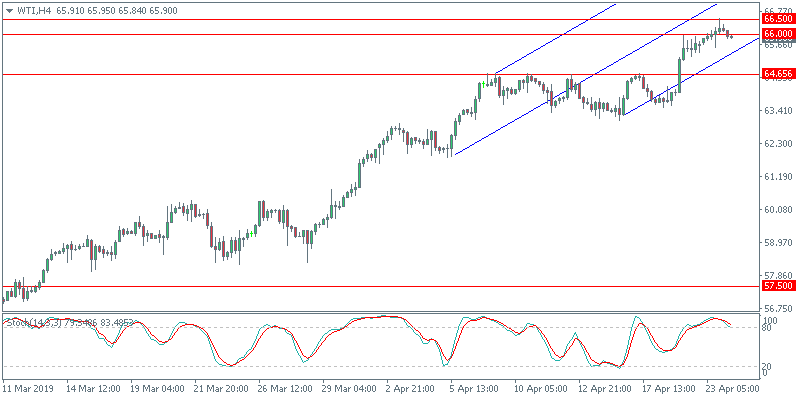
WTI Crude oil continued to maintain a steady gain as prices rose to fresh yearly highs. Oil prices briefly tested a six-month high of 66.53 before pulling back by the closing session. Uncertainty about supply shortages continues in the oil markets. The onus now falls upon OPEC and Russia to plug the supply shortage from Iran. However, it is unlikely that Saudi Arabia will act alone in raising production.
Will Crude Oil Rise Further?
Following the strong gains over the past two days, oil prices were seen pulling back from the highs. Price is trading within the resistance area of the 65 – 66 handle. As long we do not see a weekly close above this level, oil prices could consolidate near the highs. Since the rally has been rather strong, there hasn’t been any pullback so far. Therefore, oil prices could post a correction in the near term. The initial support is seen at 64.55.
Euro Slips To A 3-Week Low
The common currency extended declines on Tuesday, losing 0.3%. The eurozone’s consumer confidence report released during the day saw the index falling to -7.9. This was below the estimates of -7.0. Economic data was sparse over the day. The ECB will be releasing its economic bulletin later today.
Can the EURUSD Fall Further?
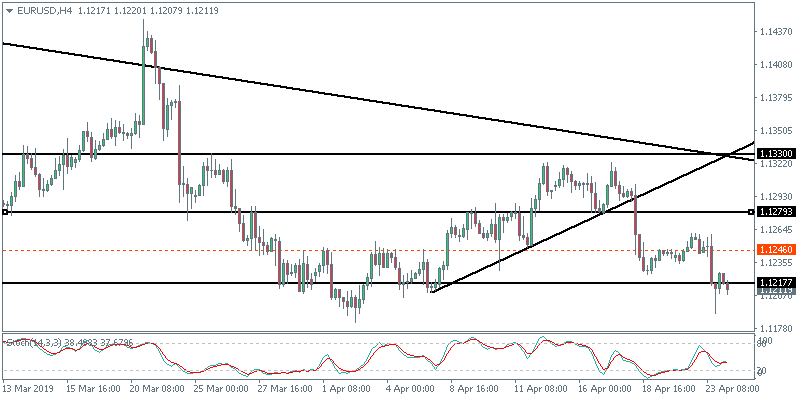
The EURUSD currency pair fell to a three-week low, briefly slipping below 1.1200 handle. Price managed to recover off the lows, but the overall bias remains to the downside. With the support level of 1.1217 being breached, further downside is expected. The next lower support at 1.1174 could stall the declines temporarily.
BOC Interest Rate Decision
Today during the American session (14:00, GMT), Bank of Canada is expected to release its interest rate decision. The bank is widely expected to remain on hold at +1.75% and currently CAD OIS imply a probability of 100.00% for the bank to remain on hold, practically rendering the interest rate level as an open and shut case. Hence we expect the market to turn its focus on the accompanying statement, the bank’s new projections and the press conference (15:15, GMT). Analysts seem to be prepared for the bank to maintain a dovish tone, especially after the last decision, when the bank had removed its explicit hawkish bias. Yet we could see the bank trying to keep its options open, moderating its tone, as oil prices are rising and uncertainty about global growth seems to be easing somewhat. Also should the bank lower its projections, especially for the GDP rate, we could see the Loonie losing ground. Please bear in mind that volatility could be maintained throughout BoC Governor Poloz’s press conference later on. USD/CAD rose yesterday, breaking the 1.3360 (S1) and the 1.3425 (S2) resistance line (now turned to support). We could see the pair maintain some bullish tendencies today and expect it to be sensitive to the BoC interest rate decision. Also please be advised that the RSI indicator in the 4 hour chart, has touched the reading of 70 implying aa rather overcrowded long position. Should the pair find fresh buying orders along its path once again today, we could see it breaking the 1.3510 (R1) resistance line and aim for the 1.3590 (R2) resistance level. On the other hand if the pair comes under the selling interest of the market, we could see it breaking the 1.3425 (S1) support line and aim for the 1.3360 (S2) support level.
BoJ interest rate decision.
Tomorrow during the Asian session, albeit at a tentative time, Bank of Japan is expected to release its interest rate decision. The bank is widely expected to remain on hold at -0.10% and currently JPY OIS imply a probability of 96.18% for the bank to remain on hold. Hence we expect the market to turn its focus on the accompanying statement, the bank’s new projections and the press conference. Given recent statements made by a number of BoJ officials, the bank seems prepared to ease its ultra-light monetary policy in order to bring momentum for inflation to rise. Furthermore the release of BoJ’s outlook report, especially if its forecasts are lowered, could also add volatility to the release. Should the bank maintain or even enhance its dovish tone and/or revise downwards its projections, we could see the JPY weakening. Please bear in mind that volatility could be maintained throughout BoJ Governor Kuroda’s press conference later on. USD/JPY maintained a sideways movement yesterday, constantly teasing the 112.00 (R1) resistance line. We could see the pair having some bullish tendencies today, especially if the market expects the BoJ to maintain a dovish tone tomorrow. Should the bulls dictate the pairs direction, we could see it breaking the 112.00 (R1) resistance line and aim for the 112.50 (R2) resistance hurdle. On the flip side should the bears take over, we could see the pair breaking the 111.40 (S1) support line and aim for the 110.90 (S2) support barrier.
Other economic highlights, today and early tomorrow
Today during the European session we get Germany’s Ifo Business Climate for April and in the American session we get from the US the weekly EIA crude oil inventories figure.
USD/JPY H4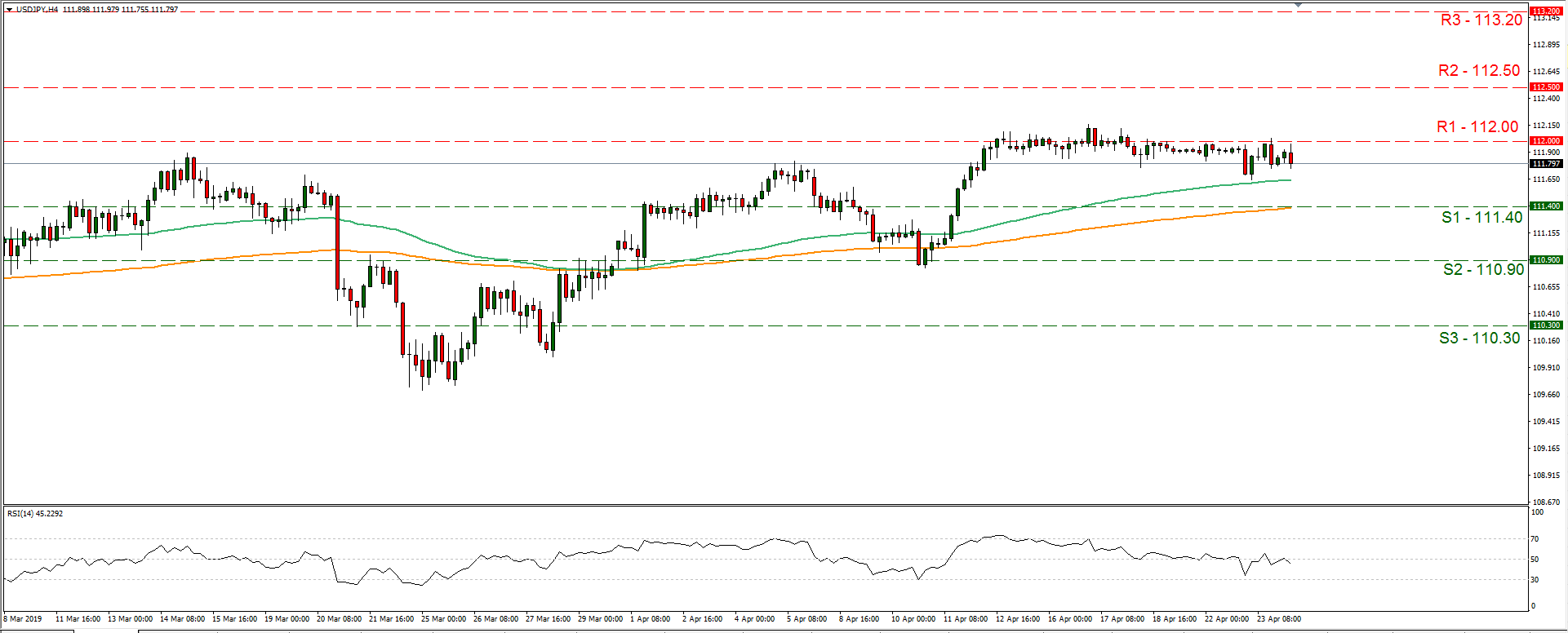
Support: 111.40 (S1), 110.90 (S2), 110.30 (S3)
Resistance: 112.00 (R1), 112.50 (R2), 113.20 (R3)
USD/CAD H4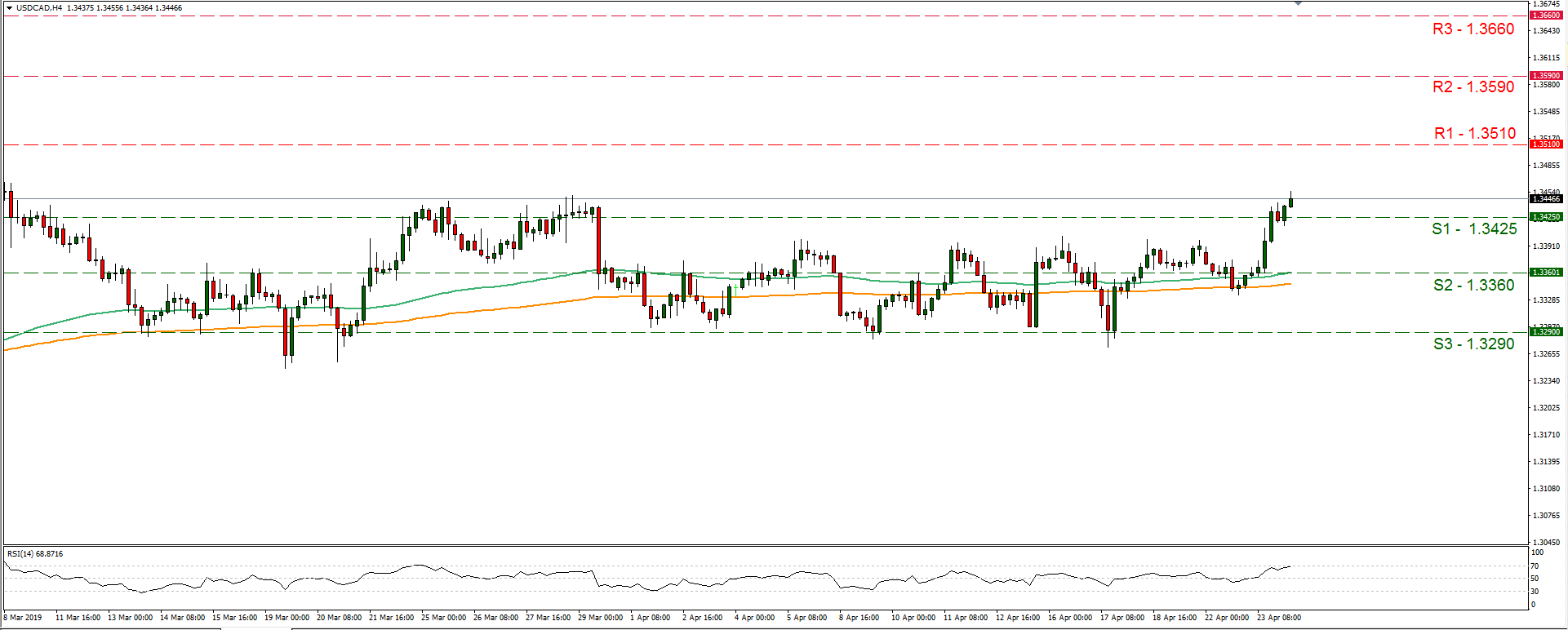
Support: 1.3425 (S1), 1.3360 (S2), 1.3290 (S3)
Resistance: 1.3510 (R1), 1.3590 (R2), 1.3660 (R3)
BoC May Disappoint Bears, US Stocks Hit Records
- Bank of Canada may not be as dovish as markets expect today
- US stocks close at new record highs on blockbuster earnings
- Dollar rallies amid demand for US equities
- Aussie suffers after disappointing CPIs fuel rate-cut bets
BoC: Cautious, but less than markets expect
The main event today will be the Bank of Canada (BoC) policy decision at 14:00 GMT. No change in policy is expected, so price action will depend on the language of the accompanying statement, the updated forecasts, and Governor Poloz's tone. The economy hit a soft patch lately, as was highlighted by the BoC's own business survey for Q1. Wages and house prices have also been struggling – a toxic cocktail for consumers.
In this context, markets seem to expect the central bank to strike an overly cautious tone today, perhaps by abandoning its rate-hike bias completely. In fact, market pricing now indicates a ~50% probability for a rate cut by December. This seems excessively pessimistic. There are still bright spots in the economy, like the rally in oil prices and decent inflation data lately, so officials won't be in a rush to change their guidance again. Overall, the BoC may be less dovish than markets anticipate, and if so, the Canadian dollar could soar as it finally starts playing catch-up with the oil rally too.
Wall Street hits new records as strong earnings revitalize bulls
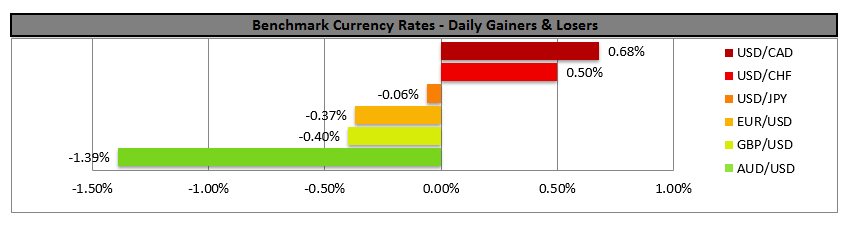
US equity markets made headlines on Tuesday. Both the S&P 500 (+0.88%) index and the tech-heavy Nasdaq Composite (+1.32%) rallied to close at new record highs, following some blockbuster earnings from the likes of Twitter (+15.7%). The earnings season in general has been much better than expected so far, with the vast majority of firms beating forecasts, which has reinvigorated demand for stocks.
The earnings season continues in earnest today, with giants like Facebook and Microsoft releasing their results after Wall Street's closing bell. Industrial bellwethers Boeing and Caterpillar will also announce earnings, and those may be especially important for expectations around broader economic growth, as well as for the Dow Jones.
Dollar finds love amid demand for US equities
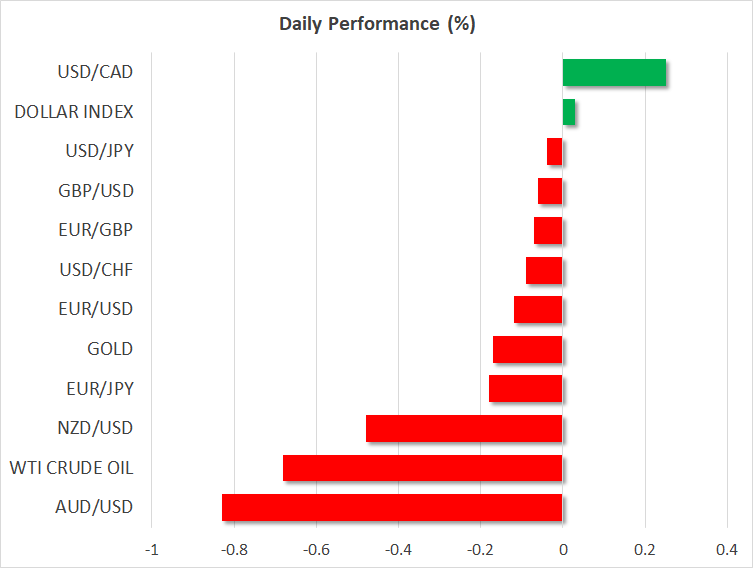
In the FX market, the rally in American stocks translated into a rally in the dollar, which outperformed all its major peers outside of the yen. There wasn't a clear catalyst behind the greenback's gains. One could argue that the robustness in corporate earnings dampened concerns about a slowdown in the US economy, but the bond market would argue otherwise, as long-term US interest rates fell while the probability for a Fed rate cut by December actually rose.
Hence, the gains in the dollar seem owed simply to demand for US equities attracting foreign funds into America and thus, generating demand for the greenback. Moving forward, the next major market mover for the dollar will probably be the GDP data for Q1 on Friday.
Aussie sinks as inflation miss reinforces RBA rate-cut expectations
Overnight, Australia's CPI data for Q1 disappointed, with both headline and underlying inflation slowing by much more than expected. The softness likely reinforced market expectations that the RBA could cut rates soon, consequently weighing on the Australian dollar. The kiwi is also on the back foot today, mainly in sympathy to the aussie, as there haven't been any news from New Zealand.
EUR/USD Likely To Decline
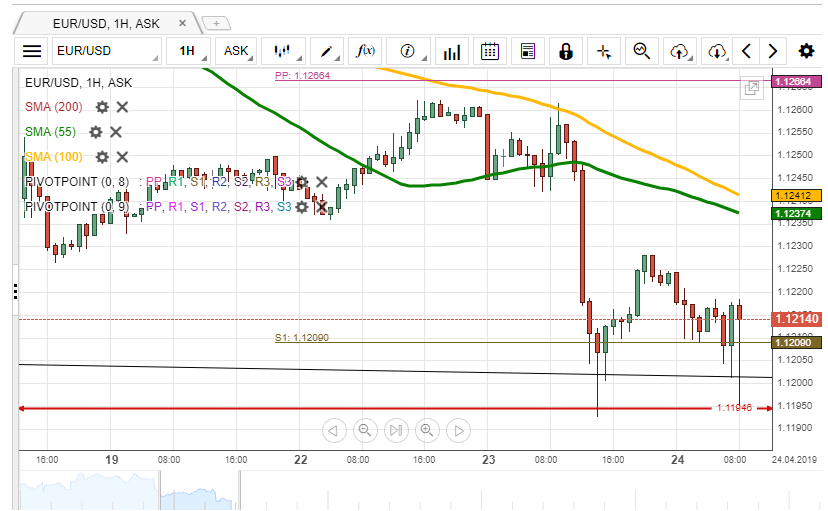
Yesterday, the EUR/USD currency pair declined to the support level formed by the weekly S1 at the 1.1209 mark.
From a technical perspective, it is likely, that the pair could maintain its slump, as it is pressured by the 55– and 100-hour SMAs, currently located circa 1.1240. The exchange rate could re-new the 2018/2019 minimum located at 1.1195.
However, if the short-term descending channel holds, it is expected, that the rate could trade sideways around the weekly S1. It is unlikely, that bulls could prevail in the market and surpass the given moving averages.
GBP/USD: Falling Wedge Pattern In Sight
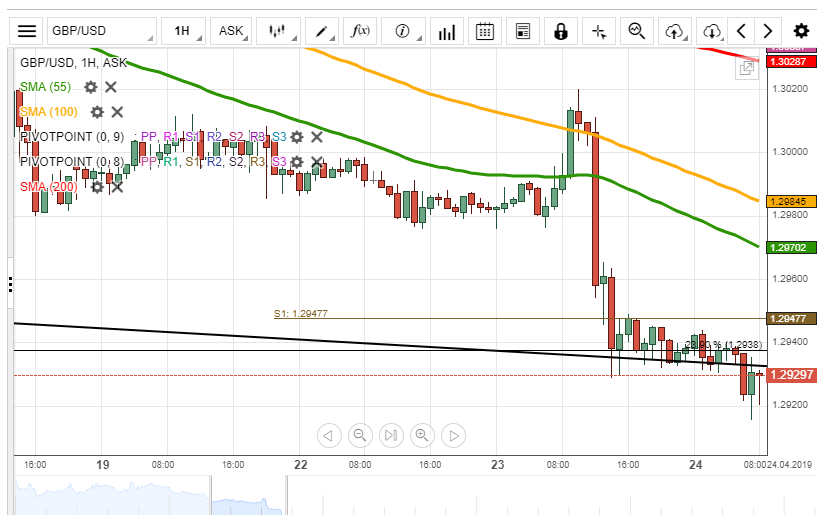
On Tuesday, the GBP/USD exchange rate declined to the Fibo 23.90% at 1.12938. During Wednesday's morning, the rate started to test the lower boundary of the falling wedge pattern at 1.2920.
If the given pattern holds, is expected, that the currency pair reverses north and targets the 55– and 100-hour SMAs, currently located circa 1.2980. However, the pair has to surpass the weekly S1 at 1.2948.
If the given pattern does not hold, a breakout north occurs in the nearest future. In this case, the pair could target the weekly S2 located at the 1.2894 mark.