Sample Category Title
Bank of Canada shifts to neutral bias; takes an axe to 2019 growth forecast
- As expected, the overnight rate was held steady at 1.75% for a fourth consecutive meeting
- The BoC’s 2019 GDP growth forecast was lowered to 1.2% from 1.7% previously—a more substantial downward revision than we expected
- GDP growth is expected to average just 0.8% annualized over the first half of 2019 before picking up later this year and returning to around 2% in 2020 and 2021
- The bank’s estimate of the neutral policy rate was revised down by 25 bps to a 2.25-3.25% range—a dovish development (it means the BoC doesn’t have to raise rates as much to get “home”) that wasn’t entirely unexpected
The Bank of Canada was widely expected to drop their mild tightening bias today and they did just that, now indicating current accommodation is warranted and Governing Council will “continue to evaluate the appropriate degree of monetary policy accommodation as new data arrive.” A few other developments added to the dovish tone, including a sharp downward revision to their 2019 growth forecast (now several ticks below consensus) and a lower assumed neutral interest rate. The former means the economy is operating with a bit more slack than previously thought, while the latter indicates the current overnight rate is slightly less accommodative than previously assumed. The statement pointed to ongoing trade tensions, slower-than-expected global growth, and a dovish shift from other central banks—not exactly a global backdrop that supports further tightening from the BoC. It did, however, note that investment and exports outside the energy sector should be supported by high capacity utilization and strengthening global demand as 2019 progresses. Stabilization in housing and decent consumption growth will also contribute to a return to more trend-like (or slightly stronger) growth later this year.
While we agree with the BoC that Canadian GDP growth should pick up in the coming quarters, we don’t expect activity will be strong enough on a sustained basis for the central bank to get back to raising interest rates. The bank’s forecast for only modestly above-trend growth in 2020 and 2021 indicates excess capacity will only be absorbed slowly—in that respect, their shift to neutral seems appropriate. Although we don’t see an argument for rate hikes at this stage, we also don’t think an outlook that calls for continued low unemployment and near-2% inflation warrants a reversal of the BoC’s recent moves. Our forecast assumes the overnight rate will be held at 1.75% through next year, so expect more steady rate decisions in the months ahead.
USD/CAD Mid-Day Outlook
Daily Pivots: (S1) 1.3362; (P) 1.3403; (R1) 1.3463; More...
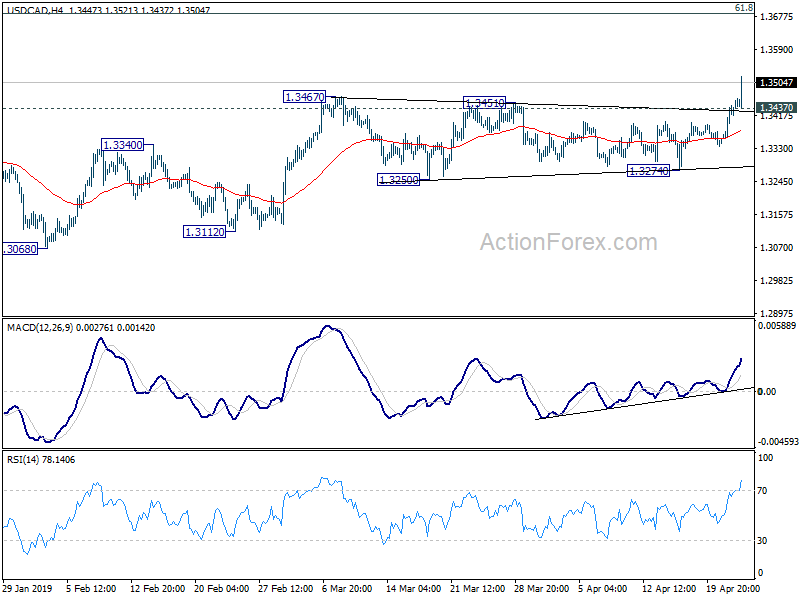
USD/CAD surges to as high as 1.3521 in early US session. Firm break of 1.3467 resistance confirms resumption of rise from 1.3068. Further rise should now be seen back to retest 1.3664 high and then 1.3685 key fibonacci level. On the downside, below 1.3437 minor support will turn intraday bias neutral and bring consolidation, before staging another rise.
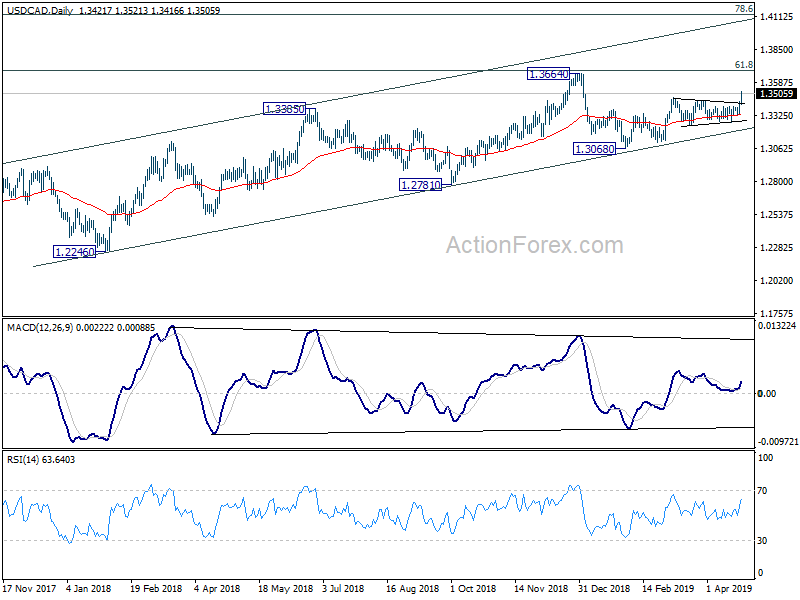
In the bigger picture, USD/CAD is staying well inside medium term rising channel (support at 1.3221). Thus, the up trend from 1.2061 should be in progress. On the upside, decisive break of 61.8% retracement of 1.4689 (2016 high) to 1.2061 at 1.3685 will pave the way to 78.6% retracement at 1.4127 next. This will remain the favored case as long as 1.3068 support holds.
Sunset Market Commentary
Markets
Global core bonds gain ground today. WS closed yesterday’s session at all-time highs, supported by better-than-expected corporate earnings. However, that didn’t spill-over to FX/FI markets with core bonds maintaining this week’s upward trend. European equities failed to track WS gains and edged lower at opening, further supporting core bonds. German ifo business confidence printed below expectations and failed to confirm last month’s cautious rebound. German Bunds gained some more ground and continued the upward path throughout the day, causing the German 10-yr yield to enter negative territory again. The German yield curve is bull flattening with changes up to ‑5.5 bps (30-yr). US Treasuries followed the Bunds’ move higher ahead of the US opening, with no US economic data other than more Q1 corporate earnings lined up to guide investors. The US yield curve is edging lower with changes in the range of -2.5 bps (30-yr) to -4.1 bps (5-yr). Peripheral spreads over the German 10-yr yield are little widening with Italy (+2 bps) underperforming.
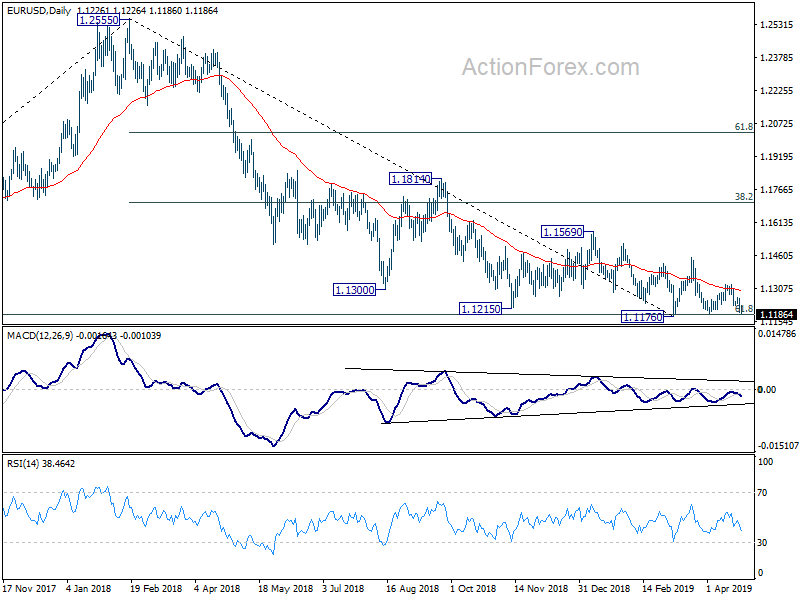
Since mid last week, EUR/USD traded with a negative bias. Downside pressure was mainly inspired by ongoing sluggish EMU eco data, including disappointing April EMU PMI’s. At the same time, the dollar enjoyed some kind of ‘by default’ bid. US data are mixed, but there is no reason yet for (FX) markets to position for a softer Fed compared to what is currently discounted. First US corporate earnings also left a rather constructive sentiment on the US economy. This combination of doubts on Europe combined with graded optimism on the US persisted today. The German ifo business confidence was today again unconvincing. EUR/USD initially lost little ground. However, as was often the case of late, the dollar again captured a better bid at the start of the US session. EUR/USD is currently testing the 1.1187 (62% retracement MT)/1.1177 (correction low) support area. A break would further hurt the technical picture in the cross rate. The dollar is also holding up well against the yen, but still fails to regain the 112.00/112.17 resistance.
Sterling hovered near recent lows around EUR/GBP 0.87 at the start of European dealings but staged a remarkable comeback around noon. UK government borrowing data were strong but usually have only limited impact on trading. Sterling likely profited from David Lidington’s comments. Britains shadow PM signaled the government is aiming for a kind of customs union that both the Conservatives as Labour can agree to. Part of the move was also driven by euro softness following a weaker than expected German IFO business confidence (see below), raising ever more questions about the long called German recovery. The common currency slipping through/testing technically important levels vs. the dollar (see above) is having follow-through in other currency pairs such as EUR/GBP (currently changing hands at 0.864, down from 0.868 this morning). Cable is trading virtually unchanged at 1.294.
News Headlines
The German IFO Business Confidence gauge fell to 99.2 in April, down from 99.7 last month and below expectations (99.9). The gauge fails to confirm last month’s cautious rebound. The forward-looking component also unexpectedly declined to 95.2, down from 95.6 in March, and suggests the economic recovery will be tougher than expected.
Belgian business confidence unexpectedly dropped from -0.7 to -3.2 in April, the lowest level since September 2017. Consensus expected a stabilization. Details showed weakness in the manufacturing and construction sectors with especially order books under huge pressure. A small rebound in retail/wholesale trade and business-related services couldn’t offset this.
BoC drops tightening bias, Canadian Dollar dives
Canadian Dollar dives sharply after BoC kept overnight rate unchanged at 1.75% and drops tightening bias. The accompanying statement concluded by saying that " an accommodative policy interest rate continues to be warranted". The "appropriate degree" of accommodation will be evaluated as new data come in . In particular, BoC will monitor "developments in household spending, oil markets, and global trade policy". The sentence regarding " future rate increases" was omitted.
Growth forecasts for 2019 was sharply revised lower to 1.2%, down from January projection of 1.7%. 2020 growth forecast was revised slightly lower from 2.1% to 2.0%. Inflation is expected to remain around 2% through 2020 and 2021.
Full statement below.
Bank of Canada maintains overnight rate target at 1 ¾ per cent
The Bank of Canada today maintained its target for the overnight rate at 1 ¾ per cent. The Bank Rate is correspondingly 2 per cent and the deposit rate is 1 ½ per cent.
Global economic growth has slowed by more than the Bank forecast in its January Monetary Policy Report (MPR). Ongoing uncertainty related to trade conflicts has undermined business sentiment and activity, contributing to a synchronous slowdown across many countries. In response, many central banks have signalled a slower pace of monetary policy normalization. Financial conditions and market sentiment have improved as a result, pushing up prices for oil and other commodities.
Global economic activity is expected to pick up during 2019 and average 3 ¼ per cent over the projection period, supported by accommodative financial conditions and as a number of temporary factors weighing on growth fade. This is roughly in line with the global economy's potential and a modest downgrade to the Bank's January projection.
In Canada, growth during the first half of 2019 is now expected to be slower than was anticipated in January. Last year's oil price decline and ongoing transportation constraints have curbed investment and exports in the energy sector. Investment and exports outside the energy sector, meanwhile, have been negatively affected by trade policy uncertainty and the global slowdown. Weaker-than-anticipated housing and consumption also contributed to slower growth.
The Bank expects growth to pick up, starting in the second quarter of this year. Housing activity is expected to stabilize given continued population gains, the fading effects of past housing policy changes, and improved global financial conditions. Consumption will be underpinned by strong growth in employment income. Outside of the oil and gas sector, investment will be supported by high rates of capacity utilization and exports will expand with strengthening global demand. Meanwhile, the contribution to growth from government spending has been revised down in light of Ontario's new budget.
Overall, the Bank projects real GDP growth of 1.2 per cent in 2019 and around 2 per cent in 2020 and 2021. This forecast implies a modest widening of the output gap, which will be absorbed over the projection period.
CPI and measures of core inflation are all close to 2 per cent. CPI inflation will likely dip in the third quarter, largely because of the dynamics of gasoline prices, before returning to about 2 per cent by year end. Taking into account the effects of the new carbon pollution charge, as well as modest excess capacity, the Bank expects inflation to remain around 2 per cent through 2020 and 2021.
Given all of these developments, Governing Council judges that an accommodative policy interest rate continues to be warranted. We will continue to evaluate the appropriate degree of monetary policy accommodation as new data arrive. In particular, we are monitoring developments in household spending, oil markets, and global trade policy to gauge the extent to which the factors weighing on growth and the inflation outlook are dissipating.
Information note
The next scheduled date for announcing the overnight rate target is May 29, 2019. The next full update of the Bank's outlook for the economy and inflation, including risks to the projection, will be published in the MPR on July 10, 2019.
(BOC) Bank of Canada maintains overnight rate target at 1 ¾ per cent
The Bank of Canada today maintained its target for the overnight rate at 1 ¾ per cent. The Bank Rate is correspondingly 2 per cent and the deposit rate is 1 ½ per cent.
Global economic growth has slowed by more than the Bank forecast in its January Monetary Policy Report (MPR). Ongoing uncertainty related to trade conflicts has undermined business sentiment and activity, contributing to a synchronous slowdown across many countries. In response, many central banks have signalled a slower pace of monetary policy normalization. Financial conditions and market sentiment have improved as a result, pushing up prices for oil and other commodities.
Global economic activity is expected to pick up during 2019 and average 3 ¼ per cent over the projection period, supported by accommodative financial conditions and as a number of temporary factors weighing on growth fade. This is roughly in line with the global economy's potential and a modest downgrade to the Bank's January projection.
In Canada, growth during the first half of 2019 is now expected to be slower than was anticipated in January. Last year's oil price decline and ongoing transportation constraints have curbed investment and exports in the energy sector. Investment and exports outside the energy sector, meanwhile, have been negatively affected by trade policy uncertainty and the global slowdown. Weaker-than-anticipated housing and consumption also contributed to slower growth.
The Bank expects growth to pick up, starting in the second quarter of this year. Housing activity is expected to stabilize given continued population gains, the fading effects of past housing policy changes, and improved global financial conditions. Consumption will be underpinned by strong growth in employment income. Outside of the oil and gas sector, investment will be supported by high rates of capacity utilization and exports will expand with strengthening global demand. Meanwhile, the contribution to growth from government spending has been revised down in light of Ontario's new budget.
Overall, the Bank projects real GDP growth of 1.2 per cent in 2019 and around 2 per cent in 2020 and 2021. This forecast implies a modest widening of the output gap, which will be absorbed over the projection period.
CPI and measures of core inflation are all close to 2 per cent. CPI inflation will likely dip in the third quarter, largely because of the dynamics of gasoline prices, before returning to about 2 per cent by year end. Taking into account the effects of the new carbon pollution charge, as well as modest excess capacity, the Bank expects inflation to remain around 2 per cent through 2020 and 2021.
Given all of these developments, Governing Council judges that an accommodative policy interest rate continues to be warranted. We will continue to evaluate the appropriate degree of monetary policy accommodation as new data arrive. In particular, we are monitoring developments in household spending, oil markets, and global trade policy to gauge the extent to which the factors weighing on growth and the inflation outlook are dissipating.
Information note
The next scheduled date for announcing the overnight rate target is May 29, 2019. The next full update of the Bank's outlook for the economy and inflation, including risks to the projection, will be published in the MPR on July 10, 2019.
Japan Abe, Aso and Motegi to visit US on trade and currencies
Japanese Deputy Prime Minister and Finance Minister Taro Aso, and Economic and Fiscal policy minister Toshimitsu Motegi, economic and fiscal policy minister, will visit Washing on Thursday.
Aso will meet US Treasury Secretary Steven Mnuchin and currency issues are believed to be the major focuses. Mnuchin said before that the US would likely include a provision regarding currency manipulation in any upcoming trade agreement with Japan. But it's facing strong resistance.
Motegi will meet Trade Representative Robert Lighthizer for trade negotiation. There was virtually no progress in the trade talks so far, other than exchanging views. The US highlighted a large deficit with Japan during prior meeting, much of it from auto exports. But there is no response from Japan so far.
Prime Minister Shinzo Abe will travel to Washington on April 26-27. Then the top Japanese officials will travel back to Japan on Tuesday for a series of rites related to the day's abdication of Emperor Akihito.
USD/JPY Mid-Day Outlook
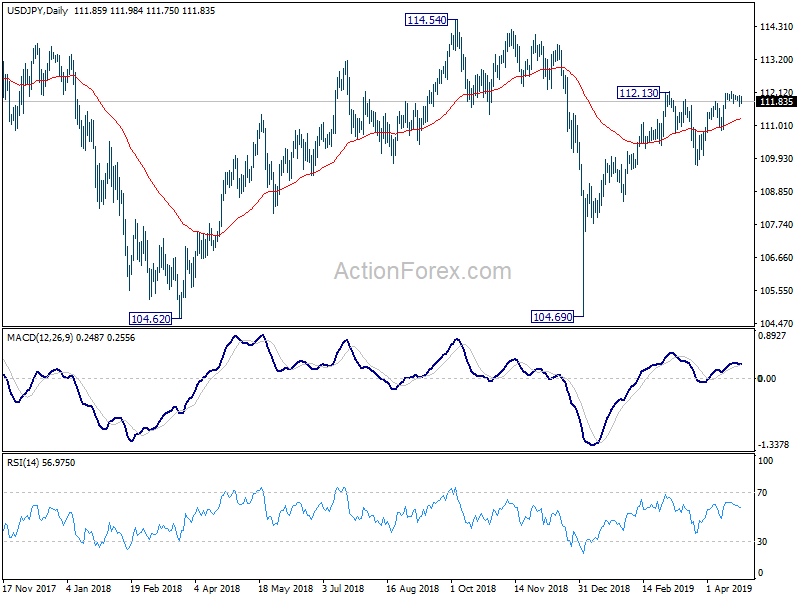
Daily Pivots: (S1) 111.66; (P) 111.85; (R1) 112.04; More...
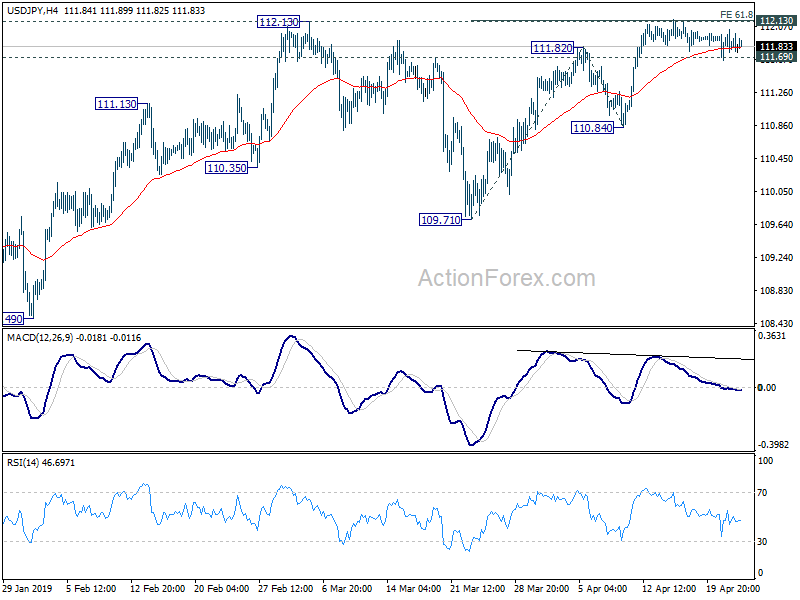
Outlook is USD/JPY remains unchanged and intraday bias stays neutral first. Focus remains on 112.13 key resistance. Decisive break there will resume whole rise from 104.69 for 100 % projection of 109.71 to 111.82 and 110.84 at 112.95 first. On the downside, firm break of 111.69 minor support will turn bias to the downside for 110.84 support. Break will bring deeper fall back to 109.71 support.
In the bigger picture, medium term outlook in USD/JPY remains a bit mixed as it's staying inside falling channel from 118.65, but there are signs of bullish reversal. On the upside, break of 114.54 resistance will revive the case the corrective fall from 118.65 has completed with three waves down to 104.69. And whole rise from 98.97 (2016 low) is resuming for 118.65 and above. But before that, outlook stays neutral first.
USD/CHF Mid-Day Outlook
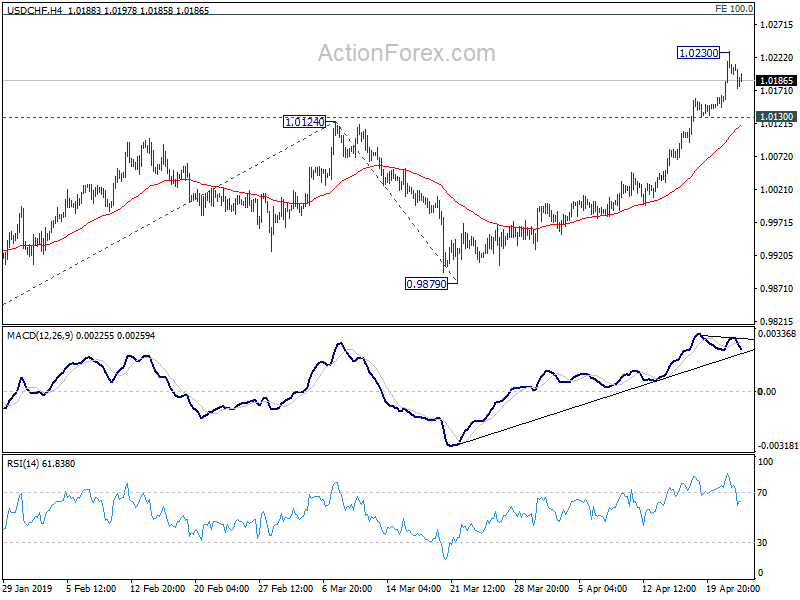
Daily Pivots: (S1) 1.0156; (P) 1.0194; (R1) 1.0236; More...
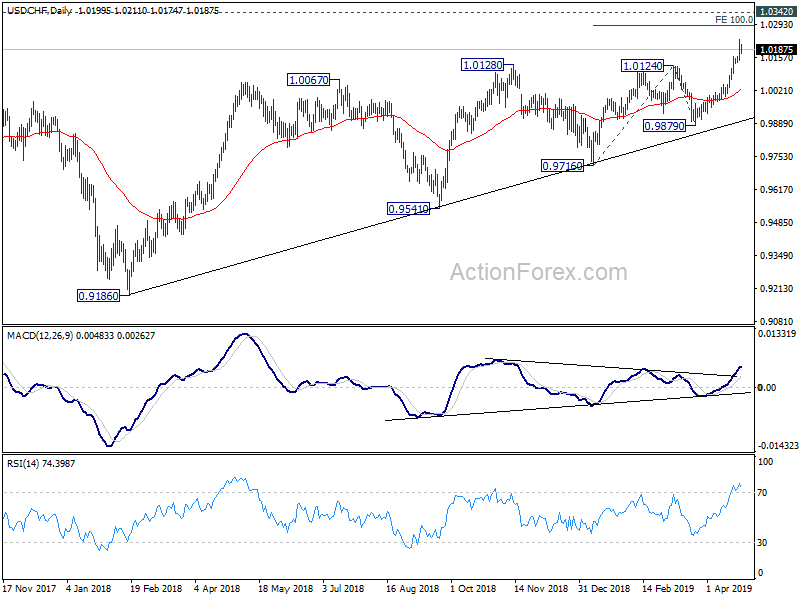
Intraday bias in USD/CHF is turned neutral as a temporary top is formed at 1.0230. Some consolidations could be seen but downside should be contained by 1.0130 minor support to bring rise resumption. On the upside, above 1.0230 will extend recent rally to 100% projection of 0.9716 to 1.0124 from 0.9879 at 1.0287, and then 1.0342 key resistance. However, break of 1.0130 will indicate short term topping and bring deeper retreat first.
In the bigger picture, medium term up trend from 0.9186 is extending. Current rise should target 1.0342 resistance next. For now, we'd be cautious on strong resistance from there to limit upside, until we see medium term upside acceleration. On the downside, break of 0.9879 support is needed to indicate reversal. Otherwise, outlook will stay bullish in case of deep pull back.
GBP/USD Mid-Day Outlook
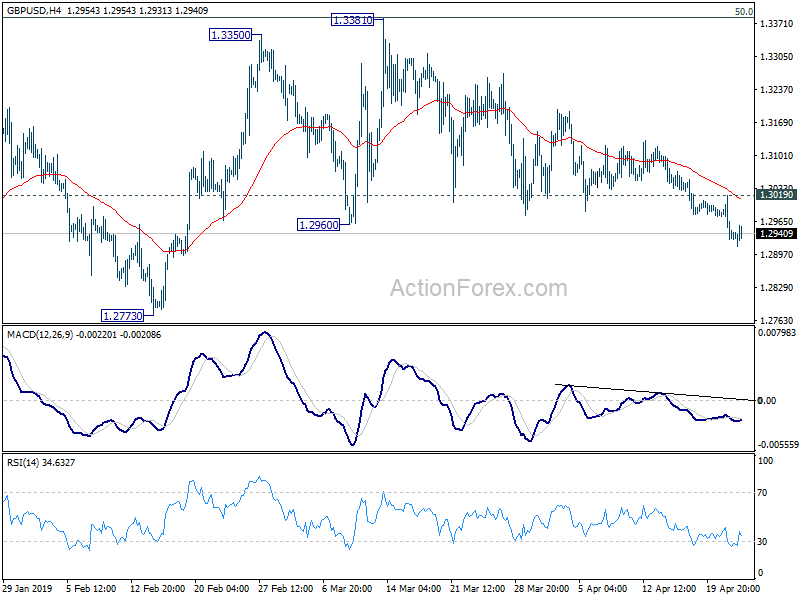
Daily Pivots: (S1) 1.2905; (P) 1.2962; (R1) 1.2996; More....
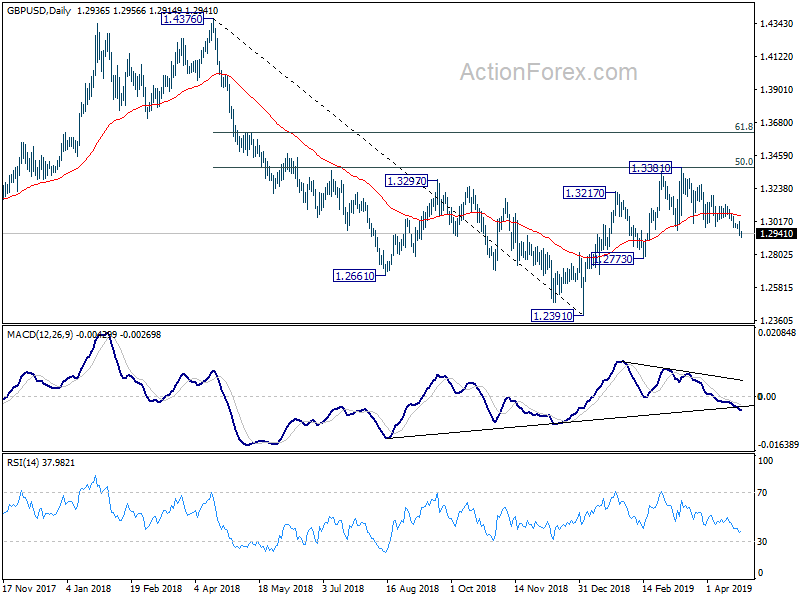
GBP/USD's fall is still in progress and intraday bias remains on the downside for 1.2773 support. Decisive break there will confirm that corrective rebound from 1.2391 has completed earlier than expected at 1.3381. Further decline should then be seen to 1.2391 low again. On the upside, though, break of 1.3019 minor resistance will dampen this bearish case and turn bias back to the upside for rebound.
In the bigger picture, medium term decline from 1.4376 (2018 high) halted after hitting 1.2391. Rise from 1.2391 could have completed after just missing 50% retracement of 1.4376 to 1.2391 at 1.338. Such rebound could be a correction to fall from 1.4376 only. Break of 1.2773 support will affirm this bearish case and target 1.2391. Break of 1.2391 will resume the fall from 1.4376 to 1.1946 (2016 low).
EUR/USD Mid-Day Outlook
Daily Pivots: (S1) 1.1192; (P) 1.1227; (R1) 1.1261; More.....
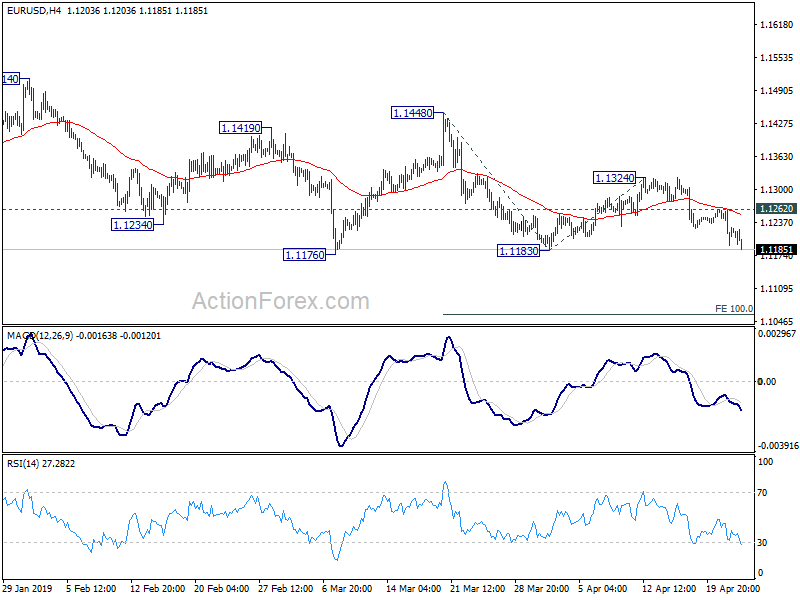
EUR/USD drops further to as low as 1.1186 so far today. Intraday bias remains on the downside for 1.1176 key support. Decisive break there will resume whole down trend form 1.2555. Next near term target will be 100% projection of 1.1448 to 1.1183 from 1.1324 at 1.1059. On the upside, above 1.1262 minor resistance will delay the bearish case and bring rebound first.
In the bigger picture, EUR/USD has been losing downside momentum around 61.8% retracement of 1.0339 (2016 low) to 1.2555 (2018 high) at 1.1186. But for now, there is no clear sign of medium term reversal yet. Down trend from 1.2555 is expected to resume sooner or later as long as 1.1569 structural resistance holds. Decisive break of 1.1186. could pave the way back to 1.0339 low.