

Sample Category Title
Risk Is On, The Dollar Is Down
Investors ended last week on a risk-on mood amid optimism regarding ongoing trade talks between China and the US. On Saturday, Treasury Secretary Steven Mnuchin said that the US and China were nearing the final stage of trade negotiations. The tone of the declaration was quite optimistic and suggested that the waiting would be finally over. A matter of days apparently. However, investors remained somewhat cautious despite the comments. The US government has been extremely optimistic over the last few months despite a clear lack of progresses. There is therefore the fear that the US delegation would under deliver, especially since China would also be able to enforce the agreement should the US reneges on certain part of the deal afterward – and vice-versa.
The buck continued to move lower on Monday morning with the dollar index reaching 96.80. The Swedish krone performed the best as USD/SEK eased 0.30% to 9.2454, while the pound sterling and the single currency were also edging higher, up 0.21% and 0.19%, respectively.
We believe that the dollar suffer more in the coming days amid rising tension between the Fed and Donald Trump. The US president suggested that the Fed should unleash liquidity to give a kick to economic growth. It would send a very bad signal to investors should the central bank starts taking order from the government as it hurt massively its credibility.
INR under pressure as a second rate cut, general elections loom
General elections, inflation and growth slowdown as well as emerging market economies vulnerability remain the major factors for the second consecutive drop in the Reserve Bank of India (RBI) Current Rate. Yet INR should continue to face further pressure as a third rate cut appears practicable in June.
Indeed, although India’s budget deficit for fiscal year 2018/2019 ended 31 March 2019 meets fiscal deficit target of 3.4% amid spending cuts and a tax collection deficit of 1 trillion rupees ($14.44 billion) compared to target, the Indian economy is facing additional headwinds. Headline inflation has been ticking higher (2.86%) in February but still remains below its long-term target of 4% while the real gauge eased at 5.02% (prior: 5.29%). Furthermore, India’s GDP growth closed the last quarter of 2018 in its slowest pace in five quarters (GDP y/y 2018: 7.20%). It is therefore to observe whether PM Narendra Modi party Bharatiya Janata will be winning actual general elections closing in 19 May 2019 and whether current budget deficit target can be achieved despite election promises.
For now, USD/TRY is expected to rise further as uncertainties within Asia’s third largest economy remains. Heading along 69.38 short-term.
Oil Slips Amid A Volatile Session
Crude oil prices were a bit volatile on Friday. Crude oil prices rose intraday after Libya's chairman of the National Oil Corporation warned that the civil unrest in the country could hit production. The news sent oil prices higher during the day, but the commodity erased the gains by Friday's close.
Can Cude Oil Prices Extend the Declines?
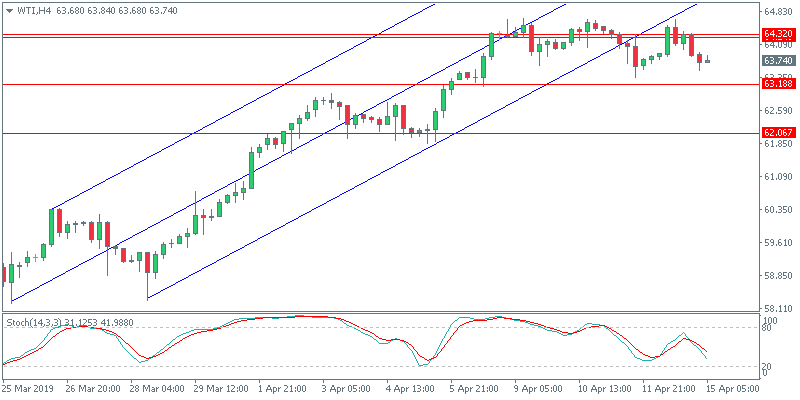
Oil prices have managed to close flat on Friday but after today's open, we could expect to see a modest retracement. The upside remains flat for the moment, but WTI crude oil could test the 64.32 level of resistance once again in the near term. A close below the previous low of 63.34 will confirm the downside. We expect oil prices to test the support at 63.19 initially.
Gold Stays Muted After Thursday’s Declines
The bearish momentum in gold prices took a pause with somewhat muted declines on Friday. Gold price turned slightly bearish on Friday, but the momentum is likely to resume today as price battles a key support level. The rising sentiment in the markets with the hawkish undertones from the Fed has weakened the appetite for gold.
Will Gold Maintain the Bearish Momentum?
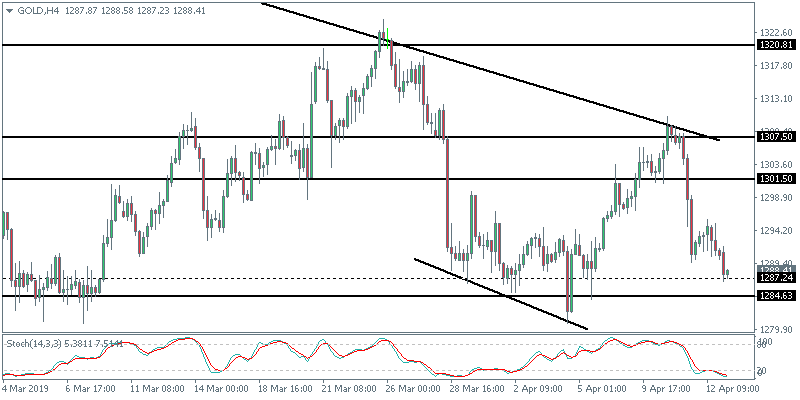
Gold prices will need to clear the support level formed at 1285 region in order to confirm the downside momentum. With the support level having held nearly three times on the past retest, there is scope for the support area to weaken. A close below 1285 on a daily basis could potentially mark the downside correction in gold. The next main target will be at the 1233 handle.
Euro Trades Higher As Industrial Production Rises
The monthly industrial production reports released on Friday saw industrial output falling 0.2% on the month. This was slightly better than the estimates pointing to a 0.5% decline. January's data was revised higher to show a 1.9% increase compared to the initial reports of a 1.4% increase. Looking ahead today, the German Bundesbank will be releasing its monthly report.
Will EUR/USD Continue to Rise?
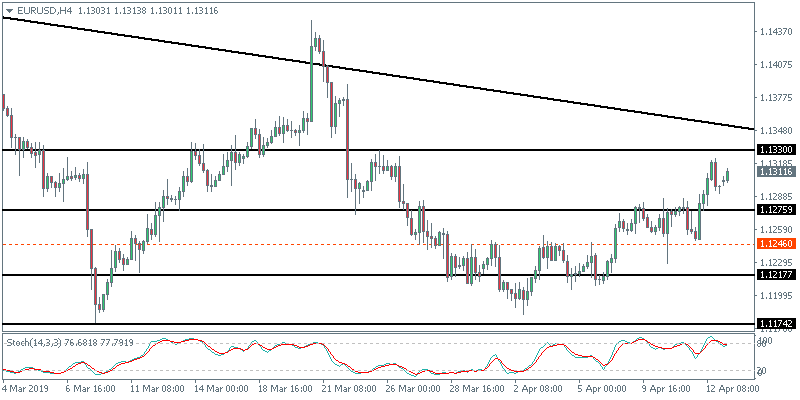
The common currency initially pared gains by Friday's close but price action has since rebounded. The current upside momentum in the EUR/USD will see price potentially testing the main resistance level at 1.1330. A breakout above this resistance will potentially clear the way for a test to 1.1400 level. To the downside, the declines could be limited to the support at 1.12580.
USD/TRY Outlook: Downbeat Turkey’s Jobs Data Increase Pressure On Lira
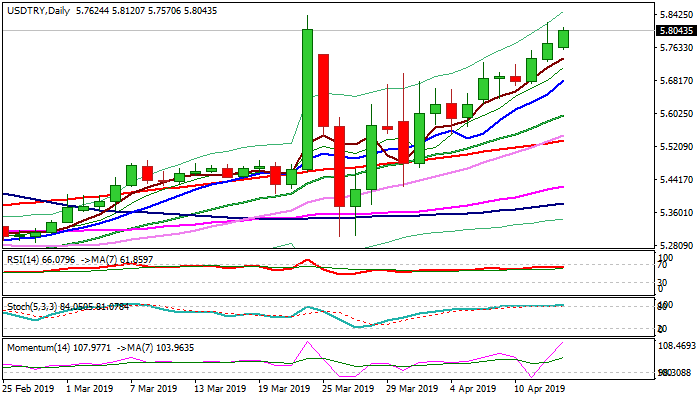
The Turkish lira remains under strong pressure as USDTRY continues to trend higher and look for retes of key short-term resistance at 5.8410 (22 Mar high). Downbeat Turkey's jobs data, released today (unemployment rose to 14.7% in Dec-Feb, hitting the highest in 10 years) add to negative outlook. Slowdown in the economy weighs on lira, with CBRT meeting on 25 Apr being in focus. The lira would likely to stay at the back foot even if the central bank opts for rate cut, as investors' confidence is rapidly fading and change of lira to foreign currencies marks additional pressure. High inflation also frustrates, with further rise expected to be seen on 3 May CPI data release. Bullish techs support scenario, but overbought conditions may slow bulls on approach to 5.8410 pivot. Price adjustment is expected to be shallow in current conditions, with extended dips not to find ground above rising 10SMA (5.6810) before bulls resume. Sustained break above 5.8410 would expose key barriers at 5.8732/67 (weekly cloud top / 3 Jan spike high) and 5.8868 (Fibo 38.2% of 7.1074/5.1323 pullback.
Res: 5.8231, 5.8410, 5.8732, 5.8868
Sup: 5.7570, 5.7366, 5.7293, 5.7140
JPY Remains Weak As RIsk Mood Turns On
The JPY remained at low levels against the USD on Friday as the market's risk appetite seems to be turning on. Recent signs of the Chinese economy stabilising seem to have caused some outflows from the JPY. It should be noted that the US-Sino negotiations may have marked some further progress, as media report that the US may be cooling their original position for Beijing curbing its subsidies for Chinese businesses. Also an optimistic start of the US earnings seasons may have motivated investors to abandon the safe haven. Analysts point out that we are probably seeing a classical risk on market at the current stage. Please bear in mind that the positive mood may have lowered concerns for the upcoming US-Japanese negotiations about trade. USD/JPY rose and stabilized on Friday, testing the 112.00 (R1) resistance line. We could see the pair trading in a bullish mood, should the risk on mood be renewed and the financial releases could support the USD side of the pair. Should USD/JPY trade in a bullish market we could see it breaking the 112.00 (R1) resistance line and aim for the 112.50 (R2) resistance level. Should on the other hand the pair's direction be dictated by the bears, we could see it dropping and breaking the 111.40 (S1) support line.
WTI prices stabilize.
WTI prices maintained their sideways motion on Friday, as conflicting fundamentals continued to push the commodity on both sides. Analysts seem also to be pointing towards a relatively tight band, due to mixed supply signals stemming from the US and OPEC with its allies. It should be noted that Libya's national oil corporation warned on Friday that renewed fighting could wipe out crude production in the country. Also Russian finance minister Siluanov, was quoted saying that Russia and OPEC may decide to increase production to fight the US for their market share in the oil market. We could see the commodity trying to make up its mind this week and black gold prices could show further sensitivity to headlines regarding its supply and/or demand. WTI prices seem to be constantly teasing the 63.80 (R1) support line (now turned to resistance). We could see the commodity maintaining a tight range of prices as it decides the direction of its next leg. Technically as the upward trendline remains intact, we tend to see the risks relating to the oil prices tilted to the upside. Should the commodity come under the selling interest of the market, we could see its prices, breaking the prementioned upward trendline and aim if not break the 62.00 (S1) support line. Should on the other hand, black gold long positions be favoured by the market we could see it breaking the 63.80 (R1) resistance line and aim for the 65.30 (R2) resistance barrier.
Other economic highlights, today and early tomorrow
In today's American session, from the US we get the NY Fed Mfg Index for April, and during tomorrow's Asian session RBA's last meeting minutes are to be released.
As for the rest of the week
On Tuesday, UK's employment data for February, Germany's ZEW economic sentiment for April and the US industrial production for March are to be released. On a busy Wednesday, we get New Zealand's CPI rate for Q1, Japan's trade balance for March, China's GDP for Q1 and industrial production for March, UK's inflation data for March, Canada's inflation data for March and Trade balance for February. On Thursday, Australia's employment data for March, a number of preliminary PMIs for April affecting the EUR, UK's retail sales for March, US retail sales for March, the US Philly Fed Business climate for April and Canada's retail sales for February are due out. On Friday, we get Japan's inflation rates for March.
USD/JPY H4

Support: 111.40 (S1), 110.90 (S2), 110.30 (S3)
Resistance: 112.00 (R1), 112.50 (R2), 113.20 (R3)
WTI H4
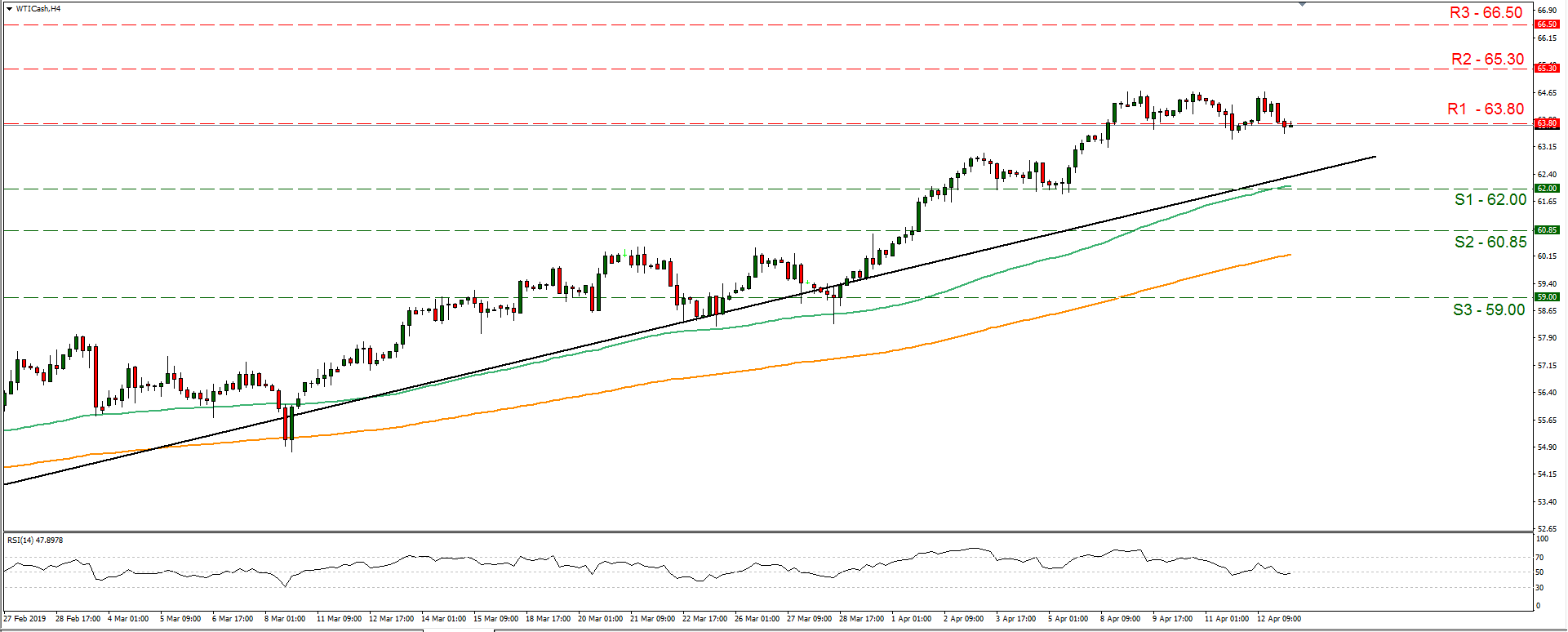
Support: 62.00 (S1), 60.85 (S2), 59.00 (S3)
Resistance: 63.80 (R1), 65.30 (R2), 66.50 (R3)


The Dollar Index Is Testing Monthly Lows. Investors Expect Additional Drivers
On Friday, the US dollar weakened against a basket of major currencies after the publication of mixed economic statistics. Thus, the indexes of consumer expectations and sentiment counted to 85.8 and 96.9 in April, respectively, and were worse than the expected values of 88.5 and 98.1. Export and import price indexes rose by 0.7% and 0.6% in March, respectively, while investors expected growth by 0.2% and 0.4%. The dollar index (#DX) closed in the negative zone (-0.26%). At the moment, the indicator is consolidating near monthly lows.
Demand for risky assets is still at a fairly high level. Investors were pleased with the recovery in exports in China, which rose by 14.2% in March instead of the expected growth by 7.3%.
This week, investors expect news on the development of trade relations between the US and China, as well as the Brexit process. The US Treasury Secretary Steven Mnuchin announced that countries were close to embarking upon the final part of the negotiations on a trade agreement. Also, this week important economic data will be published that may have a significant impact on the dynamics of the currency majors in the short term.
The "black gold" prices are moderately decreasing after a continuous rally. At the moment, futures for the WTI crude oil are testing the mark of $63.60 per barrel.
Market Indicators
- On Friday, the bullish sentiment was observed in the US stock market: #SPY (+0.68%), #DIA (+1.02%), #QQQ (+0.43%).
- The 10-year US government bonds yield is recovering. Currently, the indicator is at the level of 2.55-2.56%.
The news feed for 2019.04.15:
- Today, the publication of important economic news is not expected.
Dollar And Yen Pressured As China Optimism Lifts Markets
- Safe-haven favourites, the dollar and the yen, trade near Friday’s lows as positive data out China triggers a risk rally
- Encouraging comments from Mnuchin on US-China trade talks also helps risk sentiment
- Focus this week to centre on US earnings and China GDP ahead of long Easter weekend
Jump in Chinese lending eases growth jitters
Fears of a global slowdown, which were amplified early last week after the IMF lowered its global growth forecasts, subsided substantially on better-than-expected economic indicators out of China on Friday. Chinese exports rebounded strongly in March, but more significantly, loan growth accelerated during the same month, in a sign that the government’s efforts to stimulate lending are starting to take effect.
The safe-haven yen fell across the board after the data as investors fled to riskier assets on hopes that the slowdown in the world’s second largest economy is bottoming out. The yen skidded to one-month lows versus the US dollar at 112.09 yen, while the risk-sensitive Australian dollar rallied to a near 4-month top of 80.48 yen. The US currency also came under pressure against most of its major peers, with the dollar index slipping to two-week lows.
In the bigger picture, however, many currency pairs remain confined to their recent ranges and investors will be looking for further validation that the global economy is at a turning point before paring back their long US dollar positions, which have now hit their highest since December 2015.
One big clue that the worst of the slowdown is over could come from China’s first quarter GDP growth estimates due on Wednesday. Any negative shocks from the GDP data could undo much of the improvement in risk appetite seen since late last week.
US-China trade talks could be in ‘final round’
Another cause of optimism were signs that talks between the US and China were nearing their end after US Treasury Secretary, Steven Mnuchin, told reported on Saturday that they were “getting close to the final round of concluding issues”.
But while markets cheered Mnuchin’s comments, traders maintained some level of caution as next in line for the Trump administration’s tough trade demands is Japan. Japanese officials will begin talks with their US counterpart in Washington today, opening the prospect of a new trade battle just as one is coming to an end.
Earnings season gets off to a positive start
In case trade frictions start to escalate again, not just with Japan but with the European Union too, a strong earnings season in the US looks set to support market sentiment over the next few weeks. Banking giant, JP Morgan reported stronger-than-expected earnings on Friday, sending its share price to close almost 5% higher. The upbeat results drove the main US indices higher, with the S&P 500 surpassing the 2900 level and approaching its all-time high from September 2018.
However, shares in Asia were unable to hold on to all of their earlier gains on Monday and European indices opened mixed, amid concerns about overvaluations and ongoing uncertainties such as Brexit.
Euro and pound make modest gains as regional gloom recedes slightly
As the UK Parliament goes into Easter recess, investors will be able to breath a sigh of relief from fewer Brexit headlines. However, any developments regarding the talks between the Conservatives and Labour to reach a consensus on a Brexit deal could still upset sterling, which is currently testing the $1.31 level once again. A barrage of UK data this week will also keep the pound under the spotlight, with jobs number out first on Tuesday.
The pound received a small boost last week after the EU extended the Brexit deadline to October. The euro was also bolstered after Eurozone industrial production numbers fell less than expected in February and M&A activity provided additional support, lifting the single currency above the $1.13 handle.
Commodities start week on negative footing
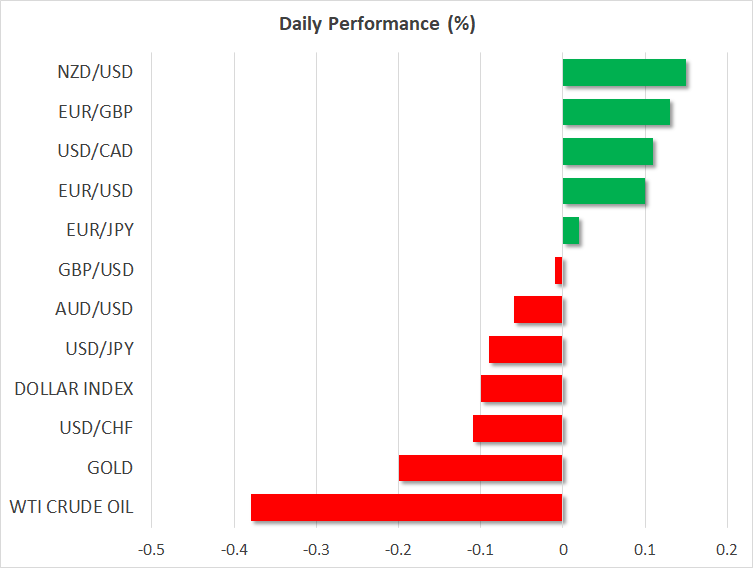
The risk-on mood failed to benefit commodities such as oil on Monday as Russia signalled it may not sign up to further cuts in output with OPEC and could even hike production. Russia is worried about losing market share to the US, which continues to enjoy rising production. Both WTI and Brent crude prices drifted away from last week’s 5-month highs on Monday.
Meanwhile, gold prices fell further below the $1,300 level as risk appetite continued to recover.

EUR/USD Outlook: Fresh Risk Mode Supports Bulls For Renewed Probe Through 55SMA
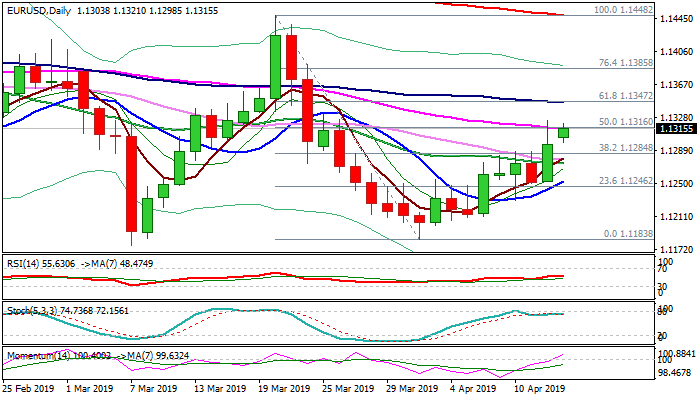
The Euro maintains bid tone at the beginning of the week which will be shortened for holiday and probes again through important barrier at 1.1316 (daily cloud base/55SMA/50% retracement of 1.1448/1.1183 bear-leg), which was cracked on Friday. Strong bullish momentum on daily chart and MA's multiple bull-crosses (5/20, 5/30SMA's) underpin the action, along with fresh risk mode. Close above here is needed to further boost recovery for attack at next strong resistance at 1.1347 (100DMA/Fibo 61.8% of 1.1448/1.1183), violation of which would confirm reversal and expose daily cloud top (1.1373). Caution of repeated failure to clearly break above 1.1316 barrier would signal that bulls might be running out of steam, but bullish bias is expected to persist while the price action holds above converged 20/30SMA's (1.1273/77).
Res: 1.1323, 1.1347, 1.1372, 1.1385
Sup: 1.1298, 1.1273, 1.1253, 1.1230
S&P 500 Eye To Close 1% Gap From Its ATH | Draghi Shows Trump His Place | RBA May...
US futures are picking up the positive momentum from the European markets. Investors are less worried about the slow down in China and global growth. There are clear signs of improvement in China trade and lending data. This is despite the fact that we have a number of warnings from the IMF in relation to the global growth slow down. On Wednesday, we are going to see a more precise image, the Chinese GDP number along with industrial and retail sales data will hit the tape.
Nonetheless, Asian stock markets are sitting at fresh six months high and we are facing similar situation over in Europe as well. The CAC 40 index is leading the gains, up 16 percent Year To Date. The Dax index scored 13.65 percent YTD despite the fact that the economic data isn’t that robust.
It seems like bullish sentiment has decent grip for now and everyone is focused on the year to date performance of the equity markets. The fact that the ECB is looking to loosen the monetary policy even further makes the European markets more attractive for investors. As a result of this, the bond yields are sliding over in Europe making the fixed income market less attractive.
The S&P 500 index closed solid on Friday, thanks to the robust start of the earnings season. The index is nearly one percent away from its all-time high. If the earning momentum continues at this pace during this week (Wall Street giants Goldman Sachs, and Citi bank announce their earnings) the index can easily close this distance without any hesitation.
Meanwhile, the independence of the central bank remains a significant area of debate for many investors. President Trump took another swing at the Fed by blaming them not achieving the higher GDP growth. The importance of Central Banks independence was also emphasized by the president of the European Central Bank. He pretty much criticized Donald Trump for meddling with the independence of the Federal Reserve.
In commodity space, WTI and Brent are up 36 percent and 30 percent YTD respectively, have started the weak on the back foot. Investors have decided to shave some profit. A sensible choice, especially when we have seen six consecutive weeks of gains. The U.S. oil-rig activity has increased and this may continue to impact the supply side of the equation.
As for currencies, the most exciting event is going to take place over in Australia. The Reserve Bank of Australia needs to make a decision with respect to its monetary policy. It is highly expected that the bank will not change its stance and leave the monetary policy unchanged. However, the overall weakness in the economic numbers is something which needs to be acknowledged by the bank. Having said this, the policymakers are also mindful of the higher odds of a new government taking in charge, and the fiscal policy would be the key ingredient. The bank would need to factor that carefully before they decide to give any new message. For now, the only thing that investors would like to hear from the bank is that it has an accommodative attitude