

Sample Category Title
US 30 Index Bulls Still Have Control; Flirts With 6-Month High
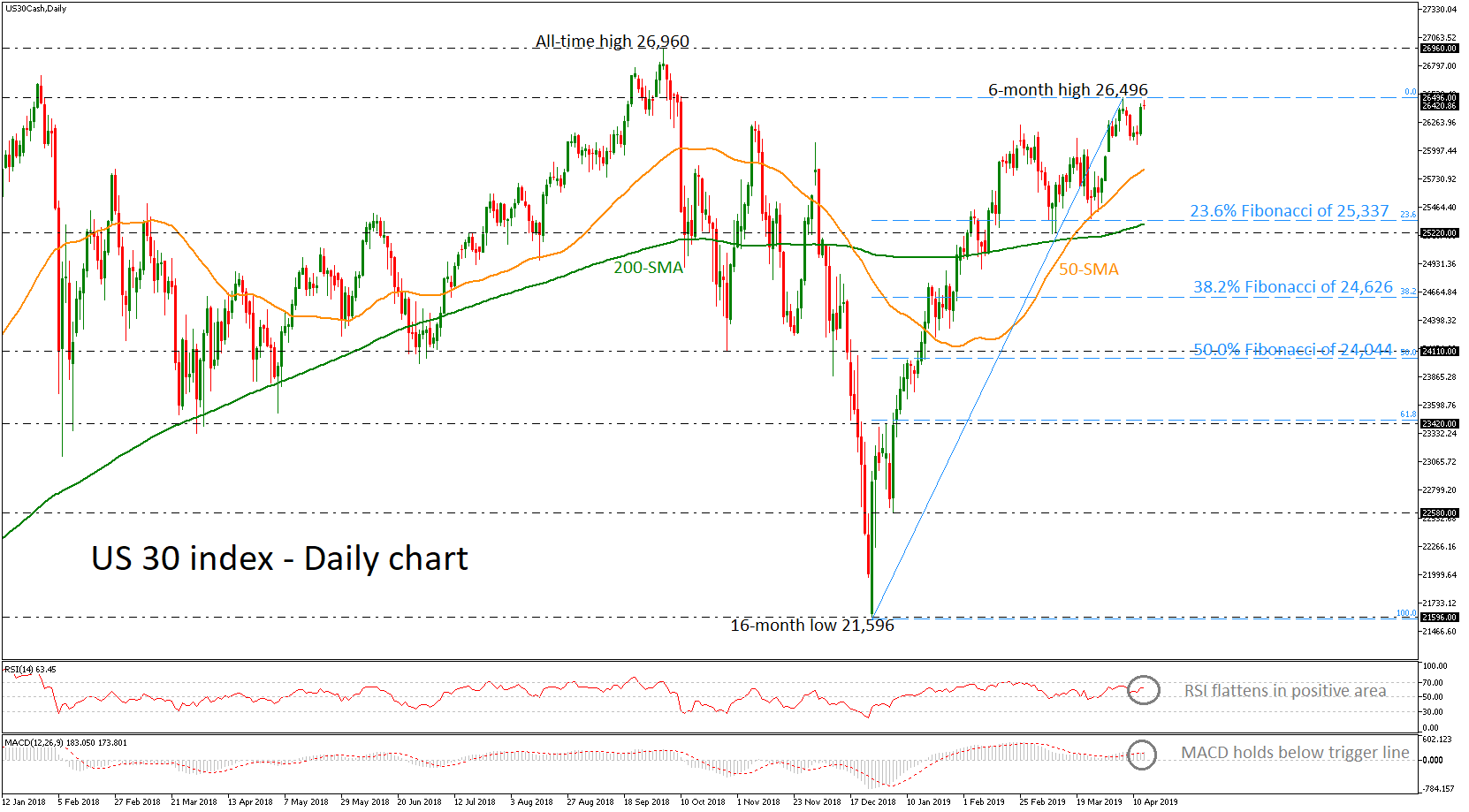
The US 30 index is hovering slightly below the six-month high of 26,496, remaining well above the ‘golden cross’ between the 50- and 200-day simple moving averages (SMAs). Today, though, the index is on the backfoot and the technical indicators suggest that the market could ease a little bit in the short-term. The RSI is flattening in the positive zone, while the MACD stands below its trigger line.
In case of a correction lower, preliminary support may be found near the 50-day SMA currently at 25,822 as well as around the 23.6% Fibonacci retracement level of the upleg from 21,596 to 26,496 around 25,337 and the 200-day SMA. Falling slightly below this area would turn the bias back to neutral, meeting the 25,220 support.
On the other hand, if the bulls continue to have the control, immediate resistance could come around the six-month high of 26,496, where it topped on April 5. If buyers pierce above that, the next obstacle may be the all-time high of 26,960.
In the short-term, the indicators point to a possible bearish retracement, however, the index is still creating higher highs and higher lows over the last couple of months, which augurs well for the medium-term.
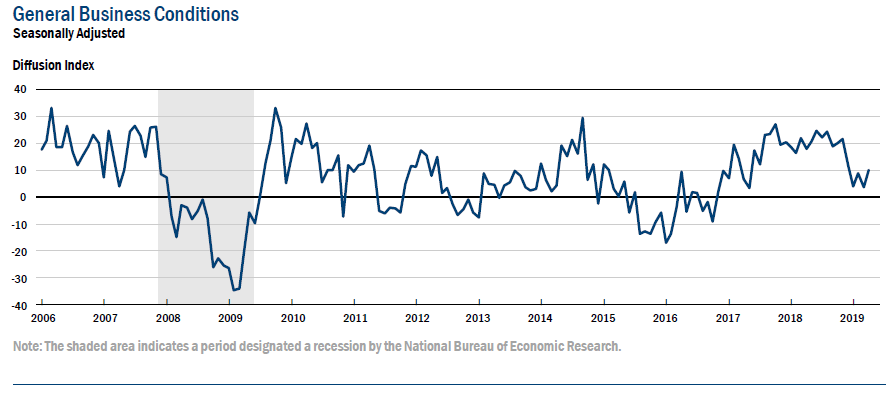
US Empire State manfacturing rose to 10.1, but future conditions dropped to 3-year low
US Empire State manufacturing general business conditions index rose 10.1 in April, up from 3.7 and beat expectation of 8. 33% of respondents reported improved conditions, 23% said worsened. New orders index rose 5pts to 7.5. Shipments rose 1pts to 8.6. However, index for future business conditions dropped a massive -17 pts to 12.4, lowest in more than three years.
New York Fed noted in the release that growth picked up somewhat but remained fairly subdued. New orders rose slightly, and shipments continued to grow modestly. Delivery times and inventories both increased. Labor market indicators pointed to ongoing employment gains and a small increase in hours worked. The prices paid and prices received indexes moved lower, pointing to a slowing in both input price increases and selling price increases. Indexes assessing the six month outlook suggested that firms were much less optimistic about future business conditions than last month.
Canadian Dollar Edges Higher, U.S. Manufacturing Report Beats Estimate
USD/CAD is slightly lower at the start of the week. Currently, the pair is trading at 1.3302, down 0.18% on the day. In the U.S., the Empire State Manufacturing Index improved to 10.1, beating the estimate of 8.1 points. Later in the day, Canada releases the BoC Business Outlook Survey. This indicator provides a snapshot of business sentiment, and should be treated as a market-mover. On Tuesday, Canada releases manufacturing sales, which is expected to decline by 0.1% in February, after a strong gain of 1.0% in January.
The Bank of Canada remains in dovish mode and may freeze rate hikes until 2020. The lack of activity from the BoC could weigh on the Canadian dollar, as the prospect of higher rates would make the Canadian currency more attractive to investors. Last week, the IMF downgraded economic forecasts worldwide, and Canada was no exception. The IMF lowered its forecast for the Canadian growth from 1.9% to 1.5%. The report noted that Canada would be a major beneficiary if the U.S and China can hammer out a deal and end their bruising trade war. The IMF also lowered its forecast for global growth, from 3.5% to 3.3%.
There was positive news on the U.S. inflation front last week, as key indicators headed higher in March. CPI, the key gauge of consumer spending, climbed to 0.4%, its highest gain since January 2018. The producer price index also looked strong, climbing 0.6%, a 5-month high. Inflation remains well below the Federal Reserve target of 2.0%, but stronger inflation numbers will bolster the case of Fed officials who favor raising rates in 2019 if the economic outlook improves. The Fed minutes from the March meeting left the door open to further rate hikes this year, but current market pricing suggests no hikes until 2020, and some analysts are expecting a cut in rates later this year.
USD/JPY Outlook: Bulls Probe Again Through Key 111.97/112.20 Resistance Zone
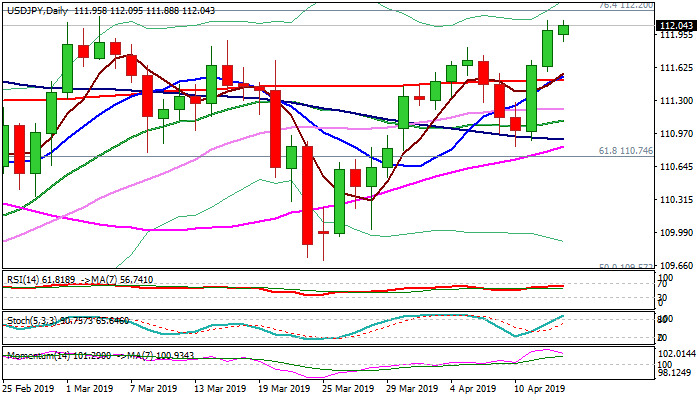
The pair holds bullish tone on Monday, boosted by fresh risk mode and focuses 2019 high (112.13). Bulls attempt to clearly break 200WMA (111.97) that would generate positive signal for extension of recovery leg from 104.59 (30 Dec spike low). Two long daily bullish candles (Thu/Fri) underpin the action, but fading bullish momentum and overbought stochastic on daily chart suggest that bulls may take a breather before eventual break above strong barriers at 111.97/112.20 zone (200WMA/2019 high/Fibo 76.4% of 114.54/104.59 fall). Broken 200SMA (111.51) marks solid support which should contain corrective dips and maintain bullish bias.
Res: 112.13; 112.20; 112.60; 113.00
Sup: 111.88; 111.51; 111.22; 111.10
US asking China to shift tariffs from privileged agriculture to other industries
According to a Bloomberg report, US is asking China to shift some tariffs away from agricultural goods to other products. And China is in consideration.
The request came as Trump didn't want to lift punitive tariffs on China even when a trade deal is made. Yet, Bloomberg said Trump want to "sell any eventual trade deal as a win for farmers ahead of the 2020 election". But there was no explanation on why the agricultural industry has this special privilege over others. And there is no indications on which industries are going to take the burden, and why.
It's also noted that the shift could make it easier for China to ramp up its purchases of US agricultural goods as part of the trade deal. But again, there is no details on whether China will cut imports from others countries, and who they will buy less from.
At this point, we'll treat this as a speculation as no one from USTR nor MOFCOM have responded. And we don't expect them to.
EU gives final greenlight for trade negotiation with US, except red-line in agriculture
Today, European Council gave the greenback to start formal trade negotiations with the US on two agreements. One is a trade agreement strictly focused on industrial goods, excluding agricultural products. The other is on conformity assessment to make it easier for companies to prove their products meet technical requirements on both sides of the Atlantic.
According to a European Commission analysis, the first agreement would increases EU exports to US by 8% and US exports to EU by 9% by 2033. That is, additional gains of €27 billion and €26 billion in EU and U.S. exports respectively.
European Commission President Jean-Claude Juncker said EU is delivered what he has agreed with Trump on July 25, 2018. Juncker added: "We want a win-win situation on trade, beneficial for both the EU and the U.S. Notably we want to slash tariffs on industrial products as this could lead to an additional increase in EU and U.S. exports worth around €26 billion. "
Full European Commission statement here.
At a news conference, Trade Commissioner Cecilia Malmstrom said "I will reach out as soon as they wake up in the U.S.... and see if can have more clarity on when we can meet to have the first talks on this... We are ready as soon as they are... We are definitely determined to do everything we can to finish this during the Juncker Commission". That is, Juncker's term ends on October 31.
Malmstrom also added agriculture is "certainly not" a part of the negotiations. And, "this is a red line for Europe and you'll not find any mention of this in our mandate."
Bundesbank said manufacturing orders literally collapsed, government said no need for stimulus for now
In the April Monthly Report, Bundesbank said growth picked up only moderately in Q1. Also, the underlying momentum of expansion remained subdued as dragged down by manufacturing downturn. The description of the manufacturing sector are rather dramatic, as orders "literally collapsed" and mode has "significantly deteriorated".
Separately, German government spokesman Steffen Seibert said for now there is no need for a stimulus package to reinvigorate the economy. He emphasized Germany has a "very solid budget policy". And, "we are coupling solid budgets with an increase in investments and this should in the coming years improve the basis for more growth." Seibert added, "the budget stipulates investment spending that is significantly higher than in the previous legislative period and as such we see no need for a stimulus package."
UK May not thinking about general election, Hunt said it’s not time for leadership contest
UK Prime Minister Theresa May's spokesman James Slack said today that she is not thinking about an election for the moment. The cross-party talk with Labour regarding Brexit will continue. The talks are now carried out in "smaller groups" which concentrate on "specific issues". But there is no timetable for an agreement yet. Meanwhile, no-deal preparation would continue towards the new Brexit deadline on October 31.
Foreign Minister Jeremy Hunt also insisted that Conservative party leader contest would only happen after Brexit Withdrawal agreement if voted through the parliament. Hunt added: "There will be a time for all those discussions about whether this shade of person or that shade of person is the right person to take over from the prime minister. But the time for that is when she has announced she's going and there's a formal leadership contest."
Hunt also said that "talks we are having with Labour are detailed and I think more constructive than people have thought. " Also, "they are more detailed and more constructive than people had been expecting on both sides.
Netflix Stock Eases Below SMAs In Neutral Bias
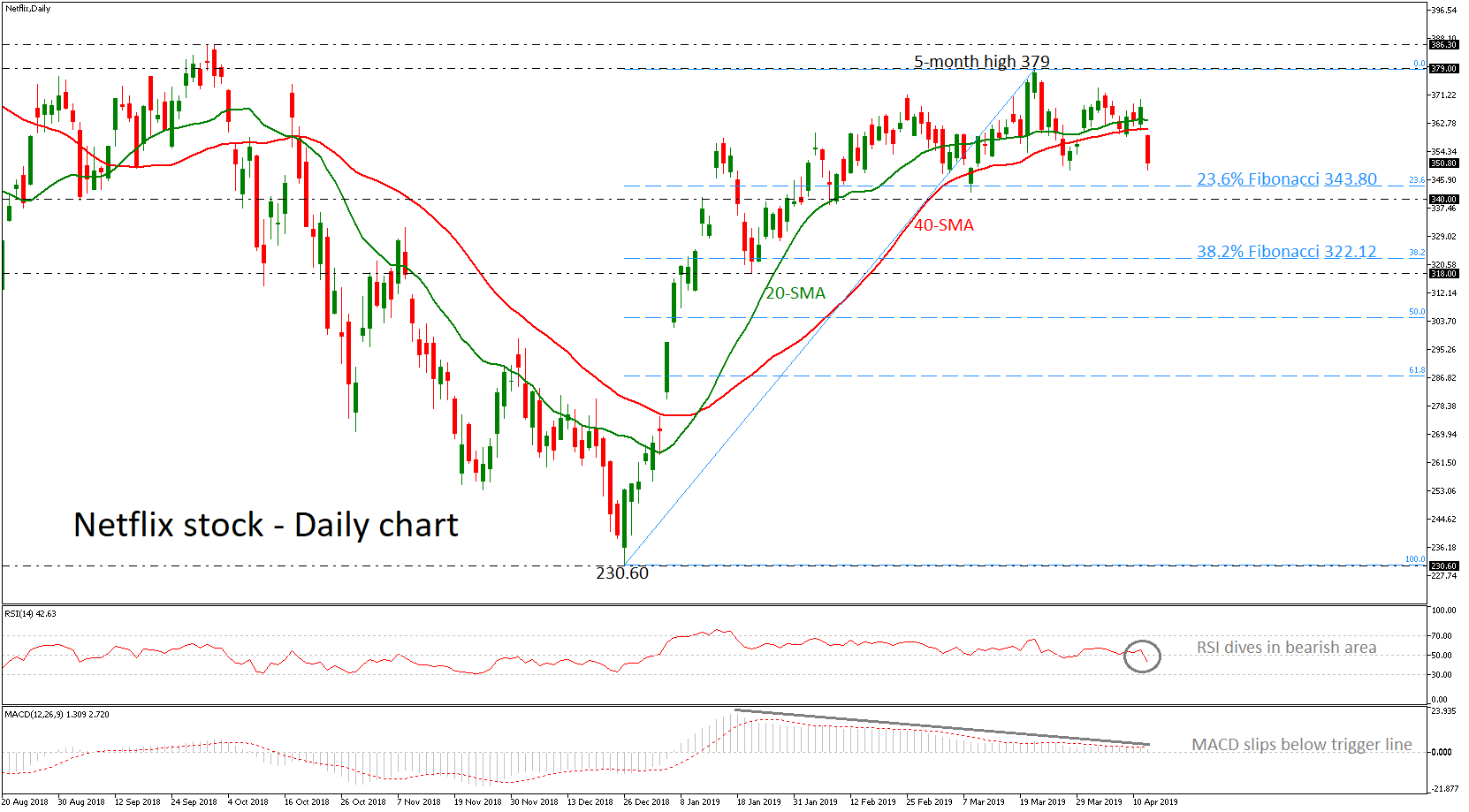
Netflix stock price posted a significant red day on Friday, heading below the short-term moving averages in the daily timeframe, creating a neutral bias. The RSI indicator dropped beneath the 50 level with strong momentum, while the MACD oscillator is weakening below the trigger line over the last three months, but it is still developing in the positive territory.
Should the market extend losses, support could be met between the 23.6% Fibonacci retracement level of the upleg from 230.60 to 379, around 343.80 and the 340 barrier. A significant leg below this area could send prices towards the 38.2% Fibonacci of 322.12.
On the flip side, if the pair bounces up, immediate resistance could be met at the five-month high of 379 ahead of the 386.30 obstacle, taken from the highs on October 2018. A jump above these lines would endorse the short-term bullish bias.
In the bigger picture, the stock is positive as long as it holds above the 20- and 40-week SMAs, around 329 which are ready to create a bullish cross. In case it violates this cross, bears could take the upper hand.
DAX Steady On Solid Chinese Trade Surplus
The DAX index has posted small gains on Monday. Currently, the DAX is at 12,019, up 0.16% on the day. In economic news, there are no major German or eurozone events. On Tuesday, Germany releases ZEW Economic Sentiment, with a forecast of 0.9 points.
With a light data calendar on Monday, investors will be keeping a close eye on German ZEW economic sentiment, a key gauge of investor confidence. The well-respected indicator has been mired in negative territory for the past 12 months, but the scores have been improving. The April estimate stands at 0..9, which although not a strong gain, is symbolic for being in positive territory. The all-eurozone indicator has shown a similar trend, and improved in March to -2.5 points. The April estimate stands at 1.2 points.
The economic slowdown in China has rocked equity markets worldwide, but there are signs that the world’s second largest economy is moving upwards. There was relief on the weekend, as China’s trade surplus surged to USD 32.64 billion. Last week, Chinese CPI posted a gain of 2.3%, its best gain in 5 months. A key test is on Tuesday, with the release of Chinese GDP. Third-quarter growth edged lower to 6.4%, and the estimate for Q4 stands at 6.3%. Although these are very strong growth rates, the downward trend has investors worried, and a weak GDP reading could send equities lower.