

Sample Category Title
Silver: White Metal Trading On A Weaker Footing This Morning
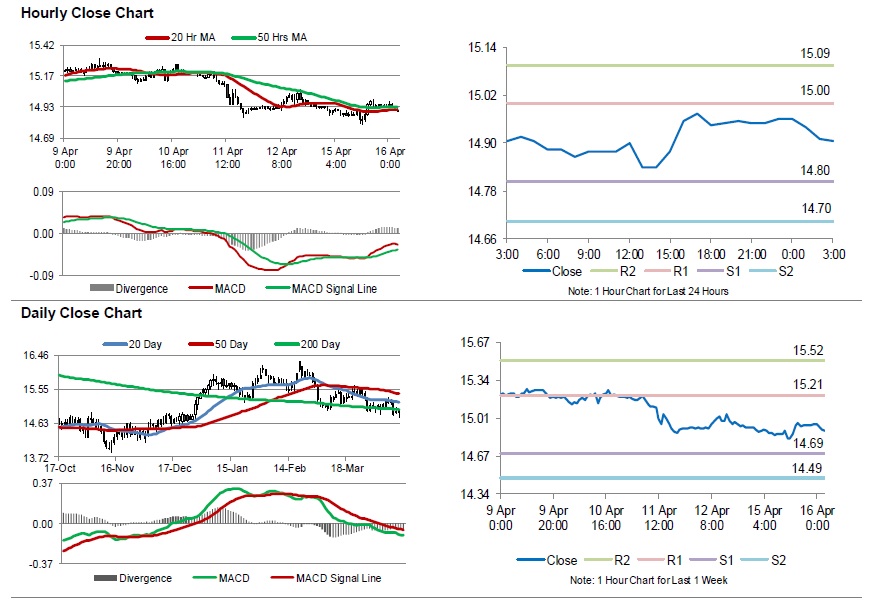
For the 24 hours to 23:00 GMT, Silver rose 0.44% against the USD and closed at USD14.96 per ounce, tracking gains in gold prices.
In the Asian session, at GMT0300, the pair is trading at 14.90, with silver trading 0.37% lower against the USD from yesterday’s close.
The pair is expected to find support at 14.80, and a fall through could take it to the next support level of 14.70. The pair is expected to find its first resistance at 14.99, and a rise through could take it to the next resistance level of 15.09.
The white metal is showing convergence with its 20 Hr moving average and trading below its 50 Hr moving average.
Crude Oil: Oil Trading Lower, Ahead Of API’s Weekly Crude Oil Stockpiles Data
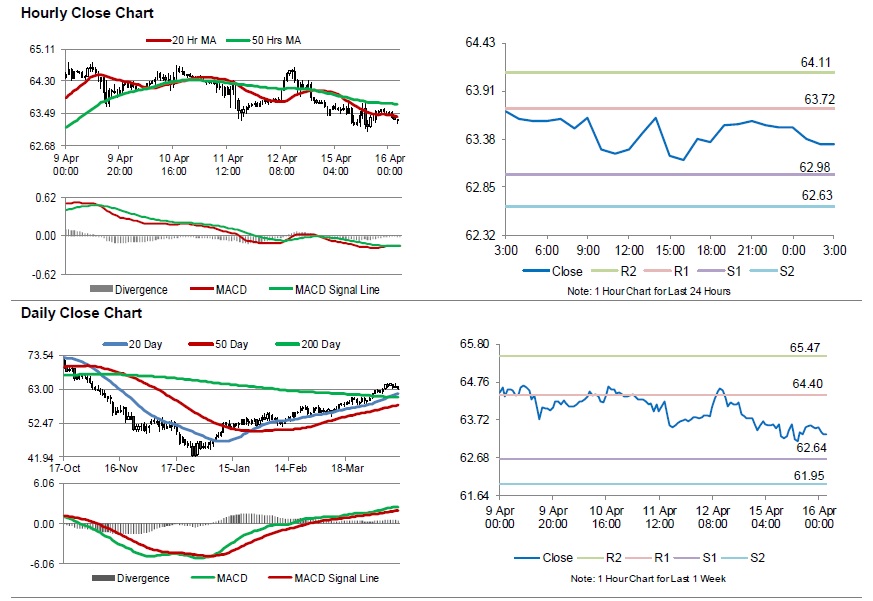
For the 24 hours to 23:00 GMT, Crude Oil declined 0.13% against the USD and closed at USD63.50 per barrel, amid speculation that Russia and the OPEC might step back from their move on productions cuts.
In the Asian session, at GMT0300, the pair is trading at 63.32, with oil trading 0.28% lower against the USD from yesterday's close.
The pair is expected to find support at 62.98, and a fall through could take it to the next support level of 62.63. The pair is expected to find its first resistance at 63.72, and a rise through could take it to the next resistance level of 64.11.
Crude oil is trading below its 20 Hr and 50 Hr moving averages.
Elliott Wave View: S&P 500 Futures Eyeing New All-Time High
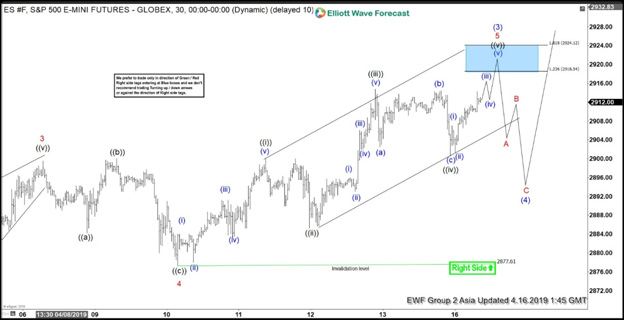
Short term Elliott Wave view on S&P 500 Futures (ES_F) suggests that the rally from March 9, 2019 low (2726.50) is unfolding as a 5 waves impulse Elliott Wave structure. The Index is now within wave (3) which subdivides in 5 waves of lesser degree. In the chart below, we can see wave 3 of (3) ended at 2899.5 and wave 4 of (3) pullback ended at 2877.61.
Short term, expect the Index to extend higher towards 2918.54 – 2924.12 to end wave 5 of (3). Subdivision of wave 5 is unfolding as a 5 waves impulse of lesser degree. Up from 2877.61, wave ((i)) ended at 2900 and wave ((ii)) pullback ended at 2885.25. Rally to 2914.75 ended wave ((iii)), and wave ((iv)) ended at 2900.50. Wave ((v)) of 5 is in progress towards 2918.54 – 2924.12. Afterwards, Index should end wave (3) and pullback in wave (4) to correct cycle from March 25, 2019 low before the rally resumes. The pullback in wave (4) is expected to stay above March 25, 2019 low (2790.25) for further upside. We don't like selling the Index.
1 Hour S&P 500 Futures (ES_F) Elliott Wave Chart Asia Update
AUD/USD Daily Outlook
Daily Pivots: (S1) 0.7163; (P) 0.7173; (R1) 0.7183; More...
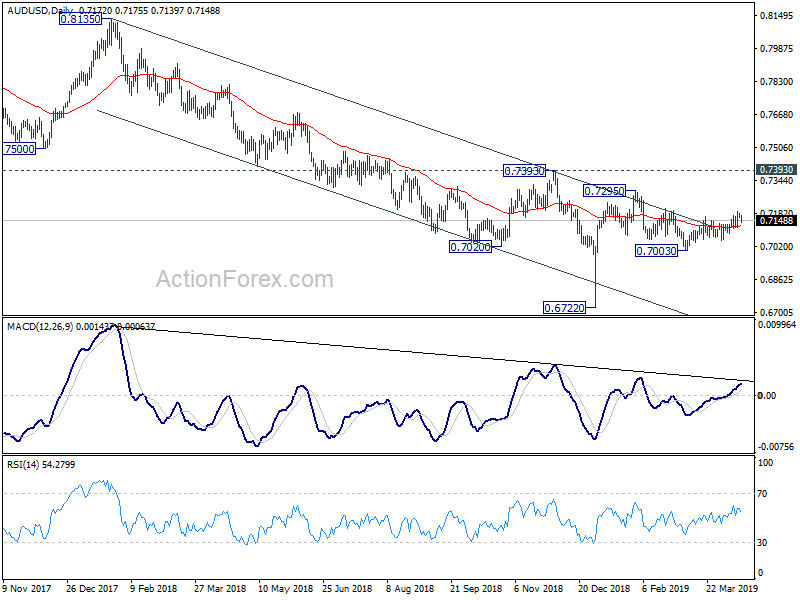
Today's sharp retreat suggests temporary topping at 0.7192 in AUD/USD. Intraday bias is turned neutral first. Further rise remains in favor with 0.7115 minor support intact. On the upside, above 0.7192 will target 0.7206 resistance first. Break will likely resume larger rebound from 0.6722 through 0.7295 resistance. On the downside, though, break of 0.7115 minor support will turn intraday bias back to the downside for 0.7003/7052 support zone instead.
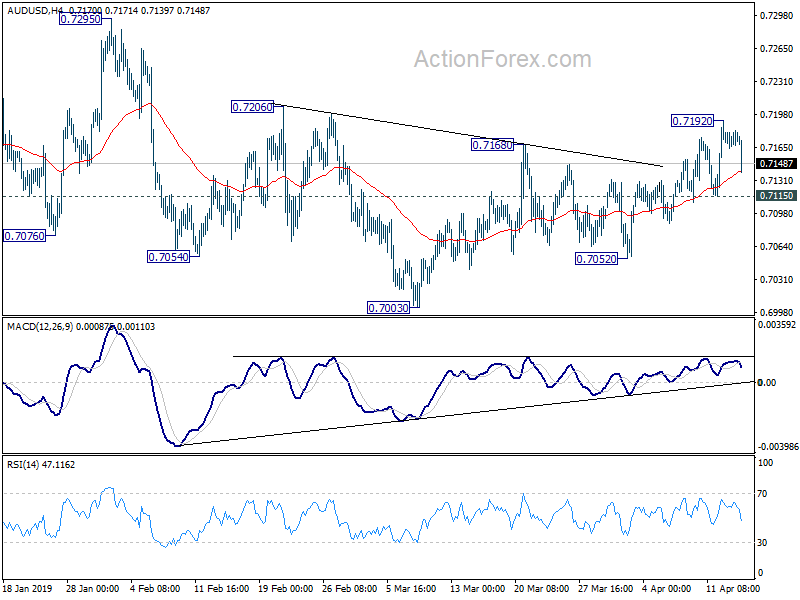
In the bigger picture, break of medium term channel resistance is the first sign of bullish reversal. But there is no confirmation yet. As long as 0.7393 resistance holds, larger fall from 0.8135 is still expected to resume later. Such decline is seen as resuming long term down trend from 1.1079 (2011 high). Decisive break of 0.6826 (2016 low) will confirm this bearish view and resume the down trend to 0.6008 (2008 low). However, firm break of 0.7393 will argue that fall from 0.8135 has completed. And corrective pattern from 0.6826 has started the third leg, targeting 0.8135 again.
Australian Dollar Tumbles on Dovish RBA Minutes, New Zealand and Canadian Also Weak
Commodity currencies are generally under some selling pressure today. Australian Dollar is the weakest one as RBA took another step to laid the ground for rate cut by dovish minutes. RBNZ Governor Adrian Orr reiterated the central bank's easing bias. Canadian Dollar was sold off overnight after poor Business Outlook Survey and remains weak in Asian session. On the other hand, Yen is paring some losses, but upside is limited by mild risk appetite in Asian stock markets. Swiss franc and Dollar follow as next strongest. Focus will turn to employment data from UK and investor sentiment in Germany.
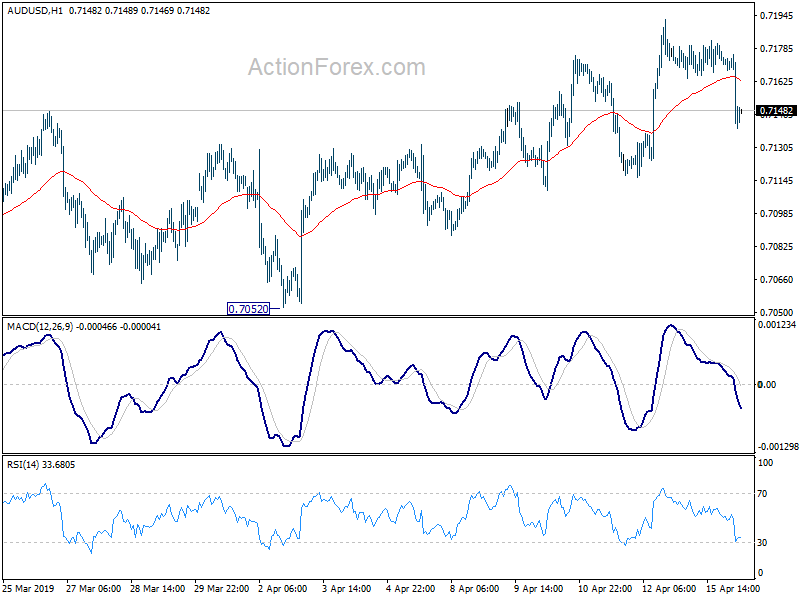
Technically, AUD/USD is holding well above 0.7115 minor support despite today's pull back. Thus, more upside remains mildly in favor in near term. Despite overnight strong rebound, USD/CAD is held well in range below 1.3467 resistance and more consolidation could be seen before upside breakout. USD/JPY lost momentum ahead of 112.13 but retreat is so far very shallow. Focus remains on this key resistance for today.
In Asia, currently, Nikkei is up 0.26%. Hong Kong HSI is up 0.63%. China Shanghai SSE is up 1.11%. Singapore Strait Times is up 0.15%. Japan 10-year JGB yield is down -0.0037 at -0.034. Overnight, DOW dropped -0.10%. S&P 500 dropped -0.06%. NASDAQ dropped -0.10%. 10-year yield dropped -0.007 to 2.553, comfortably above 2.5 handle.
AUD tumbles as RBA said lower interest rates could be expected
Australian Dollar tumbles sharply in Asian session after dovish RBA minutes set out the conditions for a rate cut. It's seen as another step towards more monetary easing ahead, as markets are expecting two cuts this year.
The most important part of the minutes is that RBA confirmed there could be a need for rate cut. It said "a lower level of interest rates could still be expected to support the economy through a depreciation of the exchange rate and via reducing required interest payments on borrowing, freeing up cash for other expenditure". Also, in a scenario where " inflation did not move any higher and unemployment trended up", "a decrease in the cash rate would likely be appropriate in these circumstances"."
Nevertheless, "members agreed that there was not a strong case for a near-term adjustment in monetary policy". It suggested RBA would wait-and-see, likely at least through Q2.
Suggested readings on RBA.
- (RBA) Minutes of the Monetary Policy Meeting of the Reserve Bank Board
- RBA Minutes – Confirming Dovish Monetary Policy Stance. Low Inflation Raises the Chance of Rate Cut
- RBA Board Minutes Set Out the Conditions for a Rate Cut
RBNZ Orr: Q1 inflation undershot "already" factored in dovish bias
RBNZ Governor Adrian Orr said today that monetary easing bias remains in place for now. And softer economic conditions in US, Europe and China are having a role in the dovish tone.
Also, Orr added that "possibilities of first quarter inflation numbers being undershot have already being factored in the RBNZ's dovish bias". The comments came just ahead of New Zealand's CPI release tomorrow. Headline inflation is expected to slow from 1.9% yoy to 1.7% yoy in Q1.
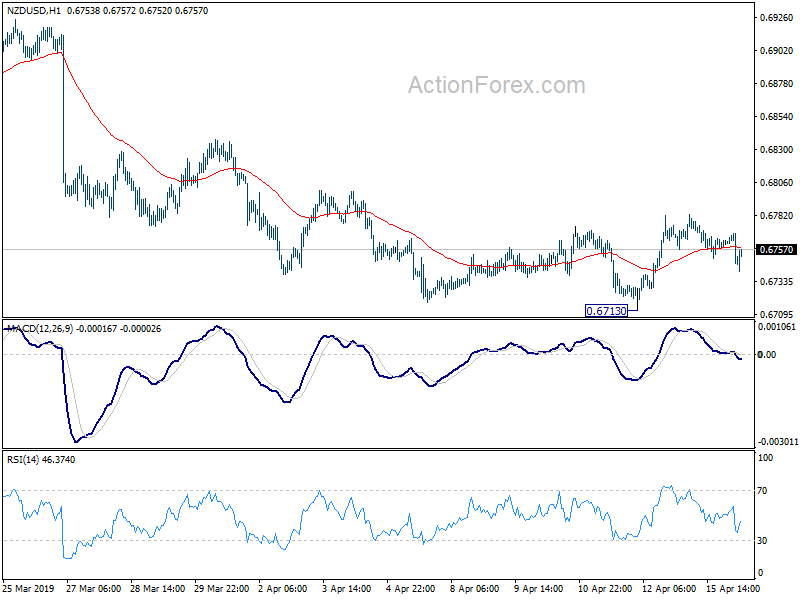
NZD/USD is a touch lower after the comments. However, Orr said that inflation undershot was already factored in. Thus, there is prospect of a mild rebound should tomorrow's CPI release meets expectations.
CAD dives on BoC Business Outlook Survey, global trade headwinds affecting firms' operations
Canadian Dollar tumbles notably overnight after poor results of BoC's Business Outlook Survey. Business Outlook Survey indicator dropped from 2.31 in Q4 to -0.64 in Q1. It suggested "a softening in business sentiment." Also, responses to several BOS survey questions moved below their historical averages.
BoC also warned that global trade headwinds and geopolitical tensions are affecting firms' operations. Several respondents cited negative impacts on their outlooks from US policy changes and related uncertainty. Some firms reported impediments to their export sales resulting from US protectionism. Other respondents reported that US tax cuts and regulatory differences reduce their competitiveness vis-à-vis US firms. Several firms noted cost increases due either directly or indirectly to tariffs, notably those on steel and aluminum as well as those associated with Canadian countermeasures. Some firms noted that the US–China trade dispute weighs indirectly on their business.
Overall, respondents citing negative impacts generally have weaker foreign sales expectations, investment intentions and hiring plans than unaffected businesses.
Evans: Fed should embrace inflation above 2%, 50% of time
Chicago Fed President Charles Evans said on Monday that Fed's policy has been "successful" in achieving the maximum employment mandate. It's "less successful" regarding the inflation objective. And to fix this, he added, "Fed must be willing to embrace inflation modestly above 2 percent 50 percent of the time." For him, he would "communicate comfort" with core inflation at 2.5%, as long as there is "no obvious upward momentum" while the path back to 2% can be "well managed".
For now, Evans is still expecting that "some further rate increases may be appropriate over time". He expects growth to be at around 1.75-2.00% this year. Still he maintained that current patient stance is appropriate given the "heightened uncertainty" including US-China trade war. He also emphasized that "if activity softens more than expected or if inflation and inflation expectations run too low, then policy may have to be left on hold - or perhaps even loosened - to provide the appropriate accommodation to obtain our objectives."
Fed Rosengren prefers inflation range targeting
Ahead of a broad review on monetary policy framework, Boston Fed President Eric Rosengren said he'd prefer a range targeting approach on inflation. That is, Fed could be forced to accept inflation below 2% during recessions. On the other hand, Fed should commit to achieve above 2% inflation in good times. For example a range of 1.5-2.5%.
Rosengren echoed other platemakers' comment that the current 2% target is "symmetric". But in practice, people saw that figure as a "ceiling". He added, "even though we're only missing by a little bit it actually does matter if you miss by a little bit on a regular basis."
On the data front
UK employment and German ZEW economic sentiment are the major focuses for today. Later in US session, Canada manufacturing sales and international securities transactions will be release. US will also feature industrial production and NAHB housing index.
AUD/USD Daily Outlook
Daily Pivots: (S1) 0.7163; (P) 0.7173; (R1) 0.7183; More...
Today's sharp retreat suggests temporary topping at 0.7192 in AUD/USD. Intraday bias is turned neutral first. Further rise remains in favor with 0.7115 minor support intact. On the upside, above 0.7192 will target 0.7206 resistance first. Break will likely resume larger rebound from 0.6722 through 0.7295 resistance. On the downside, though, break of 0.7115 minor support will turn intraday bias back to the downside for 0.7003/7052 support zone instead.
In the bigger picture, break of medium term channel resistance is the first sign of bullish reversal. But there is no confirmation yet. As long as 0.7393 resistance holds, larger fall from 0.8135 is still expected to resume later. Such decline is seen as resuming long term down trend from 1.1079 (2011 high). Decisive break of 0.6826 (2016 low) will confirm this bearish view and resume the down trend to 0.6008 (2008 low). However, firm break of 0.7393 will argue that fall from 0.8135 has completed. And corrective pattern from 0.6826 has started the third leg, targeting 0.8135 again.
Economic Indicators Update
| GMT | Ccy | Events | Actual | Forecast | Previous | Revised |
|---|---|---|---|---|---|---|
| 1:30 | AUD | RBA Minutes | ||||
| 4:30 | JPY | Tertiary Industry Index M/M Feb | -0.60% | -0.20% | 0.40% | 0.60% |
| 8:30 | GBP | Jobless Claims Change Mar | 17.3K | 27.0K | ||
| 8:30 | GBP | Claimant Count Rate Mar | 2.90% | |||
| 8:30 | GBP | ILO Unemployment Rate 3Mths Feb | 4.00% | 3.90% | ||
| 8:30 | GBP | Average Weekly Earnings 3M/Y Feb | 3.50% | 3.40% | ||
| 8:30 | GBP | Weekly Earnings ex Bonus 3M/Y Feb | 3.40% | 3.40% | ||
| 9:00 | EUR | German ZEW Economic Sentiment Apr | 0.5 | -3.6 | ||
| 9:00 | EUR | German ZEW Current Situation Apr | 8.5 | 11.1 | ||
| 9:00 | EUR | Eurozone ZEW Economic Sentiment Apr | -2.5 | |||
| 12:30 | CAD | International Securities Transactions (CAD) Feb | 28.40B | |||
| 12:30 | CAD | Manufacturing Sales M/M Feb | 1.00% | |||
| 13:15 | USD | Industrial Production M/M Mar | 0.30% | 0.10% | ||
| 13:15 | USD | Capacity Utilization Mar | 79.20% | 78.20% | ||
| 14:00 | USD | NAHB Housing Market Index Apr | 64 | 62 |
RBNZ Orr: Q1 inflation undershot “already” factored in dovish bias
RBNZ Governor Adrian Orr said today that monetary easing bias remains in place for now. And softer economic conditions in US, Europe and China are having a role in the dovish tone.
Also, Orr added that "possibilities of first quarter inflation numbers being undershot have already being factored in the RBNZ's dovish bias". The comments came just ahead of New Zealand's CPI release tomorrow. Headline inflation is expected to slow from 1.9% yoy to 1.7% yoy in Q1.
NZD/USD is a touch lower after the comments. However, Orr said that inflation undershot was already factored in. Thus, there is prospect of a mild rebound should tomorrow's CPI release meets expectations.
AUD tumbles as RBA said lower interest rates could be expected
Australian Dollar tumbles sharply in Asian session after dovish RBA minutes set out the conditions for a rate cut. It's seen as another step towards more monetary easing ahead, as markets are expecting two cuts this year.
The most important part of the minutes is that RBA confirmed there could be a need for rate cut. It said "a lower level of interest rates could still be expected to support the economy through a depreciation of the exchange rate and via reducing required interest payments on borrowing, freeing up cash for other expenditure". Also, in a scenario where " inflation did not move any higher and unemployment trended up", "a decrease in the cash rate would likely be appropriate in these circumstances"."
Nevertheless, "members agreed that there was not a strong case for a near-term adjustment in monetary policy". It suggested RBA would wait-and-see, likely at least through Q2.
Suggested readings on RBA.
- (RBA) Minutes of the Monetary Policy Meeting of the Reserve Bank Board
- RBA Minutes – Confirming Dovish Monetary Policy Stance. Low Inflation Raises the Chance of Rate Cut
- RBA Board Minutes Set Out the Conditions for a Rate Cut
RBA Board Minutes Set Out the Conditions for a Rate Cut
The RBA minutes clearly indicate that they are willing to cut the cash rate and have set out the conditions that need to be fulfilled for it to occur. We are encouraged by this new detail, and continue to believe the RBA will cut the cash rate in August and November this year.
The minutes of the April monetary policy meeting of the Reserve Bank Board have provided the clearest signal yet that the Bank would be prepared to cut the cash rate.
Firstly, the final section “Considerations for Monetary Policy” states “a lower level of interest rates could still be expected to support the economy through a depreciation of the exchange rate and via reducing required interest payments on borrowing, freeing up cash for other expenditure”.
The Board even sets out the conditions for a rate cut, “members also discussed the scenario where inflation did not move any higher and unemployment trended up, noting that a decrease in the cash rate would likely be appropriate in these circumstances”.
The Board also notes that “members agreed that there was not a strong case for a near-term adjustment in monetary policy”. We would interpret the “near-term” concept as referring to the next Board meeting in May. We do not believe that statement excludes the possibility of our target timing of August for the first rate cut.
Of course, while the Board refers to “continued strength in the labour market data and moderating GDP growth sending different signals”, it would appear that the labour market data has a higher weighting from a policy perspective.
We are somewhat perplexed by that approach, given that employment is seen to be a lagging variable, and while the lags may be longer in this cycle, we think it is reasonable that the slowdown in expenditure and income growth will eventually weigh on jobs growth. The minutes even refer to the evidence around forward looking indicators of labour demand being mixed with job advertisements having eased but job vacancies having increased as a share of the labour force. What is unclear is whether businesses, in a climate of softening demand, actually intend filling these vacancies.
We were interested that the Governor excluded his standard growth forecast for the current year in his Statement immediately following the April Board meeting. The minutes also exclude that forecast while pointing out that the 2018 growth rate of 2.3% was “below the forecasts presented in the February Statement on Monetary Policy”. It appears almost certain that the RBA will lower its growth forecast for 2019 from 3 per cent (above-trend) to 2 ¾ per cent (around trend). Of course, the RBA has consistently argued that growth in 2020 will be a ¼ per cent below 2019 due to a slowdown in the contribution to growth from LNG exports. If it is to be true to that approach then it will have to forecast growth in 2020 at 2 ½ per cent (below trend). Traditionally, central banks which are forecasting below trend growth should at the least be adopting an easing bias. The tension between growth and the labour market data may allow a looser interpretation of the policy stance. Certainly, the approach taken in these minutes appears to point to a bias towards lower rather than higher rates, although ongoing strength in the labour market will keep rates on hold, at least for the time being.
Further support for this ‘bias’ interpretation comes with the observation that “financial market pricing implied that the cash rate was expected to be lowered in the second half of 2019 and then again in 2020”.
While in previous commentaries, the RBA was dismissive of a significant wealth effect, or a near-term downturn in dwelling construction, these minutes are more realistic. Weakness in consumption, is noted to be concentrated in those items that are historically most correlated with housing prices and housing turnover, and the RBA’s liaison suggested that growth in housing related consumption had remained soft in recent months. Dwelling investment is noted to be past its peak but there is still uncertainty about how quickly dwelling investment might decline with a large amount of work still in the pipeline. Westpac expects a contraction in new dwelling investment of around 10% in 2019.
Conditions in the established housing market are noted to have remained weak in recent months, with house prices continuing to fall in Sydney, Melbourne and Perth, and even declining in most other capital cities and regional areas. The RBA offers no forward guidance as to how far this cycle has to run. Westpac expects that this market will remain soft throughout the course of 2019 and well into 2020.
Conclusion
We have been encouraged by these minutes from the perspective of our rate cut call.
The Board has made a clear case for the benefits of lower interest rates, discounting arguments to suggest that it sees little benefit from lowering rates given the very low starting point. The Board also lays out clearly the conditions for lowering those rates around inflation and the labour market. It appears that it has resolved the uncertainty around the conflicting signals between growth and employment by favouring the labour market. That is disappointing for us, given that the previous policy responses have been linked to growth forecasts, although we expect that persistently slow growth should begin weigh on the labour market.
While prospects for a policy response in May have disappeared, there is still ample time and data releases to justify our timing that there will be cash rate cuts in August and November.
Market Morning Briefing: The Euro-Yen Is Facing Resistance Bear 126.80
STOCKS
Equities like the Dow and Nikkei may consolidate before moving higher while the Shanghai can dip in the near term. DAX is close to a key resistance. Sensex and Nifty are likely to see an upside breakout of its sideways range and move higher in the coming sessions.
Dow (26384.77, -27.53, -0.10%) has dipped slightly. A narrow range bound move between the support at 26250 and resistance at 26500 is likely in the near term. We retain the bullish bias for the Dow to breach 26500 eventually and target 26750 and 27000.
DAX (12020.28, +20.35, +0.17%) is just below the crucial resistance level of 12030 which has to be broken for it to rise further towards 12100 and even higher levels. But a pull-back from 12030 can drag the index lower to 11850 levels again.
Nikkei (22208.22 +39.11, +0.18%) remains bullish for a rise to 22500-22600. A strong break above 22250 can trigger this rally. Support is in the 21950-21930 region.
Shanghai (3182.88, +5.09, +0.16%) is facing resistance near 3255 and has come-off sharply. A dip to 3130 looks likely in the near term while the index trades below 3200.
Sensex (38905.84, +138.73, +0.36%) and Nifty (11690.35, +46.90, +0.40%) are heading towards their key resistance levels of 39000 and 11700. The bias is bullish. Sensex can rise to 39500-39700 on a break above 39000. Nifty can break 11700 and rise to 11750 and 11800 in the coming sessions/days.
COMMODITIES
Gold and Silver are holding above their crucial supports. Copper retains its sideways range. Oil looks mixed with WTI slightly weaker than Brent.
Gold (1285) fell as expected and made a low of 1283. Though it has bounced from the low, looks weak to test 1283-1280 again. A break below 1280 will see the current down move extending to 1275 and 1270. A strong rise past 1290 is needed to get a breather and move higher to 1300 levels again.
Silver (14.97) has bounced after testing the crucial support level of 15.85. An upmove to 15.10 and 15.20 is possible if it sustains above 14.95.
Copper (2.93) is holding below 2.96 and is retaining its 2.88-2.96 sideways range. As mentioned yesterday, a breakout on either side of 2.88 or 2.96 will decide whether copper will go up to 3.0 or fall to 2.84.
Brent (71.05) continues to trade stable between 70.50 and 72. A breakout on either side of 70.5 or 72 will decide whether Brent will go up to 72.7 or fall to 69.85
WTI (63.35) looks slightly weaker than Brent. Resistance is in between 63.8 and 64. While below 64, it looks vulnerable to dip to 62.8 in the coming sessions. A strong break above 64 is needed to turn the bias positive again.
FOREX
Major currencies continues to hover around their crucial levels. Price action in the coming sessions will need a close watch to get a cue on the next trend.
The Dollar Index (96.97) is managing to hold above the 21-week moving average support level of 96.62. This keeps the possibility alive of the index moving up to 97.20 and 97.35. A break below 96.62 will turn the outlook negative for a test of 96.4 and 96.
The Euro (1.1303) continues to hover around the crucial juncture and has come-off from 1.1321 yesterday. A strong break above 1.1325 is needed for it to gain strength and move up to 1.1350 and 1.1400. Else a dip to 1.1275 looks possible in the near term which will keep our bearish view intact for a test of 1.1250-1.1200.
The Euro-Yen (126.55) is facing resistance bear 126.80 which if holds can drag it to 126-125.75 in the near-term. A strong break above 126.8 is needed for it to extend the current upmove to 127.6 and 128.
Dollar-Yen (111.98) is not getting strong follow-through buyers above 112 and is stuck in between the support at 111.90 and resistance at 112.10. A breakout on either side of 111.90 or 112.10 will decide whether the Dollar-Yen is going up to 112.5 or 111.75-111.50 in the enar term.
The Aussie (0.7170) is holding below the key resistance level of 0.72. Looks like last week's rally is losing steam and a dip to 0.7150-0.7135 is likely in the near term. A strong breka above 0.72 is needed for it to regain strength and target 0.73 in the short term.
Chinese Yuan (6.7087) is managing to hold above 6.70. A range bound move between 6.70 and 6.72 looks likely in the near term. The Yuan will come under pressure if it breaks below 6.70 which will increase the possibility of a fall to 6.67-6.66.
Dollar-Rupee (69.4250) has risen sharply yesterday and remains bullish for a test of 69.75 in the near term. A break above 69.75 will see the upmove extending to 70. But a pull-back from 69.75 can take the Dollar-Rupee lower to 69.50-69.35.
INTEREST RATES
US yield have dipped slightly while the German yields are testing crucial resistances.
The US 2Yr (2.39%), 5Yr (2.37%), 10Yr (2.551%) and 30Yr (2.97%) have dipped slightly. The resistances at 2.59% on the 10YR and 3.0% on the 30Yr yields seems to be holding well. While these resistances hold, the 10Yr yield can dip to 2.52%-2.50% and the 30Yr can test 2.93%-2.90%.
The German 2Yr (-0.557%) has dipped while the 10Yr (0.059%) and 30Yr (0.719%) has moved up. The 5Yr (-0.373%) remains stable. The 10Yr and 5Yr yields have resistance near current levels and may reverse lower in the coming days to 0.05% and -0.45% respectively.
The 10Yr GOI (7.5381%) yield is facing resistance at 7.57% and may dip to 7.50% in the near term.
(RBA) Minutes of the Monetary Policy Meeting of the Reserve Bank Board
Sydney – 2 April 2019
Members Present
Philip Lowe (Governor and Chair), Guy Debelle (Deputy Governor), Mark Barnaba AM, Wendy Craik AM, Philip Gaetjens, Ian Harper, Allan Moss AO, Carol Schwartz AM, Catherine Tanna
Others Present
Michele Bullock (Assistant Governor, Financial System), Luci Ellis (Assistant Governor, Economic), Christopher Kent (Assistant Governor, Financial Markets), Alexandra Heath (Head, Economic Analysis Department), Jonathan Kearns (Head, Financial Stability Department)
Anthony Dickman (Secretary), Andrea Brischetto (Deputy Secretary)
International Economic Conditions
Members commenced their discussion by noting that the slower pace of global economic activity had continued in recent months. This had been particularly evident in the manufacturing sector. Survey measures of conditions in the manufacturing sector had declined across a range of economies, although they had ticked up in China in March. Slower external demand, especially from China, had continued to weigh on export growth and the manufacturing sectors in the trade-exposed economies of east Asia, Japan and the euro area. In east Asia, the electronics cycle had turned, which had affected the region's exports as well as investment in those economies with sizeable semi-conductor sectors.
Recent trade talks between the United States and China had taken on a somewhat more positive tone. However, the United States had also said it would consider imposing restrictions on automotive imports, which would affect large car exporters, including Germany and Japan.
In the major advanced economies, however, domestic demand conditions had remained positive, supported by an easing in financial conditions since the beginning of 2019, and were consistent with growth being around, or even above, potential. Underlying inflation had remained close to target in a number of advanced economies, but global headline inflation had declined since late 2018 because of the fall in oil prices.
Growth in consumption in the advanced economies had been supported by ongoing tightness in labour markets, which had led to an upward trend in wages growth over a number of years. In the United States, the unemployment rate had remained below levels consistent with full employment and employers had been finding it increasingly difficult to find suitable labour. Members observed that most sectors of the US labour market had experienced strong conditions and the pick-up in wages growth had been most pronounced for lower-income workers.
In Japan, consumption was expected to be supported by a bring-forward of spending ahead of an increase in the consumption tax in October 2019, as well as ongoing tightness in the labour market. In the euro area, the unemployment rate had been declining gradually and wage pressures had increased. However, employment intentions had eased in the euro area and, more sharply, in the United Kingdom in the context of ongoing uncertainty around Britain's exit from the European Union.
The outlook for investment across the major advanced economies had been more mixed. In the United States, investment indicators had eased a little but remained above average, while investment in the euro area had weakened further. Members noted that political uncertainty in the United Kingdom and the euro area was weighing on investment in those economies. In Japan, survey measures suggested that business conditions would remain strong despite a prospective moderation in investment growth.
In China, growth in domestic demand had slowed. At its March meeting, the National People's Congress had set a target of 6–6.5 per cent for growth in output in 2019, which was below the target of around 6.5 per cent in 2018. Members noted signs that stimulus measures implemented by the authorities over recent months were having an impact: growth in total social financing had increased a little, after slowing over the preceding year, and growth in infrastructure investment and retail spending had recovered. Residential construction activity had also increased. However, some recent indicators of production and investment in the manufacturing sector, which is more exposed to external demand, had been subdued. Exports from China to the United States had continued to decline, but China's imports from the United States had increased a little over the first few months of 2019, after an earlier sharp decline. Australian coal shipments had continued to be affected by customs delays at Chinese ports.
Australia's terms of trade had increased in the December quarter to be around 6 per cent higher over 2018. The terms of trade were expected to have increased further in the March quarter, although commodity price developments had been mixed since the previous meeting. Bulk commodity prices had been little changed because falls in coal prices had been largely offset by an increase in iron ore prices. Oil prices had risen, but were still 20 per cent below their recent peak in October 2018. Reflecting oil price movements in late 2018, liquefied natural gas (LNG) prices were expected to have declined over the first quarter of 2019. Other commodity prices had been little changed over the previous month.
Domestic Economic Conditions
Members commenced their discussion of the domestic economy by observing that growth had slowed markedly in the second half of 2018 compared with the first half. GDP had increased by 0.2 per cent in the December quarter and by 2.3 per cent over the year, which was below the forecasts presented in the February Statement on Monetary Policy. The soft December quarter outcome partly reflected another weak quarter of consumption growth and a larger-than-expected fall in dwelling investment. It also reflected some temporary factors, such as the weather-related disruption to resource exports and the effect of the drought. Public demand and non-mining investment had supported output growth. Members noted that the income-based measure of GDP growth had been particularly weak over the preceding year, while the expenditure-based measure had been stronger.
Growth in consumption had clearly slowed in the second half of 2018. The weakness had been concentrated in discretionary items, especially those that have historically been most correlated with housing prices and housing turnover, such as motor vehicles and home furnishings. Retail sales data and contacts in the Bank's liaison program suggested that growth in housing-related consumption had remained soft in recent months.
Members noted that growth in household disposable income, which is an important driver of consumption growth, had been subdued for a number of years. In 2018, labour income growth had been above the very low rates seen in recent years, supported by a pick-up in growth in average hourly earnings and continued employment growth, but non-labour income growth had remained weak. Members observed that tax payments by households had been growing noticeably faster than income growth in recent years, partly because of efforts to increase tax compliance.
Dwelling investment appeared to have passed its peak, although there continued to be uncertainty about how quickly dwelling investment might decline over the forecast period. Construction of new dwellings had contracted in the second half of 2018; the largest falls in the December quarter had been for apartments in New South Wales and detached housing in Queensland. Slower housing activity had also weighed on the incomes of some building contractors and property professionals in the December quarter. There continued to be a large amount of work in the pipeline, which should support a relatively high level of building activity in the near term. Members noted that there had been a substantial rise in building approvals for high-density residential projects in February, although this series was volatile and in trend terms remained well below earlier peaks. Members also noted that population growth was expected to continue to support demand for housing over the medium term.
Conditions in the established housing market had remained weak in recent months. Housing prices had continued to fall in Sydney, Melbourne and Perth, and had declined a little in most other capital cities and regional areas. In March, Sydney prices were 13 per cent below their 2017 peak and Melbourne prices were 10 per cent below their peak. Although auction clearance rates in Sydney and Melbourne had increased over the first quarter of 2019, they remained at relatively low levels. Members noted that in Perth, housing prices had declined over the previous year, while the rental vacancy rate had declined sharply and there were signs that newly advertised rents were starting to increase. By contrast, rental vacancies in Sydney had risen, particularly in suburbs where the supply of new apartments had increased significantly.
Non-mining business investment had grown solidly in the December quarter, with non-residential construction having made the largest contribution to growth in the quarter, driven partly by strong growth in private sector infrastructure projects, such as roads and renewable energy. Forward-looking indicators, such as the substantial amount of work still to be done on private infrastructure projects, the relatively high level of non-residential building approvals and positive business investment intentions, pointed to further growth in non-mining business investment. Survey measures of business conditions had declined in late 2018, but had stabilised at above-average levels.
Mining activity had subtracted from growth in the second half of 2018, mainly reflecting ongoing declines in mining investment as remaining LNG projects approached completion. Members noted that investment required to sustain capacity and recently announced expansion projects were expected to support stronger mining investment over the medium term. Declines in resource exports, partly related to supply disruptions, had also subtracted from growth in the second half of 2018. Coal exports to China had declined by 20 per cent, partly as a result of weather-related disruptions. The longer time taken for imports of coal to clear Chinese customs in recent months was also likely to have played a role. Liaison contacts had reported that they expected to continue to be able to redirect coal shipments intended for China to other destinations. Members noted that there had been some disruptions to iron ore shipments as a result of Tropical Cyclone Veronica, which were likely to have affected iron ore export volumes in March.
The ongoing effects of the drought had weighed on farm output and income in the December quarter, and rural exports had declined; farm GDP had fallen by more than 6 per cent over the second half of 2018. Based on the latest estimates from the Australian Bureau of Agricultural and Resource Economics and Sciences, farm production was expected to improve gradually in 2019/20 assuming rainfall returned to average levels. This was a more favourable outlook than had been assumed in the forecasts presented in the February Statement on Monetary Policy. However, members noted that shortages of water in the Murray-Darling Basin had been severe and that it would take significant rainfall to increase soil moisture content from current low levels in this region.
Public demand had contributed strongly to GDP growth over 2018, supported by spending on the National Disability Insurance Scheme and aged care and health services, and investment in infrastructure. Members noted that, despite this, the overall fiscal impact on the economy had been negative because of slow growth in some other forms of government expenditure and strong growth in tax revenues.
The labour market had continued to improve in early 2019, despite the slowing in growth recorded in the national accounts through 2018. Employment had increased a little in February, following strong growth in January, and the unemployment rate had declined to 4.9 per cent, continuing the run of months with an unemployment rate at or around 5 per cent. Other measures of spare capacity, including the underemployment rate and the long-term unemployment rate, had also trended downwards. The participation rate had been relatively stable at a high level over the preceding year or so.
Employment growth over the previous year had been particularly strong in the health care & social assistance, professional services and construction industries. Over the same period, employment-to-population ratios had increased further in New South Wales and Victoria, where unemployment rates had been around historically low levels. Employment-to-population ratios had declined a little in other states more recently. Forward-looking indicators of labour demand had been mixed in recent months. Job advertisements had eased, but job vacancies reported by employers through the ABS survey had increased further as a share of the labour force in February.
Financial Markets
Members commenced their discussion of financial market developments by noting that global financial conditions remained accommodative and had eased over the preceding couple of months.
Market expectations for the future path of monetary policy in a number of economies had been lowered since the beginning of the year. This was consistent with guidance from major central banks that monetary policy would remain more accommodative than earlier expected, given downward revisions to growth forecasts and little upside risk to inflation despite increasingly tight labour markets.
At its March meeting, the US Federal Open Market Committee (FOMC) had kept the federal funds rate unchanged and announced that the decline in the Federal Reserve's asset holdings would slow from May and cease after September, which was sooner than had been expected. The FOMC also published the quarterly update of its members' projections for where they believed the federal funds rate was likely to be in coming years. These projections implied that the federal funds rate was likely to remain unchanged throughout the rest of 2019, followed by one increase (of 25 basis points) in 2020. By contrast, at the time of the December 2018 meeting, the median FOMC projection had been for two rate increases in 2019 and one in 2020. Policy expectations implied by financial market pricing had also been revised down since December. These implied that the next move in the federal funds rate was expected to be down.
In the euro area and Japan, financial market pricing indicated that policy rates were expected to be maintained at very low levels for an extended period, in line with recent statements by the respective central banks. In March, the European Central Bank had announced that it would roll over a long-term lending program to euro area banks. In Canada, New Zealand and Australia, financial market pricing implied that declines in policy rates were expected in the coming year or so.
Members noted that 10-year government bond yields had declined noticeably across all major markets over the preceding month. In some cases, including in Australia, yields had declined to historic lows. These declines had reflected lower expected paths for monetary policy, lower term premiums and, to varying extents, lower inflation expectations. In Germany and Japan, long-term bond yields had again turned negative, approaching the lows that had been reached in 2016. In the United States, long-term rates had moved below some short-term rates for a brief period, with market commentators noting that past episodes of yield curve inversion had tended to precede recessions. At the same time, the recent decline in risk premiums in credit and equity markets suggested financial market participants did not consider a recession to be likely.
Members observed that financing conditions for corporations had improved. Corporate bond yields had moved lower, reflecting the decline in government bond yields as well as a decline in spreads following increases in late 2018. Non-financial firms had increased their bond issuance in 2019, particularly in the US dollar high-yield sector. By contrast, issuance of leveraged loans had been more subdued, which partly reflected an easing in investors' appetites for floating rate securities in response to the lowering of policy rate expectations. Equity markets in the advanced economies had been little changed in March, having previously rebounded from their sharp fall in late 2018.
In China, equity markets had risen particularly sharply since the end of 2018, which was likely to have reflected some easing in US–China trade tensions, as well as the authorities' stimulus measures. Growth in total social financing had increased a little in recent months, as the authorities had taken measures to encourage bond issuance. They had also encouraged banks to provide finance to smaller private firms. To support this, the authorities had signalled additional targeted monetary easing for the period ahead. These changes had followed a slowing in the growth of total social financing over the preceding year or more as the authorities had taken measures to reduce non-bank lending, which had been an important source of funding for private firms, in order to reduce overall risks in the financial system.
In other emerging markets, conditions had been relatively stable in 2019, although Argentina and Turkey had experienced renewed depreciation of their exchange rates in response to continued macro-financial and political risks in those economies.
Members noted that there had been little change in major economies' foreign exchange markets over the preceding month. The Australian dollar had also been little changed, remaining at the lower end of its range of recent years. The strength in commodity prices and the terms of trade had been supporting the exchange rate, while the continued decline in Australian government bond yields relative to those in other major markets had been working in the opposite direction.
Growth in housing lending to owner-occupiers had slowed to 4¾ per cent in six-month-ended annualised terms, although the monthly growth rate had increased slightly in February. Growth in housing lending to investors remained at a very low level. Housing loan approvals were materially below the levels of a year earlier, but had also increased slightly in February, with the small uptick in approvals broadly based across types of borrowers. Members observed that the slowing in housing lending over the preceding year had been driven largely by weakness in demand, particularly from investors. There had also been some tightening in lending practices. Lenders continued to compete for borrowers of high credit quality by offering lower interest rates on new loans than typically paid on existing loans.
Members noted that the major banks' funding costs had declined over the preceding couple of months. The cost of debt funding had declined as pressures had eased in short-term money markets and bank bond spreads had narrowed. Deposit rates had also continued to edge downwards.
Funding conditions for Australian businesses more broadly were accommodative. Three-year bond yields for corporations across all major sectors had declined to record lows, reflecting the decline in both government bond yields and spreads. Bond issuance by non-financial corporations in the first quarter of 2019 had been in line with that of recent years. Growth in bank lending to businesses had remained robust, in part reflecting increased lending by the major banks, although other institutions had accounted for most of the growth. Members observed that the growth in business lending had been entirely to large businesses. Meanwhile, credit conditions for some small businesses were reported to have tightened further recently.
Financial market participants' expectations of a rate cut had been brought forward following weaker than expected data, most notably the December quarter national accounts. Financial market pricing implied that the cash rate was expected to be lowered in the second half of 2019 and then again in 2020.
Financial Stability
Members were briefed on the Bank's regular half-yearly assessment of the financial system. Overall, members noted that financial stability risks were slightly higher than six months earlier but were not especially elevated.
Globally, investors were receiving little compensation for taking on risk. Notably, risk-free rates were very low and the term premium in the United States had briefly turned negative. Furthermore, corporate bond spreads remained low. These conditions had contributed to the significant increase in borrowing by businesses since the global financial crisis. However, members noted that debt servicing costs had not increased to the same extent, given the decline in interest rates over this period. The high prices of a range of assets in this environment meant that there was heightened risk of an abrupt repricing in response to news.
Members observed that the profitability of banks globally had generally increased. In part, this reflected above-trend economic growth in the first half of 2018. However, some European banks remained fragile, given large stocks of non-performing loans, high cost structures and overcapacity. The large stock of sovereign debt held by some European banks, along with concerns about sovereign debt sustainability, raised potential issues about the resilience of some banking systems.
In China, the authorities had taken measures to contain risks in the financial system. As a result, the pace of growth in debt had slowed to below the pace of growth in the economy. However, given the earlier rapid growth in debt, China's ratio of non-financial debt to GDP remained higher than in other economies with comparable income and even higher than in many high-income economies. Members noted that the earlier rapid growth in debt had also raised concerns about the lending standards under which those loans had been made.
In Australia, conditions in the housing market had remained weak. Housing prices had fallen further in the capital cities and regional areas. Over the preceding six months, the falls had been largest in Sydney and Melbourne, but prices in these cities had remained more than 40 per cent higher than in 2012. Falls in housing prices had resulted in some borrowers having negative equity, where the value of their loans exceeded that of their properties. Nationally, just over 2 per cent of borrowers, accounting for less than 3 per cent of housing debt, were estimated to have negative equity. Around 90 per cent of these borrowers were in Queensland, Western Australia and the Northern Territory. Members observed that negative equity by itself was not a concern for financial stability. However, if unemployment were to rise and borrowers were not able to continue to make repayments, then financial institutions would incur increased losses. Members noted that the decline in high loan-to-valuation ratio (LVR) lending in recent years was expected to lessen any losses for lenders. In recent quarters, almost all loans to investors had LVRs less than 90 per cent. By contrast, a decade earlier only 85 per cent of loans to investors had LVRs less than 90 per cent. The share of owner-occupiers with high LVR loans had also declined.
Members noted that total household payments on housing debt as a share of income had been broadly stable in recent years. Within the total, however, an increase in scheduled principal repayments had roughly offset a fall in unscheduled principal repayments. Members noted that households' excess payments amounted to about two-and-a-half years' worth of scheduled repayments on average. Housing loan interest payments had increased slightly as housing debt had increased.
Banks' assets had continued to perform well overall. Although banks' non-performing housing loans had increased, they remained low at less than 1 per cent of their total housing lending. Members noted that the increase in housing loan arrears had been driven by loans remaining in arrears for longer, on average. Banks' business loans had been performing well, with non-performing loan rates around their lowest levels in a decade. Banks had continued to accumulate capital, with the capital ratios of the four major banks all exceeding or close to the 'unquestionably strong' benchmarks set out by the Australian Prudential Regulation Authority (APRA).
The tightening in banks' housing lending practices over recent years had been accompanied by an increase in lending by non-banks, although this was still estimated to account for less than 5 per cent of total housing credit. Members noted that, while not subject to prudential regulation by APRA, non-banks' housing lending is subject to responsible lending obligations. The available evidence suggested that the riskiness of non-bank housing lending had not increased.
Members noted that the International Monetary Fund's Financial Sector Assessment Program report on the Australian financial system was generally positive about the resilience of domestic financial institutions and the quality of regulatory and supervisory oversight, but made several high-level recommendations for improving current arrangements.
Considerations for Monetary Policy
In considering the stance of monetary policy, members observed that growth in the global economy had slowed over the second half of 2018 and into 2019. Trade tensions and political developments in Europe remained sources of uncertainty. At the same time, though, global financial conditions had eased in preceding months and, in China, the authorities had provided targeted stimulus to support domestic growth. In a number of economies, continued strength in labour market data and moderating GDP growth were sending different signals about the momentum in economic activity. Members noted that this was also the case in Australia. While the labour market had continued to improve in early 2019, GDP growth had slowed over 2018. Continued low growth in household disposable income and the adjustment in housing markets had weighed on household spending.
Members noted that the sustained low level of interest rates over recent years had been supporting economic activity and had contributed to progress in reducing the unemployment rate and returning inflation towards the midpoint of the target, albeit only gradually. The central scenario was for further gradual progress to be made on both unemployment and inflation. Members observed that a pick-up in growth in household disposable income was an important element of these forecasts. Given this outlook for further progress towards the Bank's goals, members agreed that there was not a strong case for a near-term adjustment in monetary policy. Members recognised that it was not possible to fine-tune outcomes and that holding monetary policy steady would enable the Bank to be a source of stability and confidence.
Members agreed that inflation was likely to remain low for some time. Wages growth had remained low, there continued to be strong competition in the retail sector and governments had been working to ease cost of living pressures, including through their influence on administered prices. In these circumstances, members agreed that the likelihood of a scenario where the cash rate would need to be increased in the near term was low.
Members also discussed the scenario where inflation did not move any higher and unemployment trended up, noting that a decrease in the cash rate would likely be appropriate in these circumstances. They recognised that the effect on the economy of lower interest rates could be expected to be smaller than in the past, given the high level of household debt and the adjustment that was occurring in housing markets. Nevertheless, a lower level of interest rates could still be expected to support the economy through a depreciation of the exchange rate and by reducing required interest payments on borrowing, freeing up cash for other expenditure.
Taking account of the further progress expected towards the Bank's goals, members assessed that it was appropriate to hold the cash rate steady. Looking forward, the Board will continue to monitor developments, including how the current tensions between the domestic GDP and labour market data evolve, and set monetary policy to support sustainable growth in the economy and achieve the inflation target over time.
The Decision
The Board decided to leave the cash rate unchanged at 1.5 per cent.