

Sample Category Title
DOW: Sentiment Sours on Weak Bank Earnings
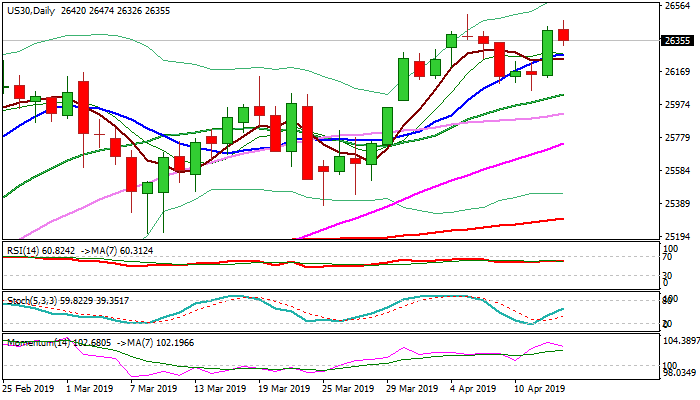
The Dow Jones eases from marginally higher one-week high at 26474 on Monday, as mixed bank earnings soured the sentiment.
Signals that earnings season will disappoint came from weaker than expected earnings results for Goldman Sachs, Citi and Bank of America.
Dow lost traction after last Friday’s 1.02% advance on approach to 2019 high at 26506 (the highest since early Oct 2018).
Deeper pullback can be expected as bullish sentiment fades and sentiment weakens after earnings data.
Fresh bears eye initial support at 26271 (10SMA), violation of which would expose higher low at 26059 (11 Apr) reinforced by rising 20SMA, where dips should be ideally contained to keep bulls intact.
Overall structure is bullish and underpinned by rising thick daily cloud (top of cloud lays at 25619) and marks key support, loss of which would point to deeper correction.
Res: 26474; 26506; 26817; 26962
Sup: 26326; 26272; 26138; 26059
CAD dives on BoC Business Outlook Survey, global trade headwinds affecting firms’ operations
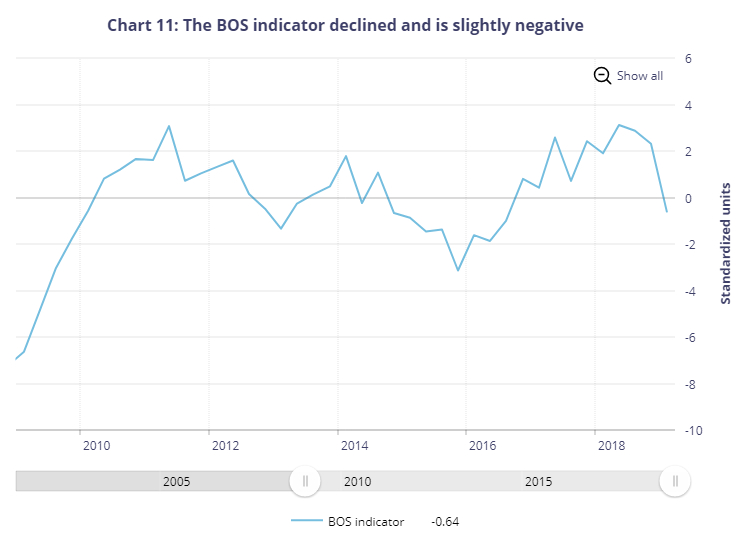
Canadian Dollar tumbles notably after poor results of BoC's Business Outlook Survey. Business Outlook Survey indicator dropped from 2.31 in Q4 to -0.64 in Q1. It suggested "a softening in business sentiment."Also, responses to several BOS survey questions moved below their historical averages.
BoC also warned that global trade headwinds and geopolitical tensions are affecting firms' operations.
- Several respondents cited negative impacts on their outlooks from US policy changes and related uncertainty.
- Some firms reported impediments to their export sales resulting from US protectionism.
- Other respondents reported that US tax cuts and regulatory differences reduce their competitiveness vis-à-vis US firms.
- Several firms noted cost increases due either directly or indirectly to tariffs, notably those on steel and aluminum as well as those associated with Canadian countermeasures.
- Some firms noted that the US–China trade dispute weighs indirectly on their business.
Overall, respondents citing negative impacts generally have weaker foreign sales expectations, investment intentions and hiring plans than unaffected businesses.
USD/JPY Mid-Day Outlook
Daily Pivots: (S1) 111.68; (P) 111.88; (R1) 112.22; More...
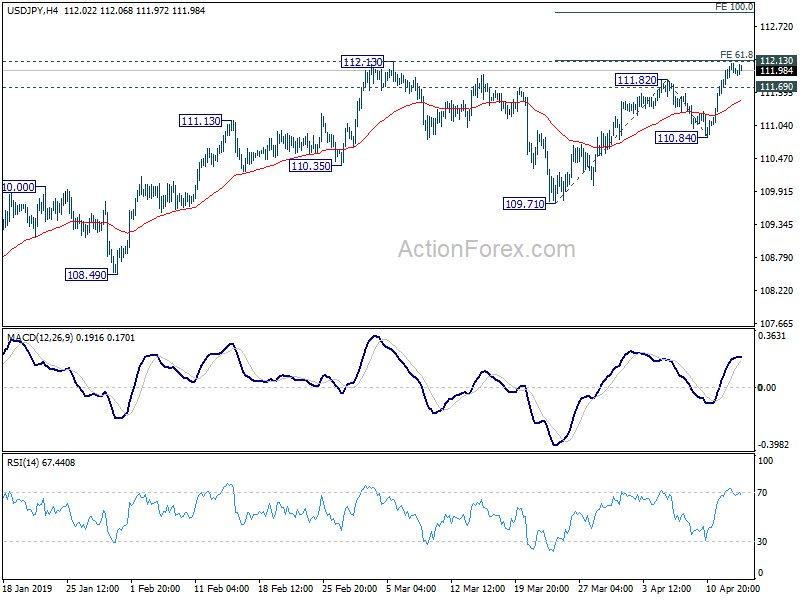
No change in USD/JPY's outlook. Intraday bias stays on the upside with focus on 112.13 key resistance. Decisive break there will resume whole rise from 104.69 for 100 % projection of 109.71 to 111.82 and 110.84 at 112.95 first. On the downside, below 111.69 minor support will turn intraday bias neutral. But, break of 110.84 is needed to confirm completion of rise form 109.71. Otherwise, further rally will remain in favor in case of retreat.
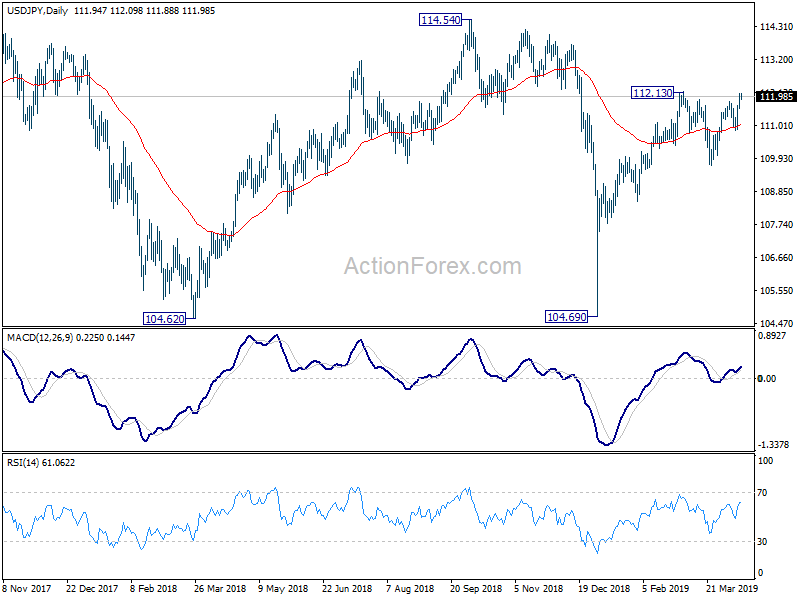
In the bigger picture, medium term outlook in USD/JPY remains a bit mixed as it's staying inside falling channel from 118.65, but there are signs of bullish reversal. On the upside, break of 114.54 resistance will revive the case the corrective fall from 118.65 has completed with three waves down to 104.69. And whole rise from 98.97 (2016 low) is resuming for 118.65 and above. But before that, outlook stays neutral first.
USD/CHF Mid-Day Outlook
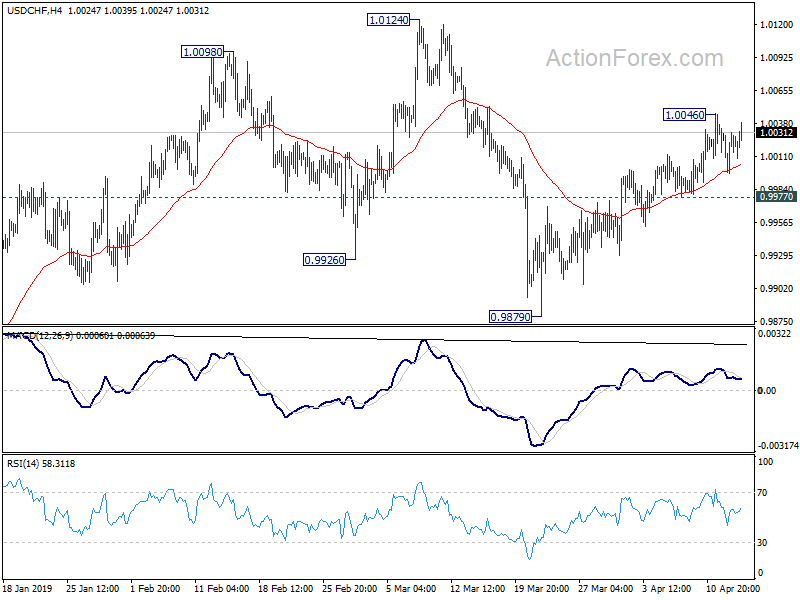
Daily Pivots: (S1) 1.0004; (P) 1.0020; (R1) 1.0044; More...
USD/CHF is staying in consolidation below 1.0046 temporary top. Intraday bias remains neutral first. With 0.9977 minor support intact, further rise is in favor. Above 1.0046 will extend the rebound from 0.9879 and turn bias to the upside for 1.0124 resistance. However, as the structure of the rise is corrective looking, we'd expect strong resistance from 1.0124 to limit upside to bring another reversal. On the downside, below 0.9977 minor support will turn bias to the downside for 0.9879 support.
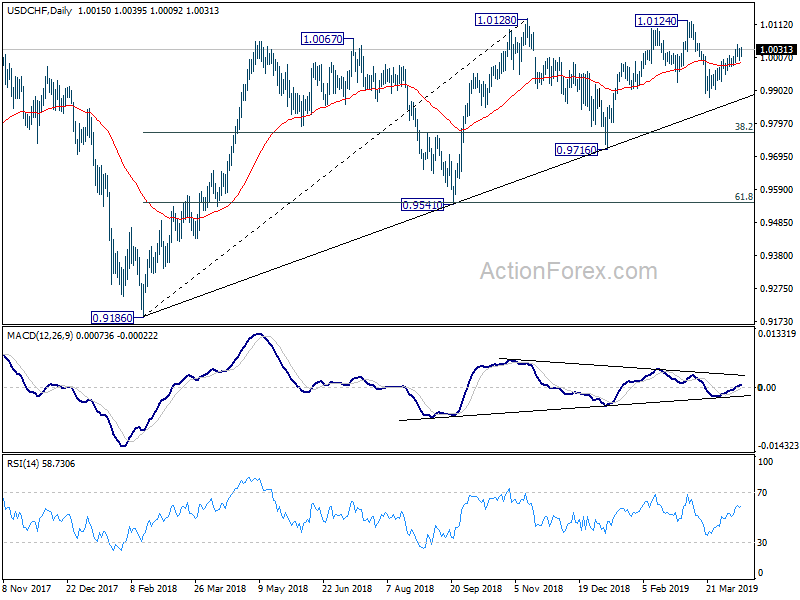
In the bigger picture, loss of upside momentum is seen is bearish divergence in daily MACD. But there is no clear sign of bearish reversal in USD/CHF yet. Rise fro 0.9186 is likely still in progress. Decisive break of 1.0128 resistance will resume this medium term rally to 1.0342 resistance next. This will remain the preferred case now, as long as 0.9716 support holds.
GBP/USD Mid-Day Outlook
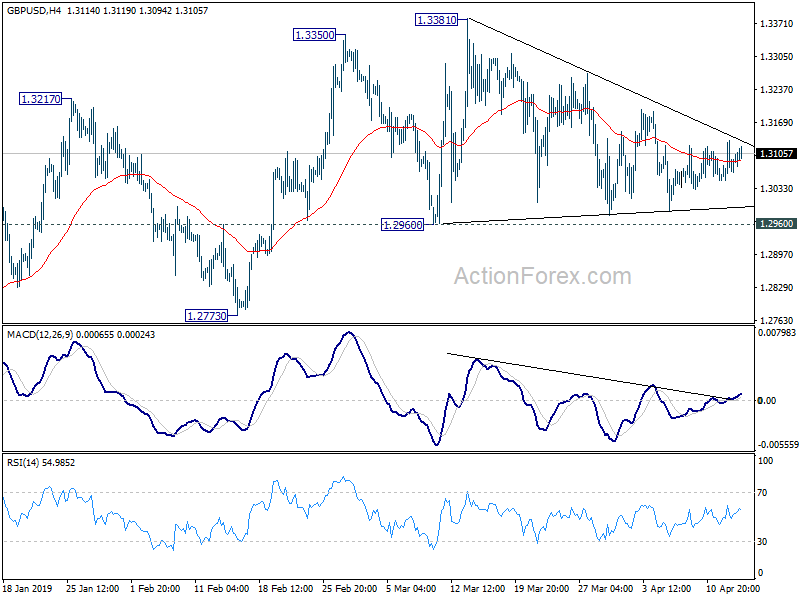
Daily Pivots: (S1) 1.3036; (P) 1.3085; (R1) 1.3120; More....
GBP/USD is staying in consolidation from 1.3381. Intraday bias remains neutral and some more consolidation could be seen. For now, further rise is expected as long as 1.2960 support holds. On the upside, decisive break of 1.3381 resistance ill resume whole rise from 1.2391. Next target will be 61.8% retracement of 1.4376 to 1.2391 at 1.3618 next. However, on the downside, sustained break of 1.2960 will indicate that rebound from 1.2391 has completed earlier than expected. Deeper fall would then be seen to 1.2773 support for confirmation.
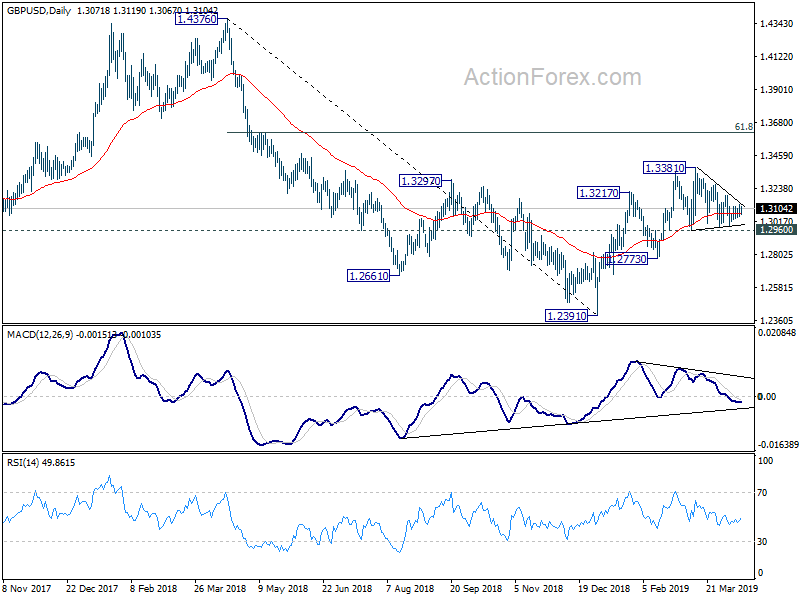
In the bigger picture, medium term decline from 1.4376 (2018 high) should have completed at 1.2391. Rise from 1.2391 is seen as the third leg of the corrective pattern from 1.1946 (2016 low). Further rise could be seen through 1.4376 in medium term. On the downside, though, break of 1.2773 support will dampen this view. Focus will be turned back to 1.2391 low and break will resume the fall from 1.4376 to 1.1946.
WTI Oil Outlook: Corrective Action Was So Far Shallow and Contained by 10SMA
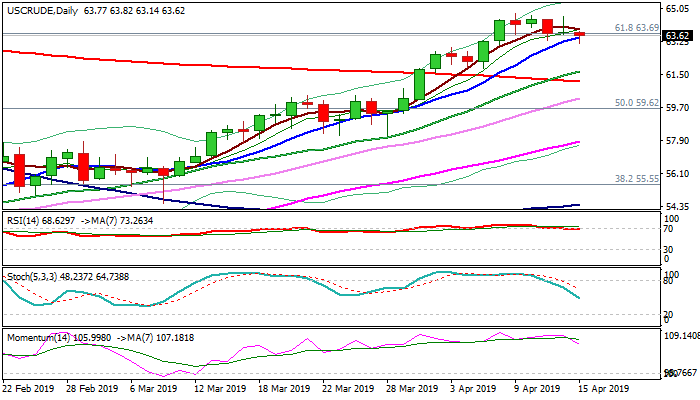
WTI oil price extends pullback from new five-month high at $64.77 on Monday, driven by negative technical signals as well as revived concerns about global supply. Initial signals of pullback on overbought conditions and stochastics' / RSI bearish divergence have materialized and oil price entered corrective phase. Weakening daily momentum adds to the sentiment, with fresh bears probing through significant support at $63.45 (10SMA). Close below is needed to generate fresh signal for further easing, as daily stochastic is in steep fall and showing room for further downside, while RSI reversed from overbought zone. The action for now looks like price adjustment before broader bulls resume. Initial scenario suggests shallow pullback, contained by 10 SMA (support is also reinforced by rising thick 4-hr cloud) that would keep immediate bulls in play, while deeper dips should fin d ground above $63.11 (200SMA). Revived concerns in the market regarding global supply, as US oil producers are on track for further output increase while other main world oil producers in the OPEC+ group decided to cut production in order to stabilize and tighten oil market. However, risk that the cartel may decide to stop output reduction by 1.2 mln bpd on its meeting in June exists and keeps markets cautious, as renewed oversupply threats could again slash oil price.
Res: 63.94; 64.77; 65.00; 65.37
Sup: 63.47; 63.14; 62.26; 61.63
Forex Markets Turn Mixed as Risk Appetite Cools, More Inspirations Needed
The forex markets turn relatively mixed today and markets lack a general direction. Risk appetite appeared to be firm earlier in Asian session but quickly faded. Major US indices open the day mildly lower. While German 10-year yield is trading up at the time of writing, US 10-year yield is trading down mildly. In the currency markets, Sterling is the strongest one for the moment but it's still staying well inside recently established range. Canadian Dollar follows as the second strongest., then Euro. Swiss Franc is the weakest one, followed by Australian Dollar. Markets will need more inspiration from the upcoming economic data in the week.
Technically, 112.13 resistance in USD/JPY remains a focus for the rest of the session. Break will confirm resumption of larger rally from 104.69. EUR/JPY is still on track to test equivalent resistance at 127.50. USD/CHF is looking at 1.0040 temporary top and break will resume rebound from 0.9879. GBP/USD, EUR/GBP, GBP/JPY, USD/CAD and EUR/AUD are all bounded in familiar range.
In other markets, DOW is down -0.14%. S&P 500 is down -0.11%. NASDAQ is down -0.13%. US 10-year yield is down -0.002 at 2.558, comfortably above 2.5 handle. In Europe, FTSE is down -0.14%. DAX is up 0.11%. CAC is down -0.01%. German 10-year bund yield is up 0.011 at 0.067. Earlier in Asia, Nikkei closed up 1.37%. Hong Kong HSI dropped -0.33%. China Shanghai SSE dropped -0.34%. Singapore Strait Times dropped -0.18%. Japan 10-year JGB yield rose -0.017 to -0.031.
US Empire State manufacturing rose to 10.1, but future conditions dropped to 3-year low
US Empire State manufacturing general business conditions index rose 10.1 in April, up from 3.7 and beat expectation of 8. 33% of respondents reported improved conditions, 23% said worsened. New orders index rose 5pts to 7.5. Shipments rose 1pts to 8.6. However, index for future business conditions dropped a massive -17 pts to 12.4, lowest in more than three years.
New York Fed noted in the release that growth picked up somewhat but remained fairly subdued. New orders rose slightly, and shipments continued to grow modestly. Delivery times and inventories both increased. Labor market indicators pointed to ongoing employment gains and a small increase in hours worked. The prices paid and prices received indexes moved lower, pointing to a slowing in both input price increases and selling price increases. Indexes assessing the six month outlook suggested that firms were much less optimistic about future business conditions than last month.
Also released today, Swiss PPI rose 0.3% mom, dropped -0.2% yoy in March, versus expectation of 0.2% mom, -0.2% yoy. UK Rightmove house prices index rose 1.1% mom in April.
US asking China to shift tariffs from privileged agriculture to other industries
According to a Bloomberg report, US is asking China to shift some tariffs away from agricultural goods to other products. And China is in consideration.
The request came as Trump didn't want to lift punitive tariffs on China even when a trade deal is made. Yet, Bloomberg said Trump want to "sell any eventual trade deal as a win for farmers ahead of the 2020 election". But there was no explanation on why the agricultural industry has this special privilege over others. And there is no indications on which industries are going to take the burden, and why.
It's also noted that the shift could make it easier for China to ramp up its purchases of US agricultural goods as part of the trade deal. But again, there is no details on whether China will cut imports from others countries, and who they will buy less from.
At this point, we'll treat this as a speculation as no one from USTR nor MOFCOM have responded. And we don't expect them to.
US watering down demands on SOEs in trade negotiations with China
Separately, according to a Reuters report quoting unnamed sources, the US is stepping back on its demand regarding subsidies to State Owned Enterprises (SOEs)
An important tricky point regarding SOEs is that it's tightly interwind with the Chinese government's industrial policy. That's deeply rooted in the fundamental nature of China's system, a "systematic rival" to major economies in the world as seen by EU. While China is making concessions in other areas, it's an area that the socialist country won't concede ground. A source said that "if U.S. negotiators define success as changing the way China's economy operates, that will never happen".
In addition, China is expected to ramp up purchases of US goods as part of the trade deal. But who's going to make the purchases? It's most likely the SOEs which the government has direct control on. Thus, another sources said "the purchasing, for example, reinforces the role of the state sector because the purchasing is all being done through state enterprises."
EU gives final greenlight for trade negotiation with US, except red-line in agriculture
Today, European Council gave the greenback to start formal trade negotiations with the US on two agreements. One is a trade agreement strictly focused on industrial goods, excluding agricultural products. The other is on conformity assessment to make it easier for companies to prove their products meet technical requirements on both sides of the Atlantic.
According to a European Commission analysis, the first agreement would increases EU exports to US by 8% and US exports to EU by 9% by 2033. That is, additional gains of €27 billion and €26 billion in EU and U.S. exports respectively.
European Commission President Jean-Claude Juncker said EU is delivered what he has agreed with Trump on July 25, 2018. Juncker added: "We want a win-win situation on trade, beneficial for both the EU and the U.S. Notably we want to slash tariffs on industrial products as this could lead to an additional increase in EU and U.S. exports worth around €26 billion. "
At a news conference, Trade Commissioner Cecilia Malmstrom said "I will reach out as soon as they wake up in the U.S.... and see if can have more clarity on when we can meet to have the first talks on this... We are ready as soon as they are... We are definitely determined to do everything we can to finish this during the Juncker Commission". That is, Juncker's term ends on October 31.
Malmstrom also added agriculture is "certainly not" a part of the negotiations. And, "this is a red line for Europe and you'll not find any mention of this in our mandate."
Bundesbank said manufacturing orders literally collapsed, government said no need for stimulus for now
In the April Monthly Report, Bundesbank said growth picked up only moderately in Q1. Also, the underlying momentum of expansion remained subdued as dragged down by manufacturing downturn. The description of the manufacturing sector are rather dramatic, as orders "literally collapsed" and mode has "significantly deteriorated".
Separately, German government spokesman Steffen Seibert said for now there is no need for a stimulus package to reinvigorate the economy. He emphasized Germany has a "very solid budget policy". And, "we are coupling solid budgets with an increase in investments and this should in the coming years improve the basis for more growth." Seibert added, "the budget stipulates investment spending that is significantly higher than in the previous legislative period and as such we see no need for a stimulus package."
UK May not thinking about general election, Hunt said it's not time for leadership contest
UK Prime Minister Theresa May's spokesman James Slack said today that she is not thinking about an election for the moment. The cross-party talk with Labour regarding Brexit will continue. The talks are now carried out in "smaller groups" which concentrate on "specific issues". But there is no timetable for an agreement yet. Meanwhile, no-deal preparation would continue towards the new Brexit deadline on October 31.
Foreign Minister Jeremy Hunt also insisted that Conservative party leader contest would only happen after Brexit Withdrawal agreement if voted through the parliament. Hunt added: "There will be a time for all those discussions about whether this shade of person or that shade of person is the right person to take over from the prime minister. But the time for that is when she has announced she's going and there's a formal leadership contest."
Hunt also said that "talks we are having with Labour are detailed and I think more constructive than people have thought. " Also, "they are more detailed and more constructive than people had been expecting on both sides.
EUR/USD Mid-Day Outlook
Daily Pivots: (S1) 1.1260; (P) 1.1292; (R1) 1.1331; More.....
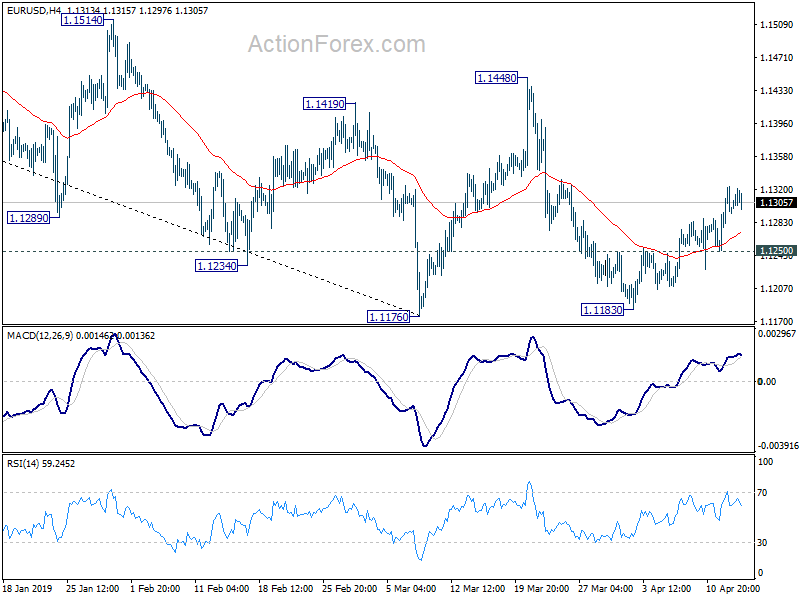
EUR/USD's recovery from 1.1183 is still in progress and intraday bias remains on the upside. Current rise could extend to 1.1448 resistance and above. But in that case, we'd expect strong resistance between 1.1448/1569 to limit upside. On the downside, below 1.1250 minor support will turn bias to the downside. Decisive break of 1.1176 will resume the down trend from 1.2555.
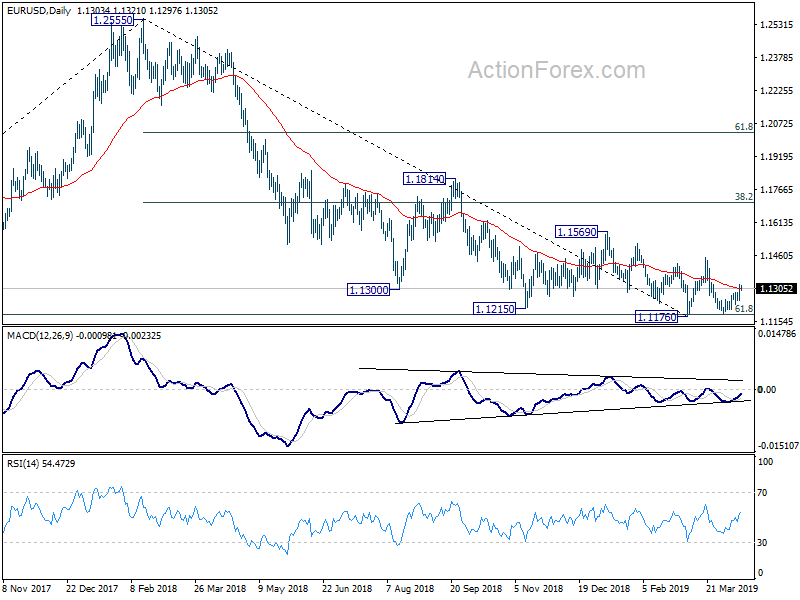
In the bigger picture, EUR/USD has been losing downside momentum around 61.8% retracement of 1.0339 (2016 low) to 1.2555 (2018 high) at 1.1186. But for now, there is no clear sign of medium term reversal yet. Downside from 1.2555 is expected to resume sooner or later as long as 1.1569 structural resistance holds. Decisive break of 1.1186. could pave the way back to 1.0339 low.
Economic Indicators Update
| GMT | Ccy | Events | Actual | Forecast | Previous | Revised |
|---|---|---|---|---|---|---|
| 23:01 | GBP | Rightmove House Prices M/M Apr | 1.10% | 0.40% | ||
| 06:30 | CHF | Producer & Import Prices M/M Mar | 0.30% | 0.20% | 0.20% | |
| 06:30 | CHF | Producer & Import Prices Y/Y Mar | -0.20% | -0.20% | -0.70% | |
| 12:30 | USD | Empire State Manufacturing Index Apr | 10.1 | 8 | 3.7 | |
| 14:30 | CAD | BoC Business Outlook Survey | ||||
| 20:00 | USD | Net Long-term TIC Flows (USD Feb | -18.2B | -7.2B |
EUR/USD Mid-Day Outlook
Daily Pivots: (S1) 1.1260; (P) 1.1292; (R1) 1.1331; More.....
EUR/USD's recovery from 1.1183 is still in progress and intraday bias remains on the upside. Current rise could extend to 1.1448 resistance and above. But in that case, we'd expect strong resistance between 1.1448/1569 to limit upside. On the downside, below 1.1250 minor support will turn bias to the downside. Decisive break of 1.1176 will resume the down trend from 1.2555.
In the bigger picture, EUR/USD has been losing downside momentum around 61.8% retracement of 1.0339 (2016 low) to 1.2555 (2018 high) at 1.1186. But for now, there is no clear sign of medium term reversal yet. Downside from 1.2555 is expected to resume sooner or later as long as 1.1569 structural resistance holds. Decisive break of 1.1186. could pave the way back to 1.0339 low.
Japenese Yen Hovering at 112 in Light-Data Session
USD/JPY is unchanged in Monday trading. In the North American session, the pair is trading at 112.00, down 0.02% on the day. There are no Japanese events on the schedule. In the U.S., the Empire State Manufacturing Index improved to 10.1, beating the estimate of 8.1 points. On Tuesday, Japan releases trade balance.
With the Japanese economy feeling the squeeze of the U.S.-China trade war and the BoJ offering negative interest rates, there isn’t much to attract investors to the yen unless risk appetite drops sharply. Trade talks between China and the U.S. are continuing, but last week a U.S. official said that an agreement could be months away. Still any progress between the sides would be good news for the export-dependent Japanese economy.
The International Monetary Fund downgraded its economic forecasts last week, lowering its estimate of Japanese growth. The January forecast of 1.1% was lowered to 1.0%. The IMF said that the downgrade was due to weaker Japanese exports, a result of the global trade war. The IMF also lowered its forecast for global growth, from 3.5% in January to 3.3%. Earlier in the week, a BoJ forecast downgraded its assessment for three of the country’s nine regions. Nonetheless, BoJ Governor Haruhiko Kuroda remained optimistic, saying that stronger domestic demand will offset the decline in exports, which would enable the economy to grow at a moderate pace.
Sunset Market Commentary
Markets
Global core bonds lose ground today with German Bunds underperforming US Treasuries. With an empty eco calendar, it was up to risk sentiment to guide investors. Following Friday’s profit-taking on the bond markets, triggered by better-than-expected Chinese lending data and strong US earnings, global core bonds opened neutral. Following mixed results on Asian bourses, EU equities opened hesitant. German Bunds remained close to unchanged throughout the day, but maintained a downward bias as risk sentiment remained cautiously upbeat. The German yield curve is bear steepening with changes up to +3.1 bps (30-yr). US Treasuries stabilized as well during European trading, but made another attempt lower on a stronger than expected US Empire Manufacturing result for April. The confidence gauge printed 10.1, up from 3.7 in March and well above market expectations. However, the subcomponent for the future business conditions dropped to its lowest level in over three years, possibly explaining why US Treasuries paired its (limited) losses right away. The US yield curve is flattening with changes in the range of -0.7 bps (30-yr) to +0.6 bps (2-yr). Peripheral spreads over the German 10-yr yield are close to unchanged.
Dollar trading developed within extremely narrow trading ranges. Risk sentiment during European trading hours was less ebullient compared to Asia this morning. The dollar nevertheless remained in the defensive. EUR/USD retested Friday’s intraday high around 1.1320 several times but the hurdle remains too high for now. The couple does recapture the 1.13-mark (1.1310 at the time of writing). USD/JPY had been losing territory throughout the day. A better than expected headline NY manufacturing index (10.1 vs. 8.0 expected) failed to produce a convincing (and lasting?) move back above 112 as underlying (forward looking) details were outright weak. Friday’s rally clearly dwindled today. Markets want that end of week optimism validated by more evidence before engaging in the same directional positioning. Corporate earnings and guidance, important Chinese growth data on Wednesday and PMI business confidence in the euro zone this Thursday will be closely watched.
British parliament is in recess until April 23 but negotiations between May and Labour’s Jeremy Corbyn continue. Talks happen behind closed doors and little juicy headlines escaped the room. Sterling initially stayed under pressure at the start of European dealings but soon took the upper hand, erasing most of Friday’s losses. The moves were technically irrelevant though. EUR/GBP is trading around 0.862 (vs. 0.865 at the start of the sessions) at the time of writing. Cable traded with an upward bias at 1.31, profiting from some overall dollar weakness.
News Headlines
The US Empire Manufacturing business survey rebounded more than expected in April, from 3.7 to 10.1 (vs 8 consensus). Details show that new orders, shipments and inventories contributed positively. However, the index for future business conditions (6m ahead) dropped by 17 points to 12.4, the lowest level in more than 3 years.
The European council greenlighted the start of trade negotiations with the US. EU trade commissioner Malmström hopes to seal a deal by September. The directives for the negotiations cover two potential agreements. The first one is strictly focused on industrial goods, excluding agricultural products. The second one is focused on conformity assessment, to make it easier to prove products meet technical requirements.
Goldman Sachs’ quarterly earnings fell by a fifth, but manages to beat estimates. Tough trading conditions, lower private equity profits and smaller transaction revenues were to blame even if pay costs were cut by 20%. The expected strategic review is postponed by a year. Citigroup earnings also beat consensus, thanks to expense control and share repurchases. Their battle to raise revenue persists.