Sample Category Title
RBA Minutes – Confirming Dovish Monetary Policy Stance. Low Inflation Raises the Chance of Rate Cut
While RBA had left the cash unchanged at 1.5% in April, the minutes for the meeting was closely-watched. Recall that the central bank turned more dovish as it acknowledged more downside risks to the growth outlook. The minutes reinforced this view. More importantly, the minutes affirmed that the central bank has shifted its monetary policy stance to dovish from neutral. The members judged that the current low inflation and low wage growth environment would not justify a rate hike in the near-term. Instead, they would consider to lower interest rate if inflation stays weak for a prolonged period of time.
What concerned the members most was weak inflation and the job market. They believed that inflation should “remain low for some time”. Meanwhile, “wages growth had remained low, there continued to be strong competition in the retail sector and governments had been working to ease cost of living pressures, including through their influence on administered prices”. Against this backdrop, the chance of a rate hike “in the near term was low”. The minutes unveiled that policymakers “discussed the scenario where inflation did not move any higher and unemployment trended up”. They judged that “a decrease in the cash rate would likely be appropriate in these circumstances".
With regards to the impact on additional monetary easing, the members admitted that the effects on the macroeconomic developments would be less than the previous round of stimulus. The members “recognised that the effect on the economy of lower interest rates could be expected to be smaller than in the past, given the high level of household debt and the adjustment that was occurring in housing markets". However, they believed it would still offer some help as lower interest rate could weaken the exchange rate. This should help boost exports. Meanwhile, lower interest rate could also reduce the debt burden of investors. As noted in the minutes, “a lower level of interest rates could still be expected to support the economy through a depreciation of the exchange rate and by reducing required interest payments on borrowing, freeing up cash for other expenditure”.
In order to gauge the likelihood, as well as the timing of RBA rate cut, the next key events to watch for would be the March employment report due April 18 and first quarter inflation data due April 24. For the former, the market expects the unemployment rate to climbed higher to 5%, from 8-year low of 4.9% in February. Headline CPI probably eased to +1.5% y/y in 1Q19, from +1.8% in the last quarter of 2018.
Fed Rosengren prefers inflation range targeting
Ahead of a broad review on monetary policy framework, Boston Fed President Eric Rosengren said he'd prefer a range targeting approach on inflation. That is, Fed could be forced to accept inflation below 2% during recessions. On the other hand, Fed should commit to achieve above 2% inflation in good times. For example a range of 1.5-2.5%.
Rosengren echoed other platemakers' comment that the current 2% target is "symmetric". But in practice, people saw that figure as a "ceiling". He added, "even though we're only missing by a little bit it actually does matter if you miss by a little bit on a regular basis."
Evans: Fed should embrace inflation above 2%, 50% of time
Chicago Fed President Charles Evans said on Monday that Fed's policy has been "successful" in achieving the maximum employment mandate. It's "less successful" regarding the inflation objective. And to fix this, he added, "Fed must be willing to embrace inflation modestly above 2 percent 50 percent of the time." For him, he would "communicate comfort" with core inflation at 2.5%, as long as there is "no obvious upward momentum" while the path back to 2% can be "well managed".
For now, Evans is still expecting that "some further rate increases may be appropriate over time". He expects growth to be at around 1.75-2.00% this year. Still he maintained that current patient stance is appropriate given the "heightened uncertainty" including US-China trade war. He also emphasized that "if activity softens more than expected or if inflation and inflation expectations run too low, then policy may have to be left on hold - or perhaps even loosened - to provide the appropriate accommodation to obtain our objectives."
Daily Markets Broadcast
Bank earnings drag Wall Street lower
Whereas the first day of the bank reporting season was strong, the second day was not, so Wall Street gave back some of Friday's gains yesterday. Despite this, positive risk appetite remains intact.
US30USD Daily Chart
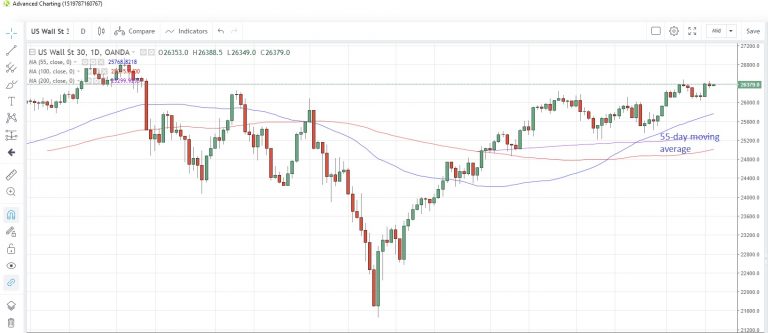
The US30 index slipped after touching a 10-day high yesterday following disappointing earnings from Citigroup and Goldmans
The rising 55-day moving average support is at 25,768 today
US industrial production is expected to improve slightly in March, expanding 0.2% m/m after a flat reading in February. Capacity utilisation is seen steady at 79.1%.
DE30EUR Daily Chart
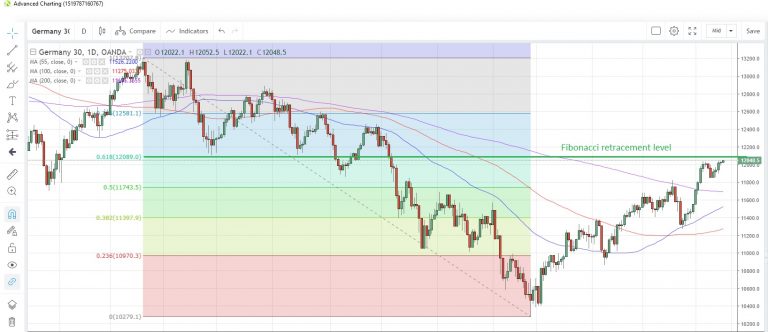
The Germany30 index looks set to advance for a fifth straight day today, supported by comments from the ECB saying growth in Q1 may have seen a pickup
The index touched the highest since October 8 this morning but is still below the 61.8% Fibonacci retracement level of the May-December drop at 12,089
ZEW surveys from Germany and the Euro-zone are due today, with both expected to rebound back into positive territory in April.
XAU/USD Daily Chart
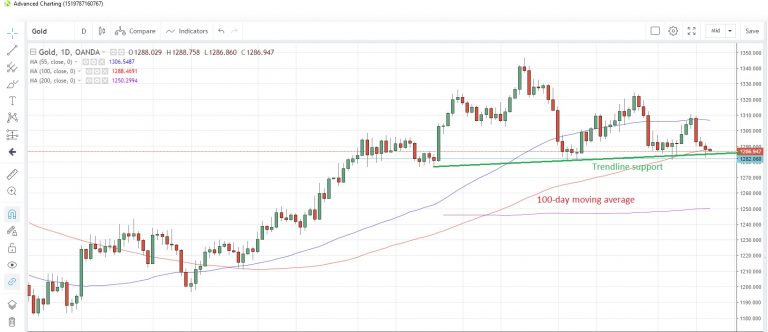
Gold looks on track to post the fourth consecutive daily loss today as risk appetite remains buoyant despite yesterday's setback on the bank earnings front
XAU/USD has opened today's session below the 100-day moving average at 1,288.47 for the first time since November 15 and looks set to test trendline support around 1,285
China's Foreign Direct Investment data for March could be released today, which rose 5.5% y/y last month. If it echoes the surge in new loans seen in March, then gold could feel more pressure.
GBP/USD Remains In Uptrend Above 1.3000
Key Highlights
- The British Pound remains well supported above the key 1.3000 support against the US Dollar.
- A major bullish trend line is in place with support at 1.3040 on the daily chart of GBP/USD.
- The NY Empire State Manufacturing Index in April 2019 increased from 3.7 to 10.1.
- The UK Claimant Count in Feb 2019 could change 20K, less than the last 27K.
GBPUSD Technical Analysis
The British Pound formed a strong support base near 1.2980 against the US Dollar. The GBP/USD pair is likely to climb higher above the 1.3150 and 1.3200 resistance as long as it is above 1.3000 and 1.2980.
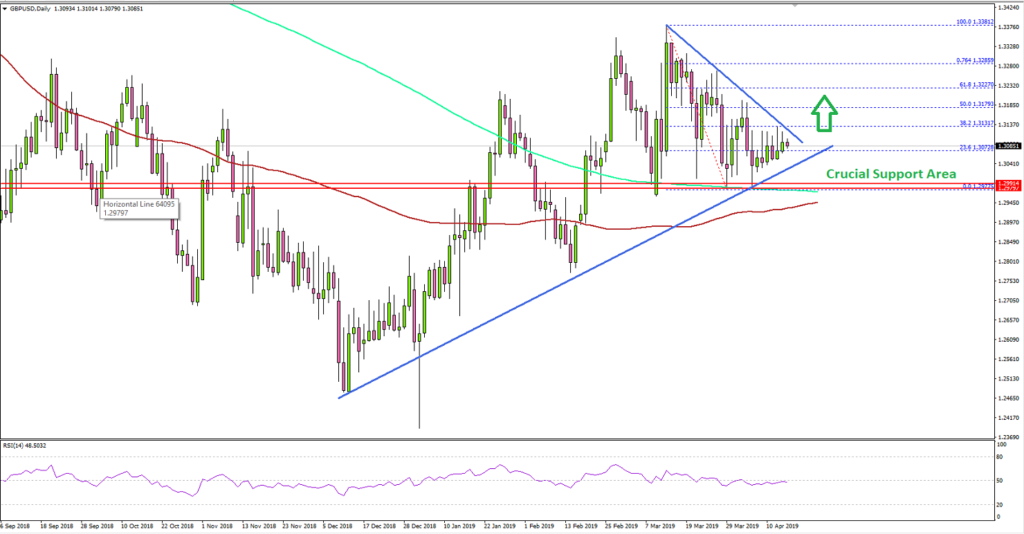
Looking at the daily chart, the pair declined this past week, but the all-important 1.2980 area acted as a strong support along with the 200-day simple moving average (green).
The chart clearly suggests the significance of the 1.2980 support, below which bears are likely to take control in the medium term. There is also a major bullish trend line is in place with support at 1.3040 on the same chart.
At the moment, the pair is trading with a positive angle and it could surpass the 1.3150 resistance in the near term. The next resistance is near the 1.3180 level and the 50% Fib retracement level of the last slide from the 1.3381 high to 1.2977 low.
If there is an upside break above 1.3180 and 1.3200, the pair could continue to rise towards the 1.3300 resistance area. On the downside, the main support is at 1.2980, below which there is a risk of a sharp drop towards the 1.2840 support.
Fundamentally, the NY Empire State Manufacturing Index for April 2019 was released by the Federal Reserve Bank of New York. The market was looking for an increase from 3.7 to 6.0.
The actual result was better than the forecast, as the NY Empire State Manufacturing Index climbed sharply to 10.1. There was a slight increase in new orders, and shipments continued to rise modestly. Delivery times and inventories both grew in April 2019.
Overall, GBP/USD remains in an uptrend as long as it is above 1.2980 and it could rise towards 1.3200 or even 1.3300 in the coming days.
Economic Releases to Watch Today
- German ZEW Business Economic Sentiment Index for April 2019 – Forecast 0.8, versus -3.6 previous.
- UK Claimant Count Change Feb 2019 – Forecast 20.0K, versus 27.0K previous.
- UK ILO Unemployment Rate Feb 2019 (3M) – Forecast 3.9%, versus 3.9% previous.
- US Industrial Production March 2019 (MoM) – Forecast 0.2%, versus 0% previous.
What Happens If The USMCA Doesn’t Happen?
Executive Summary
The U.S. Congress has not yet ratified the United States-Mexico-Canada Agreement (USMCA). If Congress does not ultimately ratify the deal, the United States could potentially withdraw from the North American Free Trade Agreement (NAFTA). A revocation of duty-free trade between the United States and its North American neighbors likely would not have meaningful macroeconomic effects for the U.S. economy, at least not in the short run, but it could lead to significant adjustment costs for individual industries, especially for the automotive industry.
Does No USMCA Lead to NAFTA Withdrawal?
Due to the surge of Central American migrants that have streamed into the United States to seek asylum, President Trump recently threatened to close the U.S.-Mexico border, or at least parts of it. Not only would a closure of the southern border impede the flow of people, but it would also have a detrimental effect on the flows of goods that are traded between the United States and Mexico. We addressed the potential economic fallout from a border closure in a recent report.1 However, the president subsequently softened his stance, so a closure of the U.S.-Mexico border does not seem to be an imminent possibility at present. But there is still an outstanding trade issue between the United States and Mexico that has not received much attention recently. Specifically, the USMCA, which was finalized and signed by the leaders of the three North American economies last autumn, has not yet been ratified.
The USMCA made some changes to NAFTA, which has governed the trade in goods and services among the three North American economies since 1994. One of the more notable alterations to NAFTA was the domestic content stipulations of automobile production. Under NAFTA, 62.5% of an automobile had to originate in one of the three NAFTA countries to qualify for duty-free trade. The USMCA raises this proportion to 75%, and at least 40% of a car must be produced by workers who make at least $16/hour. In addition, the USMCA would exempt Canada and Mexico, at least for the foreseeable future, from any tariffs that the United States may impose on auto imports later this year. Some of the dispute settlement procedures among the three signatories have been altered, the United States won expanded access to Canada's dairy market and the countries agreed to review the overall USMCA deal after six years. However, the United States Congress has not yet ratified the USMCA, and passage remains uncertain. What happens if Congress does not ratify the deal?
Trade among the three North American economies at present continues to be governed by NAFTA rules. So if Congress does not ratify the USMCA, then the status quo (i.e., current NAFTA rules) would be maintained. But while negotiations were ongoing last year, President Trump had threatened to “rip up” NAFTA if the three countries could not reach agreement on a new trade pact. Any of the three signatories has the right to withdraw from NAFTA provided that it gives the other two partners six months' notice. It is unclear whether the president can withdraw the United States from NAFTA without congressional approval. But if President Trump ultimately succeeded in withdrawing the United States from NAFTA because Congress does not ratify the USMCA, then trade between the United States and its two North American neighbors would no longer be duty free. How harmful would a revocation of duty-free trade be?
Would NAFTA Withdrawal Bring the U.S. Economy to Its Knees?
The United States exported roughly $300 billion of goods to Canada in 2018 while American imports from that country totaled nearly $320 billion (Figure 1). Two-way trade between the United States and Mexico also exceeded $600 billion last year.2 Together, Canada and Mexico accounted for one-third of the value of American exports of goods in 2018, and the United States received onequarter of its imports from its two NAFTA neighbors. Is short, Canada and Mexico were America's second and third most important trading partners, respectively, in 2018.3
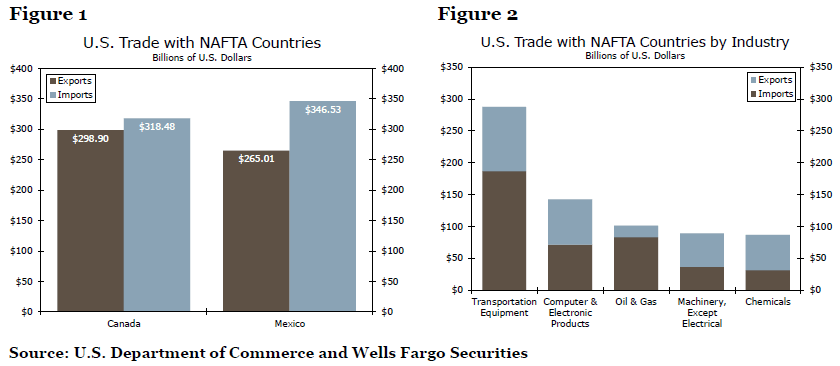
All sorts of goods flow across America's northern and southern borders, but the five largest categories of exports and imports are shown in Figure 2. For starters, there is significant two-way trade in transportation equipment that was valued at nearly $300 billion in 2018. Although there is some trade in aerospace products, motor vehicles and parts account for the vast majority of trade in transportation equipment among the three North American neighbors. Computer & electronic products, oil & gas, machinery and chemicals round out the top five categories of two-way trade in goods. The five categories that are shown in Figure 2 suggest that the United States imports and exports significant quantities of intermediate goods (i.e., goods that are used in the production of other goods) from Canada and Mexico. Indeed, roughly one-half of the goods that the United States imports from its NAFTA partners are intermediate goods. Finished products comprise the other half.
A revocation of duty-free trade between the United States and its NAFTA partners would raise prices of the goods that the United States imports from Canada and Mexico. But a return to duties on imported goods from Canada and Mexico would likely not have much of a measurable effect on consumer price inflation. First, the amount of finished goods that the United States imports from its North American neighbors is equivalent to only 7% or so of the goods that American consumers buy. But with goods accounting for only one-third of U.S. consumer expenditures—services account for the other two-thirds—the effect on overall consumer prices would not be large. Moreover, the tariff rates that the United States levies on most imported goods are only in the single digits. A return to tariffs on finished goods originating in Canada and Mexico would likely not have a meaningful effect on the prices that American consumers pay for those products
U.S. exports to Canada and Mexico are also split roughly evenly between finished products and intermediate goods. Revocation of duty-free trade would raise the prices of finished goods that the United States sends to its North American neighbors, potentially reducing the quantities of those exports. But any associated hit to U.S. GDP growth would be miniscule because final spending by households, businesses and governments in Canada and Mexico accounts for only 2% of the value added that is created in the U.S. economy. In sum, there likely would not be significant macroeconomic effects, at least not in the short run, if the United States were to withdraw from NAFTA, although the inefficiencies that are associated with the price-distorting effects of tariffs could compound the negative macroeconomic effects over time. Moreover, there could be meaningful effects on individual industries from potential changes in trade flows, a topic to which we now turn.
The Importance of Two-Way Trade for the Auto Industry
The discussion above indicates that there is a significant amount of trade in intermediate goods between the United States and its NAFTA partners. Consequently, there could be meaningful effects on individual industries that use these goods in the production process. Consider the auto industry, where two-way trade in auto parts between the United States and its NAFTA partners totaled about $105 billion last year (Figure 3).4 Although American consumers could be the end purchasers of some of these automotive parts, we suspect that most of the parts are ultimately used in the assembly of finished cars and trucks.
Some auto parts reportedly cross borders multiple times. For example, a part may be manufactured in Canada and then shipped to the United States where it is used in the assembly of an engine. The engine is subsequently shipped to Mexico where it is used in the final assembly of a car, which is then sent back to the United States for sale to a consumer. If duties are applied every time auto parts cross the border, the cost of producing a car could be materially affected. Consequently, American auto manufacturers could decide to curtail operations in Canada and Mexico and instead produce the vehicle entirely in the United States. Although this move could lead to higher employment in the U.S. auto industry in the long run, it could also impose some significant nearterm costs on manufacturers as they close down operations in Canada and Mexico and build new production facilities in the United States.5
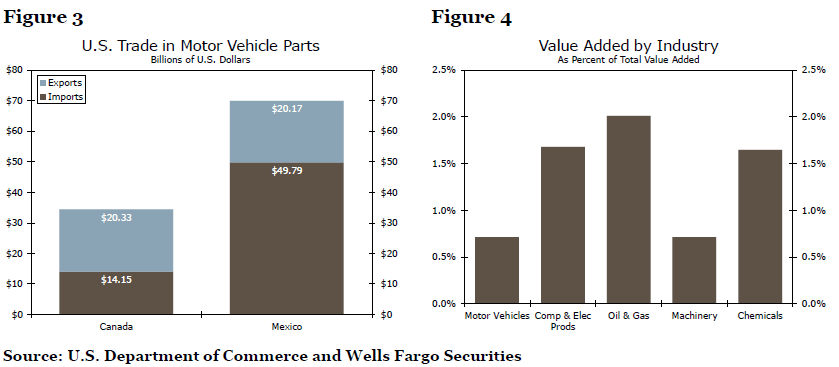
But the motor vehicle industry accounts for less than 1% of the value added that is created in the U.S. economy (Figure 4). The other four American industries with the most absolute exposure to two-way trade with Canada and Mexico also account for 2% or less of value added in the U.S. economy. In short, there probably would not be significant macroeconomic effects, at least not in the short run, from a revocation of duty-free trade between the United States and its NAFTA trading partners.
Conclusion
The leaders of the United States, Mexico and Canada reached agreement late last year on a trade deal that would reform NAFTA, but the U.S. Congress has not yet ratified the accord. If Congress does not ratify the USMCA, the Trump administration could potentially withdraw the United States from NAFTA. In that event, trade between the United States and its North American neighbors would no longer be duty free, as it has been over the past 25 years.
Revocation of duty-free trade likely would not have meaningful macro effects, at least not in the short run, on the U.S. economy. The United States levies single-digit tariff rates on imports of goods from most countries, so inflation likely would not rise significantly if duties would be imposed on Canadian and Mexican goods. Tariffs would raise the prices on American goods entering Canada and Mexico, but final spending in those two countries accounts for only 2% of the value added that is created in the U.S. economy. That said, the inefficiencies that are associated with the price-distorting effects of tariffs could compound the negative macroeconomic effects over time. Moreover, individual industries, especially the automotive industry, could be significantly affected if trade between the United States and its North American neighbors is no longer duty free
Not All That Glitters Is Goldman
Not all that glitters is Goldman
Goldman Sachs took the heat out of Wall Street overnight reporting a 20% slump in Q1 earnings. Fellow financial heavyweight, Citigroup, also produced an “is that it” moment as well, reporting flat revenues for the quarter. Although the S&P 500 is within shouting distance of record highs, the air has been let out of its tyres today with a 0.06% drop. The Nasdaq also dropped 0.10%, while the Dow Jones was down 0.11%.
The JP Morgan afterglow has been quickly forgotten, but with earnings season really just getting underway, we can expect this sort of flip flop in sentiment as market heavyweights report daily. Two things that do appear to be true though are that a lot of money is sitting on the sidelines awaiting a clearer picture of the US and global economies, and a lot of monetary policy and global recovery is now baked into the prices of equities globally – China and the US being the standouts. You can quite reasonably add emerging market FX, commodities and energy into that mix as well.
The data from both China and the US has been consistently upbeat of late, suggesting things may not get as bad as the doomsayers are proclaiming. That said, without sounding like a broken record, a resolution of the US-China trade issues must occur before a more complete picture of what 2019 holds for the global economy can be built. Europe and Japan will almost certainly receive the same treatment from President Trump once China is resolved, but right now, US-China talks remain the only game in town.
The Reserve Bank of Australia minutes at 0930 Singapore time will be the day’s highlight in Asia ahead of German ZEW data this afternoon and then US Industrial Production this evening. China’s House Price Index at 0930 could provide some short-term volatility should prices rise much less than the previous months 10.40%, but official China data rarely surprises these days.
Equities
Regional stock markets were a mixed bag yesterday with the Japan Topix rising over 1%. The China CSI 300 and the Hong Kong Hang Seng both started brightly but gave up their gains to finish slightly in the red. Two things should be noted though: China and Hong Kong equities have been the primary beneficiaries of the Q1 global reflation trade, and neither could sustain gains yesterday despite a positive session from Wall Street on Friday.
The local stocks markets should start the day cautiously, likely sitting on the sidelines following an inconclusive Wall Street session. More probable, price action will be dictated by the performance of mainland China’s markets today.
FX
The currency markets have gone back into hibernation mode as the Goldman Sachs result nipped the rotation out of dollar trades in the bud. Ahead of Indonesia’s elections tomorrow – and with the first two days of US reporting season giving an ambiguous result – the currency markets will happily stay in wait-and-see mode.
Oil
Oil continues to tread water near its recent highs with Brent Crude falling 0.40% to USD71.25 a barrel and WTI falling 0.60% to USD63.50 a barrel. With both contracts hugely overbought on a technical basis, and with so much good news pumped into prices at these levels, momentum continues to wane. The risk of a correction lower will increase unless the energy markets get a fill-up, and soon.
Gold
Gold remains trapped in a twilight zone around USD1,290.00 an ounce, unable to rally as both the dollar and bond yields remain firm. The USD1,280.00 region remains the critical support region for the yellow metal.
Oil Slides On Weaker Economy And Production Cut Outlook
Much of today’s attention fell on non-market moving events. A terrible fire broke out at Notre Dame Cathedral and a redacted version of the Mueller report is expected to be presented by Attorney General William Barr to Congress on Thursday. Markets had a negative start to the trading day following poor earnings results from the banks, while the dollar posted a mix reaction to the New York Fed Empire index.
- USD- Empire Index shows future business falls to lowest level in 3 years
- S&P 500 – Financials pump the breaks on this rally
- CAD- Conservatives to return to power in Alberta
- Oil – Slow growth and nearing end of production cuts sink oil
- Gold – Weak earnings already priced in softer on trade outlook
USD
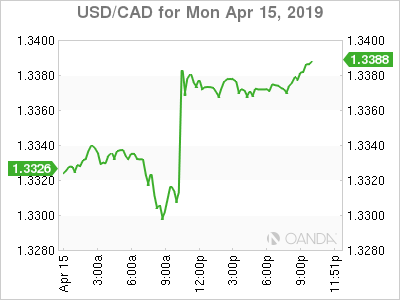
The US dollar provided lackluster moves to start the week against most of its trading partners except for the loonie. Early in New York, the dollar posted a mix reaction to the Empire State manufacturing survey. The headline posted a strong beat with a 10.1 reading, higher than the prior print of 3.1 and a beat of the 8.0 consensus. The index for future business conditions however fell to the 17.2 points to 12.4, the worst reading in over three years. The dollar finished the session little changed against the euro and yen.
The greenback posted its best gains against the loonie, as oil prices pulled back. The Australian dollar posted limited moves ahead of the release of the RBA’s policy minutes. The market has fully priced in a rate cut by the RBA by the end of the fourth quarter, tonight’s Minutes may provide a little more clarity on the RBA’s concerns to housing and global growth risks.
S&P 500
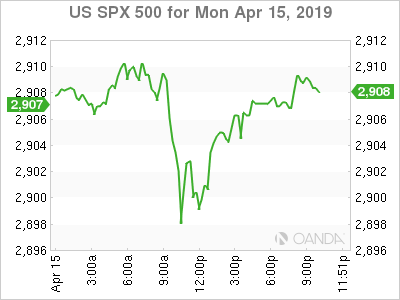
US stocks are unable to shake off a dismal earnings day from the banks. Both Goldman Sachs and Citigroup headlined today’s earnings disappointments, a sign that we could see the markets have correctly price in a weak first quarter. Financials could see some good results from the last couple rounds of rate hikes, but the outlook is like to be dampened by the Fed’s dovish stance.
Despite the recent rally with stocks, many investors are still on the sidelines and assessing the outlook for the US economy. So far, the consumer seems healthy and credit markets are fine, but that could change when hear more results from the rest of the financials and we get our first taste of technology earnings, with IBM, Taiwan Semiconductor, and Netflix results.
CAD
Conservatives are expected take back power in Alberta’s provincial election on Tuesday, April 16th. The United Conservatives are expected to beat the NDP (center-left) party and if turnout is strong, it could spell trouble for PM Trudeau for his election later in the Fall. Current polling shows Albertans are both frustrated they do not see their share of federal spending and are unhappy with Trudeau’s policies effect on Alberta’s oil.
If the United Conservative Party leader Jason Kenney wins, markets will closely watch if he quickly delivers on his promise to turn off gasoline taps, a move that would signal a spike with gas prices. The battle for the Trans Mountain pipeline will heighten between Alberta and British Colombia if Kenney wins. If Kenney also shuts down the government’s plan to deliver crude by rail, we could see a Western Canadian Select crude fall.
Oil
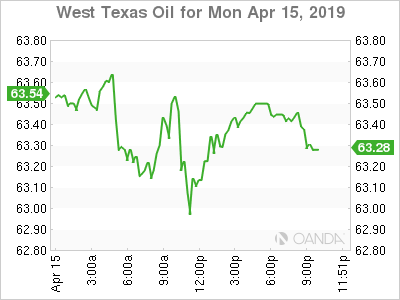
Crude prices are off to a soft start on global growth concerns and uncertainty on how much longer OPEC + will deliver their production cuts. Over the weekend, Russian Finance Minister Siluanov told TASS news agency, “There is a dilemma. What should we do with OPEC: should we lose the market, which is being occupied by the Americans, or quit the deal?”
This is a growing concern that Russia will not agree on extending production cuts and we could see them officially abandon it in the coming months. The Russians would be happy to return production back to normal even if it meant we saw Brent trade back closer to the mid-50s area.
A soft start to earnings season is also painting a weaker economy picture that is raising demand concerns for oil. First quarter results are expected to be soft and weaker outlooks are not likely to spark any demand-side arguments for higher oil.
The supply-side remains the key for higher oil in the short-term and any escalation in Libya could prove to be key. Much of the fighting is far from key oilfields and export terminals, but we still could see that affect production levels. If production stalls in Libya, we could see that provide a key catalyst to keep the rally going for oil prices.
Gold
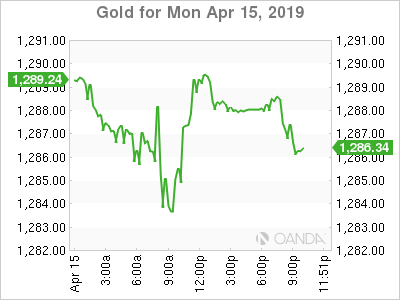
The precious metal remains vulnerable on trade optimism and on the nearing of major technical levels. The base case scenario on trade talks between China and the US is for an agreement to be reached in the next couple of months. Dismal earnings results appear to already be priced in, so we may need to see some disastrous outlooks for gold to catch a bid.
After failing to break out above $1,350, gold has made consistent lower highs and is now both testing the 50-day SMA and monthly lows. Selling pressures could accelerate on the break of $1,280, with the next major support level coming from the 200-day SMA, which is just above the $1,250 level.
Eco Data 4/16/19
[php_everywhere instance="1"]
Banks Drag Stocks Down on Slow Earnings Start
The holiday shortened trading week got off to a slow start after earnings duds from Citigroup and Goldman Sachs dragged down stocks. Traders focused on Goldman’s declining backlog and miss on revenue, while for Citigroup the big slide in stock trading revenue. Revenues declined for both banks, Citi had a slight beat with the earnings, while Goldman delivered a strong beat along with a dividend increase.
The S&P 500 index is down 0.2% in early trade, tentatively finding support from 2,900, which was key resistance last week. A sluggish start to earnings season does not support a run towards the record highs made last year. The banks will have difficulty surviving a low interest rate environment, so we may see other financial earnings results struggle to drive the sector higher.