Sample Category Title
EUR/CHF Weekly Outlook
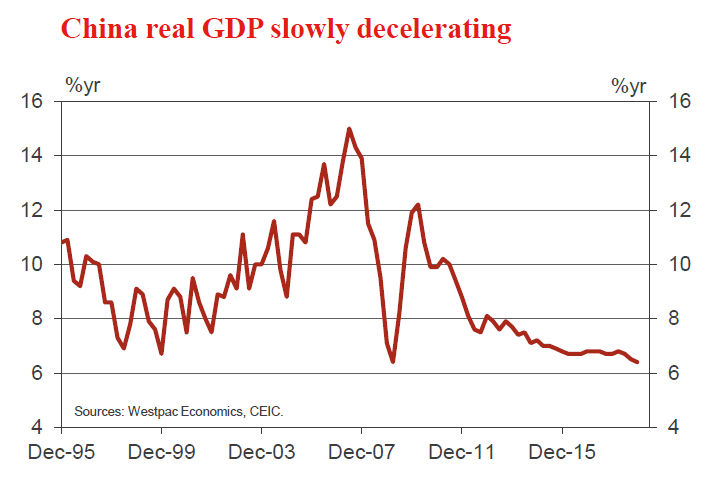
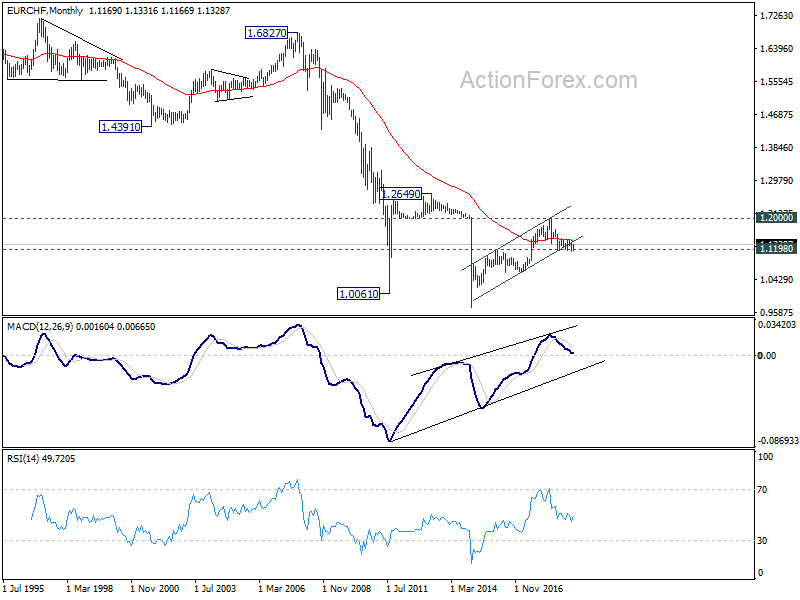
EUR/CHF's rise from 1.1162 accelerated to as high as 1.1331 last week. The development suggests that fall from 1.1444 has completed at 1.1162 already. Initial bias stays on the upside for 1.1384 resistance first. Break will target 1.1444 key resistance next. On the downside, however, break of 1.1254 will indicate completion of the rebound and turn bias back to the downside for 1.1162 low.
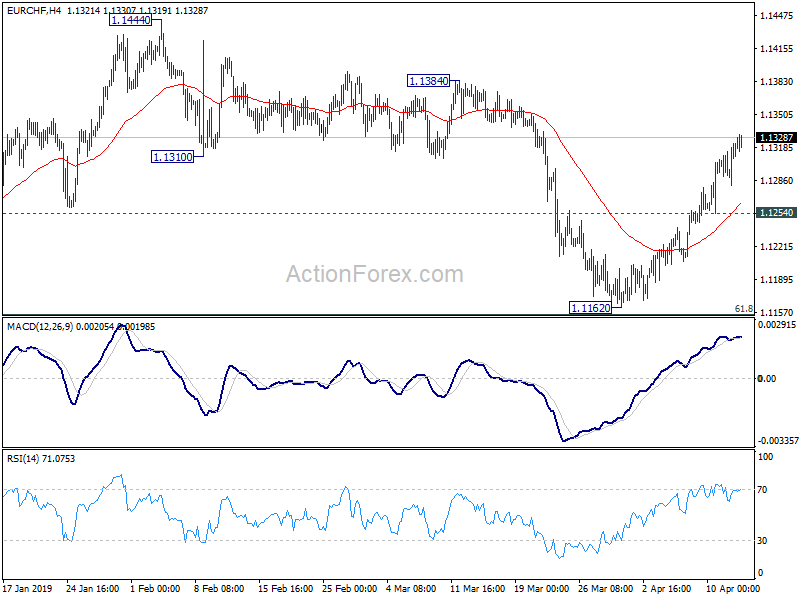
In the bigger picture, multiple rejection by 55 week EMA indicates medium term bearishness. Focus remains on 1.1154/98 support zone (2016 high and 61.8% retracement of 1.0629 to 1.2004 at 1.1154). Decisive break there will confirm resumption of whole down trend from 1.2004 and long term bearish reversal. EUR/CHF should then target 1.0629 support and below. This will now remain the favored case as long as 1.1444 resistance holds. However, decisive break of 1.1444 will indicate completion of fall from 1.2004 and turn medium term outlook bullish.
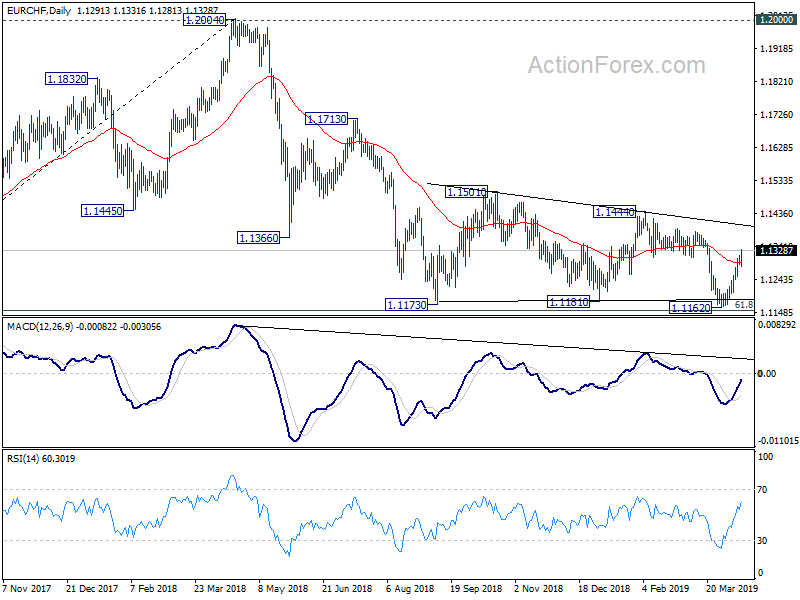
In the long term picture, the current development argues that long term up trend has completed at 1.2004 after rejection of 1.2 key resistance. Sustained break of 1.1198 support will confirm this bearish case and target 1.0629 and below.
Summary 4/15 – 4/19
Monday, Apr 15, 2019
[php_everywhere instance="1"]
Tuesday, Apr 16, 2019
[php_everywhere instance="2"]
Wednesday, Apr 17, 2019
[php_everywhere instance="3"]
Thursday, Apr 18, 2019
[php_everywhere instance="4"]
Friday, Apr 19, 2019
[php_everywhere instance="5"]
China Weekly Letter: More Signs of Recovery, Roadblock Cleared for Trade Deal
- Recovery signs continue as exports, car sales, credit and money growth all revive in March
- IMF lifts the 2019 growth forecast for China from 6.2% to 6.3%
- US and China clear an important roadblock in trade talks as the two sides agree on an enforcement mechanism
- March data surprise to the upside across the board
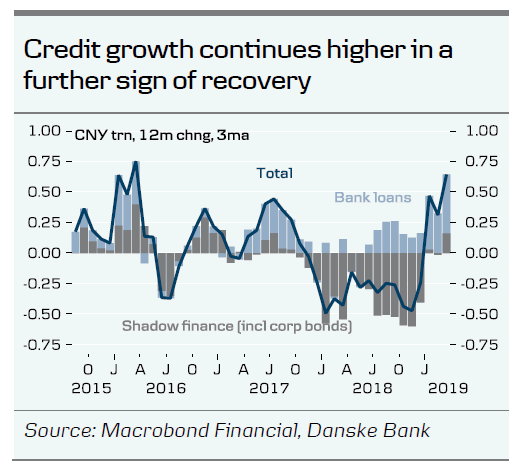
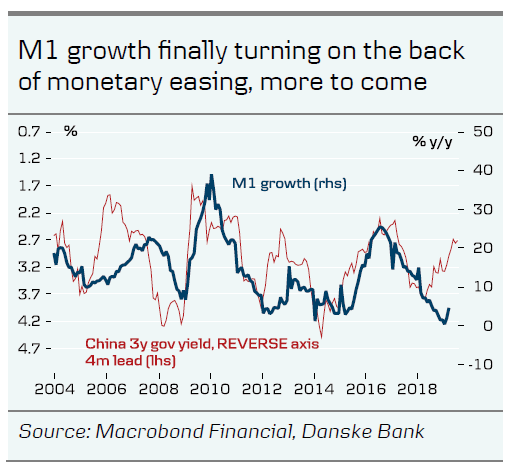
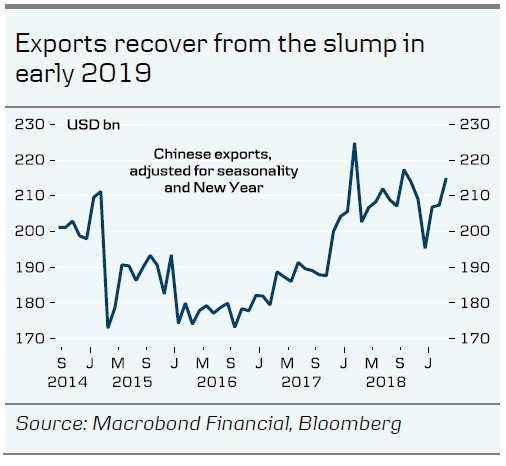
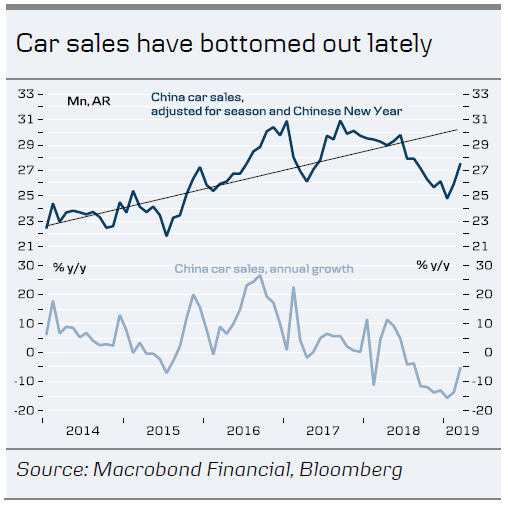
The positive news flow on the Chinese economy continued this week . Credit growth moved higher in March and grew at the strongest pace since 2015 (see chart). Both bank lending and shadow finance contributed to the increase. M1 growth moved higher to 4.6% y/y in March from 3.0% y/y in February. Exports rebounded as well, beating expectations with a rise of 14.2% in March (consensus 6.3% y/y). Finally car sales edged higher, breaking a string of negative surprises (see chart next page).
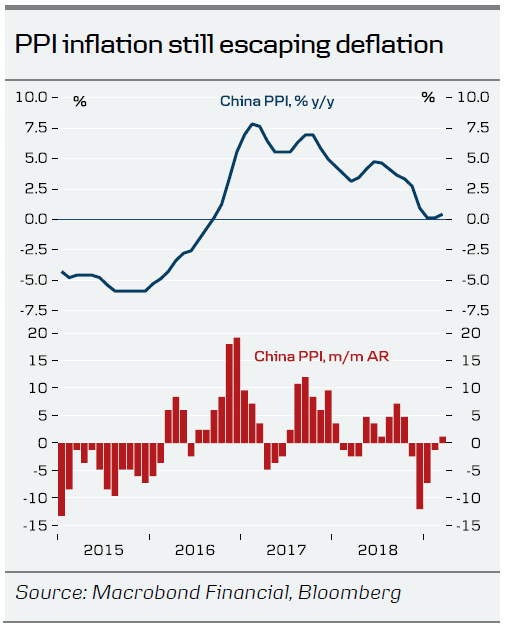
On the inflation side producer price inflation increased on a monthly basis after declining for four months in a row. It generally reflects the rise in industrial commodity prices lately but is positive for industrial profits.
The IMF released its spring forecasts this week. While growth was revised lower for most countries, China was the outlier as the IMF lifted the forecast for 2019 to 6.3% from 6.2%. The revision was based on changed assumptions for US tariffs. The tariff the rate on USD200bn of Chinese goods was kept at 10% as part of the ceasefire deal instead of rising to 25% as assumed in the previous forecast. For 2020 the IMF estimate was lowered to 6.1% from 6.2%.
Comment. The string of positive March numbers confirm the recovery signal from PMIs and metal markets . There may be some overshooting in March as it is difficult to correct fully for the Chinese New Year effect. But given how broad the improvement is across exports, industry, service and consumer numbers it is getting more likely that a gradual recovery has begun. Stimulus is kicking in and uncertainty from trade tensions has started to ebb. We get Q1 GDP growth next week, which will probably show further slowing to 6.3% y/y from 6.4% y/y in Q4. But we expect this to be the bottom in this cycle.
Agreement on enforcement mechanism a milestone in talks
US and China continue to talk ' around the clock' according to US Treasury Secretary Stephen Mnuchin. In an interview with CNBC on Wednesday, he said that trade talks were ' very productive' and that the US and China had ' pretty much agreed on an enforcement mechanism' . According to Mnuchin, the two sides will establish enforcement offices that will deal with the ongoing matters.
On the issue of whether tariffs would stay in place, he would not comment on which would stay and which would go. This revealed though that some tariffs will likely be removed.
On the timing and scope of a deal, Mnuchin stated that they are working on a 150-page document and that it is more important to get the right deal than to set an 'arbitrary deadline'. If a deal is done, Mnuchin expressed that 'this will be the most significant changes to the economic relationship between US and China in the last 40 years' and that the opening of the Chinese economy will give 'tremendous opportunities' for US companies.
Comment. The enforcement mechanism has been one of the key obstacles in the trade talks and the agreement in this area is a big step closer to a deal, see SCMP 11 April for more colour on this. The main sticking point now seems to be how many tariffs will stay in place and how many will be removed. Trump said two weeks ago that all tariffs would stay on for some time. However, China is unlikely to accept this and Mnuchin's comments suggest that the US is ready to remove some of the tariffs. The timing of a deal is still uncertain but our best guess right now is that a deal will emerge within 4-6 weeks.
Other selected China news of the week
The improving data have pushed up bond yields as the expectation of further monetary stimulus is being scaled back. Stock markets have had a volatile week but the pullbacks in the market tend to be quite short-lived despite already strong gains this year. It suggests to us that there is still appetite to buy into Chinese equities on the expectation of a recovery and that the increasing weight in MSCI will drive inflows into the A-share market.
USD/CNY has moved sideways in a very tight range around 6.71 since the middle of February. It could very well be a deliberate attempt by China to keep the currency stable to underpin the positive spirit in the trade talks.
China's Premier Li Keqiang promised further reforms at the EU-China Summit this week, see SCMP 10 April. 'When we say it, we have got to do it' he said. The summit ended with a joint statement, posted on the European Council website, which among other things stated that 'the high level of ambition will be reflected in substantially improved market access, the elimination of discriminatory requirements and practices affecting foreign investors'.
China and Malaysia agree to restart the construction of the East Coast Rail Line, a part of China's Belt and Road Initiative, see Reuters 12 April. The project was put on hold by the 93-year old Prime Minister Mahathir Mohamad after he regained power in May. The two sides agreed to cut the cost to USD10.7bn from originally close to USD16bn.
For those interested in tech and AI this article on visualcapitalist.com has an excellent infographic on the development within AI with lots of details on the global AI landscape.
Weekly Economic and Financial Commentary: No Need for the Fed to Budge
U.S. Review
No Need for the Fed to Budge
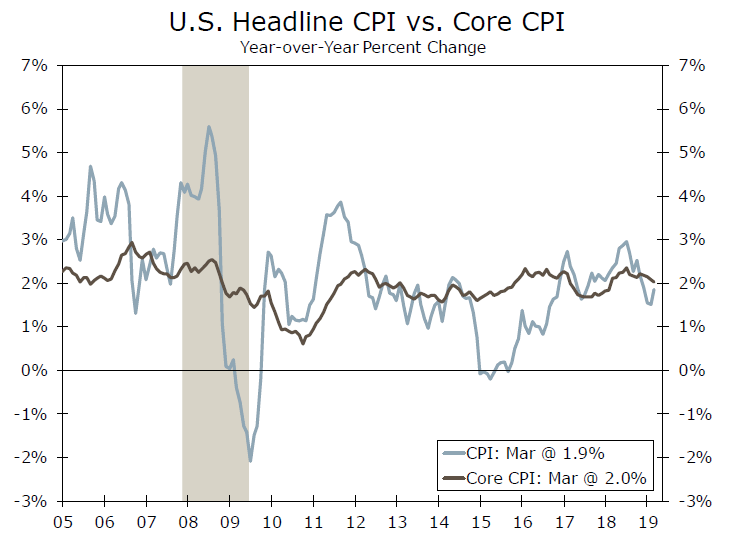
- Inflation picked up in March, with the CPI rising 0.4% and strengthening to 1.9% yr/yr. The trend in inflation remains tame, however, with consumer prices ex-food and energy edging down to 2.0% on a year-ago basis.
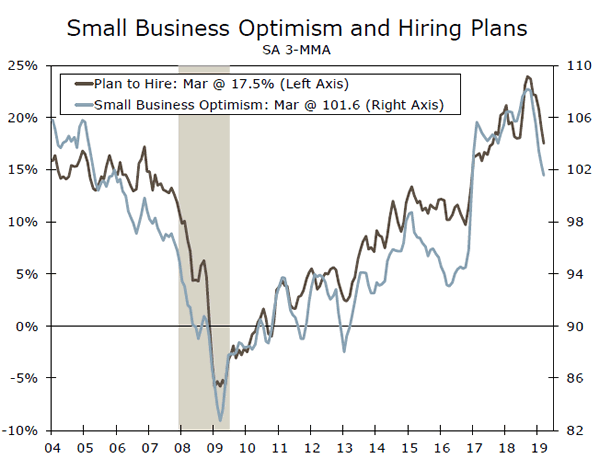
- Small business optimism was little changed in March and remains noticeably below last year's levels.
- Job openings fell sharply in February, while initial jobless claims fell to a new cycle low the first week of April. The late timing of Easter may be holding down the latest claims data, leading us to believe that the overall pace of hiring is likely to remain slower than last year.
No Need for the Fed to Budge
Incoming data this week showed that U.S. growth continues to hold up, although it is unlikely to be on the brink of a significant reacceleration. Inflation remains near 2%, while the pace of the labor market's improvement is easing on balance. Together, nothing this week suggested that the Fed may need to adjust its "patient" policy stance any time soon.
Small business optimism was virtually unchanged in March. Despite the stock market having recovered from its end-of-year rough patch and the government shutdown now firmly in the rearview mirror, the index remains noticeably below the current cycle's high reached in August. The lack of a rebound suggests that small businesses are feeling the economy's recent slowdown. Small businesses' expectations for sales have come down since the fourth quarter, and fewer respondents indicate now is a good time to expand.
Hiring plans have come down as a result, although difficulty finding workers in such a tight labor market may on its own be reducing expansion plans. The availability of quality labor remains the most frequently cited problem among small businesses. Even as hiring plans have been pared back, a record share of firms report having at least one job that is hard to fill.
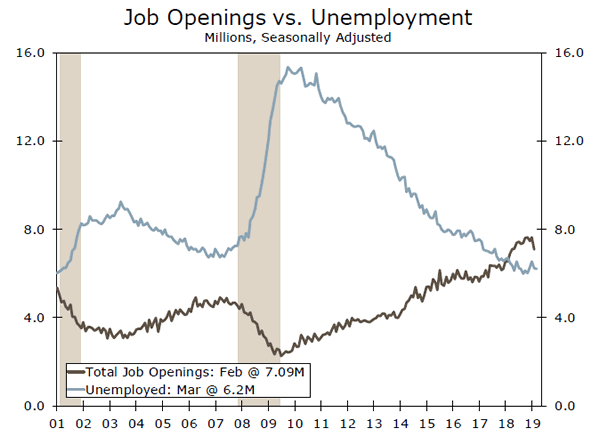
Other data released this week also suggest the labor market remains tight, but point to a more moderate pace of hiring ahead. Total job openings continue to outnumber unemployed workers, but the vacancy rate fell to a one-year low in February. Job openings can bounce around from month to month and are subject to big revisions, so the 538K drop in openings in February does not unequivocally signal a collapse in demand for workers. It does, however, offer another sign that the labor market may be nearing an inflection point, as temporary hiring has also slowed and consumers' views of the labor market have deteriorated slightly.
Jobless claims have been better in recent weeks, with initial filings falling to a 50-year. The late timing of Easter this year may be flattering the recent figures, but the multi-decade low suggests at least that the slowdown in hiring is likely to be only modest.
At the same time there are tentative signs of the labor market softening, consumers are also facing a bit more inflation. The consumer price index rose 0.4% in March, its largest gain in more than a year. Higher prices at the gas pump were partly to blame, but consumers also saw their grocery bills increase. Consumer price inflation is rising again on a year-ago basis and contributing to slower growth in real wages.
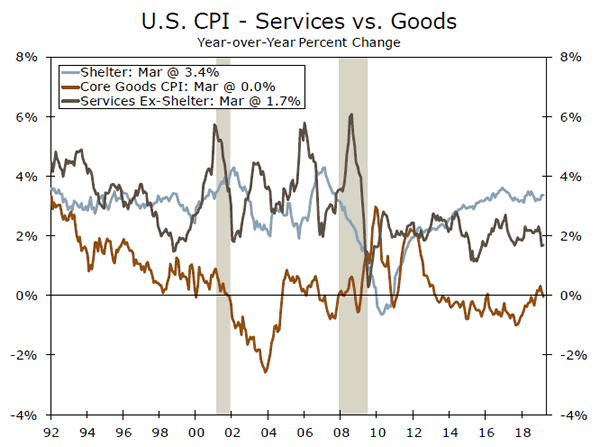
The overall trend in inflation, however, remains tame. A soft gain in March core inflation pushed core CPI down to 2.0% yr/yr. Prices for core goods are falling again, although the 0.2% drop in March looks to have been depressed by a BLS new data collection procedure. Services inflation continues to hold up better. Shelter costs rose strongly again in March, while services inflation exshelter remains within its recent band. With inflation expectations in check and growth slowing back to trend, we see little risk of inflation moving meaningfully above 2% this year.
U.S. Outlook
Industrial Production • Tuesday
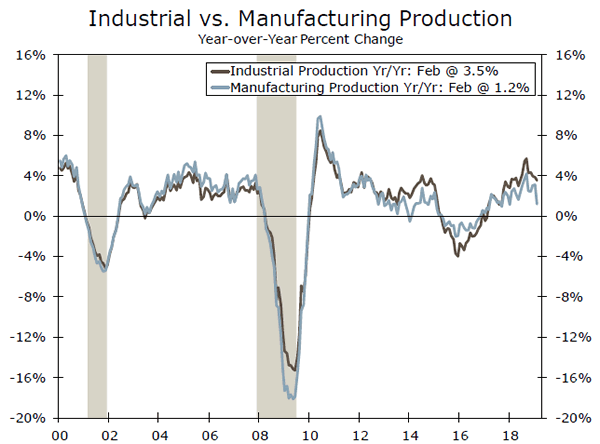
Manufacturing has lost momentum this year, as the global slowdown and trade headwinds are becoming more evident in the sector. Manufacturers shed 6,000 jobs in March—the first cut in a little over a year and a half. The decline in employment and mixed PMI readings for the month suggest it is unlikely we will see a manufacturing rebound in Tuesday's industrial production release.
Production elsewhere will likely be mixed. The unseasonably cold weather across the nation in March likely boosted utilities output again that month. But the decline in average hours worked in the mining sector may hold back a significant gain in mining output.
We expect to see a slight bounce in March, but production growth has downshifted. The ISM index is lower on trend in recent months and durable goods orders through February suggest equipment spending is set for a weak outturn in the first quarter.
Previous: 0.1% Wells Fargo: 0.2% Consensus: 0.2% (Month-over-Month)
Retail Sales • Wednesday
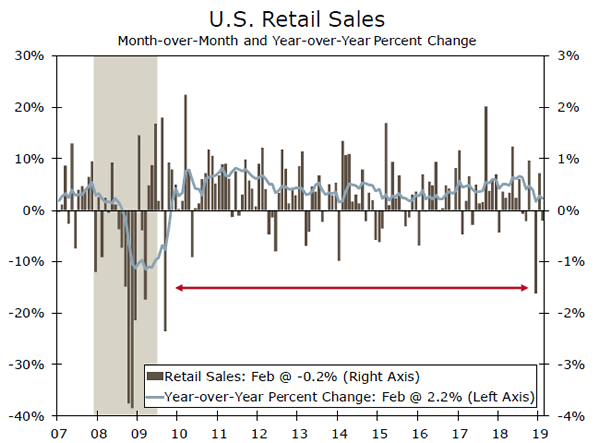
In what has been a wonky few months for consumer data, we expect retail sales to have regained some steady footing in March. The 1.6% drop in December sales caused nominal spending on goods to enter the first quarter on a weak note. Sales continued to struggle at the start of this year—rebounding 0.7% in January, but edging down 0.2% in February.
Underlying fundamentals remain supportive of strong growth in spending. The labor market is robust, household balance sheets are in generally good shape and indices of consumer confidence remain at high levels.
On that basis, we look for retail sales to have risen 0.9% in March. If sales disappoint again, however, economic growth will likely be weaker than the 1.8% annualized rate we have penciled in for the first quarter.
Previous: -0.2% Wells Fargo: 0.9% Consensus: 0.9% (Month-over-Month)
Housing Starts • Friday
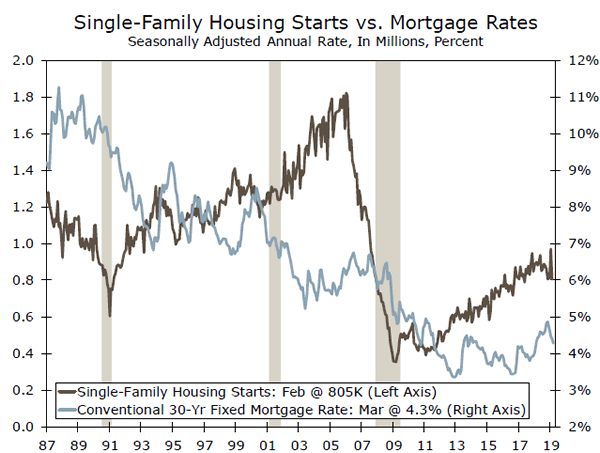
Fear that the Fed would continue to hike interest rates led to a weak outturn for housing activity at the end of last year. Affordability concerns deterred potential buyers from making a purchase, and builders slashed home prices to shed inventories. With decreased demand and an uncertain outlook, starts weakened.
The Fed's pivot on monetary policy appears to have arrested the slide in housing starts but has not reversed it. Home prices and mortgage rates have both trended lower and remain below their year-ago levels. Mortgage applications surged in March, suggesting the cooling in prices is driving greater demand, while builder confidence has also rebounded from last year's lows.
We should see a modest increase in March housing starts, as recent conditions suggest a more upbeat housing market headed into the spring selling season.
Previous: 1,162K Wells Fargo: 1,228K Consensus: 1,230K
Global Review
Global Growth: Take the Good with the Bad
- The past week has been a mixed bag on the global front, but one which might be considered an improvement considering the pervasive pessimism that has prevailed in recent weeks.
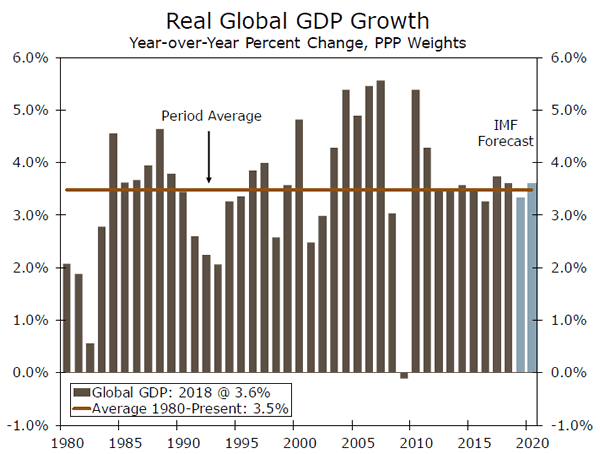
- Starting on a subdued note, the IMF cut its 2019 GDP growth forecast to 3.3%, which would be the slowest growth since 2016.
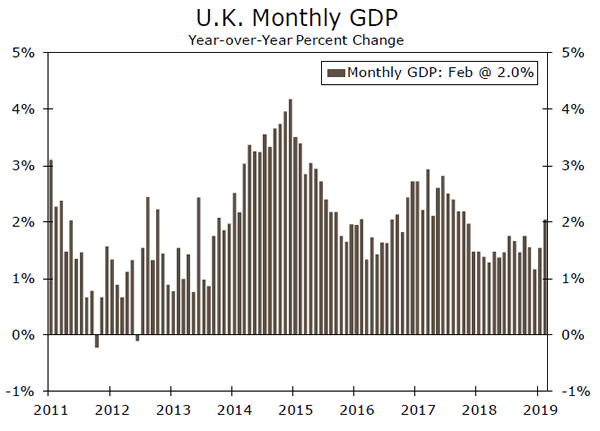
- The U.K news was better, with February services and industrial activity both rising, although an extension to the U.K.'s Brexit deadline could still growth slow going forward. Eurozone industrial output was also less bad than feared, and potentially consistent with an increase in Q1 industrial activity.
The U.K.'s Brexit Saga Continues
It has been another week and another missed deadline for U.K. politicians as they try to map out a path for the U.K.'s exit from the European Union. In early April, U.K. PM May's Brexit proposal was defeated in Parliament for a third time. At the same time, Parliament has been unable to garner a majority for an alternative course of action, while talks between May and opposition leader Jeremy Corbyn have not led to any breakthrough. Without a credible U.K. path forward, the other 27 European Union countries granted the U.K an extension of the Article 50 deadline until October 31. While that might be a short term positive in that it removes the immediate risk of a no-deal Brexit, it is potentially a longer-term negative given that uncertainty about the U.K.'s future relationship with the other European Union countries will persist.
The early part of 2019 has been notable for relativity resilient growth, even against this backdrop of Brexit uncertainty. U.K. February GDP rose 0.2% month-over-month, a solid result on the back of a 0.5% gain in January. Service sector output rose 0.1%, while industrial production rose 0.6%. That said, there are signs from the survey data that part of the early 2019 growth reflects stockpiling of inventories. Especially in the context of a long Brexit extension and the resultant and ongoing uncertainty, the pace of U.K. economic growth is likely to slow going forward.
ECB Steady in April
After a significant policy shift at its March monetary policy meeting, the European Central Bank's April announcement was a much tamer affair. The ECB held its policy interest rates steady and made no changes to its forward guidance, saying that interest rates would remain at their present low levels at least through the end of this year. The ECB also provided no extra details—for now— surrounding its new round of targeted long-term loans, and said that the risks around the Eurozone growth outlook remain tilted towards the downside.
Since the ECB's March meeting there have been some tentative signs of growth stabilization. The Eurozone services PMI rose in March, although the manufacturing PMI remains in contraction territory. That said, even though Eurozone industrial production fell 0.2% month-over-month in February, industrial activity for the first two months of the year is up 0.8% compared to its Q4 level.
Modestly Positive News From Latin America
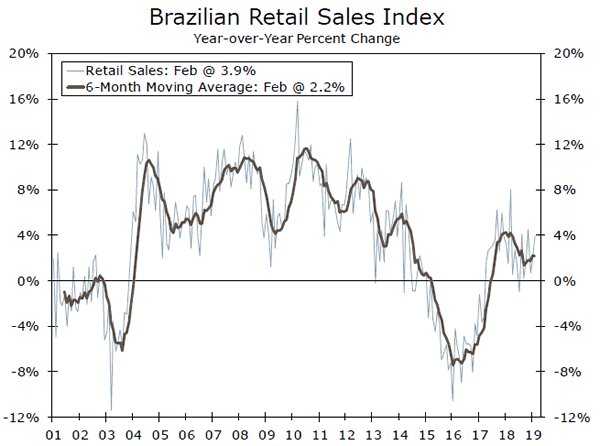
The past week saw some mildly encouraging news from Latin America, although the region's economies still face longer term challenges. Brazil's February retail sales firmed more than forecast to 3.9% year-over-year, services activity rose 3.8% and the March CPI also quickened to 4.6% year-over-year. In Mexico, January fixed investment rose 1.6% year-over-year but February industrial production fell 0.8%, while March CPI inflation was well behaved, edging higher to 4.0%. In Brazil, longer term growth prospects remain heavily dependent on pension reform and fiscal consolidation, while in Mexico policy uncertainty remains a potential medium-term growth negative.

Global Outlook
China GDP • Wednesday
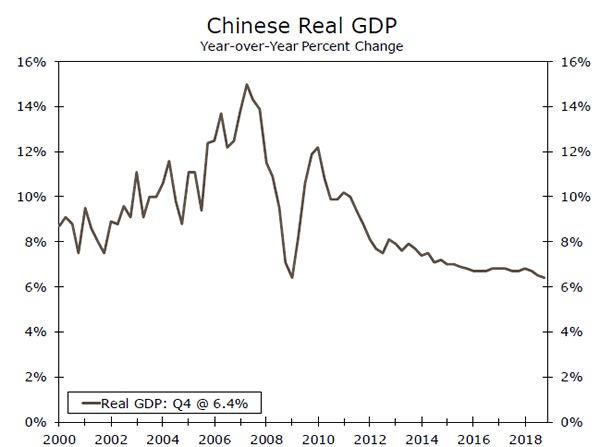
China rounds out its first quarter figures with the release of a comprehensive set of activity data in the coming week. Overall, we expect GDP growth may have held steady at 6.4% year-over-year, although the consensus sees a further slowing to 6.3%. Generally, service sector growth has held up better than manufacturing growth, a trend we think likely continued in the first quarter.
In addition to assessing the extent of the overall Q1 slowdown, there will also be much interest in whether there are any signs of stabilization in activity, hinted at by some encouraging readings for the March manufacturing and services PMIs. The consensus forecast is that these "soft signals" could translate over to the hard data. March retail sales are expected to rise 8.4% year-over-year, while industrial production is expected to rise by 6.0%—both outcomes would be stronger than the gains reported for the January-February period.
Previous: 6.4% Wells Fargo: 6.4% Consensus: 6.3% (Year-over-Year)
Canada CPI • Wednesday
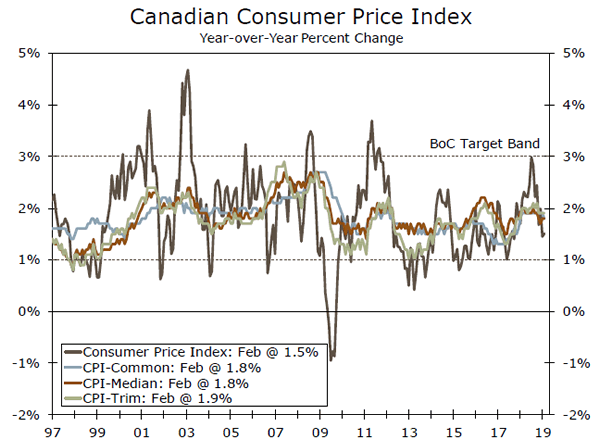
Canadian inflation trends have been benign in recent months and probably remained so in March, suggesting the Bank of Canada will likely keep policy interest rates steady for some time. The headline CPI should quicken to 1.8% year-over-year, as a recovery in oil prices in recent months should be reflected in energy prices and overall CPI trends. Services prices remained contained however, while the central bank core CPI inflation measures should remain modestly below the 2% inflation target.
Next week's activity data and confidence surveys are also unlikely to offer much reason for the Bank of Canada to contemplate a change in interest rates for now, with February retail sales among the more notable data releases. The Bank of Canada's Q1 Business Outlook Survey is also released—analysts will watch for an improvement in the future sales balance, after that index fell to -1 in Q4-2018.
Previous: 1.5% Wells Fargo: 1.8% (Year-over-Year)
U.K. Retail Sales • Thursday
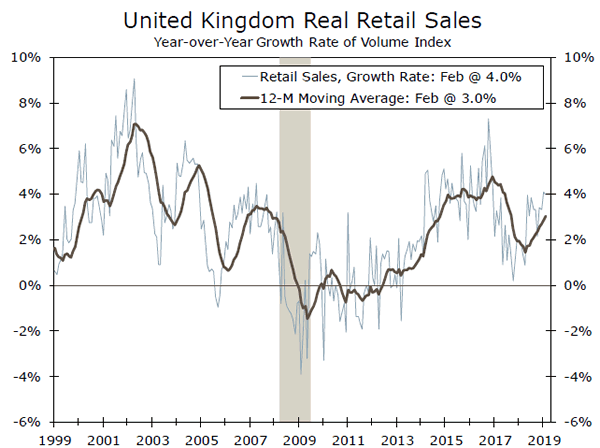
Despite the Brexit uncertainty that continues to hang over the U.K. economy, growth has remained reasonably solid during the early part of 2019. While that may in part be due to inventory stockpiling ahead of the U.K.'s eventual exit from the European Union, we note that consumer spending trends have been quite steady in the early part of this year. After increases in both January and February, the consensus expects some payback, with retail sales forecast to decline 0.3% month-over-month in March. That said, overall gains in retail sales and industrial production in recent months mean we think that Q1 GDP is on track for growth of 0.5% quarter-over-quarter.
Next week we also see the release of price and wage data. Inflation likely remain benign in March, with the CPI expected to rise 2.0% year-over-year and the core CPI expected to rise 1.9%. Look for wage trends to remain sturdy, with average weekly earnings expected to rise 3.5% year-over-year in the three months through February.
Previous: 0.4% Consensus: -0.3% (Month-over-Month)
Point of View
Interest Rate Watch
Minutes Show Fed to Remain on Hold
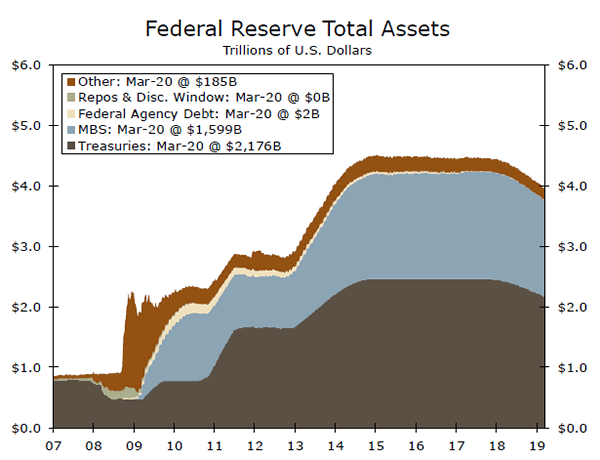
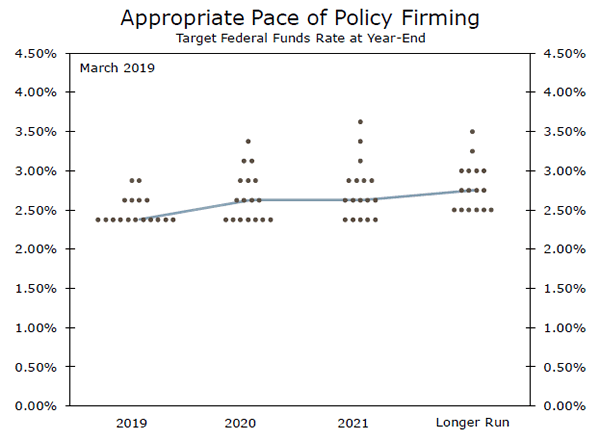
The minutes of the March 20 meeting of the Federal Open Market Committee (FOMC) were released this week. That meeting was notable because the "dot plot" that was released at the conclusion of the meeting showed that most committee members thought that rates would be on hold through the end of the year. (In December, the dot plot indicated that most FOMC members thought that rates would be at least 50 bps higher at the end of 2019.) In addition, the FOMC decided at its March 20 meeting on concrete steps to bring the shrinking of the Fed's balance sheet, which currently stands at $3.9 trillion, to an end in September 2019 (top chart).
The minutes of the March 20 meeting made it clear that the committee is in no hurry to raise the fed funds rate from its current range of 2.25% to 2.50%, at least not for the foreseeable future. However, none of the 17 committee members who attended the March 20 meeting projected that the range for the fed funds rate would be lower at the end of 2019 than it is now (middle chart). The minutes said that the committee believes that sustained economic expansion, continued strength in the labor market and inflation near the FOMC's objective of 2% are "the most likely outcomes for the U.S. economy in the period ahead." In our view, incoming economic data would need to show that 2019 real GDP growth will undershoot the 2.1% rate (Q4/Q4) that the FOMC currently projects and/or inflation will come in significantly lower than the 2% objective for the committee to cut rates in coming months.
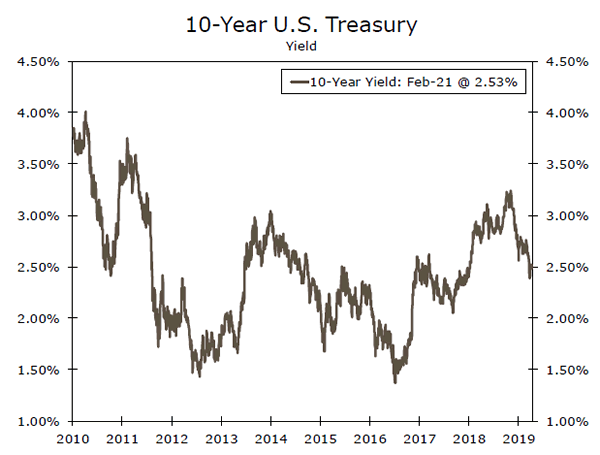
Pricing in the bond market at present shows that market participants believe there is a one-in-three chance that the Fed cuts rates by the September FOMC meeting. That probability rises to a bit more than 50% by the December policy meeting. If our view that the FOMC will remain in hold throughout 2019 is correct, then the back end of the yield curve should rise as the market prices out the expected rate cut. As we write, the yield on the 10-year Treasury security is roughly 2.54% (bottom chart). We look for this yield to drift up to 2.70% by the end of the year.
Credit Market Insights
Consumer Credit Growth Stabilizes
U.S. consumer debt growth eased in February to $15.2B from $17.7B, below market expectations. Revolving credit including credit card borrowing reached a new high of $1.06T, climbing $3B from the previous month. Non-revolving credit, which includes educational loans and automobiles, increased only $12.2B, after rising $15.1B in January.
The data suggest that consumer borrowing remains strong due to higher wages and job growth. Household debt ticked up in the fourth quarter of 2018, with mortgage balances almost unchanged from the previous quarter. The total amount of outstanding student loans increased $15B over the fourth quarter, reaching $1.46T. Student loan debt is now the second highest consumer debt category, behind mortgage debt, with over 44 million borrowers of all demographics and age groups. 11.4% of aggregate student debt was 90+ days delinquent in Q4-2018, a slight improvement from the previous quarter. The growth in student loan debt remains a concern among analysts, as it represents one of the country's most widespread financial burdens.
On balance, household balance sheets remain generally healthy and consumer fundamentals remain strong. That is, despite the recent soft patch in consumer spending, consumer confidence remains high. As we expect the first quarter lull in consumption is only temporary we do not see a large pull-back in borrowing.
Topic of the Week
The MAX Impact of Boeing's 737 Problem
Boeing's cut to production of the 737 line of aircraft is not an all-out stop but rather a scaling back by about 20% of its earlier production rate. Still, the production cuts are expected to hold down GDP slightly, while the grounding of the 737-MAX is expected to generate bigger waves for equipment spending, exports and inventories over the remainder of the year.
Prior to scaling back, Boeing stated it was planning to produce 52 737 aircraft per month, and the 737 MAX model was expected to account for roughly 90% of 737 deliveries in 2019. Boeing expected to raise production to 57 aircraft per month in June 2019. The production cuts take that figure down to 42 aircrafts per month by mid-April. At an annualized pace, adjusted for inflation, the decreased production is expected to subtract about $9 billion from output in the second quarter, or shave about 0.2 percentage points from Q2 GDP growth. If, as we expect, Boeing provides a fix to the 737 MAX system and production ramps back up in the third quarter, a catch-up boost of a similar magnitude would occur.
In the meantime, the current halt in deliveries is expected to weigh on equipment spending and exports. Without receipt of the aircraft and corresponding payment, purchases that were expected in the second quarter by U.S. and foreign buyers are to be postponed. Inventories are set to pile up, however, which should largely offset the near-term drop in spending and keep the impact to topline GDP minimal.
The precise impact to GDP will depend on how long Boeing produces the 737 at the lower rate and how long it takes various aviation authorities around the world to give the 737-MAX the all-clear to resume flying. Our modeling of the economic impact suggests that Q2 GDP growth will be held back but a catch-up boost will materialize either in the third quarter or over subsequent quarters, depending on how long it takes for the backlog in shipments to run its course.
Forward Guidance: Data Deluge Will Help Set Growth Expectations
Data deluge will help set growth expectations – but the Q1 Business Outlook Survey to take centre stage
A heavy flow of economic releases will help set the tone for near-term growth expectations in Canada. But the Bank of Canada’s abrupt shift to the side-lines in terms of the interest rate hiking cycle in recent months probably had as much to do with perceived global trade risks and benign inflation trends as domestic growth concerns. On the former, our read is that Canadian businesses have been relatively successful to date at adapting to tariffs levied bilaterally between the U.S. and Canada. And China’s effective ban on Canadian canola imports will probably be less disruptive than might be initially feared. International trade numbers have looked okay if unspectacular – non-energy export volumes were up ~3% from a year ago over the three months ending in January. We look for a smaller February trade deficit to be reported with higher oil prices boosting exports and a big increase in imports of aircraft in January not expected to be repeated.
The larger concern is still the extent to which trade uncertainty is weighing on business confidence and investment. In that context, economic data will be overshadowed by the release of the Bank of Canada’s Q1 Business Outlook Survey on Monday. Overall business sentiment has held up relatively well in recent quarters. And comments from Governor Poloz on April 1st (presumably after interviews for the BOS had already been completed) hinted that near-term M&E investment intentions are still constructive. There is nonetheless probably room for broader business sentiment to soften relative to earlier levels. Inflation expectations are likely to remain benign – and that should be confirmed by CPI data out on Wednesday. Headline inflation probably ticked higher on an energy price increase in March, but we expect ‘core’ measures of underlying trends to hold firmly at slightly below the BoC’s 2% inflation target. In other words, not so low as to argue lower interest rates are needed but also not showing any risk of jumping higher to put pressure on the central bank to hike further.
In other data reports, an earlier-reported tick up in auto sales suggests that bad weather was less of a restraining factor on Canadian consumer purchases in February than on housing investment (recall, home resales and starts fell sharply in February.) But underlying household spending trends still appear to be slowing. And we look for manufacturing sales to edge down 0.1% after a 1.0% increase in January. All-in-all, the data should still point to slow GDP growth around 1% in Q1 – but with much of the softness still attributable to oil production cuts and bad weather effects that should prove transitory.
And the US economy still looks like it’s doing okay. The industrial sector is still growing and an expected jump in retail sales in March should further ease concerns about the underlying pace of US household spending growth. Given that backdrop, there is still room for Canada’s non-energy exports to continue to grind higher going forward.
The Weekly Bottom Line: A Quiet Week Puts All Eyes On Ontario
U.S. Highlights
- Inflation pressures remain benign, as headline consumer prices rose just 1.9% year-on-year in March, and core prices came in at 2.0%. These numbers reinforce the Fed's 'patience' stance that was reiterated in its March FOMC minutes.
- US-China trade negotiations are progressing with China appearing to make further concessions on tech-related issues, and the two sides agreeing on an enforcement mechanism.
- Trade talks with the EU, however, are set to become more contentious as the U.S. threatens tariffs on EU imports following a ruling from the WTO on a longstanding disagreement.
Canadian Highlights
- Canadian markets were fairly quiet this week, reflecting the lack of domestic catalysts.
- The little economic data we got was housing-focused. Starts recovered in March, but are down markedly for the quarter as a whole, while building permits fell for a second month in February. Signs point to a sector still in a soft patch.
- Ontario's new government laid out its highly anticipated first budget. The planned path back to balance will take five years and hinges largely on expenditure control, holding program spending growth to 1% per year.
U.S. - Not too Hot, Not Too Cold, (Almost) Just Right
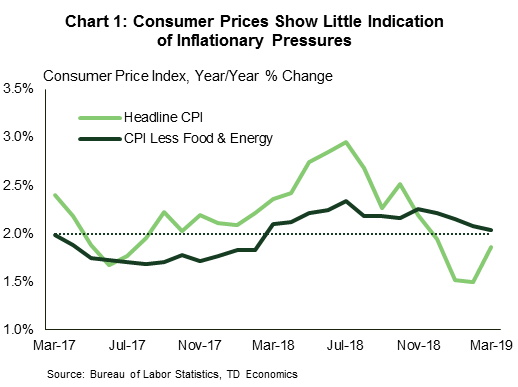
The U.S. economy continues to enjoy its Goldilocks moment – at least with respect to inflation. Consumer prices rose 1.9% year-on-year in March, up from 1.5% in February, largely driven by increases in energy prices (Chart 1). Core inflation came in at 2.0%, and while not the Fed's preferred metric, is consistent with price pressures running neither 'too high' nor 'too low'.
Several months of muted inflation readings have strengthened the Fed's decision to keep rates where they are. Minutes of the March meeting showed that board members saw little in the data to prompt a shift in policy. This rhetoric is expected to continue through the end of 2019, with signs of an improving labor market balanced against risks to growth from a struggling global economy. The Fed's European counterpart (the ECB) on the other hand, while leaving rates unchanged this week, signaled that there could be substantive changes to monetary policy at their next meeting in June. With anemic growth among member countries and lingering policy uncertainty, it signalled a willingness to act to ensure a return of inflation to target and bolster the region's faltering growth.
On the trade front, relations with China seem to have taken a turn for the better, with talks between high-level officials ongoing. As cooler heads prevail in one trade negotiation however, disputes are heating up in another. The U.S. is threatening to impose tariffs on approximately $11 billion of EU imports. The threat comes after 14 years of litigation at the WTO over subsidies for European aircraft manufacturer Airbus, which America argues puts U.S. based Boeing at a disadvantage. The U.S. emphasizes that this move is independent of current ongoing trade talks with the bloc; but the timing could be seen as an attempt to gain leverage in those negotiations.
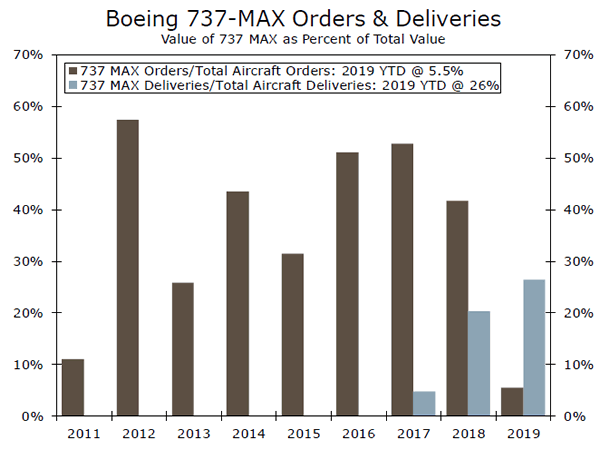
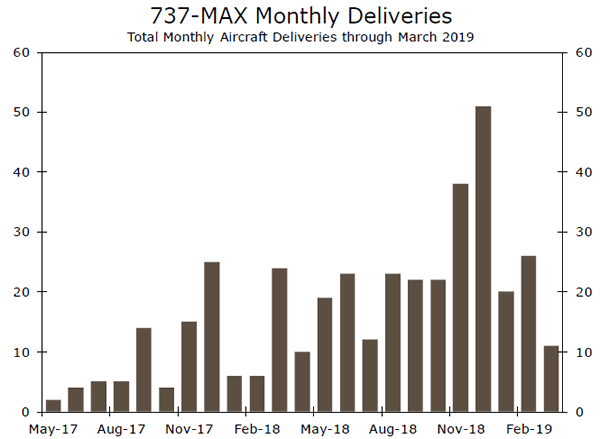
Boeing for its part continues to deal with fallout from the grounding of its 737 MAX airliners. There were no commercial orders for the product in March, the first time this has occurred since May 2012. Boeing will reduce production of the jet starting mid-April, while it works to fix flaws with the model which resulted in two fatal crashes. If the production cut lasts to the end of the quarter, they could shave 0.1 to 0.2 percentage points off Q2 GDP growth.
Internationally, Britain's attempt to leave the EU continues to push past deadlines. This week the EU granted another flexible extension to October 31st for the UK parliament to agree to a deal. The gesture, however, came with strings attached, as the UK will have to hold EU parliamentary elections if they have not ratified the deal by the end of May or risk exiting without a deal on June 1st.
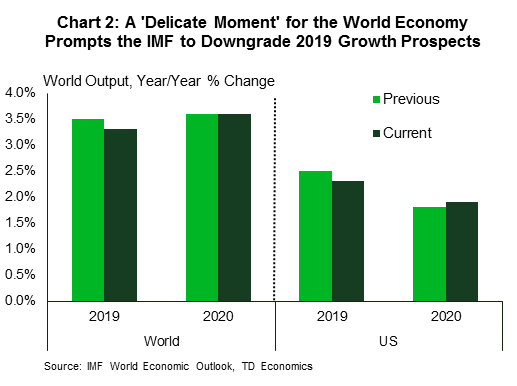
Given these and other uncertainties, the IMF downgraded projections for global growth in 2019 to 3.3%, citing ongoing trade tensions and declining confidence (Chart 2). This brings their forecast in line with our own view published in March. Growth in 2020 is expected to rebound to 3.6%, slightly above our expectation for 3.5% growth.
Canada - A Quiet Week Puts All Eyes On Ontario
It was a relatively quiet week. The most notable event in markets was the Canadian government 10 year bond yield rising back above the overnight rate for the first time in a month, ending the recent episode of yield curve inversion. Crude oil prices saw some volatility through the week, but look set to end it a bit higher than where they began. The economic calendar was thin, with only a few bits of new housing data to slake analysts' thirst. Perhaps the biggest event was the first budget from Ontario's PC party.
The Ontario budget was bound to be more closely watched than normal given the challenging fiscal position – notably a 2018-2019 budget deficit not too different from the Federal gap, and a commitment to returning to balance. The plan to meet that promise is set to take five years, and, as discussed in our commentary, rests largely on spending restraint. Program spending growth will be held to roughly 1% per year, while revenue growth is forecast to average around 3%. Running revenue growth above spending should gradually shrink the deficit, with a small surplus predicted for 2023-24. Net debt-to-GDP is forecast to rise a bit further in the near term, before bending lower, hitting 38.6% in the final year of the plan, versus 40.2% today.
On the revenue side, the major near-term change is the introduction of a refundable childcare tax credit. The corporate tax rate was left untouched, with the previously-announced accelerated capital cost allowance standing in its place. A cut to the middle income tax rate is still planned, but is forecast for year three of the mandate. Expenditure controls are notable in the education and post-secondary spending categories, with several zero-growth years forecast for the former, and an outright decline this fiscal year for the latter. Healthcare spending is to be held to a sub-inflation pace of 1.6% per year, less than half its recent trend. All told, the budget provides restraint, but with an approach that should have only a modest negative impact on the province's economic growth outlook.
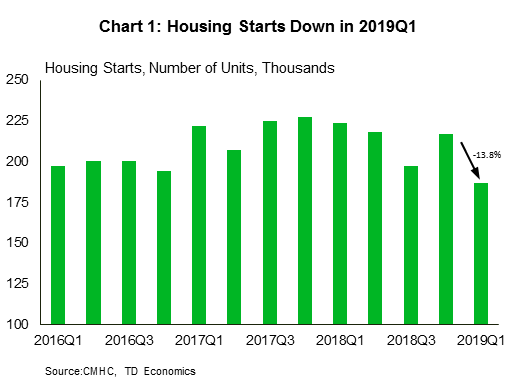
On the data front, housing was in the spotlight. First up were housing starts. These rebounded to 192.5k annualized units in March after a downwardly revised 166k February report. The rebound was welcome, and was enough to keep the trend north of 200k. Still, the first quarter as a whole marked a very soft start to the year. Starts were down 14% compared with the final quarter of 2018 (Chart 1). This was the worst quarterly performance since 2009, with activity in the single family home segment leading the way.
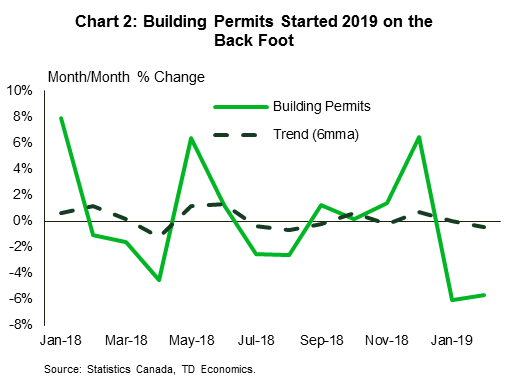
The softness in February was confirmed by Statistics Canada's release of building permits data (Chart 2). The value of permits issued fell roughly 6% month-on-month for a second month, taking the series back to early 2017 levels. The main culprit was residential multis (i.e. condos), although permits for non-residential construction were down for a second month. The permits data can be pretty noisy, but when taken together with soft resale activity and the drop-off in starts, it is clear that the housing sector, broadly defined, remains in a soft patch.
U.S.: Upcoming Key Economic Releases
U.S. Retail Sales - March
Release Date: April 18, 2019
Previous: -0.2%, ex auto: -0.4%, control group: -0.2%
TD Forecast: 1.3%, ex auto: 0.9%, control group: 0.7%
Consensus: 0.9%, ex auto: 0.7%, control group: 0.4%
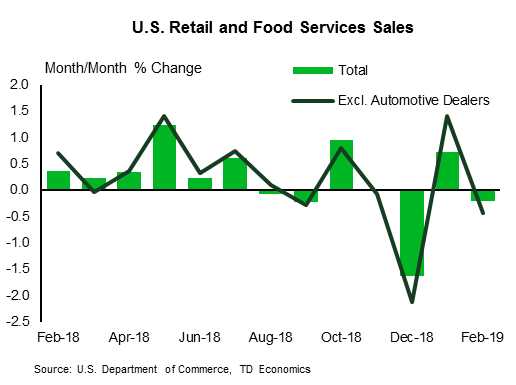
Strong March auto sales and a firm rebound in the (core) control group should underpin a solid 1.3% m/m jump in retail sales, following a 0.2% decline in February. Headline sales should also be supported by the ongoing acceleration in gasoline prices, which we expect to be reflected on a firm 5% m/m gain in gasoline station sales. We expect the 0.7% m/m improvement in sales in the key control group to be supported by a normalization in tax refunds, rising real disposable income, and a still humming labor market.
Canada: Upcoming Key Economic Releases
Canadian Manufacturing Sales - February
Release Date: April 16, 2019
Previous: 1.0%
TD Forecast: -0.7%
Consensus: 0.0%
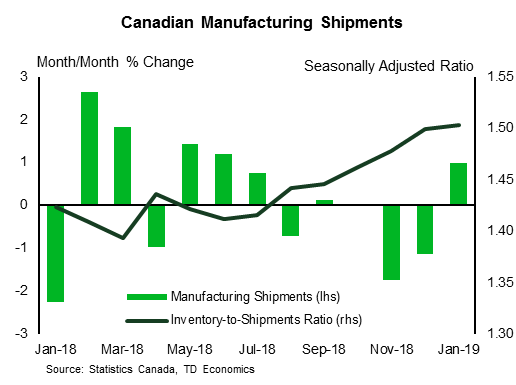
Manufacturing sales are forecast to decline by 0.7% in February as a pullback in motor vehicle production weighs on the headline print. Preliminary motor vehicle output saw a sharp pullback in February, reminiscent of the January decline south of the border. Elsewhere, the lack of February export data creates a challenge, although other indicators are consistent with a soft print. Employment data revealed a pullback in hours worked through February, while the manufacturing PMI revealed the most modest expansion since September 2016. Gasoline prices should provide a tailwind to the nominal print and there is also scope for higher volumes on the heels of an 11% decline from October. Meanwhile, real manufacturing sales should come in slightly below the nominal print, owing to higher industrial prices.
Canadian CPI - March
Release Date: April 17, 2019
Previous: 0.7% m/m, 1.5% y/y, Index: 134.5
TD: 0.7% m/m, 1.9% y/y, Index: 135.5
Consensus: 0.7% m/m, 1.9% y/y, Index: 135.3
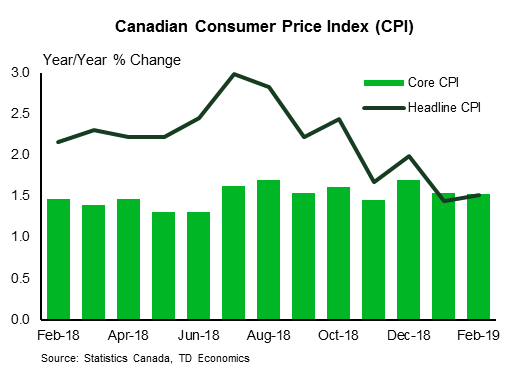
We expect headline CPI to firm to 1.9% y/y, reflecting a second consecutive 0.7% m/m increase. Gasoline prices should lend a substantial boost with retail prices having risen 11% m/m. But one-off factors are also significant this month with a focus on travel services, telephone/internet services, airfares, and rents. On balance, their expected swings point to upside for March CPI. We see potential for a boost from airfares as a result from the grounding of BA planes, which lowered capacity in the market. Internet services are exposed to an upswing from the announced price increases by Rogers and Bell over March and April. Increases in the 5-10% m/m range amount to a 5-10bp contribution to the y/y print. Rents are most uncertain, but significant increases in the past months, if maintained, suggest a 5bp contribution. However, a late Easter argues for a weaker seasonal rise in travel services in March, consistent with past trends.
Looking to core CPI, we expect the average of the BoC's preferred measures to remain stable at 1.83% y/y but see modest upside risks to CPI-trim and median on favourable base effects. Our March forecast is consistent with Q1 CPI at 1.6% y/y vs the BoC's estimate of 1.7%.
Canadian International Trade - February
Release Date: April 17, 2019
Previous Result: -$4.25bn
TD Forecast: -$4.4bn
Consensus: -$3.3bn
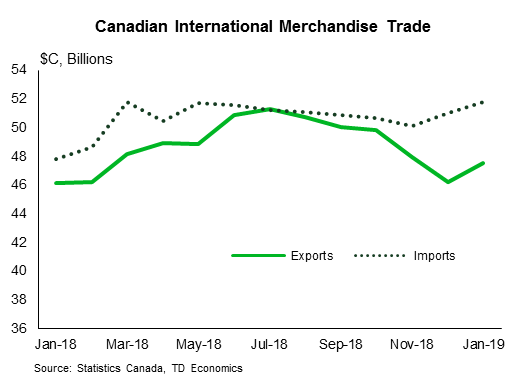
TD looks for the trade deficit to widen a touch to $4.4bn in February as weaker export activity is partially offset by a more modest pullback in imports. Softer exports should be driven by non-energy products on a pullback in motor vehicle shipments, while energy exports will provide a key offset on a recovery in crude oil prices. On the other side of the ledger, we expect imports to give up a small portion of last month's gain although aircraft products should help to buffer the declines. Aircraft imports surged by 50% m/m in January after Boeing resumed deliveries to Air Canada and Westjet, and deliveries rose again in February.
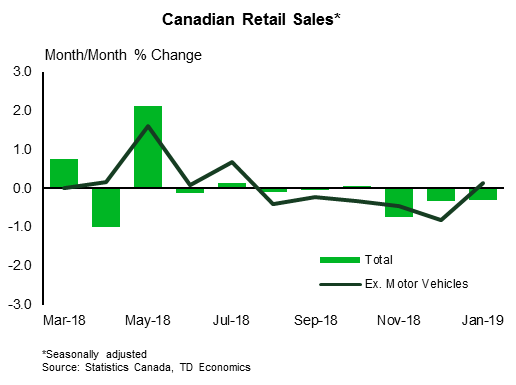
Canadian Retail Sales - February
Release Date: April 18, 2019
Previous: -0.3%, ex-auto: 0.1%
TD Forecast: 0.4%, ex-auto: 0.2%
Consensus: 0.5%, ex-auto: 0.3%
TD looks for retail sales to rise by 0.4% in February. Motor vehicle sales should make a positive contribution although harsh weather will limit the size of any rebound from the 1.4% decline last month. Unseasonably cold weather throughout February also weighed heavily on residential construction, which should feed into softer building material sales. Elsewhere, the first increase in gasoline prices since July will provide a tailwind to nominal sales which, alongside stronger auto sales, should leave core measures to underperform the headline print. Real retail sales should also come in below the headline print with a 0.1-0.2% increase owing to higher consumer prices in February.
Dollar Softens Awaiting US Retail Sales
The US dollar is lower against most major pairs except the Japanese yen and the Swiss franc. Risk appetite made a comeback this week and pushed the three currencies lower as investors shied away from safe havens. A strong start to the US earnings season with JP Morgan and Wells Fargo leading the way triggered optimism despite global growth warning from the IMF earlier in the week. Central banks were muted this week as dovish rhetoric continues to be the norm. Brexit will be around for longer as an extension until October 31 as the two major parties discuss cooperation that would bring about a softer exit. More time means less pressure on the pound, the currency rose 0.34 this week after the new timeline was announced.
GBP – Pound Rises as Brexit Halloween Extension Granted
The GBP/USD rose 0.19 percent on its way to another positive week as the European Union allowed a six-month extension to Article 50. The UK parliament remains in a paradox, not wanting to exit on a no-deal scenario, but not doing enough to support a single soft-exit alternative. The talks between Conservatives and Labour is not likely to break the deadlock and Halloween could end up being spookier than intended.
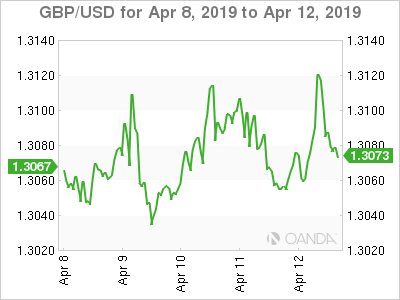
Wages, inflation data, retail sales and a speech by Bank of England (BoE) Governor Carney in Europe are on the calendar. Brexit pressure will be continued to be applied to the economy as the extension only eased anxiety in the short term, only to be revised come Hallows eve. The pound will be sensitive to political updates as Theresa May’s leadership is under threat with a lower valuation if a Eurosceptic captures the Prime Minister’s job.
OIL – Supply Concerns Overshadow Trump Pipeline Push
Brent rose 1.03 percent and WTI 0.36 percent on Friday as supply disruptions and stronger Chinese economic data eased concerns about OPEC+ rising production in the summer. The weakness of the US dollar as investors sold their positions with little need for hedging their exposures this weekend was a positive for crude.
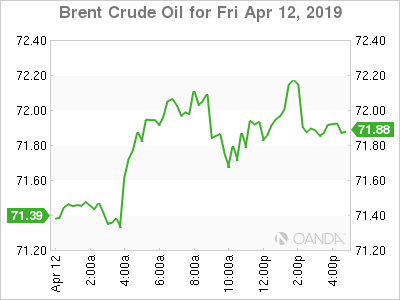
A potential civil war in Libya could wipe out all crude production and the US sanctions against Iran and Venezuela could end up convincing OPEC+ members to pause their production agreement deal and increase production to offset the losses. The meeting in June will be crucial to the extension of the agreement, but with current prices higher than previously thought Saudi Arabia will have to make a compelling case to producers.
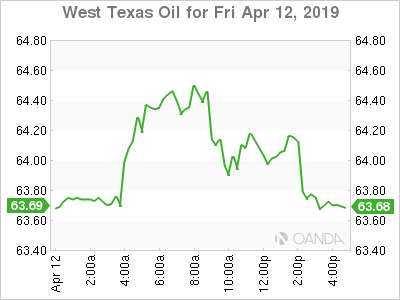
US production has been ramping up and Trump issued an executive order on pipelines to overstep on State level authority. Chevron announced the purchase of Anadarko for $33 billion in a move that could trigger more M&A activity in the shale industry.
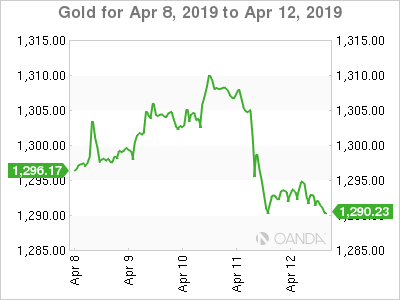
GOLD – Yellow Metal Flat as Friday Brings Dollar Softness
Gold recovered from Thursday’s losses, with a 0.11 percent rise on Friday but is headed for a weekly loss of 0.08 percent. The dollar was on the back foot, which helped the yellow metal advance towards the end of the week. US economic indicators have been mixed of late and next week could be another tough test for the dollar with core retail sales and the Philly Fed Manufacturing Index on Thursday.
The U.S. Federal Reserve hit the brakes hard in Q1 but as data has improved rate cut chances are lower and if retail sales data outperform it would start building a case for an interest rate lift later this year despite the Fed’s dovish turn in January.
ECB Draghi warns of external headwinds, Praet expects stabilization
ECB President Mario Draghi said "the outlook for the euro area fundamentally depends on global growth momentum". And he warned "the escalation of trade tensions, the downturn in global manufacturing and a turn in the tech cycle have increased the euro area's external headwinds."
ECB Chief Economist Peter Praet, on the other hand, sounds relatively more optimistic. He said "there are good reasons to say that the economy is going to stabilize, it's probably stabilizing somewhere in the second quarter ... That's our scenario and I still believe in that scenario."
On market pricing, Praet said "the OIS curve that came after the Watchers' conference in Frankfurt is something that fits well with how we think financial conditions should be today". Overnight Indexed Swap (OIS) curve suggests that money markets are not pricing in a rate hike from ECB for the next 21 months.
Week Ahead – China Q1 GDP Eyed; Inflation Data to Dominate Elsewhere
Markets will take a break from central banks and Brexit news over the coming week as the focus moves firmly onto economic fundamentals. Monthly inflation reports will be the dominant release, followed by retail sales estimates. The latest flash PMIs will also be keenly watched amid tepid signs of a recovery in some parts of the world. But while the upcoming data could prove significant in identifying shifting trends, major FX pairs will likely struggle to break out of their recent ranges just yet with too many uncertainties still lurking in the background. A shorter trading week could also contribute to reduced liquidity as many markets will be closed on Friday for the Western Easter celebrations.
Aussie seeks to extend gains from jobs numbers
Investors pared back some of their expectations around a rate cut by the Reserve Bank of Australia this week, helping the Australian dollar touch 6-week highs versus its US counterpart. The RBA’s deputy governor signalled the Bank did not see an urgency to cut rates just yet and traders will get more insight into policymakers’ thinking when the minutes of the April policy meeting are published on Tuesday. The aussie could stretch the past week’s gains if the minutes further dash expectations of an early rate cut.
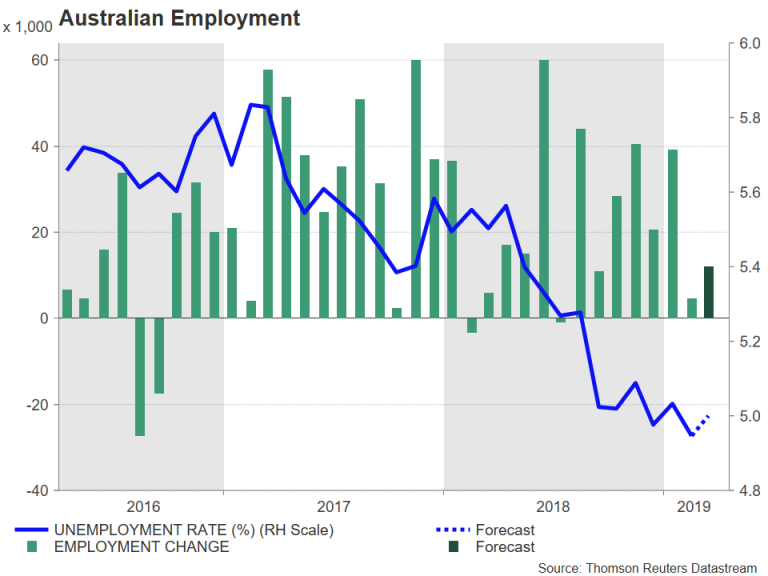
Traders will also be paying attention to Thursday’s labour market indicators. Employment is forecast to have increased by 12,000 in March, accelerating from the prior 4.6k, while the jobless rate is anticipated to inch up to 5.0%.
Chinese GDP growth likely slowed further in Q1
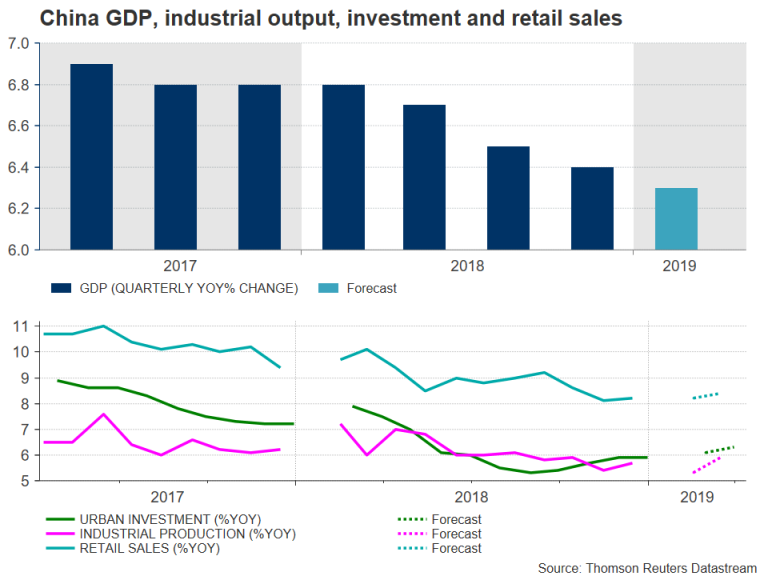
Just as important, if not more, for the aussie will be the latest growth numbers out of China. Data due on Wednesday is expected to show China’s economy grew by 6.3% year-on-year in the first three months of the year. If confirmed, this would represent the slowest growth in decades. However, unless there’s a miss in the data by 0.2 percentage points or more, there’s unlikely to be a market panic as most of the slowdown has already been priced in and there’s already some evidence of a turnaround getting underway.
Released alongside the GDP numbers will be industrial output, urban investment and retail sales figures for March. Industrial output growth is forecast to have quickened from 5.3% to 5.9% y/y in March, pointing to a possible recovery. Investment in urban area is also projected to have picked up pace, rising by 6.3% y/y in the year-to-date to March. Consumer spending probably improved too, with retail sales expected to have risen by 8.4% y/y, compared with 8.2% in February.
The aussie stands to gain from better-than-expected figures out of China as a rebound in Chinese growth would directly boost Australian exports to the Asian giant.
New Zealand CPI could fuel RBNZ rate cut bets
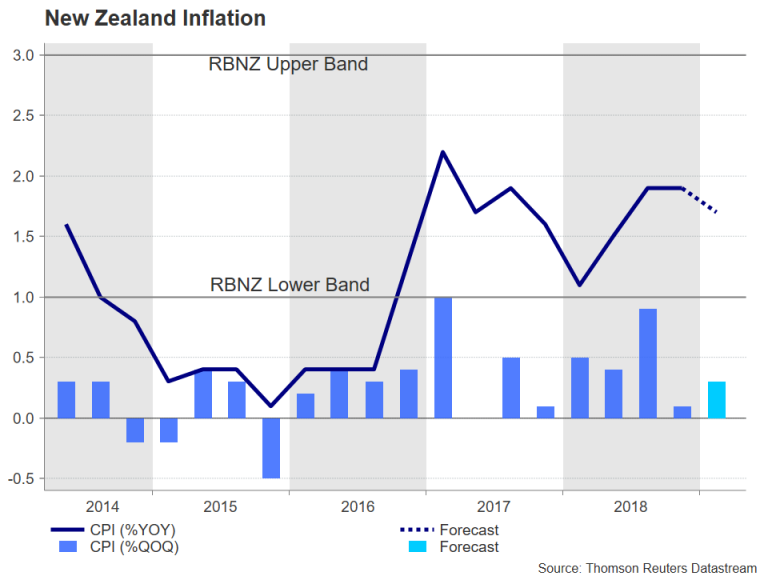
The Reserve Bank of New Zealand surprised markets at its March policy meeting by switching to an easing bias, having maintained a neutral stance at its previous meeting when investors were anticipating a dovish move. The local dollar has been on the backfoot since and there may be more losses to come for the kiwi from next week’s inflation numbers. The annual rate of CPI is forecast to moderate from 1.9% y/y in the fourth quarter to 1.7% in Q1. On a quarterly basis, CPI is expected to have increased by 0.3%.
While a figure of 1.7% would fall within the RBNZ’s target band of 1-3%, all the indications are that the risks to growth and inflation remain tilted to the downside and the RBNZ would prefer to see inflation closer to the middle of its target band.
Japan to publish trade and inflation data
Sticking to Asia, price measures will also come under the radar in Japan. Core CPI, which excludes fresh foods and is targeted by the Bank of Japan for its inflation objective, fell back to 0.7% y/y in February, straying further away from the 2% goal. Should inflation moderate further, pressure would rise on the BoJ to take fresh action to lift prices. There’s been some mixed messages from the BoJ lately, with policymakers suggesting they could expand their stimulus programme if needed even as they worry about the side effects from a prolonged period of loose monetary policy.
The CPI figures are due on Friday and ahead of that, trade numbers will be watched on Wednesday. Japanese exports slipped by 1.2% y/y in February as a global slowdown and trade tensions weighed heavily on the country’s manufacturers.
Any weakness in next week’s releases would not do the yen any favours. However, the Japanese currency is unlikely to suffer significant downside unless there’s signs of a major shift in BoJ policy.
Focus on flash Eurozone PMIs as euro perks up
A combination of M&A flows and traces of green shoots in the euro area’s largest economies drove the single currency to 2½-week highs against the US dollar this week. The euro could attract additional buying interest if important business surveys out next week provide further proof of an improving economic picture.
The week will start with the German ZEW economic sentiment gauge on Tuesday. The index is forecast to increase from -3.6 to 0 in April, which would make it the highest reading in a year. There could be more positive news on Thursday from IHS Markit’s preliminary PMI readings for April. The Eurozone’s manufacturing PMI is forecast to rise for the first time since July 2018, edging up from 47.5 to 48.0 in April. The services PMI is projected to ease to 53.1 after two months of solid increases. Meanwhile, the composite PMI, which includes both manufacturing and services, is forecast to nudge higher from 51.6 to 51.7, indicating a slight acceleration in overall growth in the euro area.
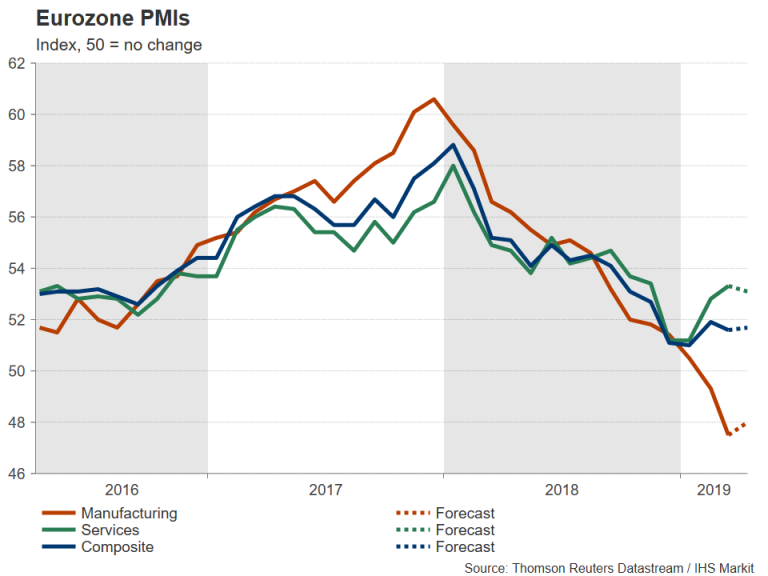
The other data to keep an eye on next week is Wednesday’s final Eurozone CPI prints for March, although no revision is being anticipated to the initial readings.
Slew of UK economic indicators could offer a break from Brexit
Markets have ignored UK economic developments almost entirely in recent months, centring mainly on the Brexit drama. The logic is that a solution to the political crisis will solve most of the economic issues as well – namely alleviate uncertainty and stimulate business investment. Case in point, sterling barely reacted last week even as the UK services PMI unexpectedly fell into contractionary territory. Another reason is that traders (correctly) believe the Bank of England has its hands tied by Brexit and won’t act again until the landscape clears a little.
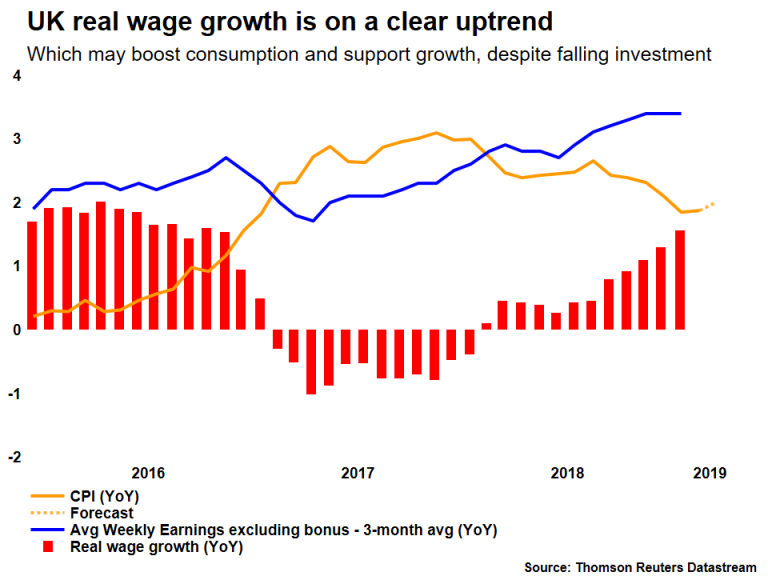
That said, it looks like it will be a quiet week on the Brexit front, so traders could gradually turn their attention back to economics. In that sense, the calendar is packed with noteworthy releases, starting with the employment numbers for February that are due on Tuesday. Inflation figures for March will follow on Wednesday, before retail sales for the same month are published on Thursday. It will be especially interesting to see if the upturn in real wages will continue, as that offers a ray of light for the economy, in that it could lift consumption, thus, keeping a floor under growth despite declining investment.
Dollar to seek direction from US data
Economic releases out of the United States next week may not necessarily be very headline grabbing but could nevertheless steer the dollar in a more decisive pattern as investors ponder whether a Fed rate cut in 2019 is on the cards.
First up on the US calendar is the Empire State manufacturing index for April on Monday. The New York Fed’s manufacturing activity gauge will be one of four indicators on US production, with investors hoping for the emergence of an uptrend. The various US manufacturing surveys have so far been mixed so further convincing signs of a pick up in growth will be welcome by dollar bulls. The other data points to monitor will be the official March industrial production numbers on Tuesday, followed by the Philly Fed manufacturing index and the IHS Markit manufacturing PMI on Thursday, both for April.
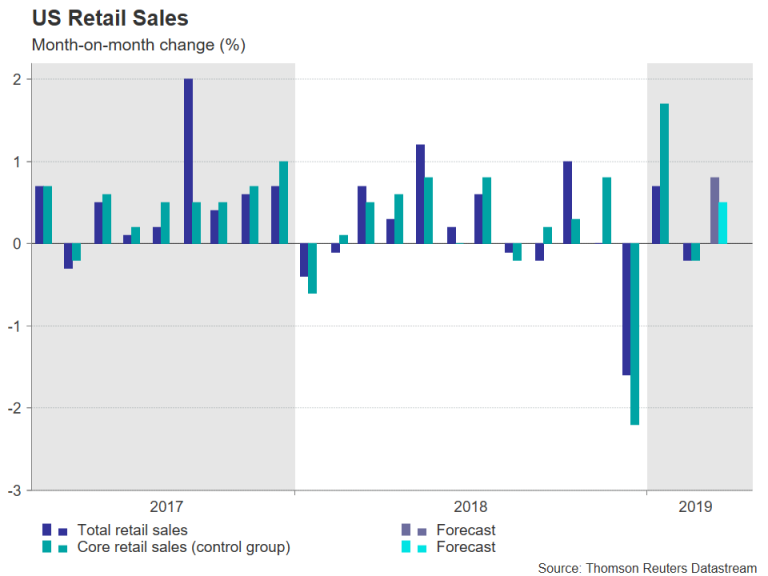
The other main releases out of the US will be February trade stats on Wednesday, March retail sales on Thursday, as well as housing starts and building permits for March on Friday. Along with the manufacturing data, the retail sales figures will be key in assessing the health of the US economy and hence, driving the greenback. Retail sales are forecast to have returned to growth in March after a surprise drop in February. Analysts are predicting sales to have rebounded by 0.8% month-on-month in March, more than reversing the prior month’s 0.2% decline. The core ‘retail control’ measure is expected to have risen by a somewhat slower pace of 0.5% m/m.
Canadian data in the spotlight as traders bet on BoC rate cuts
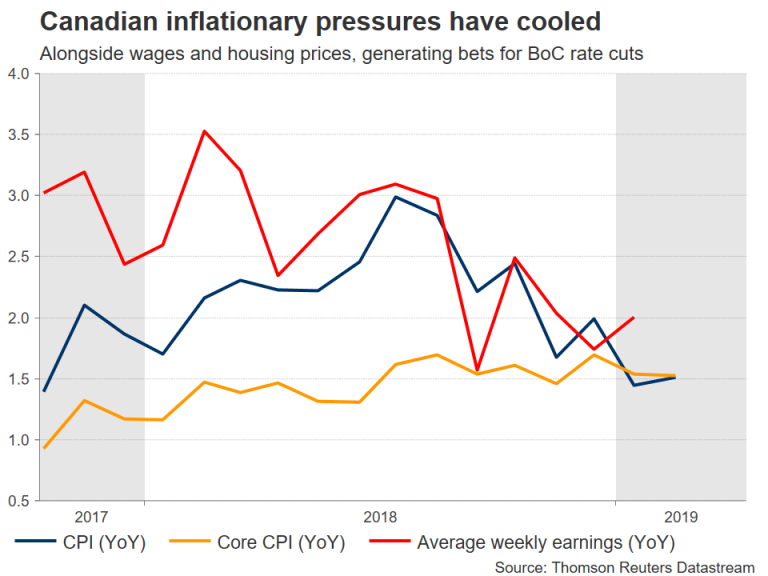
The Canadian economy has been losing steam lately, echoing the situation seen across the globe. Both the labor and real estate markets have cooled, with wage growth slowing and house prices declining, which is a toxic cocktail for consumers and therefore, for the broader economy. Against this backdrop, the Bank of Canada (BoC) has abandoned its tightening bias, but markets are more pessimistic and are leaning towards the prospect of rate cuts, pricing in a ~25% probability for one by December.
The upcoming March inflation print on Wednesday and the February retail sales figures on Thursday will provide the latest piece in this puzzle. Risks seem asymmetric here, as any decline in both inflationary pressures, especially in core CPI, and consumption could amplify the case for BoC rate cuts, and by extent, hurt the loonie substantially. Whereas it’s doubtful whether even a solid uptick in either prices or retail sales would be enough to diminish monetary easing bets and hence boost the currency in a material manner.
Australia & New Zealand Weekly: The AUD, the RBA, the FOMC and Commodities
Week beginning 15 April 2019
- The AUD, the RBA, the FOMC and commodities.
- Australia: Westpac-MI Leading Index, employment, RBA minutes, Good Friday.
- NZ: CPI.
- China: GDP, retail sales, industrial production, fixed asset investment.
- Europe: trade balance, ZEW survey.
- US: retail sales, industrial production.
- Flash PMI's for Japan, the Euro Area, and the US.
- Key economic & financial forecasts.
Information contained in this report current as at 12 April 2019.
The AUD, the RBA, the FOMC and Commodities
The Australian dollar has held within a narrow range of USD0.704 to USD0.716 over the month.
Key commodity prices, particularly iron ore, have been stable over the month with spot at around US$90/t. General expectations have been for this price to adjust downwards. For example the government's forecast for the iron ore price (fob) by March 2020 is US$55/t (Westpac expects US$74/t spot).
Supporting the iron ore price has been ongoing reports from Vale of likely decommissioning of supply following the collapse of the tailings dam in Brumadinho – general expectation is that Vale will decommission around 40t of production lowering overall annual production from 400Mt to 360Mt.
However markets are expecting even larger production cuts to eventuate. Another major producer, Rio Tinto, has also recently been impacted by a supply shock.
On the demand side, confidence is rising in response to China's commitment to stabilising growth through lifting credit; easing restrictions on the shadow banking sector; supporting bond issues by local governments to finance new infrastructure investment; tax cuts; and some support to housing in selective regions.
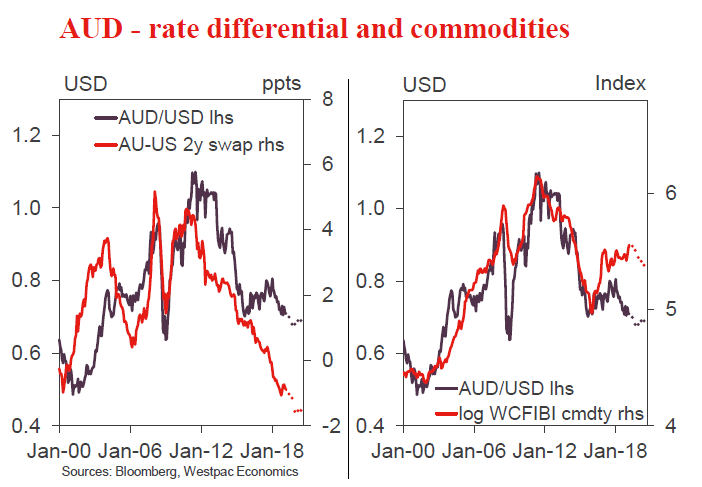
This stability at high levels for key commodity prices is providing solid support to the Australian dollar – indeed the fair value of the AUD as measured by commodity prices, is currently holding well in excess of current spot.
On the other hand, interest rate differentials continue to weigh on the AUD. When on February 21, Westpac moved to forecast the RBA would cut the cash rate by 25bps in August and November this year, markets were not anticipating a cut until April next year.
That pricing has now moved forward to August/September with 75% of a second cut priced by mid next year. (pricing COB Wednesday).
However in a Q&A follow-up to a speech on Wednesday to the American Chamber of Commerce in Australia, Deputy Governor Debelle is reported to have noted "Our expectation is that we will see decent growth in the economy…so we won't have to get to that point [of cutting rates]."
A test of that assertion will be when the RBA releases its revised growth; inflation and employment forecasts in the May Statement on Monetary Policy on 10 May. Currently, the RBA is forecasting GDP growth of 3% in 2019 and 2.75% in 2020. The lower growth rate in 2020 is largely explained by a reduced contribution from resource exports – particularly LNG.
Those forecasts were released for the February Statement on Monetary Policy when the RBA was forecasting growth of 2.75% for 2018. Subsequently, growth printed at 2.3% for 2018.
It would be very surprising if the RBA did not lower its growth forecasts at the time of the May update. (Westpac expects growth of 2.2% in both 2019 and 2020).With our view on the economy we would expect RBA forecasts of 2.5% and 2.25% (respectively).
Given Dr Debelle's remarks, it is more likely that the RBA will choose 2.75% and 2.5%. But even those forecasts point to below potential growth in 2020. By May, the 2020 forecast is the most important one from a policy perspective given monetary policy acts with a lag.
The expected trigger for the rate cut would be a further downward revision in the growth forecasts at the August Statement on Monetary Policy to, possibly, 2.5% (2019) and 2.25% (2020).
Any central bank forecasting below potential growth should adopt an easing bias.
The recent change in the Governor's Statement following the April Board meeting at least shifted the dial to a more flexible approach to policy rather than the sentiment which this Governor had maintained since his first Statement back in October 2016.
Despite the firming of the probabilities of a rate cut, the AUD has remained quite stable. That probably reflects the commodity environment and the limits to the forward expectations of currency markets.
The outlook for US interest rates is also important. In March markets had been pricing in a 70% probability of a rate cut from the FOMC by year's end. That pricing has now moved back to a more reasonable 45% although pricing is around 80% for two cuts by September 2020.
Westpac has revised its outlook for the federal funds rate. We no longer expect a late cycle rate hike at the December meeting of the FOMC. My visit to the US in February gave me little confidence that the FOMC was likely to see the need to raise rates again in this cycle. Tailwinds in 2018, including those from global growth, fiscal policy, and financial conditions, have turned into headwinds in 2019.
Confidence around the 'stickiness' of the core PCE inflation measure was also clear. Indeed there was a general view that the FOMC needed to be seen to be symmetric around the 2% target for core PCE inflation. A period in which it ran above 2% would be welcomed in confirming that symmetric policy stance.
My concern has always been with the likely persistent lift in growth in hourly earnings (up from a 2.5% to a 3.2% annual growth rate over the last year) as the labour market remains buoyant. However there was a view that statistical research had failed to find a link between wages growth and core PCE inflation.
The concept of neutral rates had also been 'adapted'. There was no longer a sense of 'long term/short term'. Neutral policy depended on potential growth (around 2%) and core PCE inflation around 2%. Westpac's, and the FOMC's forecast for GDP growth in 2019 is around 2%, providing further comfort that rates could stay at current levels since they are now at neutral.
Equally we do not subscribe to the view that rates will be cut by the FOMC over the 2019 and 2020 time horizon. With lower mortgage rates; solid income growth; some expected upward pressure on inflation; and fiscal policy likely to be supportive, especially in the election year of 2020, a steady rate profile seems most likely.
With markets expecting rate cuts in the US and under-pricing rate cuts in Australia, some further downward pressure on the AUD can be expected from the current USD0.715. But with an improving commodity price outlook we have not moved our target of USD0.68 for AUD over the course of 2019 despite the flatter profile for the federal funds rate.
The week that was
The Federal election campaign officially kicked off in Australia this week shortly after the Westpac-MI consumer sentiment indicated the Budget was well received. Overseas, central banks reiterated a cautious tone while the Brexit deadline was extended (again).
Wednesday's Westpac-MI Consumer Sentiment survey was eagerly anticipated after last week's release of the 2019/20 Federal Budget which included a further $19.5bn in income tax relief.
While the month to month rise in Sentiment was fairly muted at 100.7 compared to 98.8 in March, sentiment clearly caught an uplift from the Budget. Indeed, among those surveyed postbudget, sentiment was 7.7% higher than those surveyed prebudget – the most positive turnaround since we began tracking pre and post budget responses in 2011.
Yet it is important to take a step back from the near-term lift in overall sentiment. Persistent weak wages growth, falling house prices, and the perceived rising cost of living are all still weighing on consumers. This is reflected in the survey component 'family finances compared to a year ago' – which declined 4.9% in April (showing little movement between pre and post Budget responses) and is down 9.6% on a year ago.
In that respect, disappointing consumption growth was a key theme in RBA Deputy Governor Debelle's speech on "The State of the Economy". Ultimately, "unexpectedly weak" consumption had been the main surprise in recent growth outturns with "other parts of GDP" evolving "broadly as expected".
Here, Debelle related some part of the slowdown to declines in housing prices but was sceptical of a direct 'wealth' effect. Instead, he believes lower housing turnover is the main factor as consumers spend less on household furnishings as well as vehicles. With more supply coming on to the Melbourne and Sydney housing markets this year, Debelle sees further weight on prices. While some comfort can be found in the stable read in Feb housing finance on Tuesday, today's release of the biannual Financial Stability Review is still likely to emphasise that the RBA is cautious and watching housing.
However, of greater concern to Debelle in regards to the consumption outlook is low household income growth and the consumer's "increasing expectation that it is likely to remain low". The RBA remain of the view that household income is likely to pick-up over the next few years but this is conditioned on strength in the labour market persisting. Indeed, the key takeout from Debelle's speech is that the RBA are still assessing "conflicting signals provided by the labour market, the GDP data and the business surveys".See page 2 for further detail.
Turning to offshore matters, the major thematic this week relates to central banks remaining in a cautious watch-and-wait mode, which coincides with the IMF downgrading their 2019 growth forecast to 3.3% from 3.5%.
In the US, the FOMC minutes largely reflected communication from committee members over the past month. While "some" members noted it could be appropriate to raise rates in 2019, and "several" noted their view on rates could move up or down and were not on a pre-set course, a "majority" see rates on hold this year – as per the dot plot.
Further emphasising the capacity for the FOMC to maintain their "patient" approach was the release of Mar CPI that same morning. Headline inflation overshot expectations but the core indicator underwhelmed with annual core CPI inflation declining to 2.0% from 2.1%. A lack of inflationary pressure means the FOMC can maintain a steady hand while the outcomes of various global uncertainties unfold.
Across the Atlantic, the April ECB meeting confirmed the policy stance after the dovish shift in March. New information has been consistent with "slower growth momentum extending into the current year" and while "idiosyncratic domestic factors dampening growth are fading, global headwinds continue to weigh". Accordingly, the ECB continues to believe risks are tilted to the downside.
Discussion on the pricing of new TLTRO was scarce (an announcement to be made in forthcoming meetings), but the ECB did note in April that they are analysing possible side effects of negative interest rates on the back of the recent discussion on the ECB potentially moving to a tiered deposit rate. The analysis is still in its early stages, and we do not expect a change to tiering any time soon, but if anything, the opening of the debate underscores the ECB's awareness of rates likely being 'low-for-longer' in a general sense.
To the UK, the outcome of this week's EU Summit is that the Brexit deadline has been extended to 31 October, with the option to leave sooner if the UK Parliament can agree on a path forward. This is longer than the 30 June delay UK PM May had hoped for, and will mean the UK will have to take part in European Parliament elections on 23 May, if they have not found an agreement by then.
Chart of the week:xt
Our April Market Outlook was released this week and contains a comprehensive update on the Westpac view.
While global and local growth prospects are unchanged since our March report, we have made several key changes to our market outlook this month.
On official rates, the FOMC is no longer expected to deliver one last late cycle rate hike, and the RBNZ now looks poised to make a 25bp cut in May.
Australia's commodity prices are expected to hold up better than previously expected, leaving our forecast for the AUD unchanged despite the revised federal funds rate profile.
New Zealand: week ahead & data wrap
Close call
The outlook for monetary policy is delicately poised. Following the Reserve Bank's change of tone in its March OCR review, we shifted our call to a rate cut as early as the May Monetary Policy Statement, but we emphasised that this was subject to upcoming data and developments. We expect next week's inflation print to be subdued, but we're sensitive to any surprises. Meanwhile, a trifecta of soft data releases this week will add to the RBNZ's concerns about whether the local economy has the momentum needed to generate a sustained lift in inflation.
The RBNZ Governor's comments in a media interview this week were in line with our initial read of the March OCR review. Governor Orr noted that the March statement was meant to reflect that the balance of risks has shifted to the downside. But he emphasised that the decision in May is by no means settled.
On balance, we still think that the odds are in favour of a rate cut in May. The RBNZ has highlighted concerns about the slowing global economy in particular – a point that was underscored this week when the IMF further downgraded its world growth forecasts. We're more optimistic on global growth than the market appears to be, but we don't think that gloomy sentiment will dissipate within the space of a few weeks.
In terms of local developments, the March quarter CPI release next week presents the most immediate risk to our view. We're expecting a subdued 0.2% increase for the quarter, which would take annual inflation down from 1.9% to 1.6%.
The expected slowdown is entirely due to fuel prices. Petrol prices fell sharply at the end of 2018, and though they've started to tick up again recently, the average level over the quarter was down by more than 6%. Compared to a year ago, petrol prices are close to flat, which in turn will act as a drag on the overall inflation rate.
We expect that 'core' inflation (excluding food and fuel) will hold steady at 1.7%. Similarly, we estimate that the RBNZ's sectoral factor model of core inflation will remain at 1.7%. That would keep these measures firmly within the RBNZ's target range of 1-3%, albeit on the lower side of the midpoint.
Our CPI forecast is in line with what the RBNZ forecast in its February Monetary Policy Statement. If it turns out as expected or lower, it's likely that inflation will remain below 2% for the remainder of this year as well. That in itself wouldn't warrant an OCR cut, but it wouldn't stand in the way of one either. However, if annual inflation prints at 1.8% or higher next week, a May OCR cut would become more difficult to envisage.
In the outlook for inflation, there is a tension between gradually increasing domestic price pressures and persistent softness in tradables prices (outside of the occasional surge in oil prices). The latter has been a global phenomenon, and probably reflects a combination of the modest cyclical upturn since the Global Financial Crisis, and new technology that has helped to liberate consumers compared to the past.
In contrast, non-tradables inflation has been gradually picking up – we expect it to rise to 2.9% in March, compared to 2.3% a year ago. We (and the RBNZ) had been anticipating such a move, as the economy has moved closer to full capacity. But given the ongoing softness in tradables prices, that's still somewhat short of what would consistent with a sustained return to 2% overall inflation.
A further pickup in non-tradables inflation will depend on the strength of the economy. Growth slowed in the second half of 2018, and so far the March quarter of this year is shaping up as equally subdued. We still expect a pickup in growth over the rest of this year, supported by rising government spending, a strong pipeline of building work, and rising household incomes. But there are clearly risks to the downside.
On that note, there was a trio of activity indicators this week that were distinctly on the soft side. House sales fell further in March, and were down 13% on a year ago. Turnover was already dropping earlier this year, but back then the weakness was concentrated in Auckland. In March, it seems that there was a sharp drop in turnover in almost every region. A decline in market turnover, along with a rising inventory of unsold properties in Auckland and Waikato, is a reliable signal of price weakness ahead.
Concerns about changes to the tax treatment of property, and reduced foreign buyer activity, are likely to be weighing on the housing market. In the near term, we expect the recent sharp falls in mortgage rates to give some support to house prices, but tax changes are likely to win out in the long run.
Electronic card spending in retail stores fell 0.3% in March, which was weaker than we expected. Annual spending growth has also taken a step down over the past year, slowing to just 0.7%. This slowdown is consistent with the recent easing in consumer confidence, as well as the cooling in the housing market – spending on durables, which includes home furnishings, was particularly soft in March.
Finally, the manufacturing PMI fell to an eight-month low of 51.9 in March. The PMI is a useful leading indicator of GDP, and while it remains at a level consistent with expansion, it has clearly taken a step lower in the last year.
Data Previews
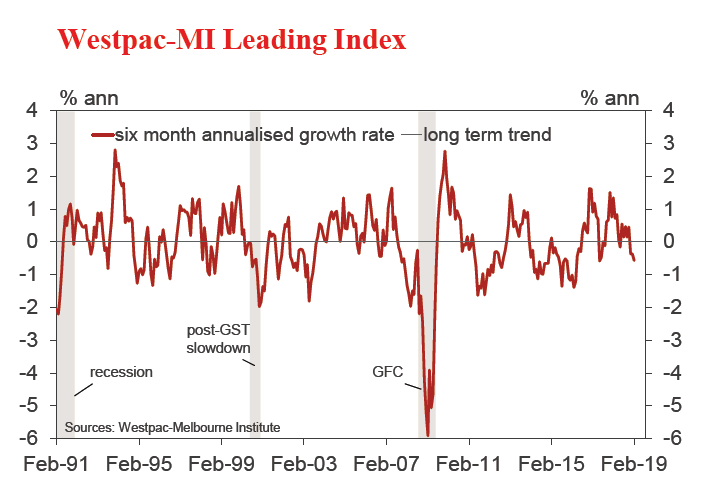
Aus Mar Westpac–MI Leading Index
- Apr 17, Last: –0.56%
The six month annualised growth rate in the Westpac– Melbourne Institute Leading Index, which indicates the likely pace of economic activity relative to trend three to nine months into the future, fell from –0.37% in January to –0.56% in February. Despite choppy reads in recent months, the signal is consistent with weak momentum in the second half of 2018 carrying into 2019.
The March read is likely to be more positive with several components recording strong rises this month including: the Westpac-MI Consumer Expectations Index, up 5.4% vs -6.1% last month and dwelling approvals, up 19.1% vs 2.3% last month. Other components have been more mixed but have mostly seen modest improvements.
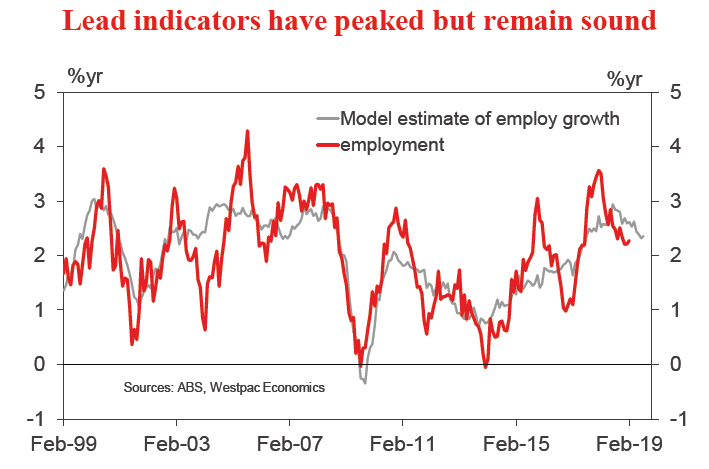
Aus Mar Labour Force Survey - employment '000
- Apr 18, Last: 4.6k, WBC f/c: 8k
- Mkt f/c: 15k, Range: 8k to 33k
Employment lifted 4.6k in Feb, less than market expectations (median +15k) for a three month average gain of 21.1k per month. Through 2018 employment grew 274.5k (2.2%yr) with solid momentum into year end with a six month annualised pace of 2.3%yr. In the year to Feb employment grew 284k (2.3%yr) but the six month annualised pace moderated from 2.9%yr in Jan to 2.3%yr.
Leading indicators have softened, annual growth in Job Ads is now down through the year but this reflects the structural shift to other recruitment methods rather than falling employment opportunities. ABS Job Vacancies growth has slowed from 24%yr in 2018 to 10%yr in 2019 and our own Westpac Jobs Index suggest firms may be less confident on lifting employment but it remains consistent with growth around 2.3%yr. Our forecast 8k gain in employment holds the annual pace at 2.3%yr.
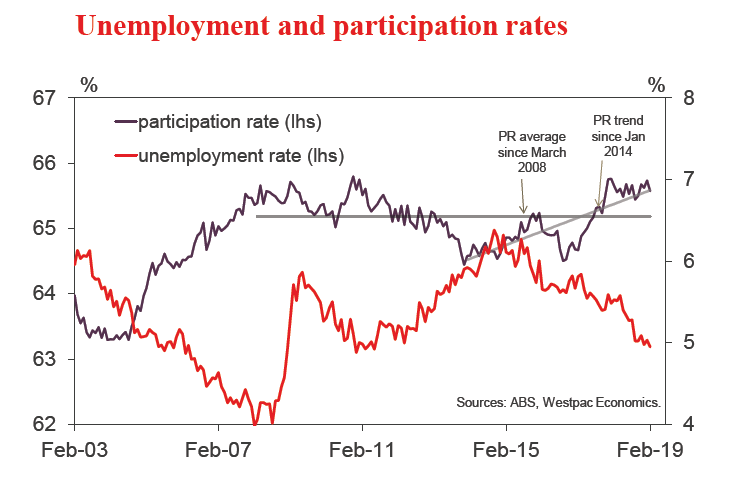
Aus Mar Labour Force Survey - unemployment %
- Apr 18, Last: 4.9%, WBC f/c: 5.1%
- Mkt f/c: 5.0%, Range: 4.8% to 5.1%
Despite the soft print on employment in Feb, the unemployment rate fell to 4.9% (market median was 5.0%) as a 0.1ppt decline in the participation rate to 65.6% resulted in a –7.1k decline in the labour force.
At this stage it appears that both male and female participation is levelling out in a trend sense and we are closely watching where they go next. We do expect both to edge lower though 2019 as employment growth stalls but not by enough to prevent a rise in unemployment.
Holding the participation rate flat at 65.6% generates a 31k rise in the labour force, and given our forecast for a soft 8k rise in employment, this should see the unemployment rate lift to 5.1%.
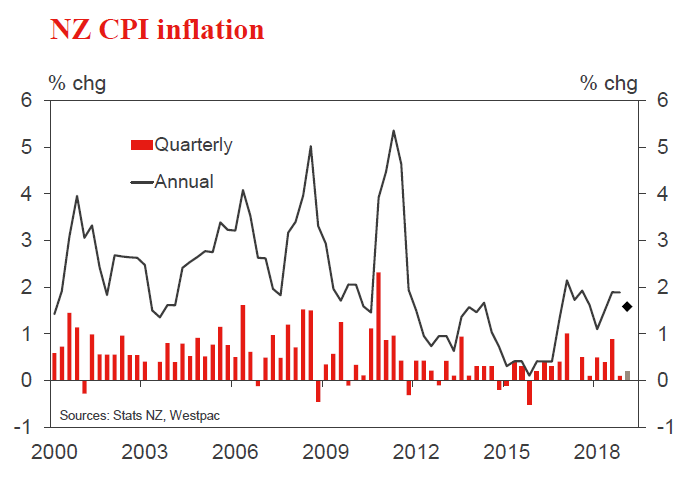
NZ Q1 CPI
- Apr 17, Last: 0.1%, Westpac f/c: 0.2%, Mkt f/c: 0.3%
We expect a 0.2% rise in the Consumer Price Index in the March quarter. That would see annual inflation slow from 1.9% to 1.6%. Such a result would be in line with the RBNZ's forecasts from February.
The sharp drop in fuel prices at the end of last year is entirely responsible for the slowdown in inflation. We expect the various 'core' inflation measures to hold steady at close to, but just below, the 2% midpoint of the Reserve Bank's target range.
The CPI release will be crucial ahead of the Reserve Bank's next Monetary Policy Statement. A result in line with or below expectations would support our forecast of an OCR cut in May. However, a substantial upside surprise would make a May OCR cut a more marginal prospect.
China Q1 GDP
- Apr 17, last 6.4%, WBC 6.4%
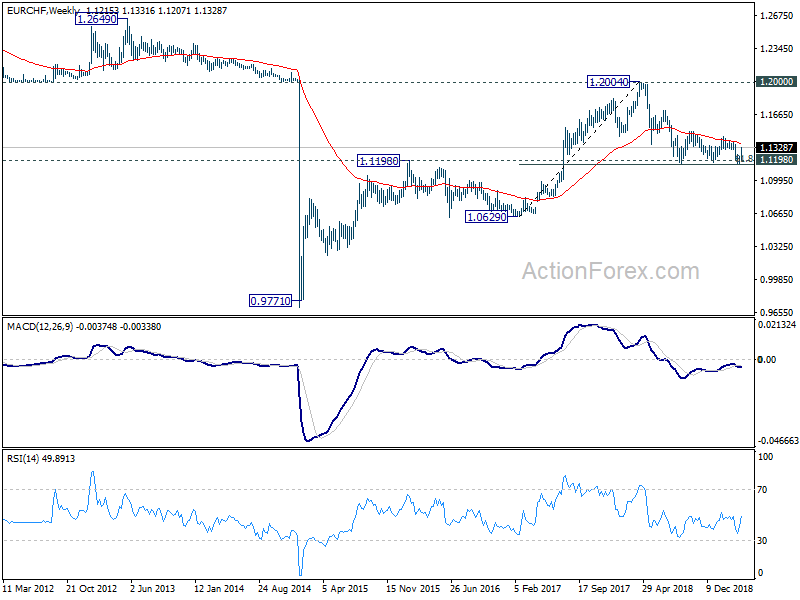
China GDP decelerated slowly through 2018, from 6.8%yr at March to 6.4%yr at December. This trend decline was the consequence of softening global momentum and authorities' hard line on the quality of investment, in both the public and private sector.
With the economy's focus on quality now set, authorities have materially increased liquidity, with flow-on benefits for the cost of credit. A quick acceleration in growth is however not anticipated in 2019.
The reason being that, while investment will accelerate through the year, the contribution from consumption is expected to throttle back. In 2018, employment growth slowed (based on the PMI detail), and this will weigh on consumption hence.
For 2019 overall, we look for a 6.1% year-average gain.