

Sample Category Title
Weekly Focus – Will Spring Finally Arrive for the Euro Area?
Market movers ahead
- In the euro area a range of sentiment indicators for April are released, but markets will particularly keep a close eye on developments in PMI manufacturing.
- After the first estimate of US GDP growth in Q1, we will also get a glimpse of how the economy started into Q2 with the Markit PMIs for April.
- The focus in China continues to be on the trade talks with the US which go on 'around the clock'.
- In Japan export figures will get some attention after the past months' weakness, while the focus during the Bank of Japan's policy meeting will be on the updated inflation projections.
- In Sweden, we expect the Riksbank to keep the repo rate path unchanged in April.
Weekly wrap-up
- US and China are edging closer to a trade deal after reaching consensus on an enforcement mechanism.
- EU leaders decided to grant the UK a second Brexit extension to 31 October 2019.
- The ECB's policy message was again on the dovish side in April, leaving the door open for further policy easing.
- The hunt for carry continues in fixed income markets, while EUR/USD shrugged off the ECB's dovish message. Oil prices ground higher amid heightened supply risks.
Sunset Market Commentary
Markets
Global core bonds lost substantial ground today. Risk sentiment was mixed overnight, giving a neutral bias to core bonds at the start of the day. European equities opened little lower, pushing core bonds cautiously higher after the EU opening bell. Little after, China reported better-than-expected lending data for March, lifting hopes on a firm economic recovery in one of the biggest economies. What followed was a general risk-on response: the euro gained ground, equities moved north and yields edged higher. Stronger-than-expected industrial production data for the EMU weighed some more on German Bunds. The German yield curve is moving higher with changes up to 4.8 bps (10-yr), with the 10-yr yield regaining the psychological 0%-level. Same story in the US, with Treasuries losing substantial ground after the strong Chinese lending data. Moreover, JPMorgan & Chase and Wells Fargo kicked of the Q1 earnings seasons and both US bank giants beat estimates, lifting hopes that the economic downturn could only be temporarily. The risk-on sentiment weighed US Treasuries down, pushing the US yield curve higher with changes up to 5.4 bps (5-yr). Peripheral spreads over the German 10-yr yield remained stable, with Greece (-9 bps) outperforming as it plans to repay parts of its loans from the IMF ahead of schedule.
Over the previous days, the euro already showed signs of underlying resilience. Amongst others, the single currency soon overcame a dovish rhetoric of ECB’s Draghi at the press conference on Wednesday. EUR/USD dropped temporary on good US data and higher US yields yesterday, but the euro bid already returned in Asia this morning. EUR/USD returned close the EUR/USD 1.13 barrier. Later, Chinese lending data surprised on the upside. The report obviously eased investor fears on Chinese/global growth and revived an outright risk-on trade. (European) equities, core yields, oil and EUR/USD all jumped higher. EMU February production data were also better (less negative) than expected. In this global move, EUR/USD broke beyond the 1.13 resistance, triggering further euro short-covering. Solid buying in EUR/JPY reinforced the overall performance of the single currency. EUR/USD is trading in the 1.1325 area. USD/JPY also profits from the risk-on and higher core yields. The pair nears the 112 big figure. EUR/JPY gained more than one big figure compared to the start in Asia this morning and trades currently in the 126.75 area.
EUR/GBP drifted cautiously higher in the mid 0.86 area. We didn’t see any UK specific news. The move was probably mainly inspired by an overall bit for the euro. EUR/GBP tested the intermediate resistance in the mid 0.86 area, but a sustained leap didn’t succeed. Sterling regained some ground later in the session. The move was maybe supported by constructive comments from UK Finance Minister Hammond as he still saw a decent chance for the negotiations between the Conservative party and Labour to yield a positive result in the coming weeks. EUR/GBP is again trading in the 0.8625 area. Cable rebounded above the 1.31 big figure but this move was mainly EUR/USD driven.
News Headlines
UK’s Nigel Farage has launched the Brexit party as a new political organization in next month’s European elections. Farage is the former Ukip leader, a strong Eurosceptic party. He stepped down shortly after the Brexit referendum outcome in 2016 and left the party completely last year.
Germany’s Bundesbank president Weidmann warned German growth could slow sharply (to less than 1%) in 2019 as trade and Brexit uncertainty continue to weigh on investment, adding that Germany is currently running expansionary fiscal policies to counter the slowdown. It is estimated to have an impact of 0.25-0.5% points on GDP.
JPMorgan Chase kicked off the earnings season on a strong note. The largest US bank topped earnings expectations as net income increased (+19%) on higher interest income and gains in its advisory business. Its CEO sounded optimistic about the overall outlook for the bank as the US economy, labour market and consumer and business confidence stays strong despite “some global geopolitical uncertainty”.
IMF: US-China trade agreement should be consistent with multilateralism
Changyong Rhee, director of the IMF's Asia and Pacific department warned that if, contrary to market expectations, there is no US-China trade agreement reached, "the market can react quite negatively because they already factor in some agreement will be reached."
He also noted that "our general view is that trade tension has had a negative impact on Asia". But that's "mostly still through the financial market ... rather than trade flows directly." However, "as trade tensions escalate more, we are starting to see the trade flows affected."
And, he urged that "the agreement also should be consistent with multilateralism rather than bilateralism between the United States and China."
USD/JPY Mid-Day Outlook
Daily Pivots: (S1) 111.14; (P) 111.42; (R1) 111.95; More...
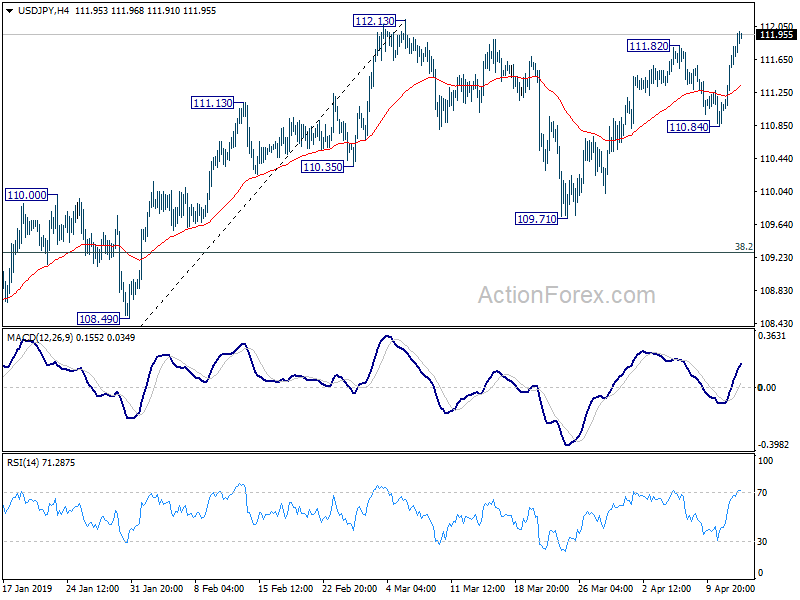
Intraday bias in USD/JPY remains on the upside for 112.13 resistance. Decisive break there will resume larger rise from 104.69. Next target will be 114.54 key resistance. On the downside, break of 110.84 is needed to indicate completion of rise from 109.71. Otherwise, further rise remains in favor even in case of retreat.
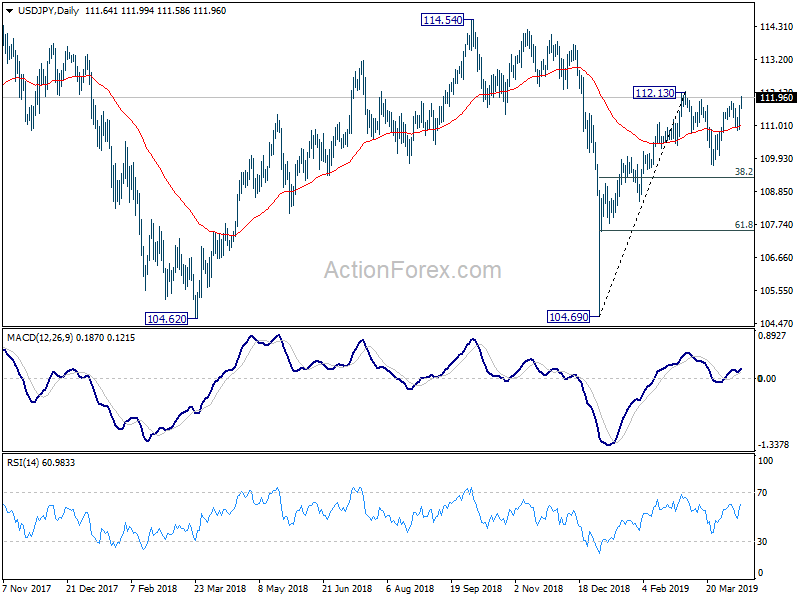
In the bigger picture, medium term outlook in USD/JPY remains a bit mixed as it's staying inside falling channel from 118.65, but there are signs of bullish reversal. On the upside, break of 114.54 resistance will revive the case the corrective fall from 118.65 has completed with three waves down to 104.69. And whole rise from 98.97 (2016 low) is resuming for 118.65 and above. But before that, outlook stays neutral first.
USD/CHF Mid-Day Outlook
Daily Pivots: (S1) 1.0012; (P) 1.0030; (R1) 1.0050; More...
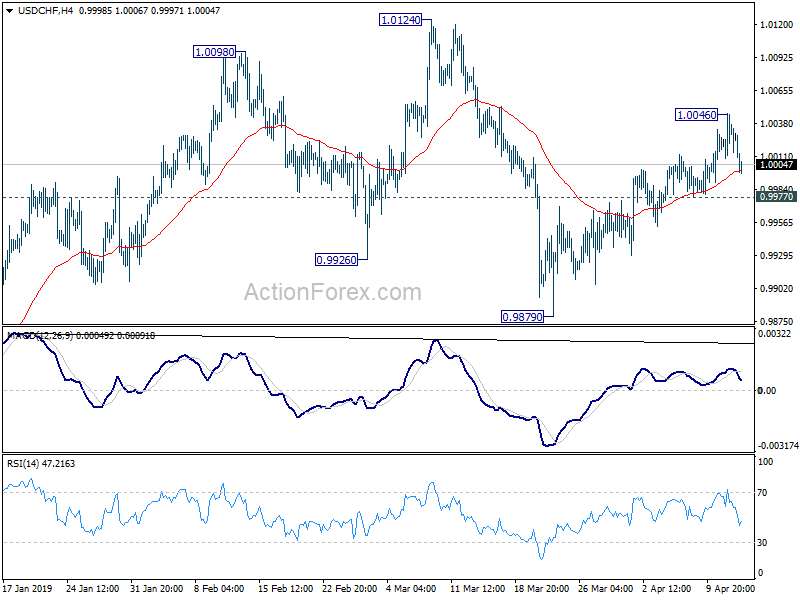
A temporary top is formed at 1.0046 with current retreat. Intraday bias in USD/CHF is turned neutral first. On the upside, above 1.0046 will extend the rise from 0.9879 to 1.0124/28 resistance zone. Decisive break will resume larger up trend from 0.9186. On the downside, though, below 0.9977 minor support will turn bias back to the downside for 0.9879 support instead.
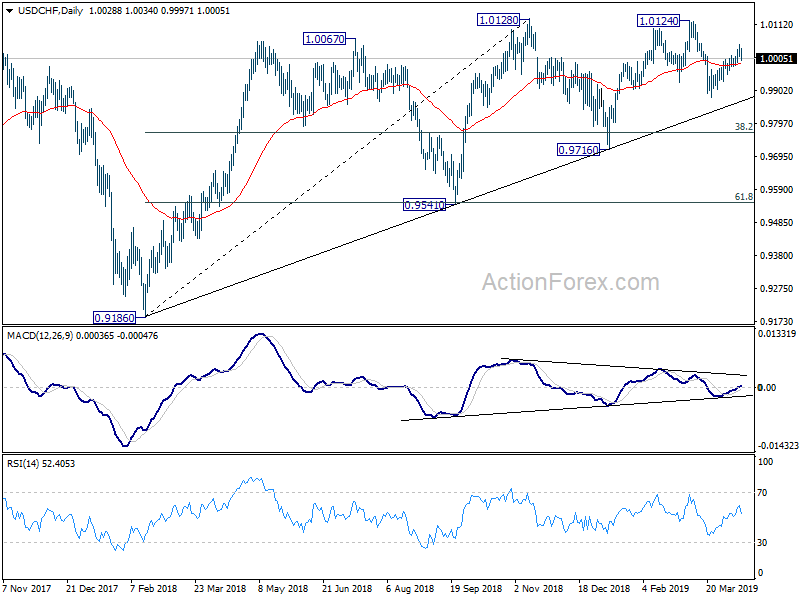
In the bigger picture, USD/CHF is still holding above medium term trend line. Rise from 0.9186 could still be in progress. Decisive break of 1.0128 will resume this medium term rally to 1.0342 resistance next. Meanwhile, sustained break of the trend line (now at 0.9884) will argue that whole rise from 0.9186 has completed. Further break of 0.9716 will confirm reversal and target next support level at 0.9541.
GBP/USD Mid-Day Outlook
Daily Pivots: (S1) 1.3032; (P) 1.3071; (R1) 1.3091; More....
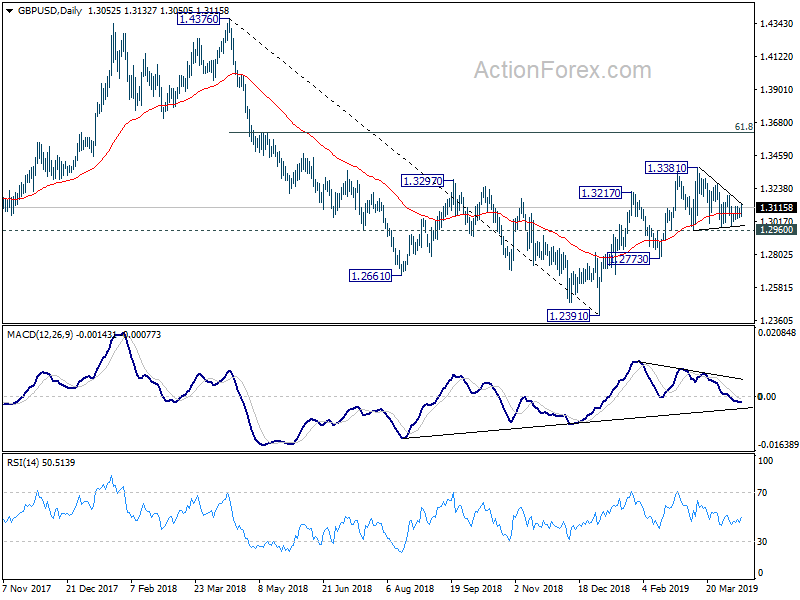
GBP/USD is still bounded in consolidation from 1.3381 and intraday bias stays neutral first. As long as 1.2960 support holds,f further rise is in favor. On the upside, decisive break of 1.3381 will extend the rise from 1.2391 and target 61.8% retracement of 1.4376 to 1.2391 at 1.3618 next. However, on the downside, sustained break of 1.2960 will indicate that rebound from 1.2391 has completed earlier than expected. Deeper fall would then be seen to 1.2773 support for confirmation.
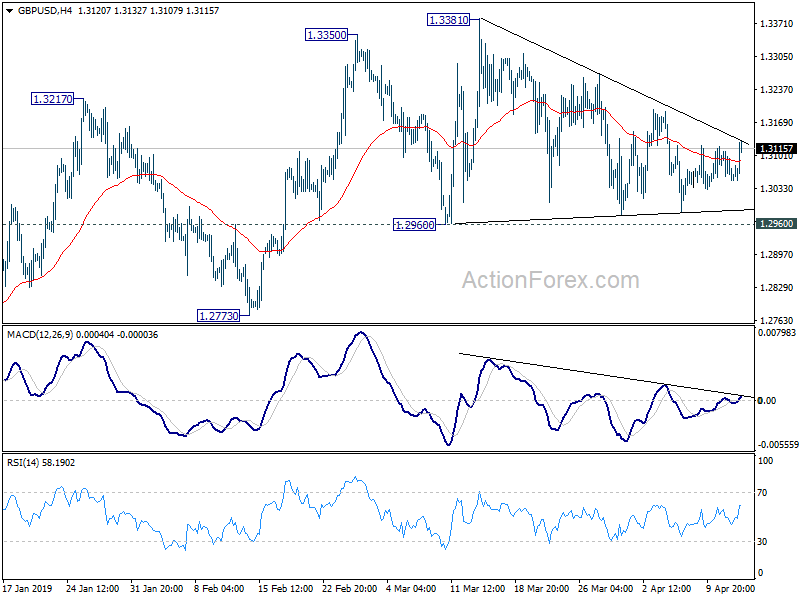
In the bigger picture, medium term decline from 1.4376 (2018 high) should have completed at 1.2391. Rise from 1.2391 is seen as the third leg of the corrective pattern from 1.1946 (2016 low). Further rise could be seen through 1.4376 in medium term. On the downside, though, break of 1.2773 support will dampen this view. Focus will be turned back to 1.2391 low and break will resume the fall from 1.4376 to 1.1946.
EUR/USD Mid-Day Outlook
Daily Pivots: (S1) 1.1241; (P) 1.1264; (R1) 1.1278; More.....
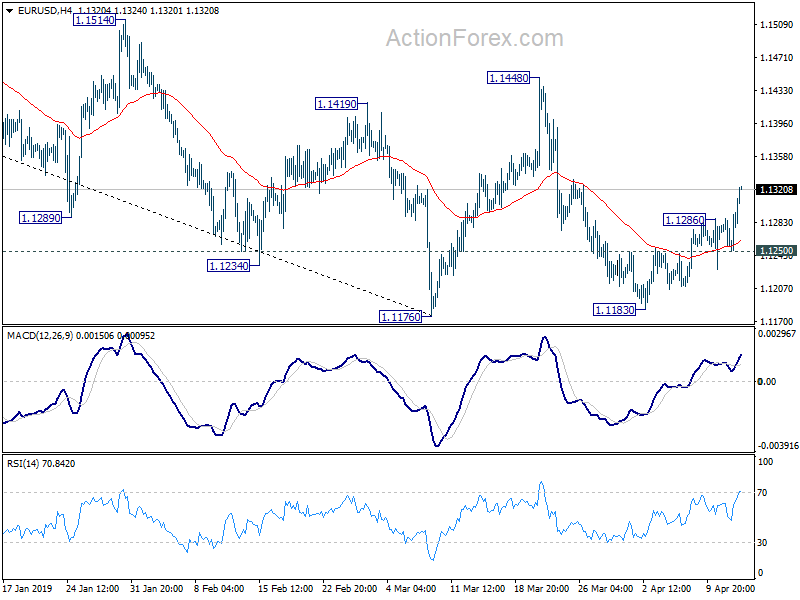
EUR/USD's rise from 1.1183 short term bottom extends to as high as 1.1324 so far today. Intraday bias remains on the upside for 1.1448 resistance, and above. For now, we'd expect strong resistance between 1.1448/1569 to limit upside. On the downside, below 1.1250 minor support will turn bias to the downside. Decisive break of 1.1176 will resume the down trend from 1.2555.
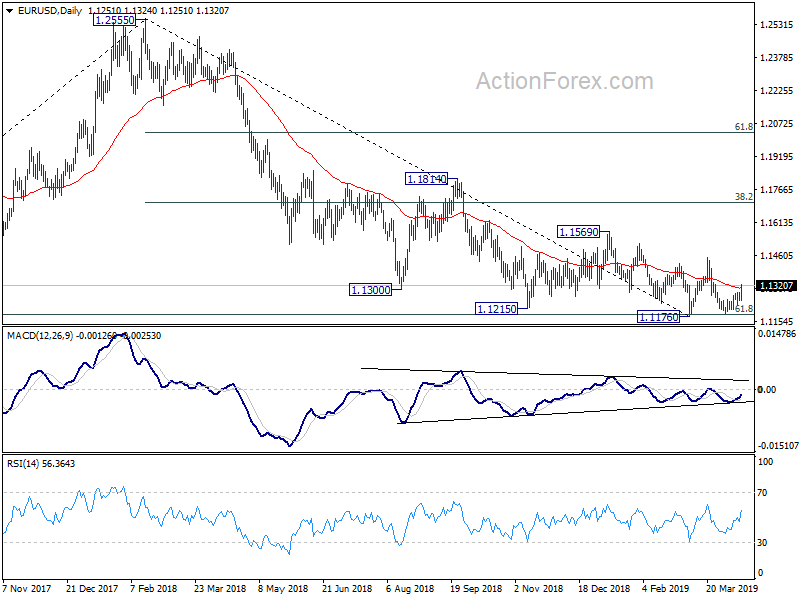
In the bigger picture, medium term weakness was revived as the weak rebound from 1.1176 was rejected well below 55 week EMA and failed to sustain above 55 day EMA. Focus is back on 1.1176 low, with 61.8% retracement of 1.0339 (2016 low) to 1.2555 (2018 high) at 1.1186. Decisive break there will resume whole down trend from 1.2555. Such decline target 1.0339 low next. On the upside, firm break of 1.1569 resistance is needed to be the first sign of medium term bottoming. Otherwise, downside breakout will be in favor.
Global Sentiments Boosted by Rebound in Chinese Exports, German & US Yields Surge
Global market sentiments appeared to be given a strong boost by trade data from China. The much larger than expected rise in export is seen as positive sign of global demand. While there were some weak spots in the set of data, investors are enjoying the rally anyway. The optimism is particular apparent in German 10-year yield jumps through 0.04 handle. US 10-year yield is also pressing 2.55 handle.
In the currency markets, Australian Dollar is the strongest one with tight link to Chinese economy. Euro is second strongest, partly supported by flows linked to Japanese bank's plans to buy a German aviation finance business. Also, EU is seen as having healthy trade growth with China. Yen is currently the weakest, followed by Dollar. From the data, US is clearly lagging behind in trade due to its down policies.
In Europe, currently, FTSE is up 0.20%. DAX is up 0.64%. CAC is up 0.38%. German 10-year yield is up 0.050 at 0.043. Earlier in Asia, Nikkei rose 073%. Hong Kong HSI rose 0.24%. China Shanghai SSE dropped -0.04%. Singapore Strait Times rose 0.03%. Japan 10-year JGB yield rose 0.0096 to -0.049.
Strong rebound in China exports suggest recovery in global trade, but US exports to China shrank -31.8% in Q1
China trade surplus widened to USD 32.6B in March, well above expectation of USD 8.1B. Exports jumped 14.2% yoy in USD 198.7B, well above expectation of 7.7% yoy. That's seen as as sign of rebound in global trade activity. Imports, however, dropped -7.6% yoy to USD 166.0B, much weaker than expectation of -0.1% yoy. It's an indication that domestic demand in China has yet to recover. Cumulative from January to March, expects rose 1.4% yoy to USD 551.8B. Imports dropped -4.8% yoy USD 475.4B. Trade surplus was at USD 76.3B.
Looking at some details, total trade between US and China shrank -15.4% in Q1, comparing with last year, as result of trade war. In particular, imports from US dropped a massive -31.8% yoy in the quarter. On the other hand, imports from Canada jumped 25.9% yoy and imports from Brazil surged 23.8% yoy. Overall trade growth with EU remained healthy.
From January to March cumulative, in USD term, with EU: Total trade rose 5.9% yoy to USD 162.6B. Exports to EU rose 8.8% yoy to USD 97.8B. Imports from EU rose 1.8% yoy to USD 64.8B. Trade surplus was at USD 33.0B.
With US: Total trade dropped -15.4% to USD 119.6B. Exports to US dropped -8.5% to USD 91.1B. Imports from USD dropped -31.8% to USD 28.5B. Trade surplus was at USD 62.6B
With AU: Total trade rose 5.7% to USD 37.9B. Exports to AU rose 9.7% to USD 11.0B. Imports from AU rose 4.1% to USD 26.9B. Trade deficit was at USD 15.9.
UK Hammond: Another Brexit referendum is very likely to be put to parliament at some stage
UK Chancellor of Exchequer Philip Hammond said new referendum was "a proposition that could and, on all the evidence, is very likely to be put to parliament at some stage".
But any new referendum could probably take six months to organize. Thence, time would be tight even though Brexit date is delayed to October 31.
Also, Hammond added: "The government's position has not changed. The government is opposed to a confirmatory referendum and therefore we would not be supporting it."
Bundesbank Weidmann: German growth plausible to be just 0.8% this year
Bundesbank President Jens Weidmann warned that German economy could slow sharply in 2019. Growth rate could eventually be lower than 1%. He pointed to IMF's new projections of just 0.8% for this year and noted that's entirely plausible. It's just half the rate of 1.6% Bundesbank projected back in December.
Weidmann also added, "Fiscal policy, as the minister (Finance Minister Olaf Scholz) said, is already expansionary in Germany and we estimate the impact of fiscal policy on GDP for this year to be between one quarter to one half percentage point."
German economy ministry: Less dynamic, but still upward trend
German Economy Ministry said in the April Economic Report today that the economy continues to show a "mixed picture". Service and construction are "expanding strongly". However, "global oriented manufacturing is still in a weak phase".
The reported note that both global industrial production and world trade were on the decline at the end of 2018. And this "continued in January 2019 in industrial production. Trade had a "slightly recovery" but remained below last year's level.
PMI was at lowest since June 106 while Ifo reflected a "gloomier mood". And, "in light of the indicators and the accumulation of global risks, international organizations are predicting a less dynamic, but still upward, global trend."
Also, "industrial economy is likely to remain subdued in the face of declining foreign demand and high international risks."
Japan-US trade talks to start next week for exchanging views
Japan Economy Minister Toshimitsu Motegi announced today that the first round of Japan-US trade talks will start next week on April 15-16 in Washington. He said he'd intend to exchange view frankly with US Trade Representative Robert Lighthizer. It's believed that a core topic is Japan's near USD 70B trade surplus, with nearly two-thirds from auto exports.
Finance Minister Taro Aso reiterated Japan's intention to "further expand trade and investment between" between the two countries, in a "mutually beneficial manner". He also pointed to the joint statement made last September. However, Japan has been very clear on its intention to defend the multilateral trade pact TPP that it leads, and US quitted under Trump. Hence, no matter what Japan is going to offer to the US, they won't be something better than what's offered to TPP partners.
IMF Gopinath: Auto tariffs could be more damaging to US-China trade war
IMF chief economist Gita Gopinath warned that auto tariffs could be more damaging to the world economy than US-China trade war. She said on the sidelines of IMF and World Bank annual meeting, "we are concerned about what auto tariffs would do to the global economy at a time when we are more in the recovery phase."
Trade conflicts of the US and others, including China, EU, Canada and Japan could spill over into the auto sector. And that could have severe damage to the global manufacturing supply chains, She warned, "that would actually be far more costly for the world economy than just the U.S.-China trade tensions that we had."
In the US, the Commerce Department has already submitted Section 232 national security report on auto imports earlier this year. Trump will have until May 17 to decide whether he wants to extend punitive tariffs from steal to auto, and from rival in China to allies in EU, Canada and Japan.
EUR/USD Mid-Day Outlook
Daily Pivots: (S1) 1.1241; (P) 1.1264; (R1) 1.1278; More.....
EUR/USD's rise from 1.1183 short term bottom extends to as high as 1.1324 so far today. Intraday bias remains on the upside for 1.1448 resistance, and above. For now, we'd expect strong resistance between 1.1448/1569 to limit upside. On the downside, below 1.1250 minor support will turn bias to the downside. Decisive break of 1.1176 will resume the down trend from 1.2555.
In the bigger picture, medium term weakness was revived as the weak rebound from 1.1176 was rejected well below 55 week EMA and failed to sustain above 55 day EMA. Focus is back on 1.1176 low, with 61.8% retracement of 1.0339 (2016 low) to 1.2555 (2018 high) at 1.1186. Decisive break there will resume whole down trend from 1.2555. Such decline target 1.0339 low next. On the upside, firm break of 1.1569 resistance is needed to be the first sign of medium term bottoming. Otherwise, downside breakout will be in favor.
Economic Indicators Update
| GMT | Ccy | Events | Actual | Forecast | Previous | Revised |
|---|---|---|---|---|---|---|
| 22:30 | NZD | BusinessNZ Manufacturing PMI Mar | 51.9 | 53.7 | ||
| 01:30 | AUD | RBA Financial Stability Review | ||||
| 06:50 | CNY | Trade Balance (USD) Mar | 32.6B | 8.1B | 4.1B | |
| 06:50 | CNY | Exports Y/Y Mar | 14.20% | 7.70% | -20.70% | |
| 06:50 | CNY | Imports Y/Y Mar | -7.60% | -0.10% | -5.20% | |
| 06:50 | CNY | Trade Balance CNY Mar | 221B | 2B | 34B | |
| 06:50 | CNY | Exports Y/Y CNY Mar | 21.30% | 5.80% | -16.60% | |
| 06:50 | CNY | Imports Y/Y CNY Mar | -1.80% | 1.00% | -0.30% | |
| 09:00 | EUR | Eurozone Industrial Production M/M Feb | -0.20% | -0.60% | 1.40% | 1.90% |
| 12:30 | USD | Import Price Index M/M Mar | 0.60% | 0.40% | 0.60% | 1.00% |
| 14:00 | USD | U. of Mich. Sentiment Apr P | 98.3 | 98.4 |
UK Hammond: Another Brexit referendum is very likely to be put to parliament at some stage
UK Chancellor of Exchequer Philip Hammond said new referendum was "a proposition that could and, on all the evidence, is very likely to be put to parliament at some stage".
But any new referendum could probably take six months to organize. Thence, time would be tight even though Brexit date is delayed to October 31.
Also, Hammond added: "The government's position has not changed. The government is opposed to a confirmatory referendum and therefore we would not be supporting it."
Canadian Dollar Lower, US Consumer Confidence Next
The Canadian dollar has lost ground on Friday, erasing most of the gains seen on Thursday. Currently, USD/CAD is trading at 1.3336, down 0.37% on the day. On the release front, there are no Canadian events. In the U.S., UoM consumer sentiment is expected to improve to 98.1. As well, the Treasury department releases its semi-annual currency report.
There was some positive news on the U.S. inflation front, as key indicators headed higher in March. CPI, the key gauge of consumer spending, climbed to 0.4%, its highest gain since January 2018. The producers price index also looked strong, climbing 0.6%, a 5-month high. Inflation remains well below the Federal Reserve target of 2.0%, but stronger inflation numbers will bolster the case of Fed officials who favor raising rates in 2019 if the economic outlook improves. The Fed minutes from the March meeting left the door open to further rate hikes this year, but current market pricing suggests no hikes until 2020, and some analysts are expecting a cut in rates later this year.
Earlier in the week, the IMF downgraded economic forecasts worldwide, and Canada was no exception. The IMF lowered its forecast for the Canadian growth from 1.9% to 1.5%. The report noted that Canada would be a major beneficiary if the U.S and China can hammer out a deal and end their bruising trade war. The IMF also lowered its forecast for global growth, from 3.5% to 3.3%.