

Sample Category Title
British Pound Reverses Its Losses In The Asian Session
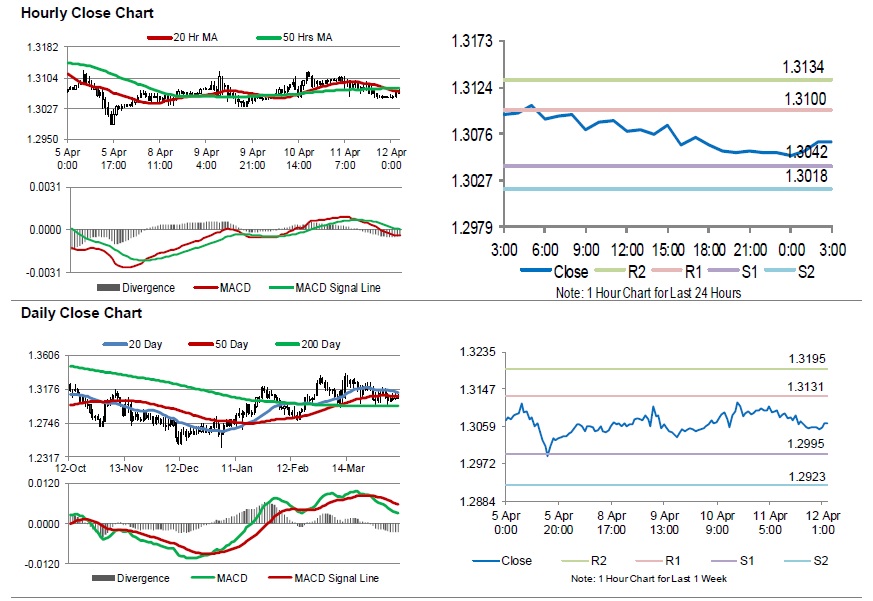
For the 24 hours to 23:00 GMT, the GBP declined 0.25% against the USD and closed at 1.3057, amid rising worries after the European leaders delayed Brexit until 31 October 2019.
In the Asian session, at GMT0300, the pair is trading at 1.3067, with the GBP trading 0.08% higher against the USD from yesterday’s close.
The pair is expected to find support at 1.3042, and a fall through could take it to the next support level of 1.3018. The pair is expected to find its first resistance at 1.3100, and a rise through could take it to the next resistance level of 1.3134.
Amid no major economic releases in the UK today, investors would focus on global macroeconomic factors for further cues.
The currency pair is showing convergence with its 20 Hr moving average and trading below its 50 Hr moving average.
Japanese Yen Extends Its Losses In The Morning Session
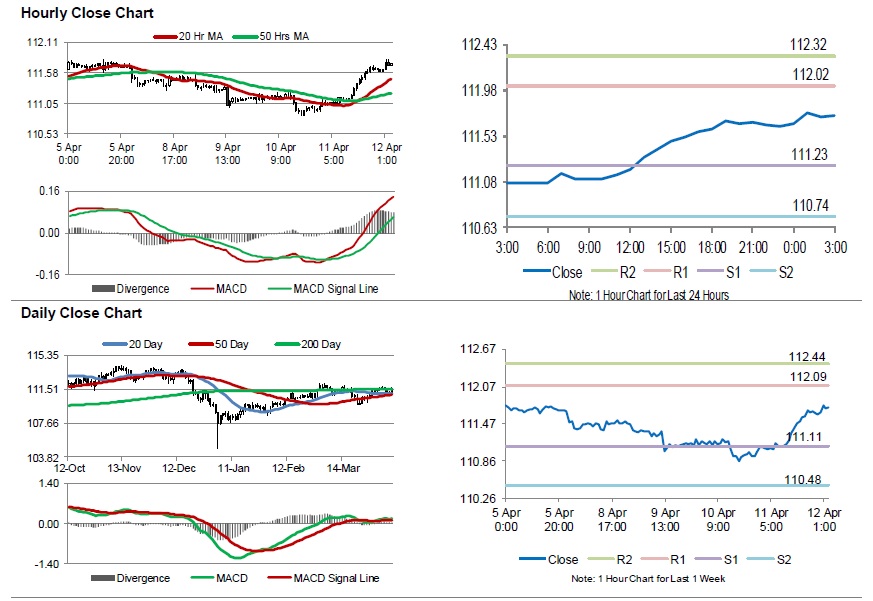
For the 24 hours to 23:00 GMT, the USD rose 0.60% against the JPY and closed at 111.62.
In the Asian session, at GMT0300, the pair is trading at 111.73, with the USD trading 0.10% higher against the JPY from yesterday’s close.
The pair is expected to find support at 111.23, and a fall through could take it to the next support level of 110.74. The pair is expected to find its first resistance at 112.02, and a rise through could take it to the next resistance level of 112.32.
Going forward, traders would await Japan’s trade balance data and industrial production, both scheduled to release next week.
The currency pair is trading above its 20 Hr and 50 Hr moving averages.
Swiss Franc Trading Slightly Higher In The Morning Session
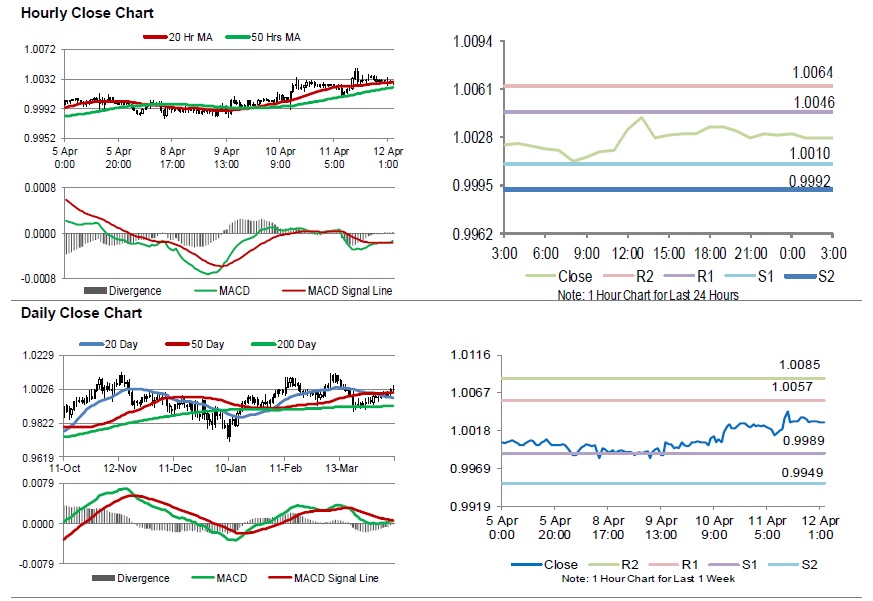
For the 24 hours to 23:00 GMT, the USD rose 0.07% against the CHF and closed at 1.0029.
In the Asian session, at GMT0300, the pair is trading at 1.0028, with the USD trading slightly lower against the CHF from yesterday’s close.
The pair is expected to find support at 1.0010, and a fall through could take it to the next support level of 0.9992. The pair is expected to find its first resistance at 1.0046, and a rise through could take it to the next resistance level of 1.0064.
The currency pair is showing convergence with its 20 Hr moving average and trading above its 50 Hr moving average.
Canada’s New Housing Price Index Advanced In Line With Estimates In February
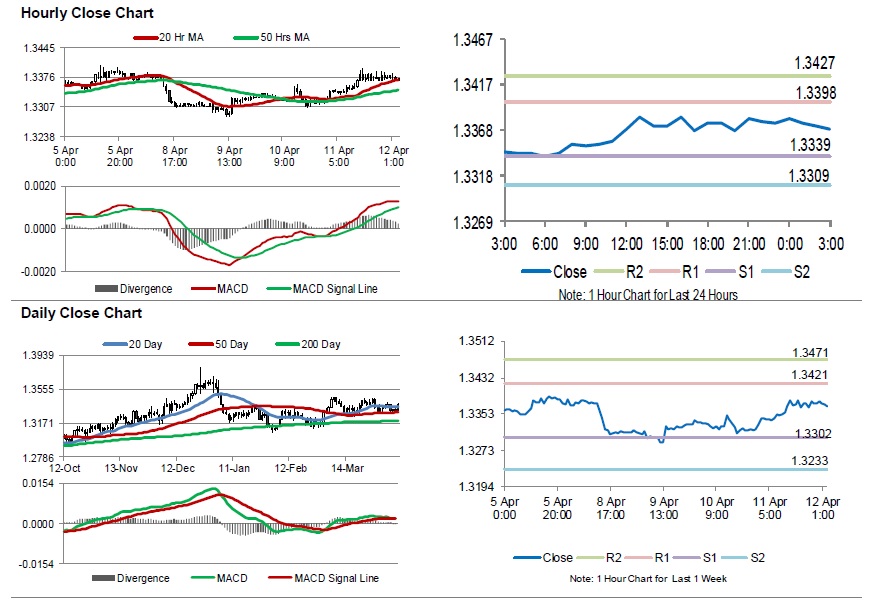
For the 24 hours to 23:00 GMT, the USD rose 0.44% against the CAD and closed at 1.3376.
Data showed that Canada's new housing price index rebounded 0.1% on a yearly basis in February, in line with market expectations. In the prior month, the index had recorded a drop of 0.1%.
In the Asian session, at GMT0300, the pair is trading at 1.3370, with the USD trading a tad lower against the CAD from yesterday's close.
The pair is expected to find support at 1.3339, and a fall through could take it to the next support level of 1.3309. The pair is expected to find its first resistance at 1.3398, and a rise through could take it to the next resistance level of 1.3427.
Going forward, investors would closely monitor Canada's existing home sales, manufacturing shipments and the consumer price index, all set to release next week.
The currency pair is showing convergence with its 20 Hr moving average and trading above its 50 Hr moving average
Aussie Trading A Tad Higher In The Asian Session
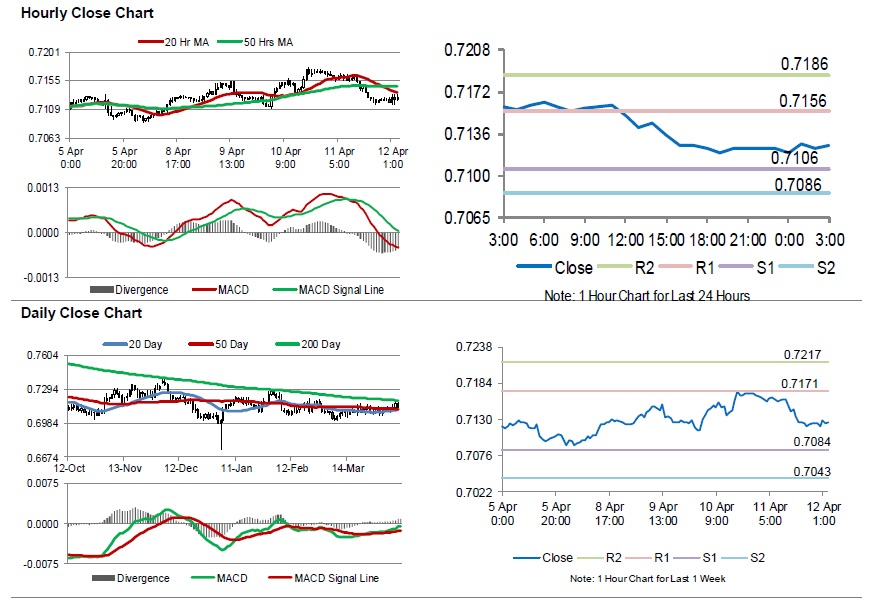
For the 24 hours to 23:00 GMT, the AUD declined 0.61% against the USD and closed at 0.7124.
LME Copper prices declined 0.2% or $14.5/MT to $6432.5/MT. Aluminium prices declined 0.2% or $4.5/MT to $1847.5/MT.
In the Asian session, at GMT0300, the pair is trading at 0.7126, with the AUD trading marginally higher against the USD from yesterday’s close.
The pair is expected to find support at 0.7106, and a fall through could take it to the next support level of 0.7086. The pair is expected to find its first resistance at 0.7156, and a rise through could take it to the next resistance level of 0.7186.
Amid lack of economic releases in Australia today, traders would focus on global macroeconomic events for further direction.
The currency pair is trading below its 20 Hr and 50 Hr moving averages.
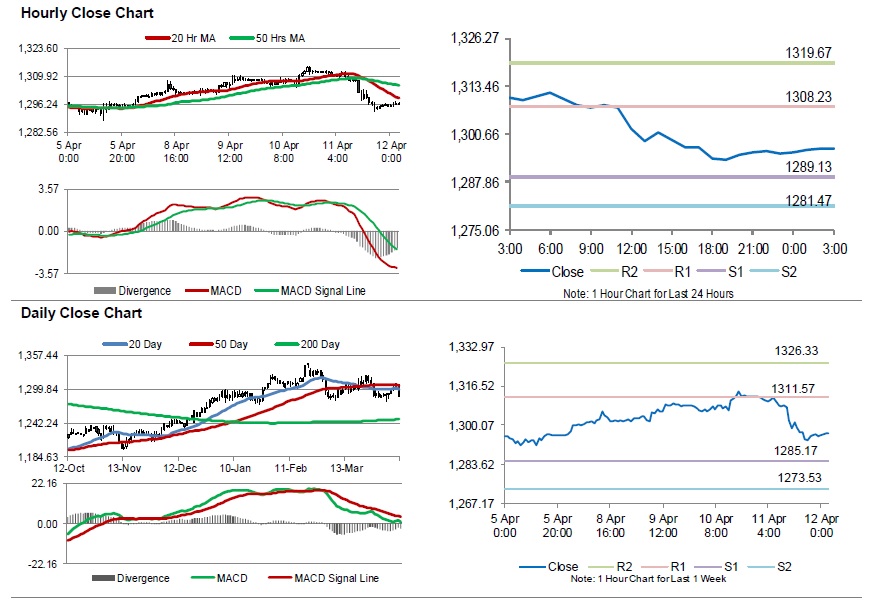
Gold: Yellow Metal Trading Higher In The Asian Session
For the 24 hours to 23:00 GMT, Gold declined 1.22% against the USD and closed at USD1296.20 per ounce, amid broad strength in the US dollar.
In the Asian session, at GMT0300, the pair is trading at 1296.80, with gold trading 0.05% higher against the USD from yesterday’s close.
The pair is expected to find support at 1289.13, and a fall through could take it to the next support level of 1281.47. The pair is expected to find its first resistance at 1308.23, and a rise through could take it to the next resistance level of 1319.67.
The yellow metal is trading below its 20 Hr and 50 Hr moving averages.
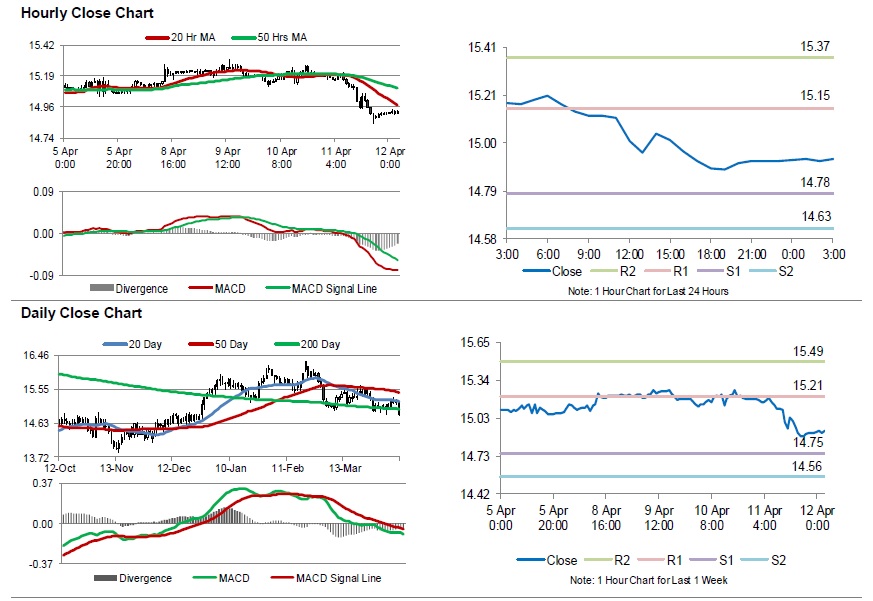
Silver: White Metal Trading On A Stronger Footing This Morning
For the 24 hours to 23:00 GMT, Silver declined 1.81% against the USD and closed at USD14.92 per ounce, led by losses in gold prices.
In the Asian session, at GMT0300, the pair is trading at 14.93, with silver trading 0.07% higher against the USD from yesterday’s close.
The pair is expected to find support at 14.78, and a fall through could take it to the next support level of 14.63. The pair is expected to find its first resistance at 15.15, and a rise through could take it to the next resistance level of 15.37.
The white metal is trading below its 20 Hr and 50 Hr moving averages.
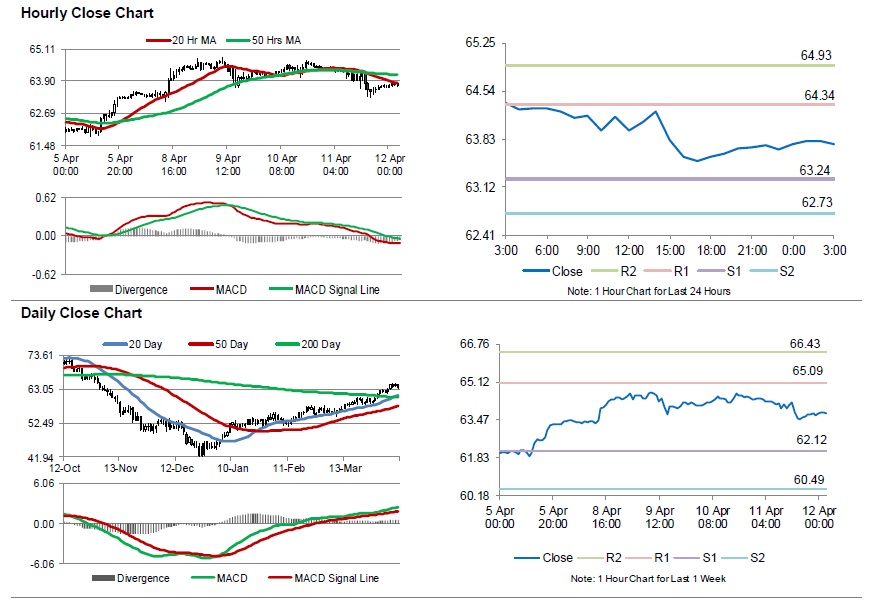
Crude Oil: Oil Trading Higher, Ahead Of Baker Hughes Weekly Rig Count Data
For the 24 hours to 23:00 GMT, Crude Oil declined 1.07% against the USD and closed at USD63.68 per barrel, after the International Energy Agency, in its monthly report, expressed concerns over the adverse effects of global economic slowdown on crude oil demand.
In the Asian session, at GMT0300, the pair is trading at 63.76, with oil trading 0.13% higher against the USD from yesterday’s close.
The pair is expected to find support at 63.24, and a fall through could take it to the next support level of 62.73. The pair is expected to find its first resistance at 64.34, and a rise through could take it to the next resistance level of 64.93.
Crude oil is showing convergence with its 20 Hr moving average and trading below its 50 Hr moving average.
Elliott Wave View: Silver Extending Lower
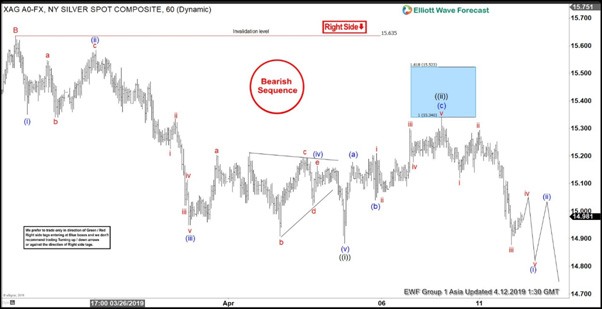
Short term Elliott Wave view on Silver (XAGUSD) suggests that the decline from February 21, 2019 ($16.21) is incomplete. Structure of the decline from $16.21 is unfolding as a zigzag Elliott Wave structure. Wave B of this zigzag structure ended at $15.63. Wave C lower has started and should subdivide in 5 waves. Down from $15.63, wave ((i)) ended at $14.88 and wave ((ii)) ended at $15.34. The internal of wave ((i)) subdivides as 5 waves of lesser degree. Wave (i) of ((i)) ended at $15.35 and bounce to $15.58 ended wave (ii) of ((i)). The metal then turned lower in wave (iii) of ((i)) and ended at $14.95. Wave (iv) of ((i)) ended at $15.16 and wave (v) of ((i)) ended at $14.88.
Bounce in wave ((ii)) unfolded as a zigzag Elliott Wave structure in lesser degree. Wave (a) of ((ii)) ended at $15.8, wave (b) of ((ii)) ended at $15.08, and wave (c) of ((ii)) ended at $15.34. Silver has since resumed lower and broken below wave ((i)) at $14.88, suggesting the next leg lower has started. We don’t like buying the bounce and expect bounce should find sellers in 3, 7, or 11 swing as far as pivot at $15.63 stays intact.
1 Hour Silver (XAGUSD) Elliott Wave Chart Asia Update
Cliff Notes: Elections and Extensions
Key insights from the week that was.
The Federal election campaign officially kicked off in Australia this week shortly after the Westpac-MI consumer sentiment indicated the Budget was well received. Overseas, central banks reiterated a cautious tone while the Brexit deadline was extended (again).
Wednesday’s Westpac-MI Consumer Sentiment survey was eagerly anticipated after last week’s release of the 2019/20 Federal Budget included a further $19.5bn in income tax relief.
While the month to month rise in Sentiment was fairly muted at 100.7 compared to 98.8 in March, sentiment clearly caught an uplift from the Budget. Indeed, among those surveyed post-budget, sentiment was 7.7% higher than those surveyed pre-budget – the most positive turnaround since we began tracking pre and post budget responses in 2011.
Yet it is important to take a step back from the near-term lift in overall sentiment. Persistent weak wages growth, falling house prices, and the perceived rising cost of living are all still weighing on consumers. This is reflected in the survey component ‘family finances compared to a year ago’ – which declined 4.9% in April (showing little movement between pre and post Budget responses) and is down 9.6% on a year ago.
In that respect, disappointing consumption growth was a key theme in RBA Deputy Governor Debelle’s speech on “The State of the Economy”. Ultimately, “unexpectedly weak” consumption had been the main surprise in recent growth outturns with “other parts of GDP” evolving “broadly as expected”.
Here, Debelle related some part of the slowdown to declines in housing prices but was sceptical of a direct ‘wealth’ effect. Instead, he believes lower housing turnover is the main factor as consumers spend less on household furnishings as well as vehicles. With more supply coming on to the Melbourne and Sydney housing markets this year, Debelle sees further weight on prices. While some comfort can be found in the stable read in Feb housing finance on Tuesday, today’s release of the biannual Financial Stability Review is still likely to emphasise that the RBA is cautious and watching housing.
However, of greater concern to Debelle in regards to the consumption outlook is low household income growth and the consumer’s “increasing expectation that it is likely to remain low”. The RBA remain of the view that household income is likely to pick-up over the next few years but this is conditioned on strength in the labour market persisting. Indeed, the key take-out from Debelle’s speech is that the RBA are still assessing “conflicting signals provided by the labour market, the GDP data and the business surveys”. Westpac believes that the ‘tension’ in the data will become clearer in due course, with our expectation that the RBA will deliver rate cuts in August and November this year – see today’s bulletin on “The AUD, the RBA, the FOMC & commodities” from our Chief Economist Bill Evans.
Turning to offshore matters, the major thematic this week relates to central banks remaining in a cautious watch-and-wait mode, which coincides with the IMF downgrading their 2019 growth forecast to 3.3% from 3.5%.
In the US, the FOMC minutes largely reflected communication from committee members over the past month. While “some” members noted it could be appropriate to raise rates in 2019, and “several” noted their view on rates could move up or down and were not on a pre-set course, a “majority” see rates on hold this year - as per the dot plot.
Further emphasising the capacity for the FOMC to maintain their “patient” approach was the release of Mar CPI that same morning. Headline inflation overshot expectations but the core indicator underwhelmed with annual core CPI inflation declining to 2.0% from 2.1%. A lack of inflationary pressure means the FOMC can maintain a steady hand while the outcomes of various global uncertainties unfold. With that in mind, Westpac has revised its outlook for the federal funds rate to being on hold in 2019 and 2020. Our April Market Outlook was released this week and contains a comprehensive update on the Westpac view.
Across the Atlantic, the April ECB meeting confirmed the policy stance after the dovish shift in March. New information has been consistent with “slower growth momentum extending into the current year” and while “idiosyncratic domestic factors dampening growth are fading, global headwinds continue to weigh”. Accordingly, the ECB continues to believe risks are tilted to the downside.
Discussion on the pricing of new TLTRO was scarce (an announcement to be made in forthcoming meetings), but the ECB did note in April that they are analysing possible side effects of negative interest rates on the back of the recent discussion on the ECB potentially moving to a tiered deposit rate. The analysis is still in its early stages, and we do not expect a change to tiering any time soon, but if anything, the opening of the debate underscores the ECB’s awareness of rates likely being ‘low-for-longer’ in a general sense.
To the UK, the outcome of this week’s EU Summit is that the Brexit deadline has been extended to 31 October, with the option to leave sooner if the UK Parliament can agree on a path forward. This is longer than the 30 June delay UK PM May had hoped for, and will mean the UK will have to take part in European Parliament elections on 23 May, if they have not found an agreement by then.