

Sample Category Title
USDJPY Sees Rally With Eyes On 111.82 Zone
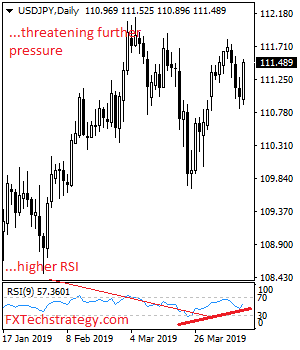
USDJPY sees rally with eyes on 111.82 zone in the days ahead. On the upside, resistance comes in at 112.00 level. Above this level will turn attention to the 112.50 level. Further out, we expect a possible move towards the 113.00 level. A cut through here will open the door for more gain towards the 113.50. On the downside, support comes in at the 111.00 level where a break will target the 110.50 level. Below that level will turn focus to the 110.00 level and then lower towards the 109.50 level. On the whole, USDJPY sees rally with eyes on 111.82 zone in the days ahead.
Fed Kashkari: We should really live the symmetric inflation target
Minneapolis Fed President Neel Kashkari noted that Fed "officially have a symmetric target" on inflation. Actual inflation has "averaged around 1.7%" for the past seven years, which was below the 2% target. Therefore, "if we were at 2.3% for several years that shouldn't be concerning." He also emphasized that "we should really live the symmetric target and not tap the brakes prematurely." Thus, "this is why I've been arguing for more accommodative monetary policy.
Kashkari also said he's "concerned" with yield curve inversion. However, he added: "I don't necessarily believe it causes recessions but i believe it's giving feedback that monetary policy is close to neutral today. We don't want contractionary monetary policy unless we have good reason. We should be careful not to end the expansion."
BoJ Kuroda: Global economy will recover in second half of the year
BoJ Governor Haruhiko Kuroda said that global economy would recover in the second half as he arrived for the G20 finance ministers meeting in Washington yesterday. He said, "our baseline scenario is that the global economy will recover in the latter half of this year, and achieve sufficiently high growth next year."
Also, he defended rule-based multilateral trade system. Kuroda warned that "protectionism benefits neither the United States nor China." He urged "both countries, as well as each G20 economy, must make efforts to solve problems based on the understanding that free trade under World Trade Organization rules has brought enormous benefits to the global economy."
Eco Data 4/12/19
[php_everywhere instance="1"]
Q1 Earnings Season: A Helping Hand or a Hand Out?
The time for the earnings season is coming again this Friday but unlike preceding releases, the S&P 500 companies are expected to have had a negative ride year-on-year in Q1 2019 for the first time since Q2 2016, with Refinitiv data suggesting a 2.5% decline in earnings per share. Another difference is that traders are feeling both nervousness and excitement as the unsurprising growth downgrade by the IMF earlier this week confirmed that something is wrong with the global economy, while in Wall Street, US stock indices look to be nearing an edge.
Markets are well informed that trade issues with China and the US, the Brexit nightmare and a slowing Europe are the primary reasons why the global and hence the US economy may lose steam in the near future. Still, despite the ups and downs in figures, the US is relatively in good shape given the uncertainty elsewhere in the world. Besides the suspicious tiny increase in February, US employment growth reached the highest in a year in January before returning to normal levels in March. The unemployment rate remains the lowest in a decade, while the wage growth did not rise dramatically in the first quarter after all. The Fed’s decision to halt its rate hiking plans this year was also a relief to businesses and could juice firms’ profits as long as the US data suggest steady interest rates.
While diminishing support from the 2017 tax cut program could excuse negative earnings, the above evidence recommends that the results may not drop as deep in the red as forecasts suggest. Yet, for Wall Street to blow itself up, business executives need to share an encouraging forward guidance, which may simply not occur this time as the recent US threat of $11 billion tariffs against EU products indicates worryingly that Washington is not feeling pressure to change its aggressive trade stance against Europe or even China. Meanwhile in Europe, Brexit remains a headache to US multinationals as the EU-UK agreement to postpone the exit day to October 31 has just extended the uncertainty further on the horizon. Italy is another dark spot and a key threat especially after the finance minister admitted that the budget deficit could hit above 2.0%, violating the government’s agreement with the EU.
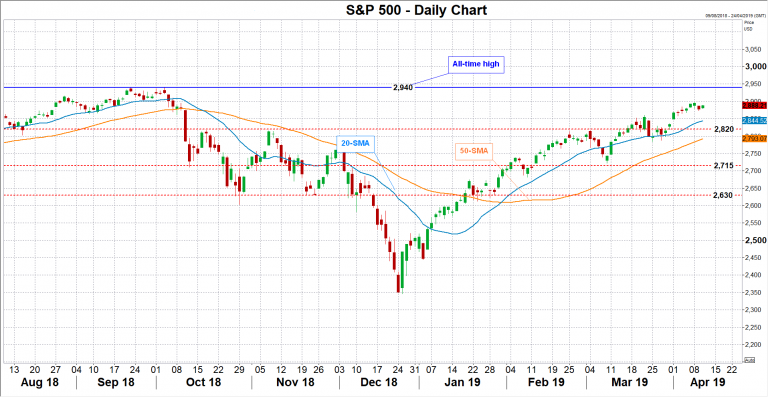
The location of the S&P 500 itself provides further conviction that the bears have more chances to retake control. Although the upward steep pattern from the December’s 20-month lows is considered a sign of continuity, the market is not far from its record high levels reached in September, nor is the Dow Jones, creating thoughts that space for improvement is limited before selling action comes into play again and hence profit taking may be more suitable. In such a case, a worse-than-expected earnings performance would match the speculation, letting the price to decline towards the 2,820 former resistance area. Breaking this level, support could be next found between 2,715 and 2,630.
In the positive scenario, a stronger earnings season accompanied with hopes of a brighter economic future would add more sparkle to stocks, lifting the index up to previous all time-highs around 2,940 or even above 3,000.
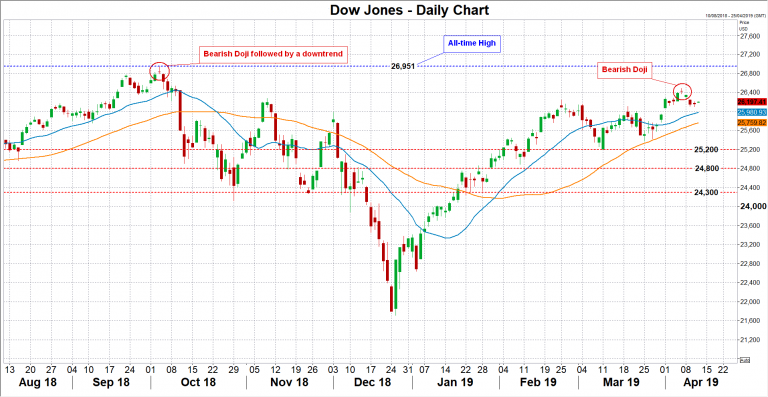
Turning to the US30 (Dow Jones), the bearish doji star around 26,400 and the following lower candles could be interpreted as a warning of a potential trend reversal as was the case back in October. If the data disappoint, the 50-day moving average (currently at 25,736) could come on the radar ahead of the 25,200 and 24,800 support levels. Deeper, 24,400 may be a bigger challenge for the bears.
Alternatively, if the doji proves an anomaly, with the price jumping above it, all eyes will shift up to the 26,951 record high.
In brief, the outcome of the earnings releases may not be as bad as forecasters believe, though with major US stock indices trading near record highs and global headwinds feeding gloomy thoughts, a sell-off is possible.
Elliott Wave Analysis: Bulls Picking USDJPY Up
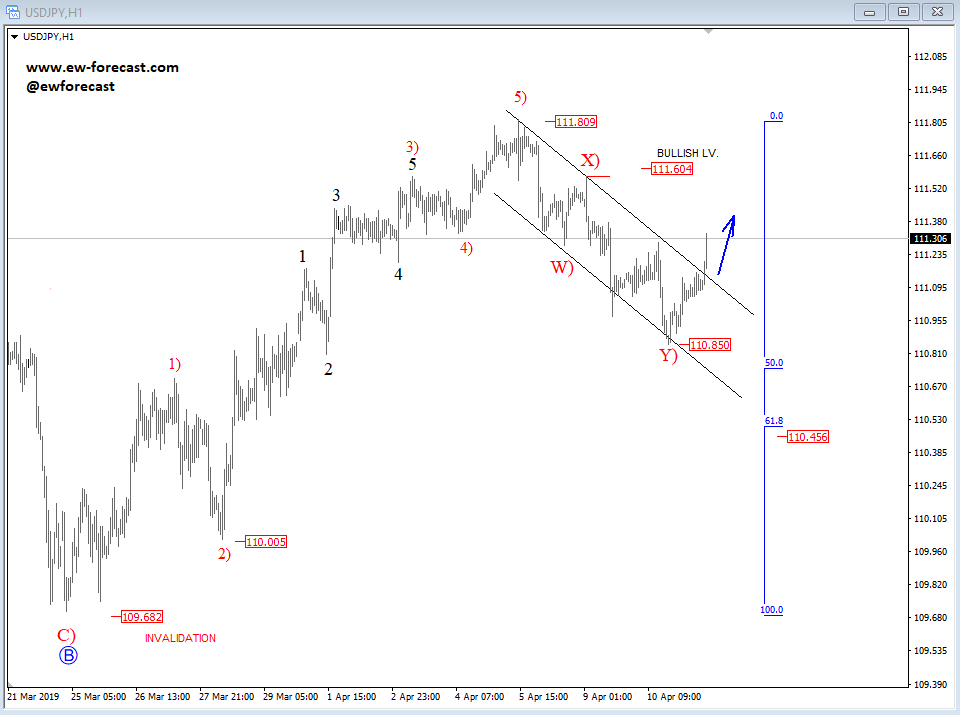
USDJPY is breaking higher according to the expectations of a strong USD. So, since we noticed a complex w-x-y corrective decline, USDJPY can be finally headed higher back to 112.15 highs, especially if pair starts breaking above 111.60 bullish confirmation level. In case we get surprised by another decline back below 110.85 region, then we would start tracking a deeper and more complex correction. However, as long as price keeps trading above 109.70 invalidation level, we remain bullish.
USDJPY, 1h
US Data Shines, But Pound Unmoved
GBP/USD has ticked lower in the Thursday session. In North American trade, GBP/USD is trading at 1.3081, down 0.06% on the day. There are no British indicators on the schedule. In the U.S., key indicators were strong. PPI climbed 0.6%, above the estimate of 0.3%. Core PPI improved to 0.3%, edging above the forecast of 0.2%. Unemployment claims sparkled, dropping to 196 thousand, well below the estimate of 210 thousand. On Friday, the U.S. releases UoM consumer sentiment and the semi-annual Treasury currency report.
The International Monetary Fund has downgraded its economic forecasts worldwide, but the projection for the U.K. was particularly bleak. The IMF warned that a no-deal Brexit would push the country into recession, and the damage to the British economy would be seven times as severe as the toll on the European Union. The IMF noted that economic dislocation to border disruption, in the event of a hard Brexit, would be particularly painful to the economy. The IMF lowered its growth forecast for the U.K. from 1.5% in January to 1.2% in April, and for the global economy, from 3.5% in January to 3.3% in April.
The Federal Reserve was on center stage on Wednesday, with the release of the minutes from the March meeting. The Fed left the door open to rate hikes in 2019, provided that economic conditions improved. Some members said that they expected the economy to improve, while others said that rate movement could shift “in either direction based on incoming data and other developments”. The markets have priced in no rate hikes in 2019, and if the Fed continues to leave the door open to higher rates this year, the U.S. dollar could become more attractive to investors.
Fed Clarida: Baseline economic projections see growth somewhat above trend in 2019
Fed Vice Chair Richard Clarida said "the current economic expansion almost certainly will become the longest on record". But " incoming data have revealed signs that U.S. economic growth is slowing somewhat from 2018's robust pace". Also, "prospects for foreign economic growth have been marked down, and important international risks, such as Brexit, remain." On inflation, core PCE, a "better gauge of underlying inflation pressures", has been muted. And, "some indicators of longer-term inflation expectations remain at the low end of a range" of price-stability.
Clarida reiterated that federal funds rate is now "in the broad range of estimates of neutral". The baseline economic projections see growth in 2019 "running somewhat above" trend and core PCE inflation remains near 2%. Thus, Fed "can be patient as we assess what adjustments, if any, will be appropriate to the stance of monetary policy.
Fed Bullard: Upcoming policy adjustments no longer part of normalization campaign
St. Louis Fed President James Bullard said if economy evolves as expected, current interest rate will be appropriate through 2019. Balance sheet reduction program will end this autumn. "These events mark the end of monetary policy normalization in the U.S."
Bullard said the normalization campaign has been "largely successful". Nominal short-term interest rates have been raised from near-zero levels, and the size of the Fed's balance sheet has been reduced as the economic expansion has continued.
Going forward, the FOMC may elect to adjust monetary policy going forward. However, Bullard said that will not be "part of an ongoing normalization strategy". Adjustments will be "in response to incoming macroeconomic data".
On yield curve inversion, Bullard said "yield curve information is not infallible, and inversion could be driven by other factors unrelated to future macroeconomic performance"."Nevertheless, the empirical evidence is relatively strong. Therefore, both policymakers and market professionals need to take the possibility of a meaningful and sustained yield curve inversion seriously."
Sunset Market Commentary
Markets
Global core bonds lost (modest) ground today with US Treasuries underperforming German Bunds. ECB chairman Draghi delivered a dovish message at yesterday’s policy meeting, lifting German Bunds. Despite positive signals from the US-Sino trade talks, risk sentiment was negative overnight. Asian bourses closed in red, with Chinese indices underperforming. The EU and UK PM May found an agreement on a new Brexit extension, but markets already anticipated that. German Bunds opened steady with a small downward bias. Sentiment was today’s driver as the second-tier eco data in the EMU didn’t impact trading. German Bunds are maintaining most of yesterday’s post-ECB gains. The German yield curve is moving little higher with changes up to 0.7 bps (10-yr). US Treasuries lost ground as well, initially as a reaction to yesterday’s rather exaggerated gains in lockstep with German Bunds. The move south accelerated as US jobless claims printed stronger-than-expected at 196k, the lowest level since 1969, underlining the strength of the US labour market. US (headline) producer inflation printed higher in March, but core inflation remained stable. The US yield curve is moving higher with changes up to 3.6 bps (5-yr).
The euro showed remarkable resilience yesterday even as ECB’s Draghi indicated that rates will probably stay very low for (very) long. He even kept the door open for additional easing if necessary. At the same time, US yields also declined, leaving the dollar with no additional interest rate support despite a soft ECB. This balance of weakness between the euro and the dollar still persisted this morning. There were few eco data with market moving potential in EMU or in the US today. EUR/USD retested this week’s peak levels in the 1.1285 area. However, no follow-through euro buying occurred. What can’t go up, must come down. A the start of the US session, US headline PPI printed substantially higher than expected and jobless claims dropped to a very low sub-200k level. The US-German interest rate spread widened slightly. EUR/USD slipped further south and is currently trading in the 1.1260 area. USD/JPY gained a few ticks to trade in the 111.30 area.
Sterling trading entered some kind of no man’s land. The immediate threat of a no-deal Brexit is probably avoided. At the same time, the impasses in UK politics persists. The negotiations between officials of PM May’s Conservative party and the Labour opposition continue. However, for now there is no indication on what a compromise might look like, if any. At the same time, UK PM May faces strong headwinds from Brexiteers in her own party, with the likely organization of EU elections in the UK a first high profile sources of discontentment. The prolonged period of uncertainty probably also keeps the BoE on the side-lines for longer. EUR/GBP hovered in in the lower part of the 0.86 big figure for most of the day. Cable is changing hands in the 1.3075 area.
News Headlines
US headline producer prices rose 0.6% M/M in March, the fastest monthly pace since October last year. The rise was mostly due to gasoline prices. However Core PPI inflation (excluding Food, energy and trade) printed at a soft 0.0% M/M and 2.0% Y/Y (2.3% Y/Y in February). In a different report US jobless claims printed 196 000, the lowest level since 1969, indicating tight labour market conditions. Continuing claims also declined to 1716k.
Sweden’s CPI inflation printed slightly higher than expected in March. CPI inflation rose 0.2% M/M to be up 1.9% Y/Y. Inflation excl. energy was also little stronger than expected at 0.3% M/M and 1.5% Y/Y. The Swedish crown temporarily rose on the report, but failed to maintain gains later in the session. EUR/SEK is again trading near 9.44.