Sample Category Title
Bitcoin Price Crossed $5,000
Some said it was dead, some said glory days were over, but smart money knew that it was the best time to take leverage of the situation. Today, Bitcoin price crossed the $5,000 touching the highest level since November 2018. In terms of percentage move, it was more than 20 percent move and it occurred at 06:21 AM London time. At the time of writing this article, Bitcoin price moved back below the level of $5,000, but I believe this is only a temporary aspect as long as the momentum hold. This is because since touching its lowest point of $3136 back in December 2018, bitcoin price has scored 61 percent gain and year-to-date it is up nearly 25 percent.
Bitcoin is a kind of a beast which has the ability to score more than 20 percent gain on a daily basis and we have seen this kind of rally towards the end of 2017 before the price crashed when it touched the all-time high of $20K (approx.). However, it has been a long time that we have not seen a move look like today and it is going to attract many investors who have been sitting on the sideline and waiting for this moment.
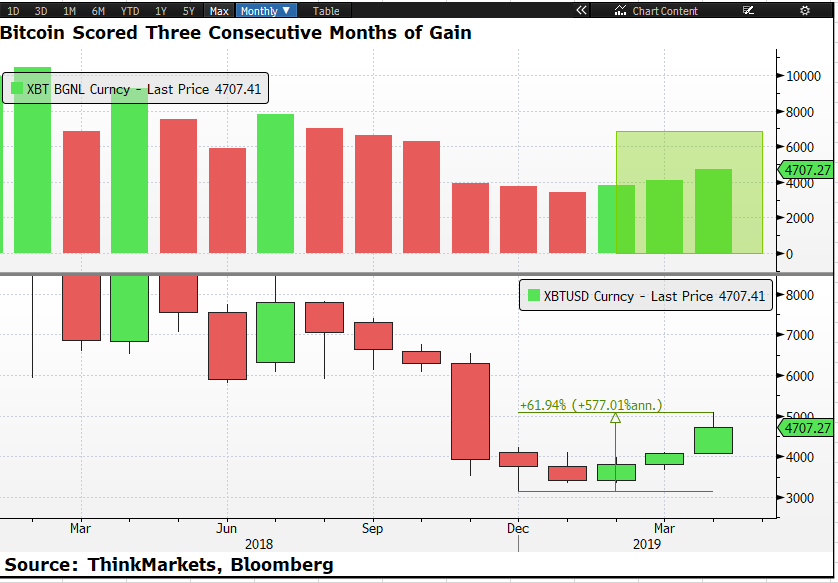
The fact is that 2019 is turning out to be a good year for Bitcoin price. We have three consecutive months of gain as shown in the chart below. This is the first time that we have this trend. These three consecutive months have more momentum in terms of price action as compared to the last three months of 2018.
Good news doesn’t stop here for the bulls. Something which may attract retail money comes from the fact that we have six consecutive weeks of gains, a trend which is not seen since the price made all-time high. The below chart shows this trend. 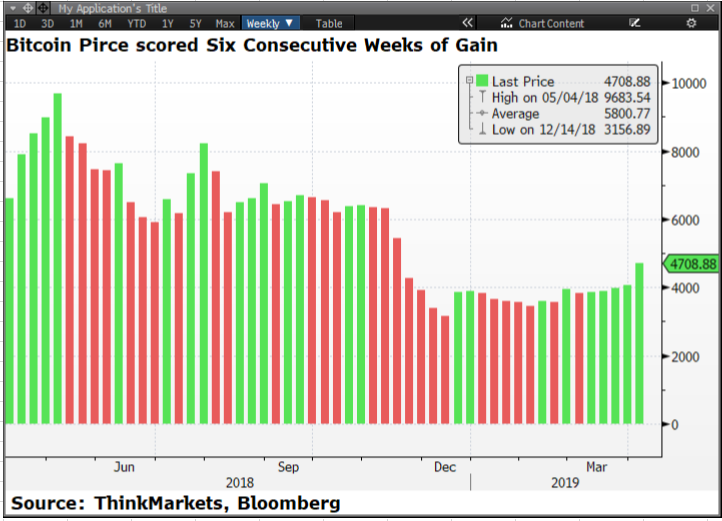
As for the other top two coins by market volume: Ethereum and XRP, we have not seen that much of enthusiasm yet. Remember, Bitcoin is the trendsetter for the cryptomarket and the spillover effects are inevitable.
Looking at the XRP price, it appears that the support of $0.30 is firmly in place and as long as this hold, I think the path of the least resistance is to the upside. Moreover, it is important to keep in mind that it is a lot easier for XRP price to grow by 2X or 3X as compared to the Bitcoin price. We have seen this concept many times in equity markets where a large-cap stock takes some time to score 100 percent gain as compared to some low price and high potential stock.
In summary, as I explained in my last article, the smart money is mostly interested to get involved in a bear market because the risk to reward ratio is at its peak. Bitcoin has the potential to topple the $100,000 mark and it is only a matter of time when this becomes a reality. I am not saying that fiat money is going to vanish, but the way the central banks are managing the monetary policy, and levels of government debts, are going to bring the shine in the Bitcoin’s price.
EUR/USD Outlook: The Euro Holds In Red For The Sixth Straight Day On Tuesday
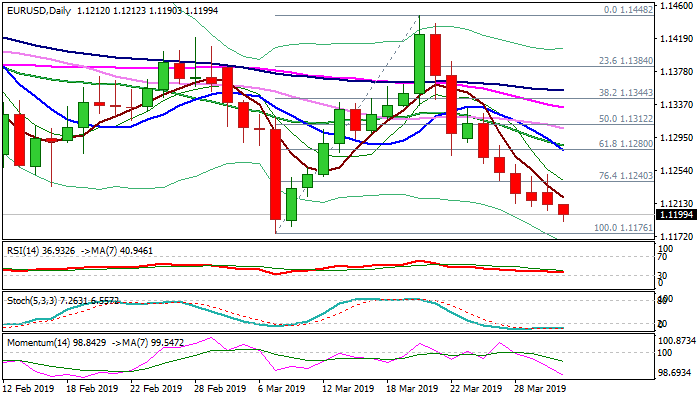
The Euro holds in red for the sixth straight day on Tuesday and focusing key support at 1.1186/76 (Fibo 61.8% of 2017/2018 1.0340/1.2553 ascend/ 2019 low posted on 7 Mar).
Strong bearish signals were generated on multiple close below 1.1240 Fibo support (76.4% of 1.1176/1.1448), boosted by daily MA's multiple bear-crosses and daily momentum in steep fall.
However, bears may take a breather before final push through 1.1186/76 pivots as slow stochastic is turning up in deep oversold territory and suggests adjustment.
Initial offers lay at 1.1240, with extended upticks expected to remain below 1.1280 (falling 10SMA/broken Fibo 61.8% support) and keep bears intact. Sustained break below 1.1186/76 would unmask psychological 1.10 support.
Res: 1.1221, 1.1240, 1.1280, 1.1306
Sup: 1.1186, 1.1176, 1.1118, 1.1021
GBP/USD Outlook: Sterling Weakens On Renewed Fears Of No-Brexit, Key Supports Intact For Now
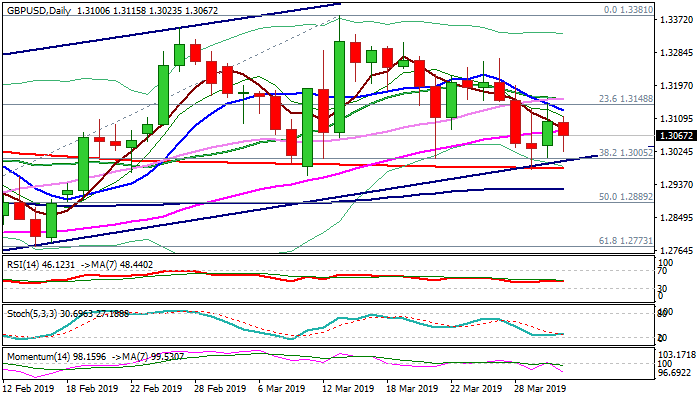
Cable turned to red on Tuesday and fell to 1.3023 low in early European trading, reversing the most of Monday's recovery that peaked at 1.3149 and was capped by falling 10SMA.
Pound remains highly volatile and sensitive on frequent and conflicting Brexit news.
Fresh weakness was sparked by rising fears about disorderly Brexit after UK lawmakers on Monday voted down again all proposed alternatives to the government's Brexit plan.
The cabinet meets today again, while the parliament will gather on Wednesday, both to discuss next steps, but quite unlikely to break the deadlock. Caution on news that will be coming as there might be a signal for MV4 on PM May's plan.
Technical studies remain mixed as thickening daily cloud continues to underpin (cloud top lays at 1.3030), with next strong bids at 1.3010/00 zone (bull-channel support line / Fibo 38.2% of 1.2397/1.3381 / psychological) and key 1.2977 support (200SMA / Fri low after MV3 rejection). Sustained break here would signal fresh bearish extension and expose supports at 1.2924 (100SMA) and 1.2889 (Fibo 50%). Falling 10SMA marks initial resistance at 1.3131, guarding converged 20/30SMA's (1.3160) and only break here would sideline bears.
Res: 1.3131, 1.3149, 1.3160, 1.3198
Sup: 1.3030, 1.3010, 1.3000, 1.2977
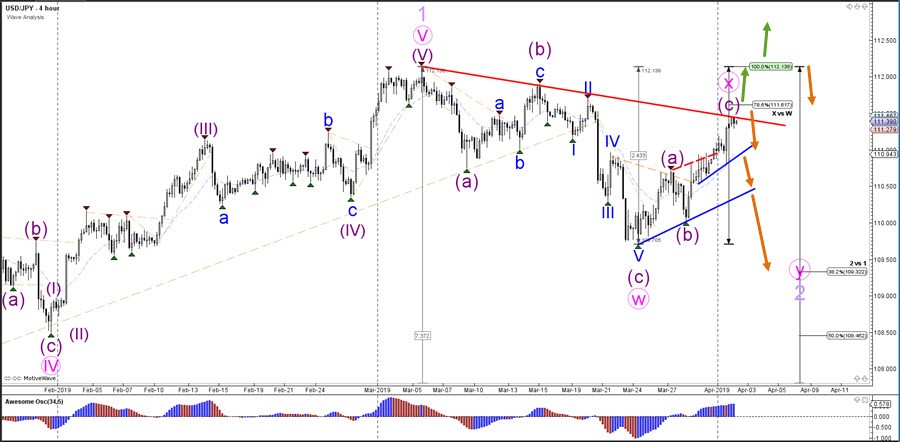
USD/JPY Completing Bullish ABC Zigzag Pattern At 112?
The USD/JPY break above the previous top and the 100% Fibonacci level of wave X vs W makes a potential uptrend more likely. Otherwise the wave patterns are suggesting a bearish reversal within the wave Y (pink) of wave 2 (purple).
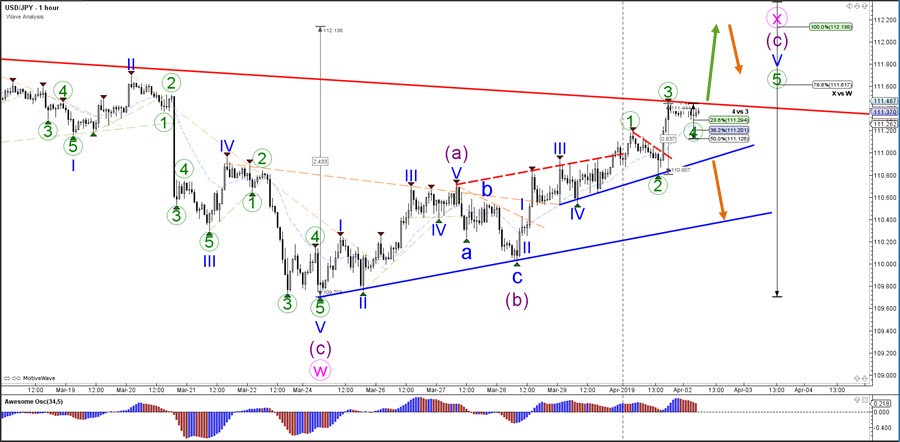
The USD/JPY is building a bull flag chart pattern, which could be part of a wave 4 (blue). A bullish break above the resistance trend line (orange) could indicate one more push within a wave 5 (blue) of wave C (purple). Bearish candlestick patterns below the resistance trend line (red) could confirm a bearish reversal.
Gold Trades Close To Three-Week Low
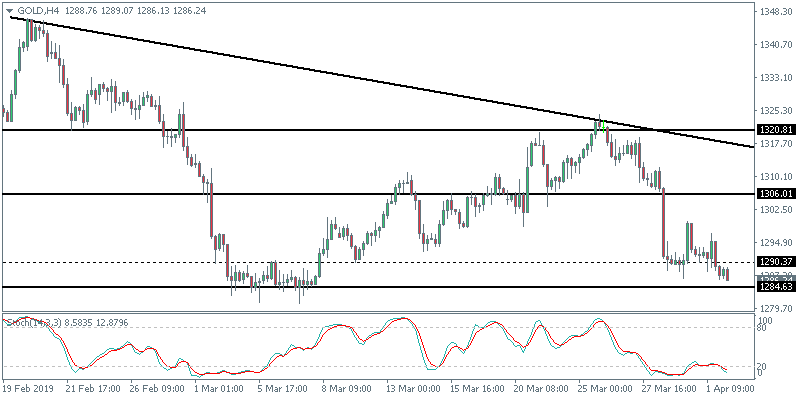
The precious metal traded mostly muted on Monday, but price action turned bearish towards Monday's close. Gold prices posted declines falling to a three-week low at the time of writing. The precious metal was down 0.36%, tracking the rising global risk appetite.
Can XAUUSD Break Out Lower from the Support?
XAUUSD is currently trading near the familiar support area of the 1290 – 1284 region. Previously, prices consolidated at this level before correcting to the upside. The 1284 support will be critical in the short term as a break down below this level could trigger sellers in the medium term. This would push gold prices lower to test the 1240 level of support. However, watch out for a potential double bottom pattern that could form at the support.
Risk Appetite Puts Yen On The Backfoot
The Japanese yen lost 0.30% on the day on Monday. The declines came despite soft US data and China's PMI which increased for the first time in five months. China's vice premier, Liu He, is expected to arrive in Washington to continue with the trade talks. Investors remained bullish on risky assets in hopes of receding trade war concerns.
Can USDJPY Break the Resistance?
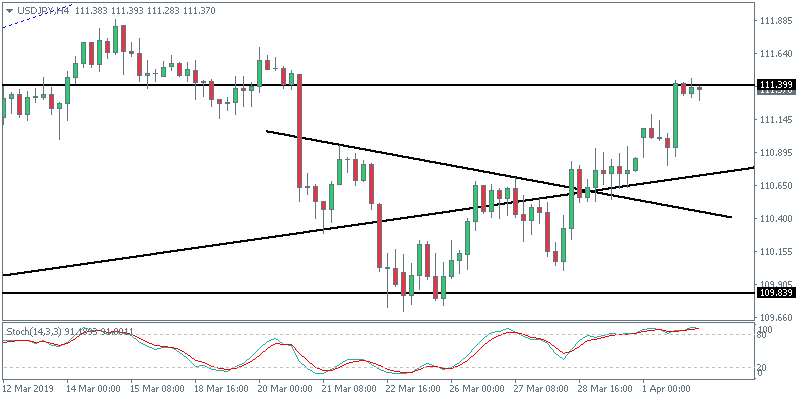
The currency pair extended strong gains on the day and price settled near 111.34 as a result. This marks a close right near the resistance level of 111.40 level where the USDJPY is currently consolidating. A breakout above this level is required for the USDJPY to continue to the upside, targeting 112.51. Failure to break out above this level may keep the USDJPY muted, but the declines could be limited.
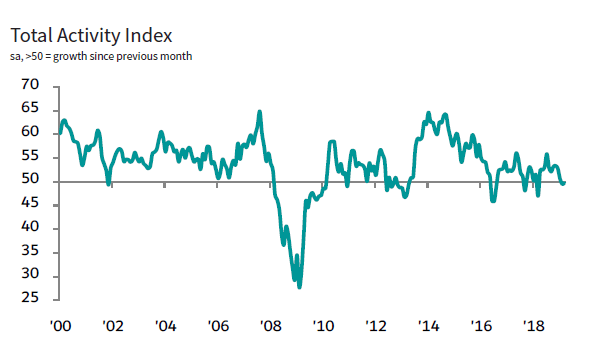
UK PMI construction rose to 49.7, outlook underwhelming by historical standards
UK PMI construction rose to 49.7 in March, up from 49.5 and matched expectations. Markit noted marginal reduction in overall construction output. Commercial work remains weakest performing area. But, residential building rises at fastest pace for three months.
Joe Hayes, Economist at IHS Markit, which compiles the survey:
"Fears that the recent weakness of the UK construction sector may not be just a blip, but a sustained soft patch, were further fuelled by latest data. Amid subdued inflows of new work, a first back-to-back decline in output since August 2016 was recorded. Brexit-related uncertainty continued to generate indecisiveness, ultimately hitting order book volumes. Furthermore, strong competition for contracts was also reported by some panel members. The outlook was subsequently underwhelming by historical standards, with the unsettled political and economic environment keeping business confidence below its long-run average.
"Nevertheless, UK construction businesses ramped up their purchases of materials and other inputs, reflecting efforts to build safety stocks ahead of any potential Brexit-related disruptions. As such, supply chain constraints persisted and average input lead times lengthened once again."
Euro Slips As Inflation Slows
Consumer prices in the eurozone rose to a slower pace of 1.4% on the year in March, official data showed on Monday. This was well below February's headline inflation of 1.5% increase.
Excluding food and energy prices, core inflation slowed to a pace of 0.8%, marking the slowest increase since April last year. The common currency lost 0.11% on the day as a result. heavily oversold. Any gains could stall near 1.1217 where resistance is likely to
be established.
Will the EURUSD Declines Continue?
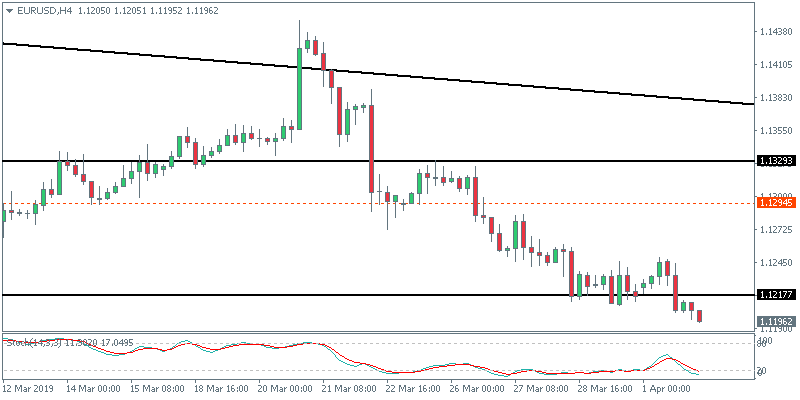
The currency pair slipped below the support level of 1.1217 on Monday and price action is now likely to test the March 7 th lows of 1.1174 if the bearish momentum continues. However, there is a risk that the euro could post a modest rebound with the Stochastics oscillator heavily oversold. Any gains could stall near 1.1217 where resistance is likely to be established.
RBA Keeps Interest Rates Unchanged And The Aussie Loses Ground
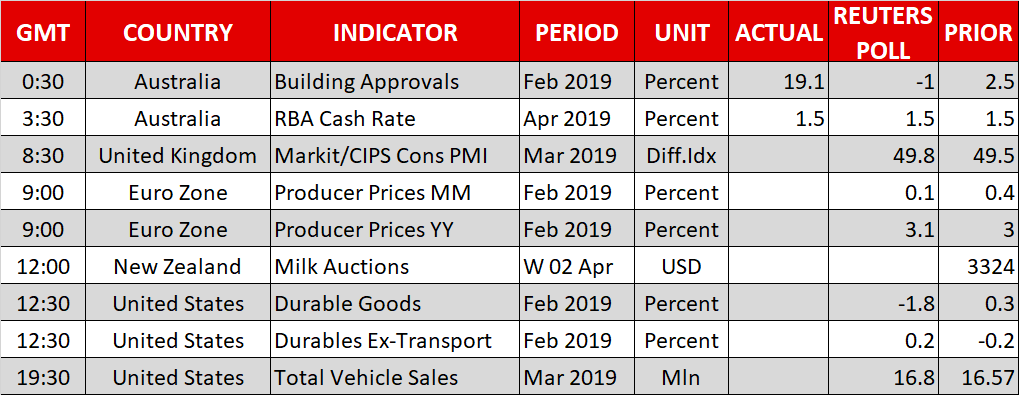
RBA kept its interest rate level unchanged at +1.50%, as was expected during today's Asian session and AUD weakened against the USD at the release. In its accompanying statement the bank mentioned the tightening of the Australian labour market, which could in turn lead to some inflationary pressures according to analysts. We must also note that the bank maintains the view of the outlook for the global economy remaining reasonable despite growth slowing down and downside risks having increased. It should also be noted that the bank seems to keep low expectations for inflation at the current stage. The release gains on importance as the country's government is about to release an annual budget which could include tax cuts and infrastructure spending, a stimulus which could weaken possibilities of a future rate cut by RBA. AUD/USD dropped during the Asian session today, aiming for the 0.7065 (S1) support line after the announcement of RBA's interest rate decision. We could see the Aussie remaining on the retreat in the short term and should the pair weaken even further we could see it aiming if not breaking the 0.7065 (S1) support line. Should on the other hand the pair's long positions be favoured by the market, we could see the pair aiming if not breaking the 0.7120 (R1) resistance line.
Pound corrects lower during today's Asian session, as Brexit uncertainty intensifies.
The GBP strengthened yesterday on hopes of a softer Brexit, however during today's Asian session, corrected lower. The pound retreated as the UK Parliament rejected all four options that were presented to replace Theresa May's deal, providing no solution to the issue. The failure of the UK Parliament to reach an alternative practically renders the UK no plan B, with the possibility of the UK crashing out of the EU getting stronger. According to media reports, the UK government is about to confront a Brexit crisis after the UK Parliament run into a stalemate yesterday. Analysts mention that the possibility of a general election could mark the beginning of a break in the deadlock, however we retain our reservations about the possible outcome of such a development, especially as such a scenario may necessitate the UK to remain within the EU for a longer period and take part in the EU parliamentary elections. As all possibilities are still open, Brexit uncertainty seems to persist and thus we expect the pound to remain under pressure. Cable rose and clearly broke the 1.3070 (R1) resistance line during yesterday's European session, however corrected lower later on and during today's late Asian session, once again landed below the prementioned resistance line. We expect the pair to maintain a bearish momentum as Brexit uncertainty seems to persist. It should be noted though that the financial releases today could provide some support for the pair at certain points. Should the bears dictate the pair's direction, we could see it aiming if not breaking the 1.2970 (S1) support line. Should on the other hand the bulls take over, we could see the pair breaking the 1.3070 (R1) resistance line and aim for the 1.3175 (R2) resistance level.
Other economic highlights, today and early tomorrow
In today's European session, we get UK's Construction PMI for March, while in the American session, we get the US durable goods orders growth rates for February. During tomorrow's Asian session, we get the Australian retail sales growth rate as well as the trade balance figure, both for February.
AUD/USD H4
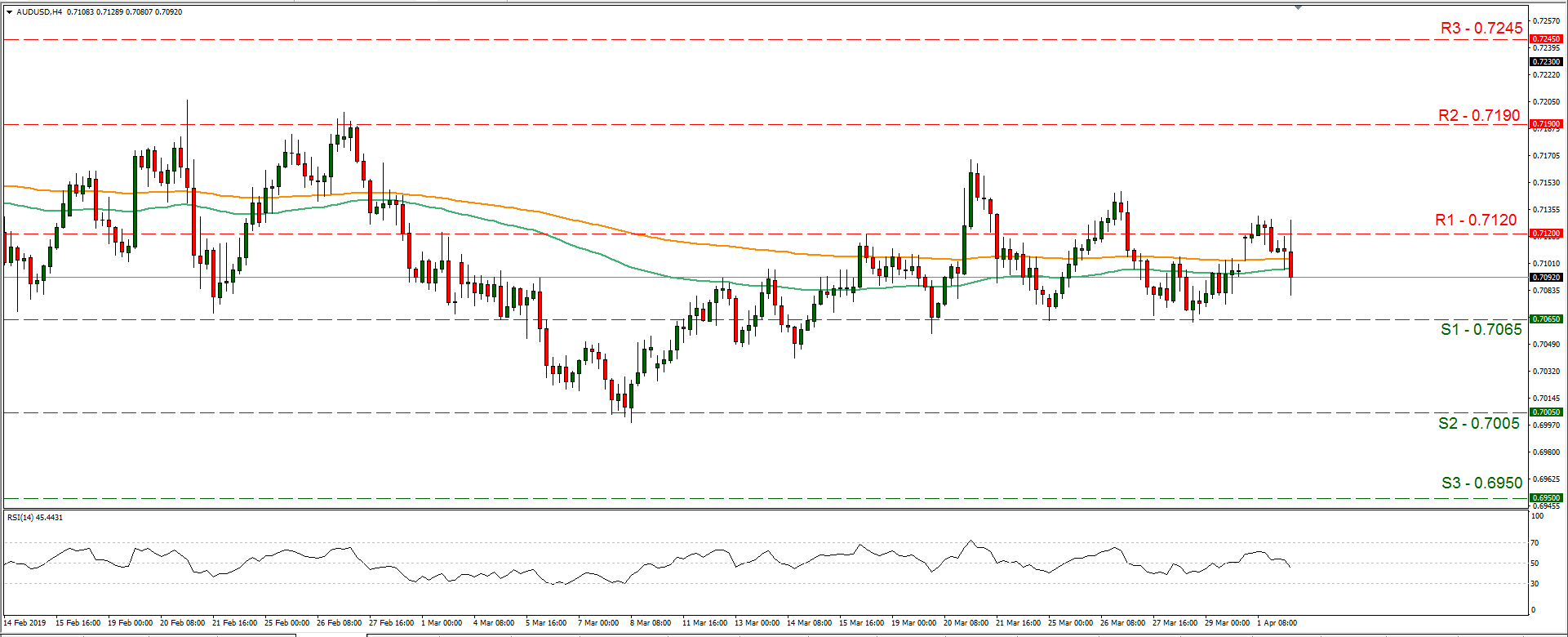
Support: 0.7065 (S1), 0.7005 (S2), 0.6950 (S3)
Resistance: 0.7120 (R1), 0.7190 (R2), 0.7245 (R3)
GBP/USD H4
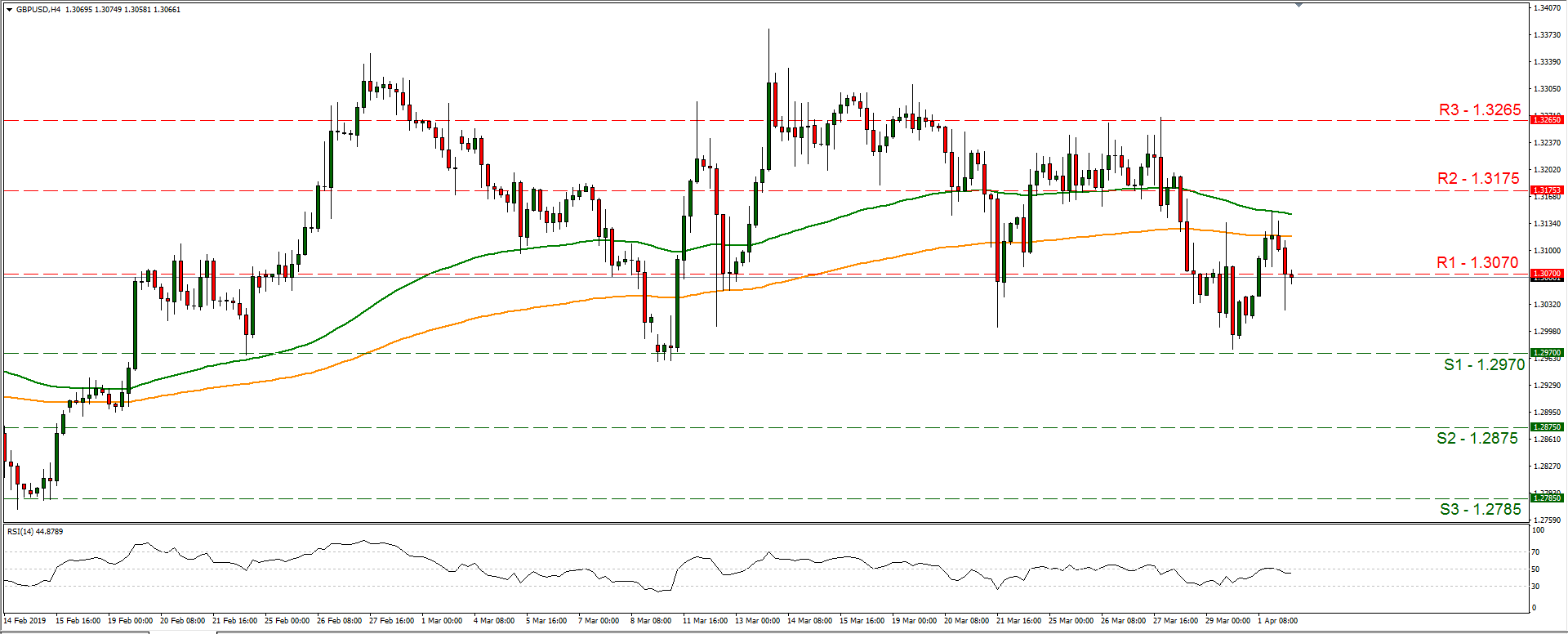
Support: 1.2970 (S1), 1.2875 (S2), 1.2785 (S3)
Resistance: 1.3070 (R1), 1.3175 (R2), 1.3265 (R3)
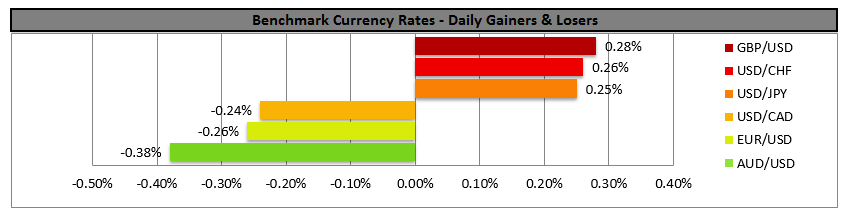
Stocks, Dollar Rip Higher As Growth Fears Ease
- Rebound in Chinese PMIs fuels rally in global stocks, dollar advances
- Pound outperforms as 'soft' Brexit outcomes or long extension seem likely
- Aussie drops after RBA recalibrates language
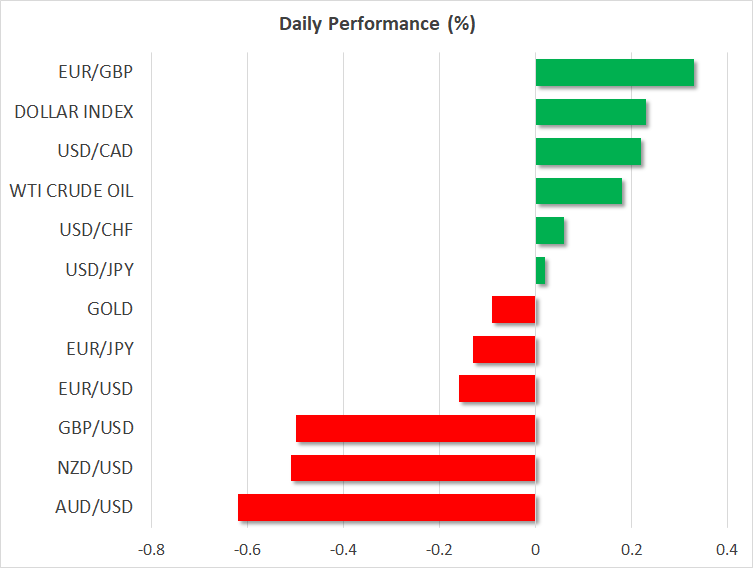
Stocks and dollar cruise higher as China-induced rally lingers
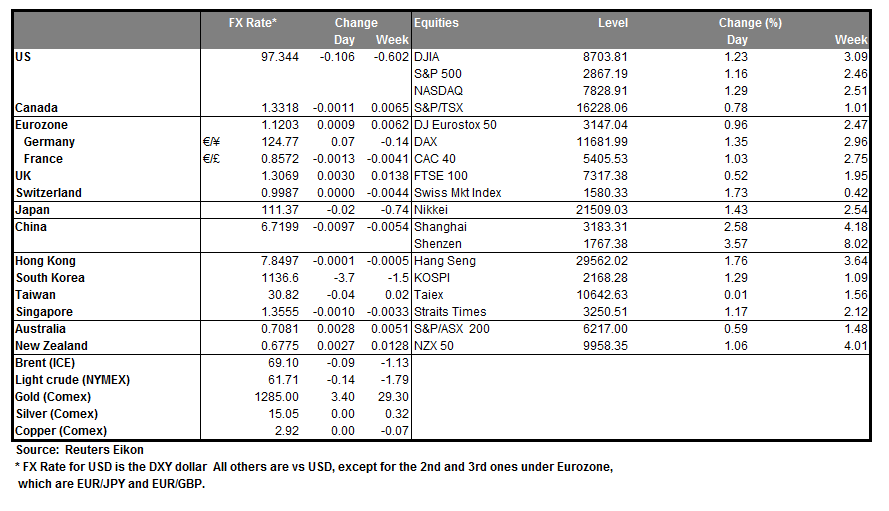
Global equity markets started the second quarter on a strong footing, after a decent set of PMI data out of China during the weekend calmed some nerves around the global growth outlook, amplifying the appeal of riskier assets. Wall Street shares rallied, with the benchmark S&P 500 (+1.16%) index closing at its highest level since early October, rising in lockstep with US Treasury yields as traders diverted funds away from the safety of the bond market.
In the FX universe, the dollar index climbed further as the sharp rebound in US bond yields added to the reserve currency's shine. The greenback also capitalized on some further weakness in the euro, which took a fresh hit after euro area inflation figures disappointed, adding more fuel to concerns about the bloc's economic health. Yet, both the loonie and sterling outperformed the dollar, the former drawing strength from another leg higher in oil prices and the latter by the latest developments in the Brexit saga.
Pound outperforms even as Parliament rejects all indicative votes (again)
The British pound gained ground across the board on Monday, despite what at first glance seems like a discouraging set of headlines from the UK. Namely, the nation's Parliament voted on alternatives to the prime minister's deal again, including the prospect of a customs union with the EU and another referendum, though none of these proposals commanded a majority. Hence, the political landscape remains as uncertain as ever, with no clear way forward and the threat of a no-deal exit still lurking in the background.
However, scratching beneath the surface, there may be some cause for optimism. The motion for a customs union was defeated by a narrow margin of three votes, while other 'soft' proposals like another referendum also gathered considerable support, despite ultimately losing. In the eyes of investors, these may have been signs that MPs are slowly but surely watering down their stance on these 'soft' outcomes. In the bigger picture, it currently looks all but inevitable that the UK will ask for a long extension at the extraordinary EU summit called for next week. That could further diminish the odds of an 'accidental' no-deal and thus, help to keep a floor under the pound over the next days.
Aussie takes a hit as RBA adjusts policy language
The Reserve Bank of Australia (RBA) kept its policy unchanged earlier today, in line with expectations. The statement accompanying the decision contained some small yet potentially important changes. Specifically, the Bank adjusted the final paragraph of its statement – which is usually considered the most important part – to reflect increasing caution. The officials omitted a phrase that holding policy unchanged would be consistent with sustainable growth and achieving the inflation target over time, noting instead that they 'will continue to monitor developments'.
Evidently, market participants interpreted this change as laying the groundwork for a formal shift in communication later on, perhaps foreshadowing the introduction of an official easing bias amid weakening momentum in the economy. The result was a notable drop in the Australian dollar, which fell as investors priced in an even greater probability for RBA rate cuts before the end of the year.